5 Types of College Admissions Consultants and the Tradeoff Each One Forces
August 16, 2026

Key Takeaways
- The single question that separates admissions consultants is who absorbs the financial loss when the plan fails.
- No ethical consultant can guarantee admission, per IECA standards, since the industry has no licensing body.
- Base-plus-bonus firms split risk between family and consultant, charging a lower base fee with a bonus tied to results.
- Large team-based firms charge flat premium packages up to six figures, leaving families to shoulder all financial risk.
- Essay and narrative specialists like Admissionado Gold run around $6,900 on a fixed plan, while demanding high effort from students.
- Independent solo consultants suit budget-conscious, hands-on parents through hourly or flat pricing that varies widely.
- Nearly every consulting model requires full upfront payment, so families carry the full financial risk.
Quick Summary
Choosing a college admissions consultant comes down to one question most families never ask: who eats the loss if the plan does not work? Almost every model asks you to pay in full up front, which means you carry all the financial risk while no one can promise an outcome. That single fact separates the five types below more sharply than price or prestige does.
Here's our read after years in this work. The industry has no licensing body, and as the IECA's own standards state plainly, no ethical consultant can guarantee admission. So when you evaluate any college admissions consultant, you're really weighing how much risk they're willing to share versus how much they hand back to you.
What Are the Five Types at a Glance?
| Type | Best For | Pricing Model | Cost Range | Effort From You | Who Absorbs the Risk |
|---|---|---|---|---|---|
| Base-plus-bonus firm | Families wanting shared accountability | Lower base, bonus on results | Fraction of premium packages | Medium | Split between family and consultant |
| Large team-based firm | Ivy-focused, high-touch planning | Flat premium package | Up to six figures | Low to medium | Fully on the family |
| Essay/narrative specialist | Strong students needing story polish | Fixed plan | ~$6,900 (Admissionado Gold) | High | Fully on the family |
| Independent solo consultant | Budget-conscious, hands-on parents | Hourly or flat | Widely variable | High | Fully on the family |
| Alternative-path advisor | Students open to studying abroad | Flat or subscription | Often lower than U.S. Routes | Medium | Fully on the family |
Pricing anchors here come from the Charlotte Observer's consulting roundup, which pegs Admissionado's Gold Plan at $6,900 and notes premium firms reaching five figures and beyond.
Why Does the Pricing Model Matter More Than the Success Rate?
Because a success rate is cheap to claim and a bonus is costly to fake. The Ivy Institute advertises a 92% Ivy success rate, and Crimson cites Ivy acceptance as high as 44%. Both numbers are probably real, but selection bias inflates them since firms take strong applicants to begin with.
Our take: a consultant who ties part of their fee to your result is offering a harder-to-fake signal than any headline percentage. It's the closest thing this unlicensed field has to enforced accountability.
When Should You Skip the Bonus Model?
Skip it if your target schools aren't actually selective. Only about 7% of colleges accept under 30% of applicants, so most four-year admissions don't justify premium help at all. A base-plus-bonus structure earns its keep at the narrow top tier, where the $3 billion counseling industry concentrates its fees and where the odds make shared risk worth paying for.
Match the model to your goal. If you want someone with skin in the game, the base-plus-bonus row is where the incentives line up with yours.
Why Choosing the Right College Admissions Consultant Matters
We see families skim past a question that determines everything else: who absorbs the loss if this does not work? The choice of consultant matters more than most families realize, because quality varies wildly across a field with no licensing exam, no shared curriculum, and no agreed standard for measuring results. Two consultants charging identical fees can produce outcomes that differ by an entire admissions tier. That variance, not office location or résumé credentials, is what deserves scrutiny first.
The stakes justify it. Families now spend an average of $6,500 on consulting services, with prices in major metro areas climbing to $15,000 and long-term engagements starting in middle school reaching $200,000. Meanwhile, the most selective universities now field record application volumes, with some flagship programs reviewing more than 100,000 files a season. You're paying a mortgage down payment for access to a system where most bets lose, and the field asks for no proof of competence before anyone hangs out a shingle.
The Risk-Transfer Gap No One Mentions
Here's what we learned after years working with families who'd already hired and fired consultants: the marketing claims that sound most impressive are the least verifiable. Firms advertise headline acceptance rates that no outside party audits, and inherent student strength skews these numbers whenever a firm only signs students who were already exceptionally strong candidates. A consultant can report a glowing success percentage while quietly declining anyone whose profile might drag the average down. While professional associations offer guidelines, membership is entirely voluntary, leaving families with little recourse if a consultant underperforms.
The real tell is how the financial agreement is structured. A consultant who collects the full fee up front carries no financial consequence if your student misses the target. A consultant who ties part of the fee to the outcome has skin in the game. This pricing model becomes a functional substitute for the licensure the field lacks, a verifiable commitment to the student's success that is far more reliable than a self-reported success percentage no third party verifies.
We structure our engagements around base-plus-bonus pricing for exactly this reason. You pay a base fee that covers our time and strategic work, then we earn a performance component only when your student gets the result we mapped out together. It shifts part of the financial risk from your family to us, which changes the dynamic from vendor-client to invested partner.
When Consultant Help Actually Moves the Needle
Skip hiring a college admissions consultant for routine applications to state schools with generous acceptance rates. The research is clear: the overwhelming majority of four-year institutions admit more than half of the students who apply. Most college admissions aren't competitive enough to justify thousands of dollars in outside help.
Where consulting earns its cost is the narrow band of ultra-selective schools where strategic positioning determines the outcome. Our team works with students targeting Ivy League and top-20 programs, the tier where acceptance advantage can reach 12x and annual scholarship yields average $54,000. At that level, three things separate admits from near-misses:
-
Narrative coherence across the application — the essay, activities list, and recommendations must tell one story, not five unrelated bullet points. Research on 50 consultant interviews found that higher-income students produce applications with greater lexical diversity and syntactic complexity, not because they're smarter but because they've had expert help translating their actual selves into admissions-legible form.
-
Authentic differentiation that survives committee scrutiny — admissions officers can spot manufactured "passion" instantly. We help students surface the genuine angle that makes them non-fungible in a pool of 4.0 GPAs. One consultant interviewed for the study put it plainly: "Colleges want to see the kid really excelling in their extracurriculars, and that's only going to happen if the kid is really into it."
-
Strategic college list construction — balancing reach, target, and safety schools requires understanding how each admissions office weights academics versus extracurriculars, legacy status, geographic diversity, and demonstrated interest. We draw on our team's decades of admissions experience and our track record across Ivy League and top-tier schools to keep that intelligence current.
What Makes Our Model Different
| Factor | Typical Firm | Endurable Education |
|---|---|---|
| Student Selection | Takes everyone who pays | Selective, based on genuine fit |
| Success Reporting | Self-reported, unaudited | Tied to targets set with you |
| Incentive Alignment | Fixed fee regardless of result | Partly outcome-based |
| Engagement Depth | Volume-driven caseloads | Limited roster each cycle |
The industry quintupled in size from 2005 to 2015, reaching 7,500 independent consultants, because families needed help managing an increasingly opaque admissions market. But growth without regulation created a market where anyone can market themselves as an expert without passing a standardized exam, and as one Duke admissions officer acknowledged, "the services provided by independent counselors give advantaged kids another advantage."
We built our pricing model to address that accountability vacuum. When we tie part of our compensation to your student's admission outcome, we're making a bet on our own work that traditional consultants avoid. It forces us to be selective about which students we take on, we only engage when we genuinely believe we can move the needle, and it aligns our incentives with yours from day one.
For more on how we approach the full admissions journey, see our life planning insights on long-term student development.
Ivy League Specialist Consultants: High Cost, High Success Rates
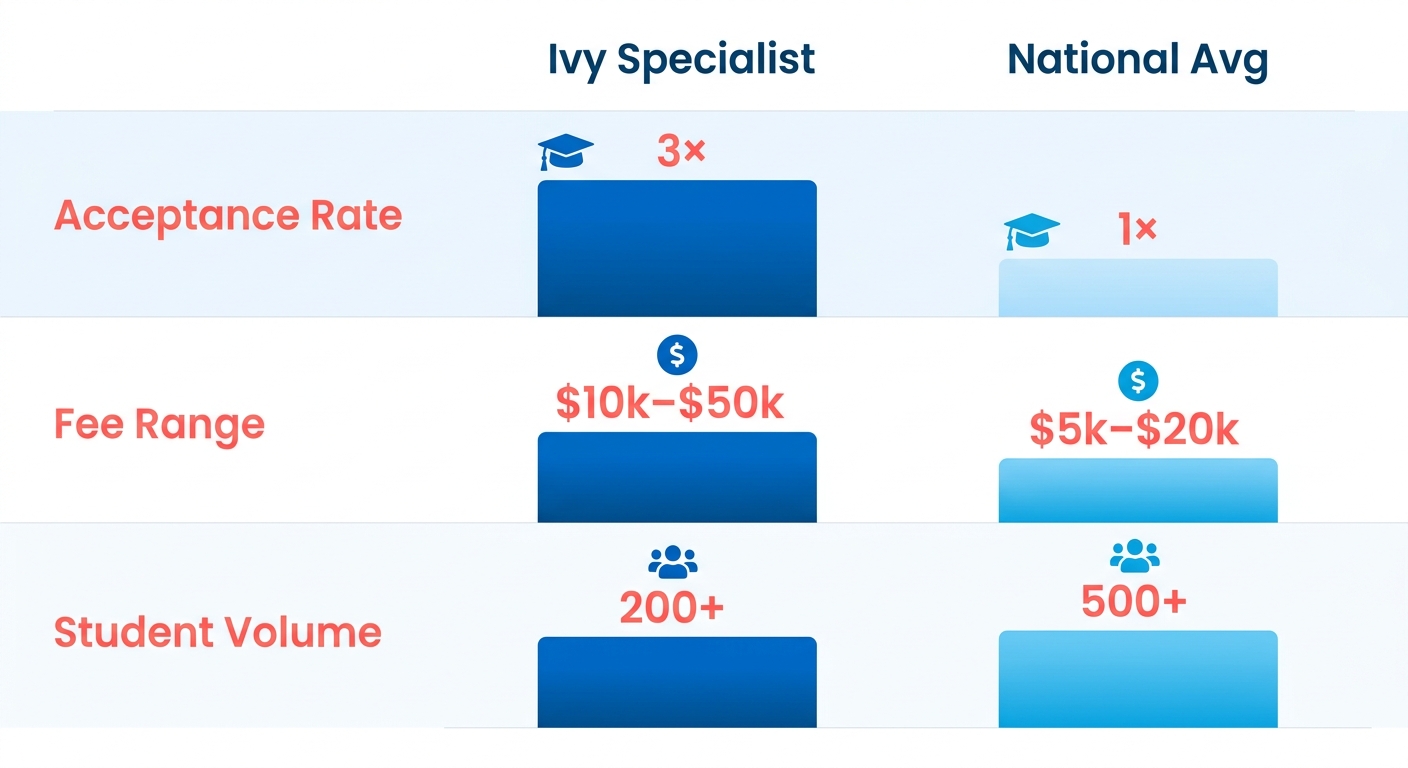
We'll be direct: when families tell us they want an Ivy League specialist, they're really asking who can deliver results that justify spending tens of thousands to six figures on consulting. The answer depends on whether you're evaluating advertised success rates or fee structures that put money at risk.
The headline numbers sound impressive. Top-tier firms advertise acceptance rates that exceed national averages by multiples, and some cite near-perfect placement into highly selective schools. But here's what those figures leave out: selective enrollment practices naturally elevate these outcomes in an industry with no independent auditing standards to verify claims. Specialists screen applicants hard before engagement, which means their success rate reflects the students they chose to work with, not magic they performed.
What Ivy League Specialists Actually Cost
Prices in major metro areas vary widely depending on engagement length and service intensity. Families who begin working with a college admissions consultant in middle school, building a multi-year strategy around course selection, extracurricular positioning, and standardized test prep, face significantly higher total costs than those who engage for application season only. The booming independent advisory market commands the highest fees within that space because they promise access to the most selective tier.
Most firms require full payment before outcomes are known. That structure makes sense for the consultant, their time investment is real, but it means an engagement that ends in rejections costs you the same as one that places your student at Princeton.
Our approach differs. We tie a portion of our fee to your satisfaction because we believe you should only pay in full if you're happy with the work. The base fee covers the work; the success bonus is paid under our Happiness Guarantee. That model pushes risk back onto us, which changes the incentive structure in your favor.
How to Evaluate Success Rates (and Why Most Are Meaningless)
When a consultant advertises exceptional Ivy acceptance rates, dig deeper before signing:
What baseline are they comparing against? National acceptance rates include applicants with minimal academic credentials. If a firm only takes students with elite test scores, top-tier GPAs, and nationally ranked extracurriculars, their success rate reflects the applicant pool they curated, not consulting effectiveness. Admissions decisions are ultimately subjective and made behind closed doors, making guarantees impossible.
How transparent is their methodology? Some firms report "top-tier placements" without breaking out truly elite admits from schools with moderate selectivity. Others exclude students who withdraw mid-engagement or choose different paths. Without standardized reporting requirements, every published rate is essentially self-audited.
What does the firm risk if the stat turns out wrong for you? If the answer is "nothing," the number is marketing, not a service contract. A fee model tied to your satisfaction is a tangible financial risk-sharing mechanism, because the consultant only gets paid the full amount if you're happy with the service.
When to Skip an Ivy League Specialist
If your student has solid but not exceptional credentials, strong grades and test scores without nationally competitive achievements, an Ivy specialist isn't the right fit, and honest ones will tell you that. Only about 11% of applicants get into top schools like UCLA, and Ivy rates are lower still. Specialists work best for students who already clear the academic threshold and need help distinguishing themselves in a pool where everyone has near-perfect stats.
We also see families overpay for "insider access" that doesn't exist. Former admissions officers acknowledge that private guidance helps students present their achievements in the most compelling light, but they are describing strategic positioning, not hidden levers. Admissions offices don't take phone calls from consultants mid-cycle, and no ethical firm should imply otherwise.
The real value of a specialist lies in application architecture: building a coherent narrative across essays, activity lists, and rec letters; identifying which schools genuinely fit the student's profile rather than chasing brand names; and managing the timeline so nothing critical slips. Those are execution advantages, not magic. A base-plus-bonus model ensures the consultant has every reason to execute well, because their full compensation depends on your satisfaction.
Boutique Individual Consultants: Personalized, Flexible, Limited Resources
When you work with a boutique college admissions consultant, you're choosing someone who operates independently, often a solo practitioner or a small team handling 10-20 students per year. That scale creates a distinct tradeoff: the consultant has complete flexibility to tailor your strategy and availability, but limited financial flexibility to offer refunds or performance-based pricing. You pay the full fee upfront while they offer the closest thing to a bespoke application strategy the industry allows.
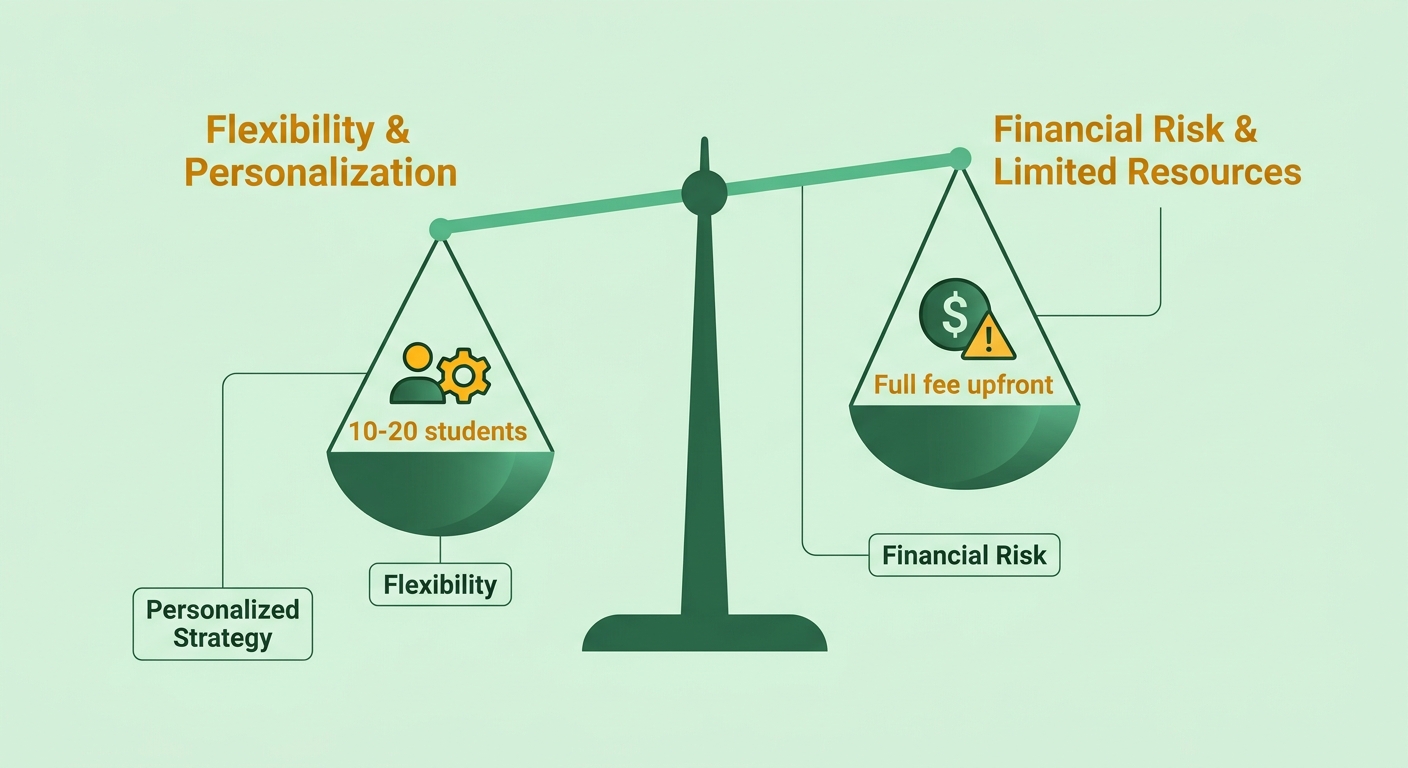
We see that tradeoff play out in three ways.
Why Personalized Attention Doesn't Solve the Risk Problem
The signature strength of boutique consultants is unmatched responsiveness. You're not competing for calendar slots with hundreds of clients the way you would at a large firm. The consultant knows your transcript cold, your extracurricular arc, and the narrative threads that run through your essays. This close working relationship allows the consultant to help you identify and articulate your genuine personal narrative, a translation process that larger, volume-driven operations often struggle to replicate.
But here's what that personalization doesn't do: shift who loses money when the outcome falls short. A boutique consultant has already been paid whether you land at your reach school or your safety. The close relationship makes the process more comfortable, but it doesn't change the fact that no independent advisor can promise a specific outcome.
One Reddit reviewer praised Admissionado for being "really efficient with essay help/edits, practical and nuanced advice" when working through multiple revisions under a tight timeline. That level of engagement is real. It just doesn't mean the consultant has any incentive structure tying their compensation to your result. A family paying $4,500 in September receives the same service intensity whether their child gains admission in March or faces a rejection wave across their target list.
Flexibility Means You Can Scale Services Down, But Not Risk
Boutique consultants typically unbundle services in ways large firms don't. That modularity matters if you only need targeted help rather than comprehensive support.
The flexibility also extends to how they work. An independent consultant isn't bound by a firm's house style or required to push you toward specific college lists that pad their success-rate marketing. They can recommend schools that genuinely fit your profile, not just the ones that appear in their promotional materials. The Princeton Review guide emphasizes this: the best consultants help students find colleges that fit their unique personality and goals, not just the most prestigious name.
But unbundling services doesn't unbundle financial risk. Whether you pay $1,200 for essay edits or $7,500 for full-year advising, you pay before the work proves itself. The consultant's flexibility is operational, not financial. They can adjust what they do, but they won't adjust what they charge based on whether you get in. A student who hires a consultant in August for comprehensive support pays the same total whether they ultimately attend Stanford or their state flagship.
The Resource Ceiling: What Happens When One Person Hits Capacity
The constraint no boutique consultant can escape is time. One person can only visit so many campuses per year, track so many admissions trends, and maintain deep relationships with so many regional admissions officers. The IECA recommends members spend 20% of their time visiting colleges to stay informed, but an independent practitioner juggling 15 active clients can't match the institutional knowledge a team-based firm accumulates.
That gap shows up in two places. First, college visit coverage: a boutique consultant might know East Coast liberal arts schools intimately but have limited firsthand knowledge of West Coast public universities or international programs. Second, admissions officer relationships: large firms build multi-year rapport with dozens of regional reps; an independent consultant might have strong ties to five or six schools and surface-level contact with the rest.
The ceiling also affects workload surges. When multiple clients face overlapping deadlines in November and December, a boutique consultant can't redistribute work to colleagues. They work late. One TrustPilot review praised a consultant for working "late into the night, on Xmas Eve and even NYE" to meet a submission deadline, but that hustle is reactive, not scalable. A consultant handling 18 seniors simultaneously will give each family roughly 2.5 hours per week during peak season, compared to the 4-6 hours a more distributed team model allows.
How We Structure Risk Differently
At Endurable Education, we don't ask you to choose between personalized attention and resource depth. Our model starts with a base consulting fee that covers strategic planning, essay development, and application coordination, the work every competitive applicant needs. Then we add a performance bonus triggered only when you gain admission to a school on your agreed target list.
That structure does what boutique consultants can't: it shifts part of the financial risk from you to us. If we recommend a strategy that doesn't work, we don't collect the bonus. If we misjudge your profile fit or miscalculate admissions trends, we absorb the cost of that error. It's not a guarantee, but it's an enforceable signal that we believe in the plan we're building with you.
We also solve the resource ceiling by maintaining a team-based model rather than operating independently. You work with one primary consultant who knows your story deeply, and that consultant collaborates with colleagues who bring over 15 years of combined experience across diverse student backgrounds, from artists and athletes to scientists and entrepreneurs. Our team includes Harvard, Yale, and Princeton graduates who've worked in prominent organizations like McKinsey and Uber, bringing both elite educational credentials and real-world professional experience to your application strategy. When your primary consultant encounters a complex case, they consult internally with teammates who've successfully guided students across hundreds of cases spanning the US, China, UK, Canada, Hong Kong, Mexico, and more. When November deadlines pile up, we redistribute workload so no client gets rushed edits at midnight on Christmas Eve.
The base-plus-bonus model isn't about promising a result. It's about building a pricing structure where our incentives match yours. Boutique consultants offer unmatched personalization, but they get paid the same whether you succeed or settle. We don't. That difference matters when you're deciding who carries the financial downside of an uncertain process.
For more perspective on how admissions strategy evolves with a long-term view, see our life planning advice blog.
High-Review 1-on-1 Mentorship Firms: Trusted, Proven Track Record, Higher Fees
When families choose a firm with a long roster of five-star reviews and a decade of verified acceptances, they're reading reputation as a proxy for competence. The problem is what that fee structure asks of them: full payment before a single application is submitted, which leaves the family carrying the entire downside if the plan falls short. Testimonials confirm that past clients felt satisfied. They do not confirm that future outcomes are predictable.
The distinction matters because satisfaction and admission are different things. A family might rave about a consultant's responsiveness, essay feedback, and emotional support, then watch their student get rejected from every reach school. Extensive writing coaching and multiple revision cycles naturally polish a student's prose, helping them present a highly sophisticated application. What gets reviewed is the service experience. What matters is whether the student got in.
Why Reputation Doesn't Shift Financial Risk
Comprehensive packages at established firms often run into the tens of thousands, with multi-year plans at some premium providers climbing past $40,000, and payment is collected before applications go out. That model asks you to trust that past performance predicts future results, but reputable firms acknowledge that the final decision rests entirely with the universities. The market lacks standardized reporting requirements, and there is no mechanism to verify that a firm's advertised outcomes weren't driven by selective enrollment practices, only taking students who would have gotten in anyway.
We work with families who assume a consultant's five-year track record protects them from downside risk. It does not. The consultant gets paid whether your student is admitted or denied. That's not a critique of their competence; it's a structural fact. A firm with 500 positive reviews is still asking you to absorb the loss if the strategy doesn't work.
Our pricing model flips that. We charge a lower base fee and tie the majority of our compensation to admission outcomes at schools you actually want to attend. If the plan fails, we earn less. That structure forces us to decline students we can't help, which shrinks our client pool but aligns our incentives with yours. A five-star rating tells you other families were happy. A fee tied to results tells you the consultant is willing to lose money if you're not.
What High Reviews Actually Signal
Positive testimonials reveal three things: the consultant communicated clearly, met deadlines, and made the family feel supported. These reviews typically highlight the consultant's responsiveness, organizational skills, and ability to keep students on track during high-stress periods. While these operational strengths are valuable, they do not guarantee that the underlying strategy will resonate with highly selective admissions committees.
The gap between service quality and outcome quality explains why some firms with stellar reviews still see students shut out of their target schools. Consultants can control their responsiveness and the depth of their essay edits. They cannot control how admissions committees interpret authenticity, fit, or competitive context. When you pay in full upfront, you're buying the service, not the result. Reviews reflect the former.
Consider what each pricing model actually communicates. A fixed-fee firm signals reputation: enough prior clients were pleased to leave a review. A base-plus-bonus structure signals direct financial alignment, because the consultant only earns their full compensation if the student is admitted somewhere they wanted to go. Reputation is cheap to accumulate when every client pays the same regardless of outcome.
That difference reshapes the intake process. A firm collecting its full fee upfront has no financial reason to turn you away. We do, because part of our compensation depends on results, so we screen out students we genuinely can't help. That screening is a more reliable signal than a portfolio of five-star reviews, especially in an unregulated advisory market with no third-party oversight.
When to Choose a High-Review Firm Over Outcome-Linked Pricing
If your student is a strong applicant with a realistic target list, a fixed-fee consultant with deep experience may be the right fit. You'll get polished essays, strategic extracurricular framing, and a structured timeline. For families who value process certainty over financial risk-sharing, that trade makes sense.
Skip it if your student's profile is uncertain, with borderline stats, unclear narrative, or a reach-heavy list. Fixed fees work when the path is clear. They do not protect you when the strategy fails, because you've already paid.
We see families treat reviews as a safety net. They're not. A consultant with 200 glowing testimonials is still asking you to carry the entire downside. Our model shifts part of that risk back onto us, which changes the intake conversation, the strategy process, and whose financial interest gets served when a student's profile doesn't fit the plan.
Data-Verified Results Consultants: Transparency, Metrics-Driven, Expensive
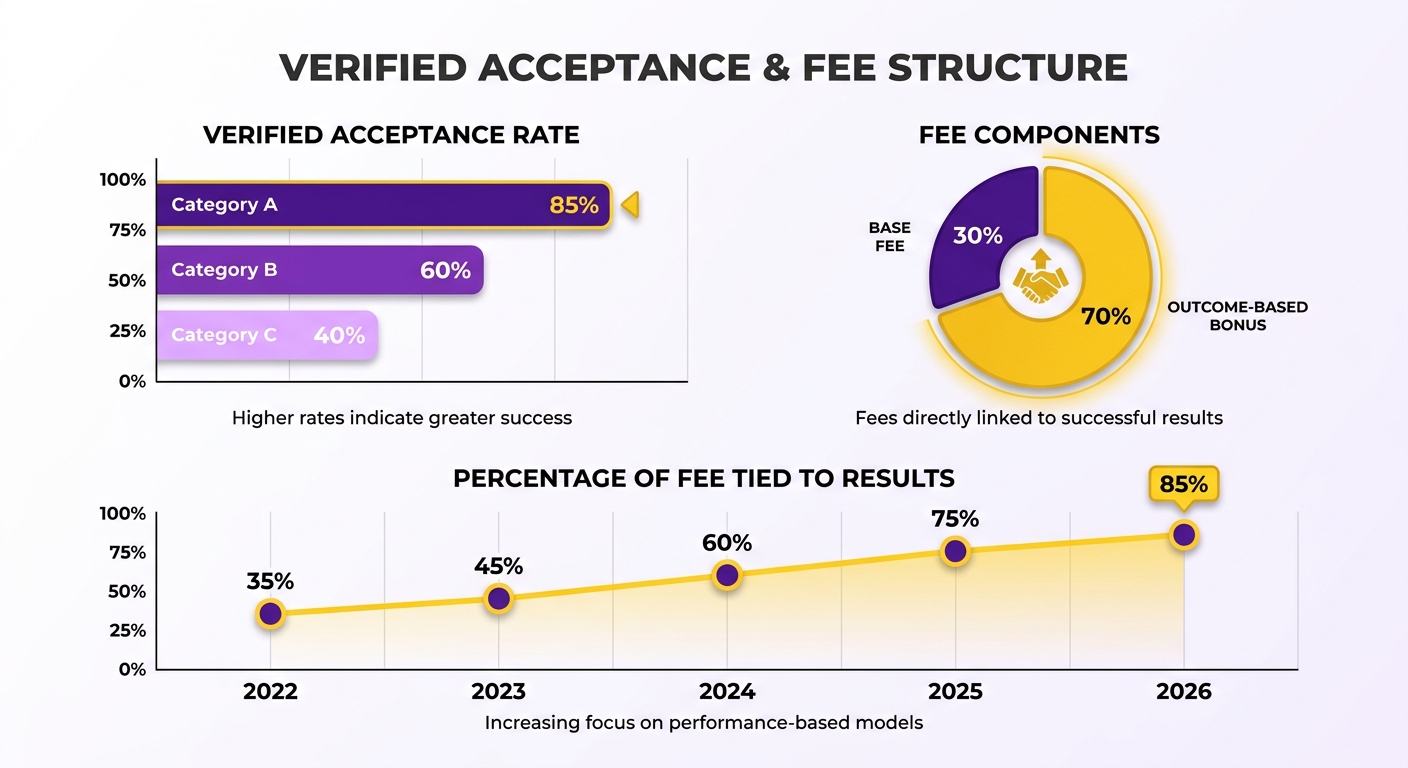
We track disclosed success metrics because they're the only substitute for accountability in a market lacking standardized metrics. When a college admissions consultant publishes verified acceptance rates and ties part of their fee to outcomes, they're putting capital at risk in a way that's harder to fake than a marketing claim. That structural difference matters more than the headline percentages because it shifts who absorbs the loss when the plan fails.
The financial architecture tells you everything. Most consulting firms require significant financial investments, often requiring substantial upfront payments before any work begins. A base-plus-bonus model flips that logic: the consultant earns a lower base fee, then collects performance bonuses only when the family is satisfied with the service and results. Endurable Education uses this structure because it forces us to deliver value throughout the engagement, not just at the application deadline.
Why Published Metrics Signal Confidence More Than Marketing Does
Self-reported success rates sound impressive until you realize the field operates without mandatory professional credentials. Without third-party validation, a consultant willing to tie fees to results is offering a more reliable signal than a statistic on their website.
Consider the logic. When a consultant publishes top-tier acceptance data, say 67% of clients admitted to at least one top-20 school, but charges fixed fees before delivering any results, the money flows one direction. The consultant gets paid whether the strategy works or not. A base-plus-bonus model forces the consultant to back those claims with deferred compensation, which is why we see it as a functional substitute for the licensure the field lacks.
What Transparency Looks Like in Practice
Data-verified results consultants publish three things competitors avoid: acceptance rates broken down by target tier (Ivy League, top-20, top-50), the cohort size those rates represent, and the fee structure that ties compensation to outcomes. We publish our numbers because families deserve to know whether the consultant's financial risk aligns with the claims they're making.
| Metric Type | What It Reveals | Why It Matters |
|---|---|---|
| Acceptance Rate by Tier | Percentage of clients admitted to Ivy League, top-20, or top-50 schools | Shows whether the consultant handles students with realistic profiles for those tiers or cherry-picks |
| Cohort Size | Number of students the rate represents | A 90% success rate across 10 students is less meaningful than the same rate across 100 students |
| Fee Structure | Base fee vs. Performance bonuses | Reveals who carries downside risk when results fall short |
| Timeline Transparency | When services start (9th grade vs. 12th grade) | Long-term relationships inflate success rates because the consultant shapes the entire academic trajectory |
The cohort size matters because small samples inflate variance. A boutique consultant working with 10 highly motivated students can hit 80% Ivy acceptances without proving the strategy scales. A firm working with 200 students across varying academic profiles faces a harder test of whether their approach works beyond hand-picked cases.
The Cost Tradeoff: Expensive Services That Put Skin in the Game
Data-verified results consultants charge more than boutique solo practitioners, often starting at $10,000 to $20,000 for comprehensive packages, but the structure shifts who absorbs the loss. Our base fee covers the operational cost of advising, essay editing, and application strategy. Performance bonuses reflect the family's satisfaction with both the process and the admissions results. If we fail to deliver the level of service families expect, we don't collect the full bonus, which means we've spent time and resources without full compensation.
That's the risk transfer in action. Families pay less upfront and more only if they're satisfied with the results. The consultant eats the margin on engagements that don't meet expectations, which creates a built-in incentive to deliver exceptional service and outcomes. Endurable Education has worked with students across a wide range of profiles, including artists, athletes, scientists, and a student with a 1320 SAT who earned admission to Harvard with full financial aid, because our model rewards quality mentorship rather than cherry-picking only the highest-achieving applicants. That inclusive approach reflects our belief that the right strategy and support can elevate students from diverse backgrounds, even in a field where highly competitive single-digit or low double-digit acceptance rates are the norm.
The key distinction: fixed-fee consultants protect their revenue regardless of outcome. Base-plus-bonus consultants earn less if families aren't satisfied, making the fee structure itself a form of enforced accountability. It's expensive because risk has a price, and the consultant is now carrying part of it.
Community and Alumni Network-Focused Consultants: Network Access, Less Individual Coaching
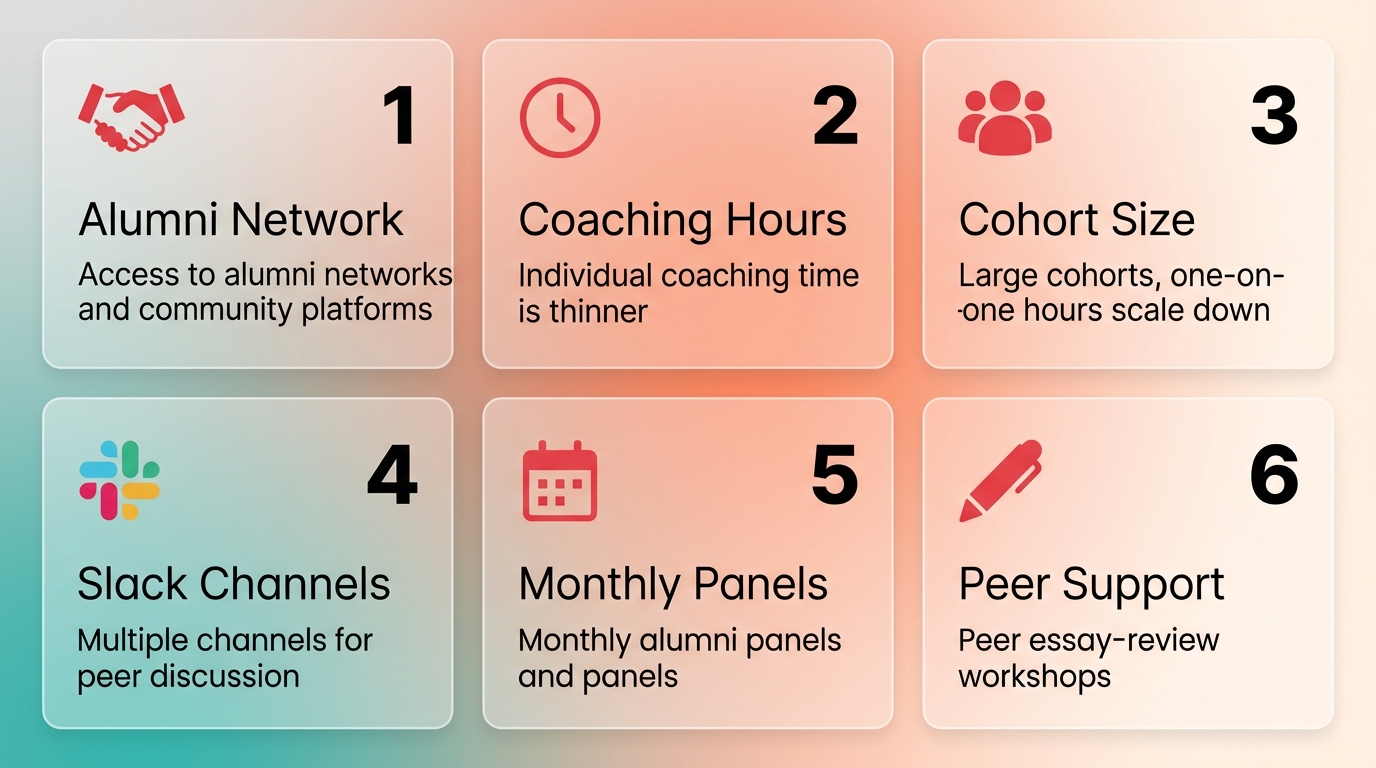
When a college admissions consultant tells you they'll introduce your student to alumni networks and community platforms, they're offering access to mentorship circles and peer groups, but they're also signaling that individual coaching time will be thinner. The network becomes the product because one-on-one hours can't scale when a consultant manages large cohorts.
We see this play out in a way most families don't catch at first. The consultant builds out Slack channels, monthly alumni panels, and peer essay-review workshops where current applicants connect with recent admits. That network infrastructure creates real value. Students get multiple perspectives on campus life, hear unfiltered stories about what worked in applications, and build relationships that outlast the admissions cycle. But the consultant's core service shifts from personalized strategy sessions to platform curation. You're paying for access to the community, not for the consultant to sit with your student for ten hours mapping out a differentiated profile.
Why Network Access Doesn't Replace Strategic Guidance
The community model assumes peer learning and alumni feedback can substitute for expert direction, which works until your student needs someone to tell them their essay thesis is generic or their extracurricular narrative doesn't differentiate. Alumni can share what got them into Yale, but they can't diagnose why your student's application reads like everyone else's. That diagnostic work requires someone who has read thousands of applications and knows what admissions officers flag. In a network-focused model, that expert typically manages far more concurrent clients than in boutique arrangements.
In a high-touch consulting relationship, the consultant catches a weak essay angle in draft one and redirects the entire approach before the student invests hours developing the wrong narrative. In a network model, the student posts the draft to the group, gets encouraging feedback from peers who lack admissions expertise, and submits something polished but strategically flat. The varying levels of expertise among peer reviewers mean there's no enforced standard for who gives feedback in these peer channels, so the quality swings wildly. A recent admit might praise an essay's emotional tone while missing that it fails to answer the prompt's core question.
How Network Models Shift Risk Without Shifting Fees
Here's the part that matters for the risk-transfer question we opened with. Community-focused consultants collect payment before application season begins, locking in revenue regardless of outcomes. The platform persists whether your student gets into their reach schools or not, which means the consultant has already captured payment and you carry the outcome uncertainty.
What makes this different from a boutique consultant is the explicit tradeoff: you get broader access to perspectives and ongoing community support, but you lose the consultant's undivided attention during the weeks that determine your application strategy. For some families, that trade makes sense. Students who are self-directed and just need sounding boards benefit more from diverse alumni input than from intensive one-on-one sessions. For students who need someone to overhaul their narrative or catch strategic blind spots, the network model leaves gaps that peers can't fill. Consider the student whose transcript shows scattered interests. Their application needs an expert to identify a connecting thread that makes sense of the academic path. Alumni can share their own stories, but they can't perform that synthesis work for someone else's profile.
The real test comes when you compare fee structures. A consultant who builds their business around community scale can serve more students per year, which lets them charge less per family while maintaining revenue. That lower price point looks appealing until you realize it reflects the reduced individual coaching hours, not a better deal on the same service. You're paying less because you're getting less direct expert input, and the consultant still collects the fee whether your student's application succeeds or not. The difference shows up when your student needs immediate help resolving conflicting advice from three alumni about whether to write about their summer research or their nonprofit work. The network provides input, but no one has accountability for making the decision that determines essay quality.
When Network Models Make Sense and When They Don't
Skip this model if your student needs hands-on help translating their experiences into a cohesive application story. The alumni network can tell them what Stanford values, but it won't catch that their five extracurriculars don't connect to their intended major or that their personal statement reads like a resume. That diagnostic work requires an expert who has seen hundreds of applications fail for fixable reasons, and in a network model, that expert is splitting their time across too many students to catch every gap.
The model works when your student is already a strong self-editor with a clear narrative and just needs validation, perspective, and access to insider knowledge. If they can draft an essay, post it for feedback, synthesize conflicting advice, and revise independently, the alumni network becomes a force multiplier rather than a substitute for missing expertise. But that describes a narrow slice of applicants. Most high schoolers don't yet have the judgment to separate useful feedback from noise, which is exactly why families hire consultants in the first place.
We see families choose network models because the price point feels accessible and the community language sounds collaborative. What they miss is that collaboration doesn't replace expertise, and access doesn't replace accountability. When the consultant has no money at risk and limited hours per student, you're betting that peer feedback and alumni stories will close the gaps that individual coaching would have caught. That bet only pays off if your student already knows how to convert input into strategic action. The families who succeed with this model typically have students who would have performed well with minimal guidance anyway, while those who need directional help find themselves with plenty of opinions but no clear path forward.
Conclusion and Recommendation: Choosing the Best College Admissions Consultant for Your Needs
The question families ask us most often isn't "who has the best credentials" or "who charges the most." It's "how do I know this will work?" In an industry where no independent advisor can promise a specific outcome and the market lacks independent oversight, that's the right question. The answer determines how much financial risk you carry versus how much the college admissions consultant accepts.
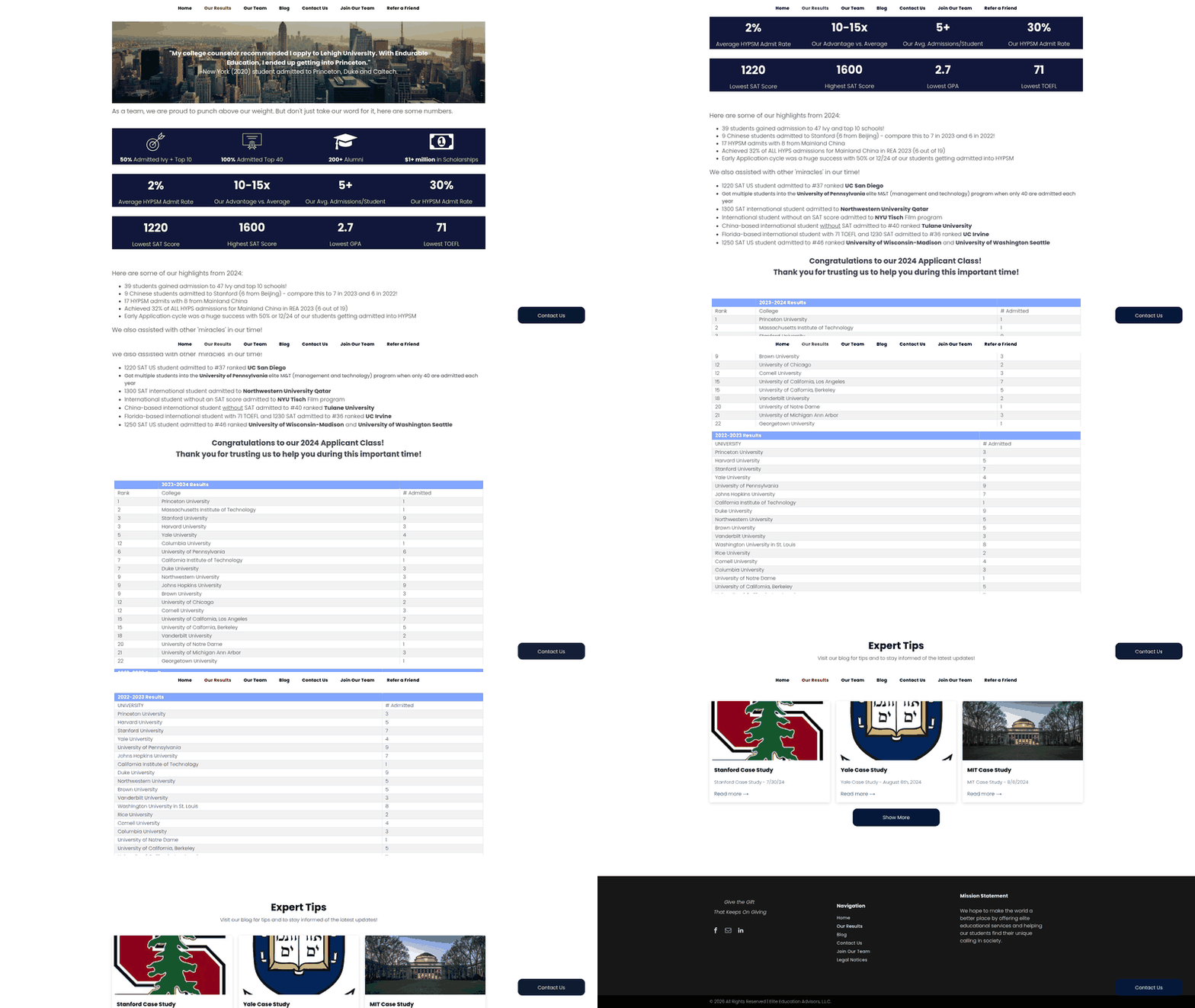
We've shown you five models in this guide. Each one shifts the risk equation differently. Ivy League specialists and high-review firms give you polished processes and strong historical numbers, but you pay the full fee before applications go out. Boutique consultants tailor every detail to your student, yet their small scale means no capital cushion to share downside risk. Network-focused firms spread your student across peer cohorts and alumni panels, which dilutes individual attention while still requiring full payment up front. Data-verified consultants publish outcomes transparently, but transparency alone doesn't change who absorbs the loss if your student doesn't land a target school.
Our Approach: Fair, Transparent Base-Plus-Bonus Pricing
We structure fees differently because we think pricing should be fair and transparent. Our model splits payment into a base fee that covers core work and a bonus you pay in full only when you're satisfied with our service. That structure keeps our standard prices lower than our competitors and keeps us honest about the work we take on.
References
[1] How to Choose a College Admissions Counselor - The Princeton Review - https://www.princetonreview.com/college-advice/how-to-choose-a-college-admissions-counselor
[2] How to Choose a College Admissions Consultant in 2026 - The Ivy Institute - https://theivyinst.org/blog/how-to-choose-a-college-admissions-consultant-in-2026-a-guide-for-families
[4] Translating Authentic Selves into Authentic Applications - https://www.researchgate.net/publication/375103215_Translating_Authentic_Selves_into_Authentic_Applications_Private_College_Consulting_and_Selective_College_Admissions
[5] Inside the $3 billion independent college counseling industry - https://www.marketplace.org/story/2025/03/24/inside-the-3-billion-independent-college-counseling-industry
[6] Private College Consulting and Selective ... - https://journals.sagepub.com/doi/10.1177/00380407231202975
[7] Standards of Excellence for IECA Member Consultants - https://www.iecaonline.com/wp-content/uploads/2017/10/IECA-Standards-of-Excellence-2023.pdf
Frequently Asked Questions
1. Does IECA membership mean a consultant is licensed or held to enforceable standards?
IECA membership indicates that a consultant has agreed to follow a voluntary code of ethics, but it does not function as a professional license. Because there is no state or federal regulatory board for college consulting, families should evaluate a consultant's individual track record, professional development, and business practices rather than relying solely on association credentials.
2. Why do advertised Ivy acceptance rates look so high?
These exceptional percentages are primarily driven by selective enrollment. Many elite firms pre-screen applicants and only take on students who already possess near-perfect academic profiles, top-tier test scores, and highly competitive extracurriculars. Consequently, these statistics reflect the strength of the curated client roster rather than the value added by the consulting services alone.
3. What questions should I ask before trusting a firm's success rate?
Inquire about the total number of students in their annual cohort, how they define a "successful placement," and whether their data is independently audited. It is also critical to ask what financial recourse you have if your student does not gain admission to their target schools, as most traditional firms require full upfront payment regardless of the final outcome.
4. When is hiring any admissions consultant not worth the money?
If your student is applying to institutions with high acceptance rates, or if your local high school provides robust, low-ratio college counseling, paying for private advisory services is rarely necessary. Strategic consulting provides the most value when navigating highly selective admissions processes where qualified applicants vastly outnumber available spots.
5. How does base-plus-bonus pricing actually shift financial risk?
Under this model, you pay a lower initial fee to cover the consultant's time, research, and operational costs. The remaining balance is structured as a performance bonus, which is only paid if your student secures admission to an agreed-upon target school. This ensures the consultant has a direct financial stake in the success of the application strategy.
6. What limits a boutique solo consultant compared to a team-based firm?
A solo practitioner faces strict capacity constraints, particularly during the peak application season of November and December. Without a team to share the workload, a single consultant must divide their time among all active clients, which can limit the hours available for deep essay reviews and last-minute strategy adjustments compared to a collaborative firm.
7. Do consultants have "insider access" or hidden levers with admissions offices?
They do not. Admissions offices evaluate applications through standardized, multi-reader committee processes, and independent counselors have no direct influence over these decisions. The value of a consultant lies entirely in execution: helping your student build a cohesive narrative, manage deadlines, and present their achievements in the most compelling way possible.