Before You Ask for Reconsideration: Can New Evidence Overturn Your Rejection?
August 14, 2026

Key Takeaways
- Sara Harberson counted two successful appeals across a 24-year admissions career. Most rejection appeals fail.
- Winning cases turn on new evidence the committee never saw, not a better-written letter.
- New evidence means substantive information absent from the original file: a raised test score, fresh transcript, documented family crisis, factual error.
- If your profile looks identical to the rejected one, skip the appeal.
- Pierre Huguet warns that reapplying the next cycle with the same profile rarely changes the outcome.
- Reconsideration is an evidence-gathering project completed before you contact the admissions office, not a persuasion contest.
- Students lose this stage before starting because they approach the appeal as an argument rather than building a case file.
Why Reconsideration Matters
Most rejection appeals fail. In her analysis of appeals in college admissions, former admissions dean Sara Harberson makes this clear. The vast majority of these requests are turned down. So why does reconsideration matter at all?
Because the rare students who succeed aren't the ones who wrote a more emotional letter. They're the ones who showed up with new evidence the committee hadn't seen.
Reconsideration isn't a persuasion contest. It's an evidence-gathering project that happens before you send anything to the admissions office. The same strategic thinking we bring to customized planning applies here: success requires shifting your mindset from writing a passionate plea to compiling an objective, factual dossier.
What Counts as New Evidence
To qualify for a second look, the information you present must be entirely fresh. Admissions officers need to see data points that were impossible to include during the initial application window.
Not every applicant should pursue this. If your profile looks identical to the one that got rejected, skip it. As Pierre Huguet notes in U.S. News, colleges look for developmental growth. A redundant application yields a redundant decision.
Students who benefit most have a real change to point to. International students whose credentials were misread. Applicants who faced a medical emergency during senior fall. Transfer candidates who lifted their GPA significantly—U.S. News reports they tend to fare better on a second attempt. If you have that kind of shift, reconsideration is worth the effort. If you don't, your energy belongs elsewhere.
Admission or Money
Here's a tension most students miss. Harberson says admission decision appeals rarely move a college. But she also notes that merit scholarship appeals succeed far more often, with some schools adjusting aid under pressure before the May 1st deadline.
Aim your new evidence at the lever that actually moves. The same documentation that won't reverse a rejection might raise a scholarship offer at a school that already admitted you. Timing decides everything. Public universities like UC Irvine set hard appeal deadlines, some as early as April 15th. Scholarship windows close by May 1st.
How Much Work This Takes
Plan on real work, not a weekend. The easiest evidence to produce is a corrected factual record or an updated transcript. The hardest is documenting extenuating circumstances, which needs letters, dates, and third-party confirmation.
A general appeals guide frames success as occasionally winnable. The insider view calls it near-futile. Both are right. Appeals succeed only in narrow, evidence-backed cases, which is why they're possible and vanishingly rare. Build the case first. The letter comes last, and it should read as a summary of proof, not a plea. For more on planning the road ahead, see our college admissions advice blog.
Gathering and Presenting New Evidence
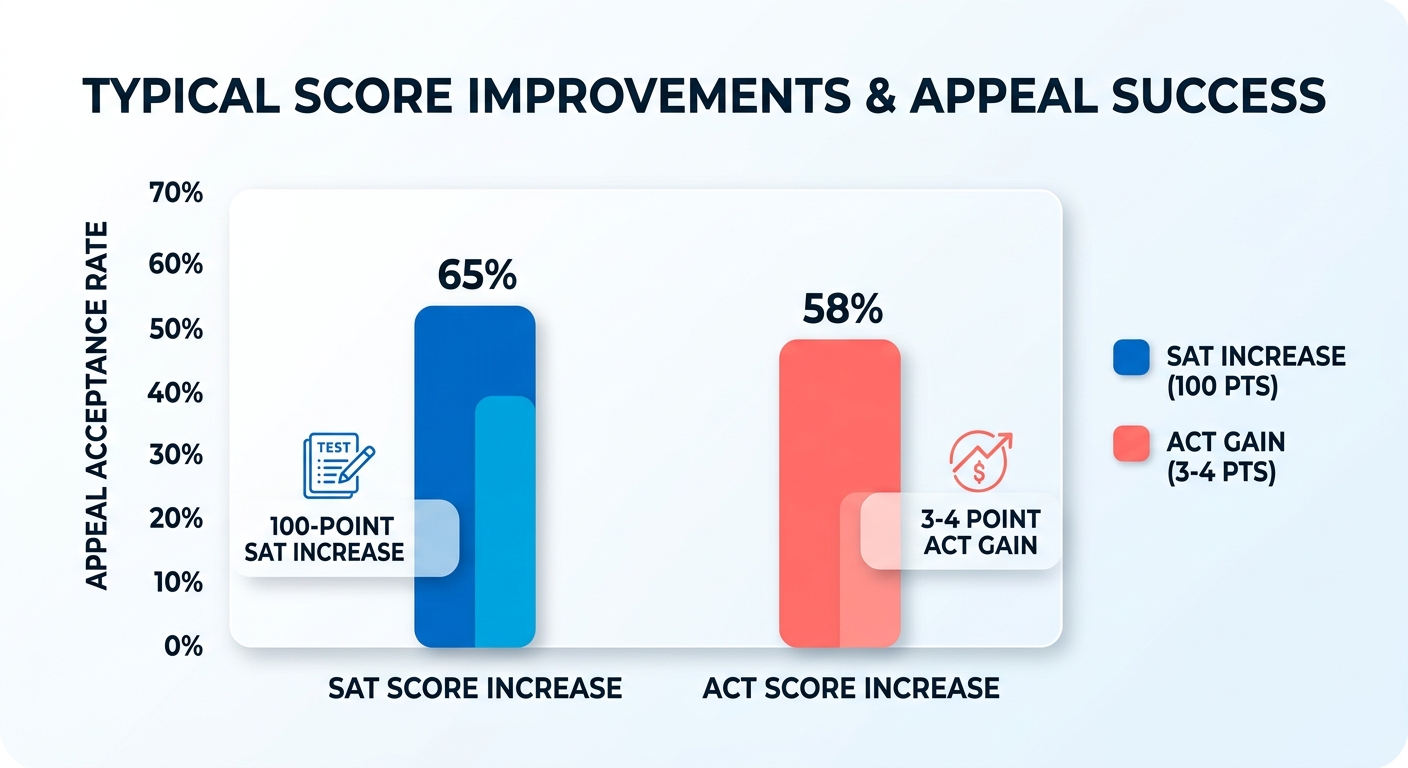
New test scores sit at the top of most appeal checklists. If you've retaken the SAT or ACT since your original application and posted a meaningful jump in your composite, that's concrete data committees can act on. We're talking about a 100-point SAT increase or a 3-4 point ACT gain, not a marginal bump. One appeal guide flags improved scores as legitimate grounds for reconsideration because they document a shift the committee couldn't have seen the first time around.
Beyond scores, documented personal circumstances that affected your academic performance carry weight if they're specific and verifiable. Unforeseen disruptions that coincided with a dip in grades matter when you can back them up. These personal challenges can justify an appeal, but only when paired with documentation: official records, letters from licensed counselors, or third-party verification that establishes both the timeline and the impact. Generic hardship narratives without proof read as emotional appeals, not evidence.
What "New" Actually Means
The line between new evidence and restated credentials trips up most students before they start. A letter from your coach praising the leadership skills you already mentioned in your original application? That's repetition, not reconsideration material. As noted in U.S. News, submitting the same fundamental profile a second time yields the same result. The same rule applies to appeals. If the committee already had a version of this information, even if it wasn't presented as well as it could have been, repackaging it won't move them.
New evidence means the committee didn't have access to it during their initial review. A second-semester grade report showing you pulled straight A's in honors courses? That's new. A published research paper that came out after your application deadline? That's new. An updated recommendation letter from a teacher who can now cite a community service initiative you launched? That's new. The distinction sounds obvious, but students blur this line constantly, treating "better framing" as equivalent to "new information."
How We Help Students Build the Case
Our process starts with an initial consultation to assess each student's unique needs and goals. We map out what the admissions committee saw in the original application and what has happened since the rejection letter arrived. That second category—the post-decision window—is where real reconsideration cases get built. We push students to document everything: test dates, grade postings, awards, published work, verifiable circumstances that emerged after submission. If it happened before the application deadline, it's not new, even if you forgot to include it the first time.
Once we've identified legitimate new evidence, we organize it into a submission packet that mirrors how admissions committees process information: chronologically, with clear documentation for every claim. A new test score gets paired with the official score report. A medical circumstance gets paired with a letter from the treating physician that includes dates and a description of how the condition affected academic performance. An additional letter of recommendation gets paired with context about what the recommender can now attest to that wasn't available during the original review cycle.
We also bring a collaborative panel to every submission, with at least two members of our team reviewing the material before it goes out. Historical data on appeals in college admissions shows that successful cases have one thing in common: the new evidence directly addressed a gap or weakness in the original application. That means if your rejection likely came down to test scores, a new award in an unrelated extracurricular won't move the needle. If it came down to rigor, a stronger second-semester transcript might. We help students avoid the trap of submitting everything new when what they need is the right new thing.
Common Pitfalls When Presenting New Evidence
The biggest mistake? Burying the lead. Students write long narratives that contextualize their new evidence instead of leading with the evidence itself. The committee doesn't need three paragraphs explaining why you decided to retake the SAT. They need the new score in the opening sentence, followed by the official documentation. We coach students to structure their appeal submissions like executive summaries: state the new evidence, attach the proof, explain why it matters in that order.
Another trap: submitting partial documentation. If you're appealing based on a medical circumstance, a vague letter from your counselor saying you "dealt with health challenges" won't cut it. The committee needs specifics—diagnosis timeline, treatment duration, academic impact—from a medical professional who can verify the claim. Incomplete documentation reads as unverifiable, which is the same as no documentation in an appeal context.
Timing errors kill appeals that might otherwise have worked. Most schools bury their reconsideration deadlines in the fine print, and those deadlines are absolute. Missing a school's specific spring cutoff means your new evidence becomes irrelevant no matter how strong it is. We build regular check-ins and feedback sessions into the workflow so students stay on track and nothing gets assembled too late to matter.
Common Mistakes to Avoid in Reconsideration
The biggest mistake we see in reconsideration attempts is treating the appeal as a second chance to make your case, rather than a chance to introduce evidence the admissions committee couldn't have evaluated the first time. Students rewrite their personal statements, polish their activity descriptions, or submit additional recommendation letters that say what the first ones did. None of that moves the needle. The reason successful appeals are so rare isn't a reflection of how many students tried. It's a reflection of how few showed up with genuinely new information that changed the evaluation calculus.
What Counts as "New" Evidence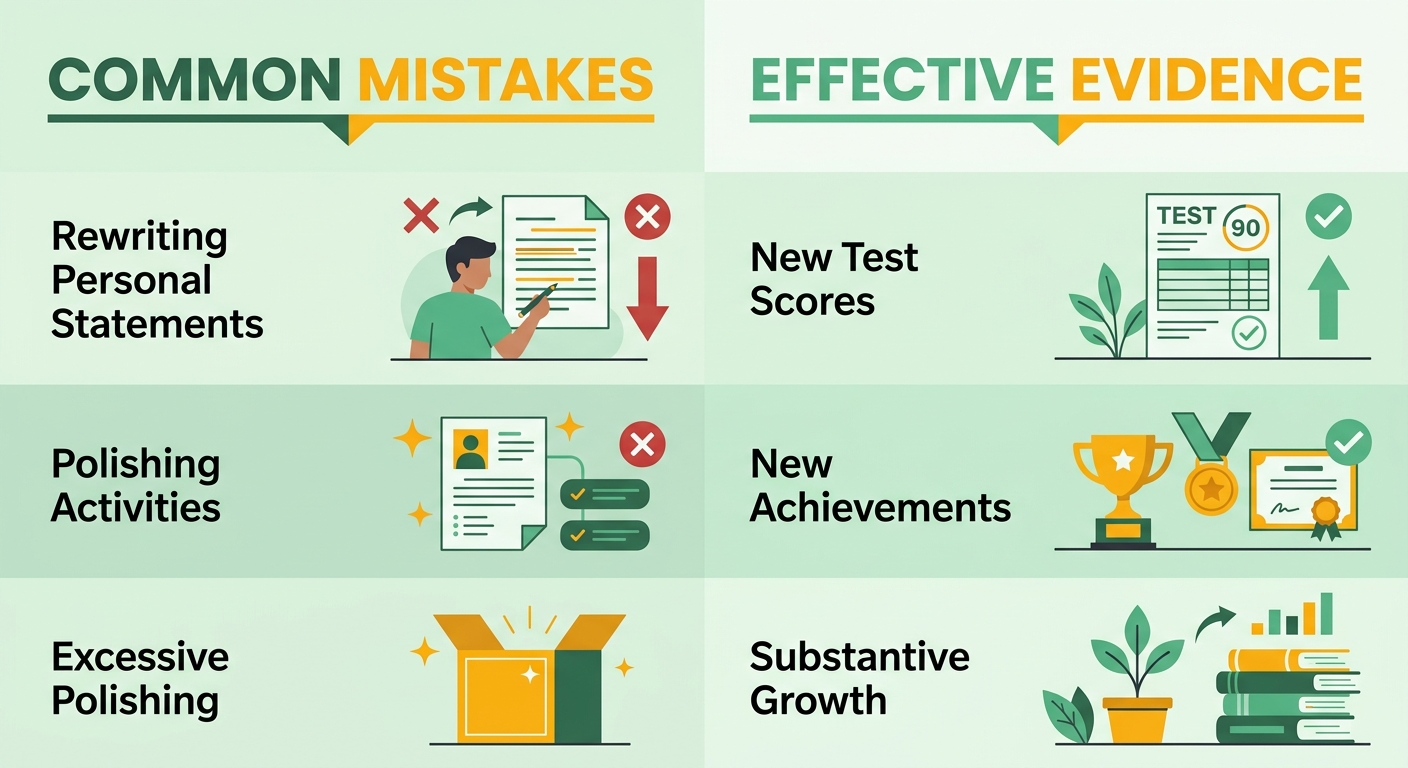
New evidence means information that did not exist or was not available when you submitted your original application. A retaken SAT with a 120-point jump qualifies. Completing a college-level dual enrollment course with a top grade during your senior spring qualifies. A regional science fair award you won in March, after the January application deadline, qualifies.
What doesn't qualify: reframing your existing achievements in more persuasive language, adding detail to experiences you already listed, or submitting a third recommendation letter from a teacher who taught the same subject as your first two recommenders.
We also see families submit documentation for circumstances that affected performance—such as sudden personal disruptions—without connecting those circumstances to concrete academic impact. A medical diagnosis alone doesn't tell the story. You need to show how it affected your GPA, why your grades recovered once the situation stabilized, and why the committee's original read of your transcript missed that context. Vague appeals to hardship don't work. Specific, verifiable timelines do.
Timing and Tone Traps
Most students wait until after they've been rejected everywhere else to file for reconsideration. That signals to the committee that the school wasn't your first choice. You're appealing because you're out of options, not because new evidence genuinely changes the fit. If you have new test scores or a major award, submit them as soon as they're available, ideally before the admissions cycle closes. Public universities with documented appeal windows post strict deadlines. Miss them and your case won't even be reviewed.
Tone matters more than students expect. Appeals that read as emotional or accusatory—questioning the committee's judgment, suggesting the decision was unfair, demanding reconsideration as if it's owed—get dismissed immediately. The effective ones are factual, concise, and respectful. Present the new evidence. Explain why it wasn't available earlier. Ask the committee to review your application in light of this updated information. Skip the rhetoric about how much you love the school or how disappointed you were. The committee already knows you want to attend. They need to know whether your profile has materially changed.
Next Steps After Reconsideration
If reconsideration comes back as a denial, you have three real paths left: appeal to a different decision-maker, redirect your new evidence toward a scholarship adjustment, or shift your energy to reapplication next cycle. Picking the right one depends on what kind of evidence you gathered and what you're actually trying to win.
Sara Harberson's analysis highlights that financial aid offices operate under different constraints than admissions offices. If your new evidence is financial, targeting the aid office directly can yield adjustments. They have separate budgets and timelines designed to secure enrollments late in the cycle. You're far more likely to move a dollar figure than a verdict.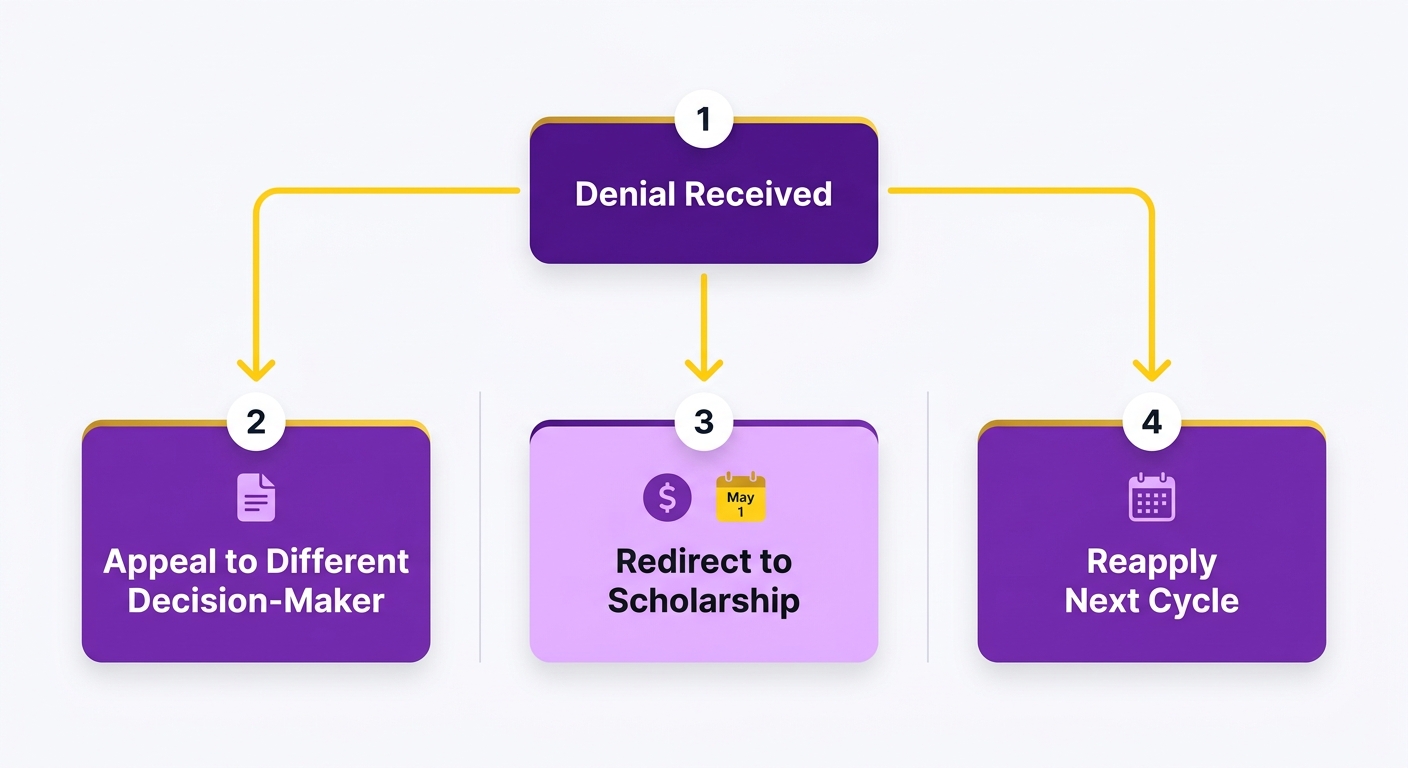
Is It Worth Appealing a Reconsideration Denial
Rarely, and you should know that going in. Once a school has already reconsidered and denied you a second time, a third attempt with the same evidence almost never changes the outcome. Save your energy for evidence you haven't presented yet, or a different goal entirely.
Public universities are the exception. Certain state systems run highly structured appeal processes with strict calendar cutoffs, as detailed in Sara Harberson's admissions guides, so a second appeal there follows an actual procedure rather than a discretionary favor. Private colleges don't work this way. If a private school already reconsidered you once, a follow-up appeal is asking the same reader to reverse their own recent judgment call.
When to Reapply Instead of Appealing Again
Reapply when your new evidence is about growth, not correction. A stronger GPA, a meaningful gap-year project, or a significant score jump belongs in a future application, not a repeat appeal to the same cycle.
The advice from Pierre Huguet in U.S. News highlights that the evidence bar for reapplication is the same one that governs appeals, just on a longer timeline. Students who spend a gap year on something substantive, not just retaking tests, tend to come back with applications that actually read differently to the committee.
The sources agree on more than they seem to at first glance. One frames appeals as almost never successful, the other frames reapplication as viable with real change behind it. Read together, both are describing the same threshold: new, verifiable evidence moves outcomes, and everything else is noise. Whether that evidence goes into a second appeal, a scholarship request, or next year's application is a targeting question, not an evidence question.
Whichever path you choose, treat the decision itself as data. A denied reconsideration doesn't erase your progress. Colleges that reconsider a case are also seeing a stronger version of you than the one that first got rejected, and that version doesn't disappear when the letter says no again.
References
[3] Appeals in College Admissions: Everything You Need to ... - https://www.saraharberson.com/blog/appeals-in-college-admissions
Frequently Asked Questions
1. I forgot to include an award in my original application. Does adding it now count as new evidence?
Information that existed before the application deadline doesn't qualify as new evidence, even if you left it out. Reconsideration only accepts material the committee couldn't have seen, like a score earned or event that occurred after submission. A forgotten pre-deadline award reads as restated credentials, not grounds for appeal.
2. How do I know which new evidence actually matters for my appeal?
Target evidence at the specific weakness that likely caused your rejection. If test scores sank your application, a new award in an unrelated activity won't help, but a stronger transcript addressing rigor concerns might. Successful reconsiderations share one trait: the new evidence directly addresses a gap in the original file.
3. Is a new recommendation letter ever considered new evidence?
A recommendation letter counts only when it attests to something unavailable during the original review, like an independent laboratory research project completed after submission. A letter from a teacher in the same subject as your first two recommenders, praising skills you already mentioned, is repetition. New context, not better phrasing, makes a letter qualify.
4. Should I mention how much I love the school in my appeal?
Skip declarations of interest entirely. The committee already knows you want to attend. Appeals that lean on emotion, love for the school, or claims the decision was unfair get dismissed fast. Effective submissions stay factual and concise: present the new evidence, explain why it wasn't available earlier, and request a fresh review.
5. Do private and public universities handle appeals differently?
Public universities often run highly structured appeal processes with strict calendar cutoffs, following an actual procedure. Private colleges rely on discretionary review, so a follow-up appeal asks the same reader to reverse their own recent judgment. That reversal almost never happens at private schools.
6. My rejection is final, but I was admitted elsewhere with weak aid. Can my evidence help?
Redirect financial evidence toward a scholarship adjustment at a school that already admitted you. Admissions experts note that while colleges rarely negotiate admission decisions, financial aid offices have separate budgets and may adjust merit scholarships under pressure before the spring enrollment deadline. You're far more likely to move a dollar figure than reverse a rejection verdict.
7. Will a denied reconsideration hurt my chances if I reapply next cycle?
A denied reconsideration doesn't erase your progress. Colleges that reconsidered your case saw a stronger version of you, and that version persists. Reapply when your evidence reflects genuine growth, like a substantive gap-year project rather than just retaken tests, since submitting a redundant application without developmental growth will yield a redundant decision.