College Will Humble You: How College Fit Creates Smarter Application Lists
August 12, 2026

Key Takeaways
- Real college research takes about 60-90 focused hours, spread from spring junior year through early fall senior year.
- Families who treat the search as a summer project often panic later.
- Good application seasons depend on fit and honest timelines.
- The work falls into phases: list-building in junior spring, then deep research and campus visits over summer.
- A useful list weighs academic programs, campus culture, financial aid, and career outcomes together.
- Visits, virtual tours, program deep-dives, and student conversations all take time.
- Start the list in senior fall, and essay deadlines collide with final decisions.
Related Video
Watch: Beyond Rankings: A Smarter Way to Build a College List by Dr. Meg, College Whisperer
Quick Summary
College will humble you. Not because you aren't ready, but because planning beats hope. Across hundreds of students in the US, China, UK, Canada, Hong Kong, Mexico, and beyond, the gap between a scattered season and a smooth one is usually the same: fit and time. Here's what to sort out before you build anything.
How long does college research really take?
Plan for roughly 60-90 hours of focused work, spread from spring of 11th grade through early fall of senior year. That covers campus visits, virtual tours, program details, and conversations with current students. Start the list in spring of junior year. Not senior fall, when essay deadlines already collide with final decisions.
Most families lowball this. They pencil in a summer of "research," then realize in September they're weighing academic programs, campus culture, financial aid policies, and career outcomes all at once, while also drafting supplements. Phase it instead: junior spring for the first list, summer for deep research and visits, early senior fall for final trims.
What makes it hard?
The hard part isn't finding information. It's reading major-specific admit rates that ranking sites often leave out. Carnegie Mellon looks manageable at a 23% overall rate. But computer science admits 7% of applicants, while business admits 23%. One school can be a far-reach, a reach, and a target at the same time, depending on what you want to study.
That's what breaks tidy reach, target, and safety buckets. Families using the institutional acceptance rate misjudge risk across the whole list. You want program-level data, not the university-wide headline.
The metrics to track
| Criterion | What to Research | Time Required | Difficulty Level |
|---|---|---|---|
| Academic fit | Major-specific admit rates, faculty research areas, curriculum flexibility | 15-20 hours | High (requires digging beyond published stats) |
| Financial viability | Net price calculator results, merit scholarship policies, work-study availability | 10-15 hours | Medium (math-heavy but straightforward) |
| Campus culture | Student-to-faculty ratio, class sizes, campus visit impressions, student reviews | 20-25 hours | Low (mostly observational) |
| Career outcomes | Internship placement rates, alumni network strength, graduate school acceptance | 15-20 hours | Medium (data often buried in department sites) |
| Location & logistics | Distance from home, weather, surrounding city resources, transportation | 5-10 hours | Low (personal preference driven) |
Apply to 12-15 schools, balanced across reach (15-30% admit rates), target (30-60%), and safety (60%+). But admit rates only tell half the story. An admissions safety can become a financial reach if the aid package falls short, so you want at least one school that works as both an admissions safety and a financial safety.
Application fees run $50-90 per school, plus $15-20 per test score report. If you apply to the recommended range, budget $800-1,500 in fees alone. Waivers exist for families who qualify on financial need. Check eligibility through the Common App or Coalition App.
Why College Fit Matters
Getting in takes more than the numbers. At selective schools, a strong GPA and test scores are the floor, not the finish. What separates students is finding a campus where learning style and goals actually align. Most families run this backward, building lists around brand names instead of measurable factors, which is why we push customized planning that helps each student find schools where they can show their best work.
What fit measures that acceptance rates don't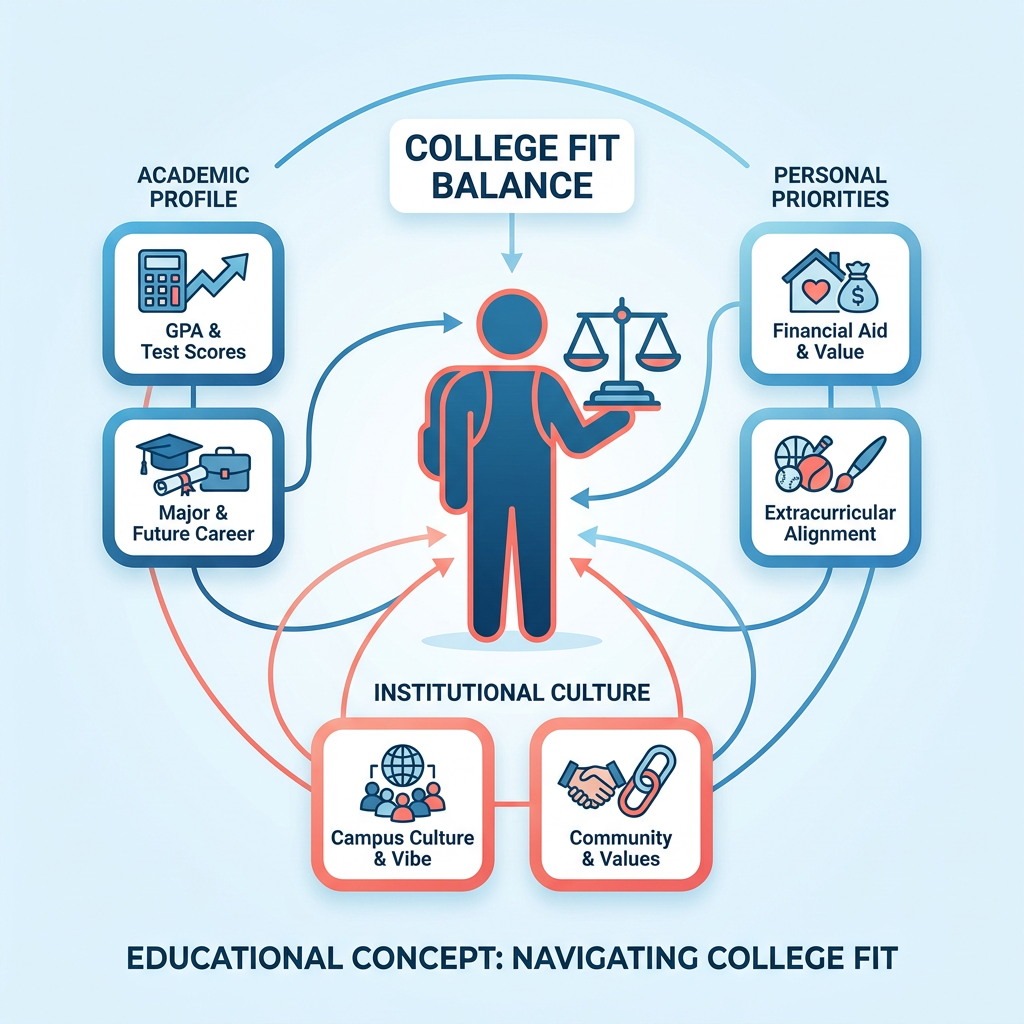
Fit sits underneath the prestige ladder families fixate on. It's learning styles, campus culture, class size, and career pathway alignment, the things that actually predict whether you stay enrolled and graduate on time. The data holds up: students who prioritize fit over rankings report higher satisfaction and better academic outcomes, while mismatched students transfer more and finish later.
A lot of that mismatch is capacity. A university's liberal arts side might have room for thousands, but its specialized tracks, nursing or engineering, are capped by lab space, clinical placements, and faculty ratios. Judge a school by its average admit rate and you miss those internal bottlenecks entirely. Look at the specific department's capacity and enrollment history instead of the university-wide number.
The list-size numbers worth arguing about
Most sources say apply to 10-20 schools, but that range hides two very different strategies. The lean 4-8 school approach works for students with clear geographic limits, specific program needs, or families who value calm over maximum optionality. The wider range fits students who need to compare aid offers or face unpredictable odds: international applicants, kids aiming at hyper-competitive programs, anyone without a legacy edge.
Neither is wrong. But the call requires an honest look at your risk tolerance and what you're actually optimizing for. The workload piles up faster than families expect.
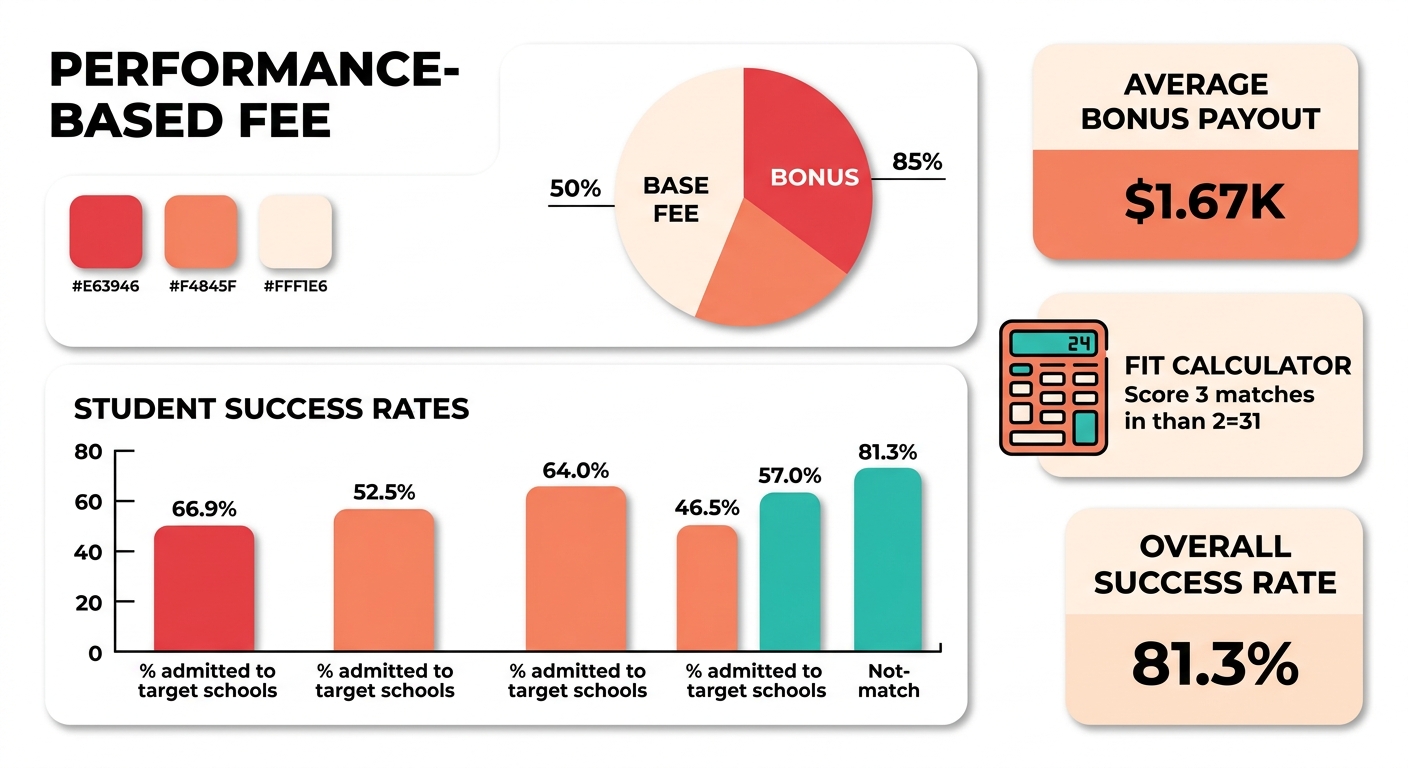
This is where our base + bonus structure earns its keep. We only collect our full fee when you're satisfied, so we have every reason to help you apply to the right number of schools instead of padding the list to justify a bill. The focus stays on a strategic list built around your strengths and goals.
Who gets the most out of a fit-first approach
The students facing the longest odds need the sharpest fit work. When you're up against thousands of applicants with nearly identical stats, fit becomes the tiebreaker. It's the proof in your application that you did the homework and understand why this program lines up with your goals. Admissions officers can spot generic enthusiasm quickly, but they respond to a student who names specific faculty research, a particular program structure, or a value that connects to something they've actually done.
International students gain even more. You're already dealing with visa requirements, higher tuition, and distance from your support network. Picking schools by faculty-to-student ratio, academic support, and career placement stops being optional. Strong international student services, an alumni network back home, and solid OPT placement rates all deserve extra weight.
The students who need fit analysis least are the ones with overwhelming conventional advantages: recruited athletes with guaranteed spots, legacy applicants at schools where the family funded a building, students whose parents can bankroll unlimited gap years and reapplications. For everyone else, leaning on brand recognition without checking fit is how you end up filing a transfer request.
Compiling an Initial College List
Building a list means filtering thousands of options down to a set that matches your profile and priorities. This is the phase that shows how programs inside one university run as separate operations. A direct-admit nursing track might take fewer than 1 in 8 applicants while the same school admits about 45% overall, a gap you'll find in the major-specific data. That's why the general admission number can mislead you when you're planning.
Start with academic anchors, not aspirational brands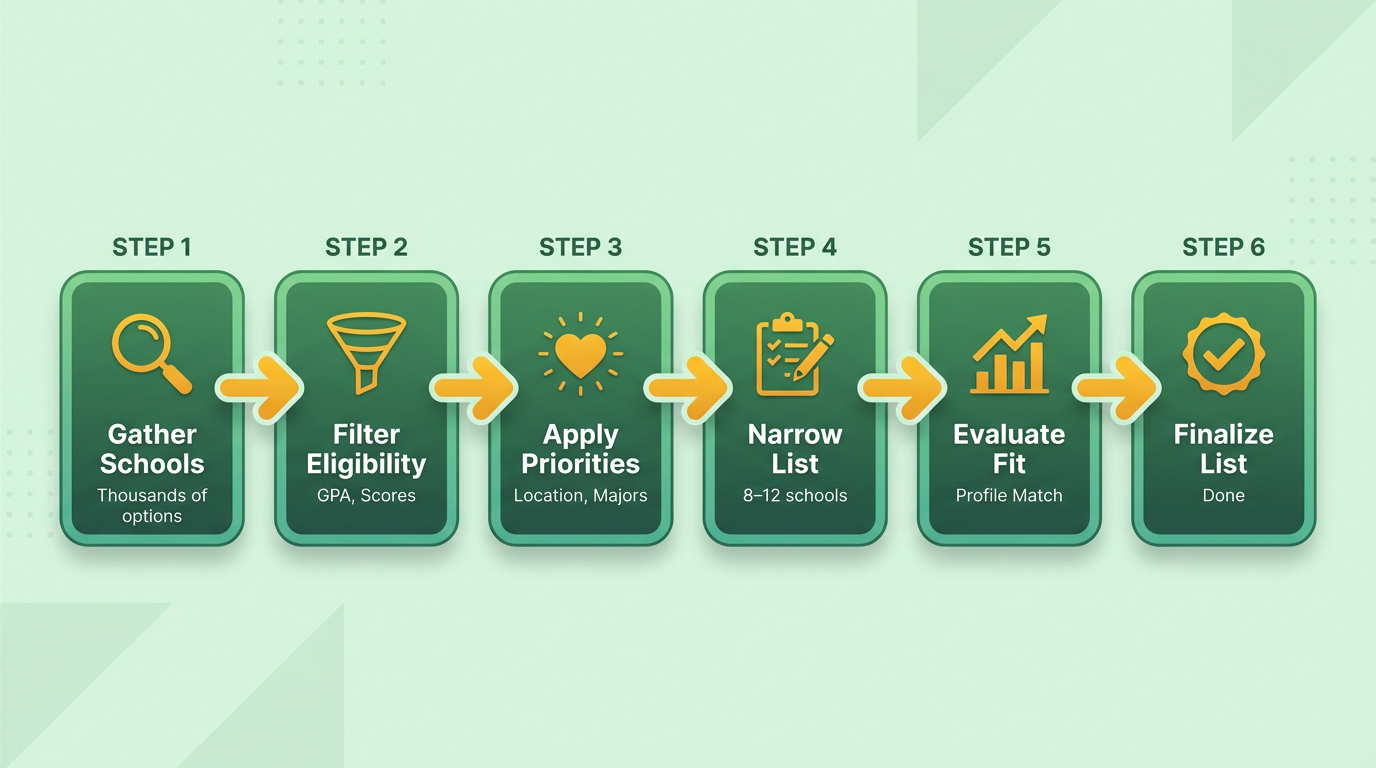
Put your unweighted GPA, test scores (if you're submitting), and intended major into a spreadsheet first. Most families do this in reverse: pick the schools, then hope the credentials fit. Research consistently shows a balanced list spreads across likely, target, reach, and far-reach tiers instead of clustering at one end. Anchor each tier to your own numbers, not a school's reputation. A program becomes a reach when your stats sit at or below its median admit, and a likely when you clear that median comfortably.
The average first-year applicant applies to 6.80 institutions, which is a useful baseline for the workload. At the most selective schools, holistic review keeps decisions unpredictable, so treat them with caution no matter how well your profile matches their averages.
Build program-level research into every entry
Once your anchor categories are set, filter by program strength, not institutional rank. Pull faculty-to-student ratios, four-year graduation rates, and major-specific acceptance data from the Common Data Set and IPEDS. Campus visit research matters less than the departmental details: lab access, research openings, internship pipelines, capstone requirements. Skip the "great engineering program" boilerplate and look for specifics, like whether sophomores can take advanced coursework or whether research labs take undergrads at all.
Location and campus size get filed under "personal preference," but they move retention rates and career placement. A student built for small seminars will struggle at a 40,000-student flagship with 300-person lectures. If you're weighing different climates or urban-versus-rural, visit or do virtual tours during the academic year, not summer when the campus is empty. Reading student newspapers, browsing Reddit threads from current students, and checking student life data on club participation tells you more than a brochure will.
Run a self-survey to lock down your non-negotiables
Before you finalize anything, run a self-survey that separates what you need from what just sounds good in the viewbook. Name your non-negotiables: must-have programs, required resources (career center, mental health services, accessibility accommodations), and financial limits. Running the aid calculators early keeps you from falling for a school that's academically right but financially out of reach.
Setting these lines early in high school lets families zero in on places that offer a genuine path to graduation. It also cools the urge to tack on selective schools purely for prestige, so the final list is made of places where the student can actually enroll and thrive.
Categorizing Schools: Reach, Target, Safety
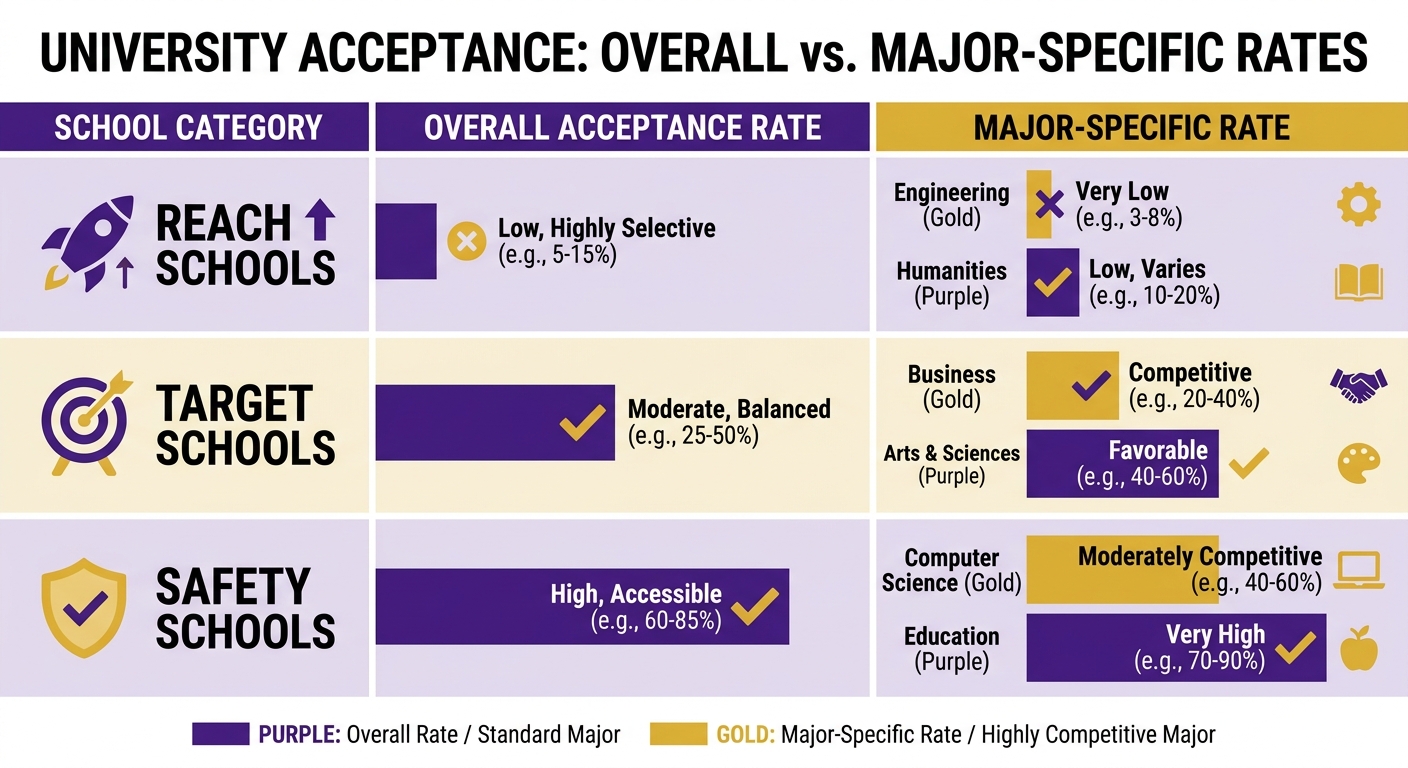
Sorting schools into reach, target, or safety means looking past the overall institutional acceptance rate. A balanced list spreads risk across schools where your credentials stack up differently against each admitted class. To stay realistic, that sorting has to account for departmental capacity and what each school is actually prioritizing.
How your profile shifts the categories
Your credentials don't sit in a vacuum. At UT Austin, engineering applicants face a 15% admit rate while liberal arts sees 42%, the same school landing in different buckets depending on your major. A 1500 SAT and 3.9 GPA might put you comfortably above the median at Boston University (19% acceptance rate), making it a solid target, while those same numbers drop you into the bottom quartile at Northwestern (8% acceptance rate), firmly a far-reach.
The research shows students who read their own profiles accurately tend to do better, because they aim at schools where they can show real fit instead of chasing brands where they're statistical outliers. With borderline schools, say a 28% acceptance rate, it's safer to call them reaches unless your credentials clearly beat the median. That keeps you from overestimating your odds and leaves you with a more secure set of options.
Building the right distribution
A working list needs 2-3 likely schools, 3-4 targets, and 2-3 reaches, per enrollment management research. The bulk should be targets, places where you're competitive and genuinely want to go, not reaches you're throwing at the wall. Some guidance trims the list for students with very specific preferences; other guidance widens it for aid comparisons.
The right number tracks your risk tolerance and financial need. Students chasing merit aid often do well casting a wider net, since scholarship thresholds swing hard even between schools with similar admit rates. What earns full tuition at one place might yield a modest award at another with an identical acceptance rate.
What "safety" actually means in 2026
Any college under a 20-25% acceptance rate is a reach for everyone, no matter your qualifications, because holistic review makes the outcome unpredictable even when you exceed the median. Test-optional policies, record application volume, and yield management mean no highly selective school is a lock. Applicants with outstanding GPAs and scores still get turned away as schools shape the class.
And a school that's likely to admit you but financially unworkable isn't a real safety. Running net price calculators early keeps your academic backstops financially real too. Public university honors colleges are strong here: rigorous academics, higher acceptance rates, and merit money. The University of Arizona (85% acceptance rate) and University of Iowa (83% acceptance rate) both run competitive honors programs with small seminars and research access while keeping admission reachable. Lock in those verified matches and every school on your list becomes a genuine, positive option.
Using Counselor Support and Online Tools
The right mix of human guidance and online tools turns a wishlist into a measured portfolio. A counselor reading your profile against real admit data, paired with a fit calculator that scores your matches, catches miscalculations before they cost you a cycle. That kind of review keeps families objective and keeps the list driven by data rather than attachment to a brand name.
What a counselor actually does
A counselor's job is to translate your credentials into honest categories and to push back on the list you're emotionally attached to. Families tend to stack reaches without checking the profile against them, which leaves thin options when decisions land, as Dr. Andrew Hoffman explains.
Counselors also settle the conflicting advice on list size by weighing your geographic preferences, aid needs, and risk tolerance. A good one audits your essay themes across applications, flags overlapping supplement prompts, and sequences your calendar so early action deadlines don't hurt regular decision quality. That logistical eye keeps stress down and heads off the late scramble.
Which tools are worth your time
Get a fit score before you look at a ranking. The CollegeFit calculator rates matches from 0 to 100 across six weighted dimensions: academic match at 35%, major availability at 20%, financial fit at 20%, then location, campus culture, and personal priorities filling the rest. It covers over 1,750 schools.
Weight the variables that shape daily life, too. Frank Brun's interactive tool, built for the New York Times, lets you generate lists by adjusting size, region, and campus culture. Put weather on that list. Moving from constant sun to five months of cloud cover can trigger seasonal issues that quietly wreck a first year.
Then cross-reference the net price calculator on each school's aid page. Run these early, before you fall for a campus, because the sticker price rarely reflects the real cost. Schools with strong endowments often deliver better aid than regional publics, even when their published tuition looks higher.
How to refine and time the final list
Finalize by early senior year, per Liberty High School's guidance. Once the list is balanced, pressure-test each choice against the long-term metrics.
Retention and graduation rates are strong reads on student satisfaction, and fit-based choices consistently track with lower transfer rates. Our customized planning and mentorship work centers on helping students present their strongest profiles from start to finish. For families who want structured guidance, our admissions planning blog shares tips and a look at how we work.
References
[1] A Guide to College Fit: Building a List and Researching ... - https://www.ilumineducation.com/a-guide-to-college-fit-building-a-list-and-researching-colleges
[2] Find Your Fit - BigFuture - College Board - https://bigfuture.collegeboard.org/plan-for-college/find-your-fit
[3] Free AI College Fit Calculator for High School Students - https://collegefit.io/college-fit-calculator
[4] Create a College List - Liberty High School - https://liberty.isd411.org/student-life/college-and-career-center/college-preparation/create-a-college-list
[5] How to Build a Balanced College List (Reach, Match, Likely ... - https://www.youtube.com/watch?v=IjrBvtamk04
[6] The importance of building a balanced college list - AcceptU - https://www.acceptu.com/blog/building-a-balanced-college-list/
[7] How to Build a College List: A Step-By-Step Guide - https://www.collegeessayguy.com/blog/how-to-choose-a-college
[8] How to build a balanced college list. strategy, fit, and realistic planning - https://collegegrind.org/posts/how_to_build_a_balanced_college_list/
Frequently Asked Questions
1. When should I start researching colleges if I'm currently a high school sophomore?
Begin initial college research in spring of 11th grade, not sophomore year. Starting too early means researching programs before you've developed clearer academic interests or built a complete transcript. Use sophomore year to explore potential majors through coursework and activities instead.
2. How do I calculate whether a school is actually a safety if acceptance rates vary by major?
Find program-specific acceptance data through Common Data Sets or by contacting admissions offices directly. A school accepting 45% overall but only 15% into your intended major is not a safety. Your credentials must exceed the median admit profile for that specific program, not the institution overall.
3. What's the real cost difference between applying to 8 schools versus 15 schools?
Expanding your list increases both financial costs and the time required for writing. Beyond application fees and test score reports, the workload grows because each additional school requires unique supplemental essays. Writing convincing, research-backed responses for dozens of prompts demands significant time that could otherwise be spent maintaining senior-year grades.
4. Can I use the same campus visit for both a reach and safety school in the same city?
Yes, but visit both campuses separately and attend program-specific information sessions at each. Generic tours miss departmental resources, lab access, and faculty interaction patterns that determine whether you'll thrive there. Schedule back-to-back visits on different days to avoid rushed impressions.
5. What happens if my financial safety admits me but my admissions safety doesn't offer enough aid?
To avoid this scenario, ensure your list includes an institution where your admission is highly probable and the net price fits your family's budget. Using financial tools during the initial research phase prevents the disappointment of receiving acceptance letters that are financially unviable.
6. Do international students need different reach-target-safety ratios than domestic applicants?
International applicants face unique variables, including visa caps and varying institutional aid policies, which often require a more geographically diverse list. Prioritizing universities with robust international student support systems and active global alumni networks helps ensure a smoother transition and better career placement opportunities after graduation.