Get Accepted to Top 10 Colleges with Proven Admissions Tips
August 3, 2026

Key Takeaways
- At some highly selective schools, roughly 70% of applicants look equally qualified on paper. Grades rarely decide who gets the offer.
- About 3 in 4 colleges call grades considerably important, but those grades qualify you for the pool rather than lift you out of it.
- Around 86% of colleges weigh curriculum strength, which means course rigor is a threshold to clear, not a way to stand out.
- Once a student clears the rigor bar, chasing a perfect GPA pays less and less. The extra effort mostly goes nowhere.
- Families get more value from shifting time and money away from grade perfection toward a distinct hook once the academics are handled.
- A top 10 degree opens networks, funding, and career access that compound over decades, though the payoff varies a lot by student.
- Fit and program strength often matter more than raw ranking. Schools like Wellesley fund academic programs seriously.
What actually decides a top 10 admission?
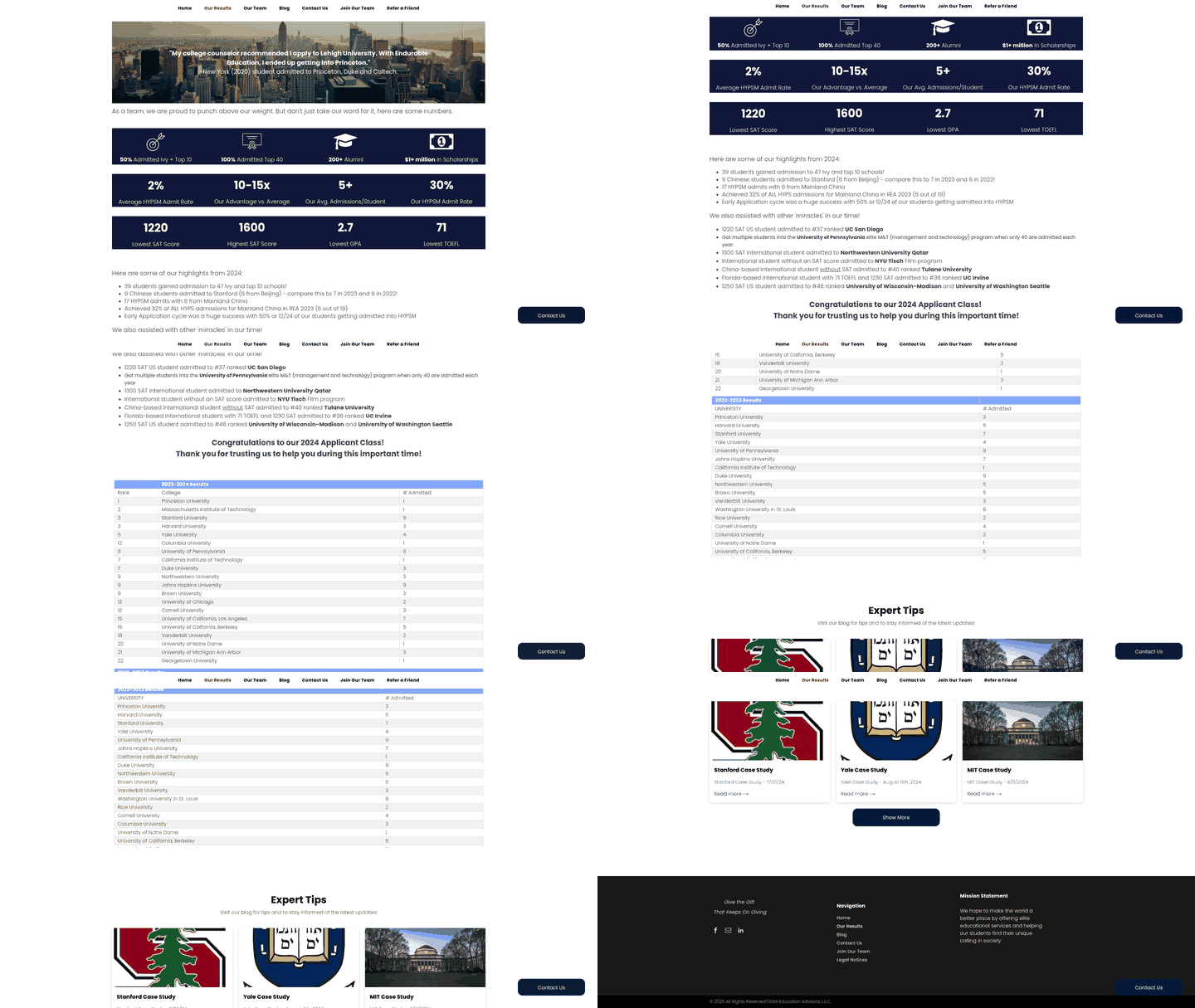
Getting into a top 10 college has less to do with a flawless transcript than most families assume. The data is blunt: at some of the most selective schools, the vast majority of applicants present near-identical academic profiles on paper. That one fact should reshape your strategy, because grades get you into the pool but rarely decide who gets pulled out of it.
That changes where a family should spend its energy. Once a student proves they can handle the academic work, the return on chasing a perfect GPA drops fast. Yes, most colleges place enormous value on classroom performance and lean hard on curriculum strength. But those things qualify you. They do not differentiate you. Build the distinct personal narrative once academic capability is established.
Why a top 10 degree still earns the effort
A degree from a top 10 school opens doors in networks, funding, and career access that compound over decades. The payoff is not uniform, though, and prestige by itself is a weak filter. Fit and program strength often matter more than rank. Some elite liberal arts colleges pour real money into attracting strong students without chasing a headline ranking.
This is where our base-plus-bonus model earns its keep. We charge a base fee for the work every student needs, then a bonus tied to admission outcomes. That structure keeps us honest. We have no reason to pad a school list or inflate a schedule when our upside depends on your acceptance, not your logged hours.
What the application workload really costs you
The real price of a prestige-maximizing list shows up in workload, not just stress. Applying to all eight Ivies means 38-plus supplemental essays, and that volume is exactly where authenticity falls apart. Meanwhile 40% of students apply to 5-8 schools and 32% apply to 9 or more, so the pull to over-apply is real.
Here's the breakdown we use with families to set expectations:
| Component | Time / effort | Difficulty | Why it matters |
|---|---|---|---|
| Rigorous coursework + GPA | Ongoing, 4 years | Medium | The gate, per NACAC factor data |
| Standardized testing | 3-6 months prep | Medium | Strategic per-school, not blanket |
| Distinct extracurricular hook | 2-3 years | High | The true differentiator |
| Personal statement + supplements | 3-4 months | High | Over half of colleges weigh essays |
| Demonstrated interest | Ongoing | Low | ~40% of colleges value it |
On testing, the evidence genuinely conflicts. Test-optional policies suggest scores matter less, yet a Dartmouth study found scores helped identify high-achieving applicants from less-advantaged backgrounds. Our read: test-optional is not test-blind. If you score well, especially coming from a less-advantaged background, submit. Decide school by school.
Who benefits most from working with us? Students who have already cleared the rigor bar and need help finding and sharpening a hook. If you're still stabilizing your grades, that comes first, and we'll tell you so before you pay for the bonus tier.
Building a college list that fits the student
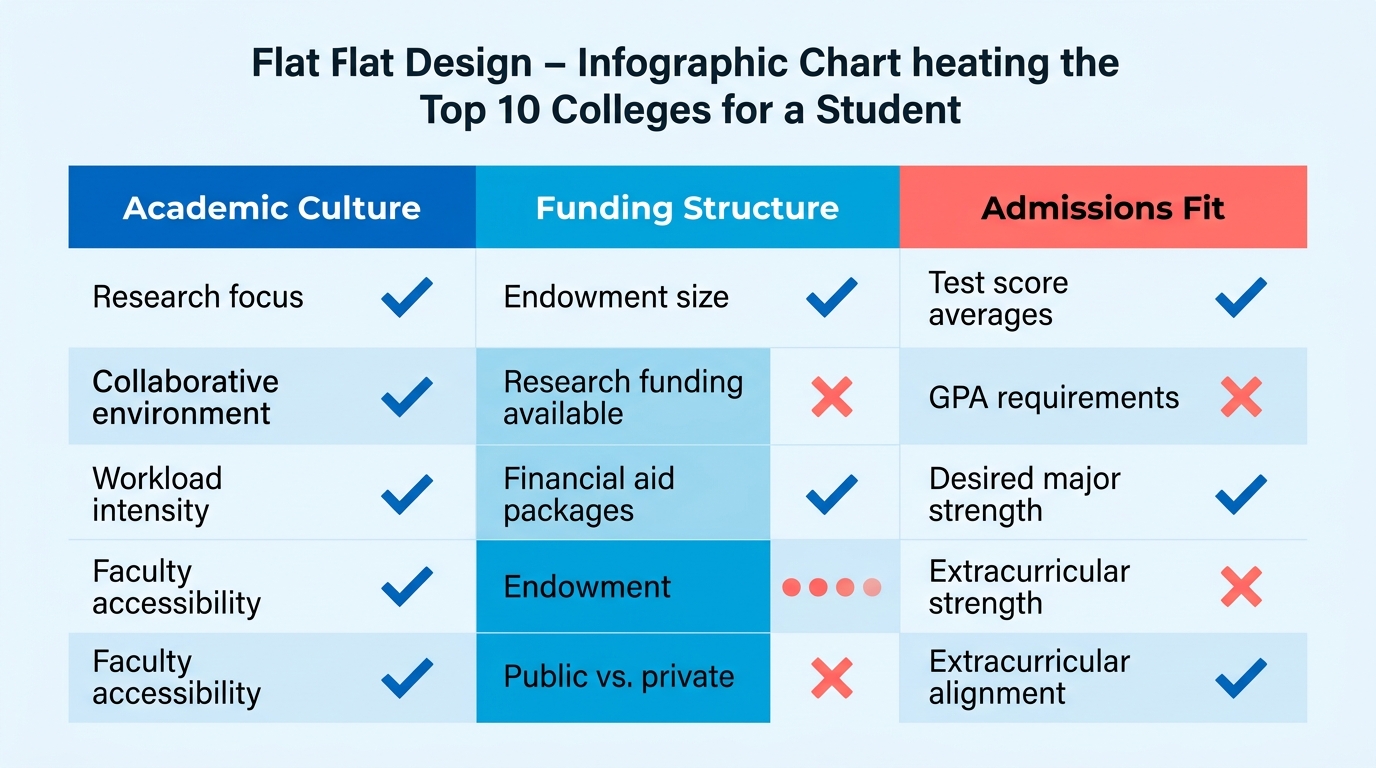
The right top 10 college is not the highest-ranked one. It is the school where a specific student fits the academic culture, the funding structure, and the role admissions is trying to fill. Good research starts by matching those variables to the student, not by copying a prestige list off a magazine cover.
That reframe changes how we build a list. Instead of pushing every student toward the same eight names, we make each school earn its spot for a reason. Experienced mentors keep saying the same thing: look for schools that fit your interests and career direction, not just the ranking. That's the discipline we apply from day one.
The four factors that actually matter
Fit breaks down into four things: academic program strength, financial structure, campus culture, and how well you match what a school actually needs. A student strong in a niche field should weight program depth over brand every time.
Money matters more than families expect. Some top-tier schools fund aggressively. Wellesley College puts up substantial aid packages to attract strong students, and every undergraduate at the University of Olivet receives some form of aid. Run each school's net-price calculator before it makes the list, not after.
One factor to hold loosely: the major. Waiting to commit while you explore is fine, and it keeps you from crossing off schools for the wrong reason.
The research tools that pull their weight
Use application platforms as research tools, not just submission portals. The Common Application connects to over 1,100 colleges and the Coalition Application to more than 150, so their directories are a quick way to filter by size, aid, and requirements.
Then talk to people. Professors, career counselors, and current students will tell you more about a program than any brochure. Campus visits do the same. We also point families to our college admissions planning blog for deeper school breakdowns.
How our panel keeps the list honest
Every list we build runs through a panel of our advisors, not a single voice, so each school on it gets pressure-tested for genuine fit instead of padded for show. That's a clean accountability check on any advising strategy.
Hold us to a high standard on personalization. Admissions readers can spot a recycled essay in seconds, which is why a genuine, distinctive voice is what separates an applicant once test scores and grades have cleared the bar. A student stretched across a dozen applications rarely gives any single one the specificity that reads as real. A padded list is a red flag, not ambition.
So we cap the list and balance it across reach, target, and likely schools. Most applicants submit several applications to keep their options open, and we keep students disciplined inside a carefully chosen range. With multiple advisors reviewing every list, we have no reason to inflate the count. That alignment is the whole point.
Getting the transcript to top 10 standards
Aligning a transcript with top 10 standards is simpler than most families think. The smart move is to treat it as a benchmark to clear, not a number to perfect. Once a student carries a demanding course load and holds a strong upward trend, the payoff from chasing a flawless GPA shrinks fast. The real work shifts to differentiation.
That threshold logic is why we focus on tailored academic planning. When the advice points to grades in tough courses mattering most, we do not just repeat it. We build a plan around your specific strengths and goals.
Which courses a top 10 applicant should take
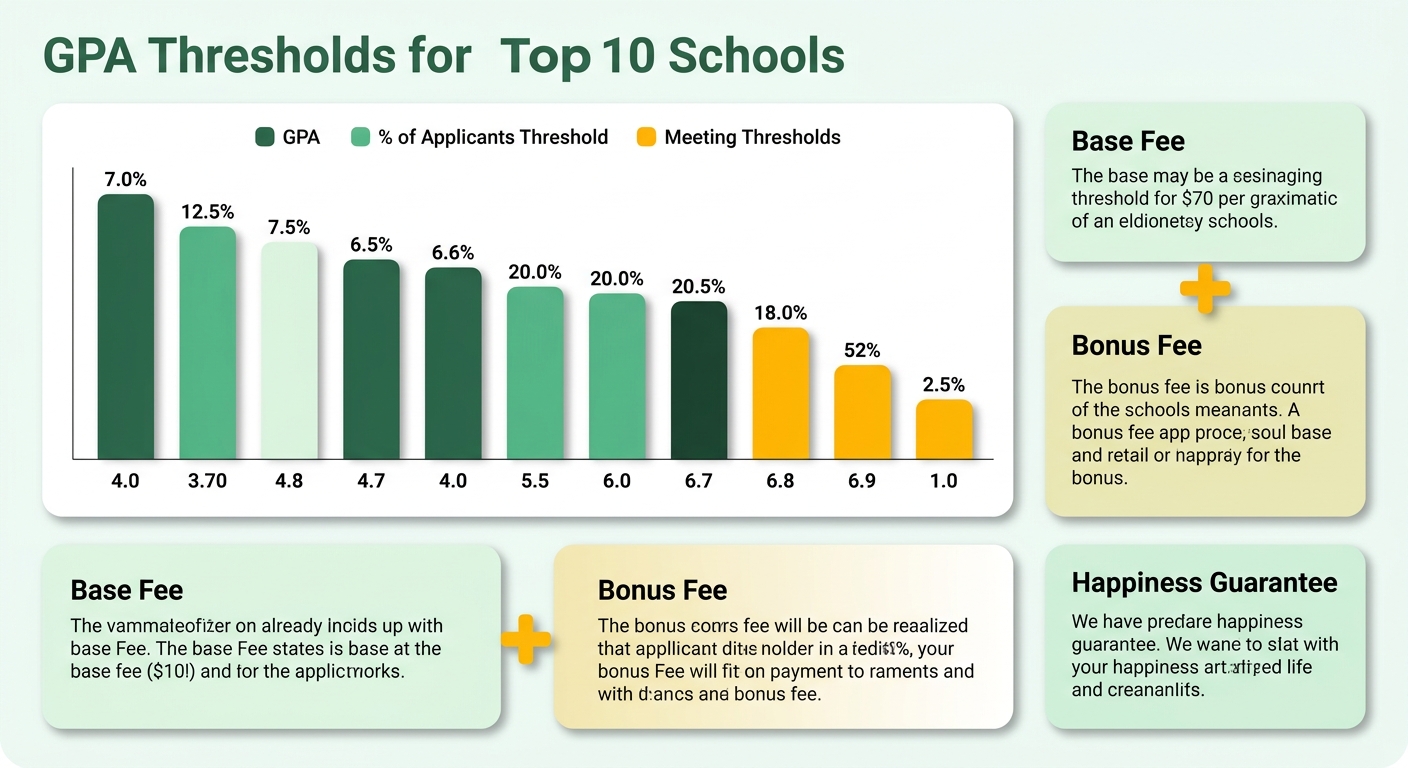
Take the hardest courses you can handle without your grades collapsing. Top schools want to see AP, IB, honors, or dual-enrollment work, plus a trend that climbs over four years. Depth in your intended field beats a scattershot pile of APs you cannot tie to a story.
Here's the nuance families miss. CollegeAdvisor's guidance notes the average college GPA nationwide sits around 3.1, with plenty of successful applicants earning mostly Bs. A NACAC-based analysis, meanwhile, confirms academic challenge is a primary filter. A B in a genuinely hard course reads better than an A in a soft one. We map course selection to that reality instead of protecting a fragile 4.0.
Dual enrollment is one lever we lean on. Experienced academic advisors flag it as a way to earn college credit and signal readiness before senior year.
How to handle standardized tests right now
Flexible testing policies do not mean scores get ignored. If your score lands in or above a school's range, submitting usually helps, and we decide school by school rather than applying one blanket rule.
The sources conflict here, genuinely. CollegeAdvisor points out that many colleges went test-optional after the pandemic, which reads as scores mattering less. But research from Ivy League institutions suggests standardized results can surface exceptional potential in students from under-resourced environments. Our position: for a strong scorer, especially one from an under-resourced school, a good score is an asset, not a liability. Stop the endless retakes once you've cleared a school's band. Past that point, more prep hours rarely move the decision.
Where our team fits in
We build a plan around each student, then stay involved through regular check-ins and feedback sessions that keep course rigor, GPA trend, and test targets on track. At least two members of our team review every student's work for a second read.
That panel-based approach is what separates a disciplined advising relationship from one that bills by the hour no matter the result. We're invested in a plan that fits your story, not one padded with prestige courses. The transcript stops being a source of anxiety and turns into a set of targets you can actually check off.
Letters of recommendation and the fees nobody budgets for
Strong letters and smart fee management are the two application tasks families most often underestimate. Both reward early planning. Both are places where the wrong approach quietly costs you money. The best move is to treat recommendations and fees as one logistics problem you solve months before deadlines, not a scramble in December.
Our approach keeps the list focused and efficient. We push you toward a capped, targeted set of schools, not the maximum count. That matters because every extra school stacks another fee on top of another round of recommendation logistics, and those costs compound faster than families expect once supplements and score-report charges get added in.
How to request letters of recommendation
Ask early, ask specifically, and ask the people who can speak to who you are beyond a grade. Strong letters are a recognized lever in admissions, and the best ones come from teachers or mentors who watched you struggle, improve, or lead.
Timing is the part students botch. Give recommenders at least a month, ideally before summer ends, since applicants and families surveyed in the College Hopes & Worries Survey consistently advise starting early. Hand each recommender a short brief: the programs you're targeting, one or two projects you did in their class, and your deadlines.
A recommender who can name a concrete moment beats a famous title who barely knows you. Two well-chosen letters that reinforce different sides of you usually outperform three generic ones, so pick people who cover distinct angles rather than repeating the same praise.
Application fees and waivers
Need-based fee waivers are the single most overlooked savings tool, and they're widely available. Qualifying students can access waivers that eliminate fees entirely, so check eligibility before you pay for a single application. Many schools also honor NACAC and SAT/ACT waiver forms, which means one approved request can carry across several campuses.
Watch the deadlines behind the deadlines. The full process includes fee submission, score sends, and transcript requests, each with its own timing and cost. Batching these steps keeps tracking in one place and avoids rush charges when you send materials late.
Skip the vanity applications. If a school is on your list only for its name, you're paying a fee and writing supplements for an application unlikely to convert. A disciplined list is a cost-control decision as much as an admissions one.
Handling letters and fees as one plan
We build a plan for each student, so recommendations, fees, and deadlines get sequenced together instead of handled piecemeal. Regular check-ins keep you on track through the season, and the panel approach means more than one set of eyes on your list and your timing. You get a clear view of what's ahead before the season opens, not surprises in December.
That framework keeps the process honest. Trimming an unnecessary application or securing a waiver lines up with our goal of efficiency, not against it. For families comparing advising approaches, that accountability is the metric worth watching.
Running the timeline, interviews, and campus visits
The timeline is the one variable in college admissions that rewards planning over talent. Get the calendar right and every other piece of your strategy has room to breathe. Get it wrong and even a strong student ends up submitting rushed essays and skipping interviews that could have tipped a decision.
We front-load the work so nothing collapses in December, and our regular check-ins and feedback sessions keep you on track from the start.
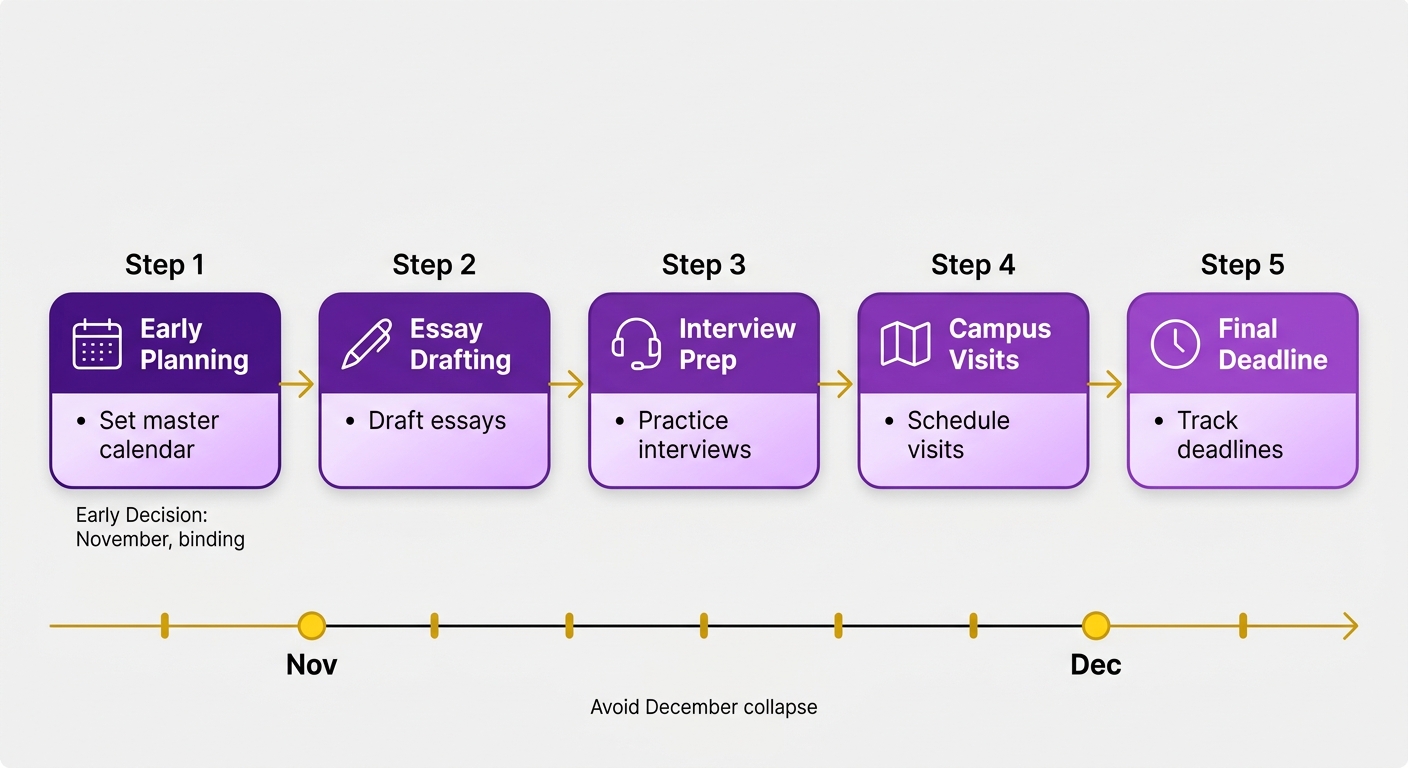
How to manage the timeline
Build a master calendar around deadline types first, then work backward. Early Decision deadlines usually land in November and are binding. Early Action is non-binding and also falls in November or December, as US News lays out. Most students apply Regular Decision by January 1 and hear back in March or April.
Two dates anchor everything else. FAFSA opens October 1, so financial aid runs parallel to applications, not after them. And the major platforms let you submit to hundreds of institutions from a single portal, which means your logistics scale better than your essay load does.
That last point matters. A running to-do list cuts anxiety, and starting early is what separates the calm applicants from the frantic ones. In our experience, a student who drafts by summer writes a genuinely better Common App essay inside the ~650-word limit than one racing a January deadline.
What makes a college essay actually work
The essay carries real weight. Over half of colleges surveyed by NACAC rate it at least moderately important. Our view: the honest essay beats the impressive one. A genuine piece that shows personality and growth will always stand out, as experienced admissions counselors keep emphasizing.
We build the narrative early because supplements multiply fast across a list. A capped, targeted list keeps essay quality high. Padding the list is exactly where a personal voice gets diluted, and it's the kind of volume we steer families away from.
Preparing for interviews and visits
Treat interviews and visits as the same task: showing you fit a specific role on campus. When academic profiles look nearly identical to a committee, extracurricular contribution becomes the differentiator. Walk into an interview ready to talk about one or two commitments in depth, not to recite a résumé.
Visit early. Seeing a 13-to-1 student-to-faculty ratio in a real classroom tells you more than any brochure. Ask professors and current students specific questions, and clean up your online presence before anyone Googles you. An appropriate email address and private social accounts are basics that quietly shape first impressions.
For families mapping a full plan, we offer optional seminars like "How to Impress in an Interview" that walk through this prep in more detail.
The quiet mistakes and how to track your way out of them
The most expensive application mistakes are the quiet ones: a prestige-stacked school list, a test-score decision made on autopilot, and a tracking system that lives only in a student's head. Good strategy closes all three gaps before deadlines hit. The fixes are cheap in effort and huge in payoff.
We focus on the moves that actually shift decisions: fewer schools, sharper essays, and a status tracker you can both see.
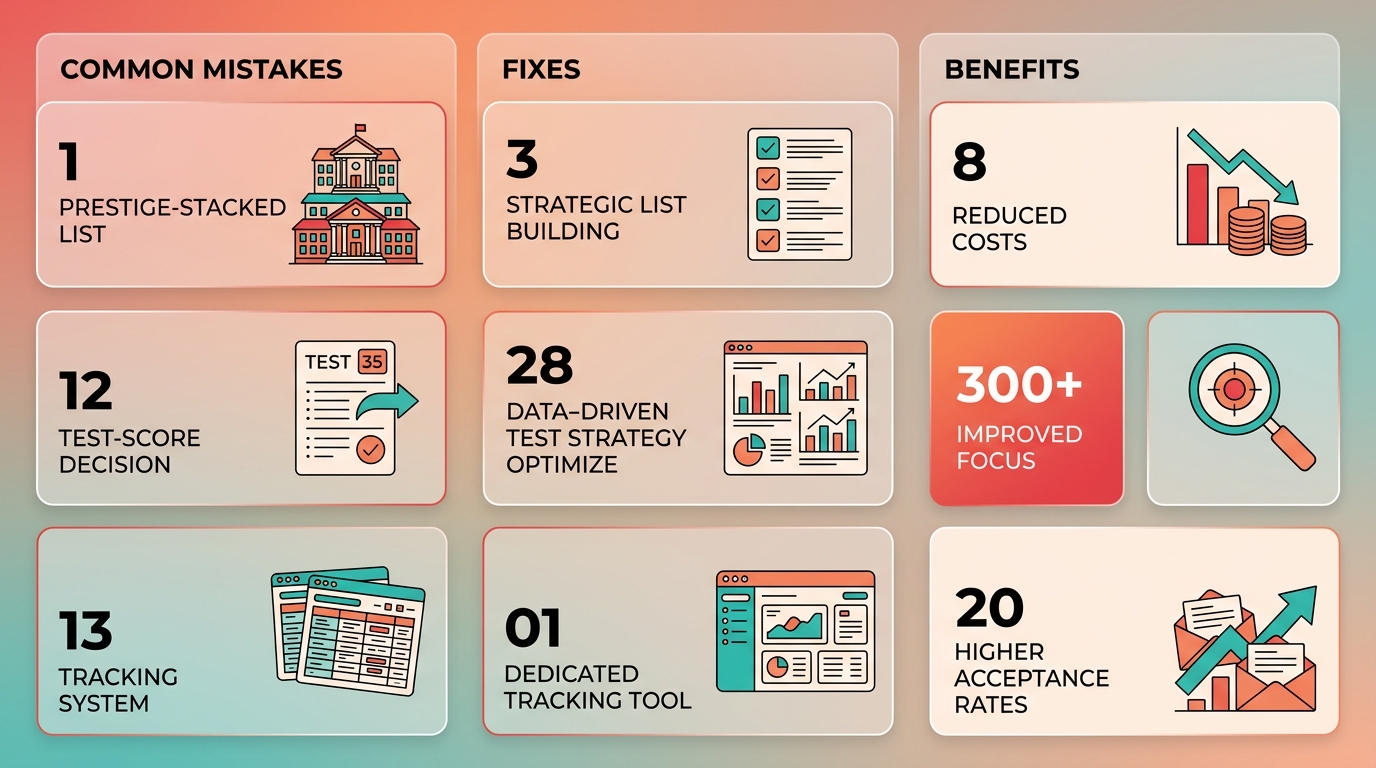
The most common application mistakes
The biggest error is chasing prestige over fit. Picking colleges on ranking alone does not guarantee acceptance, as industry experts keep pointing out.
The hidden cost is attention. When a list is too long, every essay competes for the same limited hours, and the writing turns generic. Readers spot copy-pasted prompt answers immediately, and a thin supplement can sink a file that looked strong on paper.
A capped, targeted list is both a quality and a time decision. Fewer schools means each essay gets the revision cycles that separate an admit from a maybe. Depth beats volume every time a reader compares two similar applicants.
The second common mistake is assuming flexible testing policies mean scores carry no weight. Research on admissions data shows standardized metrics can reveal high potential in students from diverse backgrounds. If your scores are strong, submitting can help. Decide per school, not by blanket rule.
How to track application status
Build one master tracker that lists every school, its deadline type, and each required component. Deadlines fall into early decision, early action, and regular rounds, and each carries its own submission date and notification window. A single dashboard keeps those overlapping calendars from colliding.
Track four things per school: submission confirmation, recommendation receipt, test-score delivery, and financial aid status. Financial aid forms run on their own strict timelines, separate from your applications. A missing recommendation or an unverified score can stall an otherwise complete file.
The advice we trust most here is the simplest. Starting well ahead of time is the single most common tip from successful applicants. Early tracking turns a December scramble into a series of small, calm checkmarks.
How to stay informed without spiraling
Set a weekly check-in, not a daily one. Log into each portal once a week to confirm materials arrived and to read any new instructions. Portals are where schools flag missing items, so this beats refreshing your email.
Skip the obsessive monitoring for schools where you've already submitted everything. There's nothing to do but wait. Our regular feedback sessions exist for exactly this reason: they give you a scheduled place to ask questions, so the anxiety has an outlet and the process stays honest.
References
[1] How do I actually get into top tier schools? - https://www.careervillage.org/questions/694446/how-do-i-actually-get-into-top-tier-schools
[2] 10 Ways to Improve Your Admissions Chances - https://www.citizensbank.com/student/articles/ways-improve-admissions-chances.aspx
[3] 11 Helpful Tips for Applying to College - https://www.uolivet.edu/11-helpful-tips-for-applying-to-college/
[4] College Admissions Guide: Process and Prep - https://www.princetonreview.com/college-advice/college-admissions-guide
[5] Applying to College? Here's the Secret to Getting In - https://www.saraharberson.com/blog/applying-to-college-secret-to-getting-in
[7] How to Get Into Top Colleges and Universities - 100 Free Guides - https://www.collegeadvisor.com/how-to-get-into/
[8] How to Get Into College: 9 Admissions Tips - https://www.bestcolleges.com/blog/tips-to-increase-college-admission-chances/
Frequently Asked Questions
1. What should I do if my grades aren't stable yet?
Stabilize academics before investing in differentiation. Challenging coursework and a strong upward grade trend are the baseline requirements every applicant must meet first. Chasing a distinctive hook or paying for admission-tier support makes little sense until you hold steady grades in demanding classes. Establish your academic foundation first, then focus on your unique differentiator.
2. Should I apply to all eight Ivy League schools?
Applying to every Ivy usually backfires because it generates dozens of unique supplemental essays, and that volume is where a unique, personal voice gets diluted. Admissions readers easily identify generic, copy-pasted responses. A capped list balanced across reach, target, and likely schools gives each essay the revision cycles that separate an admit from a maybe.
3. Is a lower grade in a hard class better than a top grade in an easy one?
A B in a genuinely hard course typically reads better than an A in a soft one. Academic challenge functions as a baseline requirement, and depth in your intended field beats a scattered pile of easy AP classes you cannot connect to a coherent academic story.
4. Does going test-optional mean I should skip submitting scores?
Flexible testing policies do not mean scores are ignored. If your score lands in or above a school's range, submitting usually helps, especially for strong scorers from under-resourced backgrounds. Research shows that standardized metrics can highlight exceptional potential in students from under-resourced environments. Decide school by school rather than applying one blanket rule.
5. How does the base-plus-bonus fee model work?
Our pricing structure includes a base fee for standard application support, with an additional performance-based component tied directly to successful admission outcomes. This model keeps our incentives aligned with your family's goals, focusing our efforts on strategic school selection rather than billable hours. Our service commitment keeps us aligned with your family's goals throughout the process.
6. When should I ask teachers for recommendation letters?
Ask at least a month ahead, ideally before summer ends. Choose recommenders who can name a concrete moment you struggled, improved, or led rather than a famous title who barely knows you. Hand each one a short brief listing target programs, one or two class projects, and your deadlines.
7. How do I decide which colleges belong on my list?
Fit beats ranking. Weigh four factors: academic program strength, financial structure, campus culture, and role fit with what a school needs. Run each school's net-price calculator before adding it, since some top-tier schools fund aggressively. Certain elite liberal arts colleges, for example, offer generous financial aid packages to attract top-tier scholars.