How AI Is Echoing Ivy League Admissions Biases
August 5, 2026

Key Takeaways
- AI models incorrectly predicted academic failure for Black students 19% of the time, compared with 12% for White and 6% for Asian applicants.
- Advising tools flagged Black students as "high risk" for not graduating at four times the rate of their White peers.
- Admissions algorithms trained on historical data reproduce past inequities and mispredict outcomes for minority applicants more often.
- A study of more than 15,000 students found measurable racial disparities in how AI screens, ranks, and predicts applicant success.
- Background signals can cause algorithms to mislabel strong applicants, filtering out compelling files before human readers see them.
- As Wendy Hall put it, biased training data produces biased algorithmic outputs in university decisions.
- Language and caste patterns in application text create subtler forms of bias that are harder to detect.
Why AI Bias in Admissions Matters
Families vetting a consultancy often scan alumni outcomes first. Which schools, which students, and which stories. Fair enough. But many overlook what can affect those outcomes before an application reaches a reader: the software handling the first pass.
AI now screens, ranks, and predicts applicant success at scale. It also tends to echo demographic patterns from past admissions decisions. That is the central problem.
Strong alumni stories come from students whose narratives received fair consideration. If an algorithm mislabels an applicant based on background signals, a compelling file may be filtered out early. Our team spent decades inside admissions offices at Harvard, Yale, and Princeton. We understand how those files are evaluated and help students present their strengths clearly.
What AI bias actually does to a file
Automated screening tools rely on predictive metrics. Those metrics do not affect every student group equally. Research on these patterns found that AI models incorrectly predict academic failure for Black students at higher rates than for their peers. This creates a barrier before anyone reads an essay.
The skew can continue after admission. Predictive advising software often assigns higher risk profiles to minority students after enrollment. This shows how front-end data imbalances can follow students through their academic careers. Wendy Hall summarized the issue as "bad inputs can mean biased outputs."
Language creates another, quieter layer of bias. A study on language and caste showed that large language models judge text through cultural and institutional markers, not capability alone. When an essay contains demographic indicators, software may undervalue the writing. That makes the framing of a story as important as the story itself.
Who gets the most out of narrative work
Underrepresented, first-generation, and minority applicants may gain the most from bias mitigation. They carry signals that these models can penalize. A six-year case study found that test-optional policies lifted minority enrollment 10 to 12%, yet scoring models still showed bias against women and first-generation students. Winning at the admissions stage does not correct the system behind it.
No single fix solves the problem. Research confirms that removing race from ranking algorithms reduces diversity without improving merit. This supports collaborative review, which helps students present their stories accurately and fully.
| Approach | Catches algorithmic bias | Catches narrative signals | Effort | Difficulty |
|---|---|---|---|---|
| Multi-advisor panel review | Partial | Yes | 4-6 weeks | Moderate |
| Algorithmic data check only | Yes | No | 1-2 weeks | Low |
| Generic essay review | No | Partial | 1-2 weeks | Low |
| Removing demographic data | No | No | Instant | Low, backfires |
Skip intensive review for early-stage sophomores. Their profiles will change before admissions decisions matter. For juniors and seniors applying through algorithm-heavy Ivy pipelines, strategic planning and human review can support a fairer process. Details appear on our admissions planning blog.
Historical Data Bias and Its Impact
When admissions offices trained ranking algorithms on acceptance data, they included the biases in those decisions. Historical patterns at Ivy League schools favored students from well-resourced high schools, legacy families, and certain zip codes. The model treats these patterns as merit signals, although they reflect structural advantages.
Research on algorithmic admissions systems shows that these models can undervalue candidates whose profiles differ from past admits. This can happen even when those candidates show comparable academic achievement. The algorithm measures historical patterns rather than potential.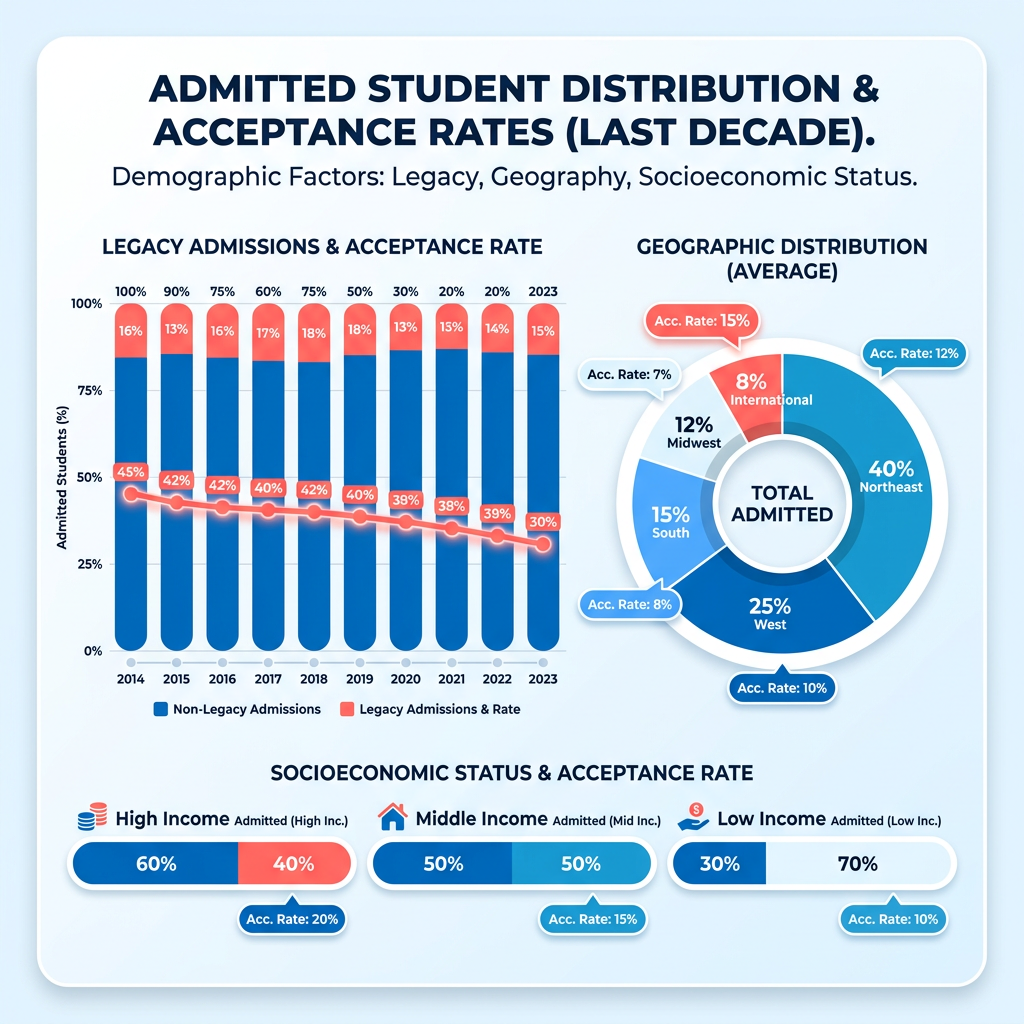
How training data rewards legacy advantage
The problem begins with how training sets define "success." Models trained on admissions data reward markers linked to socioeconomic privilege. These include specialized coursework, expensive extracurriculars, and polished résumés. When the model evaluates a new applicant, it may read these advantages as merit.
The University of Texas at Austin discontinued its machine learning program for Ph.D. admissions after finding bias against diverse applicants. The model had learned from decisions that underrepresented certain candidates. It then treated that underrepresentation as a predictor of academic success. Even well-intentioned programs can automate past patterns.
Take out race data and it gets more arbitrary, not less
Recent policy changes banning race-conscious admissions have made outcomes harder to predict. Research using four years of data from a selective university found that removing race from the ranking algorithm dropped the share of underrepresented minority applicants in the top-ranked pool by 62%. Academic merit in that pool did not meaningfully rise. Diversity declined without the promised improvement.
The modeling itself adds randomness. Only 9% of applicants land in the top 20% consistently across models trained on the same data. For students whose backgrounds differ from the historical mold, that inconsistency may be worse. This includes first-generation students, students from under-resourced schools, and underrepresented minorities.
What we do when the algorithm keeps looking backward
No two students are alike, so their strategies should differ. Analysis published by AERA tested several bias-mitigation techniques. It found that none fully eliminates prediction disparities. We therefore work as a panel, refining each student's story across applications, essays, and interviews.
We start with the student's goals and background. Then we build a plan around them. Students may be artists, athletes, scientists, or entrepreneurs. The work identifies evidence of achievement, including research, community impact, and academic growth. Models trained on older patterns may discount these accomplishments.
AI outputs can also shift based on demographic descriptors in essays. Helping students present their experiences clearly may reduce automated classification errors. Their files can then be read on their merits rather than through demographic proxies.
Another blind spot involves nontraditional achievement. Stanford researchers found that algorithmic systems struggle with markers such as family responsibilities or leadership outside formal titles. Human review can present those strengths clearly to a committee.
The Role of Diverse Stakeholders in AI Development
Diverse development teams can identify bias that homogeneous teams miss. When everyone building admissions AI shares similar backgrounds, they may encode similar blind spots. This gap affects students whose narratives do not fit the training data's default.
Fairness starts with who participates in design. USC Rossier's Royel Johnson stated this in a piece on AI's potentials and pitfalls: "AI is only as just as the equitable decisions that inform its design." Engineers, admissions veterans, ethicists, and students from underrepresented groups all belong in that room.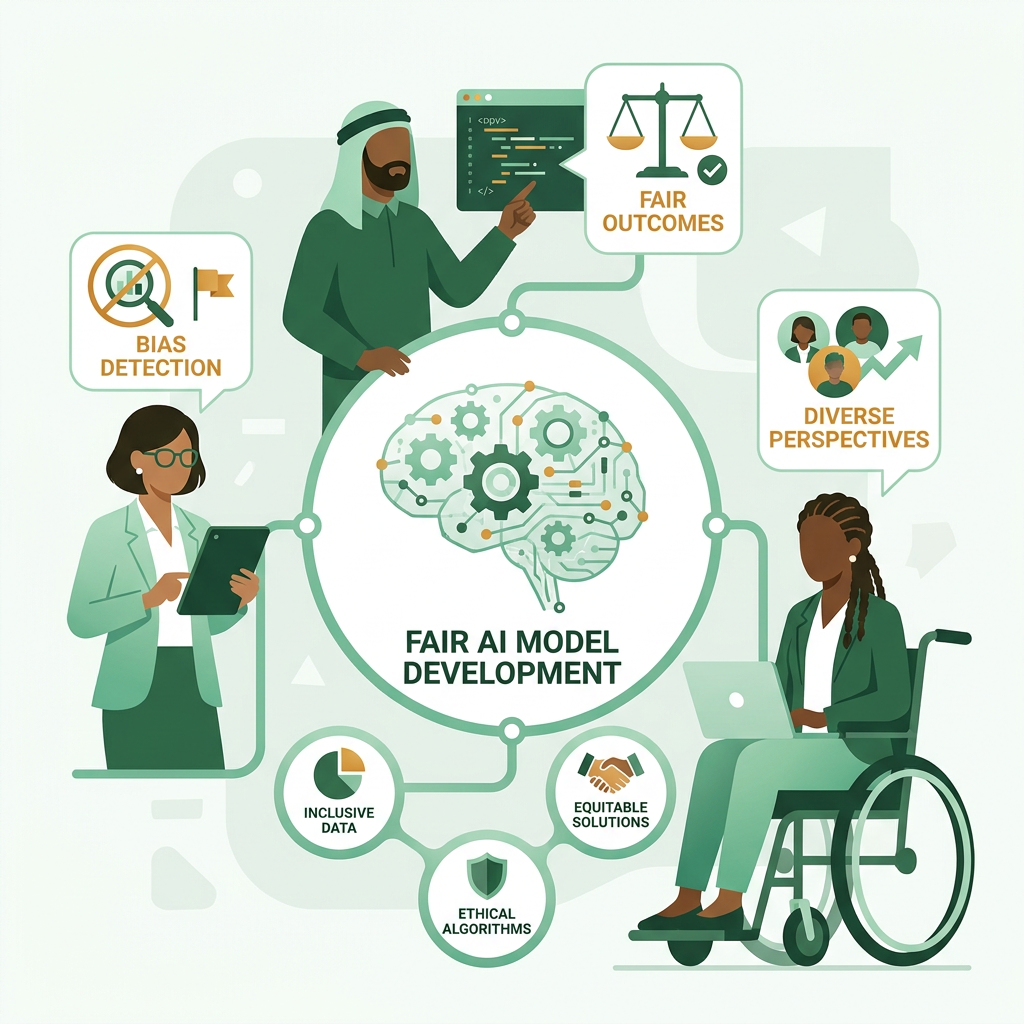
Why diverse teams reduce bias
Diverse teams can identify failure modes before they reach applicants. First-generation students and educators from different regions may question assumptions that a uniform team overlooks. The arXiv paper on fairness and ethics in educational AI makes the point directly: equitable outcomes need diverse datasets and fairness-aware design.
Early automated hiring and admissions tools show what can happen without that mix. Amazon scrapped its recruitment engine after it proved biased against female applicants. The case shows how algorithms can encode historical imbalance without proper oversight.
Who should be in the room
| Stakeholder | What they catch | What happens without them |
|---|---|---|
| Admissions veterans | Context behind background signals | Models treat structural advantage as merit |
| Underrepresented students | Cultural nuances in application text | Algorithmic penalties on specific phrasing |
| Ethicists and researchers | Systemic error patterns | Unchecked structural bias |
| Data scientists | Dataset gaps and drift | Skewed model outputs |
| Experienced advisors | Holistic narrative development | Standardized, one-dimensional feedback |
Our advisory process uses multiple reviewers for each application. This helps students shape narratives for different human readers and automated screening systems.
What keeps diverse voices out, and how we work around it
The main barriers are access and speed. Schools adopting tools like Sia may prioritize efficiency. Equity-focused institutions like Kenyon and UC Berkeley continue to emphasize human review. When timelines reward automation, diverse voices may receive less attention.
Addressing that split requires careful file development. We help students present applications that read clearly to automated systems and human committees. More information appears on our admissions planning blog.
Balancing AI Automation with Human Judgment
Automated systems have limits, which makes human oversight necessary. A recent study of predictive models showed that mathematical adjustments alone cannot fully resolve algorithmic bias. When a model ignores a sensitive attribute, it may rebuild that attribute through proxies such as geography and school profile. A human reader can treat those factors as context instead of penalties.
Many institutions use technology to manage volume. Universities use Sia and other machine learning systems to automate transcript evaluation and reproduce their decision-making at scale. This reduces the admissions office's workload.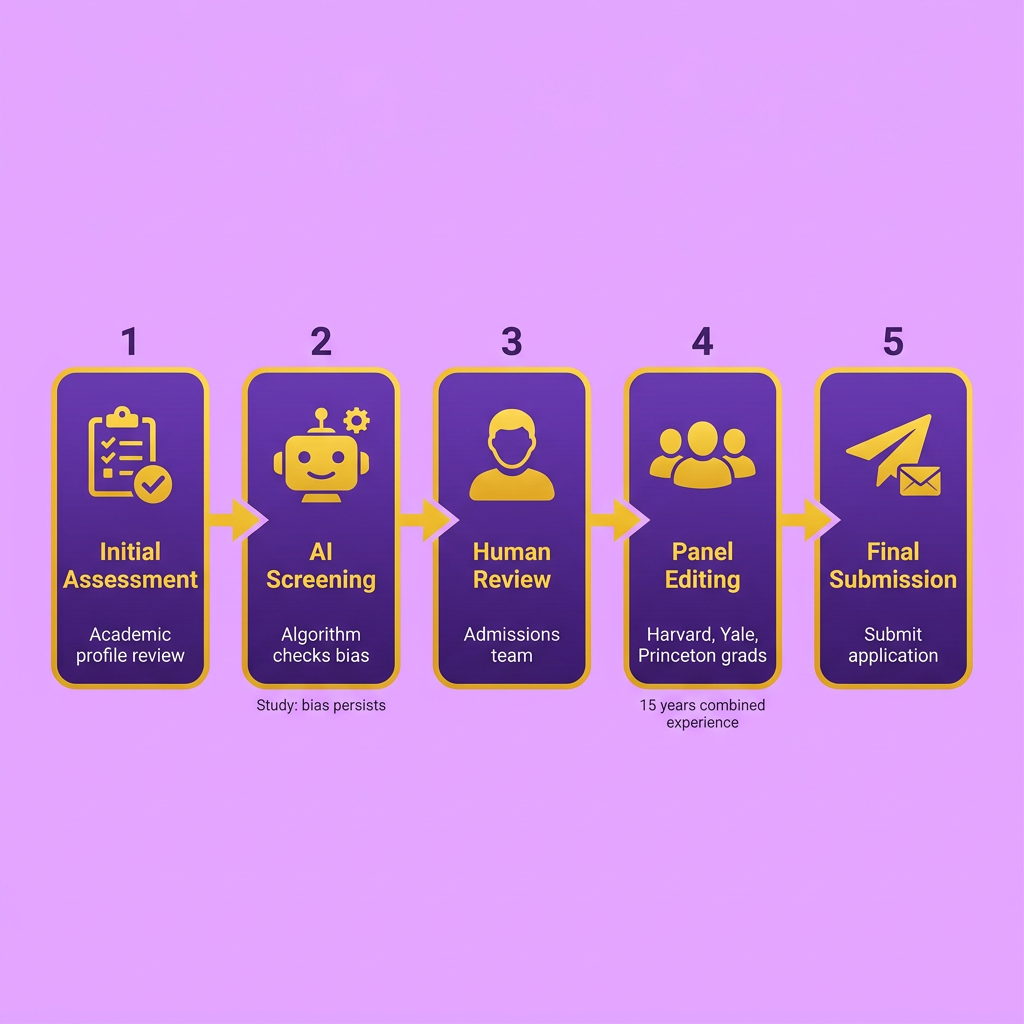
The problem starts when institutions rely on those tools alone. Predictive models can reproduce disparities in their training data. They may convert past bias into current automated decisions. When UT Austin shut down its Ph.D. admissions algorithm over disparate outcomes, the risk became visible.
Kenyon and Berkeley hold the line
Some selective schools maintain a human-centered process. Admissions offices at Kenyon College and UC Berkeley prioritize holistic evaluation. This can help prevent applicants from nontraditional backgrounds being filtered out by automated screening. Human readers can weigh achievements against educational context and identify potential algorithms miss.
Our mentoring follows that philosophy. We review applications from several perspectives and help students present their histories clearly. Royel Johnson's warning remains relevant: system design affects fairness. A clear, context-rich narrative therefore matters to applicants.
Narrative coaching built around real achievement
Policy changes alone do not produce equitable outcomes. One study found that algorithmic models may retain their biases after institutional guidelines change. The software continues relying on historical patterns when judging new candidates.
We help students structure essays around intellectual curiosity and leadership. Research on caste, income, and HBCU affiliation shows that textual cues can affect automated evaluations. Precise framing can therefore affect how an achievement is assessed.
| Review Element | AI-Only Approach | Human-Centered Approach |
|---|---|---|
| Initial screening | Automated ranking by GPA, test scores, and course rigor | Holistic assessment of academic profile and student context |
| Bias detection | None; relies on historical training data | Experienced advisors identify potential narrative weaknesses |
| Narrative review | Keyword matching and sentiment analysis | Multi-perspective feedback to refine applicant voice |
| Diversity impact | URM representation falls sharply when race data is removed | Mentorship helps all students present compelling applications |
| Accountability | Opaque model predictions | Direct advisor-student partnership with regular check-ins |
Effective strategies treat technology as a tool, not the final judge. Clear, honest applications remain important to human committees. Our blog provides guidance on building a strong application narrative.
Comparison of AI Bias Mitigation Strategies
Comparing mitigation options reveals one point quickly: technical fixes work best with qualitative review. An application must pass an automated filter and a human review. The strategy must therefore address both data and narrative.
Research supports this conclusion. A comparative review of fairness interventions found that changing data inputs does not guarantee equitable ranking. Models can still introduce disparities during processing.
Which mitigation strategy actually holds up
Bias mitigation means any technique that reduces disparate treatment across demographic groups. It may operate at the data, model, or human-review stage. Each method has strengths and limitations.
| Strategy | Where it acts | Strength | Weakness |
|---|---|---|---|
| Pre-processing (data debiasing) | Training data | Removes skewed inputs before modeling | Cannot catch bias the model learns downstream |
| In-processing (fairness-aware algorithms) | Model training | Optimizes for fairness metrics directly | Requires technical access most families do not have |
| Removing sensitive features | Model inputs | Simple, legally cautious | Cuts diversity without raising merit |
| Algorithmic auditing | Deployed model | Catches disparities across groups | Reactive; requires ongoing monitoring |
| Human holistic review | Final decision | Reads context an algorithm misses | Slow and difficult to scale |
| Narrative review | Essay development | Refines applicant voice for human readers | Labor-intensive |
What each method gets right, and where it falls short
Data preparation is necessary but rarely sufficient. Researchers identify optimized preprocessing as a useful fairness tool. However, cleaning the dataset does not stop models from forming biased associations during training. Wendy Hall's analysis examines these data dynamics further.
Post-deployment auditing can identify statistical disparities. However, it works after deployment rather than before it. As Every Learner Everywhere documented, discovering bias after launch may lead to shutting down the tool instead of fixing it.
Where our approach fits
Our work focuses on how an applicant's profile is presented. By examining how background details appear in an essay, we help students present their achievements clearly. This may lower the risk of automated misclassification.
Applicants targeting schools that rely heavily on automated screening may benefit from reviewing both quantitative and qualitative elements. More strategies appear on our college admissions blog.
What I'd Actually Recommend
The research presents an uncomfortable conclusion: AI bias in admissions can be directional and random. No single fix removes it. A file may be mislabeled by a biased pattern, then ranked inconsistently by the same model.
That inconsistency creates a problem for applicants. Small changes in model parameters can produce large ranking shifts, as the admissions-algorithm study documents. A file must withstand systematic bias and algorithmic instability.
Why a layered review beats any single fix
Technical fixes have clear limits. Studies of standard mitigation methods found that removing demographic variables does not stop models from rebuilding those signals through proxy data. This supports a second layer of human evaluation.
Human readers can provide the context automated systems flatten. Presenting quantitative data and qualitative narrative clearly offers protection against algorithmic error. Wendy Hall's analysis makes a similar point.
How the layers compare
| Review layer | Catches | Misses on its own |
|---|---|---|
| Algorithmic data check | Identifies systematic ranking risks and proxy variables | Lacks qualitative context and voice evaluation |
| Human narrative review | Evaluates personal context and authentic achievements | Cannot detect statistical model anomalies at scale |
| Combined approach | Addresses both quantitative and qualitative risks | Requires pre-submission planning |
Neither layer is sufficient alone. Used together before submission, they address each other's gaps.
What students and researchers should do next
Applicants should review their files carefully. Their achievements should be framed clearly. Researchers should continue pressing for transparency. The JBHE study authors argue that policymakers must examine the algorithms used in high-stakes educational decisions.
For students navigating selective admissions, data-driven preparation and a clear narrative can work together. More information on early preparation and strategic planning appears on our college admissions and life planning blog.
References
[1] AI and Bias in University Admissions | ISM Insights - https://www.ism.edu/ism-insights/ai-and-bias-in-university-admissions-3.html
[2] Balancing the potentials and pitfalls of AI in college admissions - https://rossier.usc.edu/news-insights/news/balancing-potentials-and-pitfalls-ai-college-admissions
[3] Study Uncovers Racial Bias in University Admissions and Decision ... - https://jbhe.com/2024/07/study-uncovers-racial-bias-in-university-admissions-and-decision-making-ai-algorithms/
[4] What Are the Risks of Algorithmic Bias in Higher Education? - https://www.everylearnereverywhere.org/blog/what-are-the-risks-of-algorithmic-bias-in-higher-education/
[5] Study: Algorithms Used by Universities to Predict Student ... - https://www.aera.net/Newsroom/Study-Algorithms-Used-by-Universities-to-Predict-Student-Success-May-Be-Racially-Biased
[6] How will AI Impact Racial Disparities in Education? - https://law.stanford.edu/2024/06/29/how-will-ai-impact-racial-disparities-in-education/
[7] Algorithms for College Admissions Decision Support - https://arxiv.org/html/2407.11199v1
[8] Language, Caste, and Context: Demographic Disparities in ... - https://arxiv.org/html/2601.14506v1
[9] Analysis of AI Models for Student Admissions: A Case Study - https://arxiv.org/pdf/2412.02528?
[10] Algorithmic bias in educational systems: Examining the ... - https://www.researchgate.net/publication/388563395_Algorithmic_bias_in_educational_systems_Examining_the_impact_of_AI-driven_decision_making_in_modern_education
[11] Navigating Fairness, Bias, and Ethics in Educational AI ... - https://arxiv.org/html/2407.18745v1
Frequently Asked Questions
1. Can removing race from admissions algorithms actually increase fairness?
Omitting demographic variables does not prevent models from finding related patterns. Algorithms can reconstruct profiles through proxy data, including geographic indicators and high school course offerings. This can reduce diversity without increasing academic merit.
2. Why do AI admissions tools flag Black students as high-risk more often than White students?
Predictive models rely on historical datasets that reflect structural inequities. When evaluating applicants, these systems may treat background and socioeconomic factors as risk markers. This can produce more negative predictions for minority students.
3. What makes panel-based essay review more effective than single-advisor feedback for college applications?
Multiple perspectives show how different readers may interpret an applicant's narrative. Subtle textual cues can influence automated systems and human reviewers. Collaborative review helps frame challenges as evidence of leadership and growth.
4. Do test-optional policies eliminate AI bias in college admissions?
Policy changes can alter the applicant pool's composition. However, they do not automatically update the historical data used to train predictive models. Automated systems may therefore continue applying historical biases under new guidelines.
5. How do income and school affiliation signals affect AI evaluation of college essays?
Natural language models often evaluate essays through cultural and institutional associations. Markers linked to specific backgrounds may be misinterpreted. This can produce lower evaluations that do not reflect a student's academic capability.
6. What happens when universities rely entirely on human review instead of AI screening?
Some selective universities avoid automated screening to preserve holistic evaluation. Admissions officers can then consider the context of an applicant's achievements. This includes local educational opportunities and personal responsibilities that automated systems may overlook.
7. Why don't bias-mitigation techniques work consistently across different admissions algorithms?
Algorithmic models can rank applicants differently based on their configuration. This can create inconsistent outcomes for borderline candidates. Technical adjustments also involve trade-offs between accuracy and equity, making consistent fairness difficult across applicant pools.