How Data-Driven Advisors Rebuilt Three Rejected MIT Applications Into Acceptances
August 16, 2026

Key Takeaways
- Strong GPAs and SAT scores alone do not guarantee MIT admission. Rejected applicants usually fail on positioning, not academics.
- Biochemistry applicants with standard lab credentials blend into oversubscribed pools. Interdisciplinary positioning makes them distinct.
- We use insights from Harvard, Yale, and Princeton graduates to identify oversubscribed and undersubscribed major pools, then reposition students strategically.
- Every essay gets reviewed by at least two team members. The goal is to show cross-disciplinary connections, not just depth in one field.
- We customize strategies for each student. No two applicants are alike, so no two plans are alike.
Rebuilding Rejected MIT Applications: A Case Study Approach
Strong metrics do not secure a spot at MIT. Applicants with near-perfect GPAs and SAT scores receive Early Action rejections every cycle. The reason is not academic. It is positioning.
What Broke in the Original Applications
The most common problem is not a weak transcript. It is an application that reads like dozens of others in the same category. A biochemistry applicant with standard lab research credentials blends into an oversubscribed pool, regardless of their numbers.
Our approach repositions students across interdisciplinary ground. We highlight projects and connections that make their stories distinct. Every essay is reviewed by at least two team members. Revised narratives show how a student's work bridges disciplines rather than deepening one crowded field.
The Common Thread: Distinct Positioning
We use the elite education and admissions experience of our Harvard, Yale, and Princeton graduates to identify where each student sits in oversubscribed and undersubscribed major pools. MIT's 5.98% Early Action acceptance rate means near-perfect statistics get applicants into the pool. Positioning gets them out of it.
Our customized planning targets three points: major selection, narrative arc, and contribution framing. We ask what the applicant can do that most others in their category cannot, then develop the application around that gap. For a science-focused student, that might mean foregrounding field conservation work over sterile lab protocols. For a computer science applicant, it might mean showing how computational methods could enable primary-source research inaccessible to traditional scholars.
This is not about inventing a false profile. We help students refine and develop stories rooted in their actual experiences. The work surfaces what was buried: what makes them non-substitutable in a specific academic cohort rather than impressive in a generic one.
Lessons from the Application Process
A college admissions consultant working with deferred applicants often focuses on Letters of Continued Interest filled with genuine specifics. That approach works when the original positioning was sound but the application lacked polish. Many cases require deeper intervention. Rejected applications are often not poorly written. They are correctly written for the wrong positioning.
One provider reports a 28% Regular Decision conversion rate for deferred MIT applicants. That figure has a mechanism: most deferrals signal that the student is academically qualified but not distinct within their chosen major. Conversion happens when the Regular Decision application repositions the student into a less saturated pool.
Every rebuild moves at its own pace. Some students need more time to foreground work that an original application relegated to a supplementary essay. Others move faster when their existing portfolio contains projects that need reframing. We schedule regular check-ins to keep goals clear and commitments prioritized.
Our results show the value of distinct positioning: over 65% of our students earn admission to Top 10 and Ivy League schools, and our average Top 20 admit rate runs well above the norm. Repositioning works only when a student is willing to embrace it rather than insist on being accepted exactly as originally presented. We respect either choice.
Character & Personal Qualities: The Hidden Data Point
Character is the variable that near-perfect metrics cannot explain. When two applicants share identical scores and one gets in, the deciding factor lies in qualities admissions readers infer from essays, recommendations, and activity choices. We treat this as measurable data, not soft fluff.
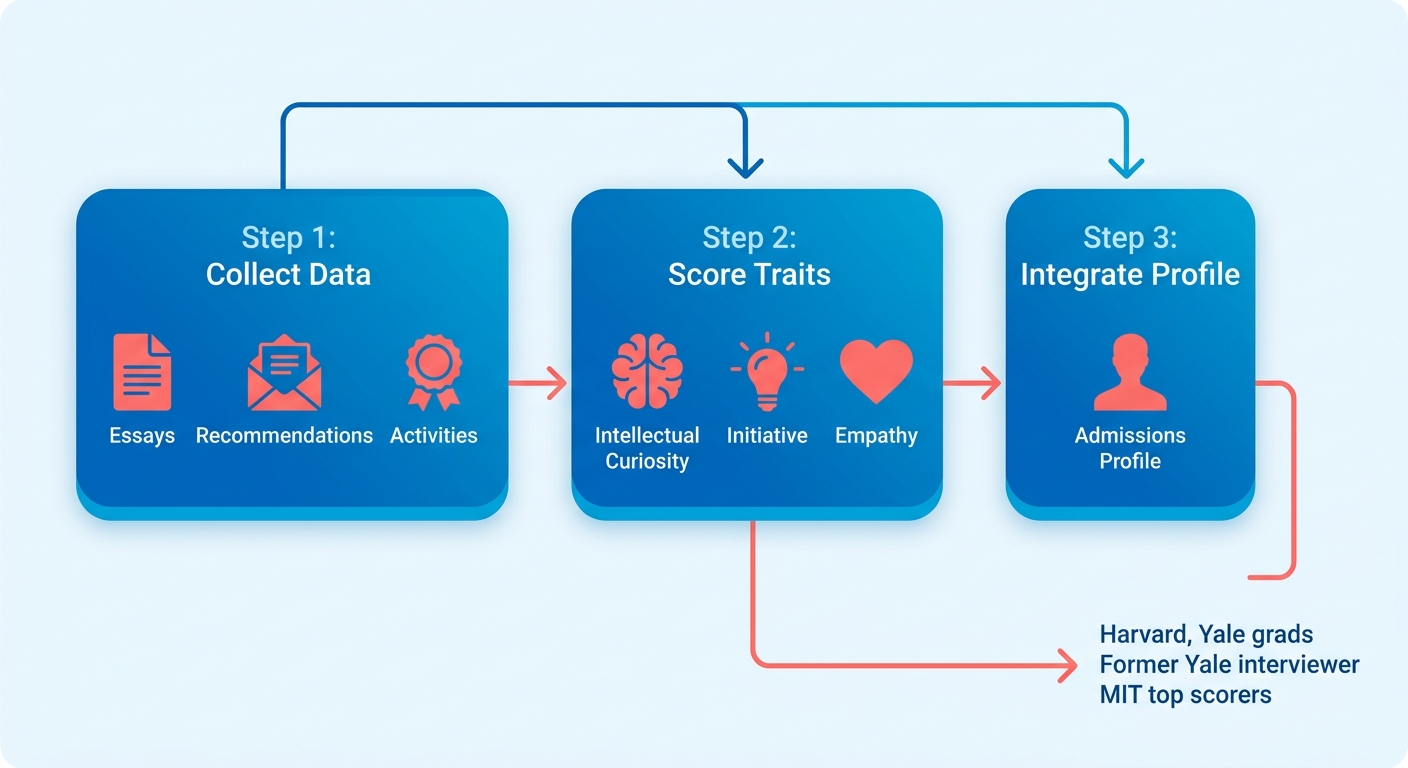
Admissions committees evaluate qualitative traits by looking for patterns of intellectual curiosity, initiative, and community impact. These signals carry real weight at MIT, where the pool is packed with top scorers. Most rejected applications fail to surface these traits clearly.
How to Present Character in a Rebuilt Application
Presenting character means showing personal qualities through specific actions and consequences, not adjectives. The strongest rebuilds replace self-description with evidence. A student who says they "love collaboration" says little. A student who reorganized a struggling robotics team and named who benefited says much more.
We audit three places where character either appears or goes missing:
- Essays: The prompt answer should reveal a decision the student made and what it cost them. Readers trust choices, not claims.
- Recommendations: We coach students on which teachers to ask and what context to provide, so letters describe behavior instead of repeating the transcript.
- Activity framing: The order and language of the activities list signal what a student actually values.
Where Rebuilt Applications Go Wrong
The most common mistake is treating character as a personality quiz answered with buzzwords. Reviewers see "passionate" and "driven" thousands of times each cycle. The words register as noise.
The second mistake is contradiction. An application claiming leadership while every recommendation describes a quiet individual contributor reads as inauthentic. We align the essays, letters, and activities so they tell one consistent story. External recommendations validate the student's self-narrative and present a unified front.
Skip heavy character rework if a student's original file already showed clear, specific personal qualities. In that case, the fix is positioning, not personality. For the near-perfect applicant who received an unexpected rejection, this hidden data point is usually where the answer lies.
Quantifying Academic Metrics: SAT, GPA, and Beyond
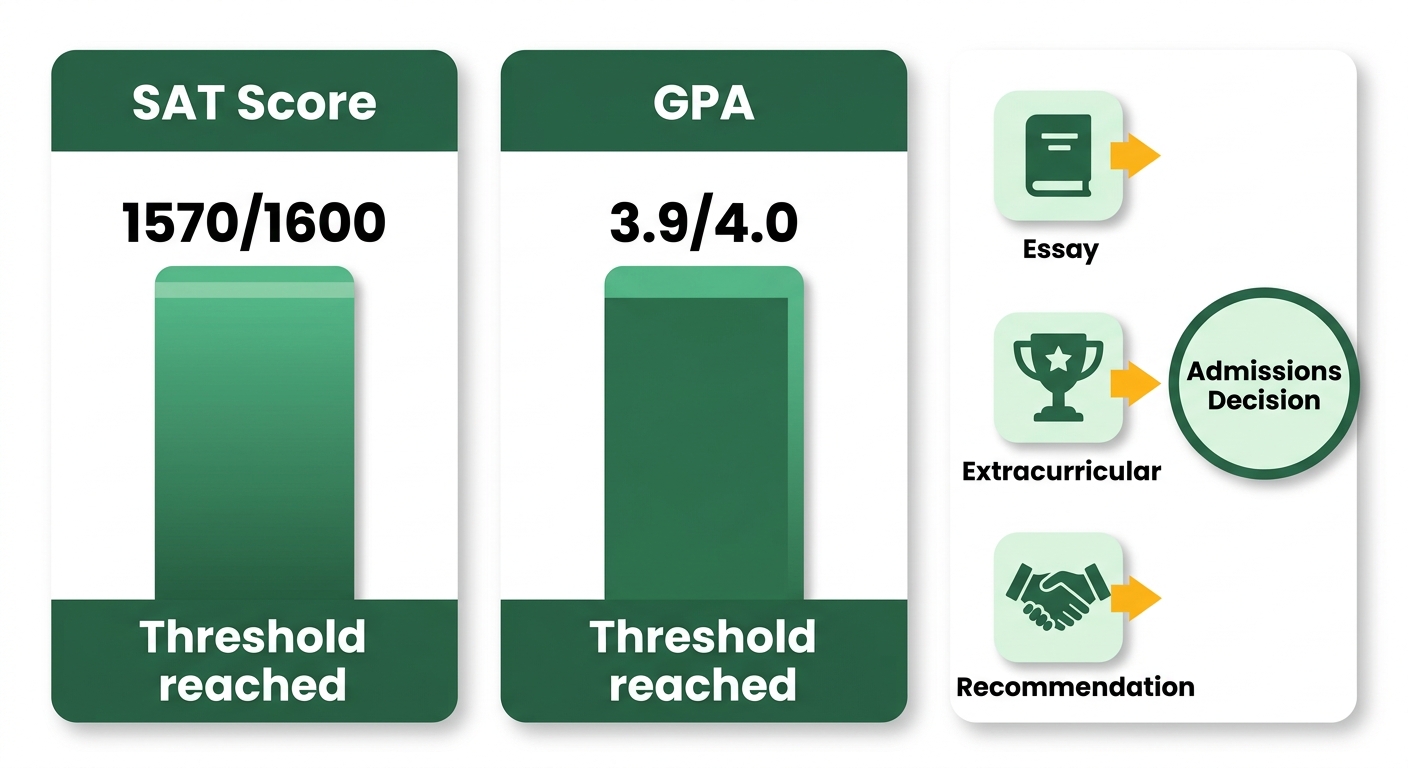
Academic metrics are the entry ticket, not the differentiator. At MIT's score ceiling, a 1570 SAT and a 3.9 GPA barely register as remarkable. When we build a customized plan, we treat numbers as context supporting the surrounding story.
Your metrics answer whether a student can handle the work. They do not answer much more. Once that box is checked, the numbers do no additional lifting. Admissions data shows that once an applicant clears the academic threshold, marginal score increases do not improve their chances. Strategic positioning becomes the primary differentiator.
How to Quantify SAT and GPA in a Strong Application
Quantifying metrics means placing them in context, not restating them more loudly. A 1580 SAT looks identical to a 1570 to a reader. What matters is whether the transcript shows a student tackling difficult material and connecting it across fields.
We map each metric to the narrative it supports. A 3.7 GPA paired with graduate-level neuroscience and philosophy coursework tells a more compelling story than a flat 4.0 with no reach. The rigor pattern carries more signal than the raw average.
AP courses and academic awards work the same way. Listed as trophies, they read as noise. Tied to a through-line, an AP biology cluster and research placement become evidence of genuine direction.
Common Mistakes With Academic Metrics
The biggest mistake is leading with numbers that every competitor already matches. A materials science and environmental policy applicant with a 1570 does not stand out on scores. They stand out when those scores anchor an interdisciplinary path bridging engineering and public policy.
The second mistake is padding. Long lists of awards without connective tissue signal a student chasing credentials rather than an interest. We cut anything that does not advance the through-line.
Skip metric polishing if the numbers already clear MIT's bar. Retaking a 1560 to reach 1580 is wasted effort. That time belongs in positioning.
Tracking Outcomes: Metrics for Success
We track outcomes after every application cycle to ensure our strategies work. We compare final admissions results with initial expectations based on our team's decades of counseling experience. We also assess how clearly students articulate their narratives after working with us. Finally, we stay connected beyond college acceptance to see whether their academic paths align with the positioning we developed together.
Most college admissions consultants stop at acceptance letters. We do not. The real test of a strategy is whether the student thrives in the program, not just whether they get in.
How We Evaluate Admissions Outcomes
We evaluate outcomes by comparing actual results with our initial expectations based on each student's profile. When we begin working with a student, our team draws on over 16 years of experience helping hundreds of students from diverse backgrounds. We use that experience to assess their admissions prospects. A student with a 1520 SAT, strong but conventional STEM research, and generic leadership roles might initially face an uphill battle at MIT based on historical patterns. If that student gains admission after our customized planning and collaborative support, we know our approach worked.
We track results for every student and log the gap between each student's projected reach schools and actual admits. On average, students who complete our full planning process convert two to three designated reach schools into offers, including schools they would not have seriously targeted on their own. When outcomes fall short, we analyze which positioning element did not resonate with admissions readers and apply that insight to the next cycle's planning.
Student Confidence and Long-Term Fit
We measure whether students can confidently defend their stories under pressure. Before working with us, most students struggle to explain their application narratives in a few minutes. They default to listing activities. After our process, they can connect their academic interests, extracurricular choices, and future goals. Students who develop this clarity consistently perform better in interviews.
We also track whether the student's positioning was authentic. Our mentorship and life advice extend beyond college admissions. We host educational seminars, manage a growing alumni network, and offer career advice. Through these touchpoints, we see whether students pursue the interests highlighted in their applications. Our goal is not just admission. It is ensuring the application reflects genuine passions the student will continue developing.
References
[1] What To Do After Being Deferred or Rejected by MIT? - https://www.ivycoach.com/the-ivy-coach-blog/early-decision-early-action/what-to-do-if-youve-been-deferred-or-rejected-by-mit/
[2] College Admission Case Studies for A/A+ Students - https://www.solomonadmissions.com/why-solomon/case-studies/a-students/
Frequently Asked Questions
1. Why do students with near-perfect SAT scores and GPAs still get rejected from MIT?
Strong academics confirm that a student can handle coursework, but they do not differentiate applicants in MIT's pool. Most applicants have similar metrics. Rejection typically stems from weak positioning: applications that resemble others in oversubscribed majors rather than showing how a student's interests fill a specific niche in the incoming class.
2. What does "repositioning" mean in the context of rebuilding a rejected MIT application?
Repositioning moves a student from an oversubscribed major pool into less saturated interdisciplinary ground. It reframes existing work and projects within a clearer narrative. For example, an applicant focused on mechanical engineering might highlight assistive technology design for local clinics. This demonstrates engineering's direct application to community healthcare needs rather than standard robotics club participation.
3. How much does character actually matter compared to test scores in elite admissions?
Character is the deciding variable when two applicants share identical metrics. Admissions readers weigh qualities such as intellectual curiosity, initiative, and interpersonal behavior. They infer these qualities from essays, recommendations, and activity choices. Strong applications replace self-descriptive adjectives with specific actions and consequences. They detail the steps a student took to resolve a problem and the measurable impact on their community.
4. If my GPA is slightly lower than 4.0, should I retake classes or focus elsewhere?
Focus on positioning rather than polishing metrics that already clear MIT's threshold. A slightly lower GPA supported by advanced, self-directed research projects can signal intellectual curiosity more compellingly than a perfect GPA from a standard, unchallenging curriculum. Retaking courses to improve an already strong academic record wastes time better spent developing the unique narrative and projects that differentiate you from competitors.
5. How do you know if your application positioning is authentic versus fabricated?
Authentic positioning surfaces work a student has actually undertaken. It then reframes that work into a clearer narrative connecting disciplines. The test is not whether the new framing feels comfortable immediately. Students often resist moving away from their initial self-image. The key question is whether the framing reflects genuine work and curiosity that the student will continue developing throughout college.
6. What's the actual conversion rate for deferred MIT applicants who reapply Regular Decision?
Deferred applicants who gain admission during Regular Decision typically address the core positioning problem rather than submit a standard update. A deferral signals that the student is academically qualified. Gaining acceptance requires shifting the application's focus toward a less saturated academic angle. This helps the student stand out in the final selection pool.