How to Build a College Portfolio That Shows Messy Sketches, Not Just Finals
August 24, 2026
Key Takeaways
- A creative portfolio without purpose reads as a scrapbook. Name the problem your work investigates.
- Elite admissions readers increasingly value process and reflection. Showing early and later drafts reveals your thinking.
- Alignment means matching one core narrative to each school's criteria and rubric.
- Write one reusable purpose statement in two or three sentences. Name your problem, medium, and learning process.
- The messy-sketch approach is powerful but not universal. Some schools want finished technical work.
- Sketch progressions become your strongest section when programs reward visible process.
- Numeric goals and advisor check-ins keep long projects focused.
Define Your Portfolio Purpose & Align with School Goals
A creative portfolio without purpose reads as a scrapbook. Before reviewing sketches, decide what problem your work explores. Strong applications answer one question upfront: What am I investigating? Sustainability, cultural identity, or technology and art can become your central thread.
That purpose turns messy sketches into evidence. Elite programs increasingly ask for process and reflection, not polished finals alone. A rough first draft beside your third iteration shows your response to resistance. It puts resilience directly on the page.
How Do You Align a Portfolio With Each School's Goals?
Portfolio alignment means matching your core narrative to each school's criteria. Read the rubric before submitting anything. When a program rewards process and reflection, make sketch progressions your strongest section.
Build one purpose statement you can reuse and tailor. Use two or three sentences covering your problem, medium, and learning process. Then echo each school's stated language when adjusting emphasis.
Do not force alignment where it does not exist. If a school wants finished technical work only, omit the messy-sketch framing. This approach is powerful, but it is not universal.
Set Measurable Goals So the Project Stays Focused
Set numerical goals for your project. Our advisors build customized plans with each student. Regular check-ins keep long projects on track. Tailor goals to your strengths and intended story.
Track progress with a simple dashboard. Record completed pieces, hours logged, and feedback cycles. These measures show sustained effort and keep the project honest.
Then connect your sketch work to your academic record. Iteration logs pair naturally with a hard STEM final. Both show persistence when the first answer fails. For more on creative work and admissions strategy, see our college admissions blog.
Map Out the Timeline & Submission Logistics
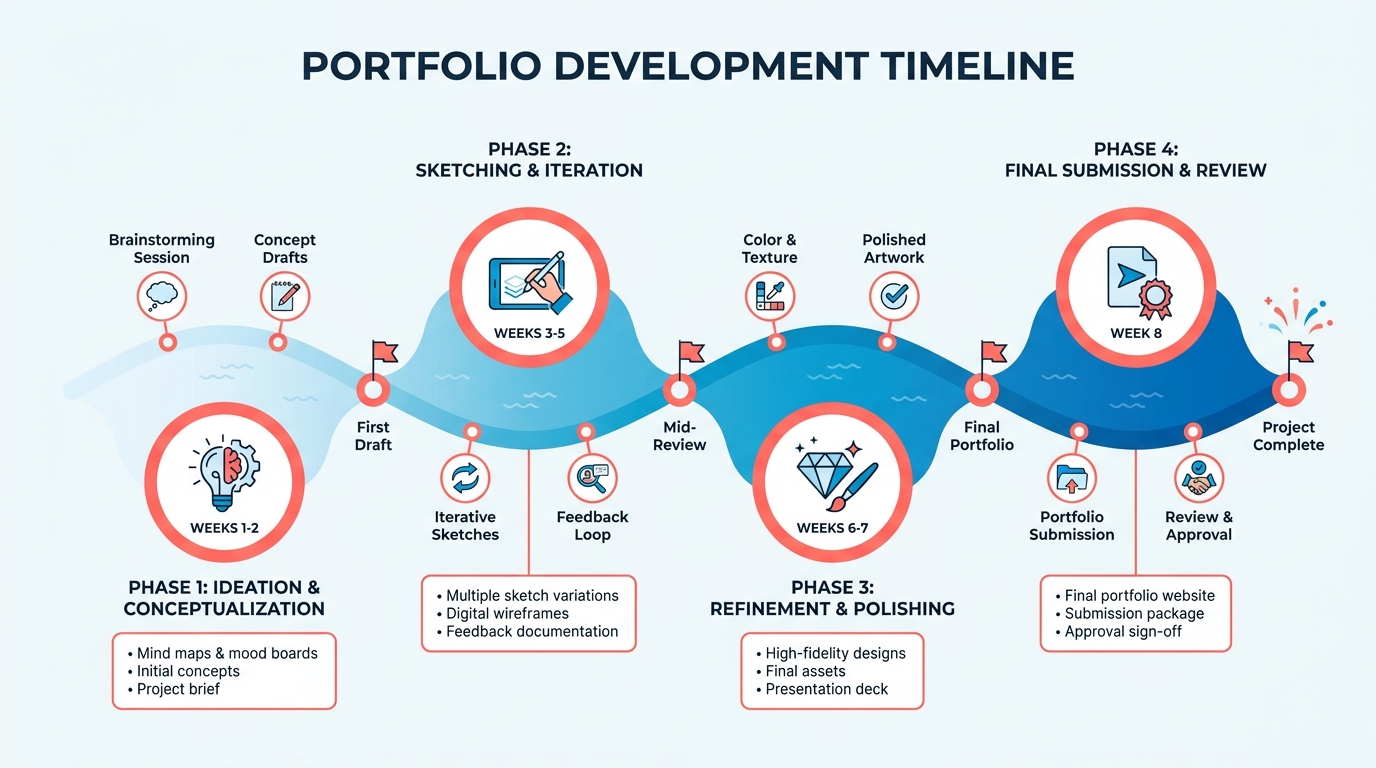
A messy-sketch portfolio needs a process-based schedule. Break the work into phases across your available weeks. Each phase captures another layer of your thinking. This keeps raw drafts from disappearing during final editing.
Start early. Strong portfolios come from authentic, daily documentation. Recreating a semester of development during the final week looks forced.
What Does a Phase-by-Phase Portfolio Timeline Look Like?
Phase 1 (Weeks 1-3): Discovery. Review every existing piece, including abandoned drafts. Schedule two weekly sketch sessions. Treat them like classes. Focus on inventory, not perfection.
Phase 2 (Weeks 4-9): Collection. Produce new work and photograph pieces mid-process. Log timestamps on every image. These dated photographs document your iteration. Treat them as seriously as your finals.
Phase 3 (Weeks 10-13): Documentation. Write captions explaining failures and changes. Edit short videos, then build your PDF. Place rough drafts beside later versions. That comparison demonstrates your process.
Phase 4 (Weeks 14-15): Submission Prep. Test file sizes against portal limits. Run accessibility checks on PDFs. Request a final mentor sign-off. Leave buffer days because portals crash near deadlines.
How Do You Sync Deadlines With Application Portals?
Map Phase 4 backward from the earliest portal deadline. Common App, Coalition App, and school-specific art portals may close on different days. Create one master calendar with every date and requirement.
For digital work, scan at high resolution and calibrate color. This helps prints match your screen. For physical submissions, confirm courier timing early. Shipping delays do not earn extensions.
Protect everything with cloud storage and clear version-control folders. Use consistent, dated filenames to identify each draft. That order proves your growth.
At Endurable Education, milestone reviews help students manage these logistics. This helps ensure every requirement is met early.
Document and Showcase Your Creative Process
A creative portfolio gains strength from documentation. If you do not capture your process, you cannot reconstruct it later. Log the work as it happens. Preserve that thinking as evidence.
This matters more than many students realize. Research on design students found that many present sketchbooks with as few as four pages. Many also submit computer-rendered work instead of drawings, according to Lisa Thurlow's study on sketch inhibition. If the field is sketch-averse, a documented sketchbook gives committees a distinct signal.
How Do You Document Messy Work Systematically?
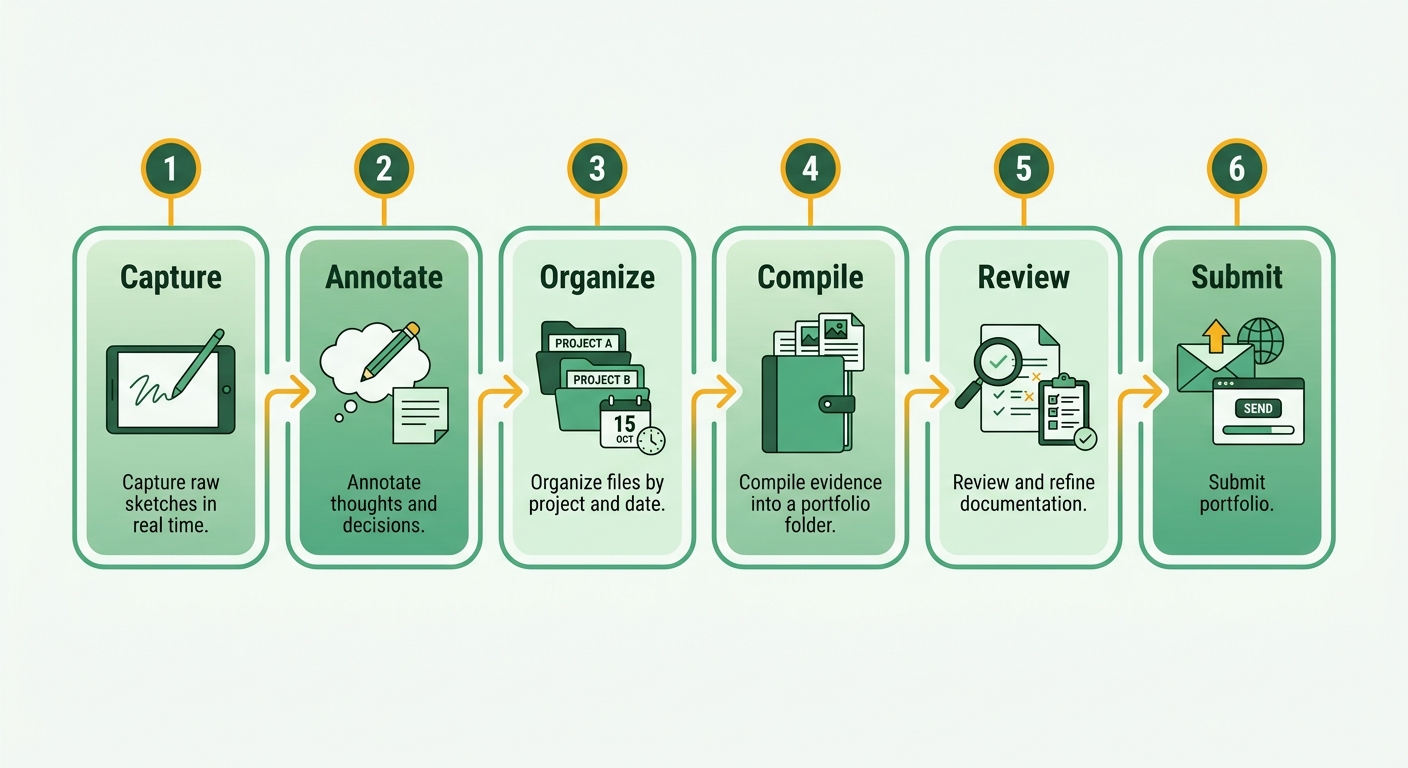
Documentation captures every stage, not only the final result. Use four tools: a dated sketchbook, photo log, time-lapse videos, and annotated notes. Each tool records another layer of your thinking.
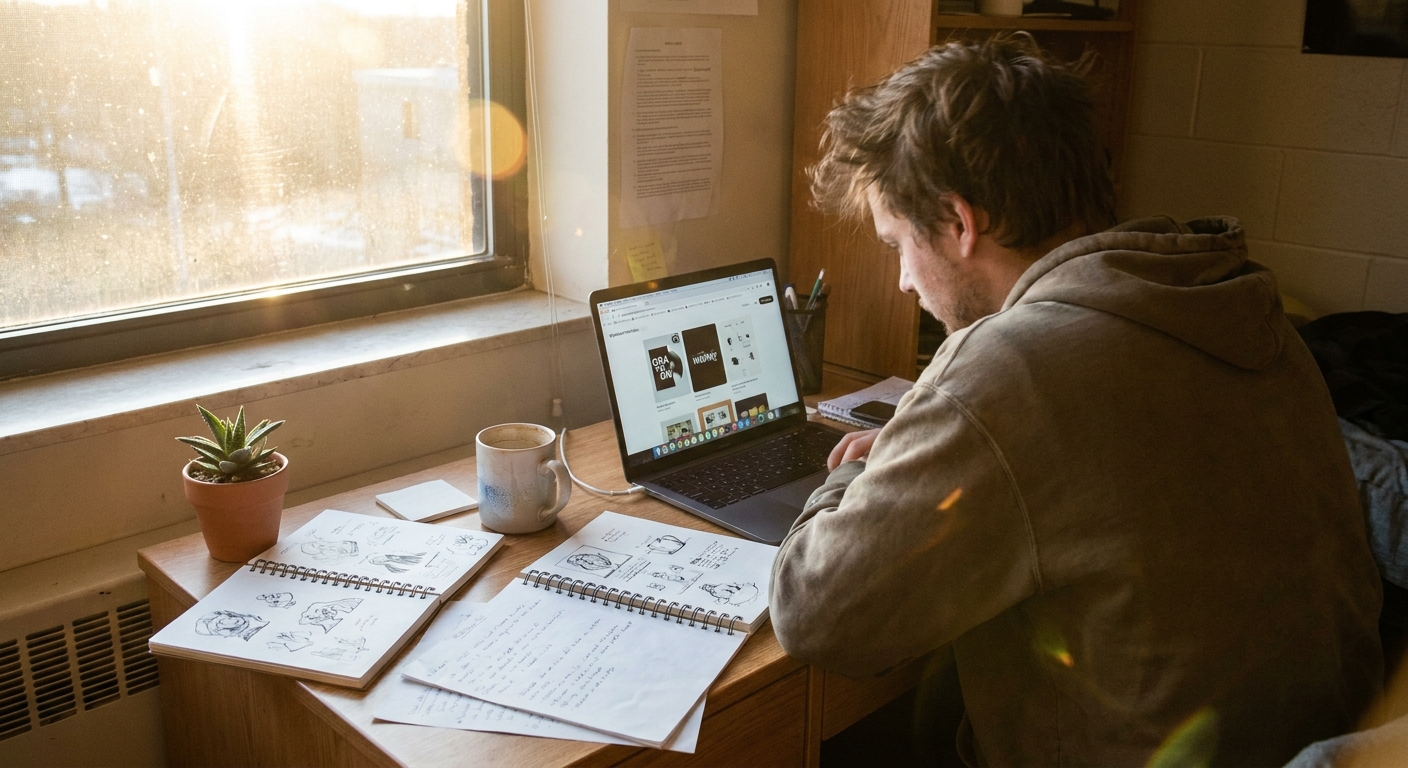
Start with the sketchbook. Date every page and add a brief caption. Explain what you were trying to solve. Use high-contrast pens so faint pencil work photographs clearly. This shows sketching as a search for ideas, a process digital tools cannot replicate, as the research argues.
For photos, use a consistent angle and lightbox. Capture several stages of each piece. This lets readers watch the work evolve. A 30-second time-lapse can compress a two-hour session. Add a short voice-over describing one changed decision.
Annotation tip: Mark decision points with colored arrows. Add two-line reflective bullets. Name files by project, date, and stage. A format like 2024-03-12_Sustainability_Concept1_Rough.jpg simplifies retrieval.
Which Raw Sketches Actually Belong in the Portfolio?
Include sketches showing visible iteration. Choose multiple attempts, real mistakes, and clear thought trails. A scratched-out idea beside a better one tells a stronger story. The mistake provides evidence.
Pair each rough sketch with the final piece resolving its problem. That connection turns “sloppy” into “resilient.” Balance process and finished pieces according to each school's rubric. Give greater weight to what the program rewards.
Most programs want between 10 and 20 pieces. You get 1,000 characters to describe each one, according to Artriculate's portfolio guide. Use that space to explain your thinking, not only the medium. As consultant Florence Lehr writes:
"Your portfolio is yet another way schools will get to know you; in some ways, it is your 'elevator speech' to schools." — Florence Lehr, in the Artriculate guide
How Do You Present Process Inside the Final PDF?
Build a dedicated Process Appendix at the back of your PDF. Include clickable thumbnails linking rough sketches to resolved finals. This keeps polished work prominent while showing its development.
Capture these moments as they happen. This avoids reconstructing your creative journey later. The gap between school expectations and student submissions creates an opportunity. Address it deliberately.
Organize, Theme, and Present Your Portfolio
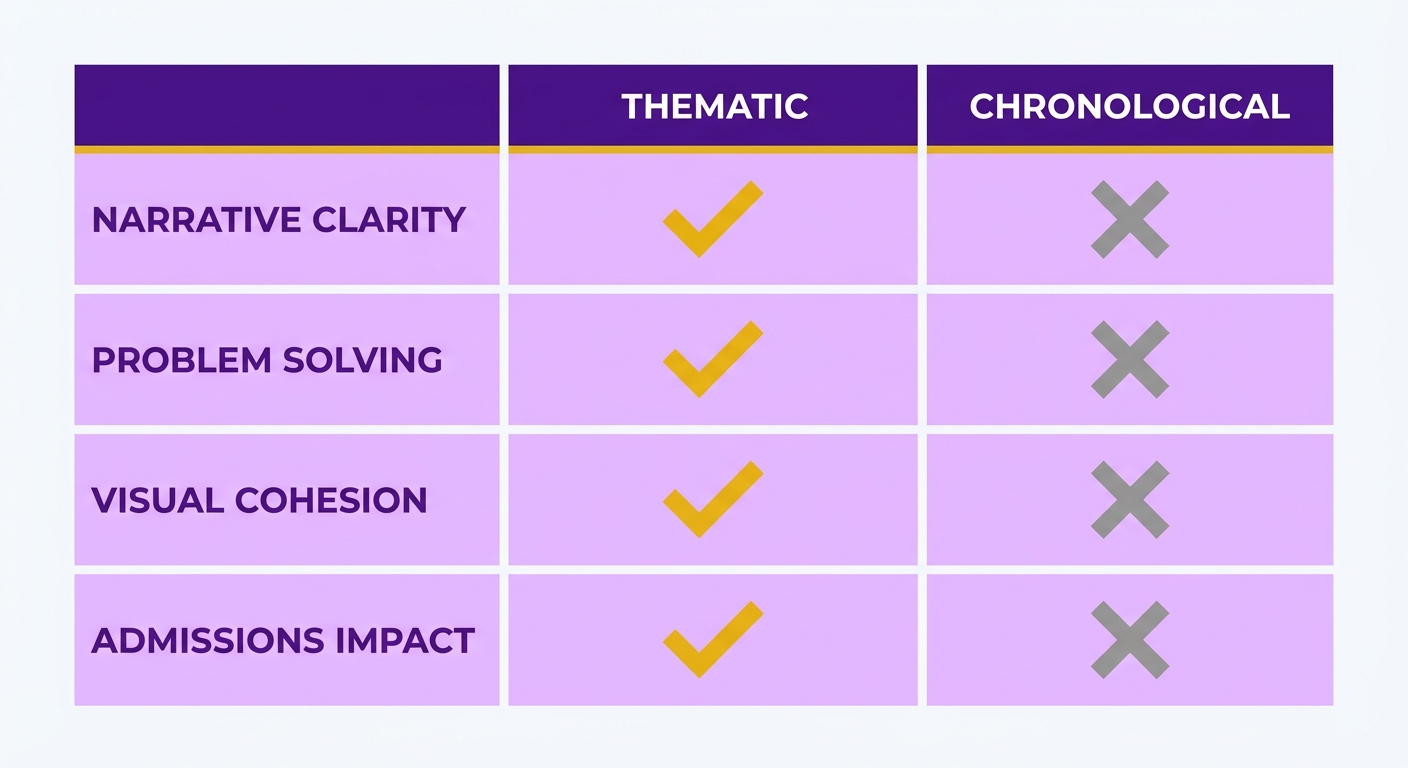
How you arrange a creative portfolio determines whether it reads as an argument. Group pieces by concept, not calendar. Place sketches beside polished outcomes under clear themes. The sequence then demonstrates problem-solving.
Treat your portfolio as a pitch to schools. Each grouping choice contributes to that pitch. The order tells your story before the text does.
How Do You Theme and Sequence Your Work?
Thematic grouping organizes pieces by idea. Examples include “Identity,” “Technology,” and “Nature.” This helps readers follow your investigation instead of your timeline.
Within each theme, cluster pieces by medium. Keep charcoal studies together and digital renders separate. This lets reviewers see your range without visual whiplash.
Then build a story arc within each theme. Start with a bold, rough sketch. Show iterations and false starts. End with the resolved piece. This sequence makes your growth visible.
Choose your strongest concepts for a curated collection. Trim the inventory to meet each program's limits. Give every piece a numbered caption. Explain how each piece developed and what it taught you.
What Presentation Rules Keep It Clean and Personal?
Consistency communicates professionalism. Set 1-inch margins and use one font, such as Helvetica at 10 pt. Number captions throughout. For physical work, use a matte case and protective sleeves.
Add QR codes linking to short process videos. For digital submissions, embed quick GIFs showing iterations. Bookmark each theme so reviewers can navigate easily.
Then rehearse your explanation. At Endurable Education, we work with students as a panel rather than one-on-one. This provides diverse perspectives on presenting and defending your work. It also helps you explain messy pages, not only finals. Committees may probe both. Our broader admissions guidance appears on the Endurable Education blog.
Get Feedback, Refine, and Use Endurable Education's Support
A creative portfolio improves when others challenge it. Feedback shows whether messy sketches support the story. Use a layered loop: peer review, teacher critique, then formal review.
Start with peers because they identify confusion quickly. Next, ask a teacher familiar with your medium. Save formal review for the complete portfolio.
What Should a Critique Checklist Cover?
Ask every reviewer the same four questions. This keeps feedback consistent:
- Clarity of process: Can a reader trace your progress from sketch to final?
- Relevance to narrative: Does each piece support your investigation?
- Visual quality: Is the work strong enough for the school's standard?
- Rubric alignment: Does it answer this specific program's requirements?
Track answers in a simple spreadsheet. Log original and revised ratings after each round. A change from 6 to 8 shows progress. Flat scores suggest moving on.
How Does Our Collaborative Review Work?
We built our review around teamwork rather than one advisor. One perspective can miss important issues. At least two team members review every student's work. This gives you varied feedback before admissions review.
Budget roughly 10% of your total project time for revisions after each round. Endless polishing can remove the raw evidence that makes process portfolios effective.
Our team also emphasizes wellness breaks. Portfolio season can overwhelm students who work without pauses. Regular mentorship check-ins help manage that load. Burned-out students make weaker revision decisions. Avoid all-nighters. Resilient work comes from students who pace themselves.
References
[1] Submitting a Great Visual Arts Portfolio - https://www.artriculate.com/blog/submitting-a-bfa-art-portfolio
[2] Where have all the ideas gone? An anatomy of sketch inhibition among student designers - https://www.researchgate.net/profile/Lisa_Thurlow/publication/335567891_Where_have_all_the_ideas_gone_An_anatomy_of_sketch_inhibition_among_student_designers/links/5d6d629ea6fdcc547d758100/Where-have-all-the-ideas-gone-An-anatomy-of-sketch-inhibition-among-student-designers.pdf
Frequently Asked Questions
1. What if my target school only wants finished technical work, not process?
Focus on technical execution and formal presentation. Some traditional programs prioritize medium mastery, draftsmanship, and final rendering. Select polished, completed works that highlight technical range and precision. Do not include preparatory drawings.
2. How many pieces should my portfolio actually contain?
Requirements vary by institution. Standard guidelines typically request your best work with concise descriptions. Prepare a larger pool of high-quality projects. Then tailor your final selection to each department's criteria.
3. Can I photograph my sketches after finishing instead of documenting as I go?
Document your work progressively. Retrospective photography often misses authentic intermediate stages. Reviewers can distinguish real-time problem-solving from staged drawings. Authentic documentation better shows the project's development.
4. Where should messy sketches go so they don't crowd out polished finals?
Use primary pages for completed, high-impact projects. Place developmental drawings in supplementary pages or a secondary section. This keeps them supportive rather than distracting.
5. How much time should I spend revising after each feedback round?
Set strict limits for revision phases. Over-refining one piece can remove the spontaneity of early concepts. If evaluation remains unchanged after edits, redirect your energy elsewhere.
6. Why do messy sketches carry weight when the design field seems to prefer polish?
Admissions committees look for critical thinking and ideation. Final renderings show technical execution but not your path to a solution. Initial concepts demonstrate idea generation and design problem-solving. This distinguishes applications showing only finished products.
7. How does Endurable Education's review process differ from a single advisor's feedback?
Our methodology uses collaborative evaluation by multiple experienced educators. This multi-perspective review provides balanced critiques and strategic guidance. It also supports a healthy, sustainable pace during the application cycle.