How to Choose the Right Cornell College for Your Application
August 9, 2026

Key Takeaways
- Cornell's 2025 cycle drew 72,523 applications and admitted 8.7% overall, across eight undergraduate colleges.
- Each college has its own admissions office and supplemental essay. Your college choice is a graded part of your application.
- Readers reward demonstrated fit over admit-rate math. They quickly spot applicants chasing an easier admission.
- Arts & Sciences and Engineering have "very high" relative difficulty. CALS and SC Johnson Business rank "high."
- Former Cornell assistant director Heidi Lovette said mismatched applications get flagged immediately.
- Successful applicants match their academic profiles to one college's mission.
- Relative difficulty is a tiebreaker, not a screening tool.
- Supplements seek different evidence, from broad curiosity to mission alignment.
Quick Summary
Start with fit, not admit rate. Cornell reads applicants through eight undergraduate colleges and schools. Each has its own admissions office and supplement, according to this insider admissions guide. Your college choice can affect your odds as much as your grades. Successful applicants match their profiles to a specific college's mission before writing.
Readers care how well your background fits their academic world. Build your shortlist around fit. Let relative difficulty settle ties only at the end.
Which Cornell College Matches Your Profile?
Use this table as a first-pass map. "Difficulty" is relative, not a published admit rate. College-specific rates change each year, and fit remains essential.
| College / School | Best-Fit Student | Application Emphasis | Relative Difficulty | Supplement Angle |
|---|---|---|---|---|
| Arts & Sciences | Broad intellectual, undecided majors | Depth across disciplines | Very High | Curiosity + range |
| Engineering | STEM builders, research-driven | Math/science rigor | Very High | Technical projects |
| CALS (Ag & Life Sciences) | Bio, environment, data, applied science | Purpose + applied work | High | Mission alignment |
| SC Johnson Business (Dyson) | Analytical, entrepreneurial | Quant + leadership | Very High | Business impact |
| Human Ecology | Health, policy, human behavior | Interdisciplinary service | Moderate–High | People-centered goals |
| ILR School | Labor, law, policy, negotiation | Social science + advocacy | Moderate–High | Systems thinking |
| Architecture, Art & Planning | Designers, artists, planners | Portfolio + vision | High | Creative body of work |
| Public Policy | Governance, economics, social change | Policy reasoning | Moderate–High | Real-world civic work |
How Much Time Should This Decision Take?
Spend more time choosing the college than handling paperwork. The mechanics move quickly: an $85 application fee with waivers for eligible students, two teacher recommendations, and transcripts. Cornell lists these requirements on its first-year admissions page. The deadlines are firm: November 1 for binding Early Decision and January 2 for Regular Decision.
The college-specific supplement requires the most preparation. Give yourself two to three weeks to research programs, talk with students, and draft. Do this before committing to Early Decision, because ED is binding.
Does Admit Rate Matter at All?
It is a tiebreaker, not a strategy. Cornell warns that choosing a college by acceptance rate can lead to rejection. The consultancy guide allows admit data as a secondary factor. Put fit first. Roughly 10% of students transfer between colleges internally each year. That figure shows how costly front-end mismatches can become. Careful planning helps prevent them.
Why the Right Cornell College Is Half the Battle
Strong Cornell applications rarely begin with the easiest door. They begin with a clear match. Applicants who align their profiles with a college's mission often present stronger cases than rate-focused applicants.
One admissions consultancy reported a 61% admission rate among its students. That figure exceeded Cornell's overall rate, according to the same insider guide. Read the difference as a fit signal, not a secret formula. Genuine interests create a clearer, more credible application.
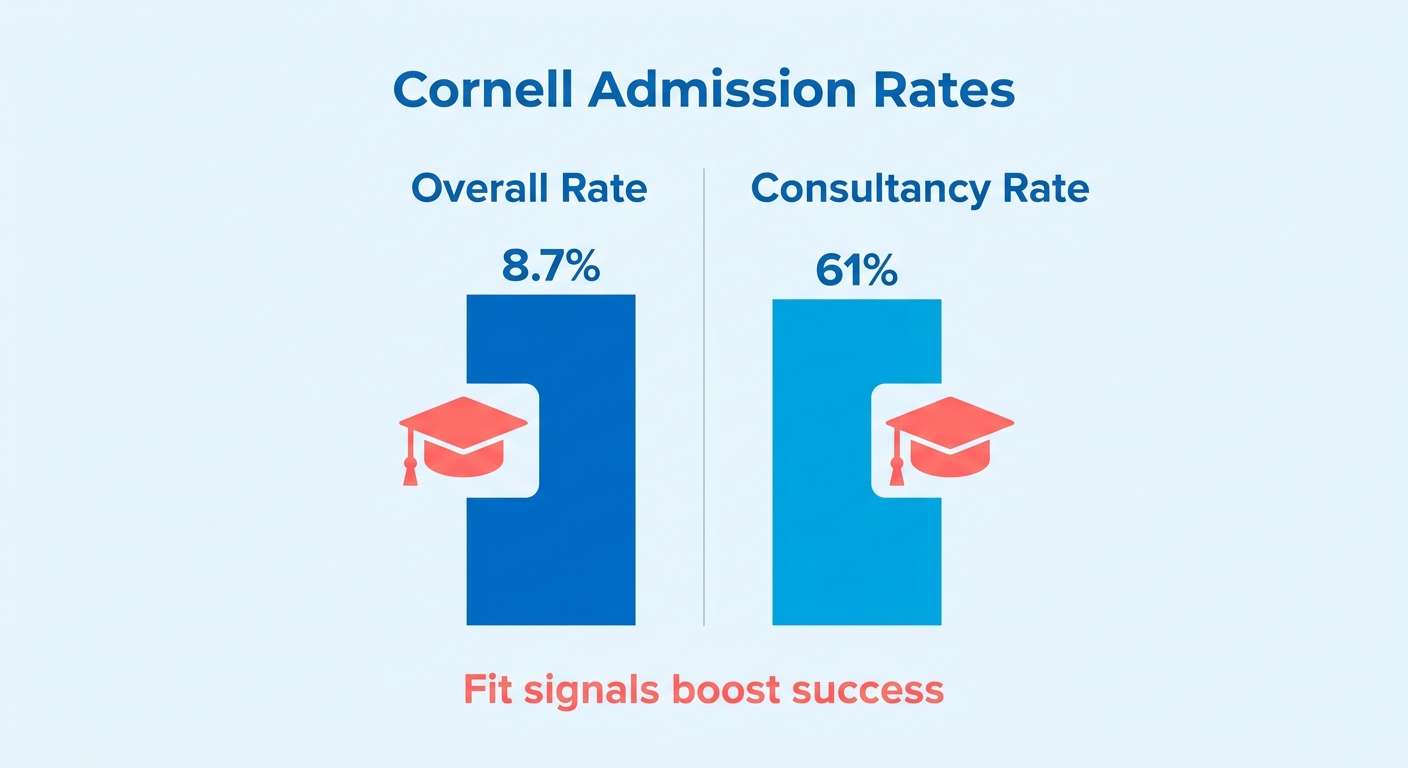
Why Fit Beats Admit Rate at Cornell
Fit means your grades, scores, and interests support one college's mission. Each college expects a different academic story. Engineering needs different evidence than Arts & Sciences. Admissions readers recognize what belongs in each application.
The advice contains a real tension. The consultancy considers admit-rate data useful. Cornell warns against using it. Both positions apply at different stages. Build your shortlist around fit. Use admit rate only when two colleges fit equally well.
What a Wrong Pick Actually Costs
A mismatch can cost more than an admissions decision. Students transferring between Cornell colleges report graduation delays and redundant coursework. Internal transfer is also competitive. Acceptance is not guaranteed, leaving some students in programs that do not fit.
A transfer can cost a semester of momentum. It adds new requirements and may not solve the original problem. You applied to a college that did not match your interests. Scoring your profile first can prevent that detour.
Who Gains Most From Scoring Fit First
Students with strong but ambiguous profiles gain the most. If your interests fit two or three colleges, a scoring framework supports a defensible choice.
That clarity strengthens the application. Each college has its own supplement, so fit directly shapes your essay. Starting early also helps families manage the process before pressure builds, as discussed on our admissions planning blog.
Skip scoring only if you are a true single-subject specialist. If your work clearly points toward one college, trust that pattern. Everyone else benefits from a structured comparison.
Matching Your Major to the Right College
The strongest matches connect your record and intended major. Cornell's Courses of Study page lists degree requirements by college. Read those requirements like a job description. If your transcript maps cleanly to one college, you have stronger material for its supplement.
This is not about gaming the system. It reflects your first two years at Cornell. Each college sets its own core requirements, advising structure, and distribution rules. Your entry college shapes courses before you declare a concentration.
Students interested in computer science may find Engineering's hands-on labs better suited to them. Others may prefer policy over pure economics and choose Human Ecology. A mismatch can fill your first year with unrelated requirements. Planning should identify that problem before enrollment.
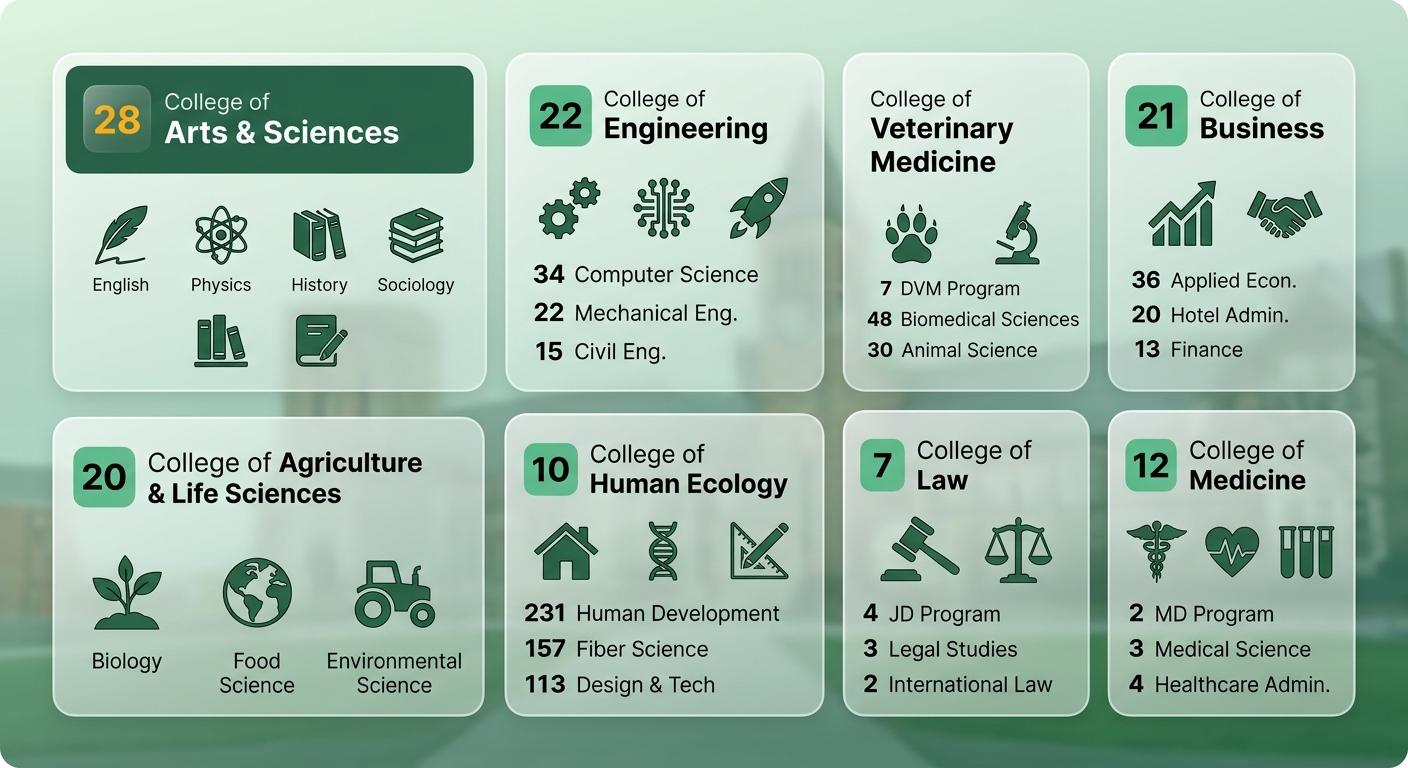
How to Map Your Profile to a College's Requirements
Start with the strongest area of your transcript. Four years of lab science and a USABO semifinal finish suggest Engineering or CALS. A social-science-heavy schedule, supported by policy briefs, points toward Arts & Sciences or Human Ecology.
Then check degree requirements. Engineering wants physics and chemistry. Applied Economics and Management in Dyson wants microeconomics and macroeconomics. Information Science in Computing and Information Science expects discrete mathematics. Missing prerequisites may raise questions about your preparation. If admitted, you may also struggle during your first year.
Look for overlap with your previous study. Successful transfer students often cite the elective system's flexibility. Flexibility helps only after you choose the right college. An Arts & Sciences biology major has room for humanities electives. A Biological Engineering major has less. Choose the structure that fits how you learn.
Letting Career Goals Narrow the Choice
Cornell recommends entering with defined career objectives. That does not require a 10-year plan. Know whether you want research, industry, policy, or clinical work.
Interested in technology product management? Information Science or Operations Research develops modeling skills companies hire for. Agricultural policy? CALS supports that land-grant mission and offers DC connections. Veterinary work? Animal Science in CALS is pre-professional. Each college leads toward different career paths.
Read alumni profiles in your intended major. Where did recent graduates work? Which curriculum skills did employers value? This review can clarify which college supports your goals. Cornell publishes career outcomes data. Use it.
Pressure-Testing Fit With Students and Faculty
After narrowing your options, validate your choice. Email a current student in your intended major. Ask what surprised them about the curriculum. Ask whether the requirements felt suitable or restrictive.
Faculty can be harder to reach, but specific questions may help. Mention their lab's focus or a recent paper in two sentences. A response can provide useful supplement material. A nonresponse costs you nothing.
Students who read syllabi and speak with faculty can explain their choices. That preparation appears in their essays. Make this final step personal. Talk with people inside the program. Reconsider if their answers conflict with your expectations.
The Supplements and Interviews That Decide It
At Cornell, your college choice is a graded criterion. Finish that decision before writing. The supplement is where admissions readers evaluate the choice.
Match your GPA, test profile, and interests to one college. Then let that match guide the supplement. Cornell prohibits AI-generated essays and warns that AI will "dilute authenticity." It also tells applicants, "Cornell wants to hear your voice." Use a structured process for decisions, not writing. Write the story yourself.
What Makes a Cornell Supplement Land?
A strong supplement demonstrates fit through specific courses, faculty, and programs. Generic enthusiasm is not enough. CALS applicants should connect experiences to their chosen majors. The case for tailoring essays to each college applies elsewhere too.
Use a simple test. Can you name three courses, a lab, or program feature? Each should connect to your transcript. If not, reconsider the college rather than polishing the prose.
How to Prep for a College-Specific Interview
Most Cornell colleges do not interview. Design-based majors do, and those interviews test your claims. Architecture applicants submit a portfolio and complete an interview during review. Be ready to explain why this program suits you.
Rehearse three points: a specific college reason, relevant work, and one curriculum question. Avoid memorizing a script. The essay's authenticity standard also applies to interviews.
Does Applying Early Change Your Fit Strategy?
Early Decision has a 21.4% acceptance rate, compared with 8.6% for Regular Decision. The same CollegeVine guide reports these figures. That difference may tempt students to decide before establishing fit. Do not rush. ED is binding, so a weak match becomes difficult to undo.
When the match is genuine, applying early strengthens the case. When it is not, it only accelerates rejection. Make the fit decision before choosing the timeline.
A Framework for Choosing Your Cornell College
A useful rubric ranks four factors: academic fit, campus culture, support services, and long-term goals. Score each college against your profile. Weight academic fit most heavily because it shapes your daily course load. Use culture and support to separate colleges that fit your major equally well. Treat admit rate as a secondary factor.
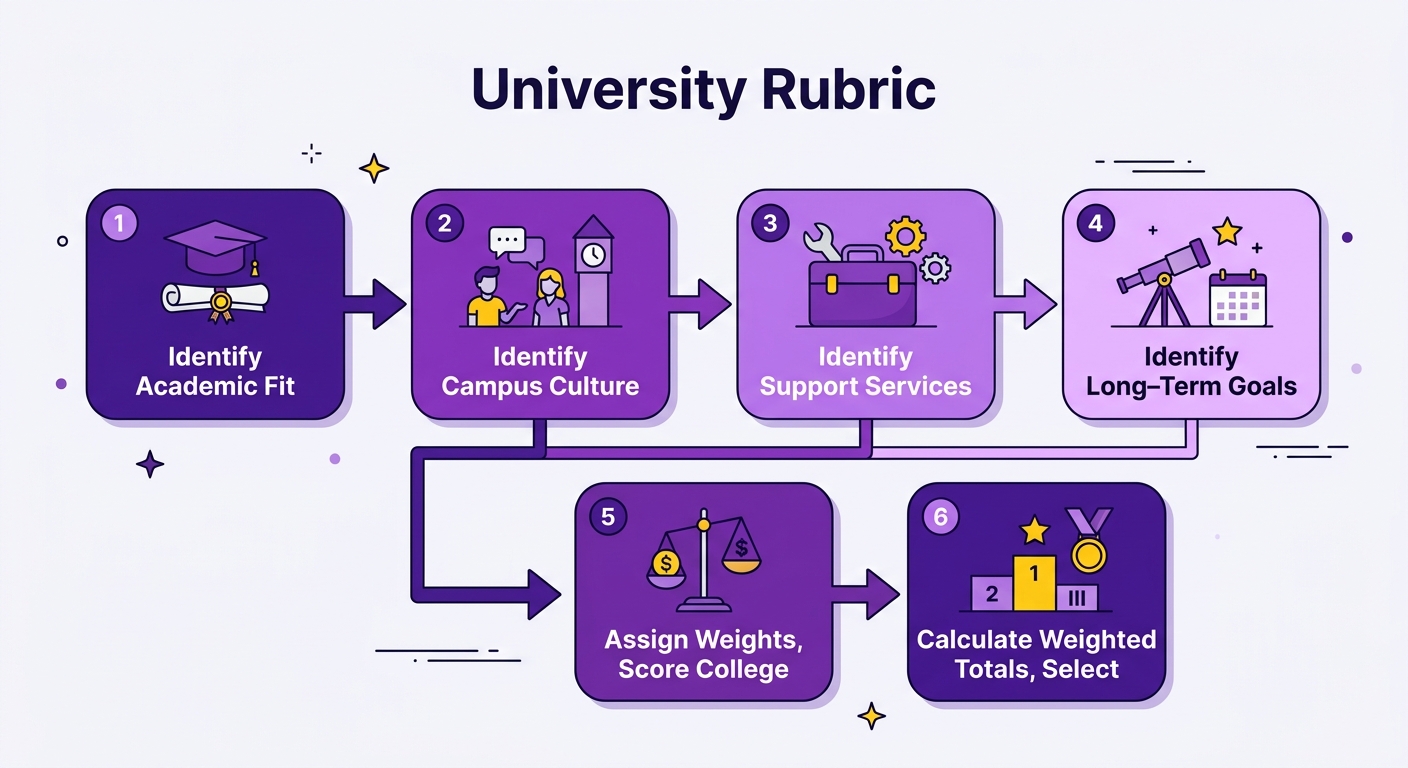
What to Weigh First
Consider academic fit first, culture and support second, and admit rate last. Create a table listing each college. Rate each one from 1 to 5 based on your transcript and interests. The Cornell FAQ identifies career objectives as an anchor. Students with clear goals can complete this step quickly.
Culture and support matter because Cornell meets 100% of demonstrated financial need. It offers no merit scholarships, according to the first-year applicant page. Because aid policies apply university-wide, financial aid will not separate colleges. Use campus fit and program depth instead.
Scoring Test Fit When the Ranges Conflict
Treat the latest university-wide range as a rough floor. Remember that it conceals college-level variation. IvyWise reports a middle-50% SAT range of 1510 to 1560 for the Class of 2028. An older figure reports 1450 to 1540.
A test-optional Arts & Sciences applicant reads differently from an Engineering applicant. Quantitative programs place more weight on quantitative signals. Engineering applicants need problem-solving evidence, not only high scores.
When Admit Rate Enters the Decision
Use admit rate only as a final tiebreaker. Selectivity rose across recent cycles, from 7.26% to 7.90% to 8.41%. That makes admit-rate arbitrage a shrinking advantage.
Cornell colleges vary widely in applicant volume. A less selective-looking school may attract a highly qualified, self-selected pool. Finish the rubric first. Then write from a match you genuinely believe.
Building the Application Around Your Fit
The Cornell checklist is short, but deadlines are unforgiving. Successful applicants turn their fit decisions into checklist items early. They choose the college, then build the application around that match. This sequence keeps the supplement aligned with committee expectations.
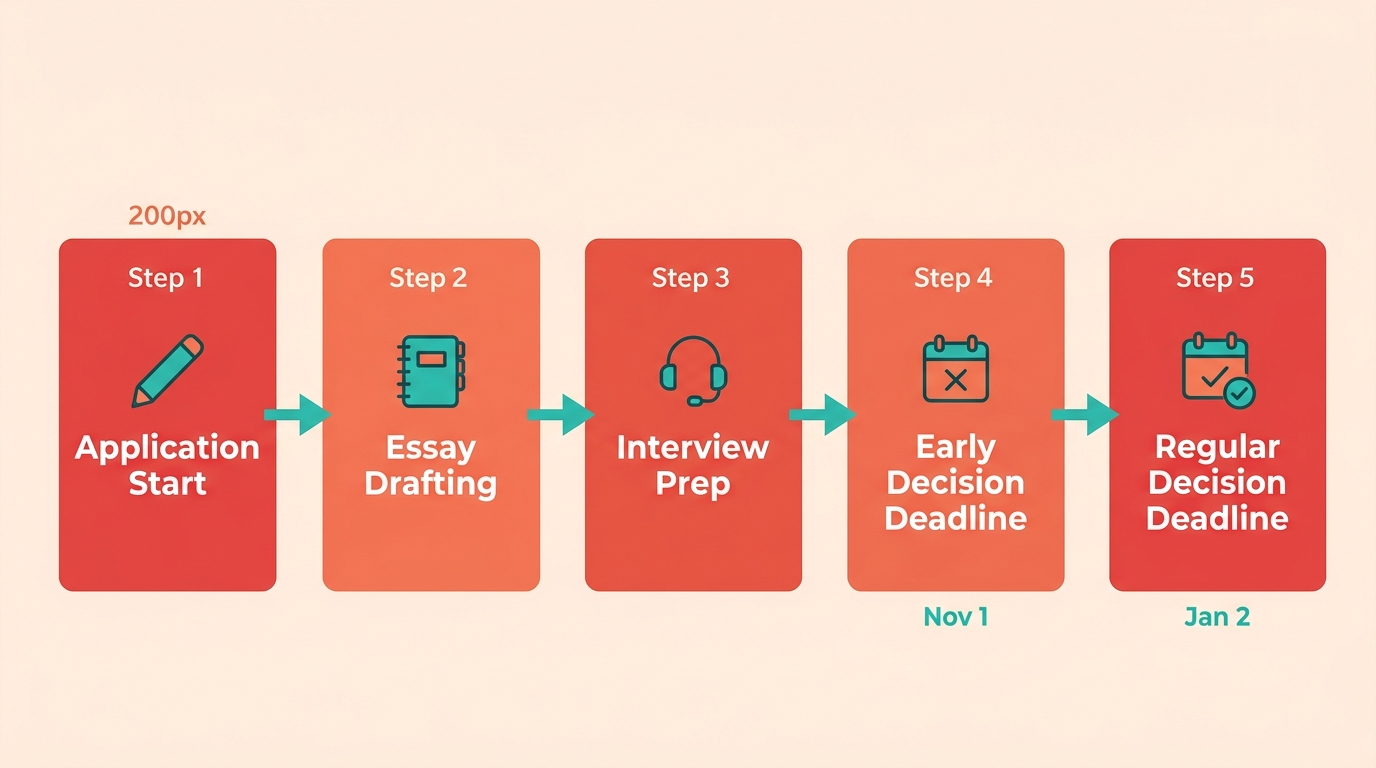
What You Actually Submit
Cornell requires the Common App, Cornell Writing Supplement, official transcript, two teacher recommendations, and counselor letter, according to IvyWise's Cornell guide. The supplement includes multiple prompts that vary by college. Engineering and ILR applicants therefore answer different questions. Design majors, including Architecture, add portfolios and interviews. Check deadlines on the preparation checklist.
Plan around college-specific requirements, not only shared materials. Portfolio reviews and interviews for programs such as Art and Architecture may follow earlier internal timelines. Missing one can end an application before essay review. Confirm requirements when you begin, not when you submit.
How to Handle Test Scores
Aim for your specific college's middle-50% range. Do not rely on one university-wide figure. Campus-wide data hides college-level differences. A score may be strong for one college but average for another. That difference makes early profile matching useful.
Does Early Decision Actually Help?
ED can improve your odds, but the mechanism matters. ED applicants form a smaller, more committed pool. Readers may view the binding commitment as a fit signal. The gap is real, but so is the commitment. Apply ED only after settling your fit. Be ready to withdraw other applications if an offer arrives in mid-December.
The Final Review
Before submitting, run three checks. First, does your supplement name specific courses or faculty? Generic praise may suggest a mismatch. Second, does the essay use your own voice? AI drafting is prohibited, so use it only for spelling. Third, does your portal show every required material?
Working through each phase helps you meet deadlines and build relevant experiences early.
References
[1] How do I decide which college or school at Cornell would be best for me? - https://faq.enrollment.cornell.edu/kb/article/192-how-do-i-decide-which-college-or-school-at-cornell-would-be-best-for-me/
[2] First-Year Applicants | Undergraduate Admissions - https://admissions.cornell.edu/how-to-apply/first-year-applicants
[3] Which Cornell College Should You Apply To? Insider Admissions Guide - https://toptieradmissions.com/which-cornell-college-to-apply-to/
[4] How to Get into Cornell: All You Need to Know - IvyWise - https://www.ivywise.com/blog/how-to-get-into-cornell-all-you-need-to-know/
[5] Which college or school at Cornell will offer me the best chance of admission? - https://cornelladmissions.happyfox.com/kb/article/201-which-college-or-school-at-cornell-will-offer-me-the-best-chance-of-admission/
[7] The Ultimate Guide to Applying to Cornell | CollegeVine Blog - https://blog.collegevine.com/the-ultimate-guide-to-applying-to-cornell
Frequently Asked Questions
1. If I'm genuinely interested in two Cornell colleges that both fit my profile, how do I make the final choice?
Compare course catalogs and graduation requirements for both programs. Speak with current students about advising and course availability. Their experiences may clarify which environment better suits your learning preferences.
2. Can I switch Cornell colleges after being admitted if I realize I picked wrong?
Yes, but internal transfer requires a formal application and is not guaranteed. Each college sets its own transfer criteria, GPA requirements, and prerequisite courses. These requirements can affect your graduation timeline.
3. Do Cornell's eight colleges share the same financial aid policies, or does aid vary by college?
Financial aid policies are uniform across the university. Funding is administered centrally rather than by individual colleges. Your aid package remains the same regardless of your undergraduate school.
4. How much does Early Decision improve my odds if my college fit is weak?
Early Decision does not offset poor academic or mission fit. Admissions officers first assess your alignment with the college's program. A binding application cannot prevent rejection when fit is weak.
5. What should I do if my intended major exists in multiple Cornell colleges?
Compare each college's foundational course requirements. An environmental science policy track may emphasize economics and governance. A laboratory track may focus on research and science. Choose the college whose core matches your strengths.
6. How do admissions officers actually spot applicants who chose a college based on admit rate instead of fit?
Reviewers look for depth in supplemental essays. Broad statements about Cornell's reputation may signal weak research. Specific academic resources, research centers, and curricular pathways show stronger college knowledge.
7. If I apply test-optional to Cornell, does that choice affect which college I should pick?
Yes. Colleges evaluate test-optional applications through different lenses. Quantitative programs may seek advanced calculus and physics coursework. These subjects can demonstrate readiness without standardized test scores.