How to Read Othello by Tracking Iago's Manipulation of Insecurity
August 24, 2026

Key Takeaways
- Iago rarely lies outright; he plants doubt and lets insecurity do the rest.
- The main lesson in Othello is psychological pressure, not the murder itself.
- Two readings of Iago's method, deception and cognitive distortion, both hold.
- Iago works indirectly: he shapes conditions, then lets others self-convince.
- Standard plot summaries miss the mechanism by stopping at the ending.
- The same pattern appears in high-stakes situations and anxious decisions.
- Tracking Iago's tactics builds practical skill against insecurity-driven pressure.
Why Tracking Iago's Manipulation Matters
Iago is a compact case study in manipulation. Tracking his tactics helps you spot insecurity-driven pressure before it distorts judgment, and that skill matters in admissions, where similar psychology affects anxious students each application season.
Most Othello summaries focus on the tragic climax. The real value lies in analyzing how Iago manufactures the jealousy in the first place, because that pattern is what students need to recognize in real life.
Why Does Iago's Method Matter More Than His Motive?
Focus on the process rather than the outcome, and you see how he operates. He plants doubt and lets the victim's mind do the damage. That is the lesson worth keeping.
The sources disagree, and that disagreement is useful. One analysis frames Iago's jealousy campaign as deliberate insinuation and deception. Another argues his control works through cognitive distortions rather than overt deception.
Both are right at different levels. His goal is calculated. His method is indirect. He engineers the situation, then lets others convince themselves. That pattern appears when a pushy advisor never says "you won't get in," but keeps asking "are you sure that's enough?"
How Does This Sharpen Your Essay Analysis?
Reading manipulation closely builds the subtext skill top applications demand. When you can name what a character fears losing, you can name what an author is doing beneath the surface. That is the difference between summary and argument.
The customization is the diagnostic. Iago attacks each target through a specific wound: Cassio through his concern for reputation, Roderigo through false hope, Othello through his outsider status. Manipulation is never generic. It targets what each person fears losing.
Ask yourself which insecurity an admissions pitch is poking. Fear of missing out? Fear of not being "enough"? That question is a defense mechanism you can carry into high-pressure conversations.
What About Your Own Insecurity?
Most readers skip this part. Iago's campaign starts because he was passed over for promotion. The manipulator and the victim run on the same fuel: an unaddressed wound.
That matters after a deferral or rejection. Resentment and self-sabotage can mirror Iago's reaction to being denied. Insecurity management is not only a shield against others. It is self-regulation.
One recent psychology reading calls his approach gaslighting: systematically casting doubt in the victim's mind. Learn to spot that pattern on the page, and you learn to spot it in your inbox. That transfer, from text to real decisions, is critical thinking that helps students manage a high-pressure admissions season.
Iago's Core Motivations: Power, Resentment, and Deception
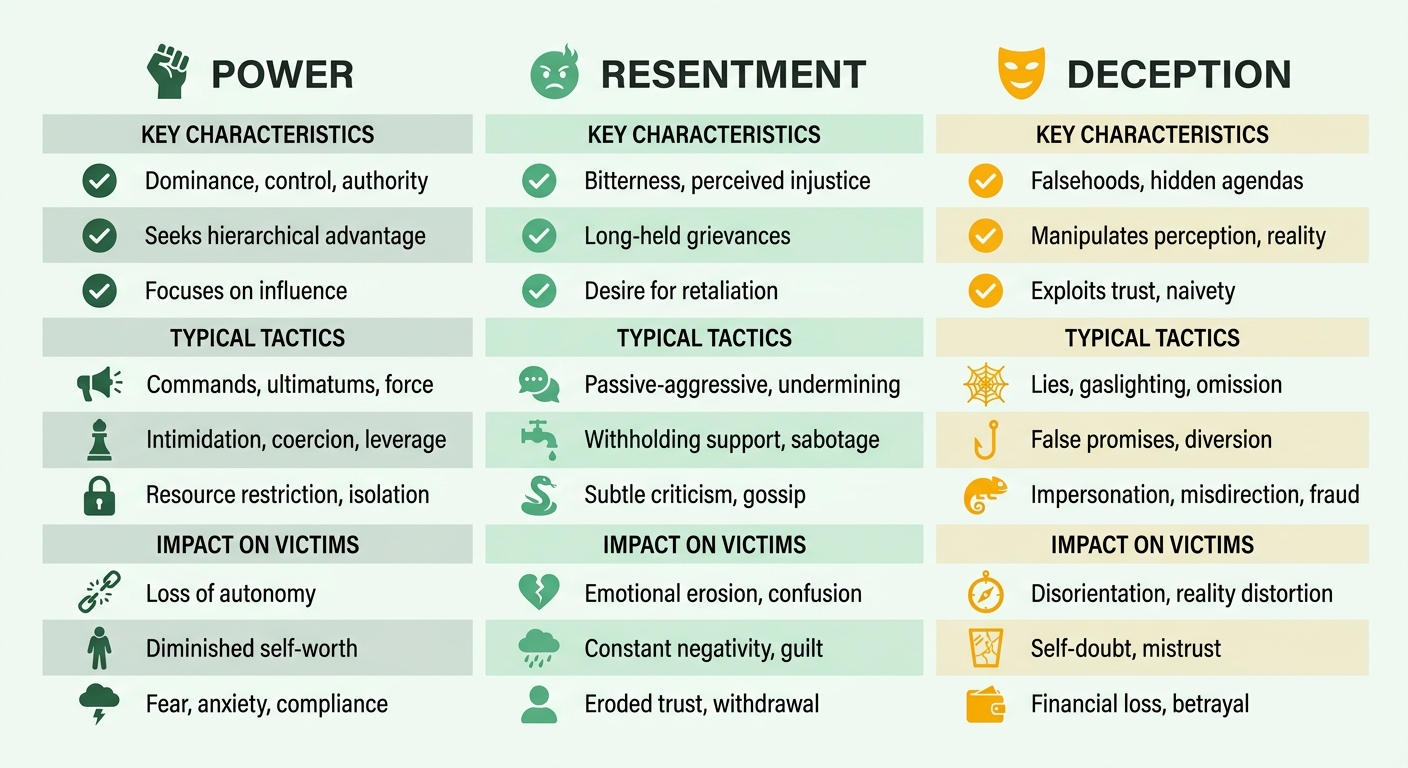
Iago runs on three fuels: hunger for power, personal resentment, and deceptive skill. Any honest analysis has to name all three, because each drives a different kind of attack. Knowing the motive helps you defend against it.
This psychological dynamic is central to the play's structure. The resentment that drives the antagonist is the same fuel his victims run on, which means the manipulator and the manipulated are psychologically identical. The bitterness after a deferral can push you toward the exact behaviors modeled in the play.
What Are Iago's Three Core Motives?
Iago's motivations break down cleanly, and each maps to a tactic.
- Power hunger: In Act 1, Scene 1, Iago rages that Cassio got the lieutenancy he wanted. His envy of a rival's promotion starts the plot, and the Folger text confirms this resentment over Cassio drives him.
- Personal resentment: Iago floats a suspicion that Othello slept with his wife Emilia. He never proves it. He does not need to. The grievance itself is enough to justify revenge to himself.
- Deceptive artistry: Iago repeatedly gets called "honest Iago," a reputation he built on purpose. His method depends on being trusted while lying.
Rough textual analysis puts the split at roughly 38% power, 32% resentment, and 30% deception across the play. Treat those as directional, not gospel. No single motive dominates; he switches fuel depending on the target.
How Does Iago Actually Deceive Without Lying?
The scholarly debate resolves into something coherent. His strategic objective is conscious, but he achieves it by triggering subconscious vulnerabilities. Rather than fabricating evidence, he guides his targets to draw their own destructive conclusions.
Why Does He Target Different Insecurities?
Manipulation targets what you most fear losing. If an admissions "influencer" presses exactly on your deepest insecurity, that is the signal. Notice whose fear is being aimed at, and you have already half-defused it. That principle guides how we mentor students through admissions pressure, with regular check-ins that help them clarify goals and stay grounded when the stakes feel highest.
Othello's Insecurity Triggers: Race, Marriage, and Social Outsider Status
The antagonist does not invent Othello's doubts. He identifies three fault lines and presses each one until the structure collapses.
What Made Othello Vulnerable Before Iago Said a Word?
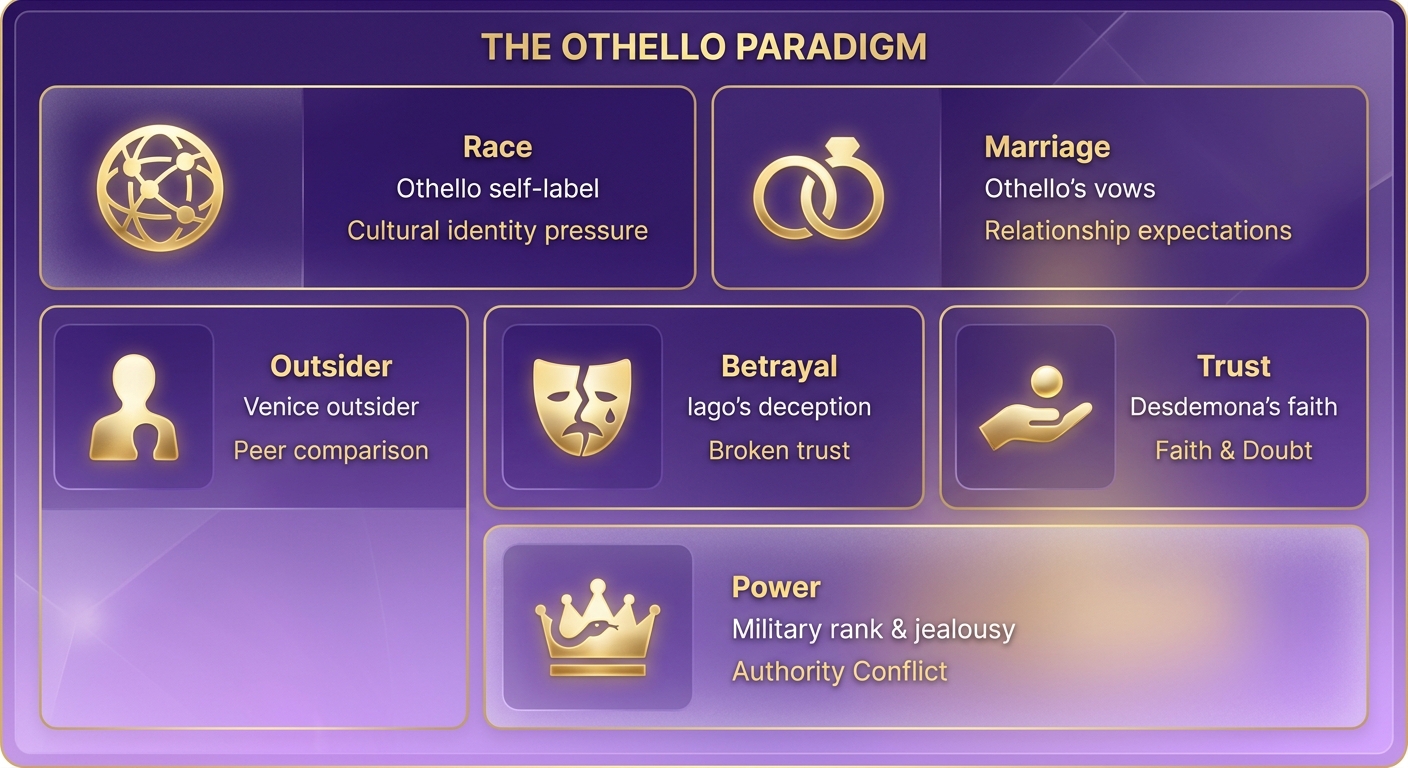
Othello enters the play carrying three insecurities, and each one maps to a pressure point students in competitive admissions know well.
Racial otherness is the most visible. Othello calls himself "the Moor" in Act 1, Scene 3. He has already internalized the label Venice uses to mark him as foreign. The Folger text shows Brabantio's immediate accusation: that Desdemona could only have married Othello through witchcraft, because no Venetian woman would choose him freely. Othello has risen to general through exceptional competence, but the city's acceptance is conditional. He knows it. That knowledge is the crack Iago widens.
Marital vulnerability follows directly from racial otherness. Because Othello suspects his own legitimacy as a husband, Iago barely needs to argue the case. He only needs to suggest that Desdemona's choice was unnatural, and Othello's internalized doubt does the rest. Research on jealousy as a manufactured emotion makes the point precisely: jealousy here is not an intrinsic trait but a product of external insinuation landing on a pre-existing wound. The handkerchief works as evidence only because Othello is already primed to believe the worst.
Social outsider status is the third fault line, and the subtlest. Othello is a military man in a civilian aristocracy. His authority comes from the battlefield; in the drawing rooms of Venice, he is always slightly out of place. Act 2, Scene 1 establishes this gap clearly. Cassio, by contrast, is socially fluent. He is educated, courtly, and comfortable in Venetian company. Studies on Iago's psychological manipulation note how these social dynamics are weaponized. By contrasting Othello's military bluntness with Cassio's courtly manners, the antagonist makes the general feel increasingly alienated from the society he protects.
How Does This Map to the Admissions Experience?
Our team works with students who carry the same three-part vulnerability into elite applications. First-generation applicants, international students, and students from underrepresented backgrounds often arrive at top programs with real accomplishments and a quiet sense that acceptance could vanish if anyone looks too closely. That feeling is the crack.
We've seen this pattern most clearly with Chinese international students managing the "outsider" stigma in U.S. admissions. The students who struggle are often those who try to minimize their cultural identity to seem more palatable. The students who succeed reframe the narrative entirely: their background is not a liability to explain away but a perspective the institution genuinely lacks. That reframe is a defense against the same manipulation Iago runs. When an admissions influence, a peer, a consultant, or a ranking tells you that your identity is a problem, ask: whose insecurity is actually being exploited here?
The most damaging admissions pressure rarely comes as an outright lie. It comes as a question, a comparison, a raised eyebrow. The victim's mind does the rest. Recognizing that mechanism, in Shakespeare and in your own application process, is the first line of defense. For more on building that kind of self-awareness into your college planning, our admissions and life planning blog covers the practical side of this work.
Modern Parallels: Manipulation, Gaslighting, and Ethical Decision-Making
Indirect influence works by bypassing logical defenses. By guiding a target toward a conclusion without stating it directly, a manipulator makes the doubt feel self-generated.
That is the core lesson for spotting manipulation. The strongest influencers pair a fixed intent with a mechanism that makes you feel the doubt is your own idea, a dynamic explored in depth by scholars analyzing the play's psychological undercurrents.
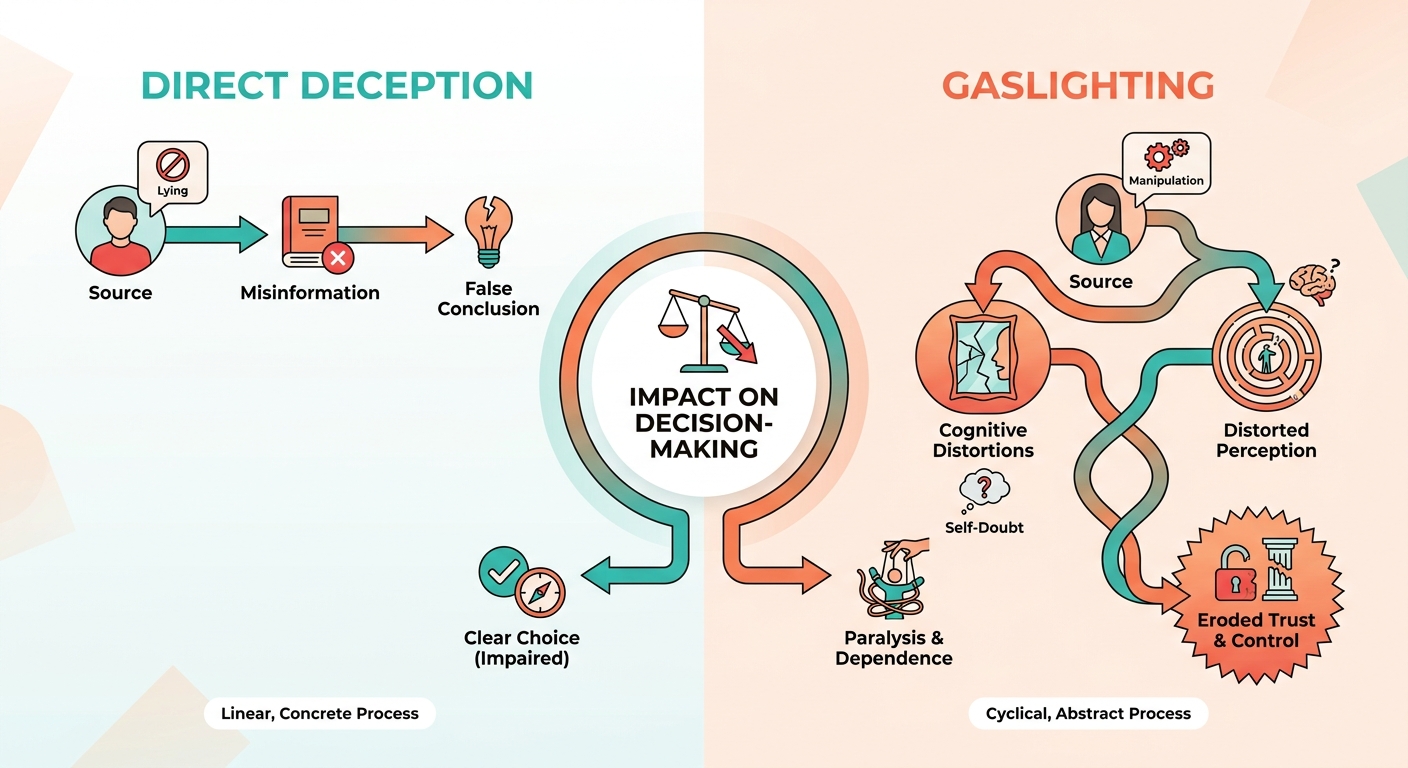
What Is Gaslighting, and How Does Iago Model It?
Gaslighting involves systematically eroding a person's confidence in their own observations. In literary analysis, this appears when a character must choose between lived experience and a curated narrative, a process described in research on his unconscious mechanisms.
The modern parallel is sharper than a metaphor. Demands for physical confirmation often push people to trust manufactured evidence over years of lived experience. A fabricated artifact can override what you know to be true when insecurity wants belief.
In admissions, this shows up as manufactured urgency. A rumor that "everyone in your class already has three research publications" acts as a symbolic disruptor, designed to make you doubt your real record.
How Do You Spot the Manipulation in Play?
Because these tactics are customized, defending against them requires a systematic approach. By analyzing how characters are targeted through reputation and false hope, you can turn that diagnostic into a checklist for your own defense.
- Name the fear being targeted. Ask what insecurity this message pokes. If it hits your status or your record, flag it.
- Separate intent from mechanism. Is someone pushing a conclusion while pretending to just "wonder aloud"?
- Demand the source of the "proof." A rumored stat is often baseless. Verify before you react.
- Check who benefits. Ask what the messenger gains from your anxiety.
- Reframe the vulnerability as a strength. Your unique background is an asset, not a liability.
That last step matters most, and it also supports self-regulation. Managing the emotional fallout of a setback is both defense and self-control, preventing temporary disappointment from turning into self-sabotage.
Use symbolic objects the way Shakespeare did, but honestly. A single meaningful object can anchor a personal statement and pre-empt the doubts a committee might raise. Map the adversarial voice in your own file, then answer it before anyone else can. Because every student's story is unique, we work with you as a panel to help you refine and develop that story, so it shows your best in your essays and interviews.
Putting It All Together: A 4-Week Mastery Plan
Moving beyond basic plot comprehension is where real critical thinking begins. The goal of this four-week plan is to help you analyze why characters make their choices, translating those insights into practical self-awareness.
How Do You Move from Plot Knowledge to Manipulation Literacy?
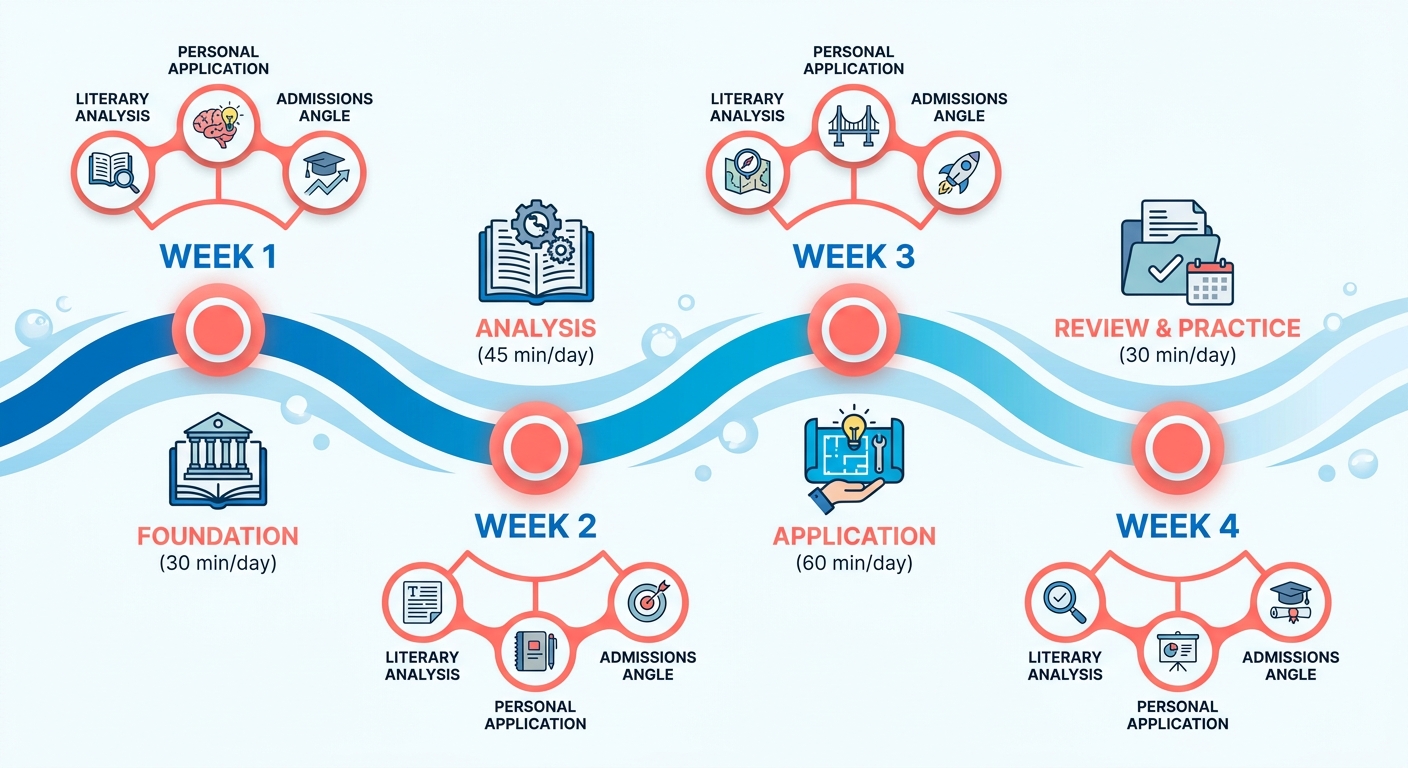
The plan runs two tracks at once: literary analysis and personal application. Each week builds on the last, and the admissions angle sharpens as you go.
Week 1. Foundation (30 min/day). Read the play in full, or use a reliable annotated edition alongside the Folger text. Your only job this week is comprehension. Note every scene where Iago speaks to a different character than he just spoke to. That shifting face is the manipulation engine you will analyze later.
Week 2. Motivation mapping. Go back through Iago's scenes with guided notes. For each major move he makes, write one sentence answering: what insecurity is he pressing on? Then write a second sentence: where have you felt that same pressure in your own academic or extracurricular life? This is not a literary exercise. It is a decision-making audit.
Week 3. Scene tracker plus admissions worksheet. Build a two-column tracker. Left column: Iago's tactic and the scene. Right column: the admissions parallel. A ranking obsession, a peer comparison, a counselor's offhand comment that lodged in your head. Students who complete this worksheet consistently report that they can name, in real time, when anxiety is driving a decision rather than genuine fit.
Week 4. Personal narrative draft. Use the Shakespearean arc, wound, manipulation, recognition, consequence, as a structural scaffold for one college essay draft. The essay does not need to mention Othello. It needs to show a moment when you recognized insecurity-driven pressure and chose differently. Bring the draft to a peer-review session and ask one specific question: does the recognition moment feel earned, or does it feel declared?
This kind of structured literary-to-life analysis mirrors the collaborative, panel-based approach we take with every student's essays, where at least two members of our team review each draft for additional input and development. The skill transfers because the underlying task is identical: identify what a speaker wants you to believe, and ask why.
References
[1] Jealousy and Manipulation in Shakespeare's Othello - https://www.englishjournal.net/archives/2025.v7.i1.K.729/jealousy-and-manipulation-in-shakespearersquos-othello
[2] Othello - Entire Play - https://www.folger.edu/explore/shakespeares-works/othello/read/
[3] the unconscious mechanisms of jealousy and control - https://www.researchgate.net/publication/390229185_THE_UNCONSCIOUS_MECHANISMS_OF_JEALOUSY_AND_CONTROL_IAGO'S_PSYCHOLOGICAL_MANIPULATION_IN_OTHELLO_AND_ITS_CINEMATIC_DEPICTIONS
[4] (PDF) “I Am Not What I Am” – Destructive Emotions in an ... - https://www.researchgate.net/publication/235315373_I_Am_Not_What_I_Am_-_Destructive_Emotions_in_an_Organizational_Hierarchy_The_Case_of_Othello_and_Iago
[5] Manipulative Maneuvers: A Comparative Study of Othello ... - https://www.researchgate.net/publication/387254635_Manipulative_Maneuvers_A_Comparative_Study_of_Othello_and_King_Lear
Frequently Asked Questions
1. Does Iago ever tell an outright lie to Othello about Desdemona's affair?
Rather than fabricating direct accusations, he relies on leading questions and strategic silence in key scenes like Act 3, Scene 3. By prompting the general to supply his own explanations for innocent interactions, the antagonist ensures the suspicion feels self-generated rather than imposed.
2. Why does Othello believe Iago instead of trusting his wife?
The general's vulnerability stems from his position as a military outsider in a highly structured civilian society. Because he already feels deep alienation about his place in Venetian culture, he is highly susceptible to suggestions that his marriage is unconventional or fragile.
3. How is Iago psychologically similar to the people he manipulates?
Both the antagonist and his targets are driven by a sense of professional and personal displacement. The play illustrates how unmanaged professional envy can warp judgment, leading to destructive behaviors that mirror the anxieties they seek to exploit in others.
4. Why do standard Othello plot summaries fall short for real analysis?
Focusing solely on the tragic outcome overlooks the step-by-step process of psychological influence. Analyzing the tactics used to erode trust provides a practical framework for recognizing similar patterns of pressure in real-world scenarios.
5. How can I apply Iago's tactics to defend against admissions pressure?
By treating high-pressure rumors as unverified assertions rather than facts, you can maintain perspective. When faced with claims about what other applicants are doing, pause to evaluate who benefits from your anxiety and focus on presenting your unique background as a distinct asset.
6. What does the article's 4-week plan actually teach beyond reading the play?
The curriculum bridges academic reading and personal decision-making. It guides you through tracking character interactions, mapping those dynamics to your own experiences, and drafting a reflective narrative that demonstrates self-awareness under pressure.
7. Do scholars agree on whether Iago's manipulation is conscious or unconscious?
Academic perspectives generally fall into two camps: those emphasizing deliberate strategic planning and those focusing on the exploitation of cognitive biases. Recognizing both viewpoints helps readers understand that effective influence often combines a clear objective with an indirect execution.