How to Read The Scarlet Letter for Essay-Ready Moral Contradictions
August 24, 2026

Key Takeaways
- The Scarlet Letter works best as a moral-contradiction toolkit. Its three central characters map cleanly to personal-growth and ethical-decision prompts.
- Set in the Massachusetts Bay Colony between 1640 and 1650, the novel follows Hester Prynne's public shaming for adultery and her quiet refusal to let that label define her.
- Admissions readers reward literary contradiction because holding two competing truths signals the critical maturity holistic review looks for.
- The strongest essays argue that Chillingworth becomes monstrous because a sympathetic, betrayed man chose revenge, not because he was born a villain.
- Each main character represents a different structural type of contradiction, so students can match one to their own story.
- Arguing the contradiction itself separates a genuine argument from a plot summary with extra steps.
Why The Scarlet Letter Is an Essay-Ready Moral Contradiction Toolkit
Most students treat The Scarlet Letter as a reading-comprehension chore. It works better as a moral-contradiction toolkit. The novel gives you three characters who each embody a different kind of ethical tension, and those tensions map closely to the personal-growth and ethical-decision prompts that dominate top-tier applications.
To make this work, look past the basic plot. The core engine of your essay is the psychological triangle: a woman forced to bear her shame openly, a minister rotting from the inside out, and an observer whose pursuit of justice curdles into obsession. This dynamic, detailed in this ethical-conflict analysis, provides rich tension for personal statements.
Why do admissions readers reward literary contradiction?
Because contradiction is where real thinking shows. Admissions officers read thousands of essays with neat conclusions. When you present a character who is sympathetic and deeply flawed, you show that you can handle nuance. Take Chillingworth: rather than labeling him a simple villain, a sophisticated essay explores how his initial victimhood fuels his destructive choices. This signals that you do not shy away from intellectual discomfort, a trait that matters in seminar-style college classes.
How do the three characters give you a framework?
These three figures offer distinct entry points for personal reflection. By aligning your experiences with their specific conflicts, you can establish a clear thematic focus.
- Hester = external label vs. internal morality. The study guide notes she "is not accustomed to measure her ideas of right and wrong by any standard external to herself" (Progeny Press guide). This archetype fits if you've had to define your worth against a limiting external perception.
- Dimmesdale = public expectations vs. private reality. His struggle speaks to the exhausting effort of maintaining an idealized persona while dealing with unaddressed personal challenges.
- Chillingworth = valid hurt vs. destructive escalation. This path works for essays exploring the temptation to let a fair grievance dictate your future actions.
Does the novel's structure help you build a growth arc?
Yes. This is the cross-source connection worth using. The guide splits 24 chapters into six blocks, and the ResearchGate analysis tracks Hester moving from shamed sinner to respected community member. Put those together and you get a redemption-through-time arc you can borrow directly for an 800–1,000 word essay.
One honest carve-out: skip this lens entirely for straight academic supplements ("Why our major?"). It works only when the prompt asks about personal growth or an ethical choice. Force it elsewhere and it reads as showing off. For more on matching essays to prompts, see our admissions planning blog.
Mapping Puritan Moral Contradictions: A Framework for Analysis
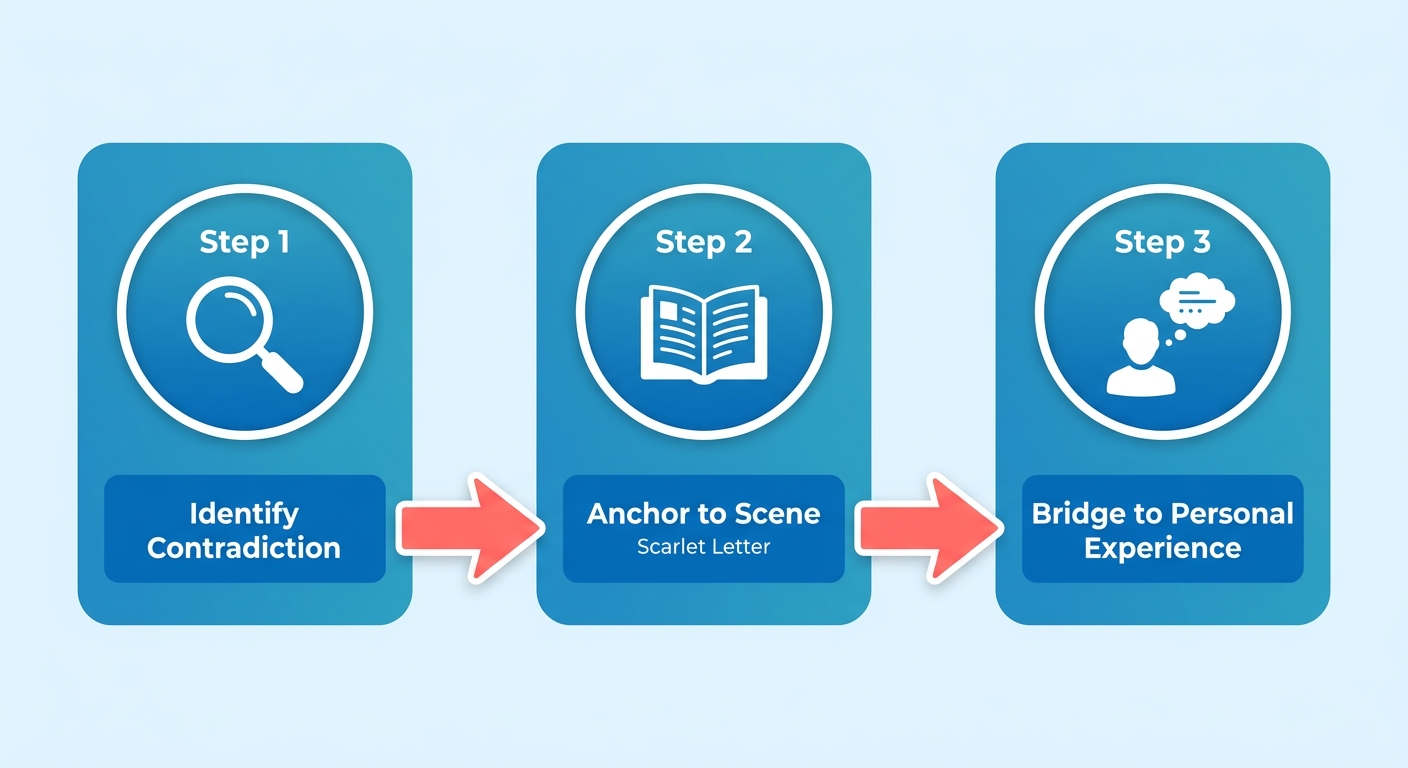
A moral contradiction is the gap between what a society preaches in public and what its members do in private. That gap is raw material for a strong admissions essay, and Hawthorne hands you three clear examples. When we teach students to pull an essay argument from the text, we start by naming the contradiction precisely, then anchoring it to a scene, then bridging it to their own life.
Here's our step-by-step model for turning Puritan hypocrisy into an argument you can write about. It works because the conflict between the individual and society plays out in scenes with clear stakes. Start by mapping each contradiction to a specific chapter, so your claim always has a moment behind it.
What Are the Four Core Puritan Contradictions to Track?
Focus your notes on four tensions, each a ready-made essay theme. Sin vs. Salvation: the colony claims grace is possible, yet it brands Hester permanently. Community vs. Individuality: the town demands conformity while Hester builds a self-defined moral code. Authority vs. Conscience: leaders enforce rules they secretly break. Gender roles vs. Personal agency: Hester is punished as a woman yet becomes the strongest moral agent in the book.
That fourth tension has real bite. The study guide highlights how Hester's isolation forces her to construct an independent ethical framework, completely detached from the community's rigid dogmas. This self-reliance is exactly the kind of active stance a strong essay takes.
How Do You Build the Contradiction Matrix?
Use a two-column matrix: Contradiction on the left, Textual Evidence on the right. One row per tension, one scene per row. This forces you to prove abstract claims with specific moments, the same discipline admissions readers reward.
In our experience, the matrix is why so many drafts land. Because every essay we work with is reviewed by at least two members of our team, a clear outline gives our mentors something concrete to refine and develop with you. The structure does the thinking so the writing stays clean. By organizing your thoughts this way, you ensure that your personal narrative is tightly woven with literary analysis, preventing the essay from drifting into vague generalizations.
What's the Modern Parallel That Makes It Yours?
Link each contradiction to a present-day version of the same gap. The obvious one: your polished social-media reputation versus your offline identity. That's Dimmesdale's public-private split in a phone.
One caveat worth stating plainly: avoid oversimplifying these conflicts. The ethical-conflict analysis emphasizes that true moral dilemmas do not have easy answers. Our take: the strongest essays sit inside that discomfort rather than resolving it too neatly. When you work with us on structuring a personal-growth arc, we help you explore these gray areas, ensuring your narrative reflects the genuine complexity of real-world decision-making.
Hester Prynne: Moral Complexity, Gender Dynamics, and the Power of the Scarlet 'A'
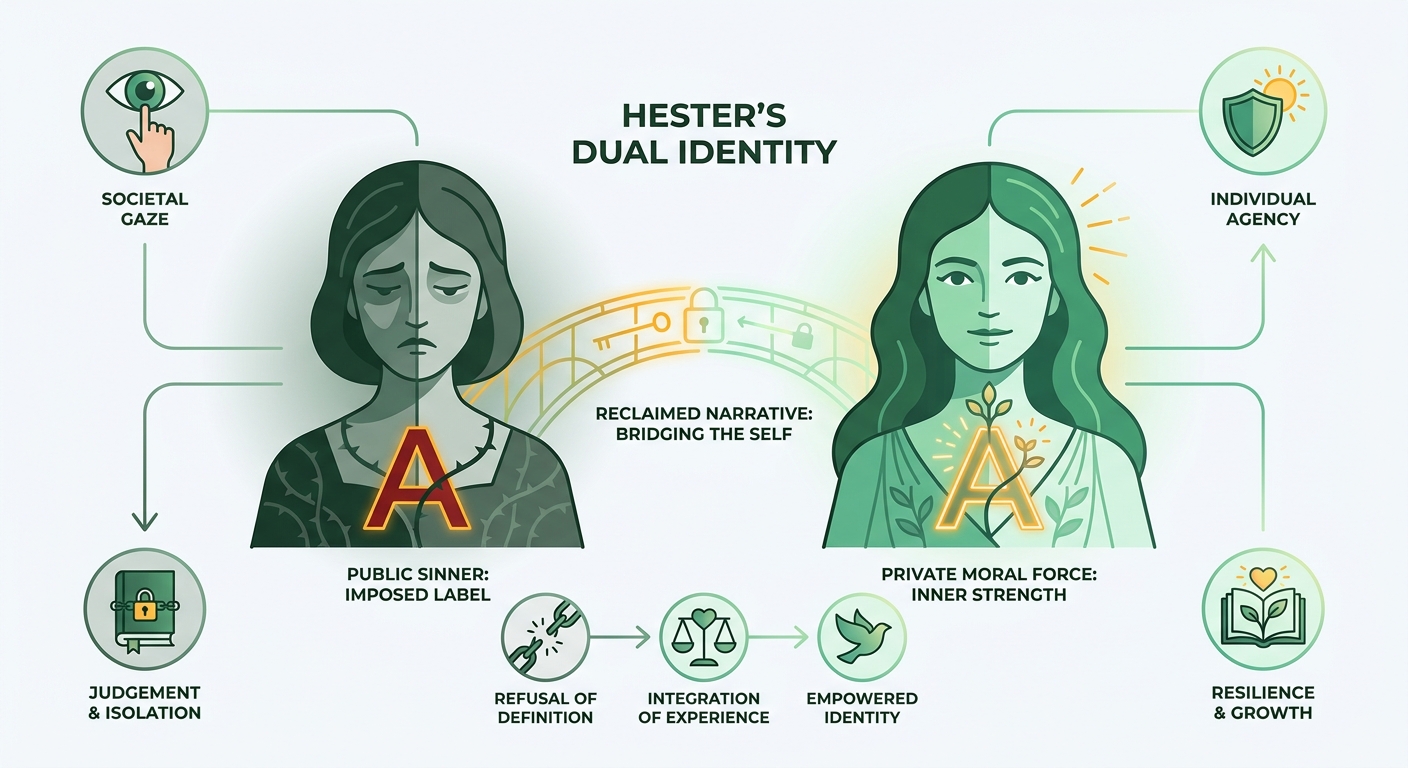
Hester Prynne is the essay-writer's best model because she holds two truths at once: she's a public sinner and a private moral force. That contradiction, labeled by her community and redefined by her own actions, is exactly the arc admissions readers reward. The real lesson here isn't that Hester argues she's innocent. She never does. She just refuses to let the label be the whole story.
That refusal is the move. She wears the "A" and quietly outworks the town that pinned it on her, nursing the sick and clothing the poor while the pious watch. Scholars highlight how her labor transforms her isolation into quiet authority, framing her actions as subversive strength rather than victimhood. For an essay, that distinction is everything: readers want agency, not a plea for sympathy.
How Does the Scarlet 'A' Change Meaning?
The "A" starts as Adultery, becomes Able through her deeds, and finally reads as autonomy she never surrendered. Hawthorne never restamps it officially. The town's read of it drifts because Hester's behavior forces the shift. The label stays; the meaning moves.
This is a structural trick you can use directly. The Penguin Random House reading guide frames Hester as "the herald of the modern American heroine," a woman who towers over the citizens who judged her. Kathryn Harrison's introduction calls out her "strength and stature." In practice, that means your essay should not fight the label a coach, teacher, or setback gave you. Redefine it through what you did next.
Why Focus on Hester's Agency in Your Essay?
Agency scores better. Essays built on Hester's choices read stronger than essays that dwell on her punishment. Punishment is passive. Redefinition is active, and active is what gets scored. When evaluating drafts, we look closely at whether the narrative leans on agency or slips into a plea for sympathy.
Think about how modern figures do the same. Malala Yousafzai took a label meant to silence her and turned it into a platform. That's the Hester structure exactly: external stigma, internal conviction, public redefinition. When we coach this comparison, we tell students to name the stigma plainly, then spend 80% of the words on the response.
Turning Hester's Arc Into Your Growth Story
Here's how the move works when it's done right. Anchor a supplemental essay on Hester's caretaking, then bridge to a real commitment of your own. Say, ongoing volunteer work that began as an obligation and became a choice. The label is "assigned service." The redefinition is chosen commitment. That gap can carry the whole essay. Because we help students build out meaningful life experiences well before the application phase, there's usually a genuine story like this to draw on.
Annotate this quote for tone before you write: "On the breast of her gown... The scarlet letter was a symbol of..." Notice how the sentence withholds the meaning, forcing the reader to supply it. Your essay can do the same by describing the deed and letting the reader draw the conclusion.
Skip this framework if your real story is quiet competence with no external label. Forcing a "stigma I overcame" arc onto an ordinary experience reads false, and admissions readers catch it fast. Save Hester for when you genuinely had a label to redefine. For structuring that arc across a full draft, our admissions planning blog walks through the pacing.
Roger Chillingworth: Revenge, Moral Ambiguity, and the Ethics of Justice
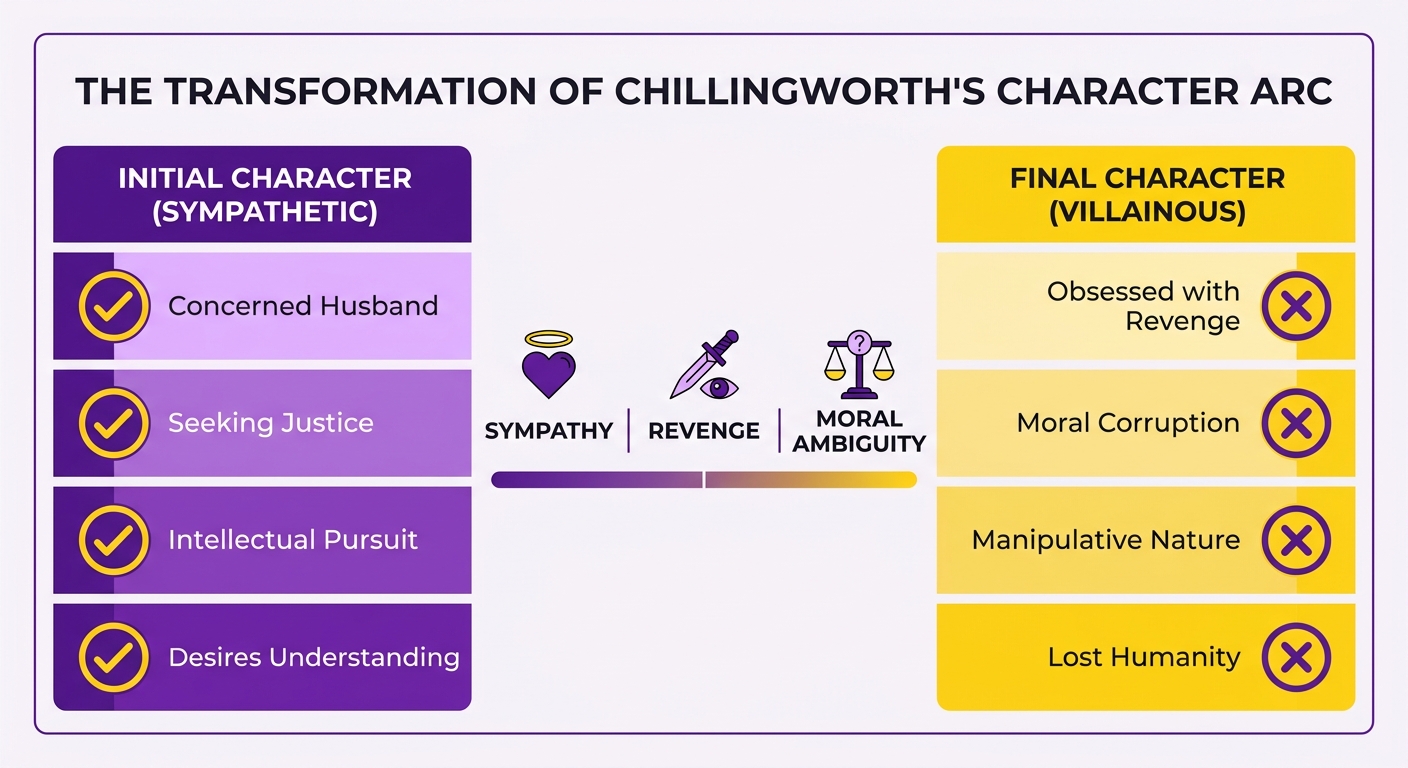
Roger Chillingworth is the character most students skip, and that's a mistake. He gives you the hardest contradiction to write about: a wronged man whose legitimate grievance curdles into something monstrous. Standard analyses paint him as the villain, full stop. The more useful read is that he starts sympathetic and chooses his way into evil, one decision at a time.
That choice is the whole essay. Chillingworth arrives to find his wife publicly shamed and her partner hidden. He has every right to feel betrayed. Then he does something no admissions reader would reward. He disguises himself, moves in beside Dimmesdale as his physician, and spends years quietly poisoning the man's health and mind. The ethical conflict analysis frames his revenge as the collision between raw human emotion and moral duty.
Is Chillingworth Actually Justified?
Short answer: his grievance is justified; his revenge is not. That gap is exactly what makes him essay gold.
Here's the tension one source holds at once. Chillingworth is often read as a Satanic figure, yet the same analysis calls his character complex and contradictory rather than purely evil. Our take: those aren't competing readings. The tragedy lies in how his initial victimhood is weaponized.
Run it through two ethical lenses and you have a built-in essay structure. A Kantian asks whether revenge could ever be a universal duty; it can't, because it treats Dimmesdale as a means to an end. A utilitarian asks whether the suffering Chillingworth caused produced any good; it didn't. It destroyed both men. Hawthorne even hands you the self-justification: "By thy first step awry, thou didst plant the germ of evil; but, since that moment, it has all been a dark necessity," a line the Progeny Press study guide flags for close analysis. Chillingworth calls his revenge fate. The reader sees it as a series of choices he refuses to own.
How Do You Turn This Into a Growth Essay?
Use Chillingworth as the "before," not the "after." His arc works when you show yourself catching the same impulse and stopping it.
We see this land best with students writing about a shift away from something driven by resentment or pure competition. A student framing a move from cutthroat sports rivalry toward community service can name the Chillingworth impulse directly: the urge to win by making someone else lose. The essay's turn is the moment they refuse the "dark necessity" excuse and choose a different response.
This maps onto modern debates worth naming in an essay. Restorative justice versus punitive punishment is the same argument Hawthorne stages: does harm get answered with repair or with more harm? A student hiding a mental-health struggle, or a whistleblower weighing exposure against silence, faces Dimmesdale's suppressed-guilt problem and Chillingworth's revenge problem at once.
Skip Chillingworth if your story is genuinely about triumph without moral cost. His arc only earns its place when you have a grievance you chose not to weaponize. When structuring this pivotal moment, focus on the conscious decision to break the cycle of retaliation, showing the reader your capacity for self-reflection.
From Insight to Essay: Thesis, Evidence, and Polishing the Final Piece
Once you have your contradiction mapped, the essay writes faster than you expect. We move students from analysis to draft in a fixed sequence, and every step has a checkpoint. The analysis you already built becomes scaffolding, not the subject. Your life is the subject.
Here's a thesis structure worth building around from day one.

What Does a Winning Thesis Look Like?
Thesis structure: [Contradiction] in The Scarlet Letter mirrors my own experience of [personal challenge] which led to [growth or outcome].
Fill in those three slots and you have an argument, not a book report. "The gap between public shame and private worth mirrors my experience of being labeled the quiet kid, which taught me to let my work speak before I did." That sentence carries a whole essay.
How Do You Gather Evidence Without Drowning?
Build a four-column table before you write a single paragraph. Skip the table and you'll pad the draft with filler quotes that add nothing.
- Quote: the exact line from the novel
- Page number: so you can verify it fast
- Analytical note: what the moral contradiction reveals
- Personal parallel: the moment in your life it maps to
Three strong rows beat ten weak ones. If a row has no personal parallel, cut it.
How Should You Budget Word Count and Revise?
Give the intro 150 to 200 words, the body 450 to 600, the conclusion 150 to 200. Most students overwrite the intro and starve the body. The body is where your growth lives.
Anticipate the skeptic. If a reader thinks "is a 19th-century novel even relevant?", answer it head-on: the moral contradictions Hawthorne names are the same ones you faced this year. Name the objection, then dismantle it in two sentences.
Then get more than one set of eyes on the draft. Seek external feedback to keep your narrative clear and sharp. A fresh perspective can help you identify where your personal growth needs more emphasis or where the literary connection could be tightened before you submit.
Connecting Historical Moral Contradictions to Modern Issues: A Final Reflection
The last move in this framework is the one that separates a good essay from a memorable one: taking a 17th-century contradiction and landing it in the world your reader lives in now. The historical narrative may end in the 1650s, but the moral tensions do not. Public shaming, hidden guilt, and revenge dressed as justice are still with us. Our job is teaching students to build that bridge without forcing it.
We see essays gain real weight when the historical contradiction earns a modern echo. The trick is precision. You're not writing a think piece on society. You're showing an admissions reader that you can hold a 400-year-old dilemma and a personal one in the same frame.
How Do You Connect Hawthorne's Contradictions to Today?
Map each character to a living tension, then to your own life. That three-part chain keeps the essay personal instead of preachy.
- Hester's public label: Her complex relationship with the community, traced in this study of individual versus society, mirrors how modern digital spaces assign rigid labels. The Penguin reading guide highlights her enduring strength. This offers a powerful angle for discussing how you navigated and redefined a limiting perception.
- Dimmesdale's private guilt: The psychological toll of his hidden life speaks to the modern pressure to maintain a flawless public image, illustrating the emotional cost of concealing personal struggles.
- Chillingworth's curdled grievance: The character's descent, analyzed in Yan Wang's ethical analysis, serves as a warning about the dangers of letting resentment dictate one's actions, mirroring contemporary call-out culture.
Our take: pick one parallel and go deep. Students who try to hit all three end up shallow on every count.
Can Symbolism Strengthen the Modern Bridge?
Yes, and it's where analytical essays pull ahead. Weaving in a symbol shows you read the book, not the plot notes. The novel runs on symbolism and imagery, including the prison-and-garden juxtaposition Hawthorne sets up early.
Here's how we teach students to embed a symbol:
- Thesis: Name the symbol and the contradiction it carries. The forest, for instance, reads as a space of moral freedom against the town's constraint.
- Body: Anchor it to a scene, then to your own moment of stepping outside expectation.
- Conclusion: Return to the symbol, changed. What looked like escape becomes clarity.
For example, a student writing about a summer research retreat could use the forest as a place where the rules that defined her at school fell away and she found her real question.
Should You End With a Future-Focused Paragraph?
Close with what the lesson will do next. We call it the future-focused paragraph, and it turns reflection into promise. State plainly how the contradiction you lived will shape your contribution on campus. Skip this move if your essay already resolves cleanly. Not every arc needs a forward look, and a forced one reads as filler.
References
[1] Ethical Conflicts and Moral Dilemma in The Scarlet Letter - https://bcpublication.org/index.php/SJOHSS/article/view/9209
[3] Reading Guide from The Scarlet Letter | Penguin Random House Canada - https://www.penguinrandomhouse.ca/books/77121/the-scarlet-letter-by-nathaniel-hawthorne/reading-guide
[4] Conflict between the Individual and Society in The Scarlet ... - https://www.researchgate.net/profile/Leema-Sen-Gupta/publication/331157807_Conflict_between_the_Individual_and_Society_in_The_Scarlet_Letter/links/5c68b4dc299bf1e3a5ad3e2b/Conflict-between-the-Individual-and-Society-in-The-Scarlet-Letter.pdf
Frequently Asked Questions
1. Which character should I choose if my experience involves both being wronged and reacting badly?
Chillingworth's arc works well for narratives centered on self-regulation. If you faced a situation where you had a legitimate reason to be angry but realized that pursuing retaliation would be self-destructive, this framework lets you show emotional maturity and the choice to prioritize growth over conflict.
2. What if my experience doesn't involve any external label or public judgment?
If your story lacks a public label, look to Dimmesdale's internal conflict instead. His struggle is entirely private, making it a better fit for essays about overcoming self-doubt, imposter syndrome, or the pressure to appear perfect. This lets you write a strong growth narrative without fabricating an external conflict.
3. Can I use this framework for a "Why our major?" or short supplemental essay?
Academic supplements require direct, evidence-based explanations of your career goals and interest in a specific program. Introducing a complex literary metaphor in a short space can distract from your qualifications. Save this analytical framework for longer personal statements where you have room to develop a reflective narrative arc.
4. How is analyzing a moral contradiction different from writing a plot summary?
A plot summary only describes what happens to the characters. In contrast, analyzing a contradiction explores the underlying tensions driving their decisions. By focusing on why a character's actions conflict with their stated beliefs, you move from passive observation to active analysis and show the higher-level critical thinking skills required in college-level writing.
5. How much of my essay should focus on the novel versus my own life?
The literary analysis should serve as a brief introduction or a thematic thread, not the bulk of the essay. Use the novel to establish the core concept in your opening paragraphs, and then pivot completely to your personal experiences. The majority of the word count must be dedicated to your actions, decisions, and subsequent personal development.
6. What's the recommended word count breakdown for this type of essay?
Prioritize the middle section of your draft. The introduction should quickly set up the literary parallel, while the conclusion should briefly project your growth into the future. The vast majority of your writing must remain in the body paragraphs, as this is where you provide the concrete details of your personal challenges and achievements.
7. How can I make a 17th-century novel feel relevant to a modern admissions reader?
Admissions readers are interested in how you connect historical themes to contemporary human behavior. By showing that the psychological pressures Hawthorne described, such as the burden of secrecy or the impact of social exclusion, are still highly relevant today, you demonstrate intellectual curiosity. Focus on a single, clear connection to keep your analysis sharp and impactful.