How to Write About Classic Literature Without Sounding Like SparkNotes
August 17, 2026

Key Takeaways
- Original literary analysis explains why events matter thematically and technically, while plot summaries recite events admissions readers already know.
- Strong essays examine texts through thematic, technical, and contextual lenses simultaneously rather than discussing a single interpretation in isolation.
- Genuine literary insight requires substantially more work than superficial plot summaries—the difference between skimming study guides and annotating the actual text.
- Admissions officers distinguish forgettable applications from competitive ones by identifying whether essays interrogate meaning or simply recite events.
- Effective analysis connects observations about the author's methods to insights about broader themes like representation or social structures.
When you search for a book summary online, you'll find thousands of results—most offering the same plot recap you could get from skimming the book jacket. The difference between a summary and literary insight is what can separate a forgettable application from a competitive one.
What Sets Original Analysis Apart
Study guides tell you what happened. Original analysis explains why it matters. A plot summary tells you the ending. Literary analysis examines how the author uses structure and choices to explore ideas like mercy, autonomy, or social failure. Admissions readers can often spot a surface-level essay quickly—it recites events without interrogating meaning.
Strong analysis reads a work through multiple lenses at once: thematic (what ideas does this explore?), technical (how does the author's craft shape meaning?), and contextual (what historical or personal forces might have influenced this work?). When analyzing character dynamics, look beyond surface traits. Instead of labeling a character as isolated, examine how specific dialogue patterns or physical boundaries established by the author might reinforce that isolation, then connect those technical choices to your broader thesis.
Time Investment vs. Depth
Developing a standout essay typically requires a structured timeline that prioritizes deep engagement over quick drafting. Rather than rushing to write, consider allocating substantial blocks of time to sit with the text, allowing your initial impressions to mature into more developed arguments.
Difficulty varies by text complexity and your familiarity with close reading. Some novels feature accessible prose but layered symbolism. Others demand more intensive analysis. Track your annotations: frequent margin notes per chapter can signal you're engaging deeply enough for original work.
A strong literature essay can show admissions committees you can synthesize, argue, and think independently—skills that selective universities often value.
Why Original Analysis Matters
Original analysis is the difference between a student who understands a book and one who just knows what happened in it. A senior can recite plot points flawlessly, name every character, trace the whole story, and still write an essay that says nothing an admissions reader hasn't seen many times before. Colleges aren't only testing whether you finished the book. They're often testing how you think. When you push past the summary and interrogate why an author makes certain structural or thematic choices, you're demonstrating reasoning that selective schools may be looking for.
Who Benefits Most From Original Analysis?
Students aiming at selective schools often benefit the most. If you're applying to schools with heavily test-based admissions, deep literary analysis may matter less. But for anyone writing a Common App essay or a supplemental that asks about a meaningful text, original thinking can be central to the evaluation.
It also helps in ways that outlast the application. The habit of asking "why does this choice matter?" can carry into college seminars, research papers, and later into work that rewards clear argument.
What Challenges Does Original Analysis Solve?
The biggest problem it addresses: the flat, forgettable essay that reads like a book report. Study guides are widespread, which means many readers have already absorbed surface versions of classics you might write about.
Original analysis addresses several things at once:
- It can prove you actually read. Specific textual detail is harder to fake from a summary.
- It reveals your voice. Your reading of a scene is yours alone. No study guide supplies that.
- It answers the prompt. Most essay questions ask what you think, not what happened.
That last point trips up more seniors than any other. The plot is often the easy part. Your interpretation is where the essay earns its place.
Selecting the Classic Text
The books you choose shape the essays you can write. Students sometimes pull summaries off the internet, assume they understand the novel, then struggle to write anything distinctive. The difference between a memorized plot and a text you actually interrogate starts with selection strategy, not comprehension skill.
What Makes a Text Work for Original Analysis?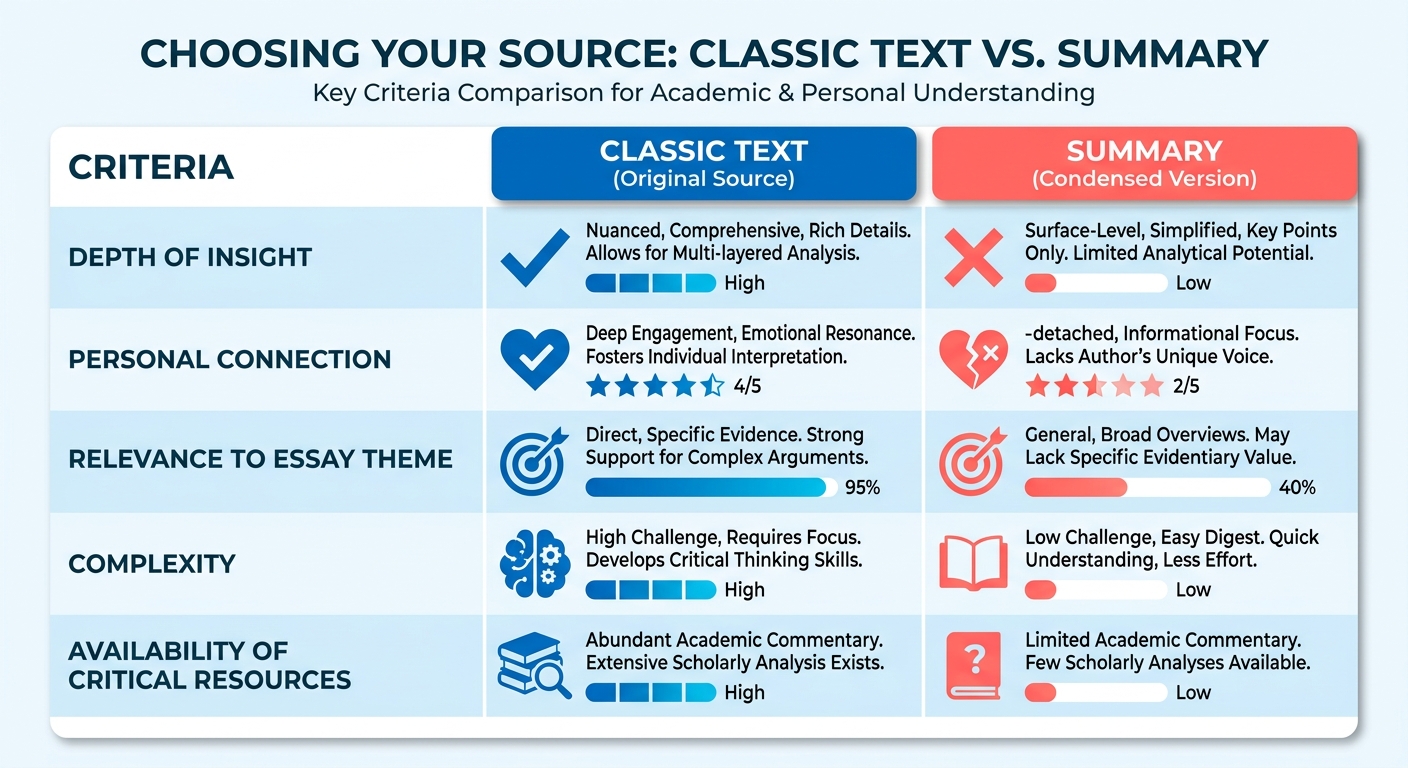
A text earns its place in your essay when it gives you competing interpretations to wrestle with. Not every classic does this equally well. Some novels present their themes plainly—the symbolism is obvious, the moral arc is clear, the ending ties everything up. Those books can make challenging essay material because they leave you little to argue about. You want friction. You want a text where smart readers might disagree about what it means.
Some works operate on structural ambiguity. Rather than resolving central conflicts cleanly, the narrative may leave the moral weight of characters' choices to the reader's judgment. Some novels rely on unreliable narrators whose personal biases color every description, forcing you to question the validity of the narrative itself. This inherent instability can make a text fertile ground for an essay.
Consider skipping texts where the "right answer" feels settled. If the book's Wikipedia page gives you a single-sentence theme summary and most readers agree on it, you may be looking at a difficult starting point for original analysis. The goal isn't to find the hardest book. The goal is to find a text where multiple defensible interpretations exist and you can stake a claim.
How to Approach Text Selection
Start by asking what question you actually want to explore. A student interested in power dynamics and complicity might find more in one courtroom drama than another. Someone wrestling with identity and performance could pull more from certain first-person coming-of-age narratives than others. The text matters less than the question you bring to it.
Don't pick a book, read it cover to cover, then discover too late that the essay angle doesn't hold. Consider whether the text will support the argument you want to make before committing extensive time to close reading.
When students try to force a text into an argument it can't support, the essay often collapses. You can read more about selecting texts and developing arguments in our college admissions blog.
Conducting a Thorough Inspection of the Text
A thorough text inspection means reading with a pen in hand, not skimming for plot. Close the summary tab and open the actual pages. The goal is to catch what the author is doing sentence by sentence, not just what happens. That's where original insight comes from.
Close reading is the skill that can separate a real essay from a recycled study guide. When you slow down and mark the text, you start noticing patterns a summary flattens out. Here's a process to consider.
How Do You Conduct a Close Reading?
Close reading is a slow, deliberate pass where you annotate language, structure, and repetition to find meaning below the plot. Read once for the story. Then read again with a specific question in mind, marking anything that answers it.
-
Read for the story first. Get the plot down so you're not distracted by "what happens next." This is the only pass where a summary-level understanding is enough.
-
Reread with a question. Pick one thread. How does the author describe a recurring element throughout the book? Where does a particular image appear? A focused question turns passive reading into active hunting.
-
Mark repetition and contrast. Underline words, images, or phrases that come back. Repetition can be purposeful in strong fiction. When an author keeps returning to a particular motif, they may be building an argument.
What Should You Annotate?
Annotate the things a plot recap ignores: possible symbolism, foreshadowing, tone shifts, and any moment where the language feels heavier than the action requires. Write your reaction in the margin, not a summary of the line.
For example, a small detail in a character's possession early in a novel might foreshadow the ending and signal a thematic tension. A margin note like "gentleness = danger?" could be the seed of a thesis.
Skip this level of scrutiny for books you're reading for pleasure. But for the text carrying your college essay, this is the work that can produce something distinctive.
Analyzing Themes, Motifs, and Style
Themes and motifs are the patterns that repeat across a text, and finding them is where your essay can move past surface-level summaries. A theme is the idea a book keeps returning to. A motif is the concrete image or phrase that carries that idea. Loneliness might be a theme. Recurring images of hands, animals, or a particular place are motifs that can make it visible.
Hunt for repetition first, then ask what it might mean. When an author repeatedly draws attention to a specific physical gesture or sensory detail, they may be establishing a thematic anchor. Tracking how these elements evolve across different scenes can allow you to build an interpretation based on textual evidence.
How Do You Identify Themes and Motifs?
Read for what recurs, not just what happens. A theme often announces itself through repetition of ideas across scenes; a motif announces itself through repeated objects, images, or language. List every element that shows up more than twice, then group them. The clusters can point to what the author emphasizes.
For example, when a particular dream or goal appears when characters need comfort, when others buy into it, or when hope briefly emerges, each repetition may raise the stakes. By the final scene, that repeated image can be what makes the ending land. Your essay should trace that arc, not just note the element exists.
Why Context Shapes the Themes
Historical context can turn a good reading into a more developed one. When an author writes during a particular economic or social period, the themes you find in the text may reflect those conditions. Certain forms of isolation you find in a text might be personal, economic, or tied to a labor system or social structure of the era.
Context is where study guides often stop and original thinking can begin. When you connect a character's isolation to the segregation or economic conditions of the period, you're reading the book as a document of its moment. That's the move admissions readers often reward.
Skip the surface symbol hunt if you can't tie it to meaning. A motif you can't interpret is trivia. One pattern, fully argued, typically beats five you only listed.
Synthesizing Analysis into Original Writing
Synthesis is where your scattered annotations become a single argument. Many students gather observations, then present them in the order they found them. The result can read like an extended summary with a few opinions attached. Consider doing the opposite: pick one claim, then build everything around it.
Start with a thesis you could actually argue against. A strong thesis invites disagreement. Rather than stating a character's actions are purely heroic, argue that their choices might stem from self-preservation or systemic pressure. Choose the reading you can defend with the most textual evidence, then let your close-reading notes serve that one line. Everything that doesn't support it gets cut.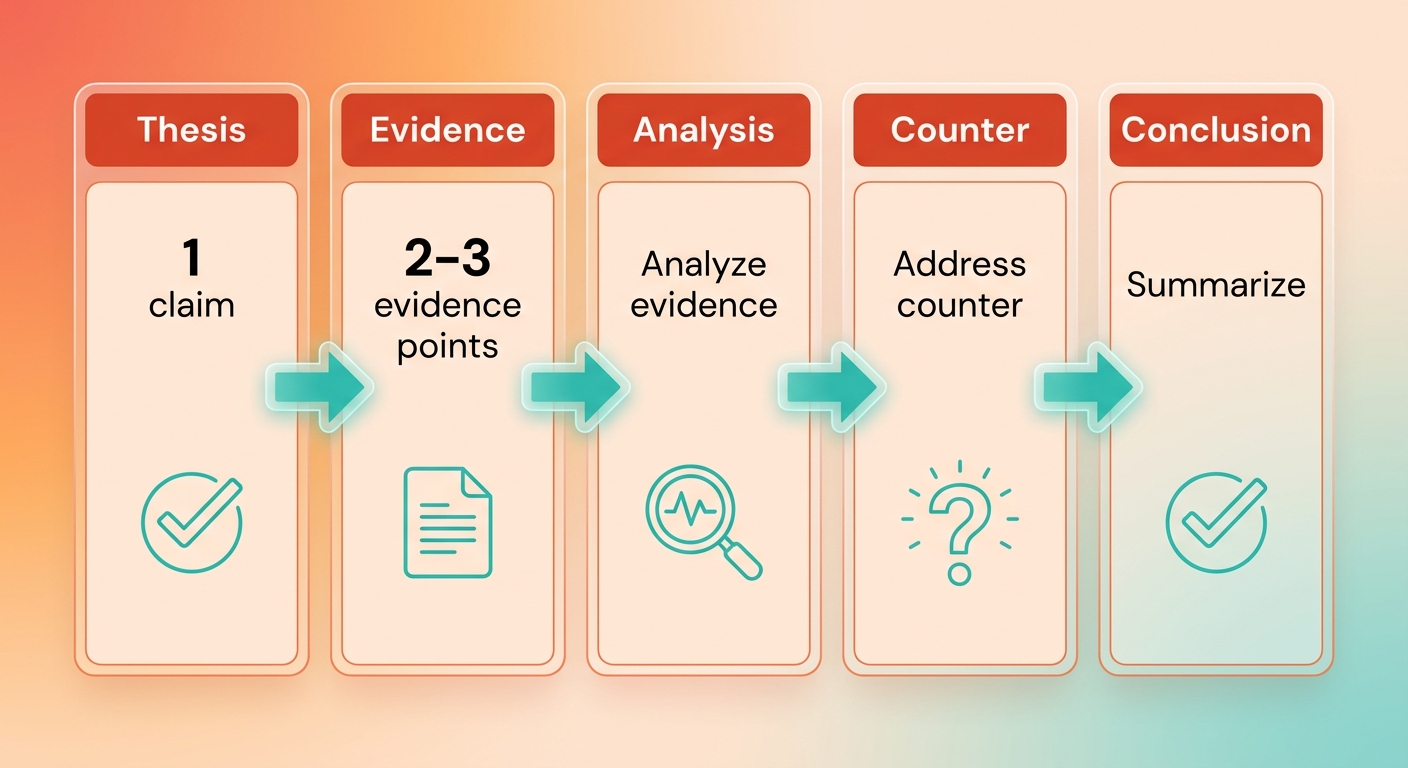
How Do You Structure the Essay?
Organize by idea, not by plot. Each paragraph should advance your argument, not walk through chapters in order. Open with the claim, bring in your strongest textual evidence, then explain what it proves. If a paragraph only restates what happened, it's summary, and it should be cut.
Fight the urge to be comprehensive. You don't need every motif you found. Two or three pieces of evidence, examined closely, can be more effective than ten mentioned in passing. Depth often wins.
How Do You Keep It Original and Avoid Plagiarism?
Originality comes from your reasoning, not your vocabulary. One way to plagiarize accidentally is to read a study guide, absorb its interpretation, and reproduce it without realizing. Consider closing the guide before you write. If your insight matches the first thing that appears online, dig for a second layer.
When you do reference outside interpretation, cite it and then push against it. Admissions readers may reward the student who says "the common reading is X, but the text suggests Y." That move can prove you read the criticism and thought past it.
Clear writing seals the deal. Short sentences. One idea per paragraph. No thesaurus gymnastics. When students write plainly, their thinking shows, and that thinking is what can earn the spot at a top school.
Developing a Unique Analytical Voice
Your analytical voice is the specific way you read a text that reflects your perspective. It's not a style trick or a fancy vocabulary. It's the angle you take, the questions you ask, and the willingness to sit with a contradiction instead of resolving it too fast. A student who moves past the plot recap starts sounding like a thinker, not a search result.
Many seniors don't have a developed voice yet because they've rarely been asked to question standard interpretations. They summarize because summarizing feels safe. A voice tells the reader why you, specifically, find one moment worth examining more closely than others might.
How Do You Cultivate Critical Thinking?
Consider arguing against your first instinct. Your first reading is often the one many others share, which means it's the one an admissions reader has likely seen before. Write down your obvious take, then spend time trying to prove it wrong. The friction is where original thought can live.
Ask more probing questions, too. Instead of "What is the theme?" try "What does the author refuse to explain?" The gaps in a text often reveal more than the resolved parts. That habit of interrogating silence can build a voice faster than any template.
What Pitfalls Kill an Original Voice?
Three traps can flatten student analysis: oversimplification, borrowed interpretations, and false certainty. Oversimplification reduces a complex character to a single label. Borrowed interpretations mean adopting a critic's opinion without testing it. False certainty is claiming a text "clearly" means one thing when the evidence pulls multiple ways.
The remedy is nuance. Strong analysis can hold two ideas at once and admit the tension. When you write "the ending is both merciful and monstrous," you sound like a mind at work.
Skip the voice-building drills if you're writing a routine class response with a fixed rubric. Save this depth for the essays that matter most. That's where a real voice can pay off.
References
[1] SparkNotes: Today's Most Popular Study Guides - https://www.sparknotes.com/
Frequently Asked Questions
1. Should I pick the hardest classic to impress admissions officers?
Admissions officers typically value the depth of your insight rather than the complexity of the book's vocabulary. A dense, difficult text can actually hinder your writing if you spend all your time decoding the language instead of analyzing the themes. Focus on finding a work where you can construct a clear, debatable argument.
2. How do I avoid accidentally plagiarizing after reading study guides?
To help ensure your ideas remain distinct, take notes in your own words while reading the text, rather than copying down summaries. When you consult external guides, use them only to verify historical facts or structural definitions. When drafting, rely on your personal annotations to build your paragraphs.
3. Does deep literary analysis matter if I'm applying to state schools?
While schools with formulaic admissions criteria focus primarily on GPA and test scores, any institution requiring personal statements or supplemental essays will likely evaluate your critical thinking. Developing these analytical skills early can also prepare you for the writing requirements of undergraduate coursework across disciplines.
4. How much textual evidence should one essay actually include?
Aim for a balance where every quote or specific detail you cite is followed by at least two sentences of your own analysis. Instead of listing every relevant scene, select only the most vivid moments that directly support your thesis, ensuring you have enough space to fully unpack their implications.
5. How do I know if I'm annotating deeply enough?
Look at the nature of your notes rather than just the quantity. If you are only writing down plot reminders, consider shifting focus. Deep annotation involves questioning the author's word choice, noting shifts in tone, and identifying recurring imagery that connects different parts of the narrative.
6. Which classic works best for someone new to close reading?
Consider beginning with shorter novels or plays that feature clear, distinct character voices and straightforward narrative structures. Works from certain literary periods often provide a manageable balance of accessible language and rich thematic material, allowing you to practice tracking motifs without getting lost in complex syntax.
7. What's the fastest way to develop an original analytical voice?
Focus on identifying contradictions within the text. When a character acts in a way that seems to violate their established personality, or when the ending feels unresolved, explore those friction points. Writing about these tensions can naturally force you to move past standard interpretations.
We're here to help you develop the analytical skills that make your application stand out. Reach out when you're ready to dig deeper.