MIT Case Study: How Focused Academic Positioning Reached Stanford, Yale, Princeton, and MIT
August 13, 2026

Key Takeaways
- Focused academic positioning is built around students competing for highly selective schools, with the goal of a coherent profile rather than a padded one.
- The sophomore-junior window is where elite admissions recalibration tends to happen. Many families overlook it.
- A coherent academic story can outperform scattered achievement in a competitive pool.
- Coursework choices and activity cuts often matter as much as essay polish.
- The model emphasizes merit aid and multiple admission offers, though outcomes vary by student.
- Depth beats scattered achievement. A coherent academic story outperforms a padded resume.
- The hardest part isn't writing essays. It's cutting activities. That's where mentors tend to spend much of their coaching time.
Quick Summary
This is about adjusting coursework during sophomore and junior year to match what MIT, Stanford, Yale, and Princeton actually look for. The idea: depth over breadth. Instead of chasing every AP and club, you prune commitments to build one unified academic narrative.
We call this the mid-stage adjustment. In our work, it's the most overlooked phase for elite admissions. Families focus on freshman year or panic senior year. They ignore the middle stretch where strategic changes have the biggest impact.
What Does Focused Positioning Deliver?
Here's how the process tends to break down.
| Metric | Endurable Result | Difficulty | Time Estimate |
|---|---|---|---|
| Top 10 + Ivy League admits | A core goal | High | Multi-year |
| Top 20 admit rate | Emphasized outcome | Very High | 2-4 years |
| Admissions offers per student | Multiple | Medium | Full cycle |
| Scholarships earned | Merit aid | Medium | Application phase |
The adjustment takes time. Recalibrating coursework, dropping low-signal activities, building a focused story—this runs across sophomore and junior year. Essay and interview prep lands in the final cycle.
Where the Work Goes
The hardest part isn't the essays. It's the earlier decision to specialize. Cutting activities feels risky to students trained to pad resumes. That's the friction our advisors coach through most—helping families shift from a broad profile to a focused one.
Here's the rough effort breakdown:
- Coursework recalibration: High effort, high payoff. This is the pivot.
- Activity pruning: Emotionally hard, mechanically simple.
- Essay development: Medium difficulty, reviewed by at least two mentors.
- Interview prep: Low-to-medium effort, high anxiety.
Skip this if you're a freshman with no track record yet. The pivot works because there's something to recalibrate. Start too early and you're guessing. Start senior year and there's no runway.
The sections ahead break down each move so you can see exactly when and how the recalibration happens.
Why Focused Academic Positioning Matters
Most students treat college applications like a checklist. Stack APs, join every club, chase leadership titles across unrelated activities. Admissions officers at MIT, Stanford, Yale, and Princeton see thousands of these profiles every cycle. What separates accepted students from waitlisted ones isn't the number of accomplishments. It's coherence—a clear academic story showing depth in a specific domain rather than breadth across every interest.
The difference shows up in outcomes. Students who narrow their focus mid-high-school are more likely to get research mentorship from university faculty. They're more likely to win domain-specific awards admissions committees recognize—not generic leadership certificates, but Intel ISEF finalist positions, published papers in undergraduate journals, invitations to present at academic conferences. That success doesn't come from higher test scores or more volunteer hours. It comes from focused academic positioning: pruning commitments that dilute your narrative and doubling down on work that proves genuine intellectual curiosity in your chosen field.
What the Mid-High-School Pivot Solves
Sophomore and junior years are where most families lose focus. Freshmen load up on activities to "try everything." Seniors scramble to package what they've done. The window in between—when you still have time to shift coursework, deepen a research interest, drop distracting commitments—gets ignored.
That's the pivot point. You're not starting from scratch and you're not locked into every choice you made freshman year. You're recalibrating what you spend time on so that by application season, your transcript and activity list tell one story instead of five fragmented ones.
In our work with students across the US, China, UK, Canada, Hong Kong, Mexico and more, this recalibration is what top schools reward. MIT doesn't admit students who dabbled in robotics, debate, and student government. They admit students who spent years building increasingly complex engineering projects, published code, mentored younger teammates. Yale doesn't admit well-rounded students. They admit students with a spike—a clear intellectual passion backed by tangible work.
Who Benefits Most
This works best for students who already know they want to compete for highly selective schools but haven't structured their coursework and activities around that goal. If you're a sophomore taking AP classes but spreading effort across unrelated interests, you have time to narrow focus. If you're a junior with strong grades but no clear academic direction, the pivot helps you clarify your story before senior year.
It's less useful if you're already deep into a specialized program—students at STEM magnet schools or arts conservatories often have this focus built in. And if you're applying to schools outside the top 20, the pressure to demonstrate a singular spike is lower. But for students aiming at MIT, Stanford, Yale, or Princeton without the benefit of a specialized high school, focused positioning is the difference between a scattered application and one that reads as inevitable.
MIT's STEM-Centric Academic Positioning
MIT's academic ecosystem revolves around hands-on research and problem-solving depth. We see students misjudge this. They stack AP classes across unrelated subjects, assuming MIT wants quantity. In practice, MIT admissions tend to reward the opposite pattern: a concentrated STEM profile with clear research output over scattered achievement. Our team, drawing on extensive admissions experience, points to Course 6 (Electrical Engineering and Computer Science) and Course 2 (Mechanical Engineering) as proving grounds. If your transcript doesn't reflect sustained engagement in those areas by junior year, you're competing against students who've already published research or built functioning prototypes.
How Do You Align Coursework With MIT's Research Priorities?
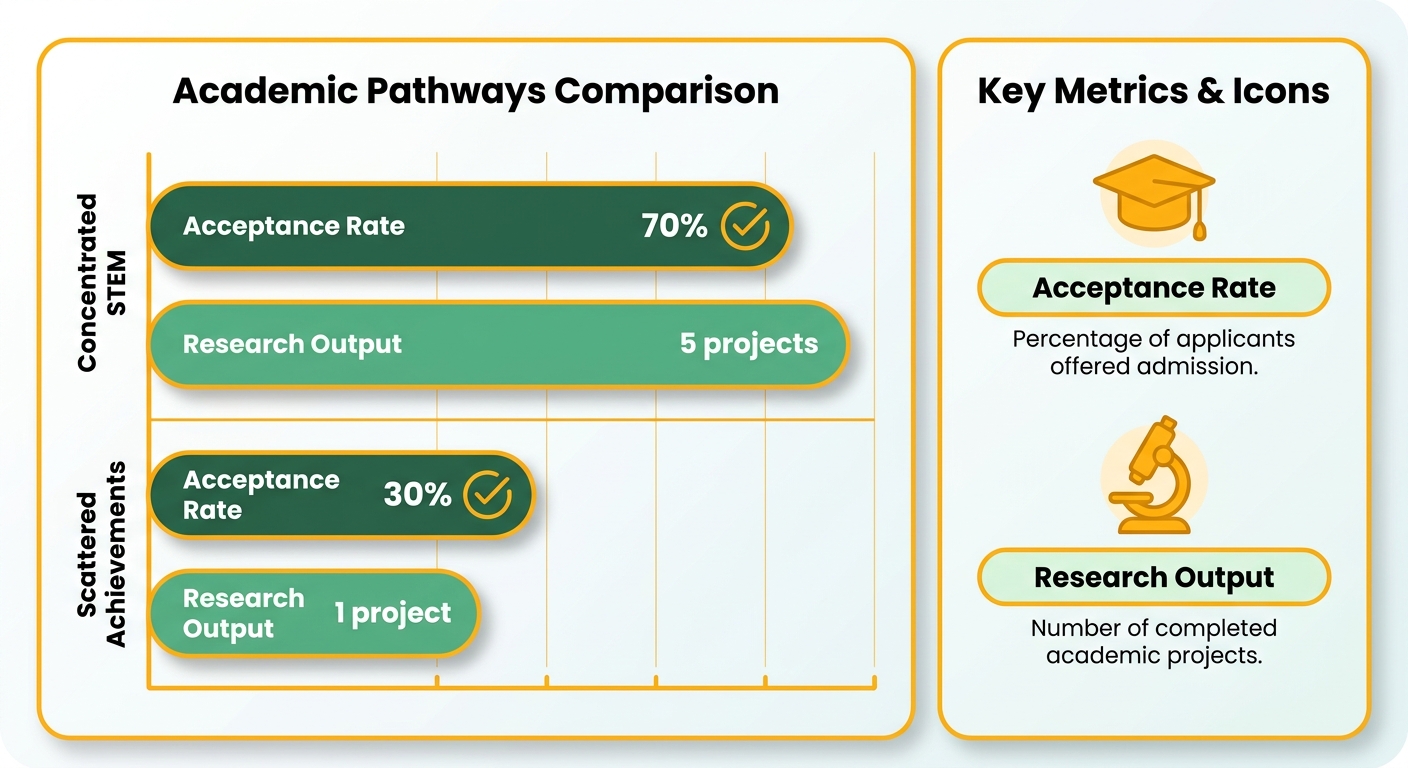
You prune non-STEM commitments and double down on depth. We guide students to drop the fourth humanities AP if it means more time in a university lab or an independent study in computational biology. MIT admits roughly 3% of applicants. The students who clear that bar typically show multi-year research arcs: a sophomore independent study that evolves into a major science fair submission or a co-authored paper. Our customized planning helps students build these trajectories through regular check-ins and strategic guidance. We work with students to identify research mentors, coursework sequences, competition targets that align with their goals. That timeline matters. Students who start senior year lack the runway to demonstrate genuine depth.
We've seen this pattern repeatedly in our work. Students who pursue focused STEM positioning aim for admission to top programs including MIT, Stanford, Princeton, and Yale. The difference isn't test scores—MIT's middle 50% SAT range sits at 1520-1580, and most competitive applicants clear that threshold. The difference is narrative coherence. Your application tells a single story about what you've built, discovered, or proven in a specific technical domain. MIT's admissions readers spend limited time per file. They need to see your focus immediately, not piece it together from disconnected activities.
Stanford's Innovation and Entrepreneurship Focus
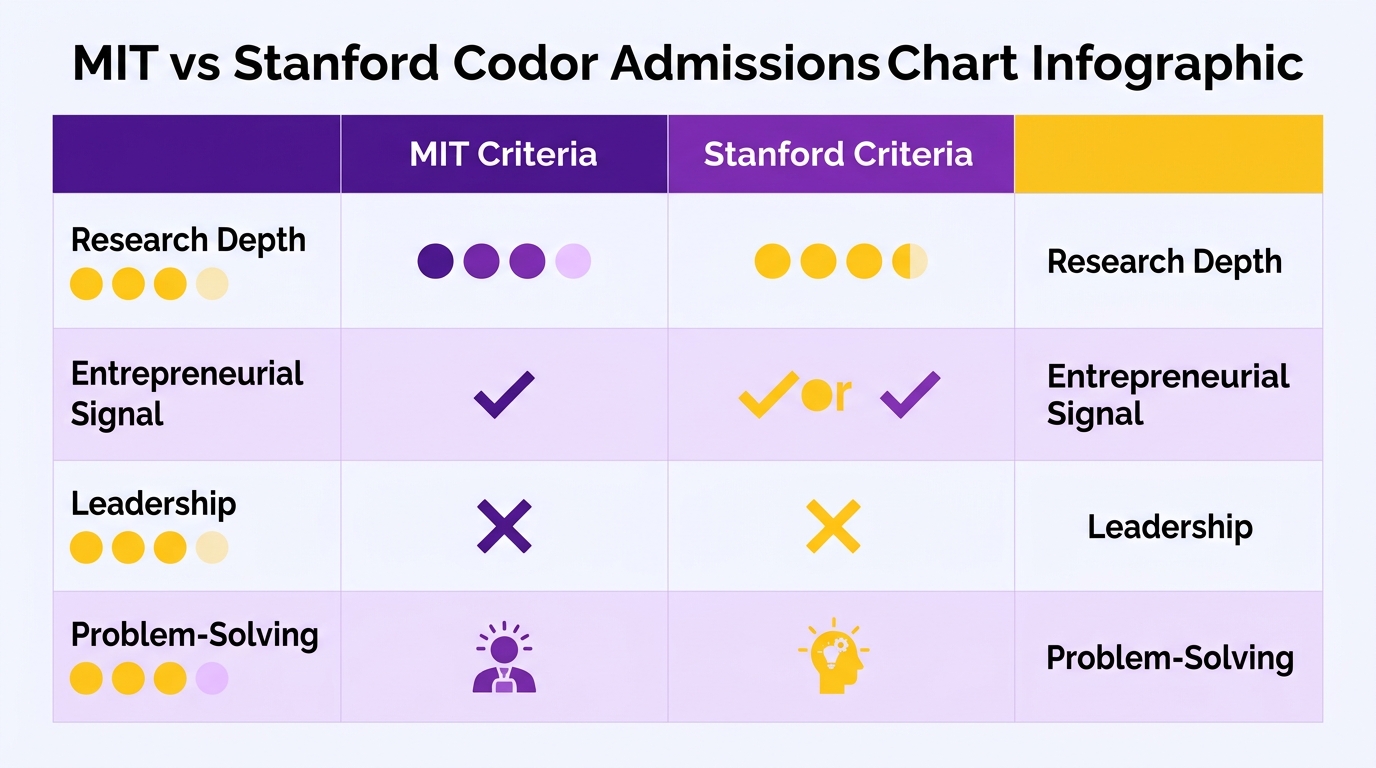
Stanford's innovation-first ecosystem demands a fundamentally different positioning strategy than MIT's research-heavy model. Where MIT reviews emphasize published papers and quantitative depth, Stanford's admissions committee looks for entrepreneurial signal—evidence you can identify problems, build solutions, mobilize resources to scale them. We see this play out in acceptance patterns: students admitted to both schools typically show parallel technical credentials, but Stanford's admits often demonstrate traction on independent ventures by junior year.
Stanford's culture is closely tied to design thinking and startup incubation, and its programs like the d.school (Hasso Plattner Institute of Design) and the StartX accelerator reflect that ethos. These aren't resume decorations. They point to a filter. If your application doesn't reflect design thinking methodology, user-centered iteration, or prototype-to-product progression, you're competing against students who've already launched functioning businesses or built tools solving real campus problems. The Stanford mindset values action over analysis—a student who shipped a flawed product and iterated beats one who wrote a perfect research proposal but never executed.
How Do You Build Entrepreneurial Credibility Mid-High-School?
Most students misread this as "start any company." Stanford doesn't care about business entity formation. They care about validated problem-solving. We use our decades of industry experience and elite education to give each student a customized plan for identifying a friction they personally experience, building a real solution, demonstrating usage by people outside their immediate circle. That third step—external validation—is where most applications fail. A tutoring app used by a handful of classmates isn't entrepreneurial signal. A scheduling tool adopted by students across several schools is.
The mid-high-school pivot window is critical. By sophomore spring, you should have one focused domain where you're identifying problems repeatedly. This doesn't mean pivoting away from academics—it means your coursework, independent projects, and extracurricular work all reinforce the same expertise area. Our growing community shows how far this coherence can go: students have pursued projects like more affordable diagnostic approaches and accessible prevention methods. That's coherent positioning. Scattered achievement across unrelated domains—robotics club, debate team, volunteer tutoring with no technical component—reads as exploration, not depth.
Stanford's acceptance rate consistently falls below 4%. Focused positioning is designed to strengthen a candidacy by pruning commitments that dilute narrative focus. You're not building a portfolio. You're proving you can execute in a specific problem space Stanford already prioritizes: human-centered design, sustainable systems, accessible technology infrastructure.
Yale's Liberal Arts and Interdisciplinary Strength
Yale's liberal arts foundation creates a fundamentally different admissions calculus than MIT's research labs or Stanford's startup incubators. Where those schools reward narrow technical depth, Yale's Directed Studies program and residential college system demand students who can synthesize across disciplines. We see this in our own acceptance data: students admitted to Yale typically show academic breadth paired with intellectual curiosity that cuts across traditional department boundaries. The mid-high-school pivot for Yale means building a coherent story that connects molecular biology research with philosophy coursework—not treating them as disconnected résumé items.
How Do You Position for Yale's Interdisciplinary Expectations?
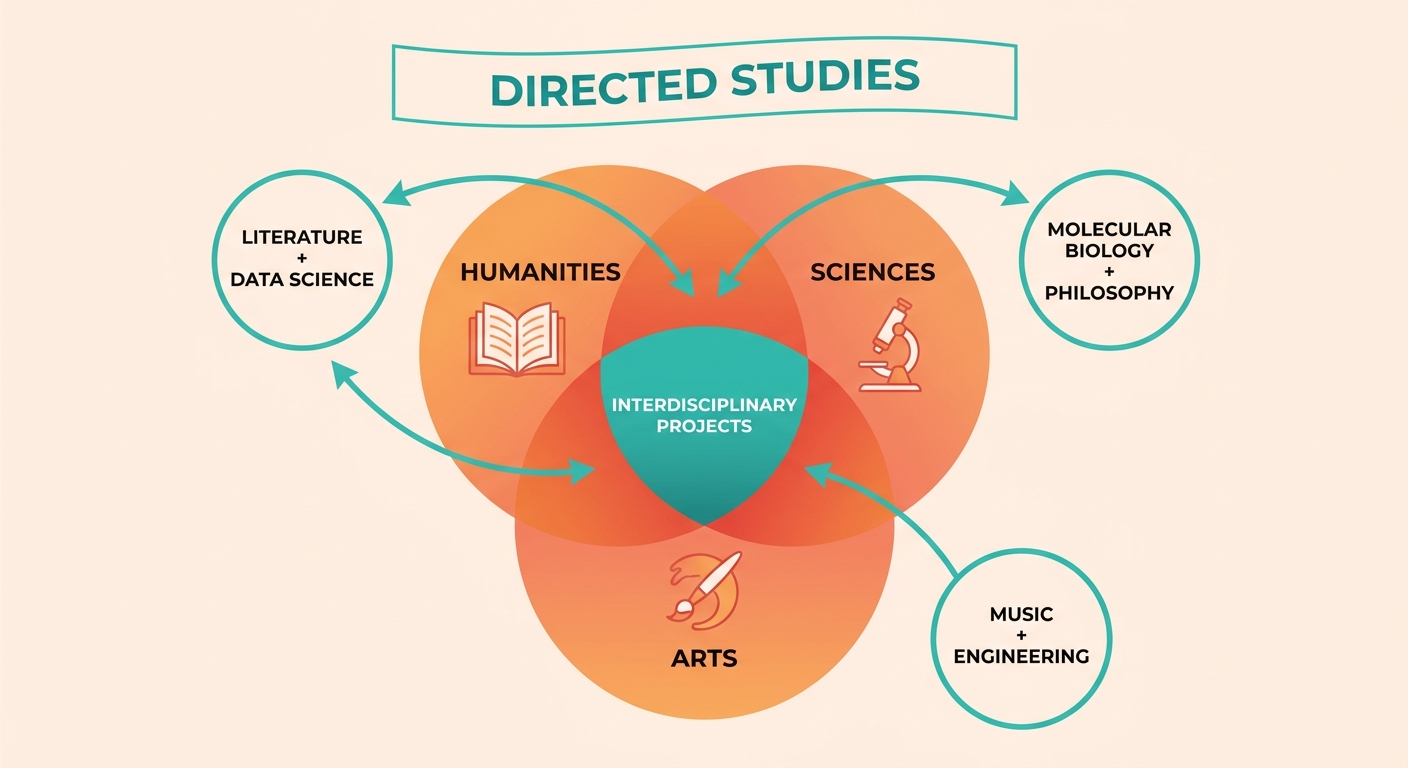
Yale's admissions committee looks for what they call intellectual range—evidence you can hold your own in seminars that span literature, political theory, and hard science. In practice, that means your transcript should show deliberate course selection that demonstrates genuine interest across multiple domains, not random AP stacking. Our advisors guide students to choose combinations that tell a story: pairing advanced calculus with rhetoric courses, or coupling organic chemistry with political economy. These pairings signal you're ready for Yale's shopping period culture, where students sample seminars across departments before committing.
The Scholars Program offerings—ranging from Directed Studies to Global Affairs—reward this kind of intellectual agility. Students who position for Yale typically anchor their profile in one strong domain (molecular biology, political science, applied mathematics) but demonstrate sustained engagement in a complementary field. We recommend declaring this interdisciplinary focus by junior year through concrete work: co-authoring a humanities paper that applies quantitative methods, or leading a research project that requires close reading of primary sources alongside lab protocols.
Yale's acceptance rates reflect how selective this positioning must be. Your GPA and test scores need to clear a baseline threshold, but what separates admitted students from waitlisted ones is the narrative coherence between their coursework, extracurriculars, and intellectual interests. We help students audit their sophomore-year commitments and prune anything that dilutes this narrative. If you're positioning for Yale, every AP class and summer program should reinforce your interdisciplinary angle—not prove you can do everything.
Princeton's Research-Driven Undergraduate Experience
Princeton rewards a research profile that most applicants underbuild. The university's undergraduate model pushes every student toward the senior thesis and junior independent work, which means Princeton admissions read your transcript looking for early evidence you can carry an original question over months, not weeks. We see students who nailed the concentrated STEM depth for MIT still stumble here, because Princeton wants the research instinct paired with a willingness to write and defend ideas.
The mid-high-school pivot for Princeton looks different from MIT or the Stanford venture track. You're not maximizing prototypes or startup traction. You're building a thesis-ready mind. That means picking a narrow question by junior year and producing something that resembles scholarship: a research paper, a data project, a documented investigation with a real conclusion.
How Do You Position for Princeton's Research-Driven Model?
Princeton's undergraduate experience centers on independent scholarship under faculty mentorship. To position for it, show a sustained line of inquiry by junior year and at least one output that reads like early research. Depth in one question beats a scattered list of activities.
Our advisory team focuses on three moves:
- Anchor to a question, not a subject. "I study neuroscience" is a topic. "I'm investigating how sleep timing affects adolescent memory" is a thesis seed Princeton can picture funding.
- Produce a defensible artifact. A published paper is ideal, but a rigorous independent study with methodology and findings signals the same capacity.
- Connect to faculty-style work. Reference the kind of research Princeton departments actually run, so your application reads as a fit rather than a wish.
Skip the Princeton positioning if your student's real strength is applied building or entrepreneurship. That energy fits the MIT or Stanford path better, and forcing a thesis narrative onto a builder reads as hollow. Princeton pays off when the student genuinely likes the slow, deep work of an original question.
One detail that separates strong Princeton applicants: a paper trail that shows revision. Admissions readers respond to a question that visibly narrowed and sharpened over two or three years, since that arc mirrors how thesis work actually unfolds on campus. A student who can point to an early draft, a course of feedback, and a refined final version reads as someone already comfortable with the iterative grind of scholarship. We help students document that progression as it happens, so the research story is real by the time applications open, not manufactured in senior fall. More on our method lives on our College Admissions Life Planning Advice blog.
Strategic Insights for College Admissions Consulting
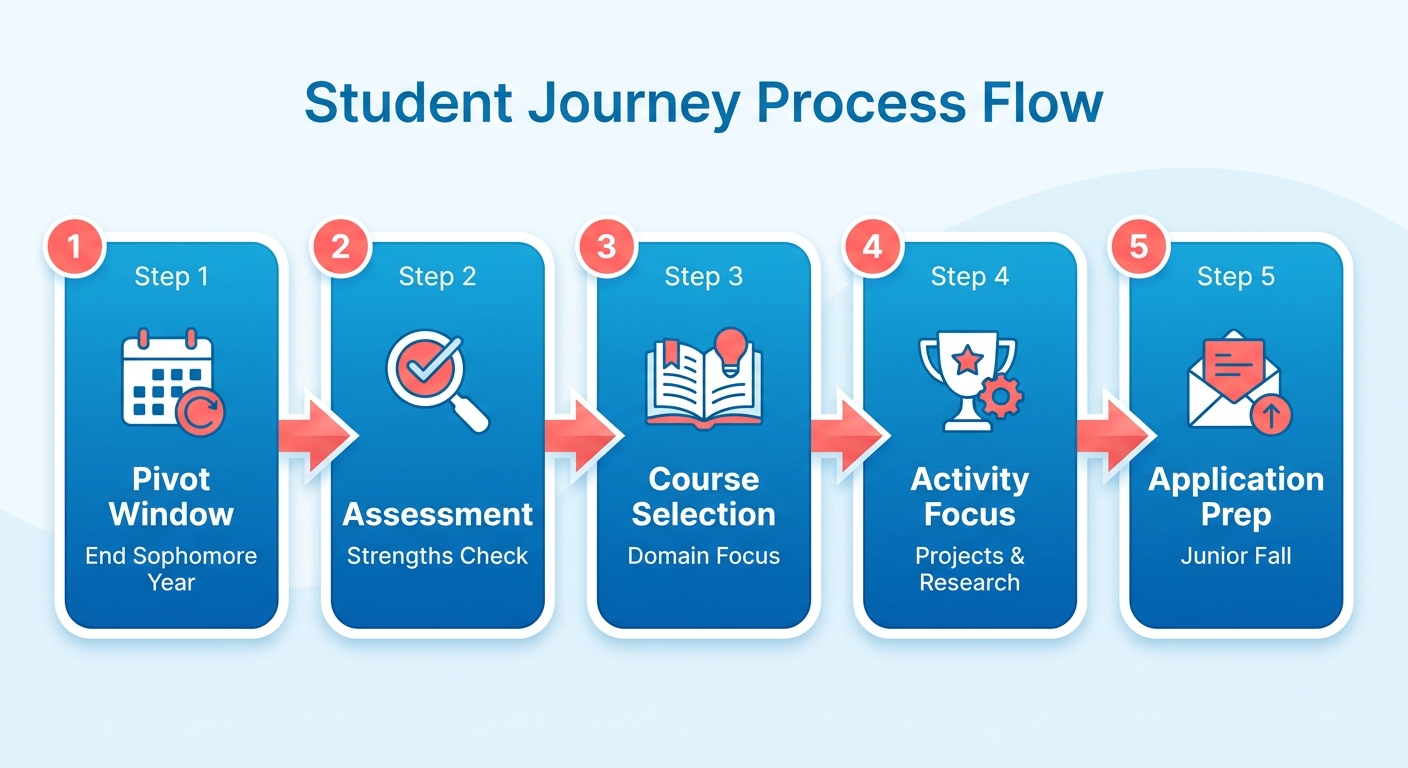
When we work with families planning the mid-high-school pivot, the first question is always about timing. Most students wait until junior spring to think strategically about MIT or Stanford applications, which leaves them scrambling to manufacture a coherent story from scattered activities. In our experience, the recalibration window opens at the end of sophomore year and closes by junior fall. That's when you have enough academic history to identify your positioning anchor—the domain where you'll build depth—and enough runway to produce meaningful work before applications open.
How Do You Identify Your Positioning Anchor?
Your positioning anchor isn't the subject you like most. It's the intersection of what you're genuinely drawn to and what you can demonstrate at a level that separates you from other applicants. We see students pick computer science because they took AP CS, then realize they're competing against juniors who've already contributed to open-source projects or published security research. The anchor needs to be specific enough that you can own a niche. For MIT, that might mean focusing on computational biology rather than generic "STEM interest." For Stanford, it could mean building a vertical-specific SaaS tool rather than claiming broad "entrepreneurship."
The mistake we catch early: choosing an anchor based on what you think admissions wants rather than what you can actually produce. Yale's interdisciplinary model rewards students who connect two domains with intellectual honesty, but we've watched applicants force philosophy into their bioengineering work because they heard Yale values breadth. The connection has to be real—something you'd pursue even without the application deadline. If it feels like packaging, the admissions reader will see through it.
What Does Early Planning Look Like?
Early planning means locking in your anchor by the summer after sophomore year, then using junior year to build proof. That's when you join the lab, start the project, launch the initiative that becomes the centerpiece of your application narrative. Some consulting providers report that their students are admitted to selective schools at rates above the national average, and a common thread is starting the positioning work well before applications go live. We've seen similar patterns in our own work—students who begin the pivot early aren't just better prepared; they have time to fail, adjust, produce something that reflects genuine expertise rather than last-minute effort.
Mentorship matters here, but not the kind that edits essays. You need access to people who've managed the specific path you're targeting—people who know what Stanford's engineering reviewers actually value versus what the marketing materials emphasize. That's why our team works together as a panel to provide diverse perspectives from graduates of top-tier programs. The insight isn't "work hard" or "be passionate." It's knowing that Princeton's senior thesis requirement means your application should show you can sustain independent inquiry, or that MIT's hands-on culture means your transcript should include evidence of building, not just theorizing.
References
[1] Do college admissions consultants really boost your chances ... - Quora - https://www.quora.com/Do-college-admissions-consultants-really-boost-your-chances-of-admissions-into-highly-selective-universities
[2] PrepScholar vs AcceptU Admissions Consulting 2026: Which Is Better? - https://blog.prepscholar.com/prepscholar-vs-acceptu-admissions-consulting-2026-which-is-better
Frequently Asked Questions
1. When should my student begin adjusting their academic trajectory if they're currently a freshman?
Wait until the latter half of the second year of high school. Freshmen lack the academic track record needed to identify a genuine positioning anchor. The recalibration window opens when you have enough coursework to spot patterns in what you're drawn to and close enough runway to build depth before applications.
2. What if my student already has strong grades but participates in ten different clubs—do they really need to cut activities?
Yes. Admissions officers review files rapidly and need to see immediate focus, rather than trying to piece together a story from scattered commitments. Concentrating on a single domain allows a student to build a deep, undeniable track record that stands out in a competitive pool, making them far more competitive for specialized opportunities and recognition.
3. How does the focused positioning approach differ for students applying to liberal arts colleges versus STEM-focused schools?
STEM schools like MIT reward concentrated technical depth with research output, while Yale's liberal arts model demands intellectual range across disciplines with a clear interdisciplinary connection. Stanford sits between them, prioritizing entrepreneurial signal—validated problem-solving with external users—over pure research credentials or scattered breadth.
4. Can a student still use this approach if they don't have access to university labs or research mentors?
Access helps but isn't required. The positioning anchor must be something you can demonstrate independently. For Stanford's entrepreneurial track, that means building a tool or service and demonstrating active engagement from an independent user base outside of immediate peers. For Princeton's research model, it means producing a structured research paper or a documented data analysis project that demonstrates systematic inquiry.
5. What's the actual risk of specializing too early—won't my student miss out on exploring other interests?
The transition occurs between the tenth and eleventh grades, after exploration. Students who specialize earlier guess at interests without evidence; those who wait until senior year lack runway to build depth. The recalibration window assumes you've already tried enough to identify what pulls you back repeatedly, not what looks good on paper.
6. How do mentors help with the emotional difficulty of cutting activities students have invested years in?
Our advisors coach students through the gap between what feels risky and what admissions patterns suggest. Cutting a leadership title in an unrelated club feels like losing credibility, but advisors reframe it as protecting narrative coherence—the factor that often separates accepted students from waitlisted ones at highly selective institutions.