The Counselor Recommendation Behind a First-Gen Stanford Admit
August 8, 2026

Key Takeaways
- A strong counselor recommendation reframes financial and structural obstacles as evidence of intellectual drive, not a hardship story alone.
- The best letters split their space between academic promise and context.
- They name concrete examples of material a student taught themselves.
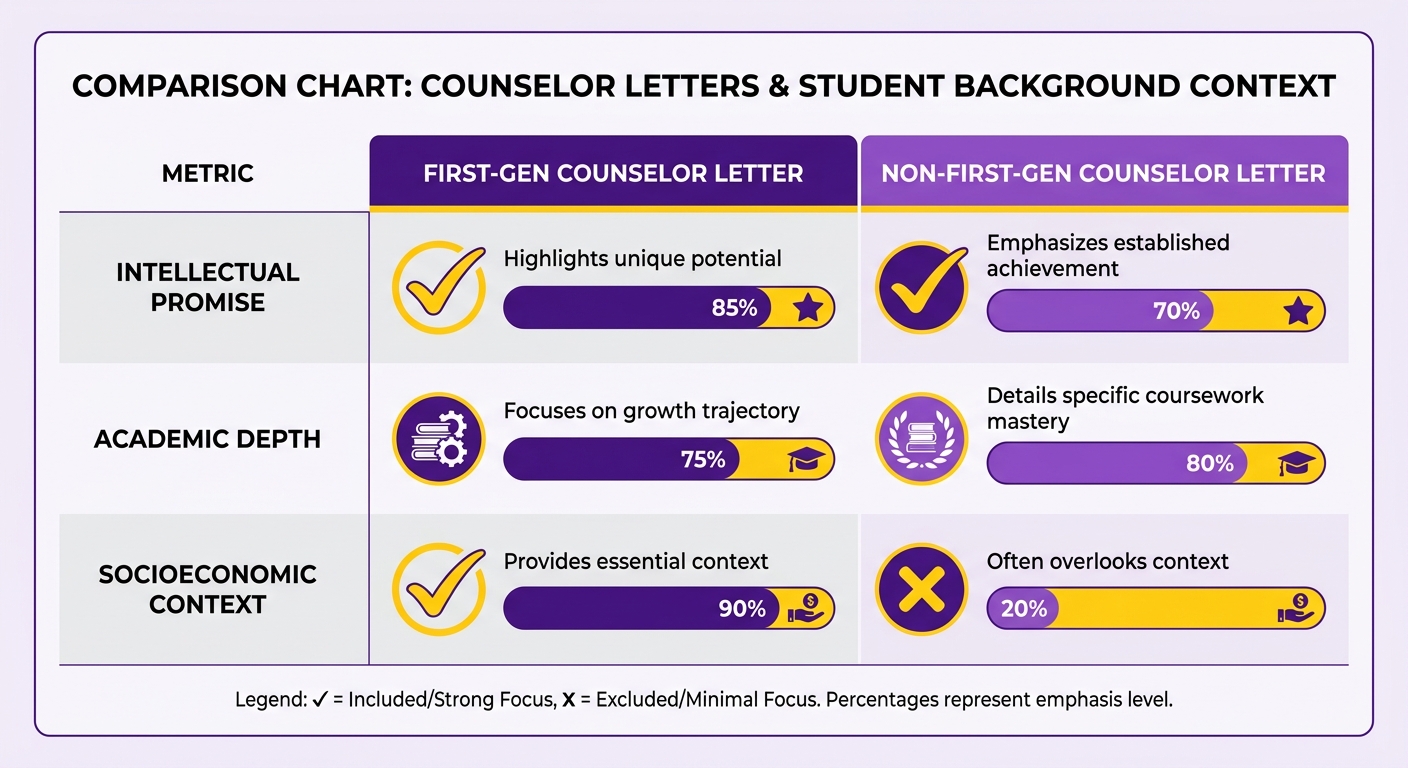
- Research shows first-gen students get fewer sentences on academics, promise, and activities.
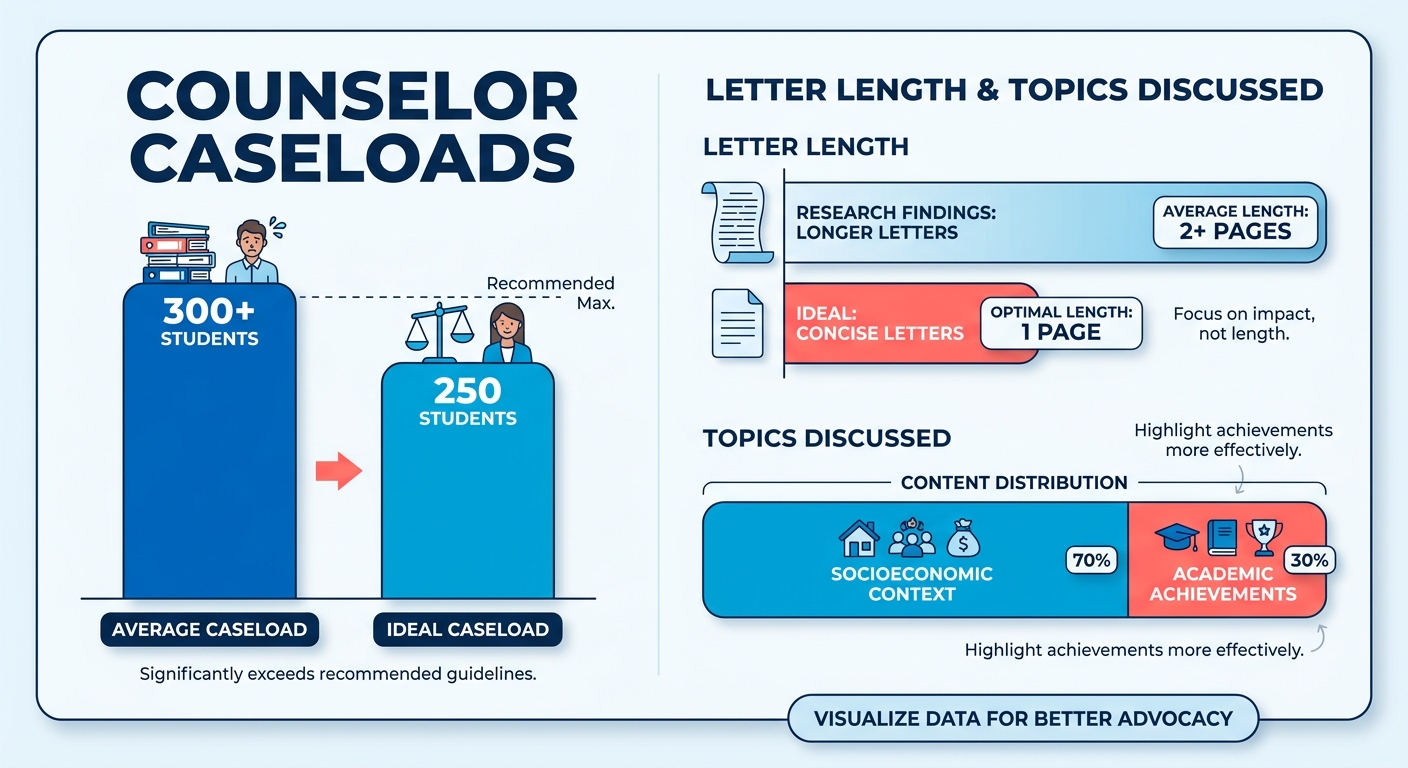
- Counselors at under-resourced schools carry roughly triple the caseload.
- A one-page brag sheet pairs each obstacle with an academic achievement.
- Stanford readers see letters from counselors who know students deeply and from those who barely know them.
- The shorter-letter penalty reflects counselor constraints, not personal failing.
Quick Summary
An effective recommendation uses a student's background to show academic initiative and problem-solving, not just struggle. The strongest ones balance potential against circumstance, pointing to moments where a student chased learning the school didn't provide. That's the framework most first-gen applicants miss: the counselor recommendation isn't a hardship essay. It's your shot at narrating resilience as a predictor of what you'll do next.
Why This Approach Works for First-Gen Applicants
Stanford readers evaluate letters written under wildly different levels of familiarity. For first-gen applicants, that knowledge gap widens because staff at underfunded schools manage far larger cohorts. They rarely have time for the close mentorship common in private settings. The data backs this up: letters for first-generation applicants tend to carry less detail on academic achievement and school activities, no matter who writes them. It's an institutional limit, which means the applicant has to bridge it.
The move is to hand your counselor a short document that ties personal hurdles directly to academic milestones. Don't settle for "I worked 20 hours a week." Write "I worked 20 hours a week at a restaurant, then taught myself linear algebra through Khan Academy and MIT OpenCourseWare because my school caps math at pre-calculus, and placed in the top 5% on the AMC 10." That sentence gives your counselor the connective tissue to treat hardship as fuel, not backdrop.
How Much Time This Actually Takes
Assembling the materials your counselor needs runs about 6-8 hours across two months. Roughly 2 hours drafting your brag sheet, 1 hour scheduling and sitting down with your counselor in person, 2 hours gathering evidence (scores, awards, a sample of self-taught work), and another 2-3 hours following up to confirm the final letter includes the academic specifics you flagged. Most students skip the follow-up. That's where it falls apart.
Your counselor will spend 3-5 hours writing if you give them organized materials upfront. Show up empty-handed and you'll get a generic 400-word letter that names your GPA and calls you "hardworking." The difference between those outcomes lives entirely in your prep. At Endurable Education, we schedule regular check-ins so students can bring one new piece of evidence to each meeting: a professor's email praising community-college coursework, a screenshot of a tutoring site they built for underclassmen, a note on how money constraints shaped their curiosity. Fed over time, that gives the counselor concrete material to work into the final draft.
How Hard Each Piece Is
Getting counselor buy-in: medium. Most counselors want to help but run on time scarcity. You're asking for maybe 4x their usual effort. Frame it as a partnership: "I know you're managing 400 students. I've prepped everything you'll need so this takes less of your time." That works. Demanding a great letter while doing none of the legwork doesn't.
Naming context without burying academics: hard. This is where most first-gen letters fail. Admitted Stanford students point out that readers need to sum you up in a single sentence. If your counselor writes three paragraphs on your financial struggles and one line on your academic interests, you've already lost the file. Build your brag sheet in two columns: obstacles on the left, and on the right, the intellectual skill or achievement each obstacle forced you to build.
Getting specifics into the letter: medium-high. Counselors default to abstraction because it's safer and faster. Your job is to make the specific detail easier to use than the vague one. Skip "demonstrated leadership." Write "founded a peer tutoring program that served 40 underclassmen in math and science, recruited volunteers from AP classes, and scheduled sessions around students' work shifts." That's a copy-paste-ready line your counselor can drop straight in.
Why the Counselor Letter Carries More Weight Than First-Gen Families Expect
Most counselors at public high schools work under severe resource limits, according to research on structural disparities in recommendation letters. Those caseloads make it nearly impossible to write the detailed, evidence-rich letters Stanford's readers expect. First-gen applicants pay a documented price here: their counselor letters average 20% fewer sentences on intellectual promise, academics, and extracurriculars, even comparing students with identical scores at the same school.
That matters because Stanford reads thousands of applications from students who are already qualified. Admitted students estimate 60-70% of applicants clear the academic bar, yet most read as "utterly forgettable." The counselor letter is your one chance to supply the institutional voice that frames your resilience as predictive of future achievement, not just something you got through.
How the Academic Story Gets Lost
There's a recurring pattern in letters from overwhelmed counselors: they lean on personal qualities and obstacles while dropping the academic specifics committees weigh most. An analysis of 615,000 letters found that fee-waiver recipients, mostly first-gen students, got longer letters overall, but those extra sentences came at the expense of STEM achievements, extracurricular depth, and course-selection context.
That's the crowding-out trap. When a counselor spends half the letter explaining a family's financial instability, they may skip the detail Stanford wants most: how a student pursued advanced coursework on their own after the school capped AP enrollment at two courses a year. The letter becomes a survival narrative instead of a forecast.
Effective letters need one clear central theme the counselor can expand with institutional authority. MIT's admissions office notes that strong letters pair specific anecdotes about a student's resourcefulness with context about what the school didn't offer. That framing turns a limitation into evidence of drive.
The Head Start Private-School Counselors Provide
Private-school counselors write letters roughly 20% longer, with far more sentences on character, intellectual promise, and extracurricular leadership. They also explain course rigor within the school's offerings, which helps readers calibrate a transcript against opportunity.
First-gen students at public schools rarely get that contextualization. A study comparing first-generation and continuing-generation students found only 32.9% of first-gen students attended a college fair, against 47.1% of their peers. They took fewer honors and AP courses and got less help with applications. The counselor letter is where that gap gets narrated, or erased.
You close it by handing the counselor real material: the self-study you used for coursework the school didn't offer, the leadership roles you created rather than inherited, the specific ways scarcity turned into curiosity. Then the counselor has something to amplify. Stanford's own guidance requires the School Report to explain what academic programs were available at your school, something private-school counselors meet automatically and public-school counselors often overlook.
Skip this strategy if you're applying to open-admissions schools or ones that weigh test scores above all. But for holistic-review institutions like Stanford, the counselor letter is the only document that can position your obstacles as a competitive advantage instead of a deficit.
Building a Real Partnership With Your Counselor, Months Early
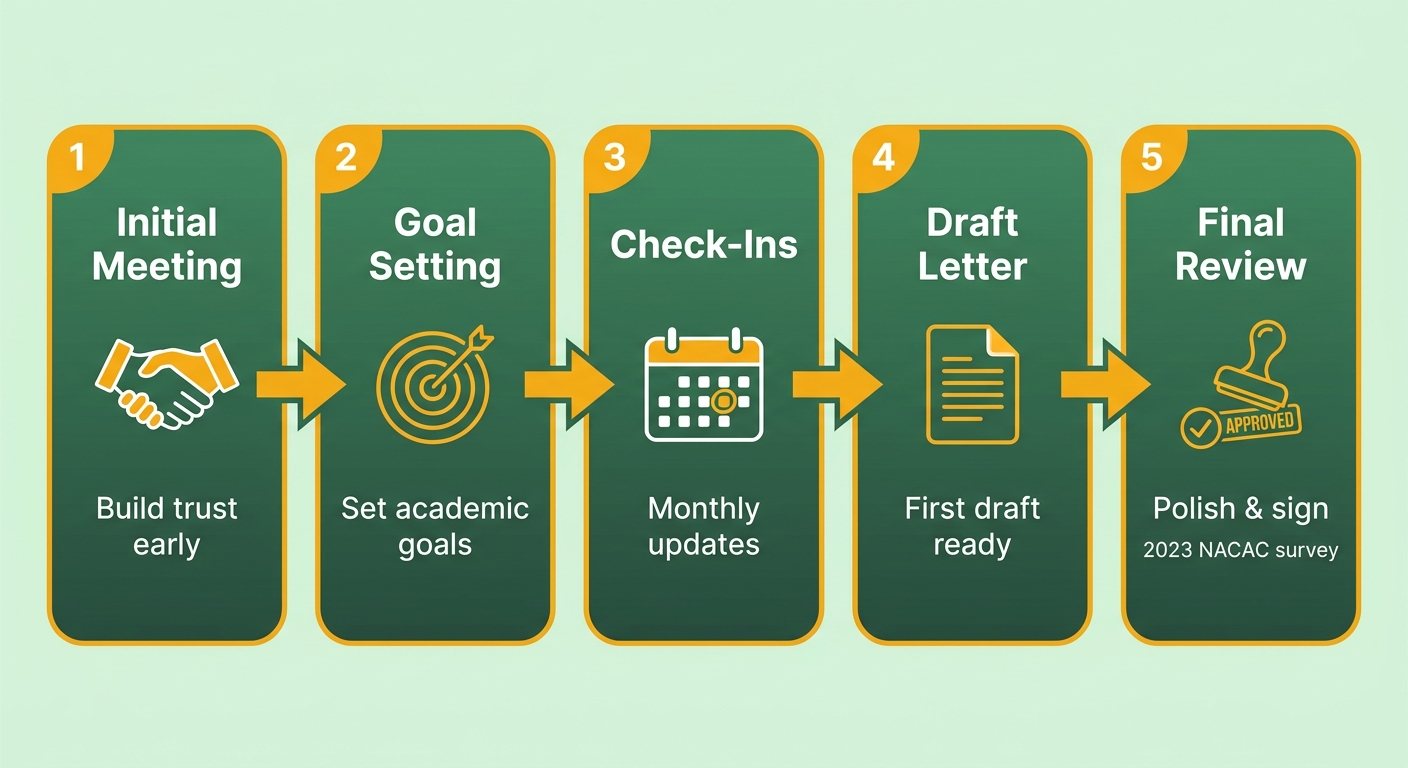
The strongest counselor letters don't start with the letter. They start in a working relationship built months before anything gets submitted. When that partnership is genuine, the letter stops being a formality and becomes the document that narrates resilience alongside academic promise.
Here's the gap most families miss. Counselor recommendations rate as considerably to moderately important in admissions decisions, per the 2023 NACAC survey, and some experts think they can outweigh the essay. Yet plenty of students build the thinnest possible relationship with the one person writing it. Fixing that is the highest-value move in the whole process.
How First-Gen Students and Counselors Should Communicate
Start early, and give the counselor something to work with. First-gen students often assume their counselor already knows the plan, but overloaded caseloads make that unlikely. Research on the high school environment stresses that counselors juggling high student-to-staff ratios rely on what each student brings forward. Yours may not know about your Stanford ambitions unless you say so directly, and repeat it.
We coach students to book a standing check-in each term, not one frantic fall meeting. Bring a structured summary: the advanced material you taught yourself, the family responsibilities you carry, the specific classes your school doesn't offer. Since first-gen students enroll in advanced courses at much lower rates, your counselor needs to explain what wasn't available, not only what you took.
What Counselors Should Emphasize to Dodge the Crowding-Out Trap
Pair context with intellectual evidence. Research shows fee-waiver students get letters heavy on personal qualities but light on academics and activities. At the same time, counselor guidance rightly praises letters that contextualize hardship, as College Essay Guy documents.
Both are true, and here's our read: a hardship narrative only helps when it frames academic promise. Never when it replaces it. Four paragraphs on adversity and one line on intellectual drive works against the student. Give the counselor a core thesis, something like "he managed family translation duties while pursuing advanced independent study," so resilience amplifies the academic story rather than displacing it.
Former Stanford assistant dean Martin Walsh warns recommenders to stay consistent and skip the hyperbole. That's the discipline to aim for. The School Report already tells Stanford what your school offered. Your counselor's job is to explain what you did with what you had, and to hit deadlines like the mid-year updates. Our best advice is plain: make it easy for them to say something specific and true.
Turning the Letter Into an Edge, Not an Excuse
The structural gap first-gen students face isn't about what counselors want to say. It's about what the writing process itself prevents them from saying. Working with first-gen applicants, we see it again and again: counselors write letters heavy on hardship that leave out the intellectual promise and academic depth committees expect. Large-scale research confirms first-gen students get significantly fewer descriptive sentences on academic potential, even after controlling for scores and school type. That penalty surfaces at the exact moment Stanford's readers are sorting qualified applicants for the ones who stand out.
The letters that work don't treat resilience as separate from academic evidence. They integrate the two in the same breath. A counselor might write, "Maria designed her own biology lab curriculum using open-source textbooks after her school cut advanced science, then scored a 5 on the AP exam." That line does two jobs at once. It shows resourcefulness and it documents promise with a specific outcome. Low-income applicants actually receive longer letters on average, but the extra sentences often crowd out academics and activities. The letter drifts into hardship essay when it should read as an intellectual endorsement.
How to Supply the Academic Evidence Your Counselor Needs
Public-school counselors can't document achievements they never heard about. The fix is simple, and almost nobody does it: build a profile sheet listing every self-taught skill, independent project, and extracurricular marker you want in the letter. A format we recommend:
- Self-directed learning: "After AP Chemistry was canceled, I worked through OpenStax Chemistry 2e and scored 720 on the SAT II."
- Extracurricular depth: "Founded the school's first debate team (0 members -> 12), coached over video calls by Georgetown debate alumni."
- Academic promise under constraint: "No AP CS at my school, so I completed Harvard's CS50 online and built a budgeting app used by 40 classmates."
Each bullet pairs a constraint with a measurable outcome. That pairing is what readers hunt for when they gauge intellectual vitality. Institutional guidelines stress that writers should place achievements inside the school's environment. If your counselor doesn't know you taught yourself Python because your school offers no CS classes, that context never lands in the letter.
The profile sheet solves a second problem too: it hands your counselor the one line readers use to remember you. The best narratives unify context, curiosity, and concrete achievement in a single statement, so you become the applicant who can be summed up in one sentence instead of another qualified file that blurs into the stack.
When to Ask for a Supplemental Letter
If your counselor's caseload makes a detailed letter impossible, request a supplemental recommendation from someone who can document your intellectual work: a teacher who supervised an independent study, a research mentor, a community-college instructor. Stanford allows one optional third letter if it adds unique insight. That letter shouldn't echo your teacher recommendations. It should fill the "academic depth under constraint" gap the counselor letter might miss.
Frame it around a specific achievement that shows both resourcefulness and promise. Took community-college classes because your high school didn't offer advanced coursework? Ask that instructor to write about your performance in a college-level room. Led a research project outside school? Ask your mentor to detail the methods you learned and the results you produced. The supplemental letter is where someone gets to say, "This student performed at a college level with no formal preparation," the exact narrative first-gen counselor letters so often miss.
The Mistakes That Cost Students
The biggest one is waiting until senior fall to build the relationship. By then your counselor is writing 100+ letters in a six-week window. Start in junior spring: schedule a meeting, explain your goals, offer to share updates on independent projects or activities. Counselors often don't realize a first-gen student is serious about competitive admissions unless the student says so, so bring a short written summary to that first meeting and follow up each semester with new accomplishments they can fold into the draft.
Another mistake: assuming the counselor knows how to position your story. If you're the first in your family to apply, your counselor may not know Stanford's readers rely on school-specific profiles to judge course rigor. Spell it out: "My school offers 4 APs; I took all 4 plus 2 dual-enrollment courses at the community college." One sentence, and the counselor has the framing to show you maxed out limited resources.
Finally, don't let the letter turn into pure hardship. Socioeconomic challenges matter, but only when they amplify academic promise instead of replacing it. Ask your counselor to read the draft with one test in mind: for every sentence describing a barrier, is there a matching sentence documenting what you accomplished anyway? If the balance tips toward struggle, the intellectual signal gets buried and readers move to the next file.
What Strong Counselor Letters Actually Look Like
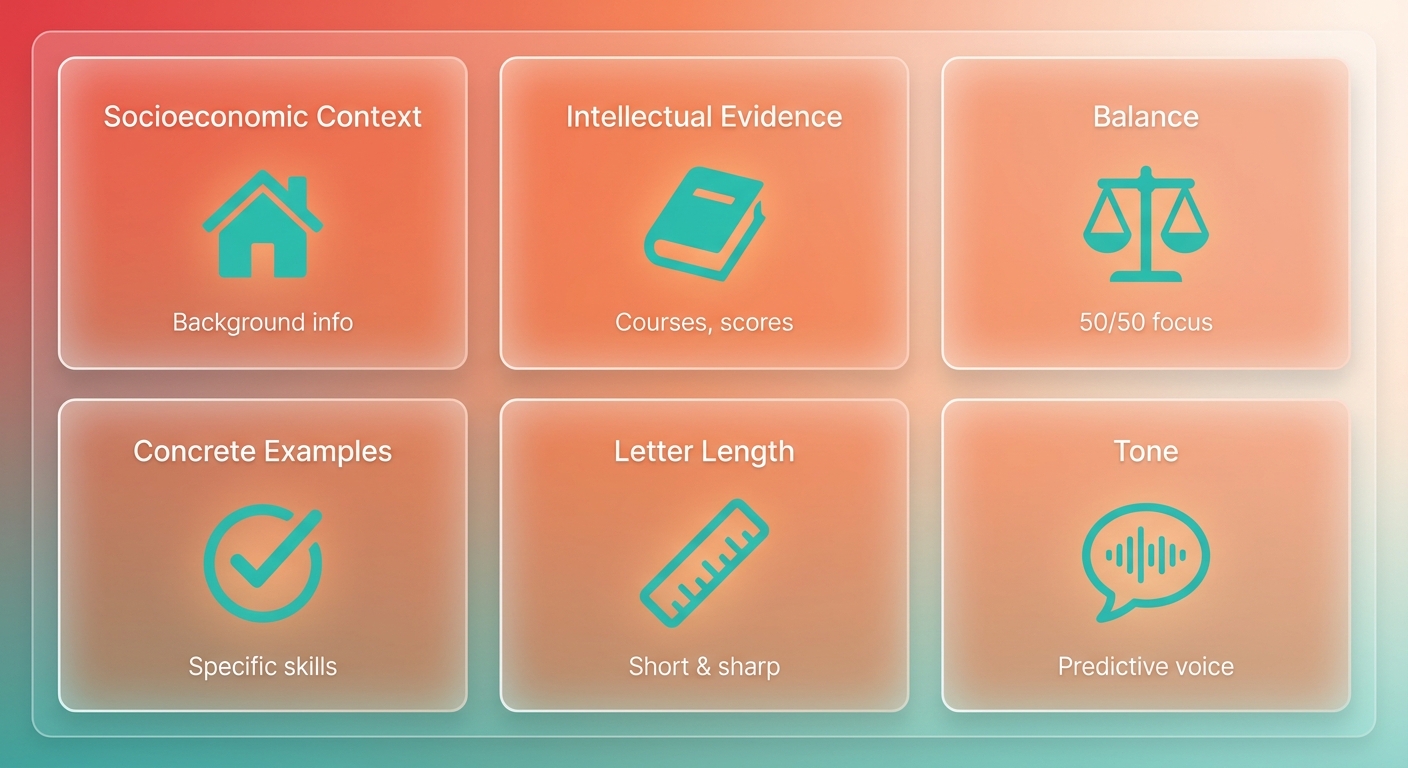
The letters that land with Stanford's readers don't spend paragraph after paragraph on hardship. The ones readers remember pair context with concrete intellectual evidence, and the balance matters more than the length. Reviewing letters with our families, we see the same pattern: the strongest succeed by weaving personal context together with academic achievement, naming specific courses, scores, or self-taught skills that prove the resilience isn't just sympathetic. It's predictive.
Two Letters, Side by Side
MIT's guidance includes two examples that show the difference. The first is a teacher recommendation for David, who shows "exceptional math aptitude" and "emotional maturity in a difficult family situation." Notice the order: the letter opens with academic strength, then uses the family context to explain why that strength is even more impressive. The second is a counselor recommendation for Jane, whose "challenging home life" "affected her academic performance." The counselor doesn't hide the impact (Jane's grades dipped), but the letter closes on her recovery and her community-service leadership. Both use hardship as a frame, not the whole picture.
That structural choice matters because of what the large-scale data shows. The analysis of over 615,000 counselor letters found that students from lower-income backgrounds got letters weighted toward personal qualities and away from academics and activities. The letters emphasized what students endured over what they achieved. That's the imbalance in one line. A letter with five paragraphs on financial struggle and one on AP Chemistry might feel thorough to the counselor, but it leaves readers without the academic evidence they need to fight for the student in committee.
The fix is a concise summary statement pairing resilience with drive. We ask students to draft something like: "Despite working 20 hours a week to help cover rent, Alex completed an independent study in computer science using online resources and built a school scheduling app." That line contextualizes the obstacle and quantifies the outcome. Hand it over early, and the letter will echo it in detail instead of choosing between hardship and achievement.
Techniques Counselors Can Borrow
Admissions experts stress consistency across recommenders. If your counselor calls you a self-starter who chased advanced coursework independently, and your teacher describes you as passive in class, readers catch the contradiction. The answer is pre-coordination: share a bullet list of your biggest academic achievements with both your counselor and your teachers, so the letters reinforce one narrative from different angles.
Counselors writing for first-gen students should also use the organized narrative format experienced school counselors recommend. Open with a one-paragraph summary of the defining trait (curiosity, resourcefulness, leadership under constraint), then give separate paragraphs to academic performance, extracurricular depth, and personal context. That structure prevents imbalance because it forces discrete sections instead of collapsing everything into one hardship story.
This is exactly what our collaborative review is built to catch. Every student's materials get read by at least two members of our team, and we check whether the academic case arrives before the hardship paragraph: defining quality first, then AP and dual-enrollment courses with exact grades, then extracurricular leadership, and only then the family or logistical context. That ordering matters. By the time a reader hits the hardship paragraph, they've already anchored on academic strength, and a second set of eyes helps families spot where a draft buries the evidence too deep.
The Mistakes That Sink a Letter
The most common is vague praise with no evidence. "One of the best students I've encountered" or "showed great resilience" does nothing unless the counselor backs it with specifics. Stanford's guidance asks counselors to place academic performance inside the school's offerings, which courses were available, which ones the student exceeded. If your school doesn't offer AP Physics but you studied it independently and scored a 5, your counselor should say so outright. Readers can't infer what they can't see.
Another: assuming longer is better. A letter can run three full pages and still fail if every added sentence names another financial or family obstacle while STEM coursework and research interests get one line. Readers finish knowing the struggles in detail but unable to picture how the student thinks. The goal isn't maximum length. It's maximum academic evidence per sentence. A tight one-and-a-half-page letter that alternates obstacle and outcome does more work than a sprawling one that saves academics for the last paragraph.
Finally, don't submit context late. Stanford requires midyear transcripts by February 15 for Regular Decision applicants, and counselors submit their letters through the Common Application before that. Wait until January to explain your family's circumstances and the letter comes out rushed. Start the conversation in September. Share a one-page summary of your academic trajectory, your obstacles, and the specific outcomes you're proud of. That gives the counselor time to write something that reads as narrative, not checklist.
For more on building a college application strategy that plays to your strengths, see our College Admissions Life Planning Advice Blog.
References
[1] Transcript, School Report and Recommendations - https://admission.stanford.edu/apply/first-year/forms.html
[2] A Complete Guide to Stanford Letters of Recommendation - https://www.ivywise.com/blog/a-complete-guide-to-stanford-letters-of-recommendation/
[3] Advice needed please! Stanford letters of rec - https://talk.collegeconfidential.com/t/advice-needed-please-stanford-letters-of-rec/3645861
[4] Advice on getting into Stanford from admitted Stanford Guide ... - https://stanfordguide.org/advice-on-getting-into-stanford-from-admitted-stanford-guide-readers/
[5] How to Write a Letter of Recommendation: Counselor's ... - https://www.collegeessayguy.com/blog/how-to-write-a-letter-of-recommendation
[6] How to write good letters of recommendation - MIT Admissions - https://mitadmissions.org/apply/parents-educators/writingrecs/
[7] Letters of Recommendation by High School Counselors in ... - https://www.researchgate.net/publication/393416608_Letters_of_Recommendation_by_High_School_Counselors_in_Selective_College_Admissions_Differences_by_Race_and_Socioeconomic_Status_in_Letter_Length_and_Topics_Discussed
[8] (PDF) Supporting and Preparing Future First-Generation ... - https://www.researchgate.net/publication/323645806_Supporting_and_Preparing_Future_First-Generation_College_Students_in_the_High_School_Environment_Implications_for_School_Counselors
Frequently Asked Questions
1. Should my counselor recommendation focus more on my hardships or my academic achievements?
Ensure the letter balances personal context with academic achievements. When counselors spend three paragraphs on financial struggles and one sentence on academics, the intellectual signal gets buried and admissions readers move to the next file.
2. How do I get my counselor to write a detailed letter when they manage 300+ students?
Provide a concise summary sheet mapping each challenge to a specific academic outcome. Format it as paired bullets: constraint on the left, measurable achievement on the right. This makes specifics easier to include than abstractions, turning a brief, generic letter into a highly detailed, evidence-rich recommendation.
3. What happens if my counselor doesn't know me well enough to write a strong letter?
Request a supplemental recommendation from someone who supervised your intellectual work outside school: a community college instructor, research mentor, or independent study teacher. Stanford allows one optional third letter if it documents academic depth your counselor can't address, like college-level performance without formal preparation.
4. Why do first-gen students get shorter letters on academics even with identical test scores?
Counselors at under-resourced schools face severe time constraints, leaving little room for the relationship-building that affluent schools build into their models. Studies show first-gen letters often contain less detail on academic achievements and extracurriculars. This penalty reflects structural constraints, not your counselor's effort, requiring you to proactively supply organized evidence.
5. When should I start working with my counselor on the recommendation letter?
Begin in junior spring, not senior fall. Schedule a meeting to explain your college goals and bring a written summary of your academic interests. Follow up each semester with new accomplishments. By senior fall, your counselor is writing 100+ letters in six weeks, so starting early gives them material to reference throughout the year.
6. How do I avoid making my letter sound like a hardship essay instead of an academic endorsement?
Give your counselor a clear, central theme that fuses resilience and intellectual evidence in one statement. Example: "he managed family translation duties while pursuing advanced independent study." This framing turns obstacles into predictors of achievement rather than standalone struggles, which is what admissions readers need to summarize your file.