The MIT STEM Profile That Beat a 4% Acceptance Rate
July 29, 2026

Key Takeaways
- MIT admits around 4% of applicants. In one recent cycle that meant 1,365 seats out of 33,240 hopefuls.
- For the class of 2025, every admit who reported class rank sat in the top 10%, with a middle-50% SAT range of 1510 to 1570.
- Academic credentials among admitted STEM applicants look nearly identical. The real decision happens past grades and test scores.
- The math bar is brutal: in a class of more than 1,400, exactly one admit scored below 700 on SAT Math.
- Three-quarters cleared 780 or higher on SAT Math. Top scores are an entry ticket, not a differentiator.
- Independent research and self-driven technical work are what actually pull a profile out of the pile.
Quick Summary
Getting into MIT means clearing one of the highest bars in higher education. The stated acceptance rate hovers near 4%, with 33,240 applicants and just 1,365 admits in a recent cycle. Across the strongest STEM profiles we've helped shape, the backbone is the same: near-perfect academics plus genuine, self-directed work in science and engineering.
The part most families miss is that academics alone don't win the seat. When we study admitted STEM profiles, the numbers look almost interchangeable, which tells you the decision is made somewhere else. That's the thread worth pulling on, and it's what this breakdown unpacks.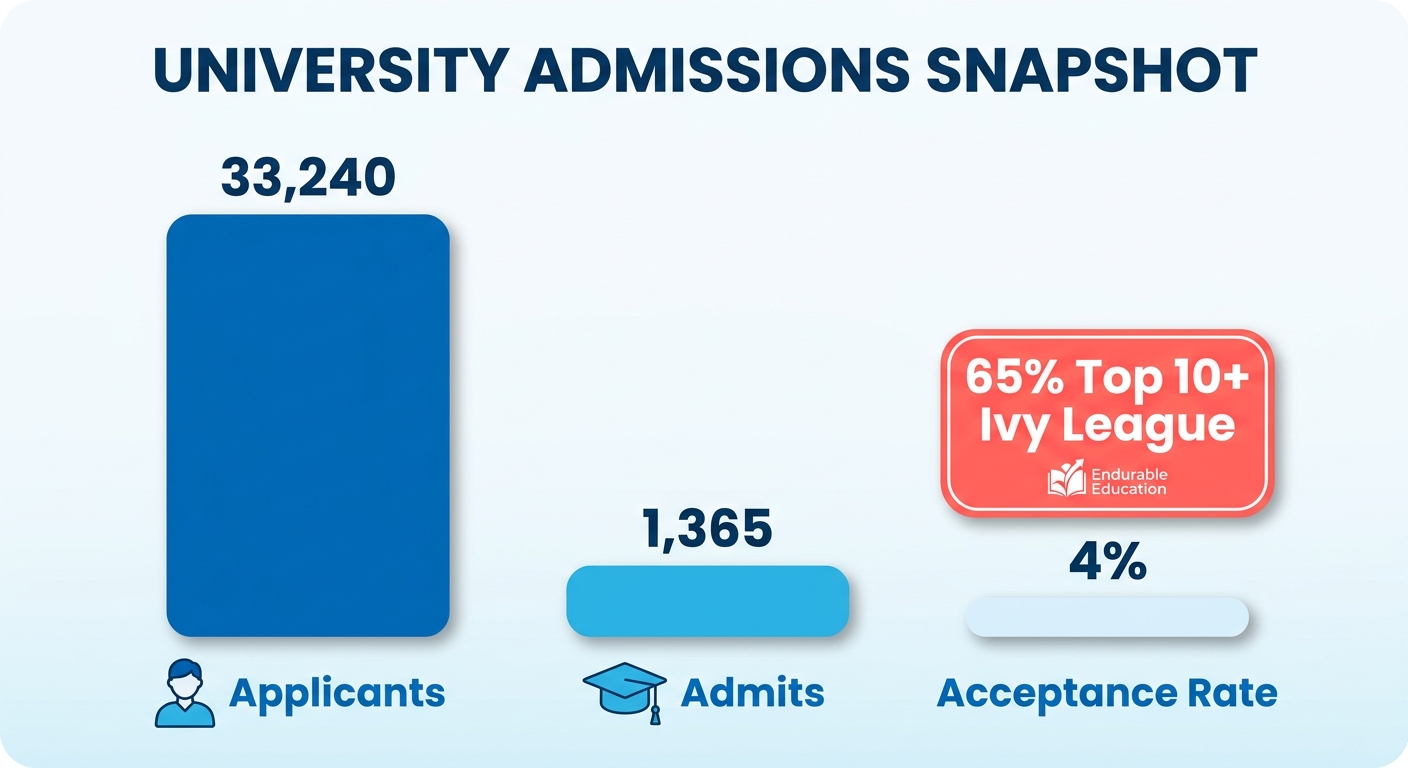
What a competitive MIT STEM profile actually looks like
A strong applicant clears three thresholds: top-decile class rank, elite test scores, and real research or leadership in a technical field. For the class of 2025, 100% of admits who reported rank landed in the top 10%, with a middle-50% SAT range of 1510 to 1570.
The math bar is where it gets unforgiving. In one class of over 1,400, only one admit scored below 700 on SAT Math, and 75% cleared 780 or higher. Treat those as entry tickets.
Research and initiative are where profiles separate. MIT flags students who've run independent research or led STEM activities as the ones who stand out.
At a glance: what a successful MIT STEM profile is built from
| Component | Target Benchmark | Time to Build | Difficulty |
|---|---|---|---|
| GPA / Class Rank | Top 10% of class | 3-4 years | High |
| SAT (Math focus) | 1510-1570; Math 780+ | 6-18 months | High |
| Research Experience | 1+ independent project | 1-2 years | High |
| STEM Extracurriculars | Sustained leadership role | 2-4 years | Medium |
| Essays + Interview | Authentic, initiative-driven | 3-6 months | Medium |
Look at the time column. A research track record takes years, not one summer, which is why we start planning with STEM-bound students well before junior year.
Why academics alone fall short
Near-perfect academics are effectively universal among admits, so they can't be the thing that wins the seat. Our read: once nearly everyone clears the same 780 math and top-10% rank, MIT decides on mission fit. That means demonstrated initiative and collaboration.
MIT looks for initiative, risk-taking, and hands-on creativity, and it treats resilience as central. The encouraging part is that impact gets judged by authenticity, not scale. A student with no fancy lab can still signal fit through modest, self-driven work, like tutoring or a local project that shows real ownership.
One strategy note. Applying Early Action buys almost nothing here. The EA rate (6.9%) barely edges the overall rate, so drop the assumption that early is a shortcut.
What we see work across the strongest profiles is this: hit the academic thresholds early so they're settled, then pour your energy into research, leadership, and essays that prove you take initiative. That's the profile that beats a 4% rate.
Why a strong STEM profile carries the file
A compelling STEM profile turns raw academic potential into applied problem-solving. Strong candidates don't treat high test scores as the finish line. They treat coursework as the floor, then build on it with self-directed work in science and engineering.
Selectivity wobbles a little year to year, so don't fixate on a half-point move in the annual percentage. The constant is what matters: the academic bar is extremely high, and clearing it only gets you serious consideration.
Why top grades aren't enough
Top grades can't secure admission because the pool is saturated with perfect transcripts. CollegeVine's breakdown of the admitted class shows test scores clustering at the ceiling, which means the traditional metrics stop separating anyone. A transcript that would be a lifetime achievement elsewhere is just standard-issue here.
Class rank tells the same story. Most applicants sit at the very top of their high schools, and MIT turns away valedictorians and salutatorians every year. When credentials are uniform, the committee has to look elsewhere.
Our take: a strong STEM profile is necessary but not sufficient. Once you've cleared the threshold, the decision moves to something the transcript can't show.
What actually separates admitted STEM applicants
Mission fit separates them. MIT says plainly that it values grades but prioritizes the match between applicant and Institute, looking for initiative, hands-on creativity, and collaboration. One line captures the whole stance:
"We want to admit applicants who are not only planning to succeed but who are also not afraid to fail."
Living up to that means turning curiosity into action. Spearheading a technical project or organizing a community science initiative signals the hands-on drive the committee wants, and it reads as the opposite of passive classroom learning.
You don't need a fancy lab to build this
You really don't. MIT frames small, accessible actions as valid evidence of fit, citing examples as modest as tutoring a kid in math or advocating for a local cause. Impact is judged by authenticity and initiative, not scale or prestige.
That's good news for students without access to university labs or corporate internships. Designing an experiment in a garage, writing a software tool to fix a neighborhood problem, or organizing a study group show the same intellectual vitality as formal research.
Our team of Harvard, Yale and Princeton graduates brings decades of admissions counseling and a panel approach, with every student's essays reviewed by at least two of us. The pattern holds: authentic, self-driven STEM work beats a resume padded with borrowed prestige.
Building a profile that gets admitted
A successful application balances academic excellence with self-directed exploration and focused extracurriculars. The most effective sequence locks in scholastic competence early, which frees up the later high school years for deep, unstructured intellectual work.
Across the portfolios we've studied, grades function as a gatekeeper, not a winning argument. The strongest applicants use their academic foundation as a launch point for tangible projects, turning theory into something they actually built.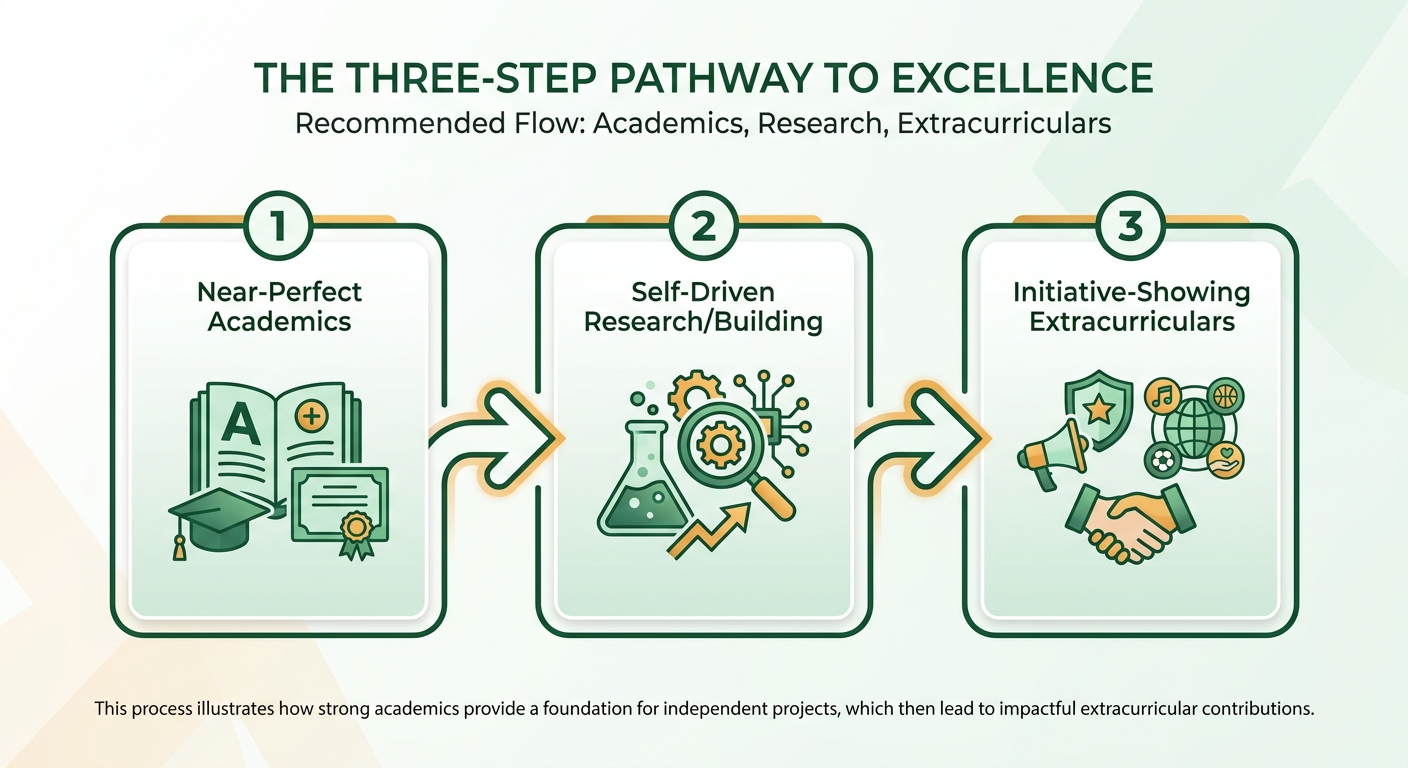
The academic rigor MIT expects
Take the hardest curriculum your school offers. Test scores and a high GPA get you through the initial academic screen, but as CollegeVine notes, they only validate readiness for MIT's workload. They don't guarantee anything.
Build the transcript to match. The hardest math and science available, including AP Physics and AP Computer Science, plus calculus as early as you can reach it. A 4.0 unweighted GPA is roughly what every admit walks in with.
Here's the honest carve-out: adding a seventh AP for the count won't move your file. Once you've shown mastery in rigorous STEM coursework, more volume is wasted effort. Depth beats breadth.
How much research and real projects matter
Original research shows a student can work at the edge of a field. CollegeVine notes it's highly valued because it proves willingness to tackle open-ended problems with no back-of-the-book answer, which lines up neatly with an institution that wants scholars "not afraid to fail."
Take a student who spends a summer chasing an anomaly in local water quality, writes a script to analyze the data, then presents the findings to the town's environmental board. That focused effort shows sustained inquiry far better than a line on a resume ever could.
Prestige isn't a prerequisite for impact. The committee weighs the depth of a student's personal contribution and the authenticity of the motivation, not the lab's budget or the mentor's fame.
What extracurriculars actually move the needle
The ones that count show leadership and depth in a few areas, not scattered membership across a dozen clubs. MIT reads for collaboration, hands-on creativity, and the ability to balance work and play. One founder role on a robotics team beats five club sign-ins.
Pick the activities you'd do anyway and go deep. Lead a coding club, mentor younger students, ship a project that solves a local problem. The pattern MIT rewards is sustained, self-directed effort.
Your extracurriculars also reveal how you'll deal with people. The academic record establishes capability. The collaborative and leadership work shows how you'll contribute once you're on campus.
Essays that show how you actually think
The essays are the main window into a candidate's thinking. The strongest ones skip the achievement summary and document the messy, iterative work of solving a hard problem.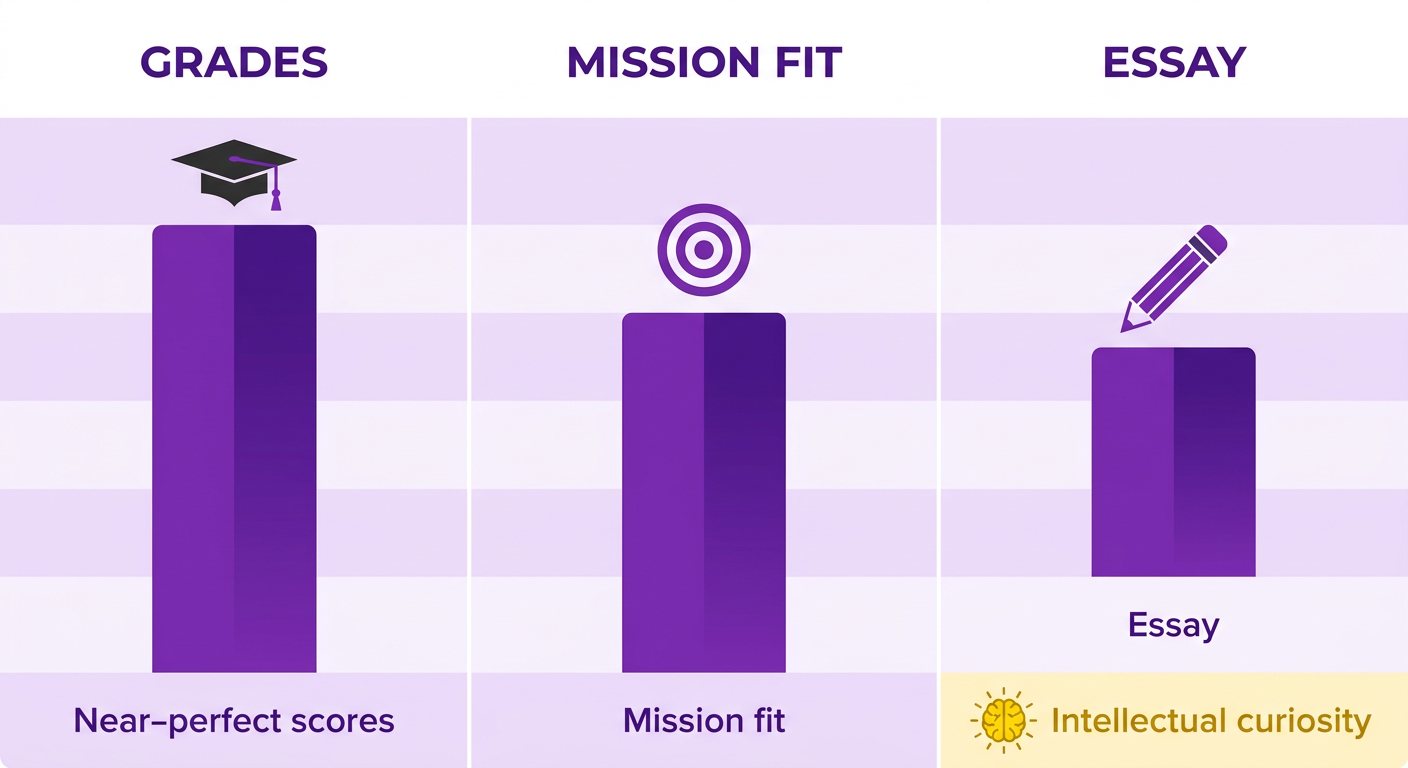
What an intellectually curious essay looks like
It walks the reader through real thinking, not a list of wins. It picks a specific problem, shows the reasoning, and admits where the student got stuck. The specificity is the signal.
Take a student writing about teaching themselves machine learning. The weak version says "I built a model and learned a lot." The strong version names the exact moment the model kept misclassifying images, what they suspected was wrong, and the three fixes they tried before one stuck. One shows curiosity. The other just claims it.
Per MIT's own guidance, fit can come through in everyday actions that show a commitment to helping others or digging deep into a topic. You don't need a breakthrough discovery. You need a persistent drive to understand how things work.
What the success stories teach about essay risk
The essays that stick often lean into vulnerability. Writing candidly about a project that failed, and dissecting why, shows an intellectual maturity that safe, boastful essays never reach.
Write about a concept that genuinely puzzles you, or a time you defended an unconventional technical approach. As CollegeVine's breakdown suggests, the essay is your chance to give the narrative behind your technical achievements, explaining not just what you did but how you think.
Skip the topic that exists only to look impressive. Readers spot a padded story fast, and it reads as the opposite of curiosity.
Where scores and financial aid fit in
Strong metrics get your application read. The essays decide whether you get an offer. With thousands of highly qualified applicants rejected every year, the deciding factor is rarely raw academic capacity. It's fit. The committee reads your essays to see whether your intellectual style and collaborative instincts match the campus culture.
Money shouldn't stop you from applying. MIT admits need-blind and commits to meeting demonstrated financial need, so a strong profile isn't reserved for families who can pay full freight. Put your energy into the essay. That's where the seat is won.
Case study: building an MIT STEM profile with Endurable Education
One student came to us with an excellent academic foundation, top marks and rigorous coursework, but no defining technical project. The transcript was exemplary. What was missing was proof of practical engineering ability for a committee that sees perfect transcripts all day.
Our process starts with a profile audit. We look at what the student has actually done, where the real technical interest lives, and what's feasible inside the timeline they have left. No two students are alike, so none of our plans are either. In the life-prep phase, we help students build meaningful experiences and skills that end up on their resumes and activity lists, tailored to their strengths and goals.
What a meaningful research project actually looks like
Every plan is customized to the individual. Instead of steering someone toward a generic submission, we connect a genuine interest to a specific, testable question with measurable results. Our community includes a student who built an Alzheimer's diagnostic 99% cheaper and faster than traditional methods, and another who developed an affordable skin cancer prevention method.
That distinction matters to MIT readers. Credible, externally validated work signals that people outside the student's own school found it worth taking seriously. It shifts the essay from "I find this interesting" to "here's what I built, and here's what happened when it failed."
Unique projects don't replace the fundamentals. GPA and test scores stay the bedrock of a viable application. Our guidance makes sure the academics are secure first, then points a student's energy at the work that shows off creative problem-solving.
The sequencing is what students miss when they try to do this alone. Meaningful work often needs to start early, sometimes as far back as 8th grade, and the project thread has to connect to the essays. Through regular check-ins, we map all of it so nothing lands in the wrong application cycle.
What I'd actually tell a family
Building a competitive application is a deliberate shift from passive learning to active creation. Lock in academic competence early, and you free up the bandwidth to chase deep, self-directed technical projects that stick with an admissions officer.
The portfolios that work prioritize depth over breadth. Rather than collecting shallow club memberships, competitive applicants commit to solving hard, open-ended problems, which is exactly the resilience and curiosity a demanding technical environment demands.
What the strongest applicants do differently
The distinguished ones bridge classroom theory and real-world application. Through original research, technical leadership, or hands-on engineering, they produce tangible evidence of what they can do.
Three things carry the most weight:
- Scholastic excellence is the price of entry. Take the most rigorous math and science your school offers to establish academic readiness.
- Independent projects prove real capability. Self-directed research or design shows you can apply knowledge to problems that don't have answers yet.
- Authentic narratives reveal character. Use the essays to work through genuine challenges and growth, not a curated highlight reel.
When to get outside help
Get help when you have the academics but no clear direction for your STEM work. That's the gap most families miss, and it's the hardest one to close alone inside a tight timeline.
Good guidance starts by finding a student's authentic technical interests, then structuring chances for independent exploration that translate naturally into a compelling application narrative. Because every path is different, the support is fully customized. And if you're already deep in a self-directed project with a clear, compelling thesis, you may not need advising at all. Keep going.
Clear the bar. Then do the work that makes the numbers mean something.
References
[1] MIT Acceptance Rate: What Does It Take to Get In? - https://blog.collegevine.com/mit-acceptance-rate-what-does-it-take-to-get-in
[2] What we look for - https://mitadmissions.org/apply/process/what-we-look-for/
[3] How to Get Into MIT: Admissions Stats + Tips - https://blog.collegevine.com/how-to-get-into-mit
Frequently Asked Questions
1. What if my school doesn't offer AP Physics, calculus, or advanced STEM courses?
Students at schools with limited course offerings aren't automatically disadvantaged — MIT's admissions team reads transcript rigor within its context. Taking the hardest available courses signals effort within your environment. Supplementing through community college coursework, online platforms like MIT OpenCourseWare, or independent study can demonstrate the same initiative MIT rewards in stronger-resourced applicants.
2. Does MIT prefer the SAT over the ACT, or are both treated equally?
MIT evaluates both tests equally and does not favor one format. ACT composite scores of 34–36 correspond to the SAT's admitted-student range. If your ACT math and science subscores are stronger than your SAT Math result, submitting the ACT may more accurately represent your quantitative ability to admissions readers.
3. Does research need to be published or formally presented to count?
Publication is not required. MIT values the process — forming a hypothesis, testing it, and persisting through setbacks — more than formal credentials. Unpublished work presented at a science fair, submitted to a journal, or documented in a portfolio still signals the self-directed initiative that separates competitive STEM applicants from equally-credentialed peers.
4. How does MIT Early Action actually differ from binding Early Decision at peer schools?
MIT's Early Action program is entirely non-binding, allowing admitted students to defer their decision until May 1 and compare financial aid offers from other institutions. Unlike binding Early Decision programs, applying early to MIT does not offer a significant statistical advantage, as the acceptance rates for the early and regular pools remain highly comparable.
5. What role does the MIT alumni interview play, and how seriously should applicants prepare for it?
MIT interviews are conducted by volunteer alumni and are not guaranteed — availability varies by geographic region. They carry less weight than research, essays, and academics, but offer a chance to demonstrate intellectual curiosity in person. Strong candidates come prepared to discuss a specific technical problem they've pursued, rather than reciting a polished summary of their activity list.
6. Can one significantly weak grade disqualify an otherwise competitive MIT applicant?
A single weak grade rarely disqualifies a strong applicant, but pattern matters more than any isolated result. One B in a non-STEM elective reads very differently than a C in calculus or physics. Addressing a documented academic setback honestly in the additional information section can reframe the narrative and demonstrate the resilience MIT's own admissions criteria explicitly prioritize.
7. At what point in high school is it too late to build a genuinely competitive MIT STEM profile?
While beginning your preparation in the junior year is challenging, it is still possible to construct a compelling profile. However, a compressed timeline makes it more difficult to demonstrate the deep, multi-year commitment to technical projects that admissions officers look for. Late-stage projects must be exceptionally focused to convey the same level of authentic, self-driven curiosity as those developed over a longer period.