Three MIT STEM Grads Reveal the Essays That Got Them In
August 7, 2026

Key Takeaways
- MIT skips the Common App's long personal statement for short-answer prompts, so every sentence must earn its place.
- Three admitted STEM essays balance personal narrative and technical detail differently.
- The strongest essays pair a personal hook with real technical substance.
- A broken-TV repair story sparked one student's engineering interest.
- A mentorship essay about tutoring diverse students emphasized narrative.
- A resilience essay centered on service for children affected by PTSD during conflict.
Quick Summary
Three MIT essays make three different bets about what earns admission. That contrast is useful before you draft. When we review alumni essays with students, the question is usually the same: should the story or technical work lead? MIT's format asks for short, targeted answers instead of one long narrative, as Shemmassian's MIT guide explains.
That format changes how you plan. With little room for a long story, successful applicants connect motivation directly to technical details. The essays analyzed by CollegeVine and AdmitYogi rarely use one register. They blend personal hooks with technical substance.
Here's how three admitted STEM essays compare.
How Do the Three Essays Compare?
| Essay Focus | Core Story | Narrative Emphasis | Key Takeaway |
|---|---|---|---|
| Technical curiosity | Fixing a broken TV that sparked engineering interest (CollegeVine) | More technical detail | Show the spark, not just the skill |
| Mentorship through STEM | Tutoring diverse students and learning empathy over instruction (AdmitYogi) | More narrative | Community impact frames the technical work |
| Resilience + service | Community service for children with PTSD during conflict (AdmitYogi) | Heavily narrative | Personal stakes carry the essay |
Which Approach Actually Wins?
The technical-heavy essay is quick to draft but easy to mishandle. It works when curiosity, rather than credentials, drives the story. The TV-repair piece succeeds because it focuses on diagnosis and problem-solving. It avoids becoming a list of skills. Readers have already seen many resumes rewritten as paragraphs.
The strongest essays often connect technical work to community impact. In the mentorship example, the writer described moving from lecturing to listening, according to AdmitYogi's collection. That places empathy alongside academic ability.
MIT's admissions process is highly selective. When many applicants have strong academic profiles, essays can differentiate them. Statistics may not separate you. A distinct voice can.
What Should You Budget?
Plan substantial time for multiple drafts. Essays with stronger narratives often need more revision. The goal is an honest tone rather than a performed one. As CollegeAdvisor's guide puts it, the best MIT essays "keep it real by talking about the author's experiences."
Difficulty follows vulnerability, not word count. A technical essay may feel easier because the subject carries some weight. A resilience essay about real adversity requires careful choices about what to reveal. Consider that before committing to a story.
Why MIT Essays Matter
MIT essays matter because they give the transcript less control. MIT's admissions process is highly competitive. Many applicants have strong grades. The essay helps distinguish you from the applicants around you.
That makes these short answers an important part of the application. Read a collection such as AdmitYogi's MIT essays, and one pattern appears: personal stories carry weight. When academic profiles are strong across the board, another elite test score adds little new information.
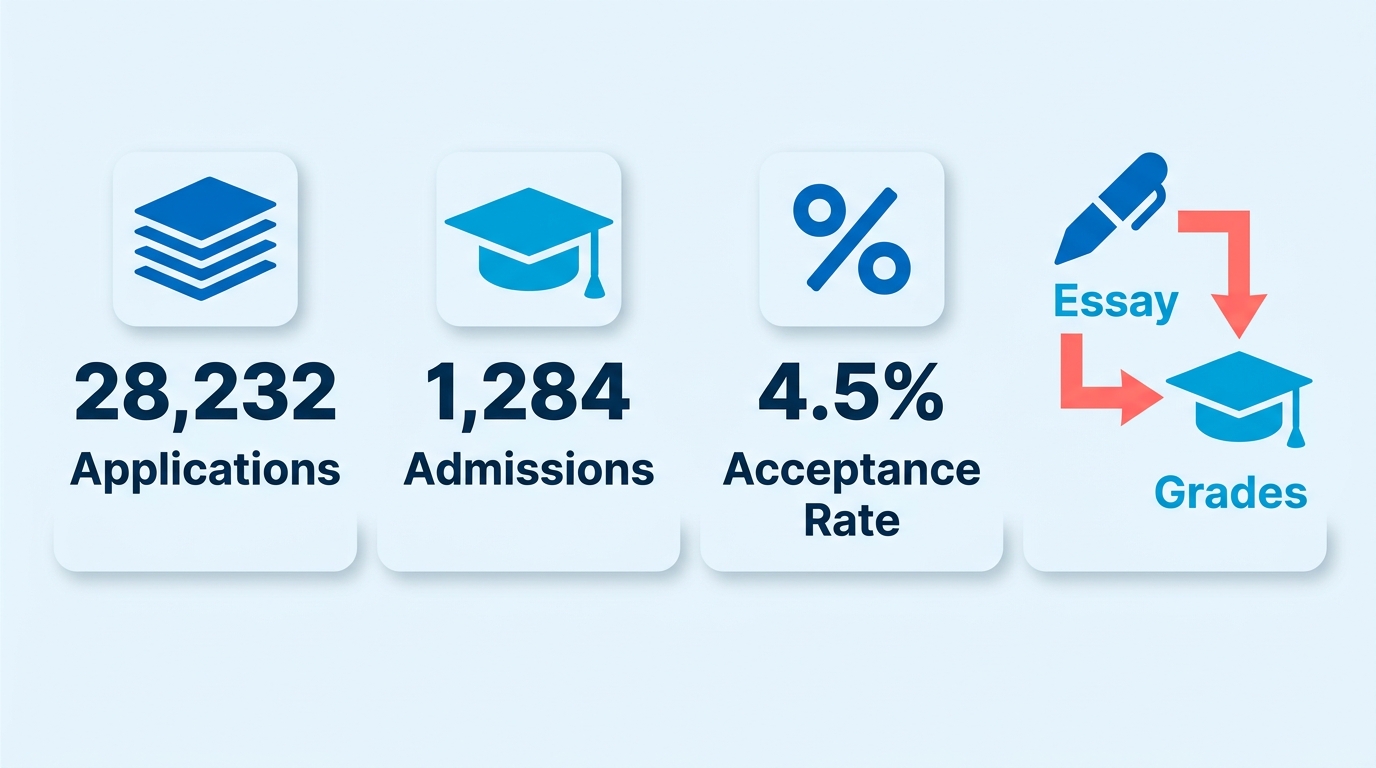
What Do the Admissions Numbers Actually Prove?
The essay is a key differentiator. When profiles are uniformly strong, writing often creates the difference. Acceptance data points to the essay as a non-numeric component you can control.
MIT provides substantial financial aid to students who qualify. Combined with a highly competitive admissions environment, that makes the essay a high-stakes part of your application. Statistics start the conversation. The story helps shape the decision.
Narrative or Technical: Which Bet Should You Make?
Neither approach wins by default. Your record should guide the choice. Published examples support both routes.
Narrative-led essays work when the story shows range. CollegeAdvisor's breakdowns highlight one student whose biracial identity shaped their reading of social issues. Another connected a love of nature to their worldview. Neither essay begins in a lab.
Technical-led essays work when curiosity defines you. CollegeVine's analysis shows how hands-on troubleshooting demonstrates diagnostic thinking without an accolade.
| Approach | Best For | Key Strength | Watch Out |
|---|---|---|---|
| Narrative-led | Applicants with strong community or identity stories | Shows range and voice | Can seem thin without real substance |
| Technical-led | Builders, tinkerers, and research students | Proves genuine curiosity | May sound like a resume in prose |
| Blended | Students strong in both areas | Combines authenticity with technical credibility | Requires sharp editing to fit the word limit |
The sources sometimes disagree. MIT's own admissions blog advises applicants not to fit a mold. Shemmassian praises an essay that names MIT courses matching the applicant's goals. Both ideas can work. Authenticity should drive the core. Institutional knowledge should support the "why MIT."
Who Gains the Most From a Strong Essay?
Students whose numbers blend into the pool gain the most. If your scores sit near the median, the essay becomes an important lever. Those applicants may have the most room to improve their position.
Successful essays share one trait: reflection matters more than polish. AdmitYogi's collection includes accounts of meaningful service during difficult circumstances. As one CollegeAdvisor guide notes, the best examples choose genuine reflection over manufactured hardship. Do not invent a struggle. Close readers will notice.
Grad A's Essay: Field of Study Perspective
Victor D. reached MIT's Course 11-6, Urban Science and Planning with Computer Science, by building his essay around an uncommon interdisciplinary problem. According to his published essays, he used programming and GIS software to map pedestrian collision data in his city. He then advocated for infrastructure changes based on those visualizations. This approach leads with technical work and lets the narrative follow.
The Field-of-Study Bet: Why Urban Planning + CS Worked
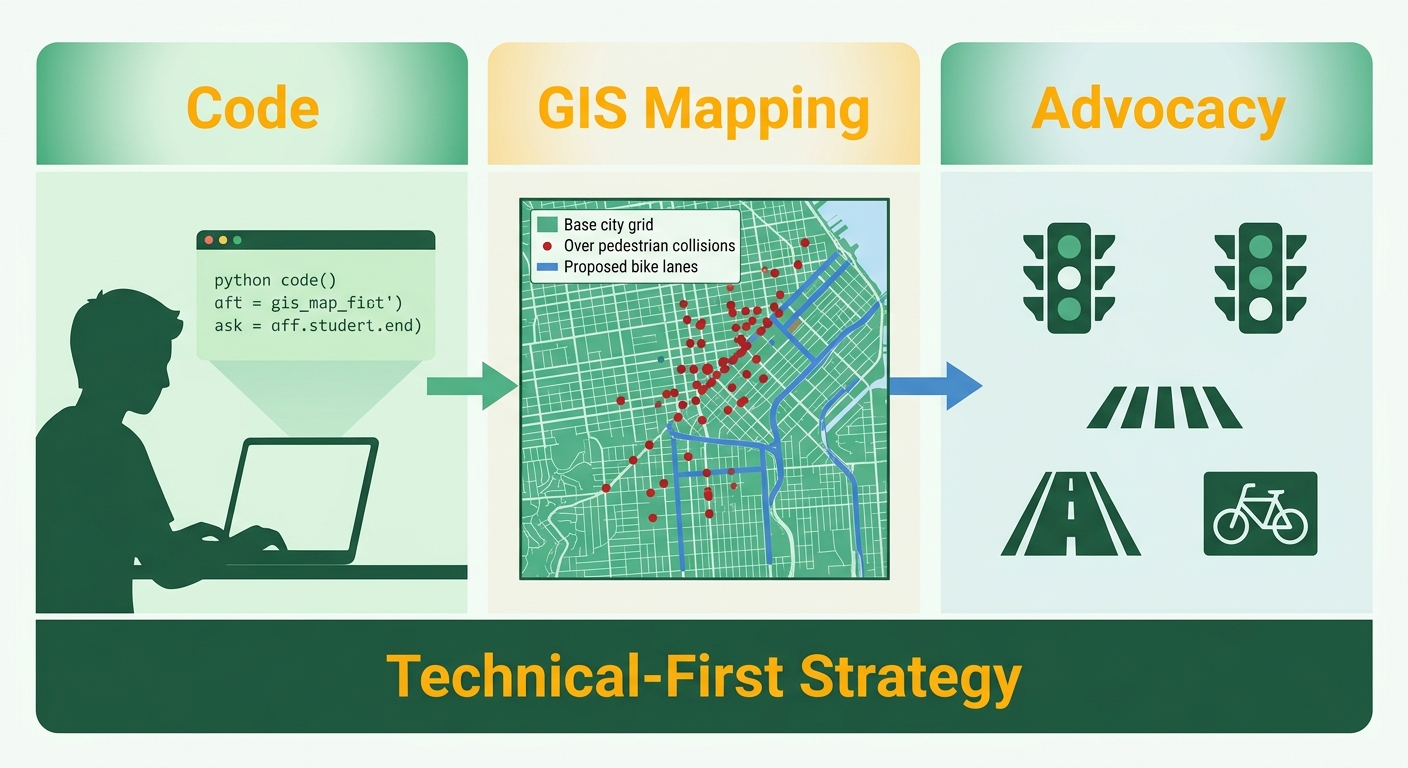
His major gave the essay a structural advantage. Course 11-6 is uncommon, and most schools do not offer it as an undergraduate degree. By naming it and connecting his project to its curriculum, he showed specific interest in MIT. Shemmassian's analysis identifies a similar pattern: strong essays can demonstrate fit through relevant courses, labs, or degree tracks.
The conflicting essay advice comes together here. Victor wrote about a real pedestrian-safety project and his dual-enrollment philosophy classes. He had also studied MIT's offerings closely enough to know Course 11-6 existed. You need both elements. The personal project provides the core, while the "why MIT" layer adds specificity.
If your field is common, such as biology, mechanical engineering, or plain CS, you may need a sharper project or angle. Victor's urban-planning focus distinguished him from many CS applicants writing about app development or robotics. That does not mean pretending to like an obscure major. It means finding the interdisciplinary edge in what you already care about.
What the Essay Skipped, and Why That Mattered
Victor competed in the First Robotics Competition, which appears in many MIT applications. He mentioned it without making it central. Instead, he used tutoring diverse students to show community engagement. He also used his smoothie-making habit to illustrate resourcefulness under constraint. CollegeVine's breakdown supports this choice: successful essays often avoid common extracurricular narratives and use more personal details.
That is the key framework decision. Your resume already contains technical wins, competitions, research positions, and AP scores. The essay does not need to repeat them. It should show the thinking behind them or reveal a dimension missing from the rest of your file. Victor's pedestrian-safety project connected urban planning, programming, and civic advocacy. Robotics stayed in the background.
Audit the whole file before drafting. If your transcript, activities list, and recommendations establish technical skill, use the essay to show intellectual curiosity or collaborative initiative. MIT's admissions blog says it values these traits when statistics look similar. Resist doubling down on your strongest credential. Show another strength.
The Teamwork Line That Tied It Together
Victor titled one response "Teamwork invents," borrowing from MIT's motto. The phrase was not a gimmick. It framed his discussion of both FRC and tutoring. Collaboration drove his technical projects and community work. The line worked because it connected two otherwise separate parts of his file through a principle MIT openly values.
Many students skip this synthesis. They write one essay about research, another about volunteering, and a third about a hobby. Each response becomes an island. Victor's thematic anchor gave his application coherence. The reader sees one driving idea across the responses.
If you are applying to a school with several short-answer prompts, choose a throughline early. It might be a value, such as collaboration, equity, or systems thinking. It might be a method, such as iterative design or interdisciplinary problem-solving. Even a recurring metaphor can help. Use it to connect the responses and give the reader a clear sense of who you are.
Grad B's Essay: Fun and Passion Perspective
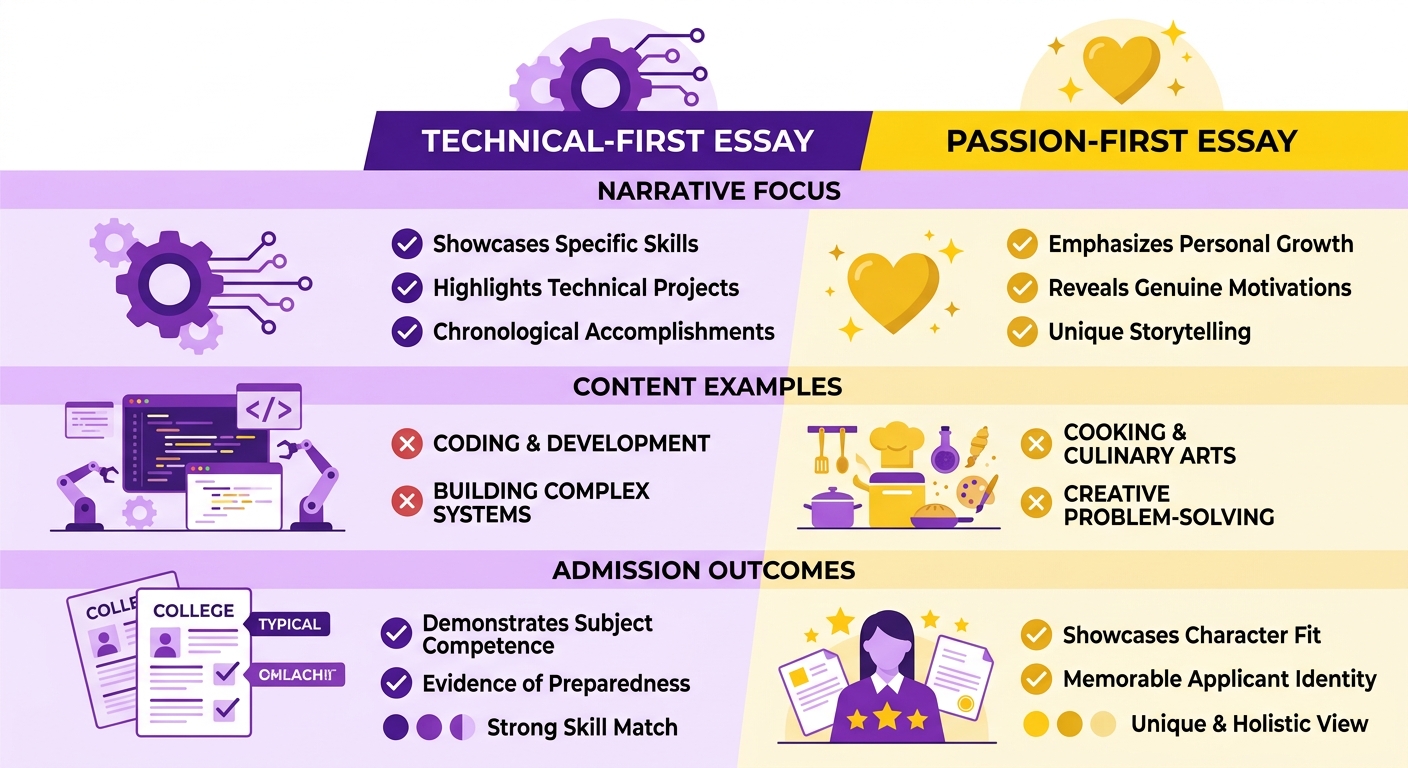
Grad B took the opposite approach: lead with joy and let intellect emerge naturally. This essay rests firmly on passion. Its hook was food. As profiled in The Tech's essays that worked, the applicant opened with, "I am an enthusiastic foodie." The essay then explored cooking, culture, and curiosity.
That may seem risky for a school with MIT's reputation. It works because a passion essay answers a question a technical essay cannot: who are you when nobody assigns the problem? Published essays about food, community, and hobbies show a similar pattern. The passion becomes evidence of an active mind.
What Made Grad B's Passion Essay Land?
A passion essay succeeds when enthusiasm is specific and reflection is honest. Grad B did not simply call food fun. The essay connected taste, experimentation, and cultural identity. It showed someone who tinkers for the pleasure of it. That instinct reflects MIT's "mens et manus" ethos.
CollegeVine's breakdowns explain why this approach works. Their examples include a student who found joy in overcoming an artistic challenge. Another student started a community-building game at a new school. The lesson is consistent: genuine storytelling beats an achievement list.
The passion route is difficult to fake. That makes it more trustworthy. Anyone can pad a resume. Explaining why you would rather be in the kitchen at midnight reveals something harder to manufacture.
When Should You Choose Passion Over Technical Achievement?
Lead with passion when a hobby reveals how you think, not just what you build. Skip it if your enthusiasm cannot answer the "so what" question. An essay that only says "I love X" will seem thin without reflection.
The published essays show the contrast. One applicant emphasized technical work, while another emphasized temperament and delight. Both succeeded. CollegeAdvisor's guide stresses that authenticity should guide topic selection. Genuine material matters more than impressive material.
If your activities already prove rigor, use the essay to show the human side. If the essay is your only chance to establish technical ability, choose a concrete project. You can read more about our approach on our college admissions blog.
Grad B at a Glance
| Attribute | Detail |
|---|---|
| Essay angle | Fun and passion (food, culture, curiosity) |
| Key features | Specific enthusiasm, cultural identity, reflective voice |
| Pros | Hard to fake, reveals temperament, memorable hook |
| Cons | Fails without genuine reflection; risky if passion is generic |
| Best for | Applicants whose rigor shows elsewhere in the file |
This does not mean passion beats technical work. Grad B found a strong personal angle and sustained it throughout the essay.
Grad C's Essay: Unconventional Paths Perspective
Applicants with unconventional backgrounds face a legitimacy challenge. MIT's short-answer format makes that challenge harder. There is less room for a slow narrative, so every line must establish credibility. For students outside a traditional STEM path, the useful approach is to lead with what they did, not what they lacked. One successful essay turned mismatched preparation into evidence of adaptability.
The Dual-Enrollment Bet: Why Breadth Can Beat Specialization
According to successful files, combining different interests can signal a distinct approach. An applicant focused on environmental policy might connect humanities coursework with data analysis. Naming specific institutional resources can make a scattered transcript look like deliberate cross-training.
The risk is that broad interests can seem like academic tourism. Strong applicants avoid this by grounding their curiosity in a concrete project. For example, applying computational tools to environmental modeling shows that policy coursework supports the technical work.
This approach succeeds when an unconventional path helps solve a problem. A student who bridges fields builds a toolkit for systems thinking. As CollegeVine's analysis notes, MIT values intellectual curiosity beyond standard STEM boundaries. The breadth must serve a purpose.
The Resilience Frame: How Adversity Became Advocacy
A technical project can seem detached. Real-world application gives it meaning. When an applicant uses findings to support community changes, they show they can explain technical work to non-technical people. Research teams value that skill.
An unconventional background can help here. A student on a standard pipeline might not connect technical tools with social advocacy. Shemmassian's guide stresses that MIT seeks intellectual creativity and risk-taking, not only proficiency. Working across disciplines can demonstrate both.
Resilience essays work best when they focus on what you built, not only what you survived. The narrative should show how your preparation enabled work most high schoolers do not face. The Tech's collection includes applicants who presented unusual preparation as an advantage. The key is making that path the reason you succeeded, not an excuse for missing a standard milestone.
The Technical Carve-Out: When Narrative Can't Carry the File
This approach requires a concrete project to anchor the narrative. If an unconventional background remains purely experiential, the strategy weakens. Readers move quickly through applications. A narrative without supporting work may not survive committee review. Non-traditional coursework must support a tangible project.
These applications raise a central choice. Should you lead with technical work and use unconventional preparation as context? Or should you lead with narrative and rely on other materials for technical credibility? CollegeAdvisor's guide argues that authenticity must connect to demonstrated achievement. The unconventional path is the hook. The project is the proof.
What the Three Essays Actually Share
The successful MIT essays do not follow one pattern. Their strongest common thread is that admitted students did not follow a template. Each made a distinct strategic choice. The useful lessons come from examining what those choices reveal about MIT's priorities.
Every applicant faces the same choice: anchor the narrative in technical achievement or personal identity? Published essays use both approaches. Some lead with measurable work, such as robotics results, research outcomes, or community infrastructure changes. Others begin with cultural identity, family influence, or passions unrelated to a major. Neither approach dominates. That suggests MIT values authenticity over formula.
How Collaboration Showed Up Differently in Each Essay
Teamwork appears in many successful MIT essays, but applicants prove it differently. The technical-first writer showed collaboration through team engineering challenges. Specific build-season moments demonstrated cross-disciplinary problem-solving. Competition results, team roles, and outcomes supported those claims.
The passion-driven essay used a softer approach. Shared interests became a way to build connection. The Tech's collection shows this works when personal joy links to intellectual curiosity. The unconventional-background applicant showed collaboration through community service. Empathy and active listening replaced technical credentials as the central skills.
MIT looks for students who can work with others, but collaboration takes different forms. Technical teamwork shows you can execute complex projects under constraints. Community-focused collaboration shows you can bridge disciplines and backgrounds. Both count. The mistake is assuming only one does.
The Extracurricular Strategy: Depth vs Breadth
Every admitted student had activities beyond class. Their framing depended on the essay's central approach. The interdisciplinary applicant used non-STEM coursework to show range. That was a breadth play, signaling adaptability across fields.
The passion essay explored one activity deeply and found its technical angles. CollegeVine's analysis shows this works when an activity becomes a lens for problem-solving. One applicant turned refereeing youth soccer into a mentoring case study. Another used hands-on repairs to illustrate diagnostic thinking under resource constraints.
Students often overthink this balance. In practice, MIT does not seem to penalize either approach when the activity connects to how you think. Narrow focus with real depth beats a shallow list. Ten clubs do not make an application well-rounded. Choose one or two activities that show genuine progression. Use them to explain how you handle challenges.
The Hard Part Wasn't Writer's Block
Successful writers did not describe perfect journeys. Their reflections show that the hardest part was handling open-ended prompts within tight word limits. MIT's short-answer format provides no single path. You must decide what matters most and build from there.
The challenge differs by approach. Technical-first applicants may struggle to show personality within project descriptions. The work speaks, but the person remains hidden. Passion-driven writers face the opposite problem. They must demonstrate rigor when their hook is joy rather than achievement.
The real difficulty is choosing which version of yourself to emphasize. Limited words force that decision. Successful applicants make their choice early and commit to it.
Step-by-Step Action Plan for Writing an MIT Essay
When we review MIT essays with students, planning raises the same question: should the essay center on technical work or personal identity? That choice shapes the draft. Decide which approach fits your file before writing.
Start by Auditing What You Already Have
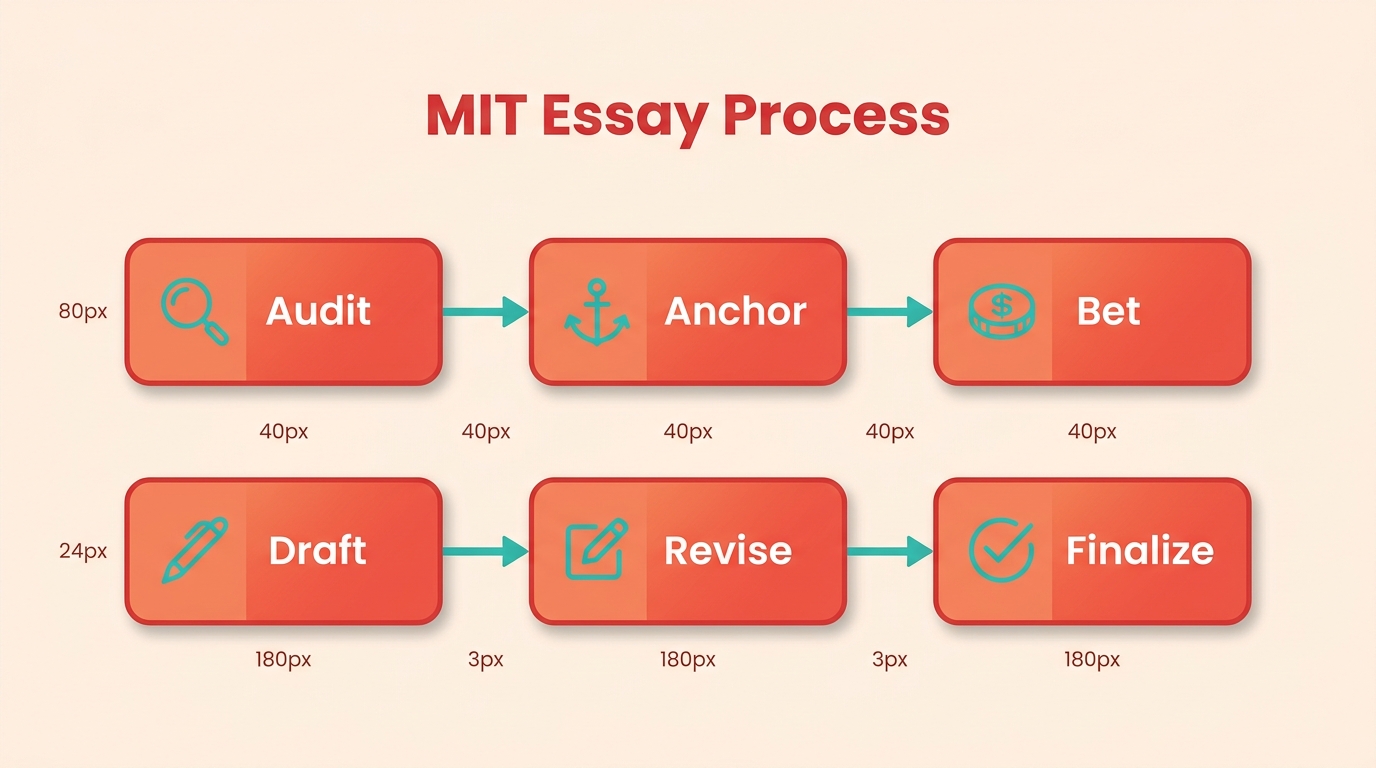
Read your existing materials first: the activities list, transcript, and teacher recommendations. Identify the pattern they create. If your file emphasizes research, competition placements, and technical work, your essay should add human context. If it emphasizes leadership, community, and breadth, anchor the essay in specific technical or intellectual curiosity.
Strong applications reflect this audit. An applicant with technical credentials and humanities coursework has already shown credibility and range. Their short answers can focus on interdisciplinary application, such as mapping local safety data. They do not need to spend words proving basic STEM ability.
Pick Your Core Bet: Technical Achievement or Personal Narrative
Once you know what your file proves, decide what the essay must add. The technical-achievement approach leads with measurable work: code, research, or a specific problem solved with a specific tool. The personal-narrative approach leads with identity, values, or experiences. It then connects them to intellectual interests.
Neither approach is objectively stronger. CollegeVine's analysis shows both working. Internal consistency matters. Do not open with a troubleshooting story and then shift into unrelated personal hardship. Do not begin with identity and then abruptly pivot to a robotics win. Either shift can weaken the essay.
Also watch how many themes you introduce. Successful essays often hold one controlling idea across all four short answers, with one supporting thread. Essays with three or four competing threads can seem indecisive. Choose the approach your file needs. Add a secondary dimension only when it reinforces the primary one.
Draft in Reverse: Write the "Why MIT" Line First
MIT's prompts include "tell us about something you do simply for the pleasure of it" and "describe the world you come from." These prompts are open-ended, but they still support one admissions question: why does this person need MIT specifically? Write one sentence answering that question before drafting.
For example, a climate-focused essay can name courses matching the applicant's goals. That detail shows an understanding of MIT's offerings compared with other top engineering programs. You do not need five professors' names. You do need one concrete detail showing that you researched MIT.
Write the "why MIT" sentence first. Then shape your short answers around it. If your sentence is "I need MIT's Urban Planning + CS dual degree because I want to use data visualization for infrastructure policy," your smoothie-making essay should connect resourcefulness and problem-solving to that goal. If your sentence is "I want computational biology and MIT's lab culture supports interdisciplinary undergrad research," your community-building essay should show curiosity that could translate to lab work.
Use the First Draft to Find Your Actual Hook
Your first draft will not be your best writing. Its purpose is to reveal what you care about. Write freely without editing. Answer the prompt directly. Then read the draft and circle the sentence where your voice changes. Look for the point where you stop trying to impress and start explaining genuine interest.
CollegeAdvisor's guide stresses precise language and self-reflection. That advice works only when you know what you are reflecting on. Students who try to sound reflective from the first sentence often write to a rubric. Students who write freely first can find the authentic moment later.
The authentic moment is often small. It may not be the competition win or the major realization. It may be the detail you almost cut because it seemed minor. A second reader can identify the paragraph that shows a shift in thinking. That paragraph is often the hook.
Cut Everything That Sounds Like an Admissions Essay
Once you find the hook, remove sentences that could appear in dozens of applications. Phrases such as "this experience taught me the value of perseverance" or "I learned to think outside the box" sound written for an audience. AdmitYogi's essays show a different pattern: the strongest pieces use plain language and avoid motivational-speech phrasing.
Replace abstract conclusions with concrete observations. Instead of writing "I realized the importance of empathy," describe what you noticed and how it changed your approach. One successful essay described a mentoring philosophy based on providing calm and protecting a student's confidence. That is a specific operating philosophy, not a generic lesson.
Review the draft for sentences beginning with "I learned" or "this taught me." Rewrite them to describe what you observed or did differently. Let the lesson appear through the action.
Test Your Draft Against the Authenticity Check
Read the essay aloud and ask whether only you could have written it. If another student with similar statistics could submit it by changing three proper nouns, it needs more distinction. Successful MIT essays often include details so specific that no other applicant could use them.
Show the draft to someone who knows you but has not seen your application. Ask whether it sounds like you or like college-essay writing. If it sounds artificial, you are still performing for the admissions office. If it sounds like you but lacks a distinct feature, you need a more specific detail.
The useful detail is rarely the achievement itself. It may be an aside, an unusual word choice, or an unexpected frame. Your reader will see many technically accomplished applicants. The question is whether they will remember your essay four hours later while writing evaluation notes.
References
[3] MIT essays that worked & MIT essay examples - Best Guide
[4] How to Get Into MIT: Essays and Strategies that Worked
[6] Tagged "mit application essays that worked"
Frequently Asked Questions
1. Should I write a narrative essay or a technical essay for MIT?
Neither approach is inherently superior. The choice depends on your application profile. If your transcript and activities list show technical depth, use the essays to highlight intellectual curiosity or collaboration. If you need to establish technical ability, focus on a concrete project.
2. How much time should I spend on each MIT essay?
Plan substantial time for drafting and revision. Technical essays about project mechanics may need fewer revisions. Narrative essays about personal experiences often need more time to maintain an authentic tone.
3. What if my field of study is common, like computer science or biology?
Focus on a unique angle or interdisciplinary application. If your intended major is common, show how you combine it with another field to solve a specific problem. Avoid a standard project description.
4. Can I write about a hobby instead of a technical achievement?
Yes, if the hobby demonstrates problem-solving and intellectual curiosity. A passion-based essay can work when academic rigor is clear elsewhere. Reflect deeply on how the hobby shapes your thinking.
5. Should I mention MIT-specific courses or labs in my essay?
Yes, when the details show genuine institutional fit. Specific academic offerings or research opportunities can demonstrate that you researched MIT. Connect those details naturally to your goals.
6. What if I have dual enrollment credits or an unconventional background?
Present your non-traditional preparation as a strategic asset. Show how those experiences enabled a specific project or shaped your perspective. Do not simply list them to prove academic ability.
7. Do MIT essays really matter as much as test scores?
Academic metrics alone may not differentiate applicants in a competitive pool. When many candidates have strong scores, essays demonstrate a distinct voice and perspective.