What a Teacher Wrote That Pushed One Student Past MIT's Cutoff
August 4, 2026

Key Takeaways
- MIT gets 30,000+ applications, where perfect grades are standard. The teacher letter is the differentiator.
- Teacher feedback is the only piece students cannot write themselves or control directly.
- The best letters reveal character traits grades cannot measure.
- MIT says explicitly that the strongest recommendations come from teachers who know students beyond test performance.
- When your GPA already matches the pool, the letter stops proving ability and starts proving uniqueness.
- Admissions readers remember specific details weeks later. Generic praise disappears.
- The gap between what your transcript proves and what a teacher can testify to is where decisions happen.
Related Video
Watch: MIT Sloan MBA Application Tips: Letters of Recommendation by MIT Sloan School of Management Admissions
Why Teacher Feedback Matters
The teacher letter is the one piece of an MIT application your child cannot write. That is why it matters.
The strongest applications do not hinge on higher test scores. They hinge on a teacher who wrote something specific enough to stick with an admissions reader.
Here is the math. MIT receives over 30,000 applications a year, and near-perfect grades are baseline. When your child's GPA and SAT already match the pool, the letter stops confirming ability. It starts doing the real work: showing character no transcript captures.
That gap between what a student can prove and what only a teacher can testify to is where admissions outcomes are decided.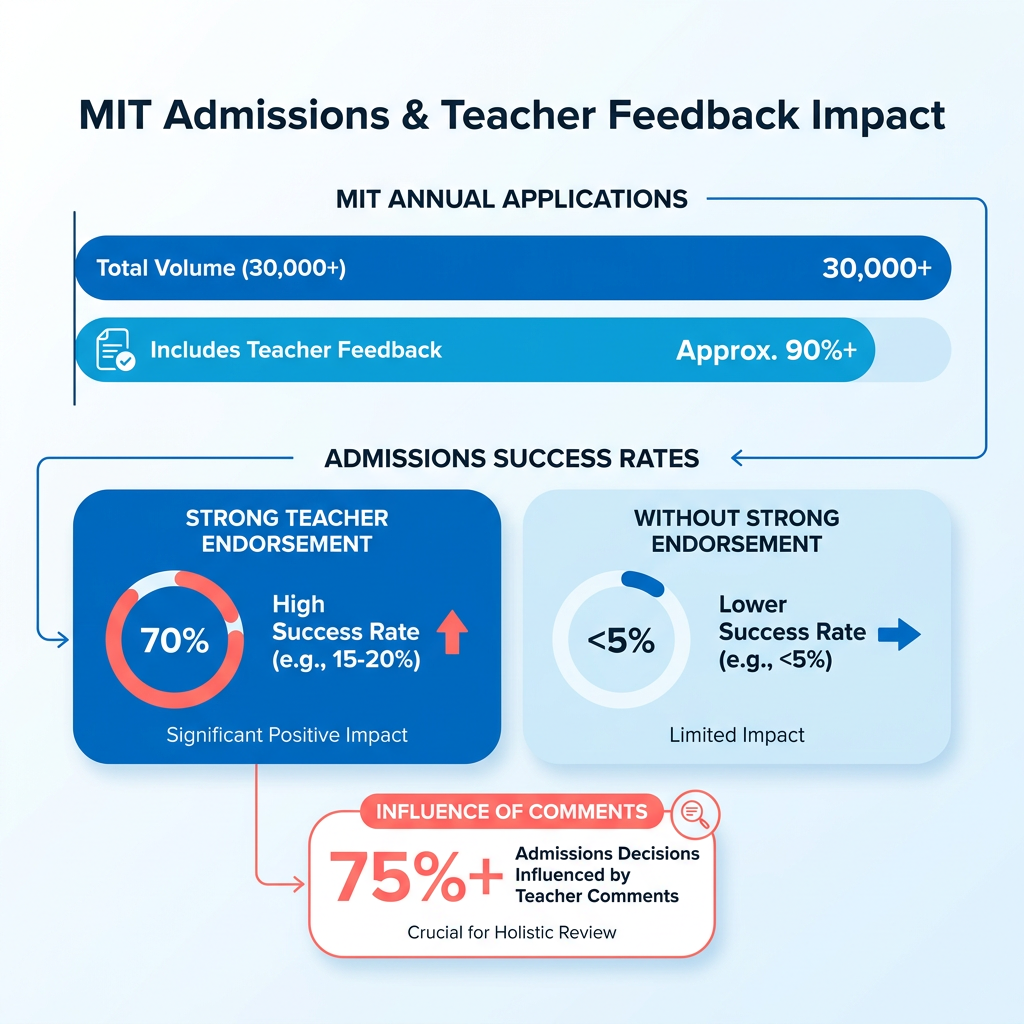
Why does teacher feedback carry weight at MIT?
MIT reads for the person behind the grades. The admissions office states plainly that the best recommendations come from teachers who know an applicant as both a student and a person. Two letters are required: one from math or science, one from humanities or social science.
Most families treat this as a compliance step. That is the mistake. The letter is the only channel where a third party can vouch for traits your child would sound arrogant claiming themselves. MIT's guidance says a strong letter highlights characteristics a student cannot advocate for on their own.
What turns a generic letter into a decisive one?
The difference is the incident, not the adjective. MIT's guide for recommenders is blunt: a story that conveys character beats a flat statement of praise. One documented moment outweighs a paragraph of superlatives.
We start with an honest read of a student's academic record, then map the specific moments that prove those strengths. Parents cannot write the letter, but they can help the teacher toward it.
That means giving your teacher two or three concrete moments to draw from. Not "she's a hard worker," but "she stepped up when the lab partner dropped the project two weeks before the deadline." That swap turns a routine letter into differentiated evidence.
One caveat: coaching only works when the teacher already believes in your child. MIT's communication lab notes that a well-crafted letter takes time and honest reflection. A recommender should be explicit about their level of support, not uniformly glowing. If a teacher has reservations, pushing for a rave letter backfires. Pick the teacher who genuinely wants to advocate for you.
Ask early. A full semester ahead gives your teacher room to reflect and write the specific evidence that clears MIT's bar. Our admissions planning notes cover how to time and structure that ask.
The Teacher's Comment That Worked
The comment that moved this student was not flattering. It was specific.
Instead of writing "she is one of the most creative students I've taught," the teacher named the moment: the student stepped in to rebuild a stalled group project when two teammates dropped out, then taught the replacements the work overnight.
That single incident did what a hundred adjectives could not. It gave an MIT reader something concrete to remember.
This is the pattern behind most admissions outcomes we see at hyper-selective schools. The letters that work do not stack superlatives. They document one telling moment. MIT's admissions team puts it plainly in their guidance for recommenders: a well-written letter reveals characteristics a student cannot advocate for themselves.
When the school admits roughly 4.1% of applicants and the average admit carries a 4.17 GPA, the transcript is settled. The comment is where the decision happens.
What made this comment work?
The comment worked because it replaced a label with an event. MIT's writing guide states the rule directly: "A story or incident that conveys the character or merit of the individual is more telling than a mere statement like 'Mary is mature.'"
Look at the sample letters MIT publishes. David's recommendation did not just call him gifted. It showed his math ability alongside his maturity in supporting his mother through illness. Mary's letter did not say she was a leader. It showed her stepping into a school publication and driving it forward. Both letters, described in MIT's recommender examples, earn their weight through incidents, not claims.
The student's first reaction to seeing a draft of this kind of comment is usually discomfort. It feels too small, too specific. But the specificity is the point. A reader who has scanned thousands of files remembers the girl who taught her replacements overnight. She forgets the fifty students described as "hardworking and creative."
How parents turn this into a coaching lever
Teachers write the honest letter on their own. That's foundational. But parents can coach their child to give that teacher the raw material to write something memorable.
Parents cannot write the letter. But you can coach your child to remind a teacher of the exact moment worth telling. The PrepScholar breakdown of Ivy-level letters makes the same point: the strongest comments grow from genuine, observed relationships, not from a template.
Students should prepare a short list of standout moments before asking. MIT's recommendation letter spotlight says a strong letter carries two to four standout attributes, each tied to a specific skill. Feed the teacher those anchors and the "Mary is mature" trap disappears.
Skip this coaching if the relationship is thin. A teacher who barely knows your child cannot fake specificity, and forcing it produces a hollow letter that reads worse than an honest short one.
Impact on MIT Application and Admission
When MIT's admissions office sat down to evaluate the massive pool of highly qualified applicants last cycle, your child's GPA and test scores had already done their job. They proved she could handle the coursework.
At that point, the teacher's comment stopped being a nice-to-have and became the only evidence that could answer the question transcripts cannot: what does she do when the script runs out and she has to write her own?
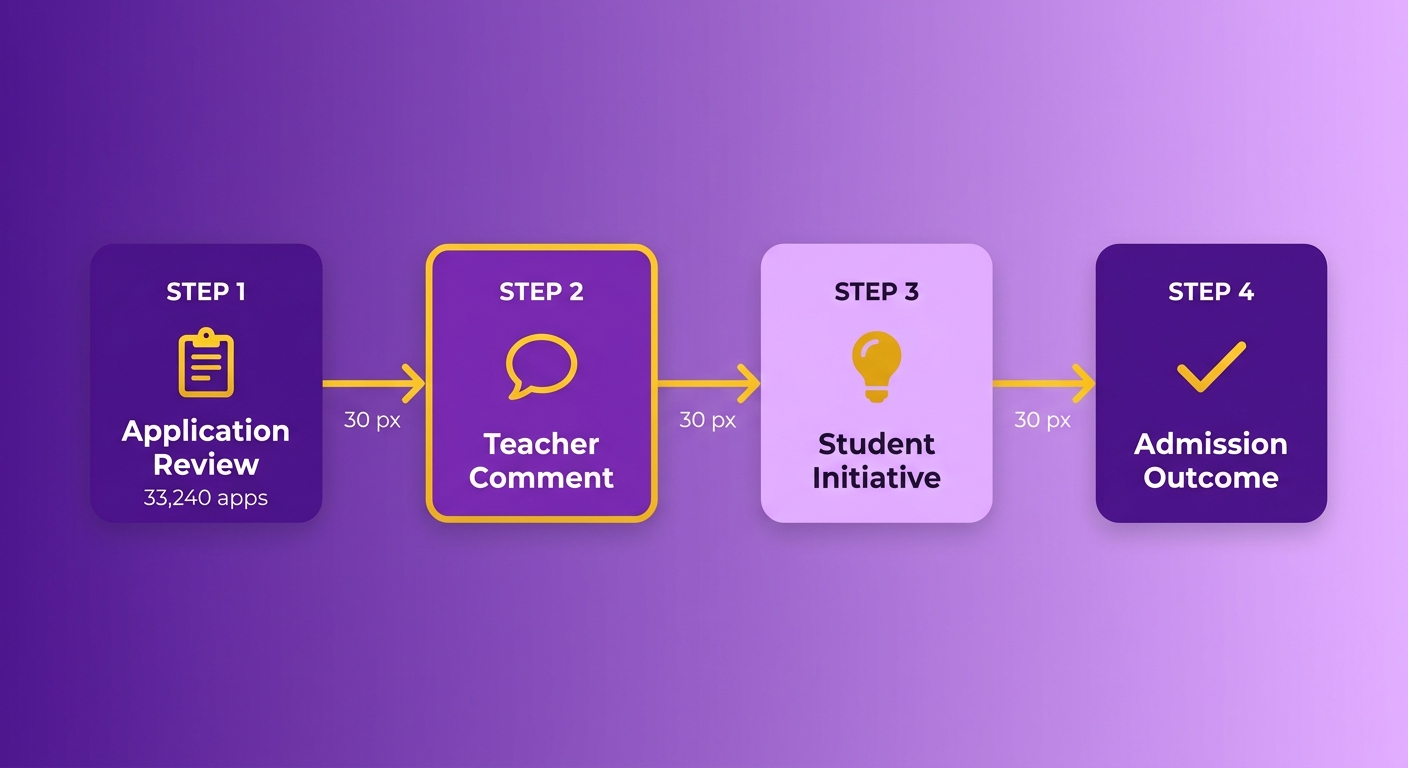
Most families treat teacher letters as something the teacher handles alone. We work with parents to step in earlier, not to dictate content, but to help surface specific moments that illustrate their child's strengths. The goal is to give teachers concrete material to work with: timelines, specific challenges the student overcame, outcomes that demonstrate character. The teacher does the writing. The parent provides context the teacher may not have seen firsthand.
How the letter shifted the application's center of gravity
MIT's guidance for recommenders states it plainly: a well-written letter reveals characteristics a student cannot self-advocate. That asymmetry is the mechanism.
Your child's essays already told MIT she's resourceful. The teacher's letter proved it by naming the moment: the 72-hour sprint, the peer teaching, the project delivered on time. That story did not replace the student's narrative. It corroborated it from a source MIT trusts more than the applicant.
The admissions timeline reinforces this. MIT's requirement for dual evaluations ensures the committee reads independent accounts from different academic perspectives before a single decision gets made. When both letters point to the same instinct under pressure, the reader stops treating it as a fluke. The documented classroom crisis did what no bullet point could: it gave the reader something concrete to recall in committee three weeks later.
When parents help teachers identify specific standout moments (as suggested in MIT's own recommendation spotlight), the letter stops reading like a generic endorsement and starts functioning as targeted evidence. The key is specificity over superlatives. One provider's sample recommendation for a management candidate did not praise his "leadership." It named the national business plan competition he placed in and the revenue model he rebuilt under a two-week deadline.
How alignment strengthens applications
The strongest outcomes share a common structure: the teacher's letter and the student's essays triangulate on the same character trait from different vantage points.
When the student wrote about intellectual risk-taking, the teacher documented the failed experiment she repeated five times until it worked. When the student claimed curiosity, the teacher described the weekend she spent reverse-engineering a lab protocol no one asked her to touch.
This is not coordination in the sense of scripting identical stories. It is strategic convergence: identifying the one or two traits MIT values most (resilience under constraint, intellectual independence, collaborative problem-solving), then ensuring both the student's self-presentation and the teacher's third-party testimony aim at the same target. The specific incident in the recommendation becomes the external proof point for the claim the student makes in her own voice.
That convergence matters more at the margin. MIT explicitly states they are evaluating "who you are" beyond metrics. When the vast majority of applicants clear the academic bar, the decision turns on whether the reader believes the character claim. A teacher who worked with your child for at least six months, who observed her in unscripted moments, carries more weight than the student's own framing. Our role is to help families make sure that weight lands where it counts.
What Students Should Actually Do
The admissions outcomes we see most often at top technical schools follow a pattern: the applicant did specific work to earn a specific letter. Grades opened the door, but a teacher's evidence walked them through it.
If you want your recommendation to do real work at a school where academic excellence is assumed, you have to act months before deadlines.
At top technical schools, admitted students typically have flawless academic records. When everyone in the pile clears that bar, the letter becomes the tiebreaker.
How do you earn a letter worth reading?
Start by giving a teacher enough time and material. A strong reference should come from someone who has observed your academic growth over a full school year, as noted in this sample recommendation, because depth of observation beats a fancy title. A teacher who watched you struggle and adjust can write things a famous name who barely knows you never could.
MIT is direct about this. The best letters come from teachers who know you "as both a student and a person," per MIT's recommendation requirements. So participate. Ask questions after class. Follow up on feedback you got on a bad quiz. You are not performing. You are building the raw footage a teacher will later narrate.
What should parents actually do?
Parents should coach teachers on specificity, not content.
Because at least two members of our team review a student's materials, we catch the difference between a letter that merely complies and one that captures the single incident proving character. When a parent helps a teacher swap a generic compliment for a specific example, such as how the student organized a peer-tutoring schedule when the math lab lost funding, the letter shifts from praise to evidence.
That swap matters because MIT's recommender guidance rewards story-driven, contextual writing over adjective stacks. As MIT tells its recommenders, a good letter reveals qualities students cannot advocate for themselves. The strongest letters work precisely because they pair a skill with a moment that demonstrated it.
One rule we hold firm: a great letter needs "examples that reflect your qualities," as this sample MIT letter guide puts it. Aim for a focused set of core strengths, each anchored to a real event, matching the structured approach recommended by admissions experts in the recommendation spotlight.
When should you skip this effort?
Skip heavy parent involvement if your target schools weigh recommendations lightly or your teacher already knows you deeply and writes vivid letters. Coaching a strong recommender wastes goodwill.
Reserve this work for the reach schools where the letter is the last uncommitted variable.
For everyone else aiming at the top, the move is simple. Plan ahead, give your teacher stories not scripts, and treat the letter as the one place your character speaks louder than your transcript. More admissions planning lives on our college admissions blog.
How Teachers Write Effective Feedback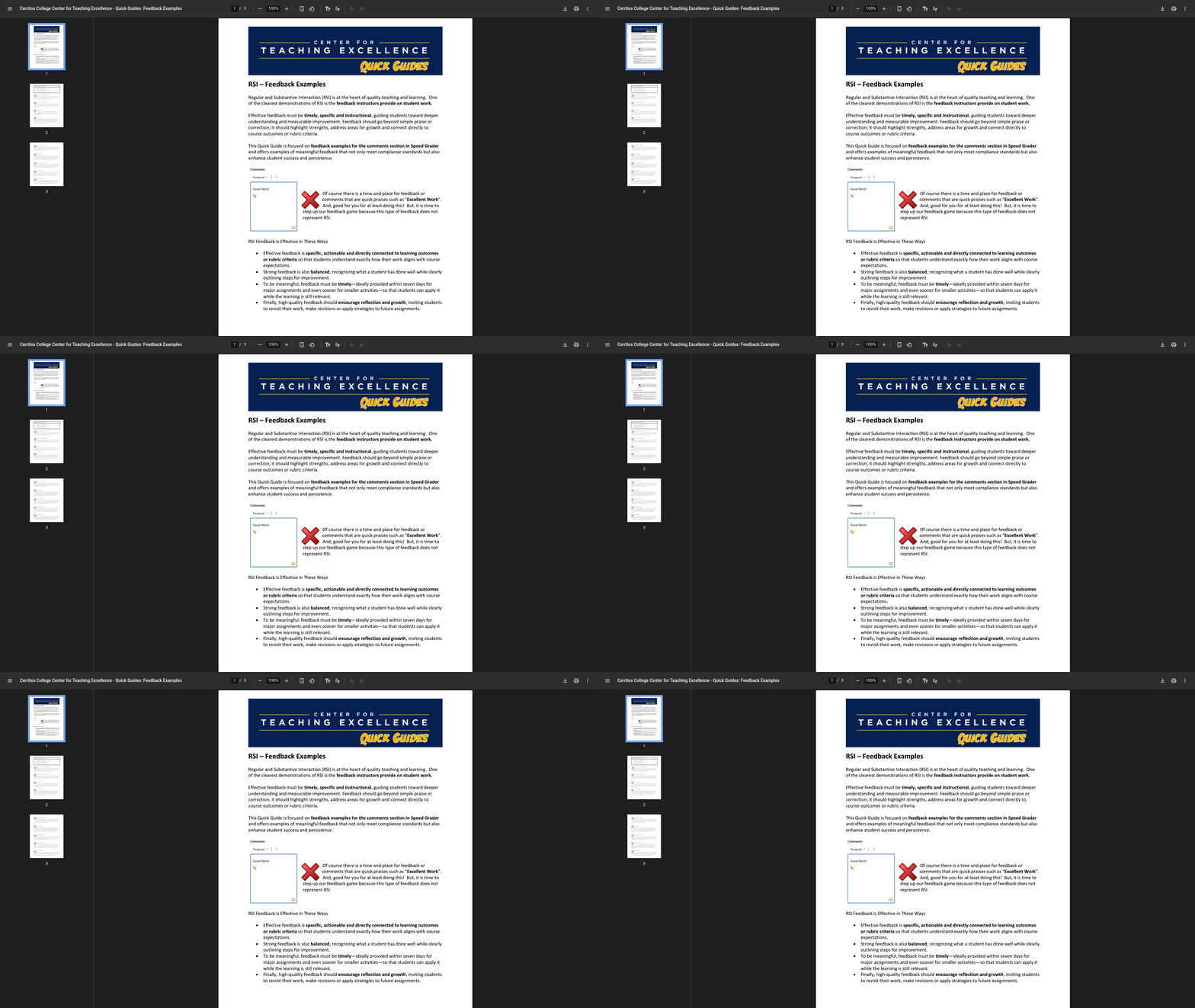
We work with teachers to reframe what makes a recommendation letter competitive, and the biggest shift we ask them to make is trading adjectives for incidents.
When a teacher writes "Sara is intellectually curious," the claim sits inert on the page. When that same teacher writes "Sara stayed after class to debate whether Rawls's veil of ignorance applies to AI ethics, then returned the next week with a paper she wrote over the weekend," the reader sees curiosity in action.
MIT's guidance for recommenders is explicit: a story or incident that conveys character is more telling than a direct statement. That principle turns generic praise into the specific evidence admissions readers remember weeks later.
This matters because letters compete in an environment where strong academic credentials are widespread. A recommendation's purpose is not to confirm what grades already show. It is to differentiate through character evidence the student cannot self-advocate.
Our role with families is to help surface the moments teachers might otherwise overlook: the time a student designed an alternative lab setup when the standard equipment failed, the time she taught herself linear algebra to understand a physics paper, the email exchange where she pushed back on a flawed assumption in the syllabus. These are the moments that turn a routine letter into decisive evidence.
What should teachers focus on?
Start with the relationship. According to MIT's admissions team, the best recommendations know the applicant well as both a student and a person. That means a teacher who has worked with the student over a significant period, ideally across multiple contexts: classroom discussion, office hours, extracurriculars, or independent projects. The depth of observation matters more than the teacher's credentials. A teacher who has witnessed daily problem-solving, intellectual resilience, and classroom leadership carries far more weight than an administrator who only knows the student on paper.
Next, replace character labels with the incidents that prove them. When a teacher writes that a student balanced advanced coursework while managing significant family responsibilities, yet still found time to mentor peers, the maturity becomes concrete. MIT's letter-writing guide includes exactly this kind of example as a model, not because it flatters the student, but because it gives the reader something specific to remember.
How do you structure the letter?
Open with the scope. State how long you have known the student, in what capacity, and what makes this relationship relevant. A teacher who supervised an independent research project carries different weight than one who taught a required course. Be explicit about the level of support: as one MIT faculty guide notes, balanced and realistic evaluations carry far more credibility than unmeasured praise. If you feel you cannot provide a highly supportive recommendation, it is best to decline the request early.
Devote each body paragraph to a distinct strength, then back it with a concrete example. Focus on a few key qualities rather than listing every strength. One MIT recommendation template structures each paragraph around a single incident: the student's response to a failed experiment, the way she approached a group conflict, or the question she asked that reframed the entire class discussion. These moments do the work adjectives cannot. They give an admissions reader evidence of how the student thinks under pressure, collaborates when stakes are high, and pursues problems no one assigned.
What do teachers get wrong?
The most common mistake is treating the letter as a performance review. A recommendation that lists accomplishments the student already reported, such as awards, grades, and test scores, wastes space on information the admissions office already has. The letter should reveal what only the teacher can testify to: how the student learns, what they do when the script runs out, why they matter in a classroom beyond their GPA.
One sample letter we reviewed praised a student's "excellent work ethic" without naming a single instance where that ethic showed up. Another spent three paragraphs on a competition the student already listed on her resume. Both missed the assignment.
A well-crafted letter takes time and requires reflection on your relationship with the student. That is where parent involvement becomes the resource. We coach families to help teachers by providing a timeline of the student's work, specific challenges they overcame, and moments the teacher may have witnessed but not recognized as letter-worthy. The goal is not to script the letter. It is to give the teacher material that makes the writing easier and the result more specific. When the teacher has that foundation, the letter stops being a burden and starts being the evidence that moves the needle.
References
[1] First-year applicants: - Letters of recommendation - https://mitadmissions.org/apply/firstyear/letters-of-recommendation/
[2] How to write good letters of recommendation - https://mitadmissions.org/apply/parents-educators/writingrecs/
[3] Writing Letters of Recommendation - https://mitcommlab.mit.edu/be/2021/07/27/writing-letters-of-recommendation/
[4] MIT Letter of Recommendation Guide | PDF | Teachers - https://www.scribd.com/document/862612732/Writing-Recommendations-MIT
[5] These 2 Recommendation Letters Got Me Into Harvard ... - https://blog.prepscholar.com/teacher-recommendation-letters-that-got-me-into-harvard-and-the-ivy-league
[6] recommendation letter spotlight - http://mitcommlab.mit.edu/be/wp-content/uploads/sites/2/2020/03/recommendation-letter-spotlight.pdf
[7] Sample MIT Recommendation Letter - https://brightlinkprep.com/sample-mit-recommendation-letter/
[8] How to Get Into MIT + Admissions Requirements 2024/2025 - https://www.collegeessayguy.com/blog/how-to-get-into-mit
[9] PRIMES STEP Experience - https://arxiv.org/html/2601.16248
[10] MIT Sloan MBA Application Tips: Letters of Recommendation by MIT Sloan School of Management Admissions - https://www.youtube.com/watch?v=NkoAg791ov0
Frequently Asked Questions
1. What if a student has a close relationship with only one teacher instead of two?
MIT requires two evaluations from distinct academic areas to ensure a balanced view of the applicant. To prepare, build depth early with multiple teachers across different contexts like office hours or projects, ensuring you have more than one strong advocate when it comes time to apply.
2. Does the teacher's title or seniority affect how much the letter counts?
Depth of observation outweighs credentials. A teacher who has witnessed your daily problem-solving, intellectual resilience, and classroom leadership carries far more weight than an administrator or famous alumnus who only knows you on paper. MIT values recommenders who can speak to your character over impressive titles.
3. What should you do if a teacher has reservations about writing a strong letter?
It is always best to find a different recommender. A hesitant teacher is likely to write a brief or generic letter, which can signal a lack of enthusiasm to the admissions committee. Seek out an educator who is genuinely excited to advocate for your journey and can speak enthusiastically about your contributions.
4. Can a student directly ask a teacher to include a specific story?
Students can supply helpful context, not scripts. Prepare a brief summary of key projects, classroom discussions, or challenges you overcame in their class before asking. This gently reminds recommenders of real events they witnessed firsthand without overstepping boundaries.
5. How is coaching a teacher different from writing the letter for them?
Coaching simply helps surface the raw material, while the actual writing remains entirely with the teacher. Parents can help by compiling a list of key milestones, personal growth moments, and academic challenges the student navigated. Our structured guidance helps families identify these pivotal moments so teachers have rich, concrete details to draw from.
6. When is heavy parent involvement in recommendations not worth the effort?
This level of preparation is best reserved for highly selective institutions where holistic review is paramount and academic credentials alone cannot guarantee admission. If a student is applying to schools that rely primarily on GPA and test scores, or if the teacher already has a stellar, highly specific letter prepared, additional coordination is unnecessary.