What Admissions Readers Call Theme: The Thread Stanford Essays Repeat on Purpose
August 18, 2026

Key Takeaways
- Stanford readers evaluate 56,000 applications in 8-minute windows, scanning over 1,400 words across 11 separate prompts per applicant.
- A unifying theme helps admissions officers synthesize disconnected essay responses into one memorable identity.
- Former Dean Richard Shaw stated Stanford seeks candidates with "sharp edges" rather than well-rounded profiles, which makes theme useful.
- Students often mistake theme for topic repetition. Writing about the same subject in every prompt gets flagged as redundant.
- Theme in college essays borrows from literary analysis: a recurring intellectual habit, value system, or question across multiple responses.
- The 480-second evaluation window makes a clear thread essential for readers to connect scattered details.
- Effective themes reveal patterns in how applicants think or what they value, not just repeated mentions of a single academic interest.
Why Readers Need a Thread
When Stanford readers open your application, they're sorting through roughly 56,000 others in an 8-minute evaluation window. In those 480 seconds, they'll scan your Common App essay, three 250-word Stanford supplements, and five 50-word short answers, over 1,400 words total. A unifying thread isn't decorative polish. It's the cognitive shortcut that lets a reader synthesize 11 disconnected prompts into a single, memorable identity without re-reading.
What Theme Actually Means
The term comes from literary analysis: a recurring pattern that ties separate moments into a coherent narrative. Here it's the intellectual habit, value system, or question that shows up across your roommate note, your intellectual vitality essay, and your "what matters to you" response. Former Dean of Admissions Richard Shaw emphasized that Stanford seeks candidates with "sharp edges" rather than well-rounded profiles. A clear theme makes those sharp edges immediately legible during the initial review.
Students often mistake theme for topic repetition. One applicant wrote about climate science in every prompt, including marine biology research, a roommate who recycles, and gratitude for clean water. Readers flagged it as redundant. The thread that works isn't "I care about the ocean." It's the how: maybe you're drawn to systems that self-correct, or you're energized by translating complex data for non-experts, or you're building things that outlast you. That pattern can surface in a lab, a debate, or a side project without sounding repetitive.
Stanford's own admissions language reinforces this. "The essays are your chance to tell us about yourself in your own words," the university states, not "tell us about your accomplishments." Readers are looking for authenticity and intellectual vitality, both of which emerge from patterns in how you think, not what you've done. A 2021 study analyzing 60,000 undergraduate applications found that essay content and style correlate strongly with household income and SAT scores. Achievement narratives, like the summer at Stanford Pre-Collegiate or the Regeneron semifinalist placement, encode socioeconomic information whether you intend them to or not. Theme discovery shifts the focus to patterns that work across income brackets: the questions you ask when no one's grading you, the problems you return to on weekends, the way you learn from failure.
Why Eight Minutes Demands Structure
Admissions readers evaluate roughly 2,500 applications per cycle. With Stanford's acceptance rate now at 3.6%, the volume creates a filtering problem: how do you stand out when 96% of applicants also have stellar GPAs, strong test scores, and two pages of extracurriculars? A theme reduces cognitive load. Instead of holding 11 separate impressions in working memory, the reader builds one cumulative story. You're not "the student who did robotics and started a podcast and plays cello." You're "the student who reverse-engineers complex systems," and robotics, the podcast, and the cello all express that core drive.
We help students spend time brainstorming the thread before they write a single draft. We work through structured discovery to surface recurring patterns in how they think and what drives them. That front-loaded investment in understanding your authentic story creates essays readers remember when they compare notes at decision time.
Who Benefits Most
First-generation students, international applicants, and those with non-linear trajectories see the largest lift from theme-focused essay strategy. If your high school didn't offer AP courses, or you switched schools mid-year, or you worked 20 hours a week to support your family, your transcript won't tell a tidy story. A theme reframes those gaps as coherence: "I'm the student who makes do with what's available." That pattern explains why you taught yourself calculus on Khan Academy, why you started a tutoring co-op instead of joining existing clubs, and why you chose community college classes over high school electives.
Stanford explicitly values authenticity over polish. Admissions reviewers report they can spot generic, pre-packaged essays within the first two sentences. The thread that works isn't manufactured to impress. It's the honest answer to "What do I keep coming back to, even when no one's watching?" International students often worry this introspective work will sound self-indulgent or culturally inappropriate. In practice, the opposite is true. A theme grounded in intellectual curiosity or a specific problem you're trying to solve reads as purposeful, not performative.
Theme discovery is the step that separates admitted students from waitlisted ones. Skip the brainstorming phase and you're left patching together 11 prompts with whatever comes to mind first. Invest the time to surface your recurring pattern, and you give readers a story they'll remember when they're comparing notes at 11 PM on decision night.
Brainstorming the Thread
When we sit down with a student who's staring at a blank Stanford application, the first question isn't "what do you want to write about?" It's "what pattern keeps showing up in your life without you noticing?" The theme isn't decoration. It's the cognitive shortcut that lets an evaluator remember you.
Map Your Timeline, Then Look for the Motive
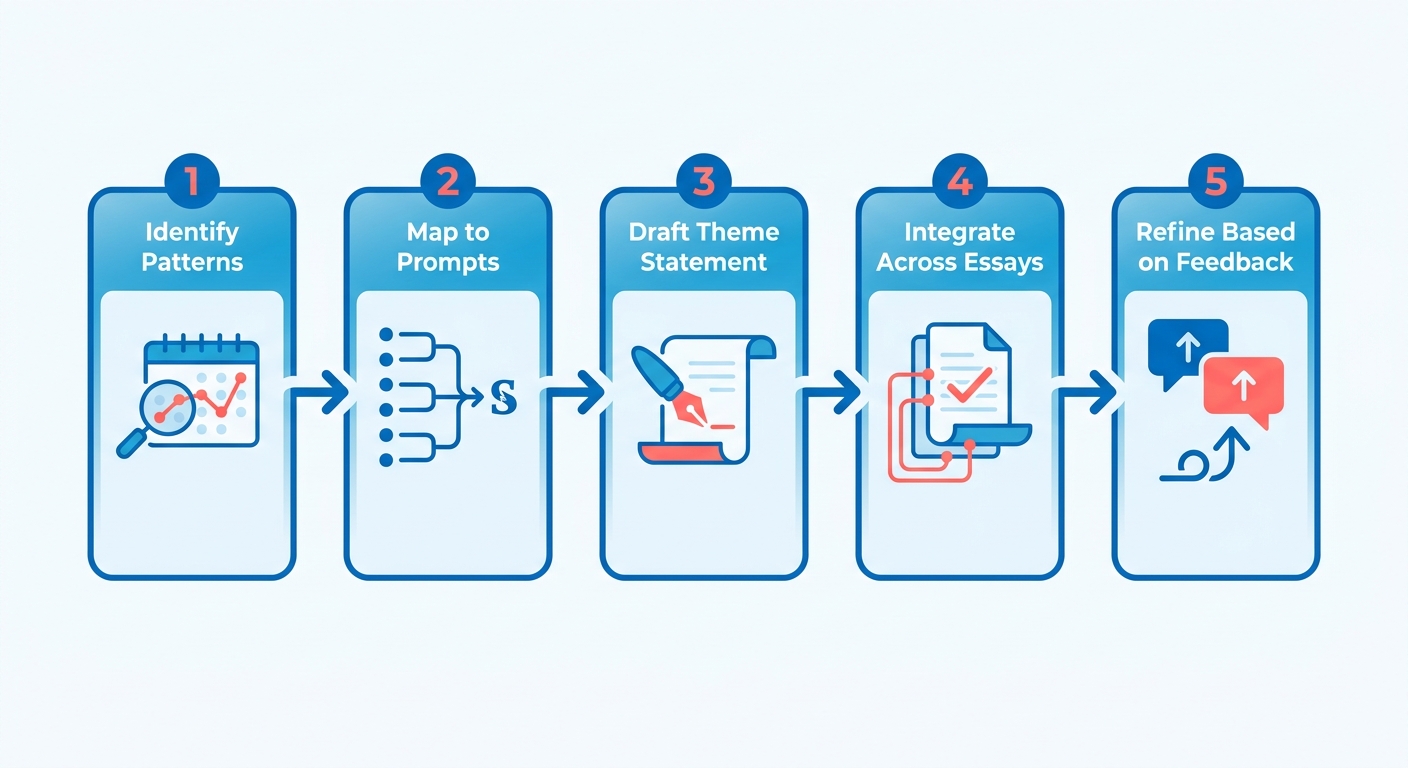
Brainstorming sessions begin by plotting every milestone from age 10 forward, including summer programs, clubs, family events, failures, and obsessions, on a single sheet. Then you code each one by underlying motive, not surface activity. A robotics club entry might code as "problem-solving for social good." A failed startup might code as "testing ideas through iteration." When the same three or four motives appear across unrelated years, you've found your thread.
Drilling down from surface activities to core drivers reveals what actually matters. If you write "I joined debate team," we ask why. "To improve public speaking." Why does that matter? "So I can advocate for policy change." Why policy? "Because I saw housing instability affect my neighborhood." Why does that drive you? By the fifth why, you're usually at a value system Stanford can anchor to, such as equity, systems thinking, or translating complexity for non-experts. Admissions readers prefer genuine voice over polish, and this kind of questioning gets you below the résumé layer to the intellectual habit that defines your perspective.
Score Impact, Then Build the Case
Not every experience illustrates a theme equally well. Ranking which moments best demonstrate the thread helps prioritize what to feature. The strongest experiences require sustained effort, produce measurable outcomes, and reveal a pattern you can defend across multiple prompts. A summer internship where you automated a nonprofit's volunteer system might be high-impact if it ties to your "service through technology" theme and gives you concrete proof points for Stanford's intellectual vitality pillar. A weekend hackathon where you built a prototype might be interesting but lack the depth to anchor three 250-word essays.
This prioritization forces hard choices. With a strict word limit across the entire application, spending space on a low-impact activity because it's recent burns space on something that doesn't compound. Readers need to see the same intellectual habit show up in your "what matters to you" essay, your roommate note, and your "challenge a belief" response without feeling like you're repeating yourself.
Use a Panel, Not a Single Reader
We work collaboratively on brainstorming because one person's read misses blind spots. When a student insists their theme is "leadership," a second reader often catches that every example actually demonstrates "translating technical concepts for non-technical stakeholders," a sharper, more defensible thread. Stanford explicitly seeks candidates with distinctive profiles. A panel approach helps you identify which intellectual angle is actually distinctive versus which one is just prominent in your own mind.
Cross-referencing your timeline against Stanford's four signature pillars, Impact, Intellectual Vitality, Community, and Self-Reflection, reveals whether your thread is comprehensive. You map each experience to one or more pillars, then filter for the thread that hits all four. If your "service through technology" theme only maps to Impact and Intellectual Vitality, you're missing Community and Self-Reflection, which means you need to either surface different examples or acknowledge that this theme won't carry the full application. Making these gaps visible before you've written a single draft saves time and strengthens your positioning.
One student had spent two summers at a materials-science lab. On paper, it looked like a research credential. After exploring underlying motives, the recurring pattern wasn't "scientific discovery," but "finding elegant solutions to resource constraints." That reframe let her tie the lab work to her family's immigration story, a failed 3D-printing startup, and her interest in sustainable manufacturing. The thread turned a single research stint into evidence of a decade-long pattern. She earned admission to a top program, and the case proved what we'd suspected: theme discovery is the highest-use hour in the entire application process.
Keeping It Real Without Repeating Yourself
When we review drafts from students trying to thread a recurring theme through Stanford's 11 prompts, we see the same misstep: they mention the core idea so frequently it stops sounding authentic. The challenge is diagnosing where repetition serves the narrative and where it becomes noise.
Cross-Checking Anecdotes Against Personal Truth
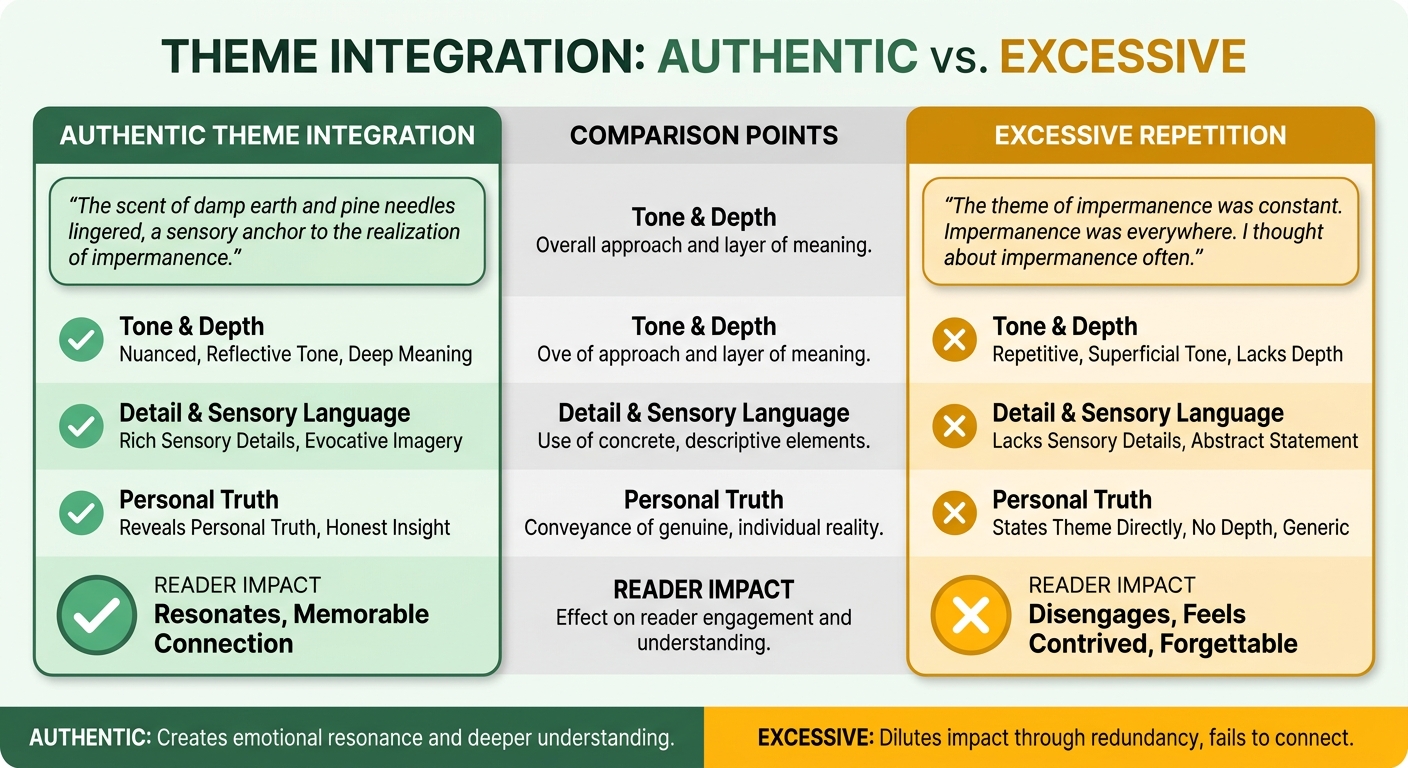
We guide students to ground every anecdote in their actual timeline with sensory details that prove they were there. Admissions readers prefer essays that reflect genuine voice over polished writing, which means manufactured "theme moments" fail faster than rough-but-honest ones. If you claim a passion for environmental justice, we ask: what did the community garden smell like in July? Who showed up late to the planning meetings? Students who pass this test write with specificity that makes the theme feel inevitable rather than constructed.
We've observed that excessive repetition of a core theme can shift a reader's perception from "this applicant has a clear identity" to "this applicant is performing an identity." The rapid evaluation process demands authenticity, not performance.
Red Flags That Signal Theme Fatigue
Generic buzzwords kill thematic authenticity faster than outright contradictions. Phrases like "making a difference," "giving back," or "pursuing my passion" often function as unsupported placeholders. When a student writes "I'm passionate about coding," we push them to show us the GitHub commit history at 2 a.m. or the forum thread where they debugged someone else's problem. Defaulting to category language, like "leader," "innovator," or "changemaker," wastes the opportunity to define yourself on your own terms.
The technique that breaks theme fatigue is shifting perspective from personal experience to impact on others. Instead of writing "I learned perseverance through debate," write "My teammate told me she almost quit before I helped her reframe the opposing case." This variation keeps the thread alive without repeating the same self-focused claim. The theme can stay consistent while the evidence shifts from institutional to interpersonal to technical.
Collaborative Review for Catching Redundancy
All of our students' essays are reviewed by at least two members of the Endurable Education team for additional input and development. One reader marks every sentence that references the core theme. Another checks whether those sentences advance the argument or repeat it.
We also test whether the theme survives removal. If we delete every explicit mention of "interdisciplinary curiosity" and the essays still convey that quality through concrete actions, like taking a CS elective to model linguistic patterns or organizing a philosophy-physics reading group, the theme is structurally sound. If the essays collapse without the labels, we're relying on assertion over demonstration. Stanford's admissions readers notice first lines that make essay-reading pleasurable, and the pleasurable ones embed theme in narrative rather than announce it.
Distributing thematic weight across supplemental essays without redundancy requires structure. The hook establishes the pattern in a single vivid moment. Conflict shows the pattern tested under pressure. Resolution demonstrates the pattern influencing a decision or outcome. A theme, such as systematic risk mitigation, can appear once as a phrase but three times as behavior.
Balancing personal voice with institutional fit means embedding Stanford-specific references only when they serve the existing narrative. Forcing a faculty name into an essay that's otherwise about your high school robotics team reads as calculated rather than curious. We coach students to reference a Stanford program only when it solves a problem their essay already raised. If you wrote about struggling to find bioethics resources in your town, mentioning Professor Hank Greely's neuroethics lab reads as a logical extension. If you haven't established that intellectual gap, the reference feels like search-engine optimization.
Our collaborative model aligns our incentives with yours. We succeed when thematic consistency lands without sounding rehearsed. That stake pushes us toward honesty about when to soften the thread. Sometimes the strongest application is the one that lets a secondary interest breathe in a 50-word short answer, breaking the pattern just enough to prove you're a person, not a personal-branding campaign.
What This Looks Like in Practice
We've worked with students across diverse backgrounds who have managed Stanford's application successfully, and the patterns that separate admits from waitlists come down to one mechanic: theme as proof of intellectual coherence. When an evaluator reviews your entire file in a single brief sitting, they aren't extracting a theme from your essays the way you'd dissect a novel. They're watching for a recurring signal that proves you think about problems the same way across contexts, such as the science lab, summer job, or family dinner table. That repetition builds conviction faster than any single "wow" anecdote.
Cross-Cultural Storytelling as Cognitive Shortcut
International students often face the challenge of standing out without typical research publications or flagship extracurriculars. We worked with a student whose activity list featured Model UN, a self-published podcast interviewing local shop owners, and volunteer translation work for a legal aid clinic. Not the typical "founded a nonprofit" profile Stanford sees from thousands of applicants. His thread: translation as cultural bridge-building.
His Common App essay opened with a mistranslation that nearly derailed a custody mediation, as he'd confused "guardianship" with "imprisonment" in Mandarin legalese. The short essay on intellectual vitality described designing a Cantonese-to-English slang dictionary for his podcast guests. His roommate note mentioned obsessively watching The West Wing with Chinese subtitles to understand American political rhetoric. Even the 50-word "what matters to you" response tied back to making invisible meaning visible. Four admissions readers saw the same intellectual habit, attention to linguistic nuance, across disconnected prompts. That's not coincidence. That's architecture.
We mapped his timeline and found the pattern emerged from age 12, when his family hosted an exchange student who couldn't order food without help. The legal clinic wasn't resume padding. It was the same problem at a different scale. Stanford admitted him Early Action.
Resilience Through Injury Without the Cliché
Student-athletes who face long recovery periods often struggle with the "sports injury taught me resilience" essay because admissions readers can spot generic narratives instantly. One approach that works: reframe the thread as system-building under constraint. The essays don't center the injury. They center what gets built around it.
A strong application might describe creating a peer mentorship program for injured athletes at the student's high school, matching rehab timelines to academic workload so students don't fall behind in AP classes. The Stanford "meaningful experience" short essay could explain how the student reverse-engineered a physical therapy protocol into a spreadsheet that tracked inflammation markers and sleep quality, then shared the template with a sports medicine clinic. The "what would you change" prompt might target insurance coverage gaps for student-athlete rehab. The roommate note could mention meal-prepping anti-inflammatory dinners for teammates during playoffs.
Same intellectual habit: optimizing recovery systems, not "overcoming adversity." This approach has helped students earn merit scholarships. The key shift: first drafts all opened with the injury. Final drafts opened with the systems built because of it.
Seven-Day Theme Sprint
Day 1: Timeline audit. List every sustained commitment from age 10 forward, including clubs, summer programs, family roles, and side projects. Mark which ones lasted over six months.
Day 2: Pattern mining. For each commitment, write one sentence answering "what problem was I solving here?" If three items share a verb, such as organizing, translating, or fixing, flag it.
Day 3: Value extraction. Test your pattern against Stanford's intellectual vitality framework. Does it show natural curiosity beyond requirements? If your pattern is "leadership," dig deeper. Leadership of what? Toward what end?
Day 4: Anecdote mapping. Pull one specific moment from each major activity. Match moments to Stanford's 11 prompts. If a moment fits multiple prompts, you've found a load-bearing anecdote.
Day 5: Redundancy check. Read all 11 responses in sequence. If you mention the same project three times, you're repeating content. If you mention the same intellectual habit three times through different projects, you're building theme.
Day 6: Peer review for authenticity. Hand your drafts to someone who's known you for five years. Ask, "Does this sound like me?" If they pause, you've drifted into polished-but-generic territory.
Day 7: Compression test. Cut each essay by 30 words without losing the theme. Stanford's 250-word limit forces precision. If removing a sentence breaks your thread, the theme wasn't load-bearing.
Self-Evaluation Rubric
Before you submit, score yourself on these five checks. Each one maps to a dimension Stanford readers track during that eight-minute window.
Specificity: Can a reader picture the scene? Generic claim: "I'm passionate about environmental justice." Specific claim: "I spent July mapping storm drain runoff in my neighborhood because our creek turns brown after every rain."
Consistency: Does your intellectual habit show up in at least three prompts? If your Common App is about marine biology and your Stanford short answers mention coding, debate, and pottery, the reader has no anchor.
Authenticity: Would a friend recognize this as your voice? Admissions staff can sense artificial polish. If you've never used the word "catalyze" in conversation, don't use it in your essay.
Stanford alignment: Does your theme connect to a specific resource on campus? Don't just say "I want to study CS." Say "I want to work with Professor Daphne Koller's probabilistic graphical models group because my podcast analysis project hit a Bayesian inference wall."
Constraint use: Did you use the 50-word short answers to advance the theme, not repeat it? One student used all five shorts to show the same problem-solving habit across robotics, tutoring, city council meetings, kitchen experiments, and family mediation. That's distributed evidence, not redundancy.
Our advisors track these five dimensions in every draft review. When a student hits four out of five consistently across prompts, the base strategy is working. Our commitment to student outcomes means we're incentivized to deliver results, and the majority of our business comes from satisfied clients referring their friends, family, and classmates. That's the measurable part of theme work.
Frequently Asked Questions
How specific should my theme be across all Stanford supplemental essays?
Specific enough that a reader can name your intellectual habit in one sentence after finishing your application, but broad enough to surface in different contexts without forced repetition. If your theme is "optimizing broken systems," it should show up in your lab work, your family role, and your weekend projects, but through different problems, not the same anecdote recycled. The test: if you can swap one example for another without changing your theme statement, you've found the right level of abstraction.
Can a theme change between the Common App essay and Stanford supplements?
No. Your Common App establishes the anchor. Stanford supplements demonstrate the same pattern at different scales or in new contexts. If your Common App is about translating complexity and your Stanford "what matters" essay is about athletic resilience with no connection to that thread, readers get whiplash. You're allowed evolution, showing how your core habit adapted when tested, but the underlying intellectual pattern needs to hold.
What if my activities don't naturally align into one theme?
Then you haven't drilled down far enough. Students who say "I do debate and I do marine biology and they're unrelated" usually haven't asked why those activities earned sustained time. Maybe debate is "testing arguments under pressure" and marine biology is "testing hypotheses under controlled conditions," both expressions of "I learn by stress-testing ideas." Or maybe debate is "making technical information accessible" and marine biology is "translating field data for policy audiences," both rooted in translation work. The theme isn't found in the surface activity. It's in the motive that keeps pulling you back.
Should I explicitly state my theme or let it emerge naturally?
Let it emerge. The strongest applications never announce "My theme is interdisciplinary problem-solving." They show a student who took a CS class to model linguistic patterns, organized a philosophy-physics reading group, and built a prototype that required electrical engineering help, and the reader infers the pattern without being told. If you feel compelled to label your theme, you're not demonstrating it clearly enough through concrete actions.
How do I avoid sounding rehearsed when reinforcing my theme across 11 prompts?
Vary the evidence type. One prompt gets an institutional example, like a research lab. Another gets an interpersonal one, like tutoring a teammate. A third gets a technical moment, like debugging code at 2 a.m. Same intellectual habit, different proof points. Also shift perspective: one essay is first-person narrative, another is impact on others, a third is systems-level change. The theme stays consistent; the lens rotates. That's how you build conviction without repetition.
References
[1] How to Write Successful Stanford Supplemental Essays - https://www.pavedwithverbs.com/blog/how-to-write-successful-stanford-supplemental-essays
[2] Let Me Introduce Myself - https://stanfordmag.org/contents/let-me-introduce-myself
[3] How to Write the Stanford University Supplemental Essays - https://www.collegeessayguy.com/blog/stanford-supplemental-essay
[4] How to Write a Stanford Application Essay That Impresses - https://college-council.com/en/blog/how-to-write-stanford-application-essays-guide
[5] Stanford University 2025-26 Supplemental Essay Guide - https://www.collegeessayadvisors.com/supplemental-essay/stanford-university-supplemental-essay-prompt-guide/
[6] Mitchell STEVENS - Graduate School of Education - https://www.researchgate.net/profile/Mitchell-Stevens-4
[7] Mitchell L. Stevens - https://scholar.google.com/citations?user=7lcn4uAAAAAJ&hl=en