What Cornell’s 2030 Acceptance Rate Means for Applicants
August 10, 2026

Key Takeaways
- Cornell admitted 5,776 students to the Class of 2030, down 0.8% even as applications climbed 40.8% over six years.
- The acceptance rate now sits around 8%, which puts Cornell in the same conversation as the most selective schools in the country.
- Early Decision applicants saw an 18.78% acceptance rate for the Class of 2029, nearly triple the 6.70% Regular Decision rate.
- ED is binding. Get in, and you give up the chance to line up competing financial aid offers.
- Admitted students posted middle-50% SAT scores of 1480 to 1560 and ACT scores of 33 to 35.
- Cornell brought back the testing requirement for the first time since 2020, so scores count again.
- The Class of 2030 pulled students from all 50 states and 102 countries.
The short version
Cornell's latest cycle tells a familiar story: a school getting harder to enter, driven by a 40.8% jump in applications over six years. Selectivity is at a high point, and that changes applicant math. For middle-income families especially, the choice between early and regular rounds decides one thing that matters a lot: whether you can compare and negotiate aid packages.
The Early Decision trap
Applying early gives you a real statistical edge. The ED acceptance rate for the Class of 2029 was 18.78%. But that number comes with a string attached. ED is binding. Get in, and you enroll. That means you can't compare Cornell's offer with anyone else's.
Plenty of families chase the early advantage without first doing the aid math. When the package comes back thin, the room to maneuver is small. You can appeal if your financial circumstances have documented changes. What you can't do is wave a better offer from a peer school and ask Cornell to match it. That leverage is gone the moment you commit.
What the numbers actually tell you
The reach of the Class of 2030 pool shows how global Cornell's applicant base has become. Academically, the students admitted brought strong credentials, as recent admissions data shows. With testing required again, prep matters more than it did a year ago.
One number worth sitting with: Cornell's yield, the share of admitted students who actually enroll, runs around 64%. That means Cornell has to admit a larger group in Regular Decision to fill the class than some peers do. Good news for regular-round applicants. The non-binding path is still a real way in, and it keeps your aid options open.
What Cornell says it's looking for
Metrics are the floor, not the finish line. Vice Provost Lisa Nishii has framed it around the university's public-service roots: the committee wants students who will actually use what Cornell offers. The incoming class includes Mason Hilburgh, who wants to pair civil engineering with ROTC service, and Faith Baker, who plans to bring animal science into veterinary work in farming communities. Specific plans, tied to specific resources.
That's the pattern in strong applications. They show how a student will use the place, not just that they're smart. At a school where nearly every applicant already has top-tier grades and scores, showing fit is what separates people.
Why the 2030 acceptance rate is really a money question
Selectivity gets treated as a bragging-rights stat. For families, it's closer to a budgeting input. Applicants tend to fixate on career payoff down the road, but the near-term problem is more concrete: the admission timeline shapes the college budget. Binding versus non-binding decides whether you get to compare aid at all.
A binding process asks you to commit before you've seen final offers from anywhere else. So the acceptance-rate pressure and your financial leverage are tied together. Think this through carefully. It's one of the few admissions decisions with a direct dollar figure attached.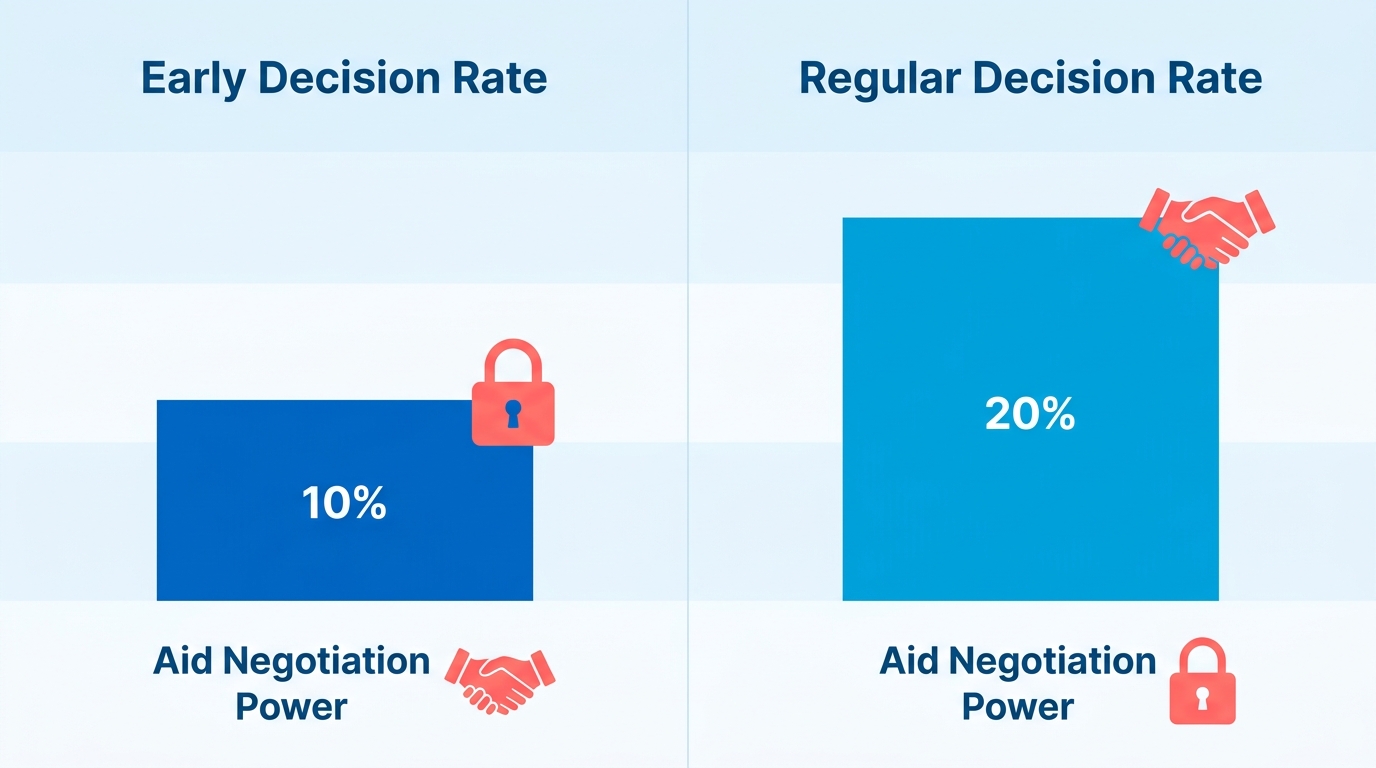
How selectivity quietly eats your aid leverage
High selectivity nudges applicants toward the early round to boost their odds. And the early round, by design, strips away your ability to negotiate. The two move together.
It's harder to run this calculation than it used to be, because Cornell stopped releasing early and regular statistics after the Class of 2024. Administrators pointed out, fairly, that averages don't predict any one student's outcome. True enough. But without the public splits, families are left guessing at the real size of the early advantage versus the flexibility they'd keep by going regular.
Where the reported numbers seem to disagree
You'll see admission figures that don't quite match across sources. Usually that's timing, not conflict. The numbers published on Ivy Day don't include later waitlist activity, so different reports are just snapshots from different points in the enrollment cycle.
Don't get lost chasing those small gaps. Focus on the bar the committee actually sets. Competitive portfolios line up with Cornell's academic standards, including middle-50% SAT scores of 1480 to 1560, or the ACT equivalent. Test scores are required again for the first time since 2020. And remember that admit rates swing a lot across the undergraduate divisions, so the university-wide average may say very little about the program you actually want.
Who this matters most for
Reading these patterns correctly pays off most for families watching the total cost. Even against a pile of 72,523 applications, Regular Decision holds up as a real option, and it keeps the door open to compare offers.
If your enrollment call hinges on the final net price, skipping the binding early round is usually the smart move. The math shifts at the extremes. Families with very high need, or those who can write the full-tuition check without blinking, face different tradeoffs. For middle-income applicants, keeping your options open is generally the right instinct. Generally. That word matters, because every family's aid picture is its own.
Early Decision vs Regular Decision: what you're actually trading
A real application strategy starts with understanding how your timing affects both your odds and your aid. The gap between early and regular acceptance rates is a genuine tactical fork. Apply early and you improve your chances, but you lock yourself into a single financial package.
The binding agreement commits you before you see the bill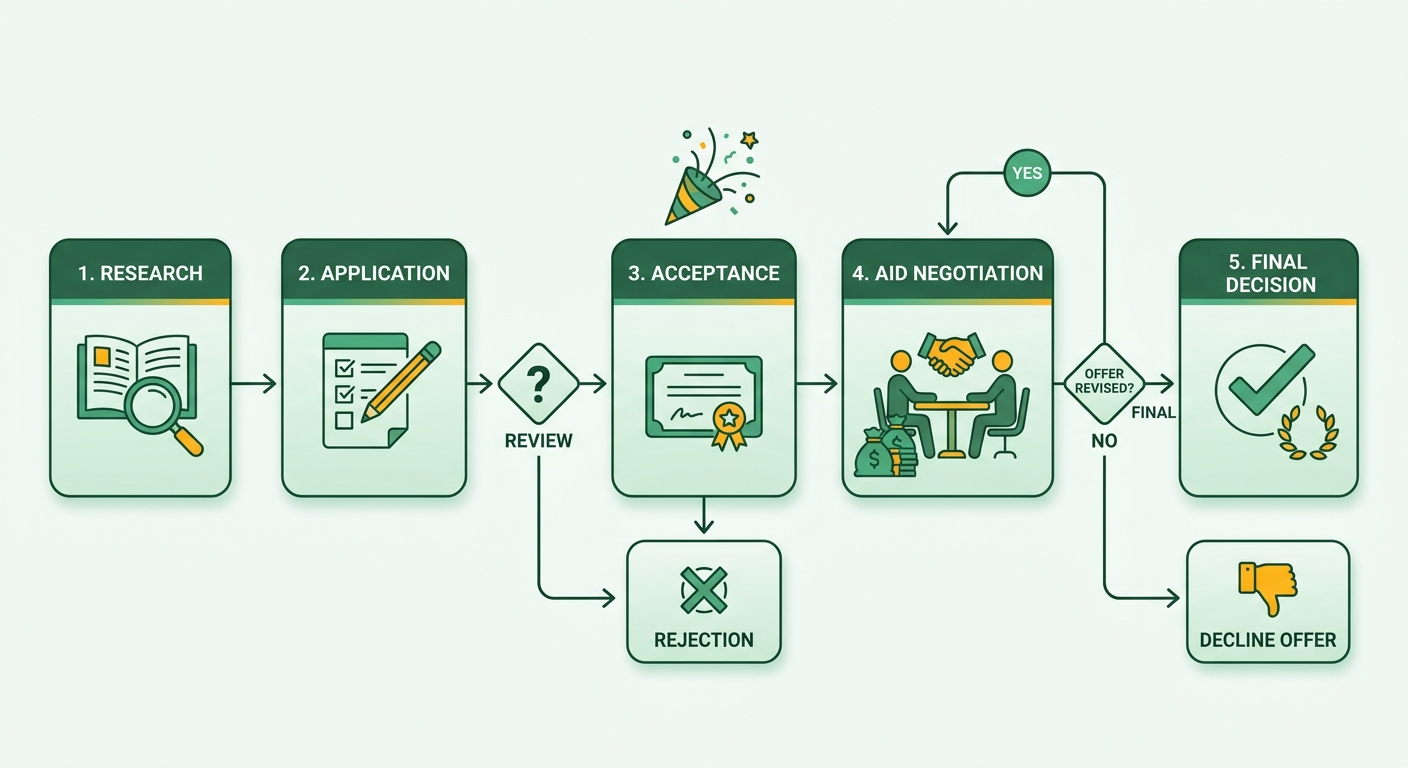
Once you're admitted ED, you withdraw every other application. Cornell notified early applicants for the Class of 2030 on December 18, 2025, which left families a narrow window to review an aid offer with nothing to weigh it against. The only exit is documented severe financial hardship, and that means walking away from the admission entirely, not talking Cornell into a better number.
The knock-on effect is that a big chunk of the class is set before Regular Decision review even starts. Early admits fill a substantial share of the first-year cohort, so seats thin out by spring. That's the point, from Cornell's side. It locks in a stable base early and cuts down on competing for students who need to shop offers later.
Regular Decision keeps your choices, at the cost of longer odds
The regular round protects your financial flexibility but throws you into a tougher pool. The acceptance rate is lower because the volume is enormous. What you get in return is a decision you can hold up against others. A Regular Decision admit lets you line up aid packages from different schools and make a call with real information.
This matters most for families who don't qualify for full aid but still feel the sticker price. Cornell doesn't offer merit scholarships, so maximizing need-based aid through comparison is the main lever you have. Regular Decision buys you the time and the leverage to actually pull it.
When ED still makes sense, and when it doesn't
If you can comfortably afford the net price the calculator spits out before you even apply, the early round is a reasonable bet. When the projected aid fits your budget, the binding commitment is a fair price for better odds. But if you need to see real offers side by side to know whether Cornell is feasible, go regular. Decide with complete information, not a projection.
The colleges have different odds, and different price tags
Cornell isn't one admissions machine. It's seven undergraduate colleges, each with its own committee, its own criteria, and its own tuition. That structure shapes both how hard you are to admit and what you'll pay before aid ever enters the picture.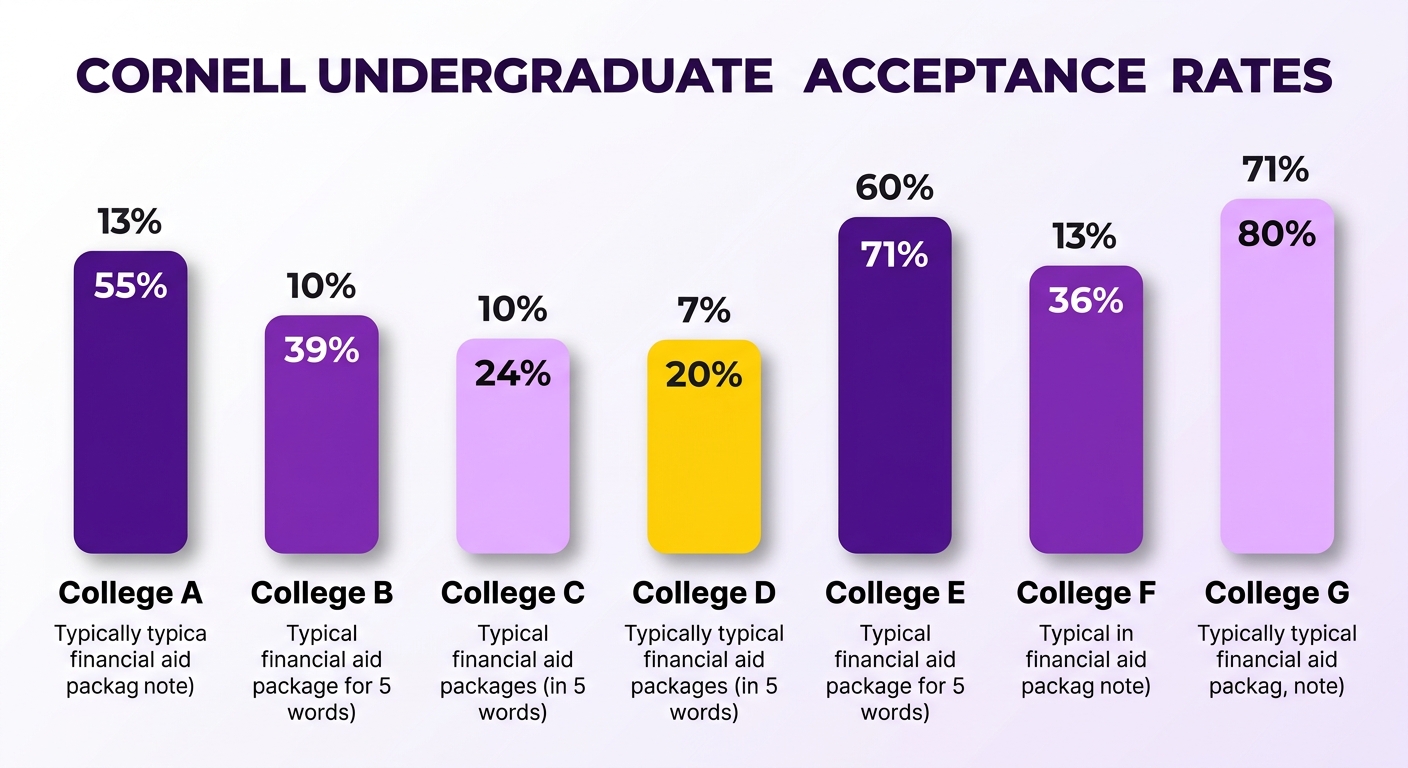
Why the acceptance rates vary by college
Each college reads for a different academic profile. Engineering leans hard on quantitative prep. Others weight humanities or specialized professional preparation. So your odds can shift a lot depending on which division you pick.
Readers are looking for real alignment between your background and the college's curriculum. As one industry observation puts it, Cornell's admissions readers "can detect strategic college selection within seconds." Picking a less selective division to game your odds almost never works. Show a genuine line from your academic history to the resources of the college you want, or don't bother.
How the contract colleges change your aid math
The split between endowed and statutory (contract) divisions is a financial-planning issue as much as an academic one. New York residents applying to contract colleges get lower in-state tuition, which can knock down the baseline cost before aid is even calculated.
Those statutory divisions, Agriculture and Life Sciences, Human Ecology, and Industrial and Labor Relations, are a real advantage for in-state families. Pair that lower tuition with a Regular Decision application and you get the best of both: reduced cost up front, and the freedom to compare final packages across schools.
What the alumni-story framing skips
Officers are consistent that metrics are only part of the read. They want students who fit the university's founding principles. In their words, "We aren't just looking for the highest-achieving students," but people with a clear plan for using Cornell's resources to do something real.
And since official college-specific acceptance rates aren't published anymore, trying to reverse-engineer precise odds is a waste of energy. Pick a college because you actually want what it teaches. That's still the strongest position you can apply from.
How to build an application that keeps your options open
Getting the most out of the non-binding round means showing up with an application that can compete. A strong profile lets a family go Regular Decision with confidence, aid comparison intact.
That flexibility depends on the strength of the file. A near-flawless application keeps you standing in the larger regular pool, where readers evaluate portfolios with no binding string attached.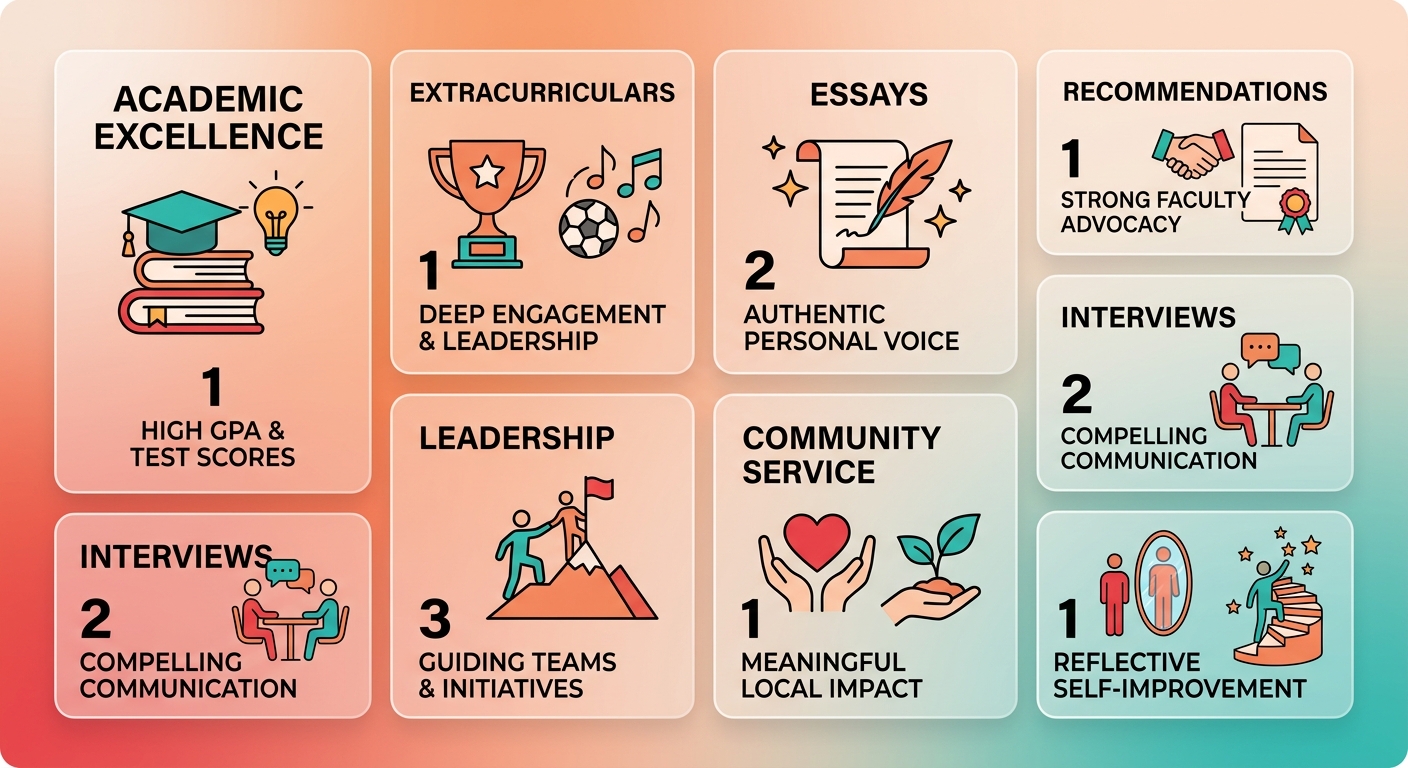
The academic profile Cornell expects
Grades and scores are the screen, not the verdict. Readers judge your record against your school's context, looking for steady work in demanding courses.
With the SAT/ACT requirement back, a competitive score is once again part of the picture. Course selection carries just as much weight. Aiming for Agriculture and Life Sciences? Show advanced biology and chemistry.
Balance the prep against the rigor, though. Committees generally favor a student who took hard classes over one who protected a perfect GPA by dodging them. Generally, doing real work matters here.
How extracurriculars and essays prove fit
Your activities should show sustained commitment and real impact, not a scattershot list. The through-line has to connect what you care about to the specific division you're applying to.
The supplemental essay is where you make that case. Skip the generic love letter to Cornell. Name the resources, the faculty, the courses inside your division. Readers are trained to spot boilerplate, and, as noted, they "can detect strategic college selection within seconds."
The essays that work tie your past experiences straight to your proposed field. Point to a research opportunity or a program that only exists at your target college. That's what builds a case an officer can believe.
Interviews and deadlines
The interview is your chance to talk through your academic goals and why Cornell specifically. Prep around your intended field and how you'd actually engage with campus life.
Then manage the calendar. Early Decision closes November 1; Regular Decision is January 2. Cost-sensitive families usually do better aiming at January. It gives you time to submit your strongest file while keeping your enrollment and financial options open.
References
[1] Cornell Accepts 5776 Students to Class of 2030 - https://www.cornellsun.com/article/2026/03/cornell-accepts-5-776-students-to-class-of-2030
[2] How to Get Into Cornell (2029–2030): Complete Admissions Guide - https://www.eduavenues.com/blog/how-to-get-into-cornell
[3] Cornell Acceptance Rate: Class of 2030 - Top Tier Admissions - https://toptieradmissions.com/cornell-acceptance-rate-class-of-2030/
[4] Class of 2030 Early Admission Rates - IvyWise - https://www.ivywise.com/blog/college-early-admission-rates/
[5] Admitted Class of 2030 seeks real-world impact | Cornell Chronicle - https://news.cornell.edu/stories/2026/03/admitted-class-2030-seeks-real-world-impact
[6] Cornell University Class of 2030 Early Decision Admission Statistics - https://www.ivycoach.com/the-ivy-coach-blog/ivy-league/cornell-university-early-decision-admission-statistics/
[7] 5,776 applicants were accepted to Cornell's Class of 2030, following ... - https://www.facebook.com/cornellsun/posts/5776-applicants-were-accepted-to-cornells-class-of-2030-following-ivy-day-on-thu/1470187404954865/
[8] How to Get Into Cornell University: Admissions Strategy - https://orieladmissions.com/how-to-get-into-cornell/
Frequently Asked Questions
1. Can I back out of Cornell's Early Decision if the financial aid package isn't enough?
The Early Decision agreement is binding, and the university expects admitted students to enroll. The only formal way to be released from this contract is by showing the offered financial aid package is insufficient to meet your family's calculated need. This process requires detailed financial documentation to prove enrollment is financially unfeasible.
2. Does Cornell offer merit scholarships to offset the cost?
The university allocates all financial assistance based on demonstrated financial need rather than academic or extracurricular merit. To determine eligibility, the financial aid office evaluates the FAFSA and CSS Profile to calculate a family's expected contribution, committing to meet the full extent of that calculated need through grants, work-study, and student loans.
3. Do New York residents get any advantage applying to Cornell?
In-state applicants may benefit from lower tuition rates when applying to the university's statutory divisions, which receive funding from New York State. To qualify for these reduced rates, applicants must meet specific residency requirements established by the state university system.
4. Why do sources report different admit counts for the Class of 2030?
Discrepancies in admissions statistics typically occur because data is collected at different points in the enrollment cycle. Initial reports reflect decisions released on Ivy Day, whereas later figures include students admitted from the waitlist or through specialized transfer programs during the spring and summer months.
5. I have a strong test score but my school offers few advanced courses. Does that hurt me?
Admissions officers evaluate academic records contextually using the School Profile provided by your high school counselor. This document outlines the specific courses and advanced programs available at your school, allowing readers to assess whether you challenged yourself relative to the opportunities available to you.
6. What does Cornell's 64% yield rate mean for a Regular Decision applicant?
The yield rate indicates the percentage of admitted students who choose to matriculate. Because this rate is lower than at some peer institutions, the university must admit a larger pool of candidates during the Regular Decision round to ensure it meets its target class size, keeping the non-binding round highly active.
7. How should I approach the "why Cornell" essay to prove genuine fit?
To demonstrate authentic interest, research specific academic offerings within your chosen division, such as unique laboratory facilities, specialized course sequences, or faculty research projects. Connecting these resources to your own academic background shows a well-considered plan for your undergraduate education.