What RISD, Carnegie Mellon, and MIT Actually Require in Creative Portfolios
August 21, 2026
What RISD, Carnegie Mellon, and MIT Actually Look for in a Portfolio
Key Takeaways
- Portfolio quality is widely cited as a primary acceptance factor among admitted students at selective institutions.
- RISD requires 12 to 20 recent works demonstrating observational intelligence, material experimentation, and conceptual range rather than polished final pieces alone.
- A portfolio optimized for one school's rubric often fails at another. RISD values process documentation while MIT prioritizes curated finished work.
- Selective programs treat portfolios as real-world auditions showing how applicants solve problems under constraints and contribute to studio culture.
- Building one strong portfolio per school requires substantially more preparation time than recycling the same 15 pieces across multiple applications.
- Schools evaluate how applicants translate what they observe into original work, not how well they replicate existing visual trends or Pinterest boards.
Quick Summary
Only if you can genuinely tailor the content to each rubric. A RISD-optimized portfolio heavy on process documentation and observational work may read as unfocused to MIT reviewers expecting a curated showcase of finished excellence. Conversely, a 10-image MIT portfolio built for impact often lacks the breadth and conceptual range RISD demands. The preparation time estimates above assume you're building one strong portfolio per school, not recycling the same 15 pieces across all applications.
Why Portfolio Requirements Matter
When selective schools evaluate creative portfolios, they're looking at how you solve problems under constraints, not just how well you render. The portfolio functions as a real-world audition for how you'll contribute to studio culture, research labs, and collaborative projects once you're on campus. It's the only artifact in your application where admissions teams see your hands-on decision-making in action.
The stakes aren't hypothetical. Admissions guidance from these institutions consistently emphasizes portfolio strength as a significant factor in acceptance decisions. These aren't decorative supplements. They're weighted decision points.
What Schools Actually Evaluate
RISD's portfolio requirements center on observational intelligence. Your ability to see and translate what's in front of you matters more than derivative online trends. The school requests a substantial body of recent work that reveals your thinking process, material experimentation, and conceptual range. Technical skill alone doesn't meet the threshold. As their admissions notes clarify, the committee prioritizes your intellectual approach over mere replication of existing imagery.
CMU's College of Fine Arts takes a different approach. The School of Architecture requires exactly 10 creative works demonstrating curiosity, critical thinking, and spatial reasoning. The School of Art asks for 10 to 20 pieces showcasing imagination and technical skills. The School of Design requires up to 18 slides plus a two-minute introductory video. It is the only CMU arts program that pairs visual work with a video narrative. Portfolios here should "tell a compelling story about the applicant's abilities and passions," not just display finished output.
MIT treats portfolios as optional, but that framing is strategic. The admissions page states portfolios should only be submitted "if they are significant and relevant to the application." For visual art and architecture, that means up to 10 images with descriptions. For maker projects, up to 25 media attachments documenting the build process. The $10 submission fee per portfolio type reinforces the point: send work that demonstrates exceptional creative achievement, not a resume of every project you've touched.
The Portfolio Size Paradox
Portfolio caps reveal how each school weights creative work in admissions. MIT's highly restricted submission limit forces radical curation. You're proving extraordinary talent in a narrow submission window. The broader ranges allowed by RISD and CMU accommodate both breadth and process documentation. MIT evaluates portfolios as supplementary evidence of specialized skill. Art schools treat them as primary admission criteria requiring a fuller creative narrative.
This inverse relationship between size and selectivity creates a strategic decision point. If you're applying to MIT, submitting a portfolio when your work doesn't reach their high threshold of exceptional relevance weakens your application. A mediocre creative supplement signals poor self-assessment. Skip it. At RISD, the portfolio is mandatory, and the expanded submission limit allows you to show both finished pieces and preparatory work. Your sketches, material tests, and conceptual drafts carry as much weight as polished final images.
Long-Term Use
Students with strong portfolios don't just get admitted. They arrive with built-in credibility. Departments offer them research positions, scholarship committees notice their work during funding reviews, and faculty pull them into early internship pipelines. The portfolio becomes your introduction to studio mentors, lab directors, and design firms recruiting on campus.
Strong portfolios open doors beyond admissions. Students who document iterative prototyping and hands-on problem-solving position themselves for paid research assistant roles and early lab placements. Those who show observational depth and conceptual range in their work catch the attention of faculty members looking for collaborators on papers and projects. The portfolio doesn't disappear after admissions. It becomes part of your academic file, visible to anyone evaluating you for opportunities.
Who Benefits Most From Portfolio Work
Four groups gain disproportionate advantage from early portfolio development. High school artists building a body of work over 10th and 11th grade—RISD explicitly recommends starting refinement by junior year—arrive with conceptual depth that one-semester portfolios lack. Interdisciplinary makers who document projects across media (robotics, textiles, digital fabrication) showcase the creative problem-solving CMU and MIT prioritize. International students whose transcripts don't translate cleanly use portfolios to demonstrate skill in a universal visual language. Homeschooled applicants without access to AP Art or IB Visual Arts courses build their own curriculum through portfolio work, proving self-direction that schools value.
The Quality-Over-Quantity Trap
The most persistent misconception we encounter: "more work is always better." It's not. Admissions teams at CMU note that portfolios should be curated, not comprehensive. Submitting 20 pieces when 15 are strong and 5 are filler dilutes your narrative. Reviewers remember the weakest image, not the average.
In practice, that means editing your portfolio with the same rigor you'd apply to a college essay. If a piece doesn't advance your story, if it repeats a skill you've already demonstrated, if it's technically competent but conceptually flat, cut it. A 12-piece RISD portfolio where every image reveals a different aspect of your observational range outperforms an 18-piece submission padded with safe, polished work that says nothing new.
Portfolio Collaboration Across Application Components
Your creative work doesn't exist in isolation. Essays that reference specific portfolio projects give admissions readers a narrative thread connecting your interests. A recommendation letter from your studio teacher that describes your material experimentation gains weight when reviewers see the actual experiments in your portfolio. Extracurriculars like organizing a student art show or teaching digital fabrication workshops become evidence of creative leadership when your portfolio proves technical competence.
Students who tie their Common App essay to a single portfolio piece, a failed sculpture project that taught them iteration under constraints, for example, create a unified narrative. The essay explains the conceptual risk. The portfolio shows the physical evidence. Admissions teams read both together, and the combination builds a case no single document can make alone.
Portfolio Size & Format Requirements
When building a creative portfolio for top-tier schools, format and file specs matter as much as the work itself. A technically perfect submission clears the first gate. Reviewers can focus on your ideas instead of wrestling with corrupted files or oversized uploads. Each school enforces different constraints that reflect how they evaluate creative work, and we've seen hundreds of students stumble on formatting requirements that seemed minor until their upload failed at the deadline.
RISD: Print-Ready Documentation Standards
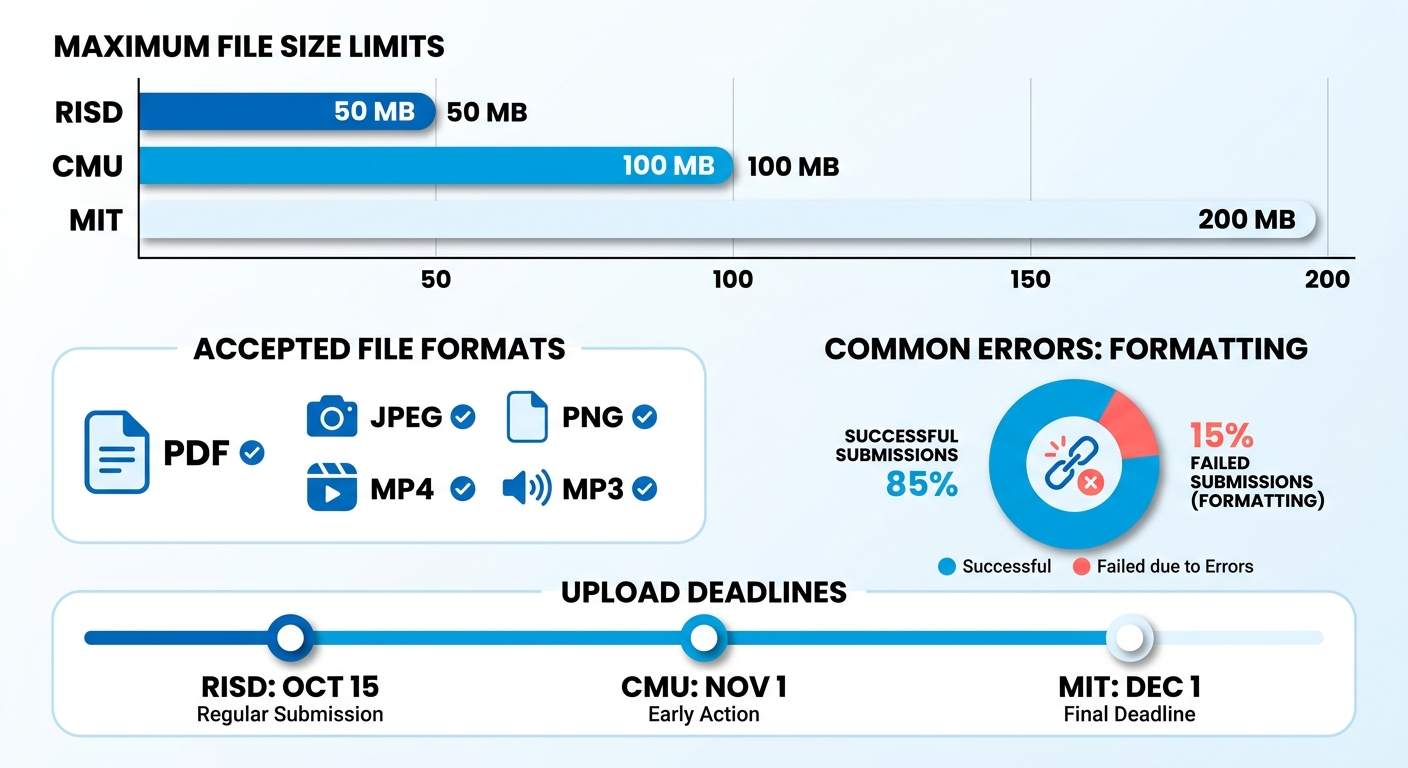
RISD asks for their standard visual submission volume via SlideRoom, with each file capped at 20 MB and an 11 × 17" printable size strongly preferred. The printable-size requirement isn't arbitrary. It signals that RISD reviewers often evaluate portfolios in printed committee packets, not just on-screen. You'll upload JPEG, PNG, GIF, MP4, or MOV files. Google Drive links and zipped folders are explicitly rejected. Direct observation work and preparatory sketches carry significant weight, so if your file compression algorithm strips detail from a charcoal drawing, the loss is real. We guide students to export at 300 DPI minimum and test-print a sample page before upload. If the graphite texture disappears at the preferred dimensions, the file needs adjustment.
Proper file organization prevents last-minute panic. We recommend creating a dedicated folder structure at least two weeks before the deadline: one master folder containing full-resolution originals, a second folder for compressed exports, and a spreadsheet tracking title, medium, dimensions, and completion date for each piece. Students who skip this step often find at 11 PM on deadline night that they've lost track of which charcoal study corresponds to which file name. In our experience, students spend significant time formatting and quality-checking a RISD portfolio, organizing files, verifying metadata consistency, and compressing without quality loss.
Carnegie Mellon: Video-Forward Digital Curation
CMU's School of Art accepts their required number of works via SlideRoom, with images uploaded as JPGs around 1 MB (roughly 1000 pixels on the shortest side) and videos capped at 250 MB in MOV, MP4, WMV, or FLV format. The school's emphasis on experimentation and process means many applicants include screen-recorded demonstrations of interactive work, ideally with narration. We've watched admissions officers scroll past portfolios that treat video as an afterthought. A silent screen-grab with no context doesn't communicate the thinking behind the project.
The total file cap across all uploads isn't explicitly stated in the undergraduate art guidelines, but CMU's architecture program enforces a stricter format rule: exactly ten creative works as JPG or video files, with PDF submissions rejected outright. That PDF restriction extends to art portfolios in practice. SlideRoom's interface allows multi-page PDFs, but CMU reviewers expect individual image files they can sequence and annotate during committee review. Students typically spend considerable time on CMU formatting, curating video clips, exporting screen demos at 1080p minimum, and resizing images to hit the 1 MB sweet spot without losing detail.
MIT: Research-Grade Image Specifications
MIT accepts their highly restricted image volume with descriptions through the same platform. This tight cap is the most demanding among these three schools, forcing radical curation. Every piece must justify its place. MIT also offers a separate Maker Portfolio option that accepts their expanded media attachment limit documenting the build process, but only one portfolio type is permitted per applicant. If you're submitting one focused portfolio, you can't also submit the other. The choice itself becomes a strategic signal about how you want admissions to frame your creative work.
The platform requires high-resolution images for print-quality review, and file naming conventions become critical at this resolution. We've seen applicants upload low-resolution phone snapshots that look fine on a laptop but pixelate when printed for committee folders. The two-step verification process some students report likely refers to SlideRoom's confirmation email plus the application portal's separate checklist. Both must show green before the deadline. Formatting time typically runs several hours for MIT: selecting the final ten from a larger body of work, photographing or scanning at high resolution, and writing concise descriptions that explain concept and execution without overselling.
Decision Framework: Matching Format to Selection Criteria
| School | Portfolio Size | File Type | Max File Size | Platform | Key Format Signal |
|---|---|---|---|---|---|
| RISD | 12–20 pieces | JPEG, PNG, GIF, MP4, MOV | 20 MB per file | SlideRoom | 11 × 17" printable size (suggests print committee review) |
| CMU School of Art | 12–20 images/videos | JPG (~1 MB), video (250 MB) | 1 MB images, 250 MB video | SlideRoom | Video emphasis (process documentation valued) |
| MIT | Up to 10 images | JPEG, video | Not specified | SlideRoom | 300 DPI + research-grade documentation |
Our customized planning approach helps students map their work to each school's specific constraints after the creative direction is clear. We catch common compression pitfalls where students use generic photo apps that prioritize speed over fidelity, stripping texture detail from observational drawings or charcoal studies. Through regular check-ins and collaborative feedback, we identify issues like incorrect aspect ratios or missing metadata fields well before the actual submission window opens.
Common formatting pitfalls we catch during review: incorrect DPI exports (72 DPI web images submitted for print review), missing metadata (no medium or completion year), inconsistent file naming (IMG_4738.jpg instead of LastName_Charcoal_Study_2025.jpg), and oversized video files that exceed platform caps. CMU's rejection of PDFs trips up students migrating portfolios from graphic design programs where multi-page layouts are standard. MIT's 10-image limit forces harder curation decisions than RISD's 20-piece range. We guide students to treat the MIT portfolio as a greatest-hits showcase, while RISD portfolios can afford to include preparatory sketches that demonstrate conceptual evolution.
The format rules encode each school's evaluation priorities. RISD's print-size preference reflects a committee-based review culture where faculty pass physical packets. CMU's video flexibility aligns with their emphasis on experimentation and risk-taking over polish. MIT's tight 10-image cap positions the portfolio as supplementary evidence of exceptional talent, not the primary admissions artifact. When students ask whether to submit 12 or 20 pieces to RISD, we point them back to the selection framework. If pieces 13–20 demonstrate meaningful range in media or concept, include them. If they're padding, the portfolio reads weaker with them than without them.
Core Content & Evaluation Criteria
When reviewers at RISD, CMU, and MIT open a creative portfolio, they're not reading a list. They're diagnosing how you think under constraint. Each school uses a distinct evaluation lens that reflects what it values most in student work, and we've built our coaching around aligning your portfolio content to those specific rubrics. A piece that earns top marks at one institution can read as incomplete or misaligned at another, which is why our process starts by examining your existing work against each school's published criteria before you shoot a single new photograph or refine a single sketch.
RISD: Observational Rigor and Conceptual Narrative
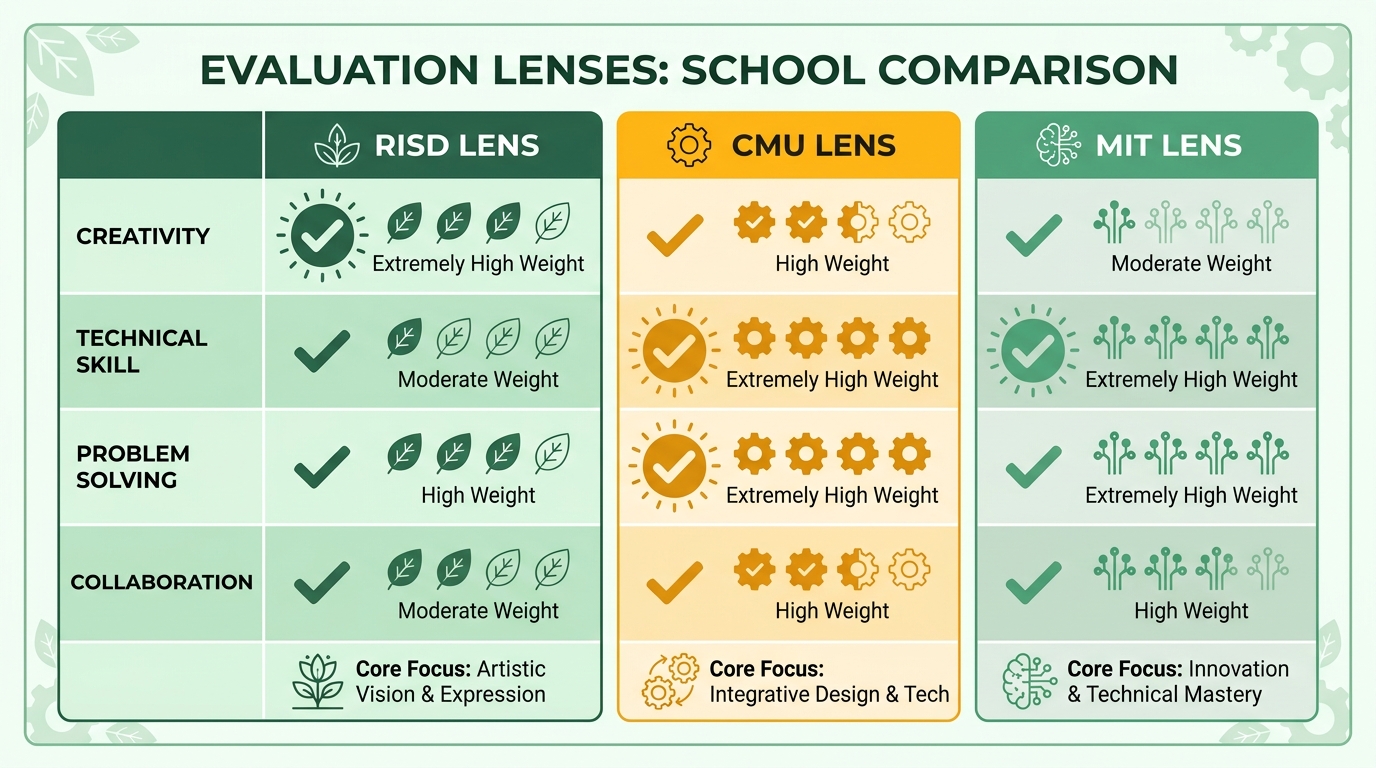
RISD's admissions team explicitly emphasizes intellectual process over mere technical replication, and that translates to a dual emphasis: direct-observation work that proves you can see form, light, and spatial relationships accurately, plus conceptual pieces that show you're curious enough to push past safe execution. Strong portfolios typically include at least four observational studies. Life drawing, still-life painting, or plein-air work helps reviewers see that foundation. The remaining slots should tell a coherent creative story across media: preparatory sketches next to finished pieces, material experiments that document your decision-making, and work that addresses questions you're genuinely wrestling with rather than assignments you completed for a grade.
Our team has mentored students who submitted kinetic sculpture series paired with process documentation: failed prototypes, material-testing grids, and annotated sketches showing iteration from concept to working mechanism. That breadth-plus-depth approach hits RISD's criteria for both technical range and conceptual coherence. According to the school's guidance, "strong documentation and concise contextual information are more effective than volume," which is why we recommend capping written descriptions at 75 words per piece and letting the visual sequence narrate the journey.
CMU: Interdisciplinary Voice and Experimental Risk
Carnegie Mellon's School of Art evaluates portfolios through a holistic lens that weighs creative voice as heavily as technical skill. Their admissions officers directly state they want to see "experimentation, risk-taking, and curiosity" over polished classroom assignments, and they explicitly encourage sketchbook pages, works made outside formal instruction, and pieces addressing personal identity or social questions. This means your portfolio should read like a creative argument about what matters to you, not a showcase of your best rendering.
We've worked with applicants who built AR installations and interactive projects exploring cultural and linguistic identity. Strong examples document the work with screen-captured demonstration videos. CMU recommends narrated walkthroughs for interactive work. They also include early concept sketches showing how students moved from linear ideas to spatial-computing formats. CMU's guidance explicitly notes that "portfolios that excite us demonstrate experimentation," and reviewers respond to evidence of format pivots and iteration rather than safe execution. For interdisciplinary work, especially pieces integrating hardware, code, or user research, we recommend dedicating three to five slots to projects that cross traditional media boundaries, because CMU evaluates your ability to synthesize methods as much as your ability to execute within one.
MIT: Research Relevance and Technical Scalability
MIT treats creative portfolios as optional and explicitly warns applicants to submit only if their work represents exceptional creative achievement, which tells you everything about how reviewers weight them: as evidence of high-level accomplishment, not as a general arts supplement. Their highly restricted submission limit forces radical curation. You're not showing breadth. You're proving you've already done work that matters beyond a classroom context. The strongest MIT portfolios tie visual or maker projects directly to a research question students are pursuing: a robotics build documented as engineering research, a data-visualization series exploring climate datasets, or an architectural model addressing urban-density challenges with quantifiable design constraints.
Strong applications have included research posters and prototypes for devices developed through university lab partnerships, with portfolios featuring CAD renderings, testing graphs, and abstracts framing projects as biomechanics research or materials engineering rather than industrial design. MIT's Research Supplement requirements ask for a 250–300 word abstract plus a mentor recommendation, and tying the portfolio piece to that supplement gives reviewers a clear throughline: this isn't decorative work, it's hypothesis-driven making. For applicants without formal research experience, we recommend framing maker projects through a problem-solution lens. What constraint were you solving, what alternatives did you test, and what measurable outcome did you achieve? MIT evaluates creative work the way it evaluates lab contributions: Does it scale? Does it answer a question someone else would care about?
| Evaluation Criterion | RISD | CMU | MIT |
|---|---|---|---|
| Primary Focus | Observational foundation + conceptual depth | Artistic voice + experimental risk | Research relevance + technical scalability |
| Process Documentation | Required (sketches, material tests, iterations) | Encouraged (especially for interactive work) | Expected for maker/research projects |
| Interdisciplinary Work | Valued if conceptually grounded | Strongly encouraged across all media | Required for most competitive portfolios |
| Portfolio Role in Admission | Central weight (art school) | High weight (holistic review) | Supplementary (submit only if exceptional) |
Personalized Portfolio Strategy
Our team reviews every portfolio before submission, applying our decades of experience helping students gain admission to top programs. We examine your existing pieces against each school's published criteria—RISD's observational emphasis, CMU's experimental lens, MIT's research threshold—and identify which elements you're currently addressing well and which need new work or stronger documentation. Our collaborative, panel-based approach ensures you receive diverse perspectives on how to strengthen your submission.
We assign school-specific revision priorities based on each institution's evaluation criteria: an MIT applicant might need to reframe a furniture-design project as material-science research, while a RISD applicant working on the same piece would instead focus on process documentation showing how they tested joint mechanisms. Our mentorship helps you understand review conditions. Portfolios are often viewed on laptop screens with limited time per piece, so we flag any work that doesn't communicate its concept quickly and clearly. You're not building one portfolio and recycling it. You're building tailored submissions that speak each institution's evaluative language, and our team provides the customized guidance so you can focus on making stronger pieces rather than guessing what reviewers want.
Endurable Education Portfolio Consulting (Business Spotlight)
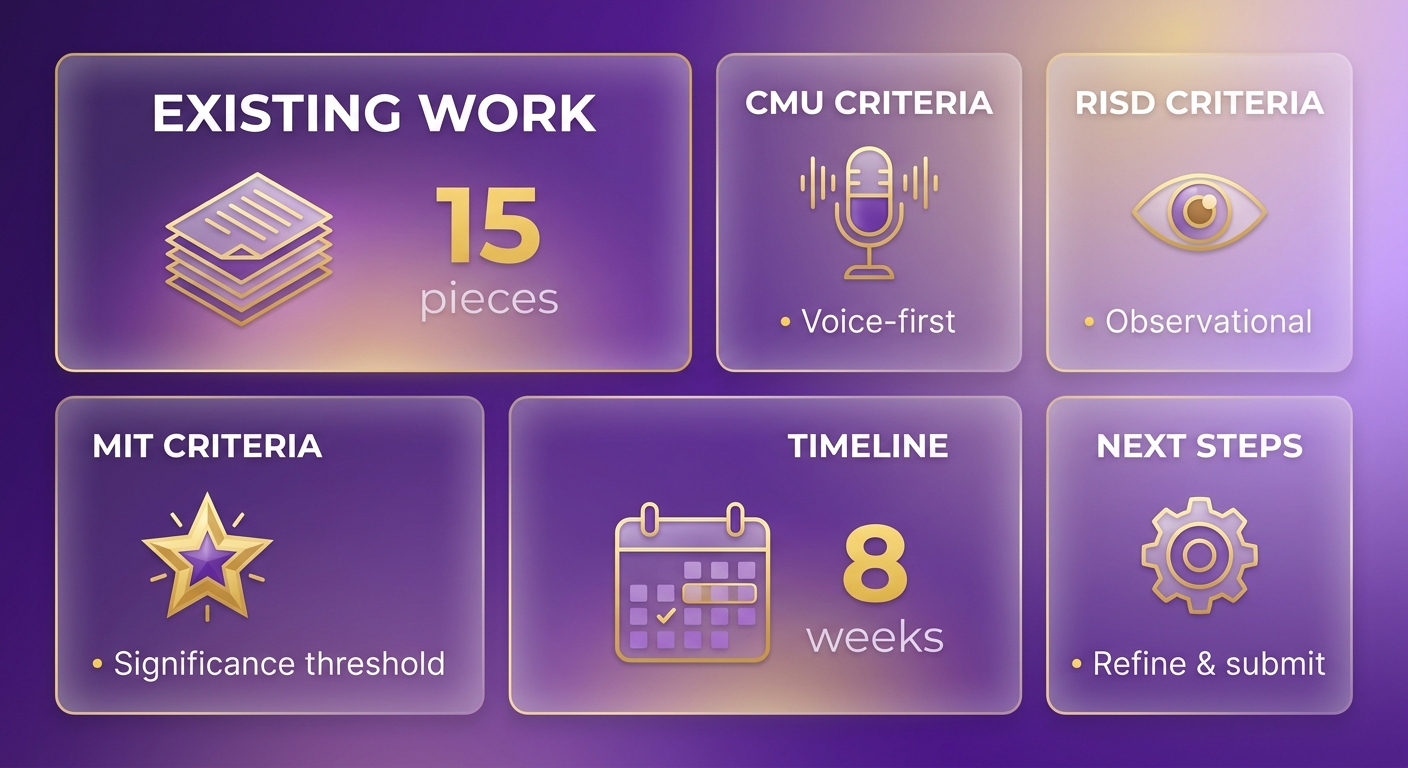
We've worked with students managing RISD, Carnegie Mellon, and MIT portfolio requirements, helping them understand how each school evaluates creative work differently. When an applicant comes to us with fifteen disparate pieces and eight weeks until the RISD deadline, we map existing work against CMU's voice-first criteria, RISD's observational requirements, and MIT's significance threshold, then build submission strategies for each school in parallel. That decision framework, matching content to criteria before a single new piece gets made, is what separates reactive portfolio coaching from strategic preparation.
Our Collaborative Mentorship Approach
Our discovery phase starts with understanding what each school is actually asking for. We review your existing portfolio against the specific language each school uses: CMU reviewers look for creative risk-taking over technical precision, while RISD explicitly asks for evidence of visual intelligence through direct-observation studies. MIT's bar is higher still. Portfolios are optional because they're only worth submitting when they demonstrate high-level accomplishments that strengthen an already competitive application. The schools aren't looking for the same creative portfolio at different file sizes. They're evaluating different intellectual qualities through similar formats.
Curation follows a school-specific logic we've developed through our extensive admissions experience. RISD portfolios earn acceptance when they balance finished excellence with visible process. Including charcoal figure studies alongside a final oil painting can give reviewers a narrative arc from observation to synthesis. CMU portfolios succeed when they reveal artistic voice through risk-taking, so we encourage students toward work that addresses identity, philosophy, or social critique rather than polished technical demonstrations. MIT portfolios fail most often not because the work is weak, but because it doesn't meet the high threshold of exceptional relevance. Our role is often telling a student their creative work, while strong, won't move the admissions needle and they should spend those hours on essays instead.
The refinement phase is where our customized planning and teamwork show most clearly. We cross-reference every portfolio piece against all three schools' stated evaluation criteria, helping you identify gaps before you upload anything to SlideRoom. One student applying to both RISD and CMU realized her thirteen ceramic sculptures answered RISD's material exploration requirements but gave CMU reviewers nothing about conceptual intent. We helped her write image captions that contextualized each piece within her broader exploration of cultural memory and displacement. We help catch technical issues, undersized files, low-resolution JPGs, video formats CMU won't accept, that would otherwise create problems on admissions platforms. Through regular check-ins, we help students practice sequencing their work and ensure their submissions meet technical requirements.
Working with Endurable Education
Our track record includes over 50% of students admitted to top 10 and Ivy League schools, with almost all students admitted to Top 35 colleges. That conversion rate reflects our careful assessment as much as our coaching. We're honest about whether a student's creative work matches institutional thresholds, rather than promising outcomes we can't deliver. Our base + bonus pricing structure keeps standard costs fair and transparent, with final fees tied to satisfaction with our service.
We've supported students on tight timelines, helping them move from first consultation to submitted portfolio in under two weeks when needed. One student had seventeen pieces of existing work but no coherent narrative. We identified six that demonstrated genuine artistic risk, worked with her on developing two new sketchbook spreads that revealed her conceptual process, and helped her sequence the final twelve images to answer CMU's explicit prompt asking to understand the applicant's identity as both an individual and a maker. She submitted via SlideRoom and received her acceptance five weeks later.
| Service Feature | Endurable Education | Generic Portfolio Coach | Art School Prep Course |
|---|---|---|---|
| School-Specific Strategy | Customized planning for RISD/CMU/MIT criteria | General "strong portfolio" feedback | Curriculum not tied to specific schools |
| Team Experience | Harvard, Yale, Princeton graduates with 15+ years admissions experience | Varies by coach availability | Instructors may lack admissions experience |
| Collaborative Support | Panel review approach, regular check-ins | Typically one-on-one | Semester-long fixed schedule |
| Track Record | Over 50% admitted to top 10 and Ivy League | Not disclosed | Not tracked per institution |
| Timeline Flexibility | Rapid turnarounds available to standard packages | Typically 8-12 weeks | Semester-long fixed schedule |
| Investment | Base + bonus structure | $2,500–$6,000 range | $1,200–$3,500 course fee |
When Our Approach Fits Your Timeline
We're the strongest choice when you need strategic portfolio guidance calibrated to specific schools and you're targeting competitive art and design programs. Students applying only to RISD may find better value in a coach who specializes exclusively in art school portfolios and can dedicate more time to observational drawing fundamentals. Students applying only to MIT should first consider whether their creative work meets the high threshold of exceptional relevance. If it doesn't, skip the portfolio entirely rather than paying for coaching on a submission that weakens your application.
Our model works best for 11th-grade spring through 12th-grade fall timelines, when the creative work already exists and the challenge is strategic curation and presentation rather than foundational skill-building. We help you decide which pieces to make based on what schools are looking for, but the studio work happens on your schedule with your art teachers. If you need someone to guide brushwork or compositional technique, you need a studio instructor, not an admissions consultant. We provide the mentorship, strategic thinking, and collaborative feedback that help students present their best work to admissions committees.
Final Recommendations & Best‑For Summary
When you're weighing where to apply, the creative portfolio decision framework comes down to matching each school's selection lens to what you already have and what you're willing to build. We see applicants waste months creating generic "best work" compilations that don't map to any school's actual rubric. The fix is simpler than most students expect: start by auditing your existing pieces against each school's specific evaluation criteria, then decide where your strengths naturally align before you shoot a single new photograph or refine a single sketch.
Who Should Choose Which School
RISD is the right target when your portfolio already contains strong observational work—life drawing, plein-air painting, studies from direct observation—and you can articulate conceptual narratives across a substantial body of work. If you're starting from scratch with eight months until the deadline, RISD's breadth requirement becomes a sprint. Our mentorship helps RISD applicants understand how preparatory work and finished pieces form a single narrative, while avoiding the technical mistakes we see every cycle: portfolios that lean too heavily on digital work without the hand-drawn foundation RISD explicitly recommends, or students who misinterpret "experimental projects" as permission to skip foundational technique entirely.
Carnegie Mellon suits applicants who want to showcase artistic voice through risk-taking experiments over polish. The admission team is looking for your authentic creative identity, not just technical execution, which means sketchbook pages showing your process often carry more weight than overly refined pieces that feel disconnected from your authentic practice. We help CMU applicants who straddle art and engineering decide which projects to foreground and which best express their unique creative voice. The SlideRoom rehearsal component matters more than most applicants expect. We've seen students lose hours at the deadline because they formatted video files as PDFs or exceeded the platform's video size limits.
MIT portfolios demand radical curation. This isn't a collection that demonstrates breadth or process. It's a showcase of finished excellence that directly supports your academic narrative. Our mentorship helps students whose creative work ties to research projects articulate why each piece matters to their application. We'd rather see you channel that energy into a compelling project description or research abstract that positions you as a contributor to MIT's maker culture.
Decision Matrix: When to Work with Us vs. DIY
| Your Situation | Endurable Education | DIY Approach |
|---|---|---|
| Timeline | 6+ months before deadline, want structured milestones | 12+ months out, comfortable self-directing |
| Portfolio Experience | First time applying to art programs, unfamiliar with SlideRoom | Strong AP Art portfolio or prior art school applications |
| Budget | Can invest in customized mentorship | Limited budget, willing to trade time for cost savings |
| Existing Work Quality | Mix of strong and weak pieces, need help curating | Confident in current portfolio, need only format review |
| Conceptual Clarity | Struggle to articulate themes across work | Clear artistic statement, just need technical polish |
We recommend DIY only when you're applying to a single school, you have 12+ months to iterate, and you've already built a portfolio for AP Studio Art or a similar program. The moment you're targeting multiple schools with conflicting criteria, say, RISD's breadth requirement plus MIT's curation demand, the risk of misalignment outweighs the cost of mentorship. Our role isn't to make your art for you. It's to prevent the structural mistakes that get portfolios rejected before a reviewer evaluates the work itself.
What to Expect from Our Process
When you start with our team, the initial consultation helps us understand your existing work and map it against school-specific requirements. You'll leave that conversation knowing which pieces are portfolio-ready, which need rework, and which schools your current body of work can realistically target. We work session-by-session rather than locking you into a fixed package. A student who realizes after three meetings that their strongest path is Cooper Union's Hometest instead of a traditional portfolio can pivot without sunk cost, while another applicant might need ongoing support through winter deadlines as they balance portfolio development with AP coursework and college essays.
Our collaborative approach means we adjust the mentorship focus as your work evolves. A student who starts in 11th grade with strong technical skills but weak conceptual range will spend more time developing narrative across their portfolio. A senior with eight weeks until the deadline and a scattered collection of pieces gets focused support on curation and formatting. The throughline is always the same: match portfolio content to selection criteria before you refine a single piece, because the most beautifully rendered work still fails if it doesn't answer what the school is asking.
Portfolio expectations shift every cycle. CMU now emphasizes storytelling through curated work more than it did five years ago, and the weight given to process documentation versus finished pieces changes as programs respond to trends in contemporary art education. Our team reviews successful portfolios and admissions trends each season to understand what works. That's the edge: you're not guessing what worked three years ago. You're building to the rubric that will evaluate your work this cycle. Ready to start? Contact us and we'll assess where your portfolio stands today.
References
[1] Portfolio & Apply - CMU School of Art - Carnegie Mellon University - https://art.cmu.edu/undergraduate/portfolio-apply/
[2] Creative portfolios - MIT Admissions - https://mitadmissions.org/apply/firstyear/portfolios-additional-material/
[3] RISD Portfolio Requirements: What Students Need to Know - https://www.portfoliocoachingnyc.com/blog/risd-portfolio-requirements
[4] MIT Creative Portfolios Submission Guidelines - The Artist Lab - https://www.theartistlabs.com/post/mit-creative-portfolios-submission-guidelines
[5] Application Process for First-Year Admissions | RISD - https://www.risd.edu/admissions/first-year/apply-risd
[6] Application Process for Graduate Admissions | RISD - https://www.risd.edu/admissions/graduate/apply-risd
[7] Undergraduate Admissions | CMU School of Architecture - https://www.architecture.cmu.edu/admissions/undergraduate-admissions
[8] College of Fine Arts Applicants - Undergraduate Admission - https://www.cmu.edu/admission/admission/college-of-fine-arts-applicants
[9] Graduate Admissions - MIT Architecture - https://architecture.mit.edu/graduate-admissions
Frequently Asked Questions
1. Should I submit the same portfolio to RISD, CMU, and MIT to save time?
No. Each institution evaluates portfolios through a fundamentally different lens. A submission tailored for an art school's emphasis on developmental stages and observational studies will not align with a research university's preference for highly curated, finished projects. To maximize your chances, you must customize your selection and framing for each school's specific rubric rather than sending a single, generic compilation.
2. How much time should I allocate for formatting and organizing my portfolio files?
You should allocate ample time across several days to handle technical preparation. For schools requiring extensive documentation, expect to spend several hours verifying metadata consistency and testing file compression. For video-heavy submissions, budget time for editing clips and exporting screen demonstrations. Even for smaller portfolios, plan a few hours for high-resolution scanning and drafting concise project descriptions. Starting this process at least two weeks before the deadline prevents technical errors from disrupting your submission.
3. What does MIT mean by portfolios should only be submitted if "significant and relevant"?
MIT's threshold means the portfolio is not a casual showcase of hobbies, but a rigorous demonstration of high-level creative work. Reviewers look for projects that align with the university's focus on problem-solving, such as advanced maker projects, design work addressing complex constraints, or artistic endeavors that connect to research inquiries. If your creative work does not represent a major, self-directed achievement of this caliber, omitting the optional supplement is the stronger strategic choice.
4. Can I include the same observational drawing across multiple schools if each requires it?
Yes, but you should adjust how you contextualize the piece. For an art-focused program like RISD, use the description to highlight your visual analysis and how the study informed your broader conceptual projects. For an interdisciplinary program like CMU, emphasize the experimental choices or developmental stages behind the drawing. For a research-oriented school like MIT, ensure the piece is framed around spatial reasoning or design methodology rather than pure artistic rendering.
5. Do preparatory sketches and failed prototypes strengthen or weaken a portfolio?
In most cases, showing your process is a major asset. Art and design programs value seeing how you iterate, test materials, and learn from unsuccessful attempts, as this reveals your creative resilience and problem-solving skills. However, for research-focused submissions, process documentation should be highly structured, focusing on how your prototypes validated specific technical concepts or resolved functional challenges rather than just showing casual sketches.
6. What file naming convention prevents common portfolio upload errors?
Adopt a systematic naming system that includes your name, the project title, and the year of completion. Avoiding default camera file names ensures your files remain organized during the upload process and helps admissions committees easily reference specific pieces during their deliberations. This simple step also keeps your workspace organized, making it much easier to manage last-minute adjustments.
7. How do I know if my portfolio demonstrates conceptual range versus just technical skill?
Conceptual range is evident when your work explores diverse ideas, themes, or intellectual questions rather than simply repeating the same visual style across different mediums. If your collection shows high technical execution but lacks thematic depth or evidence of critical inquiry, reviewers may view it as technically proficient but conceptually static. Aim to show how your work responds to specific challenges, personal inquiries, or theoretical concepts.