Why Price Rarely Predicts Which Admissions Consultant Moves Your Decision
August 29, 2026
Planning article copy tightening and cleanup****Editing article for concise, less promotional tone

Key Takeaways
- Price doesn't reliably predict which consultant helps most. Caseload and attention matter more than fees.
- Nearly 68% of families rank price first. But cost and effectiveness do not consistently match.
- The price-quality reflex makes high fees feel reassuring before work begins.
- Six experiments with 2,842 participants found higher prices raised expectations. They did not track actual quality after use.
- The researchers told marketers to stop using the price-quality shortcut.
- Private Prep's 2026 cost report says consultant fees do not always correlate with results.
- Caseload size and one-on-one attention drive outcomes. Neither appears on a price tag.
Why the Bigger Fee Rarely Wins You the Admit
Most families choose a consultant like wine at a restaurant. Pricier bottle, better bottle. The data says that instinct is wrong. Price doesn't reliably predict which college admissions consulting service moves your admission decision. The reason lies in how we process cost.
Nearly 68% of families cite price as their top comparison factor. Yet the 2026 cost report from Private Prep is blunt: fees do not always correlate with effectiveness. What drives results is caseload size and individual attention. Neither one appears on a price tag.
Why Families Read a High Fee as a Guarantee
The price-quality heuristic makes your brain expect better work from higher fees. That expectation comes before any work begins.
Researchers tested this across six experiments with 2,842 participants. Higher prices reliably raised expectations, but they didn't track actual quality after people used the product. The authors told marketers to stop relying on the shortcut.
Our take: price sells expectation, while caseload delivers results. A firm charging $80,000 can still run 40 students per counselor. That buys a feeling, not face time.
What Cheap and Premium Both Cost You
Both ends of the pricing spectrum carry hidden costs. Bargain services reduce coach time and rely on templates. Premium packages raise expectations beyond what any consultant can deliver.
The number that matters is the student-to-counselor ratio. Comprehensive packages keep the lowest ratios, around 12 to 20 students per counselor, according to the cost report.
| Factor | Essay-Only / Hourly | Premium Package | Endurable Education (Base + Bonus) |
|---|---|---|---|
| Typical cost | $100–$500/hr | $10,000–$120,000 | Lower base, bonus on satisfaction |
| Coach time | Limited, transactional | High expectation, variable delivery | Full-touch, panel review |
| Risk to family | Generic support | Post-purchase disappointment gap | Full fare only if you're satisfied |
| Incentive alignment | Bill by the hour | Paid up front regardless | Rewarded on your satisfaction |
Where Value-First Pricing Actually Wins
Best for families stressed about outcomes: a base-plus-bonus model where you only pay our full fare if you're satisfied with the service.
Here's how the sources connect. Premium packages raise expectations they cannot always meet, which creates a real disappointment gap. Our answer is a transparent structure that keeps standard prices lower than competitors. It also ties the bonus to your satisfaction, so we're pushed to keep doing good work over time. Some parents have even doubled our bonuses as a thank-you.
The stakes justify that approach. A missed admission to a scholarship school can mean $50,000 to $70,000 in tuition lost per year. Against that, the industry-average comprehensive fee falls below the monthly cost of many single-year programs. Many merit scholarships we help students earn are, frankly, a strong return on investment.
We'll be honest about the carve-out. If you're a profile-building underclassman who mostly needs early structure, an hourly or lighter-touch model may work fine. As the Private Prep team put it, "starting earlier costs less and delivers better outcomes." That's why we start long-term planning with students as early as 8th grade, laying groundwork before applications begin.
Decoding Consultant Pricing Models
Most families building a shortlist of college admissions consulting firms have no framework for what pricing actually reflects. The dollar figure is the most visible variable. It's also the least informative one.
The pricing model tells you something more useful: whose interests the structure serves.
How the Five Main Models Compare
Flat fee ($5,000–$15,000) covers a defined scope. You pay once, and the consultant delivers what was agreed. The predictability is real. So is the misalignment. Once the check clears, the consultant's financial stake in your outcome is zero. Flat-fee contracts also tend to limit services narrowly, so extra essay rounds or supplemental support become billable add-ons.
Hourly consulting ($150–$400/hr) suits families who need targeted help on one part of the application. A family that only needs to polish a single supplemental might book two or three sessions and stop. The limit is structural: hourly work rarely produces the cohesive narrative competitive applications require. You get edits, not strategy.
Tiered packages (Basic/Standard/Premium) create the appearance of choice. In practice, lower tiers often exclude the services that matter most. School list development, interview coaching, waitlist strategy. Then they push families toward premium anyway.
Base + bonus is our approach. A base fee covers full planning and drafting. A success-based bonus rewards results, and you only pay full fare if you're satisfied. The consultant's incentive connects to your outcome, not to closing a sale.
Performance guarantees and "admit-or-refund" promises deserve scrutiny before you sign anything. No consultant controls admission decisions. These guarantees either carry so many conditions they're useless, or they signal a firm that cherry-picks near-certain admits to protect its refund rate. Skip them.
| Model | Typical Cost | Outcome Alignment | Watch For |
|---|---|---|---|
| Flat Fee | $5,000–$15,000 | Low | Narrow scope; add-ons inflate total |
| Hourly | $150–$400/hr | None | No holistic strategy |
| Tiered Package | Varies | Medium | Lower tiers exclude key services |
| Base + Bonus | Base + success fee | High | Bonus terms must be written clearly upfront |
| Performance Guarantee | Varies | Misleading | Conditions often make refund near-impossible |
The Hidden-Cost Problem
The headline price rarely reflects what you'll actually pay. Many firms post a base number and bill separately for essay edits beyond a set count, interview prep, activity-list audits, and scholarship support. Ask any firm to itemize what triggers an extra charge, and the gap between the advertised figure and the real total starts to show. A "comprehensive" package at one firm may stop at three essay drafts, while another includes unlimited revisions under the same label.
Our base-plus-bonus structure defines exactly what's included before any work starts. That removes the risk of surprise upcharges. Clarity is the point. It makes the model easy to audit for families who want cost transparency without losing holistic support.
Flat Fee vs. Base + Bonus, Side by Side
Two families making this choice. The flat-fee firm collects payment at signing. The consultant works through a defined checklist, and the engagement ends when the scope is complete, regardless of your application status.
A base-plus-bonus engagement ties the consultant's daily effort to the student's progress. Because the final reward depends on a successful outcome, the advisor is motivated to run deep strategy sessions instead of ticking off administrative boxes. The pricing model shapes the incentive, and the incentive keeps your consultant engaged through the final decision.
Our take: this structure ties the firm's financial success directly to the value delivered to your family.
Red Flags and Pricing Pitfalls to Watch For
The fastest way to spot a price-driven admissions shop is to watch what they promise and hide. Guarantees that sound absolute, pricing that appears only after you commit, and pressure to sign fast are the three loudest warning signs in college admissions consulting. Each one signals a business built to sell expectation rather than deliver outcomes.
This matters because high fees can create a false sense of security. When families pay premium rates, they often assume the service is flawless, then discover later that the guidance lacks personalization. An outcome-aligned model closes that gap by tying the financial commitment to the value actually delivered.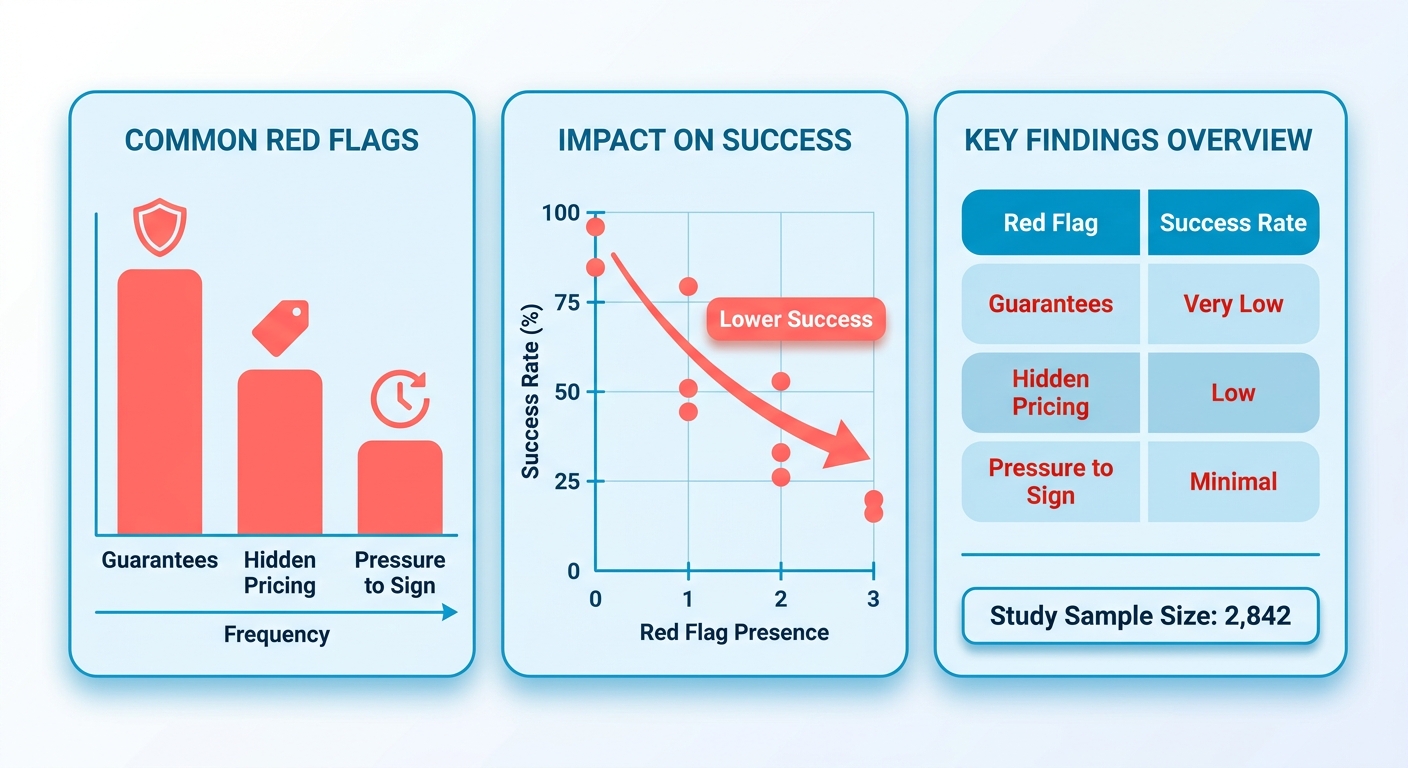
Six Red Flags Before You Sign
They separate a firm invested in your outcome from one invested in your deposit.
-
Absolute admission guarantees. No consultant controls an admissions committee. A guaranteed-entry promise is marketing, not a realistic commitment.
-
No transparent pricing. If the only number you get is a "custom quote" after a discovery call, the pricing is meant to be negotiated against your anxiety, not compared openly.
-
Multi-year contracts before any assessment. Being asked to commit for several application cycles before anyone reviews your transcript is a lock-in tactic. Once the deposit clears, your leverage to renegotiate or walk away drops near zero. Sign only after someone has reviewed your file.
-
Junior staff doing the real work. Senior names in the sales pitch, then a junior associate runs your sessions. Ask who edits your essays and how many students they carry.
-
Aggregate-only success rates. A firm quoting "95% admit rate" without defining it is hiding the math. More on this below.
-
No post-admit support. If the relationship ends the day you're accepted, with no scholarship, transition, or planning help, you bought a transaction, not guidance.
Why "Total Offers" Misleads You
Total offers counts every acceptance a firm's students collect. Unique admits counts how many students got into at least one target school. The second number is the honest one. A single student admitted to eight schools inflates "total offers" without helping anyone else.
Push for the unique-admit figure and the definition behind it. Also verify coach credentials directly: graduate institution, years of real admissions experience, and subject-matter fit. Caseload matters more than pedigree. A consultant with a manageable student load can give the deep, individual attention that actually predicts outcomes, whether or not they hold a former-officer résumé.
How Our Base + Bonus Model Ties to Your Satisfaction
We keep pricing fair and transparent, built on a structured agreement backed by a Happiness Guarantee. The model aligns our incentives with your goals without leaning on unrealistic promises. The advantage comes from a proven track record and a structure that ties our success to your satisfaction with the process.
| Red Flag | Typical Firm | Our Model |
|---|---|---|
| Pricing | Custom quote after commit | Structured base + bonus |
| Guarantee | "Admit anywhere" | Happiness Guarantee; aligned incentives |
| Contract | Multi-year lock-in | Assessment first |
| Consultant | Junior staff | Senior, credential-vetted |
Skip any firm that won't put its numbers, definitions, and coach credentials in writing. If the pricing hides and the guarantee overpromises, the outcome usually disappoints.
Three Families, Three Price Tags, Three Outcomes
The clearest way to see why price misleads is to watch three families with similar students pay three different amounts. Same GPA range, same test scores, same target schools. What separated their results wasn't the size of the check. It was how the college admissions consulting engagement was structured.
The industry offers a range of pricing structures, and comparing them side by side tells a consistent story about where value comes from.
What Each Price Point Actually Delivered
The pattern: a cheap flat fee buys low-touch service, a premium boutique buys polish that misses money, and an outcome-aligned model rewards the consultant only when the student wins. Three illustrative approaches:
Family A paid $7,000 for a flat-fee, low-touch package. The consultant reviewed essays twice and disappeared. No Ivy offers. The student landed at one safety and one match. The essays were competent and forgettable, which is what happens when nobody has time for real narrative coaching.
Family B invested $14,000 in a premium boutique with a strong admit record. They earned a top-10 acceptance. But the essays were templated across applications, and the student left roughly $5,000 in merit scholarship on the table. A brand-name admit felt like a win until the tuition bill arrived.
Family C chose a base-plus-bonus model. The advisor stayed deeply engaged through every draft of the supplements and helped with financial aid negotiation. That work helped the family secure substantial institutional aid, and the student kept getting guidance even after accepting the offer.
| Metric | Family A ($7k flat) | Family B ($14k boutique) | Family C (base + bonus) |
|---|---|---|---|
| Admit tier | Safety + match | Top-10 | Aligned to outcome |
| Merit scholarship | $0 | ~$5k lost | Scholarships pursued |
| Essay approach | Two reviews | Templated | Narrative coaching |
| Post-admit support | None | Minimal | Ongoing |
Why the Bonus Structure Changes Behavior
When a consultant's pay is tied to the quality of the final outcome, their daily workflow changes. Instead of rushing to close out a file, they have reason to review extra drafts, refine interview prep, and help families work through complex financial aid packages. That alignment keeps details from slipping during the final stretch of application season.
Skip a bonus-aligned model if you only need one essay edit. For full applications where the outcome matters, incentive alignment beats a prestigious price tag every time.
Matching Your Profile to the Right Consultant
Matching your profile to the right consultant starts with one honest question: what does your student actually need, and who benefits when they get it? The right college admissions consulting fit depends on your academic profile, your budget tier, and which outcome matters most to your family. We built our whole process around answering that.
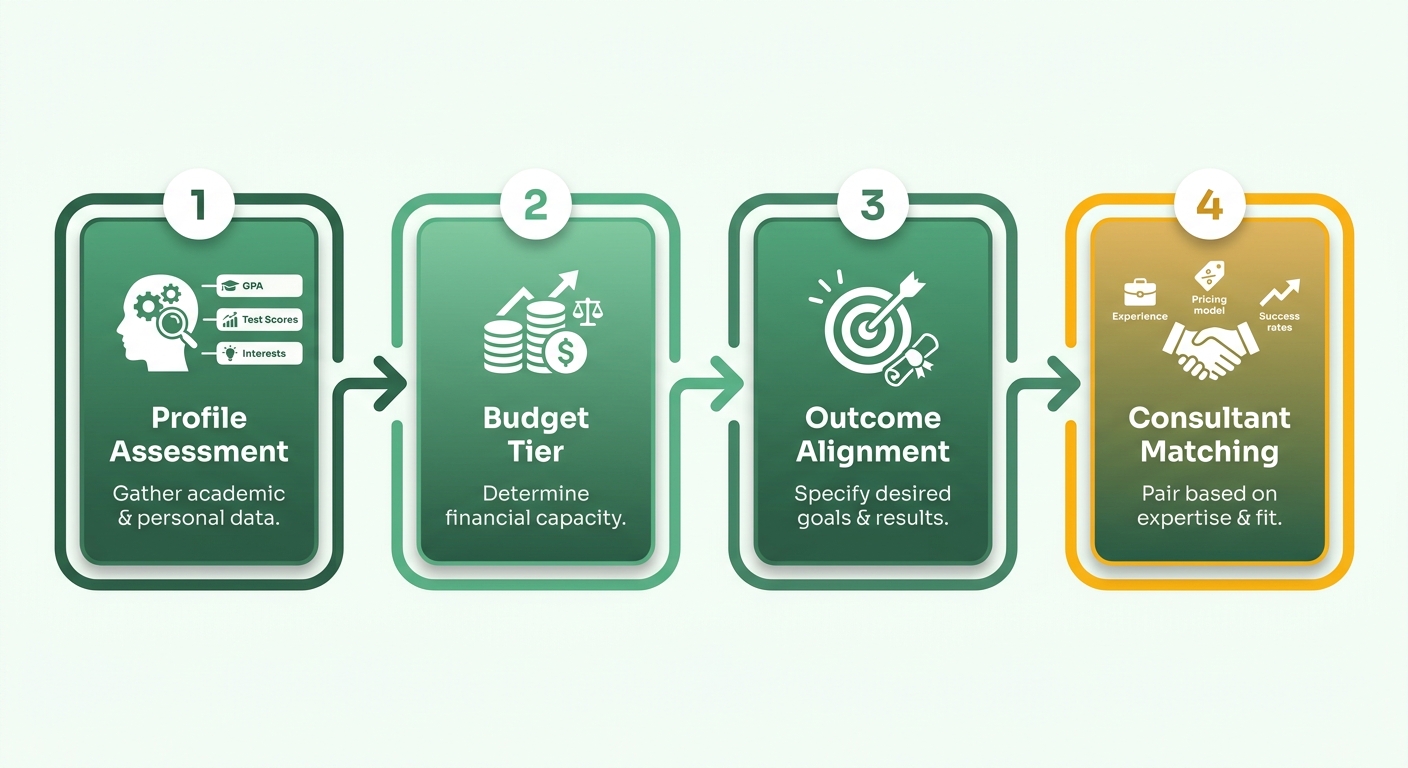
Before any commitment, think honestly about where your student stands on five things: GPA strength, test scores, activity depth, essay readiness, and scholarship need. A student strong in the first four areas needs polish and positioning. A student weak in activity depth needs multi-year profile development to build a real narrative, not a rushed senior-year essay clinic.
What Each Budget Tier Actually Buys
Budget sets your realistic options, but it doesn't dictate your outcome. Industry data shows comprehensive packages generally offer the most personalized attention. Generally. Families still need to look past the price tag to verify the actual level of support.
| Budget Tier | Typical Range | What You Get |
|---|---|---|
| Low | Under $8k | Essay-only or hourly support; higher caseloads; you drive strategy |
| Medium | $8k–$15k | Comprehensive planning, lower ratios, multi-year support |
| High | Over $15k | Boutique polish, former admissions officers, premium branding |
Notice the high tier buys prestige, not lower risk. That's the gap our model closes.
How Our Initial Consultation Works
We start with an initial consultation to assess each student's academic and extracurricular profile. We look for gaps early, then design a customized roadmap covering long-term skill development and immediate application strategy. That first conversation also tells us whether our collaborative style matches your goals.
Where we differ: the model is built for lasting trust. Most of our business comes from satisfied families referring friends and relatives. That lets us focus on student success instead of aggressive marketing.
When you interview any consultant, ask three questions. What's your current caseload? How are you paid, and what does satisfaction mean under that structure? What happens if we need a fourth essay round? The answers tell you whose interests the structure serves. For deeper planning frameworks, see our life-planning blog.
Skip us if you only want a one-hour essay review. Our model rewards long-term mentorship and satisfaction, not quick edits.
What I'd Actually Recommend for Most Families
After weighing every pricing model against real outcomes, the recommendation is clear: for most families, a base-plus-bonus structure delivers the strongest mix of affordability, personalization, and results. Structuring the engagement around shared goals reduces the misalignment built into traditional flat-fee and premium-boutique contracts.
Why it matters for you: paying a high upfront fee gives you no guarantee that the consultant's daily effort will match your expectations. Tying part of the compensation to the outcome cuts that risk and keeps the advisor committed to your student's success from start to finish.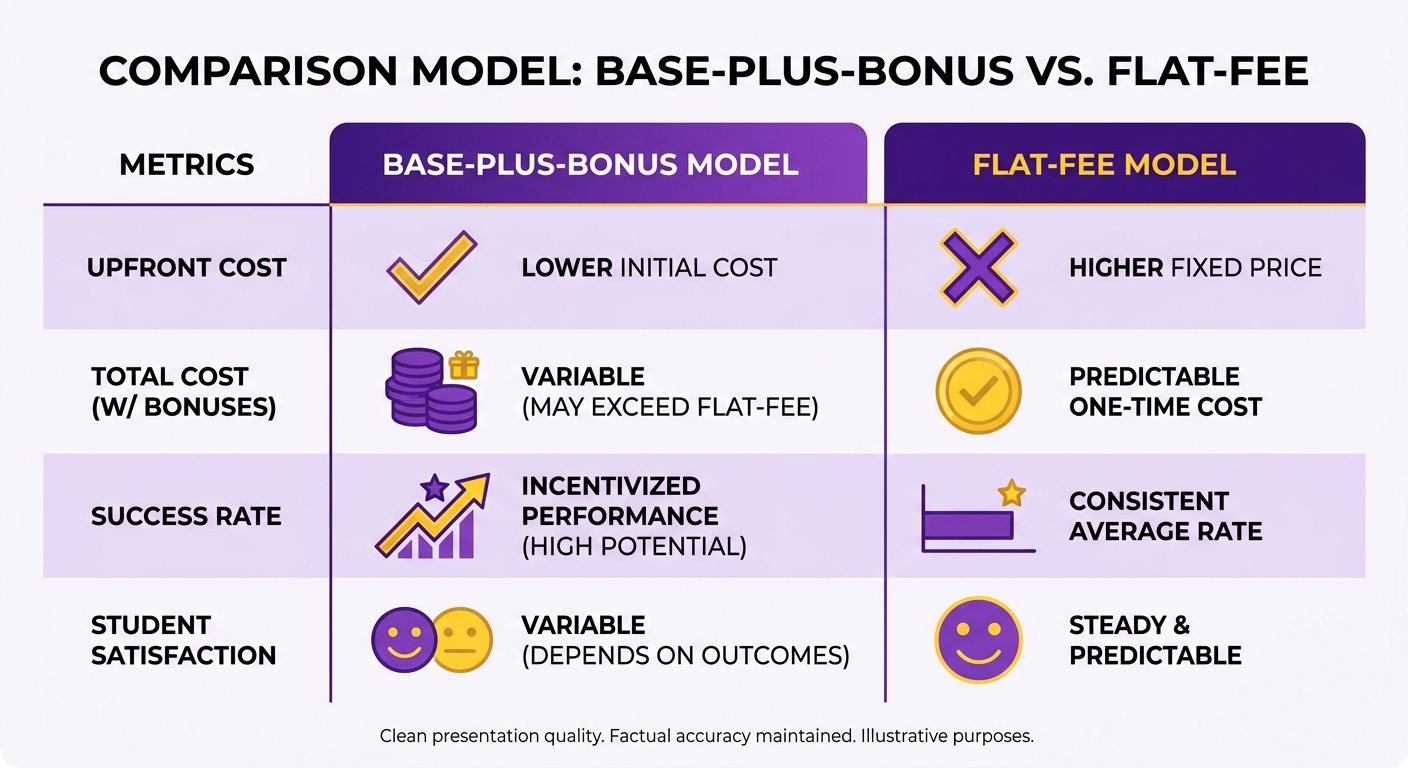
Why Endurable Is the Best-Value Choice
We combine four things few firms offer together: a panel approach where at least two team members review every essay, a track record of over 50% of students admitted to Top 10 and Ivy League schools, over $1 million in scholarships earned for our students, and lifelong mentorship through our alumni network. Our advisors graduated from Harvard, Yale, and Princeton, and built careers at firms like McKinsey and Uber.
| Dimension | Flat-Fee Firms | Premium Boutiques | Endurable Education |
|---|---|---|---|
| Pricing model | Pay once, no stake | High fixed fee | Base + bonus, satisfaction-aligned |
| Personalization | Narrow scope | One-on-one | Multi-advisor panel |
| Support horizon | Senior year only | Application window | 8th grade through career |
| ROI alignment | Weak | Weak | Direct |
Who Should Choose Us, and Who Should Skip Us
Best for families seeking high returns with transparent pricing. If you want a consultant with skin in the game, this is the model for you.
Best for students who want comprehensive development. We build long-term academic and personal skills well before application season, which helps students stand out naturally.
Skip us if you only need a single essay polished the week before a deadline. Our panel and long-term structure are built for depth, not quick fixes.
On the worry that a bonus model raises your total cost: it doesn't. The base fee stays highly competitive, and the success-based component only kicks in when the service meets your standards. As admissions shifts further toward test-optional and holistic review, having a partner whose incentives match your family's goals matters more than ever. Want to see if we fit? Get in touch for an initial consultation, or read more on our life-planning blog.
References
[1] Cost of College Admissions Consultants: 2026 Report - https://privateprep.com/cost-of-college-admissions-consultants-2025-report/
[2] Pricey therefore good? Price affects expectations, but not ... - https://www.researchgate.net/publication/368840431_Pricey_therefore_good_Price_affects_expectations_but_not_quality_perceptions_and_liking
Frequently Asked Questions
1. Does a former admissions officer on staff justify a higher consultant fee?
A former-officer résumé signals prestige, not better outcomes. The article notes that caseload matters more than pedigree, and individual attention predicts results better than a former-officer background. Vet coach credentials directly, but prioritize a low student-to-counselor ratio over a brand-name past employer when weighing fit.
2. Can any consultant honestly guarantee admission to a specific school?
No. Admissions committees operate independently, making any absolute guarantee unrealistic. Such promises are typically marketing strategies designed to attract clients, often paired with complex contract terms that make refunds highly unlikely. Families should focus on firms that offer transparent, performance-aligned pricing instead of absolute guarantees.
3. What's the difference between "total offers" and "unique admits" in success rates?
The distinction lies in how acceptances are counted. A firm reporting "total offers" adds up every acceptance letter received across its entire student pool, so one student with multiple admissions can skew the data. "Unique admits" measures how many individual students secured a spot at one target school or another, giving a clearer picture of real success rates.
4. I only need help polishing one supplemental essay. Is a base-plus-bonus model right for me?
Probably not. If you only need help with a single essay, an hourly consulting arrangement is generally the most cost-effective choice. Performance-aligned models are designed for comprehensive, multi-school application strategies where long-term guidance, narrative development, and ongoing support affect the final outcome.
5. How can I spot hidden costs before signing with a consulting firm?
Request a detailed, written breakdown of what is included before making a deposit. Ask specifically about extra charges for additional essay revisions, interview preparation sessions, or help with financial aid applications. A truly comprehensive service should cover these elements without triggering unexpected hourly fees.
6. When is starting admissions consulting early actually worth it?
Early engagement is highly beneficial for students who need to build a stronger extracurricular profile, develop leadership skills, or plan their high school course selection strategically. Beginning before senior year allows for deliberate, lower-stress portfolio development, ensuring the student has a rich set of experiences to draw from when it is time to write essays.
7. If a bonus is added to the fee, doesn't that make Endurable more expensive overall?
No, because the initial base fee is structured to be highly competitive compared to standard industry rates. The success-based bonus simply ensures that the final payment is directly tied to your satisfaction with the service. This approach protects your investment, ensuring you only pay for high-value, successful guidance rather than paying a premium upfront with no recourse.