Yale Requires SAT/ACT Scores for 2026-27 Applicants
August 4, 2026

Key Takeaways
- Yale again requires SAT or ACT scores from every first-year and transfer applicant, beginning with the 2026-27 cycle.
- The change ends six years of test-flexible admissions and removes AP or IB score substitutions.
- Most applicants already submitted scores. More than 80% did so during the flexible period, and 92% of this fall's incoming class submitted scores.
- The rule applies to the class of 2031, including current rising seniors.
- Families no longer decide whether to submit scores. They decide how many retakes to fund.
- Yale's data showed that strong applicants submitted scores voluntarily.
Related Video
Watch: Yale Just Killed its Test-Flexible Policy for First-Year Applicants by CollegeMeister
Quick Summary
Yale now requires SAT or ACT scores from all first-year and transfer applicants. The change begins with the 2026-27 cycle and reverses six years of flexible testing. The AP/IB substitute is gone. Families must now weigh test preparation against other application costs. The key question is how many test dates to fund.
Past admits offer limited guidance. The most useful examples involve scores that reached Yale's enrolled range. Those scores show where preparation may affect an application.
What Changed, and Does It Actually Move the Needle?
The requirement is firm, but most applicants already submitted scores. More than 80% did so during the last two cycles. Scores appeared for 92% of this fall's incoming class.
The timeline is short. The policy applies to the class of 2031 and every later class. It takes effect this cycle. For rising seniors, the change is immediate.
The impact varies by applicant. About 90% already tested, so little changes for them. The 8-10% who did not test must now do so. Yale says this group is socio-economically disadvantaged.
AP and IB scores no longer substitute for the SAT or ACT. A strong AP transcript does not provide an exemption.
What Score and How Much Work Is Realistic?
Aim for Yale's enrolled range or higher. The SAT 25th-75th percentile is 1470-1560, while the ACT range is 33-35. Below that range, preparation must produce meaningful gains.
Budget 40-80 hours of focused study for a first serious attempt. These targets fall within the top percentiles. Yale's admission rate is below 5%, making the climb significant.
Plan for retakes rather than one perfect sitting. Yale superscores and accepts self-reported scores. Families can fund several attempts and report their strongest sections. The decision concerns retake limits, not whether to test.
When sending official scores, use the correct codes. Yale's SAT and AP CEEB code is 3987. The ACT code is 0618.
Where Does Prep Money Actually Earn Its Keep?
Yale provides no merit aid. A high score produces no scholarship dollars. Its value lies entirely in admission probability.
If your child scores below 1470 or 33, prioritize preparation. Improvement there may justify the cost. If scores already reach the range, redirect time toward essays, activities, and course rigor. Yale calls academic strength its first consideration. Testing remains one signal among several.
For students scoring 1550 or higher, heavy preparation may not help. Extra points rarely change outcomes at a 4.2-4.75% admit rate.
Why Yale's SAT/ACT Requirement Matters
Yale describes the mandate as a way to identify strong candidates from disadvantaged backgrounds. It does not describe it as a screening tool. Dean Pericles Lewis has said SAT and ACT scores strongly predict academic performance at Yale.
The admissions committee uses scores to identify prepared applicants. These applicants may lack wealthy students' extracurricular résumés or network access. In practice, a 1520 from a rural public school provides a clear data point. It may carry more weight than a vague recommendation letter.
Why the Mandate Rewrites the Cost-Benefit Math
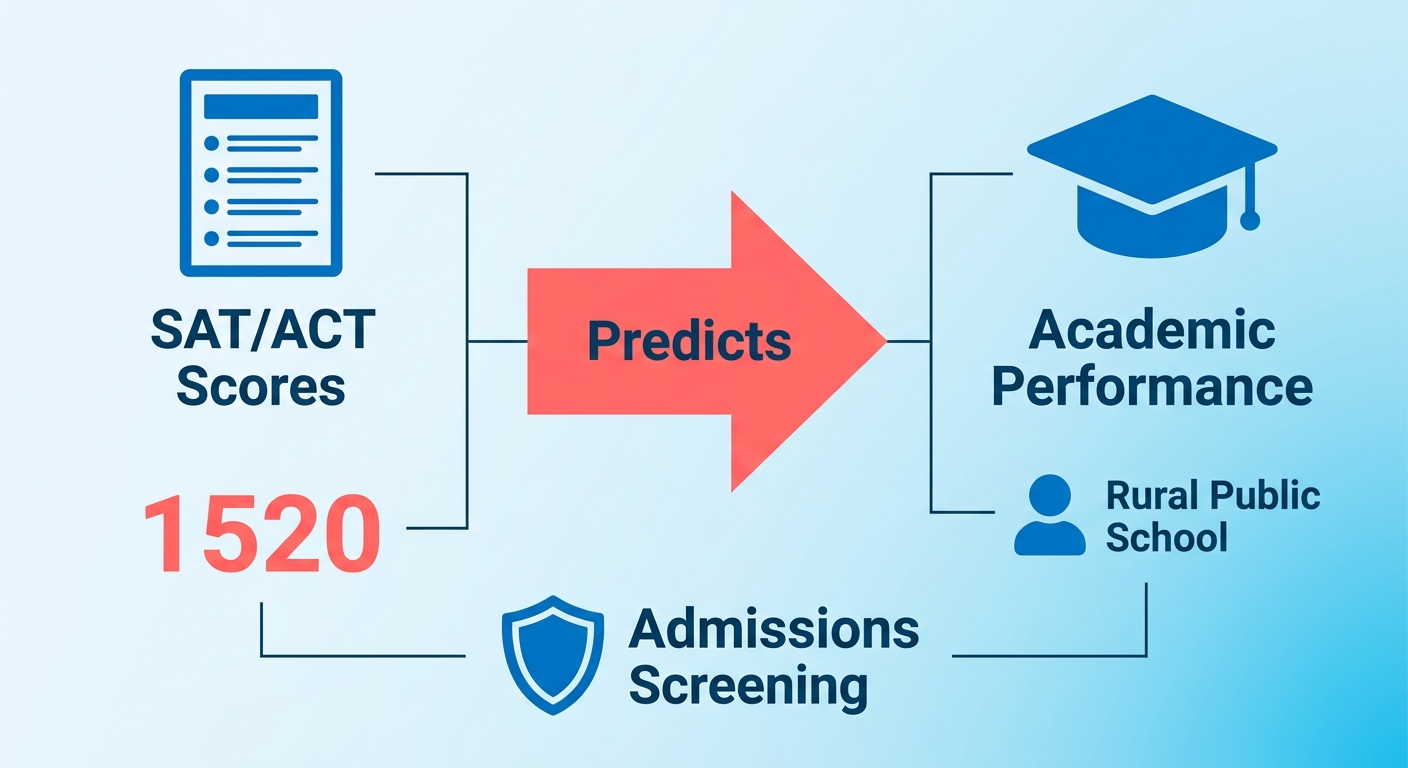
Yale awards aid strictly according to demonstrated need. A strong score does not produce institutional scholarship money. Its only value is improving admission chances.
Preparation makes the most sense when it moves students toward the middle 50% of matriculants. Scores well below that range have historically corresponded with lower acceptance odds.
The testing process also makes multiple attempts easier. Yale lets applicants report their best section scores across several dates. Families do not pay for official reports during the initial review.
Families can therefore plan several sittings and report progress. They pay for official verification only after an offer. The process rewards steady improvement across test dates.
Overall acceptance remains in the low single digits. A score within Yale's typical range guarantees nothing. A lower score places applicants in a segment with steeper odds.
Preparation should first target that baseline. Once students reach the range, extra points may return less than other application work.
Who Actually Benefits From the New Rule
- Students with uneven transcripts who test well despite GPA challenges. Their scores provide a standardized academic benchmark.
- Applicants from under-resourced schools with limited courses and stretched counselors. Strong scores demonstrate readiness without extensive AP courses or glowing recommendations.
- Families who can afford several attempts and targeted preparation. Superscoring rewards persistence and strategic retakes. This advantage may favor families with more budget flexibility.
What Yale's Presidential Council Review Found
The Presidential Council on Yale College Admissions studied six cycles of test-flexible admissions. It recommended restoring required testing.
The council found that scores remained the most consistent predictor of first-year academic performance. It also found that the AP/IB substitute did not expand access as Yale intended.
Most students using AP or IB scores instead of SAT or ACT scores were already strong test-takers. They had chosen to opt out strategically. Testing itself had not blocked most of them.
Other Ivy League schools show a similar pattern. Harvard, Brown, Cornell, Dartmouth, and UPenn recently reinstated testing. Each cited similar internal reviews.
Test-optional policies began as pandemic accommodations. The data suggested they did not greatly widen access. Instead, they made admissions odds harder for families to assess.
Required scores restore a clearer process. They also create new preparation demands for students who hoped to avoid testing.
Historical Context and Policy Change Overview
Yale's testing policy has changed twice in six years. Each change altered how families should allocate preparation funds.
That timeline provides more useful context than many admission stories. Students admitted under earlier policies faced different requirements than current applicants.
The budget implications are concrete. During the flexible years, families could skip testing and emphasize other strengths. That option has ended.
The change identifies which past admits remain useful comparisons. Some students succeeded under standards that no longer apply.
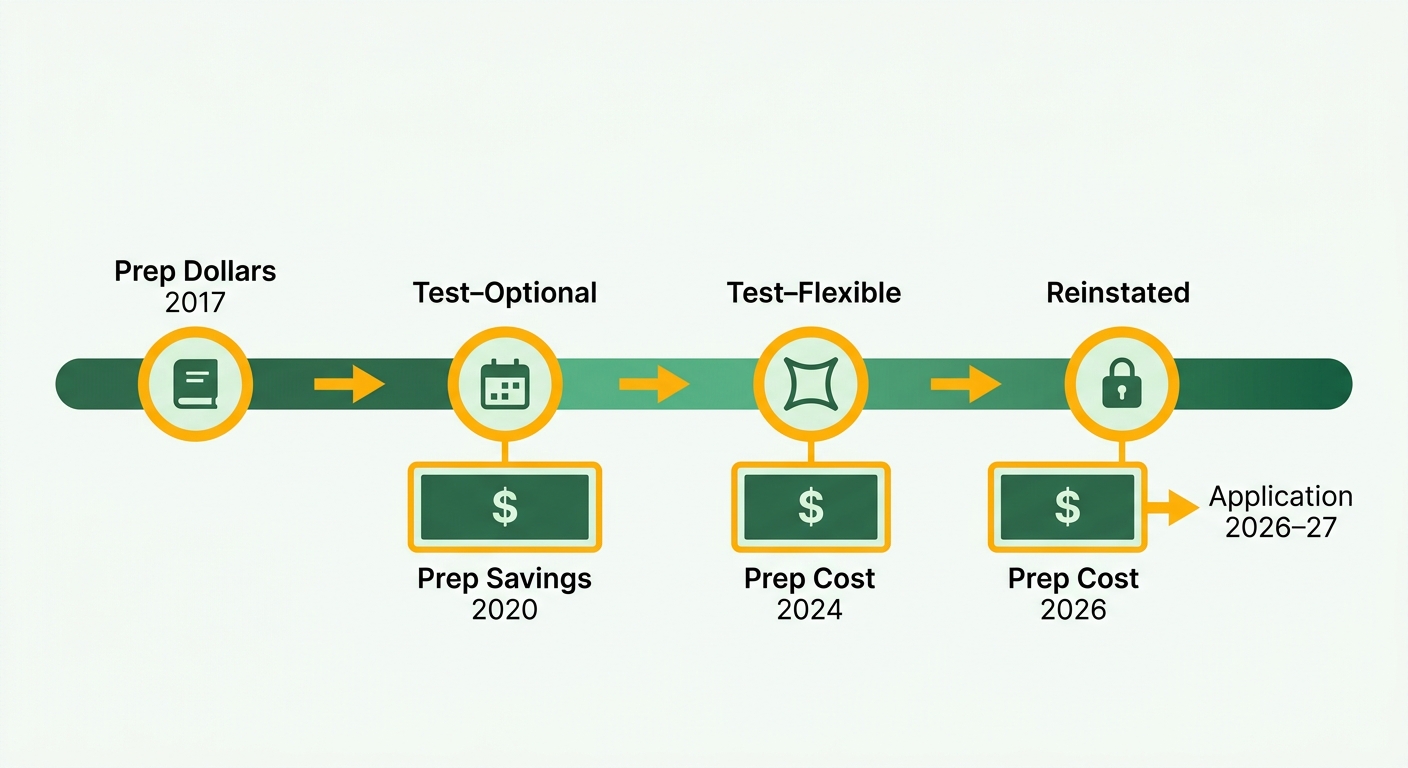
The Timeline of Yale's Testing Policy
Yale moved through several phases: a full suspension in 2020, an alternative-assessment model in 2024, and the current requirement announced May 27, 2026.
- 2020 suspension. Yale dropped the requirement entirely. Flexible-era admits therefore reveal little about current score expectations.
- 2024 test-flexible policy. Applicants could substitute AP or IB scores. That option has now ended.
- Fall 2025 Presidential Council. Yale formed a council on Yale College admissions. It later recommended reversing the policy.
- 2026-27 cycle onward. The requirement applies to the class of 2031 and every later class.
Why Yale Brought the Requirement Back
Yale cites academic prediction as its primary reason. Internal research showed that tests forecast performance specifically at Yale.
Dean of undergraduate admissions Jeremiah Quinlan stated the priority clearly: academic strength is "the admissions committee's first and most important consideration when evaluating candidates."
AP and IB scores can no longer substitute for the SAT or ACT. Faculty elsewhere, including in the UC system, raised concerns about math preparation under test-optional policies. That climate influenced the decision.
The change also reflects applicant behavior. Recent data show that roughly 71% submitted SAT scores. Another 27% submitted ACT scores.
The change affects only the smaller group that avoided testing altogether.
How This Compares to the Other Ivies
The change follows a broader movement among peer schools. Standardized scores are again baseline requirements at highly selective universities.
Dartmouth moved first in early 2024. Yale and Brown followed within weeks. The announcements suggested a coordinated retreat from pandemic-era testing policies.
Families can no longer rely on a test-optional Ivy as a backdoor. A strong score is now the common denominator across these schools.
Preparation once provided flexibility across a college list. It now establishes the same baseline across schools. Families should expect the requirement across every Ivy on their child's list, not only Yale.
Affected Applicant Groups and Implementation Timeline
The change affects every applicant, but the financial calculation varies. Three groups face different decisions: students near Yale's range, students far below it, and first-generation or low-income applicants.
Students near the range may need limited preparation. Students below it may face a steep climb. The mandate may also reduce uncertainty for some first-generation and low-income applicants.
Who Faces the Steepest Climb
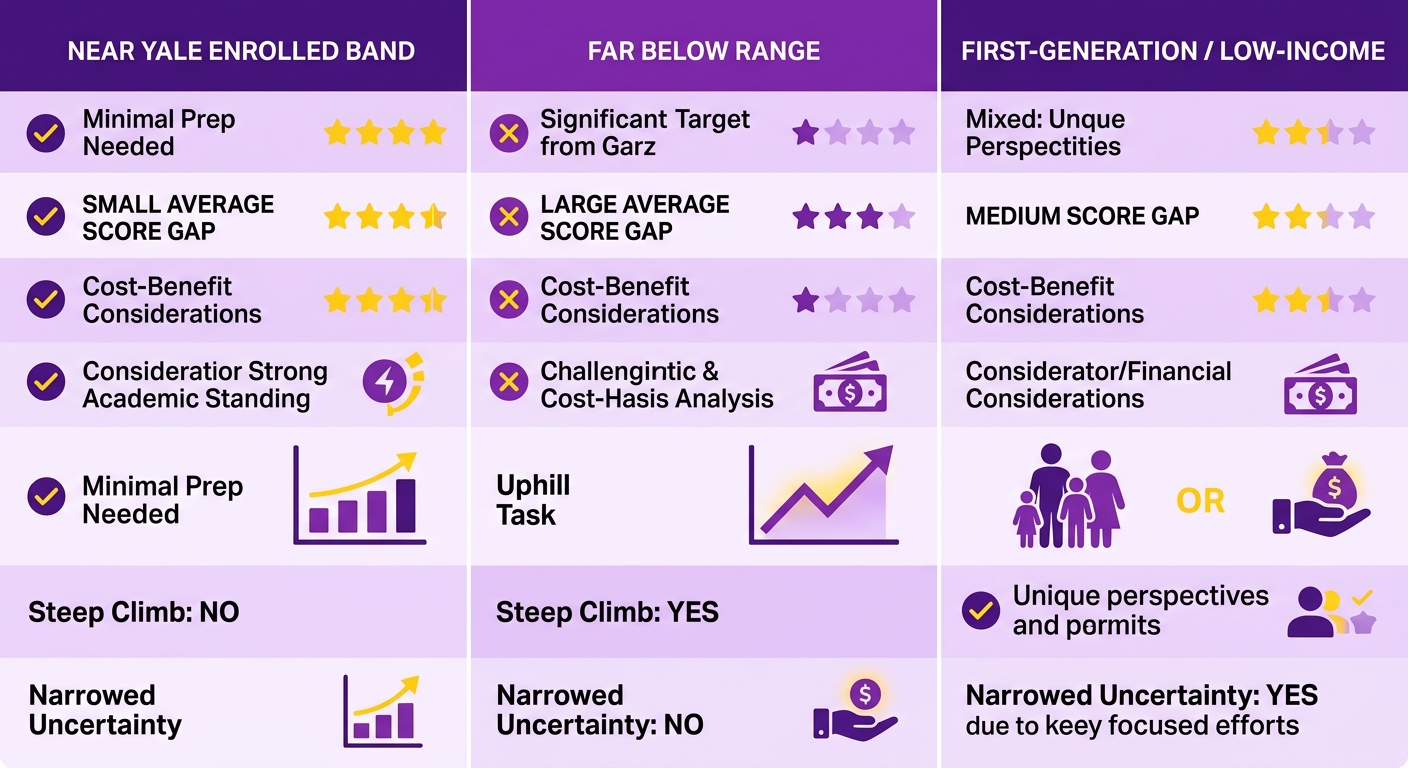
Students starting well below the competitive threshold face demanding preparation. Reaching typical matriculant levels requires sustained work. A quick retake is unlikely to close the gap.
Closing a substantial gap generally requires dozens of targeted study hours. Test-preparation providers report that lower-baseline students usually need three to six months of consistent practice.
Before starting a long retake campaign, assess the full profile. A junior with a strong unweighted GPA, research experience, and debate accolades already demonstrates academic preparation.
Compare the time required for score gains with other high-impact work. Options include leading a community project, pursuing independent research, or securing strong recommendation letters. That comparison should guide the allocation of effort.
First-Generation and Low-Income Applicants: A Different Calculus
For underrepresented students affected by test-optional strategies, the mandate may simplify decisions. Admissions leaders say scores can reveal potential at schools lacking advanced courses or college counseling.
That view assumes access to basic preparation. A high score earned with little formal coaching provides a clear ability signal. It also removes submission uncertainty that once disadvantaged families without consultants.
The policy removes another option as well. Students whose tests do not match classroom performance can no longer avoid submitting scores. Both effects are real.
Free resources can help these families. Khan Academy's official preparation, mobile practice apps, and library study guides cost only time.
Structured practice on free platforms has been shown to correlate with measurable score gains. The requirement clarifies the plan: focus on the score rather than submission decisions.
Timeline Mechanics: Superscoring and Self-Reporting Buy Room
Yale lets applicants combine their best section results across dates. That approach shifts attention toward incremental progress.
Students can target specific sections during later sittings. They do not need every section to peak on one morning.
Official reports are required only after an offer is accepted. Families therefore avoid reporting fees during the application phase. Time becomes the main investment.
A structured plan helps families evaluate each sitting. Continue when retakes show clear progress. Redirect resources when scores plateau despite focused preparation.
- Register for the SAT or ACT by early fall of junior year so spring retakes remain possible before senior-year deadlines.
- Take a timed diagnostic before paying for prep. Self-study raises some students' scores by 100-plus points without coaching.
- Track section-level gains after each attempt. Yale superscores, so improvement across dates can strengthen the composite.
- Set a retake ceiling before the first sitting. Base the number of attempts on actual score movement, not aspirational targets.
References
[1] Standardized Testing | Undergraduate Admissions - https://admissions.yale.edu/standardized-testing
[2] Undergraduate admissions updates testing policy | Yale News - https://news.yale.edu/2026/05/27/undergraduate-admissions-updates-testing-policy
[3] Yale reinstates SAT, ACT requirement after six years of ... - https://yaledailynews.com/articles/yale-reinstates-sat-act-requirement-after-six-years-of-flexible-policy
[4] Undergraduate Admissions - Yale University - https://admissions.yale.edu/
[5] ACT & SAT Requirements for Colleges - https://www.compassprep.com/college-profiles/
[6] Yale Reinstates ACT, SAT Requirements for Class of 2031 - https://talk.collegeconfidential.com/t/yale-reinstates-act-sat-requirements-for-class-of-2031/3704587
[7] Yale Ends Test-Flexible Policy: What Changed, and Why - https://toptieradmissions.com/yale-standardized-testing-requirement/
[8] Yale Just Killed its Test-Flexible Policy for First-Year Applicants by CollegeMeister - https://www.youtube.com/watch?v=3zcIOqNDGDE
Frequently Asked Questions
1. Do transfer applicants have to submit SAT or ACT scores, or just first-year students?
Both groups must submit scores. The mandate applies to all undergraduate applicants, including transfer students. Yale evaluates transfer credentials under the same standardized testing criteria established for first-year applicants.
2. My child has an excellent AP and IB record. Does that exempt them from testing?
No. Yale previously accepted AP and IB scores as alternatives. It has discontinued that option. All applicants must submit SAT or ACT results, regardless of their subject-exam records.
3. Will a higher SAT score help my child qualify for scholarship money at Yale?
No. Yale bases financial assistance solely on demonstrated financial need. Test scores help evaluate academic preparation. They do not affect financial aid awards or merit scholarships.
4. Do I have to pay to send official scores for every test attempt?
No. Students may enter scores manually on the application. Testing agencies' official reports are required only to verify those scores after admission and enrollment.
5. What free prep resources exist for families who can't afford tutoring?
Several free options are available. Students can use online practice suites and official question banks. They can also borrow preparation guides from local libraries. Consistent practice with these tools can produce significant gains for motivated students.
6. If Yale is now requiring tests, can we skip it and apply to a test-optional Ivy instead?
Avoiding testing is no longer a viable Ivy League strategy. Most peer institutions now require the SAT or ACT. Testing is again standard across highly selective colleges, so preparation is necessary for competitive applicant lists.
7. How do I know when to stop paying for retakes?
Monitor improvement across practice tests and official sittings. Continued gains may justify additional attempts. A plateau despite consistent preparation suggests that time may be better spent on other application components.