2 Ivy Rejection Triggers to Check Before Spending Another Summer
September 1, 2026
Planning editorial corrections for clarityRefining promotional language and phrasingImproving sentence clarity and flowRefining summer plan phrasingPlanning consistent grammar and style edits

Key Takeaways
- The two highest-impact Ivy rejection triggers are a research gap and an activity mismatch, each capable of derailing an otherwise strong application.
- Students routinely spend $5,000–$15,000 on summer programs that fail to close the profile gaps driving rejections.
- Closing a research gap requires the longest runway: 6 to 12 months. It typically requires mentorship or a faculty-sponsored independent project.
- Activity mismatch is the shorter fix, taking 3–6 months through strategic pruning and depth-building in one or two areas.
- Extracurriculars carry "moderate importance" for 44.3% of colleges broadly, yet that figure understates the stakes at selective Ivy programs.
- A profile listing seven activities—three begun senior year with no connecting research thread—gives admissions readers no coherent story.
- Sustained three-year commitment to one domain, with visible growth from participant to contributor, is the through-line Ivy applications need.
What You're Actually Dealing With
Most guides on how to get into Ivy League schools frame the problem as addition: more programs, more credentials, more activities. In practice, the issue is different. High-priced summer programs often fail to move the needle because underlying profile gaps do the damage before any application is submitted.
Below is an at-a-glance breakdown of how these two triggers typically present, and what it realistically takes to address each one before committing another summer to the wrong fix.
The Two Triggers at a Glance
| Research Gap | Activity Mismatch | |
|---|---|---|
| Admission Impact | High | High |
| Fix Timeline | 6–12 months | 3–6 months |
| Difficulty | Resources + Access | Skill + Reframing |
| Remediation Path | Mentorship, structured research, independent project with faculty sponsor | Strategic pruning, depth-building in 1–2 core activities, narrative reframing |
Student A (no trigger): Long-term dedication to a single domain, with a clear trajectory from basic member to active contributor. The application presents a unified narrative, and summer plans simply build on that foundation.
Student B (trigger present): A fragmented activity list, with several items started late in high school. There is no unifying academic or investigative thread, and attended programs feel disconnected. Admissions readers struggle to find a core focus. Meaningful remediation requires a long runway to restructure the narrative.
Why Extra Programs Don't Fix the Real Problem
Broad national data suggests extracurriculars play a secondary role at many institutions—a figure that's misleading in highly selective admissions. When academic profiles are nearly identical, non-academic pursuits become the primary sorting mechanism. Activity volume doesn't help here. Readers are evaluating depth, coherence, and character signal.
One finding from U.S. News reporting on extracurricular weight in admissions is worth sitting with: an applicant who listed being an "awesome big brother" impressed admissions readers more than many students with formal leadership titles. The trait signal is what matters, not the program name. In our experience, that cuts directly against the assumption that a recognizable program brand repairs a weak narrative.
The Checklist to Run Right Now
-
Map your activity list to one theme. If you can't explain the connection in two sentences, an admissions reader can't either. This is the fastest diagnostic for activity mismatch.
-
Look for a research thread. Does your profile show sustained inquiry into a specific problem? A research gap isn't closed by attending a summer program; it's closed by producing work with genuine intellectual depth.
-
Audit the calendar cost of your summer plan. If a program crowds out time you'd spend deepening existing work, it may not be worth the price. The CollegeVine breakdown on rejection factors is a useful check; some rejections come down to fit, and more credentials don't fix a fit problem.
Where This Leaves You
These two triggers account for a disproportionate share of rejections among academically elite applicants. Both can be diagnosed and addressed well before finalizing summer plans. Identifying the right vulnerability early lets families make far more strategic decisions about where to put their time and money.
The 5% Problem
Acceptance rates at Ivy League schools now sit below 5% across the board. That number changes the calculus entirely: knowing how to get into an Ivy League school stops being a question of adding credentials and becomes a question of eliminating the specific gaps that knock otherwise strong candidates out before a human ever reads their essay.
We see the consequences of this oversight every cycle. Families invest heavily in prestigious summer programs that fail to target their actual profile weaknesses, and the rejections that follow are often entirely predictable from pre-existing indicators.

When Grades Stop Being the Differentiator
Research into how extracurriculars affect admissions outcomes points to a meaningful threshold. Less selective institutions use activities to break ties; highly selective universities use them to build a diverse, multi-dimensional class from an academically indistinguishable pool. Generic advice to simply pursue a range of interests doesn't produce results at this level.
CollegeVine expert Elias Miller notes that admissions offices look closely at whether an applicant's demonstrated values and academic drive align with the institution's culture—an evaluation that goes far beyond GPA and test scores. Admissions officers frequently cite a lack of focused commitment as a primary reason for turning away otherwise strong students.
- Audit whether your extracurricular record shows genuine depth and progression over time. Admissions officers assess qualitative traits like leadership, communication, and resilience that only surface when activities carry real commitment behind them.
- Confirm academic rigor is solid before diagnosing activity gaps. At Ivy schools, a long extracurricular list cannot compensate for weak grades. The reverse holds just as firmly: strong grades alone don't offset shallow activity depth. Both dimensions have to hold up under scrutiny.
The Price of Misdiagnosis
The opportunity cost of a misaligned summer is real: it consumes both financial resources and the time needed to address actual profile gaps. NACAC data indicates that applicants with documented research experience carry a 12–15% advantage in admissions outcomes—a margin that adding standard activities cannot replicate.
The emotional cost compounds this. We walk families through the aftermath of Ivy rejection regularly, and the pattern holds: stress, disrupted timelines, and the burnout that follows years of conventional guidance that still didn't produce an acceptance. The trigger is usually something that could have been caught months earlier through a structured life preparation and planning approach applied before sophomore year ends.
- Map your profile against both triggers before committing to any summer program. Ask whether it addresses your documented gap specifically—not just whether it looks impressive.
- Establish realistic timelines for your adjustments. Closing a research gap requires a much longer runway than restructuring your existing extracurricular commitments.
Why Catching This Early Changes Your Odds
Our team is direct about one thing: admissions decisions carry irreducible arbitrariness. Individual officer reads, year-to-year pool dynamics, and contextual factors outside your control all introduce noise that no preparation fully eliminates. Students and families deserve to know that.
Early trigger detection doesn't promise certainty. What it does is remove the controllable risk factors so the arbitrary element has less to work with. A profile with documented depth, coherent narrative, and clear research engagement reads well to any officer, not just a favorable one. That's the actual return on catching these triggers early.
- Begin profile review no later than sophomore year, when course load, research direction, and activity focus can still shift meaningfully.
- Evaluate whether your portfolio tells a unified story. Sustained commitment to a single activity over years signals personal development and dedication far more effectively than a list of prestigious but disconnected programs.
Activity Mismatch: The Problem That Hides in Plain Sight
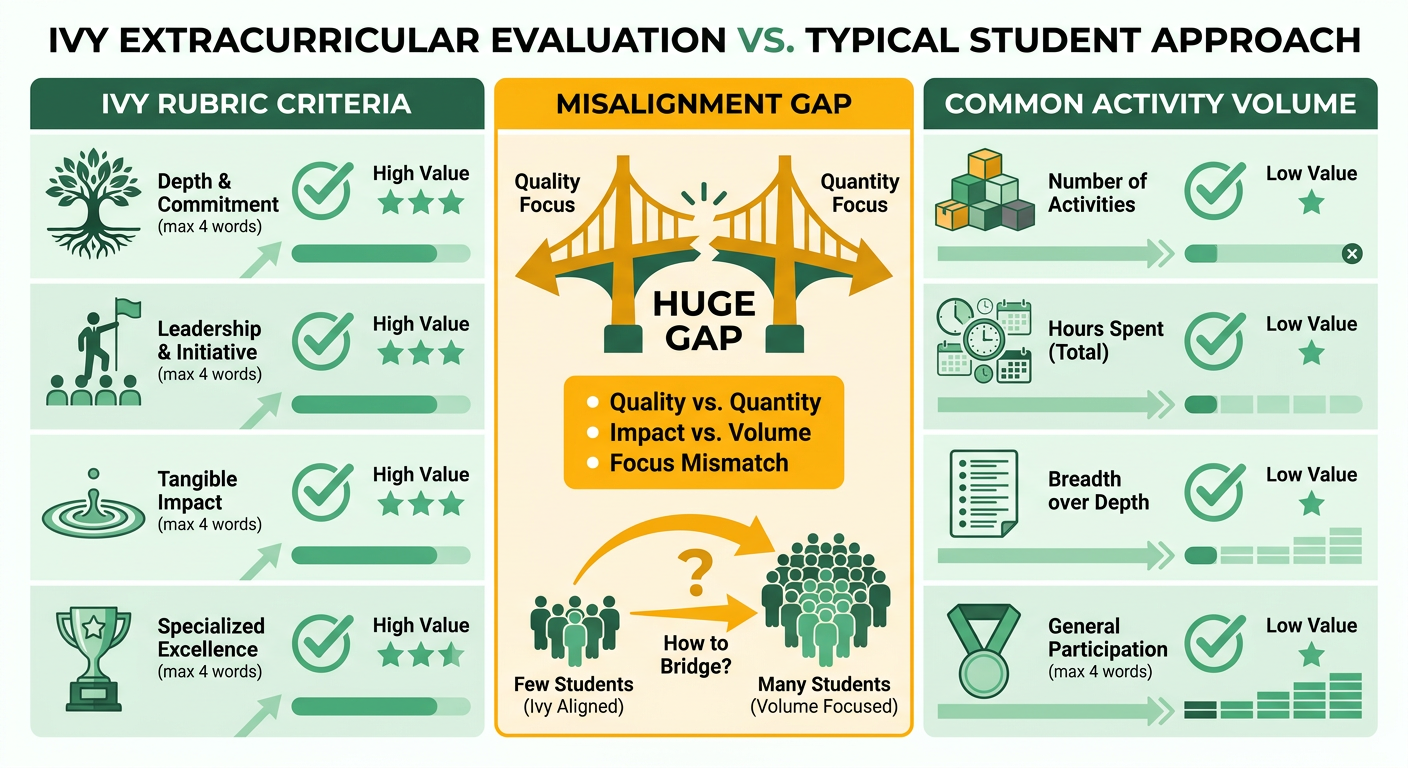
The biggest trap in Ivy prep isn't doing too little. It's doing the wrong things at scale. Students arrive with ten activities on their Common App, a full summer accounted for, and still get rejected because none of those activities address what Ivies actually evaluate. Most guides treat activity volume as the goal. The Ivy rubric treats it as noise.
Data from U.S. News on how colleges weigh extracurriculars makes this explicit: admissions offices use activities to evaluate personal qualities that grades cannot reflect. At Harvard, the Common Data Set rates extracurricular activities as "very important"—placing them on equal footing with academic GPA and course rigor. Where broader universities may only "consider" these factors, top-tier schools use them as a primary filter.
What Ivy Readers Are Actually Evaluating
Across hundreds of case studies, the applicants who stand out consistently demonstrate four qualities. Audit your list against each:
- Depth over time: Is this a 2+ year commitment with a visible growth arc, or a recent addition built for the application?
- Leadership with evidence: Have you taken on responsibilities where your decisions directly guided others? U.S. News notes that informal leadership roles can carry the same admissions signal as official titles. Officers look for underlying character traits, not the prestige of the designation.
- Measurable impact: Can you name an outcome your involvement created? "Volunteered at a food bank" is weak. "Expanded the weekend shift by recruiting 12 new volunteers" shows impact.
- Narrative fit: Does each activity support a single coherent story about who you are and where you're headed?
The Patterns That Sink Applications
In our experience, the most common rejection driver isn't a motivation problem. It's a strategy problem. Students build lists for a general audience, not for what Ivy readers are actually evaluating.
- Generic volunteering without ownership: Passive hours don't signal initiative. Founding or coordinating a program does.
- Pre-packaged summer programs: Branded camps where every attendee receives the same certificate signal a purchased credential, not a developed one.
- Sports without a leadership layer: Athletic achievement rarely tells a complete leadership story on its own. A peer coaching program or community clinic changes the read entirely.
- Unrelated breadth: A scattered list of activities can make an applicant appear unfocused. CollegeVine notes that a perceived mismatch between a student's activities and an institution's core priorities is a frequent rejection driver.
What to Build Instead
These consistently outperform generic activity stacks in our work:
- Found or restructure something: A research club, nonprofit, or community publication. Founding signals initiative and leadership simultaneously.
- Generate a publishable output: For STEM applicants, a paper or conference presentation. For humanities, an edited journal or public-facing project. "Publishable" means peer-reviewed, conference-accepted, or independently recognized—not a school assignment with extra steps.
- Deepen before you diversify: Building on an existing commitment—organizing a specialized workshop or community initiative within your current sport or club—creates a compelling growth narrative. This type of authentic engagement is precisely what admissions readers look for, and it requires no financial investment.
One honest caveat: skip this step if your academic baseline isn't solid. Former University of Notre Dame admissions director Christy Pratt is direct: no activity list rescues weak grades. The audit only matters once the academic floor is confirmed.
The Self-Audit: What Your Profile Is Actually Signaling
Most students spend months asking how to get into an Ivy League school before they stop to ask what their current profile is actually signaling. The two are different questions, and the second is where we start. Run through the rubrics below and score honestly. The combined result tells you whether you're dealing with a fixable gap or a foundational misalignment—and which one deserves your next summer.
Scoring Your Research Portfolio
Score each item 0 to 2: 0 = no evidence, 1 = partial or in progress, 2 = clear and documented. In our experience reviewing profiles of admitted candidates, competitive applicants typically score 6 or higher across these four items.
- Authorship role is substantive. You contributed original analysis, data collection, or writing—not administrative support. A mentor or faculty advisor should be able to describe your specific contribution without prompting.
- Output exists beyond participation. A paper draft, poster, dataset, or presentation exists that you can point to directly. Being part of someone else's study does not satisfy this item.
- Dissemination is verified or in progress. Work has been submitted to, presented at, or accepted by a venue others can confirm: a journal, symposium, or regional science fair or above.
- The mentorship is formalized in writing. A faculty member, researcher, or domain expert has committed in writing to advise your work. A verbal understanding does not hold up in a recommendation letter or interview.
Score thresholds: 6 to 8 = green (research pillar is competitive); 3 to 5 = amber (addressable before application season); 0 to 2 = red (research trigger is active—this is your first priority).
What Extracurricular Depth Actually Looks Like
Evaluating your activity profile means looking at the qualitative signals your activities send. How colleges weigh extracurriculars hinges on identifying key personal strengths. Use the same 0-to-2 scale to assess your current list:
- At least one activity shows measurable leadership. Not a title—a result. A program you started, a team outcome you can quantify, a role where your decisions had documented consequences.
- At least one activity connects to your intended major or stated interest. Depth of engagement in relevant areas is far more persuasive than a collection of unrelated memberships.
- Long-term commitment is visible. You have stayed with at least one activity across multiple years with growing responsibility. A single summer of involvement does not qualify.
- The work holds up without the program name. If the sponsoring institution closed tomorrow, would the activity still impress? An informal but sustained role—a major family responsibility, a self-directed community project—can demonstrate the same core strengths as a well-recognized program.
Score thresholds: 6 to 8 = green; 3 to 5 = amber; 0 to 2 = red (activity trigger is active).
Next Steps by Score Band
Red on either rubric: Address that trigger before anything else. For research: identify a faculty mentor and propose a project within two weeks. For activities: audit your current commitments and deepen one rather than starting fresh.
Amber on both: You're in remediation range. Close the larger gap first. Apply to two or three research programs, or formalize a mentorship agreement this semester.
Green on both: The fundamentals are solid. The remaining question is whether your research and activities connect into a coherent narrative. That's a different kind of work, and a different conversation.
If you want an outside read on your scores before you act, we offer an initial consultation—the same diagnostic our team runs at the start of every engagement. Details are on our college admissions planning blog.
Building a Summer Plan That Closes the Right Gaps
The summer plan only works if it's built backward from the two triggers you scored above. Treat summer as gap-closing work with deliverables tied to hard dates. That shift changes your priorities more than it first appears.
A successful summer strategy focuses on demonstrating personal growth and initiative. The U.S. News breakdown of how extracurriculars are actually evaluated emphasizes that admissions readers look for evidence of character and soft skills. Your summer plan should document those traits through tangible outputs, not certificates.
The Summer Roadmap, Built Backward from the Gaps
Discovery (Weeks 1–2): Identify which trigger is your primary fix. Don't run two remediation tracks at once—split focus produces shallow output in both.
- Score your checklist audit from the previous section and rank the two triggers by urgency.
- Map resource access: local university contacts, existing community roles, available datasets, or labs.
- Scope a contingency project now, before you need it. IRB delays and mentor withdrawals happen. Having a backup scope in week 2 keeps the summer on track.
Partnership (Weeks 2–4): Secure the right mentor or deepen the right existing commitment.
- For research gaps: use the mentor checklist below before committing.
- For activity mismatch: identify the one activity with the clearest Ivy-relevant narrative and define what a deepened commitment looks like in practice.
- Confirm a written deliverable timeline before week 4. Verbal agreements dissolve.
Execution (Weeks 4–12): This is where most students fall behind on measurable output.
- Complete a literature review, needs assessment, or community impact audit by week 4. This is the most skipped step—and the one that separates citable work from passive shadowing.
- Reach a data or activity milestone by week 8.
- Draft a manuscript section, poster abstract, or showcase proposal by week 12.
Publication and Showcase (Week 12+): Submit. A submission with revision feedback tells a better application story than work that never left a hard drive.
- Target a student journal, regional conference, or competition in your field.
- Document rejections and revisions. They're part of the research narrative, not a liability.
Choosing a Research Mentor: What Actually Matters
When seeking guidance, prioritize the quality of the collaboration over the prestige of the institution. What admissions readers assess is the depth of your intellectual contribution. A mentor with an active, recent publication record who will guide your independent work is far more valuable than a prominent name who delegates supervision to assistants.
- Published within the past two years in a peer-reviewed outlet. An active record signals an active project—and a real output pathway for your work.
- Institutional affiliation (university, hospital, research center). Affiliation opens data access and co-authorship networks that independent mentors can't.
- Provides written feedback on drafts. Supervision is not mentorship. If a prospective mentor has no bandwidth to read your work, keep looking.
- Field aligns with your stated academic narrative. Switching fields mid-summer produces work that reads as opportunistic, not committed.
Budget and Contingency
Academic performance remains the absolute foundation of your application. A long extracurricular list cannot compensate for low grades. Make sure your summer schedule doesn't compromise your academic focus, and build your budget with that priority in mind.
- Research materials and data access: $0–$400 for most social science and analysis work; $200–$1,200 for lab-based science projects. Worth it only if you're submitting work—not attending as an observer.
- Paid access to proprietary datasets, statistical software licenses, or specialized lab supply kits: $50–$250. Most academic-grade resources are freely available through public repositories and university portals. Allocate funds to specialized tools only if they are genuinely necessary to produce your target output.
- If primary research stalls, activate your contingency scope immediately. A well-executed literature synthesis can still reach a submission. A dormant project produces nothing.
- Weekly: one-paragraph progress update to your mentor noting current blockers.
- Monthly: compare actual outputs against the week 4, 8, and 12 benchmarks above and adjust scope before a missed milestone compounds.
References
[1] FAQs About Why You Got Rejected on Ivy Day | CollegeVine Blog - https://blog.collegevine.com/ivy-day-rejection-faqs
[3] The Extra Mile: How Extracurricular Activities Impact College Admissions - https://northernvirginiamag.com/family/education/2023/12/29/extracurricular-activities-impact-college-admissions/
Frequently Asked Questions
1. Can a branded summer program ever count toward closing a research gap?
Branded summer programs rarely close a research gap because they focus on structured instruction rather than independent discovery. To address a research gap, you must produce an original scholarly contribution under the guidance of an academic advisor. Programs that offer standardized certificates to all participants do not demonstrate the self-directed intellectual depth that selective universities seek.
2. What is the difference between activity mismatch and simply having too few activities?
An activity mismatch is a strategic misalignment rather than a volume issue. Having a long list of unrelated clubs can actually dilute your application by making your profile appear scattered. Admissions committees look for a clear narrative thread and evidence of personal growth. A small number of highly focused, long-term commitments is far more impactful than a broad, disconnected list compiled late in high school.
3. If a student scores red on both rubrics, which trigger should be addressed first?
Prioritize the research gap first. Developing a credible scholarly project requires a significantly longer timeline to establish mentorship, conduct analysis, and produce a final output. Trying to resolve both issues at the same time often leads to mediocre results in both areas. Secure your academic mentor and define your project scope first, then work on refining your extracurricular narrative.
4. Does closing a research gap require formal lab access, or can independent projects qualify?
Independent projects are highly effective, provided they meet rigorous academic standards. Your work must be supervised by a qualified scholar, result in a tangible manuscript or presentation, and be submitted to an external, peer-reviewed venue. While physical lab access is not always necessary—especially in the humanities or social sciences—having a mentor with institutional ties remains highly beneficial for accessing academic databases and professional networks.
5. Do these triggers carry equal weight across all Ivy schools, or does importance vary by campus?
While all elite universities heavily scrutinize these areas, individual institutional priorities can shape how they are evaluated. At highly selective campuses, where academic credentials among applicants are uniformly exceptional, non-academic achievements naturally become the primary means of distinguishing candidates. At these schools, a lack of depth or a fragmented profile will quickly eliminate an applicant, whereas less selective colleges may view activities simply as a positive addition to a strong transcript.
6. Why would an informal activity outperform a titled leadership role with a recognized program?
Admissions officers prioritize authentic impact and personal character over official titles. A student who takes initiative in an informal setting—such as managing significant family responsibilities or organizing a grassroots community effort—often demonstrates greater leadership, maturity, and problem-solving skills than someone holding a passive, titled position in a pre-packaged program. The focus is always on the depth of your contribution and what it reveals about your character.
7. At what point in high school does the self-audit described in the article actually change outcomes?
Conducting this assessment early in your high school career provides the greatest opportunity for meaningful adjustment. Initiating the audit before your junior year ensures you have sufficient time to build a relationship with an academic mentor, execute a thorough project, and refine your extracurricular focus. Waiting until senior year limits your options, as establishing genuine depth and producing scholarly work cannot be rushed.