Admissions Consultants Claim 90% Ivy Acceptance Rates. Ask These 5 Questions First
October 31, 2026

Before You Trust That Acceptance Rate
A family books a consult with a private admissions firm. The brochure lists a high Ivy League acceptance rate. That number follows them home, gets budgeted around, and sometimes leads to spending what the Crimson editorial board described as "the price of a small house" on the promise. Before any of that happens, families should ask: what does that percentage actually count?
A university's acceptance rate is straightforward: admitted applicants divided by total applicants. A consulting firm's claim works differently because the firm sets its own denominator, and that definition changes everything. A consultant working with 100 families who counts only the 20 who applied to Ivies can report a high rate and mean 18 out of 20, not 90 out of 100. The headline looks identical, while the pool behind it is only a fraction of the full client base.
What a Consulting Firm's Rate Actually Measures
The single most important question is which pool the percentage describes. Ask whether the denominator includes every client the firm worked with, only those who applied to Ivy League schools, or a hand-selected subset pre-screened as "Ivy-qualified" before applications went out. Each choice produces a different rate. Only one reflects the full client base.
Some private admissions consultancies operate without formal ethical guidelines or government oversight, as research focused on consultancies serving China documents. The same Crimson editorial noted there is "scant evidence that counselors can meaningfully influence the process." Together, those points suggest a firm can advertise a striking number with no independent body checking the math or whether the outcomes reflect students who actually enrolled.
Ask for the Numbers Behind the Number
Treat any success-rate claim the way you'd treat a headline on any major purchase: ask for specifics. What reporting period does the percentage cover? Does the firm verify outcomes independently, or does it self-report them?
What does the applicant profile look like behind those results? A high rate built on students who were already competitive for selective schools tells you something very different from one drawn from a broader, less filtered pool. Families deserve claims that are clear, supported by evidence, and honest about the denominator.
Key Takeaways
- A percentage matters only when the firm explains who was counted and who was left out.
- Private consulting companies do not operate under the same formal framework as school counselors.
- A large consulting fee does not make an outcome claim more reliable.
- Families should request the reporting period, applicant criteria, and supporting records before relying on a firm's results.
Question 1 – Is the 90% Rate Independently Verified?
School counselors work within a formal framework; private admissions consultants often do not. Research focused on consultancies serving China documents that some private firms follow no formal ethical guidelines and face no government oversight.
Without an independent watchdog, outcome claims exist largely on the honor system. So the first question to ask any consulting firm is simple: has anyone outside this organization verified that number?
If the answer involves a public audit report, third-party review, or published methodology, ask to see it. Verbal assurances, testimonials, and internal tracking don't qualify. The figure may still be accurate, but the burden of proof stays with you.
Professional association membership counts for something, but it isn't the same as outcome verification. A firm can meet every standard in an admissions consulting ethics code and still define its applicant pool in a way that inflates the number.
Ask specifically about methodology: who compiled the data, what criteria made a student eligible for inclusion, and whether you can review anonymized documentation. A firm confident in its results should answer those questions directly.
Do a basic public record search while you're at it. Look for consumer complaints filed with your state attorney general's office and any litigation involving the firm. A clean record doesn't confirm accurate numbers, but a trail of complaints is reason to dig deeper.
Our 5 Things to Verify Before You Pay a College Admissions Consultant covers related due-diligence steps worth reading alongside this one.
Question 2 – What Is the Denominator?
Two firms can both report accurate numbers while showing starkly different Ivy acceptance rates. No fabrication required. The gap often lives entirely in who gets counted, not in how many students were actually admitted. Before you compare those figures, you need the number neither firm may volunteer: how many students sit inside that percentage.
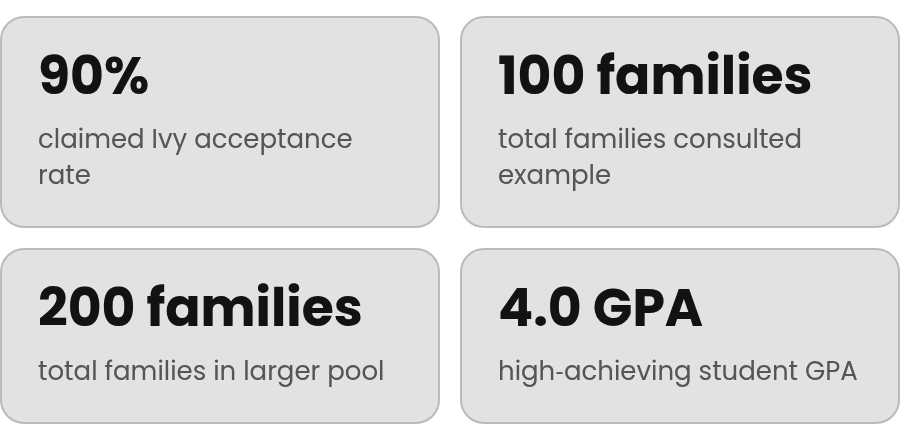
The formula is simple: acceptance rate equals admitted students divided by total students counted. What shifts everything is which students make it into that denominator. A firm that worked with 200 families but counts only the 40 who completed a full Ivy-targeted program reports a very different figure than one counting everyone who enrolled.
Families should ask which pool the firm uses:
- All clients, regardless of outcome
- Only Ivy-targeted applicants who self-selected into that track
- Students who applied to at least one Ivy, excluding those who changed their lists
- Students the firm pre-screened as "competitive" before applications went out
The composition of the pool can shift the apparent result even when the admitted-student count stays the same. Eight offers among 10 counted applicants produces 80%. The same eight offers among 72 counted applicants produces roughly 11%. That's not a cosmetic difference. It determines what the percentage actually says about the firm's full clientele.
Ask whether the firm counts students who stopped working with them, didn't finish their applications, or changed their college lists mid-process. Ask if they can break results down by cohort: grade level, geography, academic profile, or program type. We don't expect firms to publish those breakdowns publicly, but they should share them with a family considering enrollment.
Question 3 – Who Are the Students Behind Those Results?
Two students walk into the same consultant's office. One carries a 4.0 GPA, a 1550 SAT, and two state-level debate championships. The other has a 3.6, a 1280, and a serious interest in photography that hasn't yet translated into formal recognition. If both leave with acceptances to selective schools, the consultant can count both as wins. But those students started from very different places, and the acceptance rate doesn't show you that.
That's why the applicant profile behind a reported success rate matters as much as the number itself. A firm that works primarily with students already positioned for competitive admissions will naturally produce higher outcomes than one serving a broader mix. Comparing the two directly doesn't tell you much.
Ask for context about the students behind those results. What was their academic baseline before coaching began? What testing profile did they bring? How selective were their college lists? A firm that can answer those questions gives you something to actually measure against your own student's situation. One that can't, or won't, is asking you to trust a number in a vacuum.
What About Recruited Athletes and Legacy Applicants?
This part gets delicate, but it matters. Some applicants carry advantages that sit outside the typical academic and extracurricular picture: recruited athletics, legacy connections, or other institutional priorities that colleges weigh in their own processes. We're not assigning weights or percentages to those factors, because colleges don't publish that breakdown. A firm whose results include a meaningful share of students with those advantages is reporting from a different set of circumstances than the general applicant pool. Families deserve to know that context before treating the percentage as a benchmark for what's achievable for their own teenager.
References
[1] Admissions are Broke. College Consultants Aren't. - https://www.thecrimson.com/article/2025/12/5/editorial-admissions-consultants/
[2] (PDF) The Ethics of Admissions Consultancies Serving China - https://www.researchgate.net/publication/332832446_The_Ethics_of_Admissions_Consultancies_Serving_China
Common Questions
1. Can a consulting firm's acceptance rate be technically accurate and still mislead a family?
Yes. Accuracy describes the arithmetic, not the way the result is presented. A family should ask whether the published figure covers a complete client cohort, which applicants were eligible for inclusion, and whether students who changed their plans remained in the records. Without that context, even correct math can create an unrealistic expectation.
2. Does professional association membership mean a firm reports its outcomes honestly?
Not by itself. Membership may show that a consultant has agreed to follow an association's stated principles, but families still need to inspect the firm's own reporting process. Ask who collects the results, whether the firm keeps documentation, and what happens when a student does not complete the application process.
3. Should I factor in whether a firm's results include recruited athletes or students with legacy connections?
Use that information to judge comparability rather than treating it as a simple adjustment to the firm's rate. Ask whether the firm separates those applicants from the rest of its reported outcomes and whether the students being presented as examples resemble your teenager's academic profile, activities, and college list.