4 Questions to Ask Before Paying an Admissions Consultant
October 14, 2026

Quick Answers
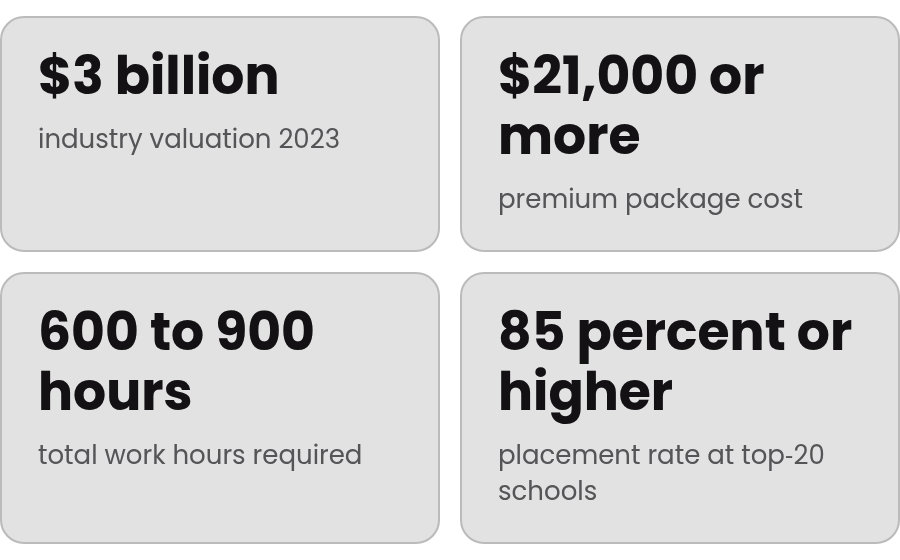
- The college consulting industry was valued at over $3 billion in 2023 according to The Harvard Crimson, and family spending is often reported in the thousands.
- Some local markets, such as Manhattan, are reported to carry higher fees for admissions consulting compared with national baselines.
- Consultants with verified former admissions officer roles and voting committee membership provide more credible guidance than those claiming vague advising experience.
- Premium consulting packages can cost $21,000 or more, yet one student found a parent’s essay feedback more authentic than a consultant’s.
- Strong consultants publish acceptance data with verifiable evidence and applicant context rather than vague top-20 placement claims.
- Full application processes require substantial sustained work across essays, lists, and interviews; personal statement drafts alone often take multiple sessions.
- Consultants who promise guaranteed admission before understanding a student's profile or who push hourly add-ons post-contract raise significant red flags.
Related Video
Watch: What questions should you ask a college admission consultant before hiring them? - The Ivy Institute by The Ivy Institute of College Admission Consultants
What You're Actually Buying
You're about to spend a meaningful sum—often thousands of dollars—on someone who will help your student write essays, build a school list, and navigate the most stressful process of their teenage life. Before you sign a contract, you need to know whether that consultant has ever sat in an admissions committee meeting, whether their track record holds up under scrutiny, and whether the fee you're paying covers what you think it covers.
The table below maps four verification checkpoints to the evidence you should ask for. Use it to compare consultants side by side, not to decide whether consulting is worth it—that's a separate question—but to figure out which consultant, if you're hiring one, is worth your money.
| Question | What to Verify | Evidence Sources | Time Anchor | Quick Verdict |
|---|---|---|---|---|
| Do they have direct admissions experience? | Former admissions officer roles, voting committee membership, or documented years evaluating applications | LinkedIn profiles, named institutional affiliations, specific committee roles | N/A | Credentials verified – proceed vs. Vague "advising experience" – reconsider |
| What's their proven success rate? | Percentage of students admitted to target schools, with context about applicant profiles and school types | Published acceptance data, verified testimonials, acceptance letters | N/A | School-level acceptance data with context – strong vs. No data or inflated claims – red flag |
| What exactly am I paying for? | Number of applications covered, essay drafts included, turnaround times, interview prep sessions | Written service agreement detailing deliverables | Ask for written turnaround estimates and hour allocations | All deliverables in writing – proceed vs. Vague "unlimited support" – clarify scope |
| How do fees align with outcomes? | Base fee vs. satisfaction-tied bonuses, refund policies, guarantees with written criteria | Contract terms, guarantee conditions, payment schedule | N/A | Performance-aligned pricing – fair vs. Full upfront payment, no recourse – high risk |
Red Flags vs. Green Lights
A consultant who promises guaranteed admission before asking about your student's GPA, test scores, or extracurricular depth is selling you certainty they cannot deliver. One admissions professional puts it plainly: strong consultants spend time understanding how your student thinks, what drives them, and what environments bring out their best work—not just their résumé—before making any recommendations.
The college consulting industry was valued at over $3 billion in 2023, yet high success rates can mislead. One student reflected that his mother gave better essay feedback than his consultant because she knew what felt authentic to his voice. The best consultant isn't always the most expensive one. It's the one whose track record matches your student's academic profile and whose process prioritizes narrative integrity over polish.
Why Four Questions Matter More Than a Sales Pitch
Most families commit after a single phone call, then discover months later that their consultant has never worked inside a selective admissions office or that the promised comprehensive package excludes secondary essays for half the schools on their list. Families often spend thousands of dollars for admissions support, with geographic premiums in some cities pushing fees higher. Some premium packages are reported to reach $21,000 or more.
The financial risk is real, but the opportunity cost can be steeper. Students applying to competitive programs face low acceptance rates at selective schools, and a consultant who promises guaranteed admissions or pushes hourly upsells without understanding your student's academic profile is selling marketing, not strategy. Red flags we've seen repeatedly: vague claims about insider knowledge, pressure to purchase hourly add-ons after signing a package, and consultants who skip asking about your student's background before offering school lists. Mismatched lists—where reach and safety designations don't align with a student's test scores and GPA—can waste application fees and narrow options unnecessarily.
Asking the right questions before you pay protects you from wasted money and helps your student build an application that reflects who they actually are, not a template the consultant reuses across dozens of clients.
Do They Have Direct Admissions Experience?
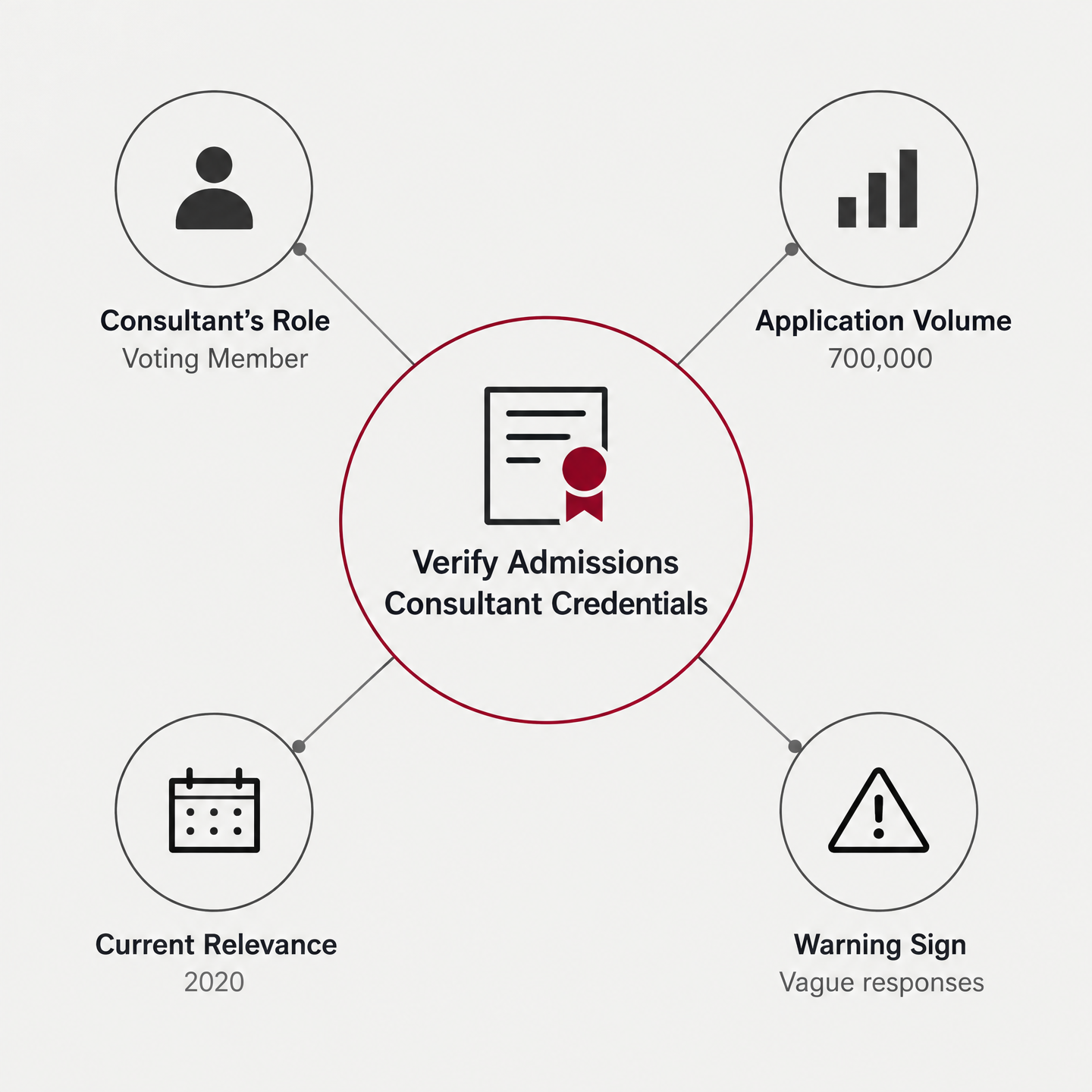
Before you commit, verify the consultant actually worked inside a selective admissions office. Ask where they served, what years, and whether they voted on applications or chaired committee meetings. A consultant who served on a selective admissions committee as a voting member brings insider knowledge that generic essay editors don't possess. You want someone who understands how readers interpret context, what creates red flags in a file, and how the pieces of an application work together when committees make final decisions.
Check LinkedIn, alumni directories, or institutional verification through alumni offices to confirm their background. Some consultants claim "admissions experience" but worked in marketing or alumni relations, not application review. Others worked at one institution decades ago and haven't kept current with how holistic review has evolved since test-optional policies reshaped the landscape.
Years in the Room vs. Years Consulting
Ask how many applications they personally read, how many cycles they served, and whether they evaluated undergraduate or graduate applicants. One firm reports a team of 100+ former admissions officers who collectively reviewed over 700,000 applications, while other consultants may command premium fees despite limited or unverifiable selective admissions experience. Volume matters less than role depth—a consultant who chaired committee for three cycles at a top-20 university often brings sharper judgment than someone who read files for one season at a regional campus.
Beware vague responses. If they avoid specifics about past work or pivot immediately to their success rate, that's a warning sign they lack the credentials they're implying. When pressed, some consultants admit they "meet with admissions staff when they come here" rather than visiting campuses or maintaining active relationships with committees.
Does Their Background Match Your Student's Goals?
A consultant who worked at a liberal arts college may not understand engineering admissions at MIT. Someone whose admissions experience ended in 2010 may not grasp how test-optional policies reshaped holistic review since 2020. Match their background to your targets—if your student aims for Ivy Plus schools, verify the consultant evaluated applications at that tier and understands what differentiation looks like in the most competitive pools.
What's Their Proven Success Rate?
Before you commit, ask to see verifiable proof of where their students actually got in. Don't settle for vague claims about "top schools" or "highly selective programs." You want school-by-school acceptance rates, the size of their student pool, and independent confirmation that the numbers are real.
What Evidence Should You Ask For?
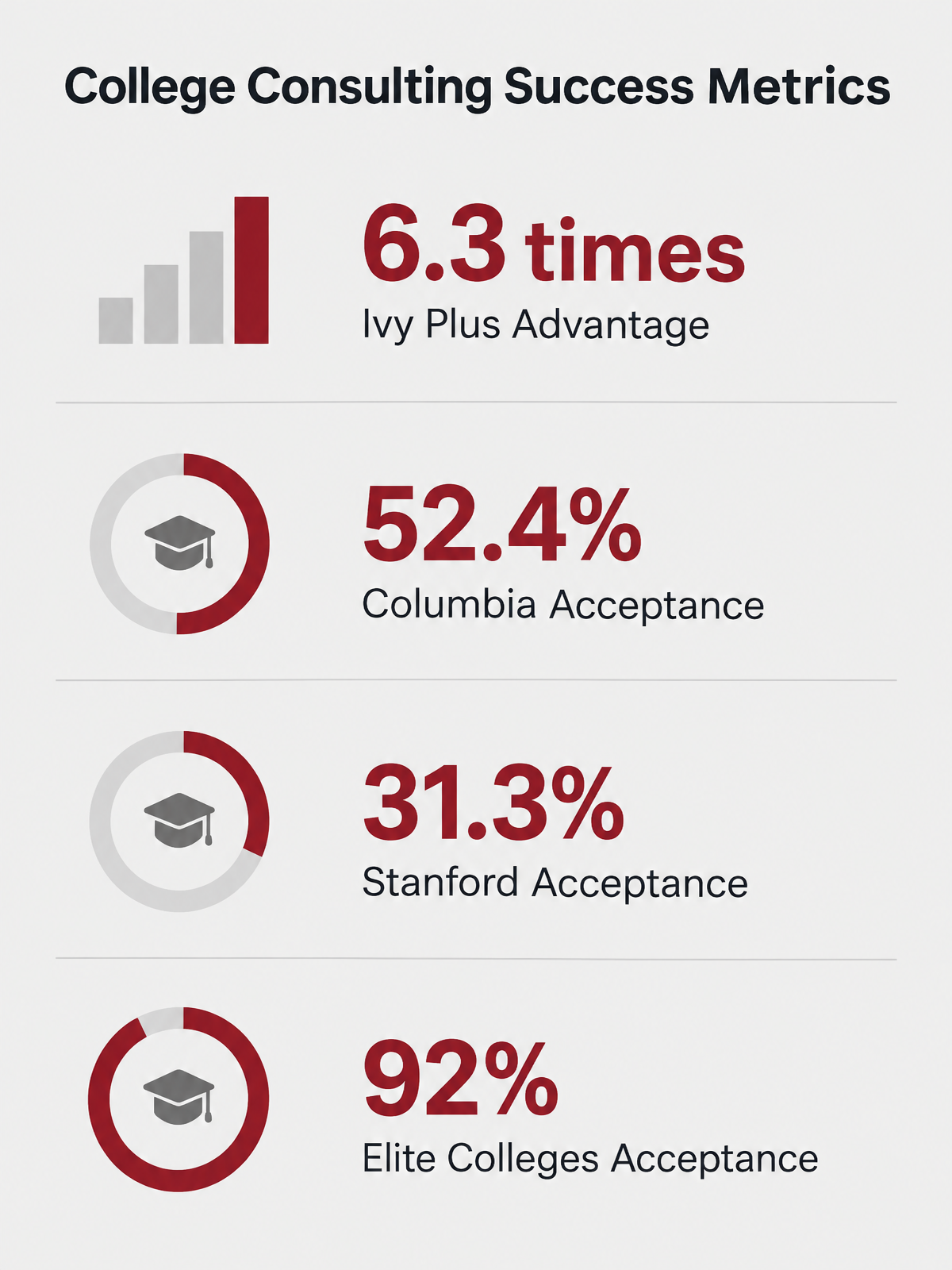
When a consultant mentions their track record, push for specifics. Some firms publish independently verified acceptance rates for Ivy Plus schools—covering all eight Ivies plus Stanford, MIT, Duke, and UChicago—compared to national averages. That data comes from a Vault 50 accounting firm that audits multiple admissions cycles, not from marketing copy the consultant wrote themselves.
School-specific numbers matter more than aggregate success rates. Ask whether the data covers every student who worked with the consultant that cycle, how the consultant defines the comparison group, and whether any results are excluded because of package level or applicant pool. Those distinctions keep a headline rate from hiding selective reporting.
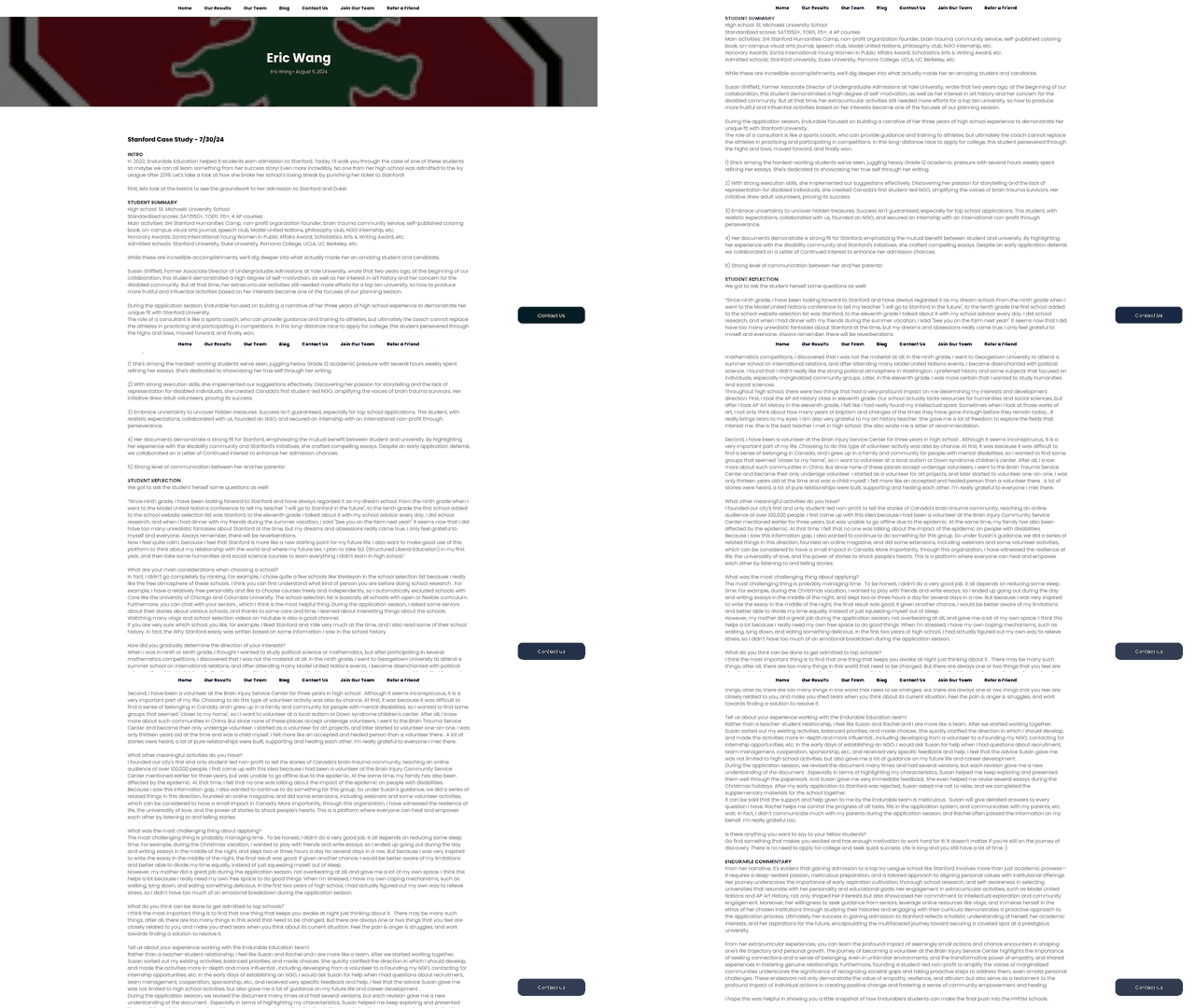
We see families fall for inflated claims when consultants don't explain which students are counted. According to admissions experts, some firms report very high acceptance rates to elite colleges but include only students who purchased premium packages or exclude those who applied to less selective schools. One student questioned whether high success rates reflect the consultant's intervention or simply the advantages their clientele already possessed. Ask how the consultant defines success—does it cover all clients, or only those who signed contracts above a certain price point?
How to Verify Testimonials
Written and video testimonials give you insight into the consultant's process, but only if they come from real students. Firms with verified reviews and detailed acceptance letters offer more credibility than generic praise. Look for testimonials that describe specific struggles—essay feedback that missed the mark, school lists that felt generic—and how the consultant addressed them.
Independent verification separates marketing spin from measurable outcomes. When a consultant's data is audited by a third-party accounting firm, you know the acceptance rates reflect actual results rather than selective storytelling. If a consultant can't point to external validation or provides only anecdotal success stories, treat that as a warning sign.
What Exactly Am I Paying For?
Ask exactly what you're paying for and whether you'll still be paying when the package runs out. Comprehensive packages can vary widely in scope and cost. Some consultants include every school on your list, unlimited essay revisions, and interview prep. Others cap the number of covered schools, charge per-school add-ons, and bill separately for secondary essays.
What Should the Price Breakdown Show?
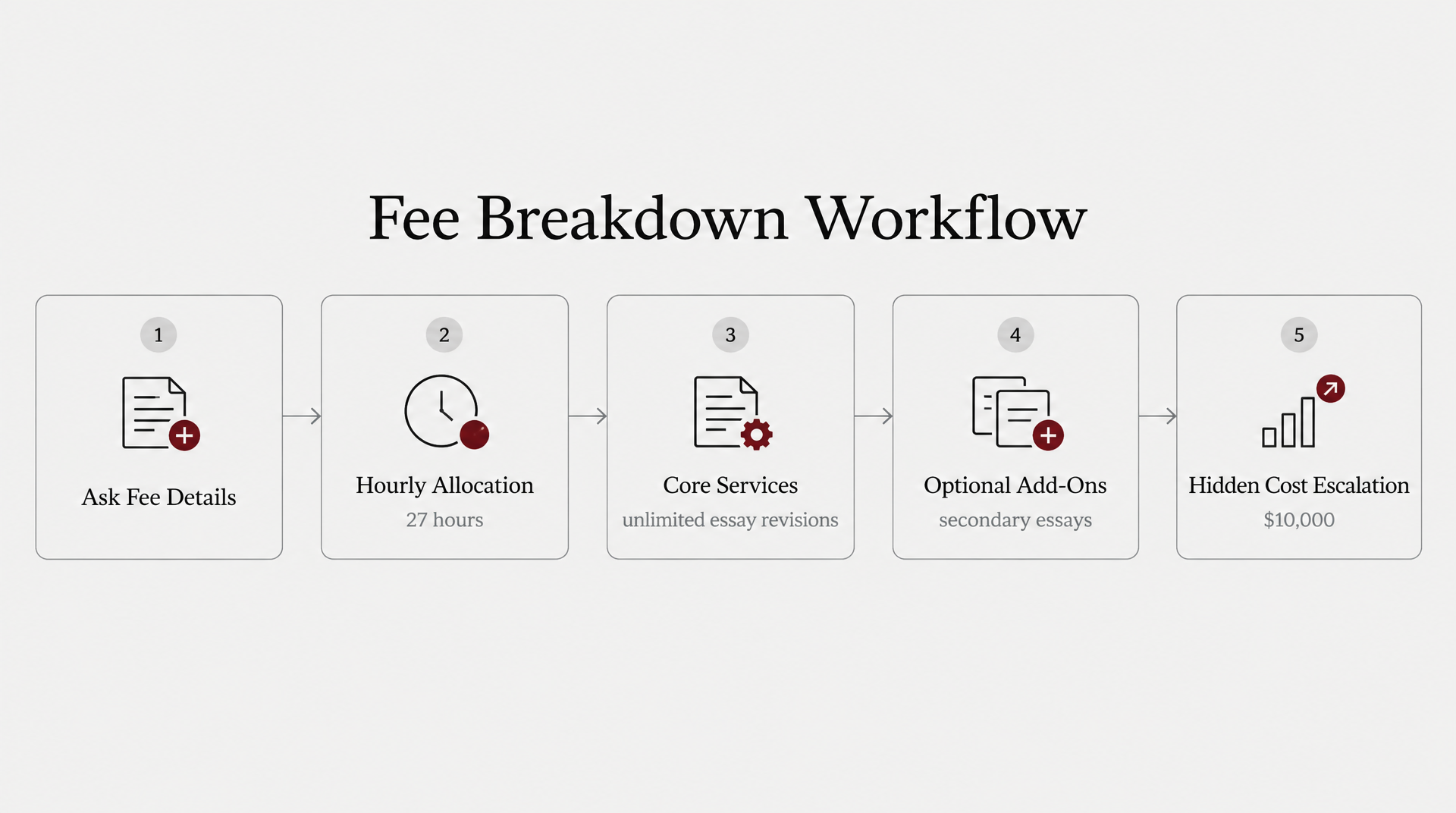
Ask for a written fee breakdown that spells out the hour allocation, what happens when you exceed it, and which services cost extra. Some firms publish estimated hour allocations based on past successful candidates so families can compare offers fairly; others keep the scope vague. If a consultant tells you the package includes "school selection and mock interviews" but doesn't specify how many schools or how many interview rounds, you're buying a service with no defined endpoint.
Geographic premiums add another layer of cost. Families in some high-cost markets may pay more than the national average for the same services. That premium doesn't always reflect better outcomes—it reflects local market positioning.
Watch for hidden costs that turn a fixed-fee package into an open-ended bill. Some consultants cap services at specific hour limits, then charge substantial overage fees when you run over. Others bill hourly consultation fees on top of a flat package rate, including parent check-ins that were not included in the original agreement. Still others impose rush fees for short-turnaround feedback, or charge separately for supplemental essay reviews that most families assume are part of the base service.
Ask about refund policies, cancellation terms, and what happens if you don't get in. Some firms guarantee free follow-up advising or a repeat cycle at no cost if you complete the program and face rejection. Others offer no recourse. The difference between those two policies is the consultant's confidence in their own work.
How Do Their Values Match Yours?
Use your interview as a values litmus test. Ask the consultant to describe a recent case where they advised a student not to apply to a highly ranked school—and why. If they can't recall one, or if their answer focuses only on admissions odds rather than student wellbeing, that's a signal their priorities may not align with yours. One independent consultant cautions families to be wary of anyone who can tell you exactly what your child needs before understanding who your child is.
Watch for three red flags that reveal misaligned incentives. First, guaranteed acceptance promises—any consultant claiming they can secure admission to a specific school is either dishonest or complicit in unethical behavior, echoing the Varsity Blues scandal. Second, artificial time pressure—consultants who warn "we need to start immediately or it's too late" create stress to close sales, not because your student genuinely needs emergency intervention. Third, vague experience claims—if a consultant lists only professional memberships rather than years spent actually working with teens during the admissions process, the credentials may not qualify them to guide your student.
Does the Consultant Measure What Actually Matters?
Ask how they define success. Some firms report acceptance rates without distinguishing highly selective colleges from less selective institutions, or first-choice admissions from safety-school outcomes. One provider verified by an accounting firm reports Ivy Plus outcomes compared with national averages—but also acknowledges that student outcomes depend heavily on academic profile and institutional fit, not just consultant involvement.
Better indicators come from organizational and accountability signals. Some firms report process metrics such as whether students stayed organized and met deadlines, and how many were accepted to one of their top-choice colleges. Those metrics, when defined clearly, can suggest the consultant built systems that reduced chaos and helped students show up prepared. They don't promise miracles, but they may reveal whether the consultant's process creates conditions for student success.
The available research doesn't cover long-term post-admission mentorship, so we can't verify whether consultants help students manage freshman transition or prevent transfers. If you're hiring someone for multi-year engagement starting in ninth or tenth grade, ask explicitly what happens after acceptance letters arrive—including whether the relationship includes support for choosing among offers, adjusting to campus life, negotiating financial aid, or reducing transfer risk—rather than assuming the engagement ends when applications are submitted. Also ask how the consultant measures success for imperfect applicants—students with lower GPAs, uneven test scores, or less conventional profiles—instead of relying only on outcomes for already strong applicants.
What to Do Before You Sign
Print this checklist and bring it to every consultation call. We built it from the verification steps above and the red flags families encounter when vetting consultants. Use it to document each consultant's answers so you can compare offers side by side.
Credential and Experience Verification
Your first checkpoint is proof that the consultant actually worked inside a selective admissions office. Ask where they served, what years, and whether they voted on applications or chaired committee decisions. Some consultants claim admissions expertise but have never read applications in an official capacity—they may have worked in enrollment marketing, alumni relations, or test prep instead. One educator who visits campuses regularly notes that the profession has minimal regulation, so understanding what credentials mean is the first step to becoming an informed consumer. Check LinkedIn profiles, alumni directories, or contact the institutional alumni office to confirm employment. If a consultant refuses to provide verifiable institutional affiliations, that's a reason to walk away.
- Confirm former admissions officer role with specific college name and years served
- Verify whether they voted on applications or chaired committee meetings
- Check LinkedIn and alumni directories for institutional affiliation proof
- Ask for professional organization membership (HECA, IECA, or AICEP certification)
Success Evidence and Transparency
Ask for proof of where their students got in, broken down school by school with acceptance rates and student pool size. Vague claims about "top schools" or "highly selective programs" don't tell you what you need to know. Some firms publish independently audited success metrics, which shows a commitment to transparency. Watch for success-rate caveats that limit data to "students who purchased the comprehensive package" or "clients who worked with master advisors"—those limitations suggest the consultant is cherry-picking results. If you cannot find clear, independently confirmed data, request references from prior clients.
- Request school-by-school acceptance rates for the past two admissions cycles
- Ask whether success data includes less selective colleges and all applicant profiles, not just top-tier candidates
- Ask how the consultant reports outcomes for imperfect applicants—lower GPA, uneven test scores, or unconventional profiles
- Confirm whether the data is independently verified or self-reported
- Speak with at least two prior clients to hear about their experience
Fee Structure and Deliverables
Write down exactly what you're paying for and what happens when you exceed the hour allocation. Some consultants include unlimited essay revisions for every school on your list. Others cap the number of covered schools and charge per-school add-ons for secondaries. Comprehensive packages can range widely in price, with significant variation by region and service scope. Ask for a written breakdown showing hour allocation, hourly overage rates, and which services cost extra. If a consultant mentions a guarantee, read the fine print—no ethical consultant can guarantee admissions outcomes.
- Get a written fee breakdown showing hours, overage rates, and add-on costs
- Confirm which schools and essays are covered in the base package
- Ask what happens if you need more hours than allocated
- Ask how financial aid negotiation support is billed and how its outcomes are measured
- Ask what support continues after acceptance and how transfer risk is addressed
- Check whether the consultant guarantees results and what that guarantee actually covers
Red-Flag Signals
Three signals tell you to walk away immediately. First, guaranteed acceptance promises—any consultant claiming they can guarantee admission to a specific school is either unethical or lying. One former admissions director who now consults reports that multiple families came to him after working with one, two, even three consultants before finding someone qualified. Second, high fees without relevant experience—some consultants charge premium rates despite never working in selective college admissions. Third, excessive caseloads—when a consultant juggles too many students at once, individualized attention becomes nearly impossible. If a consultant cannot tell you how many students they currently advise, assume the number is too high.
- Walk away if the consultant guarantees acceptance to any specific school
- Confirm their caseload allows for adequate individual attention
- Ask how they ensure continuity of service during illness or travel
- Request a clear explanation of their essay process and whether students do the actual writing
References
[1] 12 Questions to Ask Before Choosing a Med School Consultant - https://elevate.iit.edu/blog/2026/07/13/12-questions-to-ask-before-choosing-a-med-school-consultant/
[2] Questions To Ask Before Hiring A College Admissions Consultant - https://poetsandquantsforundergrads.com/admissions/questions-ask-hiring-college-admissions-consultant/
[3] 21 Questions to Ask Before Hiring an Independent College Admissions ... - https://effectivestudents.com/articles/21-questions-to-ask-before-hiring-an-independent-college-admissions-counselor/
[4] 5 Questions to Ask Before Choosing a Medical School Admissions ... - https://www.savvypremed.com/blog/5-questions-to-ask-before-choosing-a-medical-school-admissions-consultant
[5] How to Choose a College Admissions Consultant - https://www.stiphanyconsulting.com/flow-forward/how-to-choose-the-right-college-consultant-10-questions-every-family-should-ask
[6] College Admissions Consultant | College Admissions Counselor - https://www.solomonadmissions.com/
[7] The Business of Getting In | The Harvard Crimson - https://www.thecrimson.com/article/2025/11/27/college-consultants-admissions-scrutiny/
[8] 8 Best College Admissions Consultants Ranking for 2027 - https://research.com/universities-colleges/best-college-admissions-consultants-ranking
[9] How Much Does College Admissions Consulting Cost? A 2026 Pricing ... - https://www.deweysmart.com/resources/how-much-does-college-admissions-consulting-cost-2026-pricing-guide
[10] College Admissions Counselor: Factors to Consider and Questions ... - https://www.collegeessayguy.com/blog/college-admissions-counselor
[11] How to choose the right college admissions consultant - AcceptU - https://www.acceptu.com/blog/how-to-choose-the-right-college-admissions-consultant/
[12] Should You Hire a College Admissions Consultant? - YouTube - https://www.youtube.com/watch?v=rKsML0wIgAk
FAQ
Should I hire a consultant who worked in admissions ten years ago or one who left the field more recently?
Recency matters more than tenure if the consultant hasn't kept current with policy shifts. Test-optional admissions, holistic review changes, and new essay prompts have reshaped selective admissions since 2020, so verify the consultant maintains active relationships with committees or visits campuses regularly, not just that they once held the role.
What happens if my student applies to more schools than the consultant's package covers?
Many packages cap coverage at a set number of schools, then charge per-school add-ons for supplemental essay reviews, secondary applications, or additional interview prep. Before signing, confirm in writing how many schools the base fee includes and what the per-school rate is, so you can budget accurately if your list expands.
Can a consultant's high acceptance rate mean they only take competitive students?
Yes—some firms report very high elite-school acceptance rates but include only students who bought premium packages or exclude those applying to less selective schools. Ask how they define their pool: do the numbers cover all clients, or just top-tier packages? One student noted his acceptance likely reflected his family's advantages more than his consultant's input.
If a consultant refuses to name where they worked in admissions, is that always a deal-breaker?
In most cases, yes. Verified institutional affiliations—college name, years served, voting committee membership—separate former admissions officers from marketing staff or essay editors who claim vague "advising experience." If they won't provide checkable details or dodge the question, assume they lack the credentials they're implying and reconsider the engagement.