“College Humbled Me” After an Ivy Dream: What the Phrase Often Means in Real Student Terms
October 29, 2026
What You Need to Know
- "College humbled me" usually means the measuring stick changed after high school. It rarely means a student's ability actually declined.
- A Gifted Child Quarterly study of academically talented undergraduates linked honors program participation to stronger imposter feelings, so its findings may not apply to every struggling student.
- The same research tied socially prescribed perfectionism (the belief that other people expect you to be flawless) to heightened imposter feelings.
- A more competitive peer group can lower a student's academic self-concept even when their underlying skills haven't changed: perceived peer ability can shift while actual performance stays steady.
- High-achieving students often tie self-worth to results. That's why a tougher grading environment tends to hit identity, not just the transcript.
- Emerging adulthood piles identity exploration, new relationships, and first-time independence on top of harder coursework. That combined stress often looks like academic failure when it isn't.
- Weeks of hopelessness, poor sleep, or social withdrawal go beyond ordinary adjustment. Those are signs to reach out to campus counseling.
Quick Summary
She coasted to straight A's in high school. Then she got a B-minus on her first college midterm and texted home three words: "College humbled me."
We hear some version of that text often. In our experience, the real college humbled me meaning is rarely "I failed." Your ability didn't shrink overnight. Your peer group got stronger, and you're learning to run your own life at the same time. That's a lot of change for one semester.
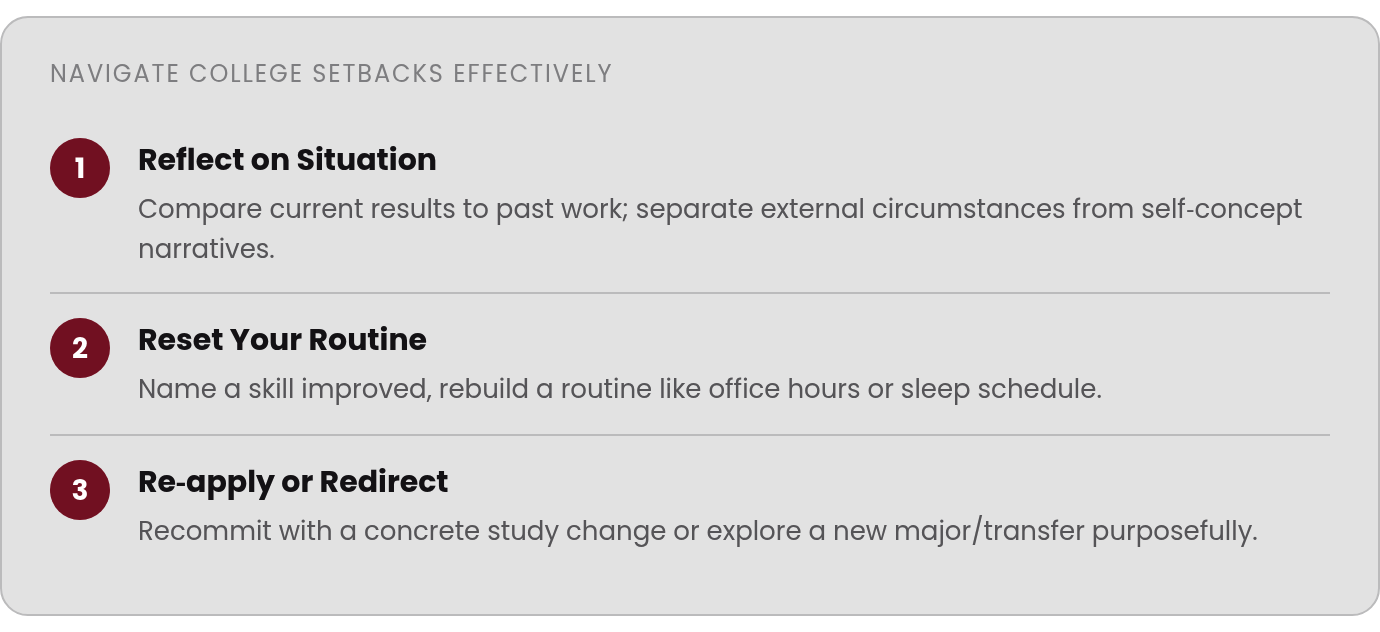
We recommend a simple three-step check before big conclusions: Reflect, Reset, then Re-apply or Redirect. The table below matches common feelings to what's often happening underneath, and to the step that tends to help.
| What you might feel | What's often going on | Reflect → Reset → Re-apply/Redirect |
|---|---|---|
| "Everyone here is smarter than me" | A more competitive peer group can lower your academic self-concept, even when your skills haven't changed | Reflect: compare yourself to your own past work, not the room |
| "I don't belong here" | Selective programs and pressure to meet others' expectations tend to feed imposter feelings | Reset: name one skill you've actually improved this term |
| "Everything feels heavy at once" | The first year of college often stacks new independence, new relationships, and bigger academic demands on top of each other | Re-apply: recommit to your goal with one concrete study change |
| "My grades are my worth" | High achievers often tie self-worth to results | Redirect: explore a better-fit major or path without shame |
For students: Run this check after one rough grade, not after one rough night. A single data point rarely tells the whole story, and 2 a.m. is a terrible time to decide your major.
For parents: Ask what your student learned, not what they scored. That one question can lower the temperature of the conversation quickly.
Two Struggles Hiding Inside One Phrase
Possible causes include adjustment stress, poor preparation, or a mental-health concern. A student with a clear pre-med path may still say "college humbled me" after a rough stretch. Compare assignments, attendance, preparation, sleep, and concentration across the term. If understanding improves with structure and support, the issue may be the conditions around the work—adjustment stress or a preparation gap—rather than a fixed limit in ability. Weeks of hopelessness, poor sleep, or pulling away from friends point toward campus counseling rather than a transfer decision.
When we help students unpack that phrase, we usually find two struggles tied together. The first is academic self-concept, meaning how capable you feel compared with others. The second is the ordinary upheaval of becoming independent. Pull those two apart, and neither one gets to pose as a final verdict on your ability.
Emerging Adulthood Adds Weight a Grade Can't Explain
Your undergraduate years fall inside what psychologists call emerging adulthood, the stretch between adolescence and adulthood. You're figuring out who you are, rebuilding a social circle from scratch, and handling real independence for the first time. Laundry, budgets, and roommate conflicts don't show up on a transcript, but they absolutely show up in your focus.
That overlap hits strong students especially hard. They've usually had a clear link between effort and results. A lonely semester or an unsettled sense of direction can drain concentration and motivation without touching anyone's underlying potential.
So before making a permanent academic decision, figure out which part of the transition is using up most of your energy. Sometimes it's the organic chemistry. Often it's everything else.
What Students Really Mean When They Say "College Humbled Me"
A freshman in an honors seminar hears a classmate cite a paper she's never read. Suddenly her acceptance letter feels like a clerical error. That flash of "I fooled them" often sits underneath the phrase.
Researchers call this the imposter phenomenon: having trouble believing your own success even when the evidence says you earned it. The Gifted Child Quarterly research mentioned above separates perceived peer ability from actual performance. It links imposter feelings to being in an honors program and to socially prescribed perfectionism, but it was drawn from academically talented undergraduates. The pattern may not generalize to every student. For some students, then, the distress has less to do with grades and more to do with feeling like a fraud in a place they worked for years to get into.
Families sometimes find this surprising. The student who made it into the selective program is exactly the one who may feel least sure she belongs there.
Feeling Humbled Can Mean Your Self-Worth Rode on the Scoreboard
High school often rewards strong students with a steady stream of praise. College tends to turn that stream down. Standout results take more effort, and the feedback comes less often.
When the old source of reassurance stops working, uncertainty can show up as shame, avoidance, or a sudden urge to leave. That doesn't mean the student lacks ability. It means the scoreboard she relied on has changed.
If this sounds familiar, examine the reaction before treating your admission as a mistake. Ask yourself two questions. Is this work helping me grow? And are the standards I'm chasing actually mine, or ones I absorbed from someone else? The answers can tell you whether you need more support, a new routine, or a bigger change in direction.
Turning Humility Into a Strategic Advantage
A transfer decision becomes clearer when you examine a disappointing term as a pattern, not a single label. This is the moment when a bruising comparison can become useful information instead of a permanent label.
Once you understand your own reaction, you can look at the decision with some distance. The goal isn't to force yourself to stay, and it isn't to force a transfer. It's to separate a genuine educational need from the wish to undo an embarrassing moment.
Reflect, Reset, Then Choose Your Direction
Reflect. Write down what happened this term. Sort each item into one of two buckets. Circumstance covers things like harder grading, stronger peers, or living on your own. Self-concept is the story you're telling yourself about your ability. Sorting keeps one disappointing result from swallowing every other explanation.
Reset. Pick one routine to rebuild, such as going to office hours, protecting your sleep, or scheduling study blocks. Pair it with one goal you can measure by finals. A small, manageable change gives you better evidence about what you can do than any decision made mid-crisis.
Re-apply or Redirect. A transfer application lets you move to a different college after you've already started at one. If transferring still appeals to you once you've reflected and reset, start by naming the gap your current school cannot fill. If prestige is your only reason, skip the transfer. In our experience, a move with a clear academic or personal purpose is much easier to defend, both to an admissions office and to yourself, than an application meant to repair wounded pride. You can find more planning ideas on our college admissions advice blog.
From a Humbling Year to a Stronger Next Step
Here's how we approach this conversation. It's a composite scenario, not a client story or a promised result. A first-year student lands at a state flagship after being waitlisted at her top choice. She's asking two questions at once: Should I transfer? And am I still the student I thought I was?
We start by rejecting a one-answer explanation. A disappointing semester might involve academic fit, a new living situation, money pressure, or an expectation nobody ever examined. Looking at each piece separately gives the student room to make a deliberate choice instead of a reactive one.
A Panel of Advisers, Several Separate Questions
Self-concept. We look at how the student judges her own ability. Is she measuring herself against an unusually accomplished cohort? Or can she point to specific pieces of work that need improvement?
Educational fit. We also ask whether her current school matches what she wants to study and how she learns best. A transfer can make sense when it fixes a concrete mismatch. It's far less persuasive when the main attraction is a more impressive name. And when her current college already supports her goals, we tell her so plainly.
Transition pressures. We look at the rest of her life: living alone, money, friendships, sleep. These can throw off both performance and decision-making without saying anything about her talent.
Then we compare those answers. Disagreement often helps clarify the choice. It can reveal that the real choice isn't simply "stay or leave." It might be whether to switch majors, find more support, or give the current school a fairer trial.
References
[1] (PDF) Perfectionism and the Imposter Phenomenon in ... - https://www.researchgate.net/publication/335107716_Perfectionism_and_the_Imposter_Phenomenon_in_Academically_Talented_Undergraduates
Common Questions
Should I drop out of my honors program if it's making me feel like an imposter?
Do not make the choice during the most discouraging part of the semester. Review the program's workload, the feedback you are receiving, and the kind of learning you hoped to do there. A conversation with an adviser or instructor can show whether the problem is an isolated adjustment, an unsustainable structure, or a poor match with your goals.
How can I tell whether my grades are slipping because of ability or because of life changes?
Look for patterns rather than treating one mark as a diagnosis. Compare assignments, attendance, preparation, sleep, and concentration across the term. If your understanding improves when you have structure and support, the issue may be the conditions around your work rather than a fixed limit in your ability.
Is wanting to transfer after a disappointing first year a good reason to reapply to my dream school?
It can be, if the new college offers something specific your current one cannot. Define that benefit before opening an application: a program, learning environment, or opportunity that fits your direction. If you cannot name anything beyond status, waiting and reassessing may lead to a stronger decision.