Hiring a Consultant Who Specializes in Your Target School's Region
October 30, 2026

Key Takeaways
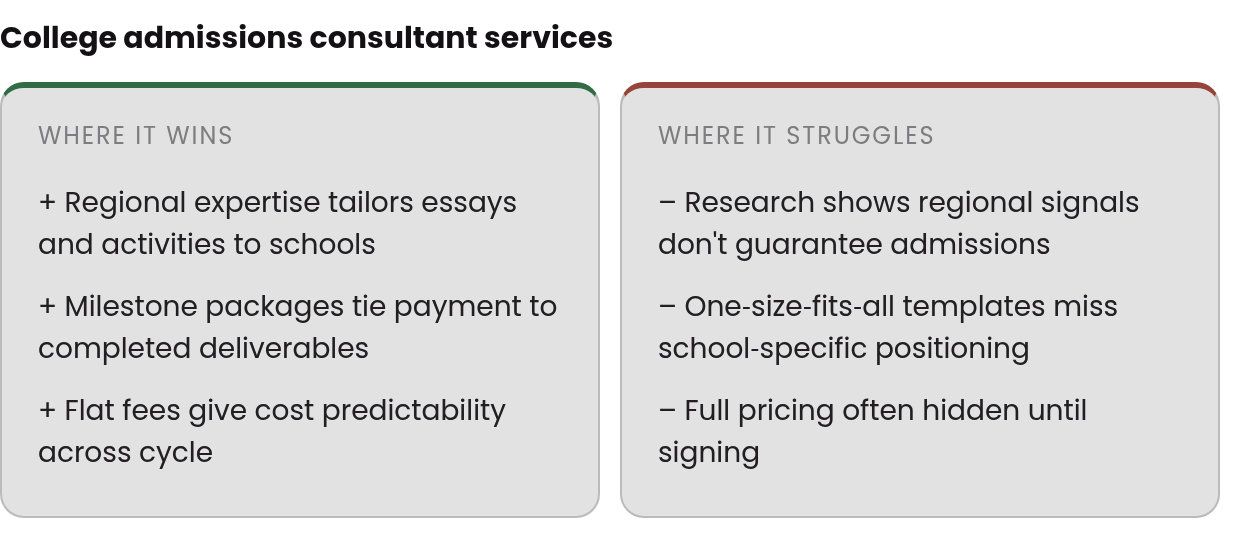
- Available research does not confirm that regional signals affect Ivy League admissions outcomes, but regional knowledge can authentically shape how essays and activities are framed for specific schools.
- NACAC lists over 2,000 member consultants who meet professional criteria — meaning you have real choices, and fit matters as much as credentials.
- Consultants who rely on identical templates may miss school-specific positioning opportunities.
- A five-dimension scorecard rates consultants from 1 to 5 on experience, methodology, communication, regional relevance, and cost transparency.
- Ask consultants how they structure fees: flat-project packages, hourly billing, or milestone-based arrangements are three options to compare.
- Full pricing may not appear online before signing, so ask for a complete fee schedule before committing.
- Milestone-based packages tie payment to completed deliverables; flat fees offer cost predictability across the full cycle.
What "Regional Expertise" Actually Gets You
A family comes in having already hired a consultant — a name they liked, a website that looked serious. Their student is targeting eight schools, four of them selective. They want a second opinion. The consultant's process is technically fine. The problem is it's the same process used for every student, regardless of whether you're applying from Hong Kong or Houston.
That's the practical risk. Not a scandal. A missed opportunity.
Regional expertise, when it's genuine, can show up in two places: how a student frames an essay topic for a specific school, and how their activities get positioned given the applicant pool that school typically reads. The available research doesn't confirm that regional signals determine admissions outcomes at Ivy or top-tier schools. What regional knowledge can do is make an application feel native to the reader rather than generic — and that's a real difference.
| What to Investigate | One-Size-Fits-All | Regional-Aware |
|---|---|---|
| Essay framing | Standard templates | Tailored to school context |
| Activity positioning | Generic achievements | Regionally relevant |
Our team's planning draws on cases across the US, China, the UK, Canada, Hong Kong, and Mexico. What that breadth teaches you is that the same student story lands differently depending on who's reading it and what they already expect from applicants with a similar profile. If you want a framework for testing any consultant on this, these four questions are a good starting point.
Scorecard: How to Evaluate Any Admissions Consultant
Finding a college admissions consultant is easy. Finding the right one for a student targeting specific schools takes considerably more work, especially when regional context is part of what you're paying for. This scorecard makes that comparison more concrete.
Five Dimensions, Rated 1 to 5
Rate any consultant from 1 (weak) to 5 (strong) across each dimension:
| Dimension | Score 1 | Score 5 |
|---|---|---|
| Experience | No prior work with your target schools | Documented history with your specific target schools |
| Methodology | Vague process, no defined milestones | Clear deliverables and a documented application timeline |
| Communication | Reactive, irregular updates | Defined response windows and proactive check-ins |
| Regional Relevance | No awareness of how target schools read applicants from your region | Deep familiarity with how regional applicant pools are evaluated |
| Cost Transparency | Pricing unclear until you've signed | Full fee structure disclosed before any commitment |
Consistently low scores across these dimensions warrant a harder conversation before you commit. Ask directly. Vague answers on methodology or regional relevance are a clear signal to keep looking.
Use this before your first conversation with us or any other consultant.
Endurable Education: What We Can Show You
Our team builds each strategy around the schools a student is actually targeting. When families ask what makes our advisors the right fit, we point to specifics: advisors who graduated from Harvard, Yale, and Princeton with meaningful real-world work experience, and experience across multiple educational systems and student backgrounds.
We hold ourselves to the same bar this scorecard sets for anyone else.
| Evidence | Current Status | How to Access |
|---|---|---|
| Advisor backgrounds and international experience | Available | Team page |
| School and educator consulting | Ongoing | Contact us |
|---|---|---|
| Student case studies across multiple regions | Available | Results page |
Some of that is documented now; some we're still building into resources families can review in full. That's the honest position to take. Our blog covers how an advisor's own background shapes the way they read a student's story across borders — what international experience actually changes about application strategy, not just in principle but in practice. The 7 Specializations Guide maps out which type of consultant fits which student profile and shows where our team sits in that picture.
What Consultant Fees Actually Look Like
Pricing is where many families hit a wall. Full details may not appear online, and structures vary enough that surprises are possible. Asking before you commit saves the awkward conversation later.
Ask how a consultant structures fees. Three models to compare are flat-project fees covering the full application cycle, hourly arrangements, and milestone-based packages tied to completed deliverables. Each has tradeoffs. A flat fee offers predictability across the cycle. Hourly can work if a student needs limited, targeted help. Milestone-based packages tie what you pay to completed deliverables.
What to Ask Before You Sign
The contract tells you as much as the pitch. Questions worth asking any consultant you're evaluating:
- Scope of services: What's explicitly included, and what triggers an additional charge?
- Refund or termination clause: What happens if the engagement ends early?
- Confidentiality provisions: Who owns the student's work product?
- Performance terms: Does the contract include any outcome-tied incentives, and if so, how are they structured?
- Availability and response time: How are communication expectations documented?
Our base + bonus structure ties part of our fee to satisfaction with the service. When comparing proposals, pay close attention to how each contract defines the end of the engagement. Language like "through matriculation" can extend an agreement further than families expect and create disputes over what counts as a final deliverable.
How to Keep Getting Value After You Submit
The submit button is not the finish line. Decision season brings its own set of choices: interview invitations, requests for additional materials, wait-list offers, and eventually the decision between multiple acceptances. Each step goes better when you have someone already familiar with the student's full story.
A strong consultant stays useful throughout the process. What that looks like varies widely, so ask directly: How do you support students after they submit? What's your process when an interview invitation or wait-list offer arrives?
Questions to Ask About Post-Submission Support
| Stage | Question to Ask |
|---|---|
| Interview prep | How many sessions, and what schools have you prepped for recently? |
| Wait-list response | Do you help draft letters of continued interest, and how does regional context factor in? |
| Supplemental requests | How do you handle schools that ask for additional writing? |
| Admission decision | Can you help compare offers, including financial aid packages? |
One resource worth asking about: former students who went through the same schools. Ask whether a consultant has alumni willing to speak with applicants, especially those from your region or targeting the same programs. Peer context, and what those schools felt like from the inside, can surface things a consultant alone cannot.
References
[1] Independent Educational Consultants Directory - NACAC - https://www.nacacnet.org/independent-educational-consultants-directory/
Common Questions
Does hiring a regionally specialized consultant actually improve my child's chances of getting into a top school?
A regional specialist cannot promise an admissions result. The more useful question is whether the consultant can demonstrate relevant school knowledge and explain how that knowledge informs the student's planning, writing process, and activity choices. Families should evaluate the consultant's work rather than treat regional specialization as a guarantee.
When does hourly billing make more sense than a flat-fee package for college admissions help?
Hourly billing tends to work when a student needs limited, targeted help, such as a few essay reviews or interview sessions, rather than support throughout the entire application process. Before choosing it, estimate how much guidance the student is likely to need and ask whether unused hours expire. A written scope can prevent a small engagement from expanding unexpectedly.
What should a college admissions consultant actually do when my student lands on a wait-list?
A wait-listed student often benefits from a letter of continued interest: a targeted message that updates the school and reaffirms commitment. Ask whether the consultant will help determine what information is appropriate to include, review the final draft, and coordinate any additional materials the school requests. The agreement should make clear whether this work is included after the original applications are submitted.