7 College Admissions Consultant Specializations That Match Your Student's Profile
October 27, 2026

When the Wrong Consultant Costs You Three Years
Consider a student who spent sophomore and junior year founding a nonprofit mentoring program because his consultant said community service "looks good." He's passionate about computer science, has decent competition placements, and wanted to spend summers at coding camps. Instead, he organized weekend tutoring sessions he didn't particularly enjoy because someone told him leadership mattered more than depth. Now his Common App reads like a student who dabbled in everything and committed to nothing.
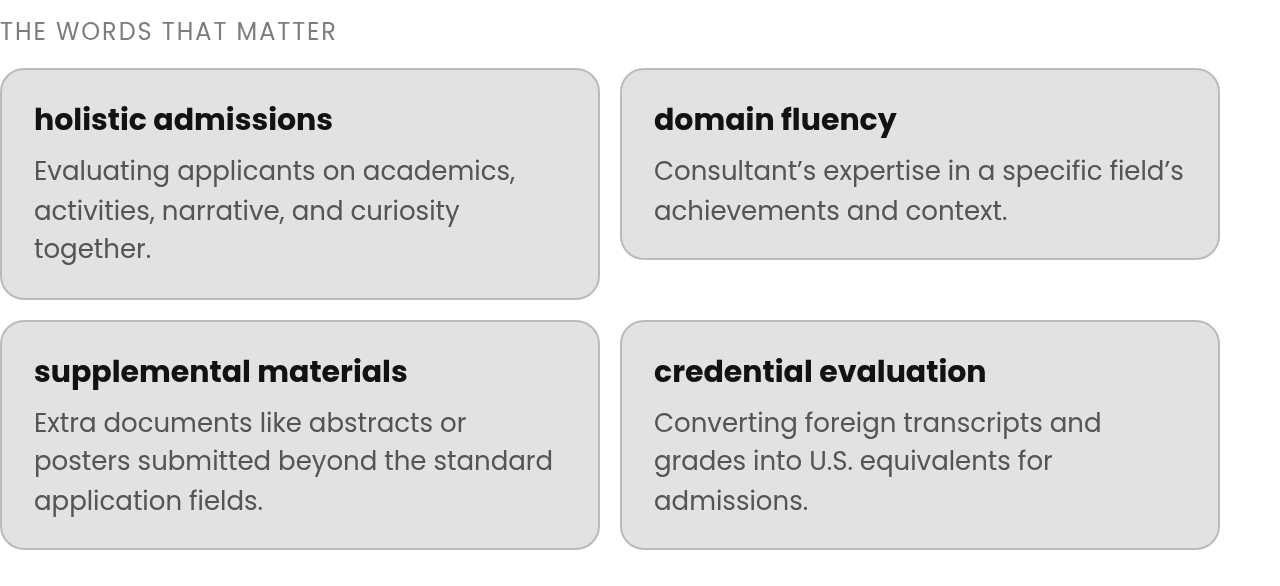
This can happen when families hire based on credentials instead of fit. The consultant may have been a former admissions officer at a selective school. But their expertise may have been positioning humanities students with strong writing portfolios, not STEM applicants with technical skills. The mismatch can create what holistic admissions—the practice of evaluating students across academics, activities, personal narrative, and intellectual curiosity—may flag as inauthentic. When your profile doesn't match your story, admissions readers may notice.
College consulting isn't one-size-fits-all. A robotics competitor may need someone who can frame research or competition abstracts for engineering schools. A recruited athlete may need someone who coordinates with coaches and understands NCAA timelines. An international applicant managing credential evaluation may need someone who has worked with students from their country or school system before. Not all former admissions officers translate their experience into strong consulting, and not all bring domain fluency to positioning niche achievements.
What Misalignment Actually Looks Like
When your consultant doesn't understand your student's core strength, the result can be generic advice that wastes time. For example, a student with genuine research depth might be steered toward easier competitions that may not match the evidence selective STEM programs expect. A visual artist might be pushed toward academic metrics when their portfolio could carry the application. An international student with national debate honors may struggle to explain why those honors matter, and a consultant may not help if they have never worked with that achievement system.
Worse, students can lose ownership of their narrative. They may pick activities for résumé impact rather than genuine interest. The disconnect can show up in essays, interviews, and recommendation letters. Admissions reviewers may be able to spot a student following someone else's script.
Our team at Endurable Education includes Harvard, Yale, and Princeton graduates with admissions experience. We separate the work into two phases: life preparation, where students build meaningful experiences starting as early as 8th grade, and college application, where we present those experiences strategically. This timeline allows profile development—course selection, summer programs, competition strategy—that can shape strong applications rather than scrambling senior year to manufacture depth that isn't there.
The approach balances fit with ambition through customized planning. Our fee structure ties to quality and satisfaction, not pushing students toward mismatched schools for trophy acceptances. Success means helping students find colleges where their actual strengths can thrive, not gaming a system that's already designed to filter out inauthentic profiles.
What You're Actually Hiring For
- A consultant whose expertise matches your student's central strength—not just "admissions experience" in the abstract.
- Seven consultant types may serve different profiles: Academic-Excellence, Athletic, Arts-Creative, STEM-Research, International, Service-Leadership, and Non-Traditional advisors.
- Misaligned guidance may create years of résumé-building activities that weaken authentic stories.
- Specialized advisors can provide context. A rural school's science fair win can mean something different than a Palo Alto robotics award, and framing can matter.
- Long-term profile planning (9th–11th grade) may require different support than senior-year application execution.
- Strong consulting connects academic choices, activities, narrative, and college fit into one coherent story.
Seven Consultant Types and When You Need Each One
Families sometimes treat college consultants like generalists, assuming basic competence across all student profiles. That assumption may miss how admissions works. A consultant who understands both the evaluation framework and the domain-specific context may be better able to frame technical, artistic, athletic, or community accomplishments with the nuance readers expect. Without that specialization, you may get advice that is technically correct but strategically empty.
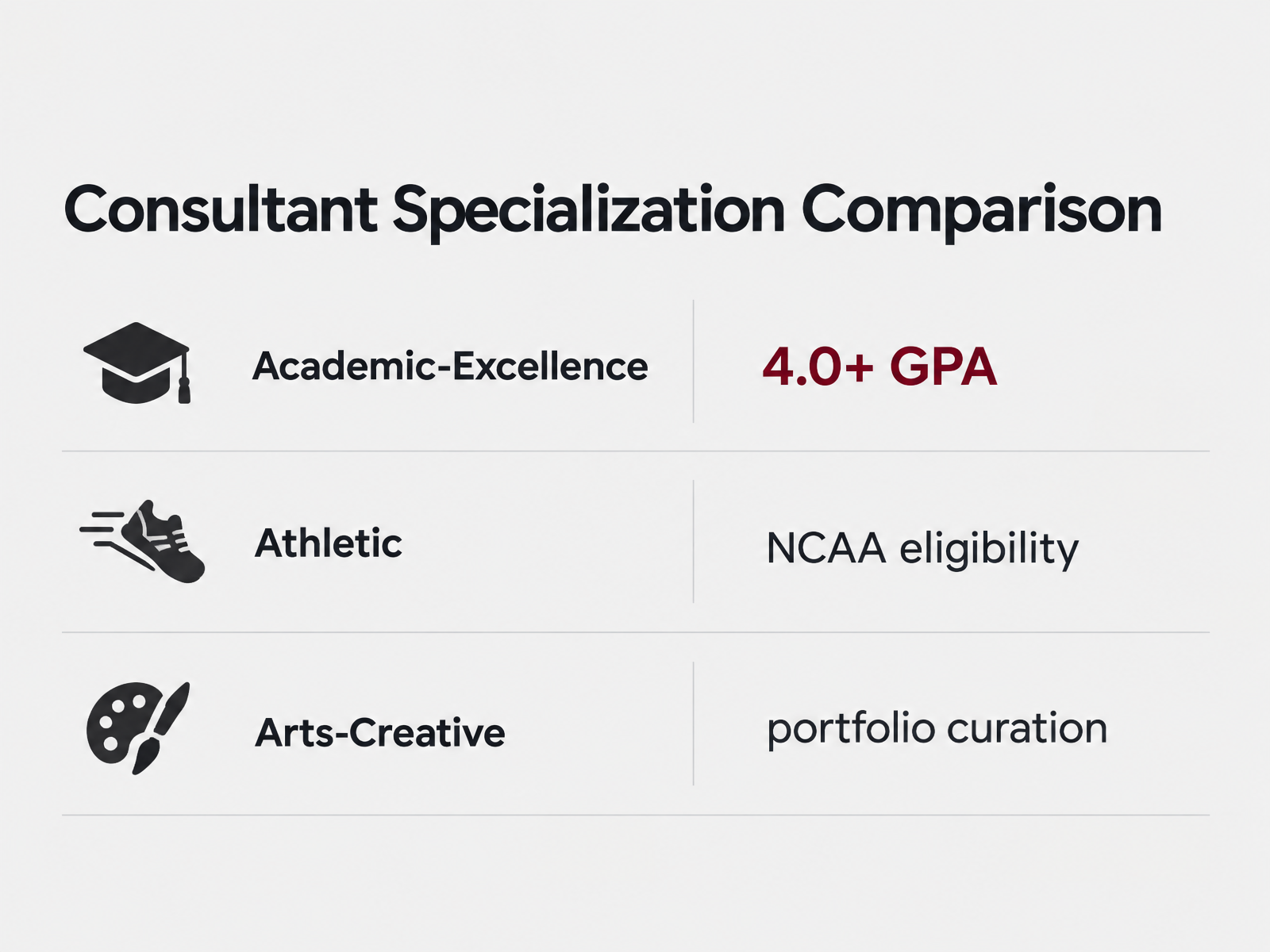
Academic-Excellence specialists often work with high-stat students targeting selective colleges or equivalent schools. These consultants can position intellectual curiosity and academic risk-taking beyond raw numbers. For example, they may help explain why a student chose an independent multivariable calculus course instead of waiting for a standard AP sequence.
Athletic consultants may manage NCAA eligibility, recruiting timelines, and the choice between Division I–III options. They can be useful for students whose sport defines a major part of their college path but who also need academic positioning that complements athletic talent rather than competing with it.
Arts-Creative advisors may help visual artists, musicians, and performing artists assemble portfolios that demonstrate technical skill and artistic voice. They can help evaluate when a student should apply to conservatories versus liberal arts programs with strong arts offerings, and how those applications differ.
STEM-Research consultants may position students with lab experience, competition placements, or independent projects. They can translate research depth for admissions readers who are not scientists—a skill that can matter when a dense abstract does not fit neatly in the Common App activity section.
International and Dual-Enrollment specialists may handle visa complexities, transcript conversions, and cultural translation for students educated outside traditional U.S. systems or splitting time between high school and college coursework. They can help determine which credentials may need third-party evaluation and which institutions accept self-reported grades.
Service-Leadership advisors can help distinguish genuine community impact from résumé padding. They may work with students whose profiles center nonprofit founding or sustained volunteer work, and they can help identify which details demonstrate commitment versus which ones may read as box-checking.
Non-Traditional and Gap-Year consultants may serve students returning after time off, military service, or career exploration. They can help reframe work experience and life context as admissions assets rather than gaps that need explaining away.
| Specialization | Core Strength | Ideal Student Profile |
|---|---|---|
| Academic-Excellence | Framing intellectual depth beyond grades | High-stat students targeting top-tier schools |
| Athletic | NCAA navigation, recruiting coordination | Committed athletes balancing sport + academics |
| Arts-Creative | Portfolio curation, conservatory strategy | Visual artists, musicians, performers |
| STEM-Research | Lab work positioning, competition framing | Research experience, science competitions |
| International/Dual | Transcript conversion, visa guidance | Non-U.S. educated or dual-enrollment students |
| Service-Leadership | Distinguishing genuine impact from padding | Community organizers, nonprofit founders |
| Non-Traditional/Gap | Reframing life experience as asset | Gap year, military, career-changers |
Former admissions officers from selective universities can bring insider knowledge of how some applications are read. But specialization match may matter more than the title alone. A former Stanford officer who reviewed humanities applications may not be the obvious choice to position a technical portfolio with the nuance a STEM-focused consultant could bring. Credentials open the door; domain fluency can keep students from wasting time on strategies that don't fit their profile.
STEM, International, and Dual-Enrollment: When Standard Advice Doesn't Translate
Your daughter has a summer research internship, a conference poster, and a dense abstract. The Common App activity section gives her limited character count. Where does the poster go? Should she upload the abstract? Does it help or clutter? A generalist might tell her to "highlight the experience in additional information." A STEM specialist can help determine which admissions offices are more likely to read supplemental materials and which may not.
An international student from India holds national debate championships but cannot figure out how to explain their significance to U.S. admissions officers who may not know the tournament. A dual-enrollment student took college courses at a local university during high school and now needs to know whether those credits transfer, whether they count as high school or college coursework, and whether the credit can affect financial aid eligibility at each college. These are common situations in competitive admissions, and they may need more than the standard playbook.
Consultants who work with diverse student populations—artists, athletes, international applicants from multiple countries and school systems—may develop fluency across these pathways. They do not need to treat every application the same way because admissions offices may evaluate different profiles differently.
STEM students can face a presentation challenge that humanities students may not. Research abstracts, lab notebooks, and conference posters rarely fit cleanly into the Common App's activity descriptions. A consultant may need to help decide when supplemental materials strengthen an application and when they become clutter that readers skip. Consultants with admissions-office experience at selective universities may understand what some readers want: intellectual curiosity and independent thinking, not just program participation or credential stacking.
International students may manage timelines for English-language testing, credential evaluation for transcripts that do not match U.S. grading scales, financial documentation requirements, and the translation challenge of adapting regional achievements to a context that may not recognize them. A national olympiad placement from one country may not translate automatically for U.S. admissions readers, and a student may need help framing its context.
Dual-enrollment students may balance rigor with realistic course loads. Taking college courses during high school can demonstrate academic readiness, but it can also raise questions about whether the student exhausted high school offerings or was simply chasing credentials. Consultants can help families understand how different institutions evaluate college credit earned during high school—some may give transfer credit, some may not, and some may consider the credit differently for financial aid or freshman status. Families should verify each college's policy.
| Pathway | Primary Challenges | Consultant Support Focus |
|---|---|---|
| STEM Research | Presenting lab work, abstracts, posters | Supplemental material strategy; translating research into narrative form |
| International | English testing; credential evaluation; financial docs | Timeline planning for TOEFL/IELTS; explaining grading systems; translating regional honors |
| Dual Enrollment | Balancing coursework; credit transfer | Course selection timing; institutional credit evaluation policies |
Matching Your Student's Strengths to the Right Specialist
Your daughter has a strong academic record, strong AP science scores, and leads her school's robotics team. She needs help packaging her STEM achievements for competitive engineering programs. A consultant who specializes in STEM applications may help translate her conference presentations and research abstracts into an admissions narrative that engineering schools can weigh. A generalist might tell her to "explain the impact." A STEM specialist can help identify which evidence is likely to matter for specific engineering programs, because different institutions may read technical depth differently.
Start with academic foundation. A 4.0+ GPA with national merit recognition may point toward an Academic-Excellence specialist who understands how selective colleges parse transcript rigor and course selection. A lower GPA paired with exceptional talent in one domain—visual arts portfolio, recruited athlete status, published research—may need a specialist who can frame that spike as the profile's anchor rather than treating the lower GPA as a weakness to overcome.
Assess extracurricular focus next. A student with research or science fair placements may benefit from a STEM specialist who can help decide how to position research abstracts and whether supplemental materials help or hurt. Portfolio-based applicants pursuing conservatory or arts programs may need an Arts specialist familiar with each school's supplement requirements, audition expectations, and how admissions offices balance artistic talent with academic fit. Recruited athletes may need someone who coordinates with coaches, understands recruiting timelines, and can explain why a specific division might offer better academic fit for a student.
Geographic and citizenship context may shape the evaluation. Students applying from China, India, or other competitive international pools may face different context than domestic applicants. An International specialist who has worked with students from your student's country may be able to manage visa considerations, explain grading systems to admissions offices, and frame achievements in U.S. admissions terms without losing their original significance.
Timeline can determine consultant type. Students starting in 9th or 10th grade may work with comprehensive specialists who build extracurricular strategy, plan summer programs, and shape course selection over multiple years. Seniors who need essay revision and application logistics may be able to work with targeted hourly consultants without paying for services they don't need.
Match caseload and attention model to your student's needs. A student aiming for highly selective schools may benefit from low caseloads and multiple consultant review. A strong applicant targeting state flagships and regional privates may not need that level of support.
Consultant credentials, institutional background, and profile fit
Ask what type of student files a consultant has worked recently, not only where they used to work. Former admissions-officer experience can signal familiarity with a reading process or institutional culture, but it does not automatically mean the consultant has evaluated your student's applicant type or stayed current with a specific pathway such as STEM research or international credentials. When comparing options, weigh the consultant's specialty against the student's primary strengths. For families applying mainly to UC campuses, the University of California application site publishes free guidance and counselor resources that may cover a standard application; paid consulting may be most useful when the student has a specialized profile or the family wants more individual planning than free materials provide.
Specialization pricing and budget risk
Specialized consulting is priced differently from general application help. Published Bay Area pricing examples include a UC-only application package, specialization premiums, and multi-year programs [2]. Endurable’s base-plus-bonus model changes budget risk by moving part of the fee into a bonus component rather than a fixed upfront retainer, which can reduce upfront budget pressure while keeping total cost tied to the engagement's results. Families who do not need specialized consulting may be better served by free UC guidance or a limited hourly review than by a multi-year specialization plan.
References
[1] How to choose the right college admissions consultant - AcceptU - https://www.acceptu.com/blog/how-to-choose-the-right-college-admissions-consultant/
[2] College Admissions Consultant Cost Bay Area (2026): Pricing Guide - https://www.findmyorbit.com/blog/college-admissions-consultant-cost-bay-area-2026
Frequently Asked Questions
When should we start working with a specialized consultant if our student is only in 9th grade?
Early support can give a consultant room to influence course choices, summer planning, and the development of meaningful activities before applications take shape. Families should ask whether a prospective advisor offers strategic planning or only helps with essays and forms.
What if my student has strong academics plus serious research experience—do we need two consultants?
Your student usually needs one consultant whose specialization matches the profile's anchor strength. A STEM-Research specialist may be better equipped to connect academic performance to technical depth, while an Academic-Excellence consultant may be less comfortable interpreting lab work. The primary spike should guide the choice.
How can we verify a consultant actually understands our student's specialized field beyond general admissions experience?
Ask how they would frame a specific achievement your student holds—a robotics award, portfolio piece, or research abstract. Domain fluency tends to show in the details: a STEM consultant should be able to explain when supplemental materials strengthen applications versus cluttering them, not simply praise participation. Former admissions experience alone does not guarantee field-specific expertise.