What Former Admissions Officers Actually Do as Private Consultants
October 29, 2026

Maya's first decision point
Maya is a composite junior, built from patterns we see every fall rather than a real student. She has a solid transcript, three years of robotics, and a summer job at her aunt's bakery. Then the application opens, and she freezes. Which of these things is the real her? And how does she say it without sounding rehearsed?
This is often when families start looking for a college admissions consultant. The worry usually isn't grades. It's translation. "Be authentic" sounds simple until you're facing a 650-word limit and an activity list that feels ordinary. Meanwhile, classmates mention hired help, and you start to wonder whether you're already behind.
That gap between who a student is and how an application reads is the heart of private consulting work. One sociology study, drawn from 50 in-depth interviews with independent educational consultants, found they coach students to stay true to themselves while paying close attention to how readers will perceive that self. Authentic, but strategically aware.
Not every family can afford that guidance. Some students with less access to coaching look for substitutes, including AI writing tools. That divide matters because good admissions support was never only about polish. It's about judgment, timing, and knowing what to leave alone.
Key Takeaways
- Former admissions officers are one kind of independent educational consultant. They are not a separate profession with special access to private committee information.
- Their real value is pattern recognition: how applications get read, where a story feels credible, and when a student's choices need clearer framing.
- Good consulting changes by phase. Before senior year it looks like exploration and résumé-building. Once applications are live, it shifts to drafting, revising, and interview practice.
- AI can help with mechanics. It can't replace human judgment about strategy, fit, restraint, or whether a student's materials hang together.
- Families should look hard at credentials, pricing terms, communication expectations, and any claim that sounds like a guarantee.
What "former admissions officer" actually means on a bio
A parent reads two consultant bios late at night. One says "former admissions officer." The other doesn't. What does that title actually mean?
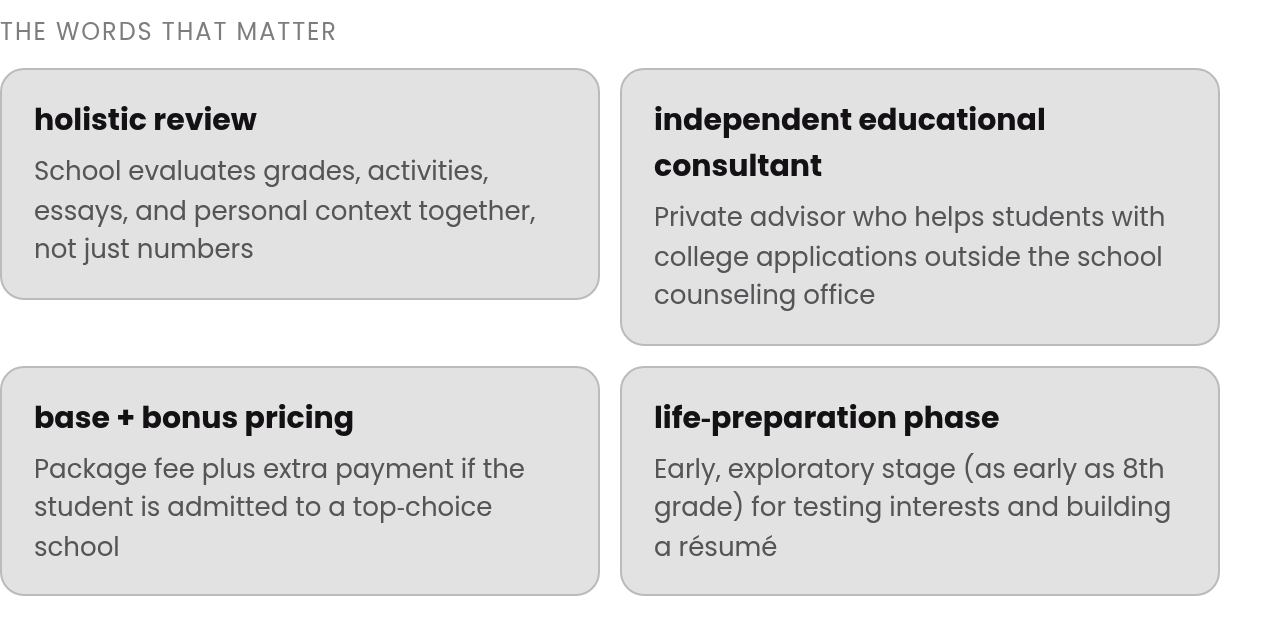
Most families use the phrase to mean a college admissions consultant who once read files for a selective school. That person belongs to a wider group called independent educational consultants, who advise students privately rather than through a school counseling office. Former readers are one slice of that field. A useful slice, but a slice.
What can a former admissions officer bring to an application?
A former reader often understands holistic review from the inside. Holistic review means a school weighs grades, activities, essays, and personal context together instead of ranking applicants by numbers alone. Having sat on that side of the desk tends to show up in a few places, including:
- Choosing between early rounds, which give a faster answer and are sometimes binding, and regular rounds
- Essay and supplement feedback that anticipates how a reader will react
We hold one firm line here. Former officers should never share confidential committee discussions, proprietary scoring details, or private applicant records from a past employer. If a consultant promises "inside numbers," walk away.
A single title is only one perspective. At Endurable Education, we don't treat one person's résumé as the whole strategy. We want a student's file read with enough distance that weak framing, overemphasis, or missing context gets caught before it's submitted.
Day-to-day work, from ninth grade to submission
A ninth grader asking whether to quit band for debate is having a very different conversation than a senior trimming an activity list for the Common App. A good college admissions consultant knows which conversation is on the table that week.
In the life-preparation phase, which can start as early as 8th grade, the pace is slower and more exploratory. We help students test interests, drop commitments that feel hollow, and go deeper on the ones that keep pulling them back. We also start a running résumé timeline early, so nothing meaningful gets lost by junior year.
We skip the polished-narrative talk at this stage. A fourteen-year-old needs room to change direction. Locking in a "brand" that early tends to produce a junior who is bored by her own story.
What changes once applications open?
The pace tightens once a student moves into the application phase. Check-ins get more frequent and more concrete. We read essay drafts line by line, revise activity descriptions for clarity, and run mock interviews so students hear how they actually come across.
Line-by-line feedback is where former readers earn their keep. They tend to flag sentences that sound coached, because a highly polished essay that clashes with the rest of a file can raise eyebrows rather than impress. A seventeen-year-old who writes like a magazine editor in one essay and like a teenager everywhere else is sending mixed signals.
That's also why AI-drafted essays concern us. A tool can smooth your prose. It can't tell you whether the essay still sounds like you.
Panels, school counselors, and solo consultants: an honest comparison
A senior emails her school counselor about a supplement, the school-specific essay many colleges ask for on top of the main one. The reply comes days later, because that counselor is also handling schedule changes, transcripts, and students in crisis. That isn't a failure. That's the job.
School counselors carry a huge range of student needs. A private college admissions consultant can focus on application strategy, essays, and how a student's story reads to a stranger. Solo consultants and panels both work in that narrower space.
A panel adds structured disagreement. One advisor may notice that an essay's emotional center is buried in the third paragraph. Another may question whether the activity list is pulling its weight. We won't claim that structure guarantees better outcomes. It's a different model. If you already have strong counselor access and a clear story, it may be more than you need.
AI fills the gap unevenly
The equity problem is worth watching. Research on admissions essays points toward lower-SES applicants leaning harder on LLM tools where coaching is scarce, which researchers read as possible substitution rather than proof.
That doesn't make AI useless. It can help a student spot clunky phrasing, tighten a sentence, or compare two versions of a draft. The limit is that software doesn't know the student's school context, family responsibilities, recommendation letters, or what a particular college is prioritizing that year. It can improve the surface of an essay and leave the application strategy exactly where it was.
How base + bonus pricing works, and what to ask
A parent gets two quotes in the same week. One is an hourly rate. The other is a package price with a bonus attached if the student gets into a top choice. Which costs more? Without the fine print, nobody can say.
We treat pricing as part of the advice. A college admissions consultant may bill hourly, charge a flat package fee, work on retainer, or tie payments to milestones. Each model can be fair. Each can hide surprises.
A base fee plus a bonus works like performance pricing in other professional services. It can align incentives, and it can also blur them. Ask how "success" is defined, what triggers the bonus, whether there's a cap, and what you owe if the goal isn't met.
What should a college admissions consultant's base fee cover?
Ask for written fee disclosures, payment timing, cancellation and refund terms, and any bonus conditions. Then confirm the base fee spells out the actual work, starting with:
- Essay guidance for the main essay and school-specific supplemental essays
The agreement should also say what happens between meetings. Who reviews drafts? How is feedback delivered? Are activity-list revisions or interview prep included, or billed separately? If a firm won't put those terms in writing, keep looking.
The bottom line on hiring a former admissions officer
Two consultants both list "former admissions officer" in their bios. After the first call, one sends a phase-by-phase plan. The other sends a promise. That difference tells you most of what you need to know.
Run this checklist before you sign with any college admissions consultant, including us:
- Verify the credential. Ask which school, which years, and what kinds of files they read. A real former reader answers without hesitating.
- Ask who touches the file. It could be one advisor, a panel, or a junior staffer working under a well-known name.
- Get the process in writing. You should see phases, deliverables, and who does what. The student writes the essays.
- Test communication. Ask how fast replies come in October, and through which channels.
- Match the timeline. A student still exploring interests needs a different plan than one finalizing applications.
A guarantee is the clearest red flag
Walk away from anyone who promises admission. No outside advisor controls a committee's decision. Results claims deserve the same scrutiny. When we give results numbers, ask us how we count, just as you'd ask anyone else.
If that's the kind of conversation you want, book a discovery call with our team. Bring your hardest questions.
References
[1] Translating Authentic Selves into Authentic Applications - https://www.researchgate.net/publication/375103215_Translating_Authentic_Selves_into_Authentic_Applications_Private_College_Consulting_and_Selective_College_Admissions
FAQ
Can a former admissions officer tell me how a specific college scores applications?
A former admissions officer can explain broad admissions logic and help you understand how your materials may be interpreted. They should not claim to know or provide a private scoring formula for a particular college. If the sales pitch depends on secret access, treat that as a warning sign.
Is it risky to use AI to polish my college essay?
It can be risky if AI starts making choices for you instead of helping you revise choices you have already made. Use it cautiously for cleanup, not for deciding the story, tone, structure, or substance of the essay. Before submitting, read the draft aloud and ask whether you would actually say it that way.
Do I still need a private consultant if my school counselor is responsive?
Maybe not. If your counselor has time for detailed essay feedback, you understand your college list, and you can manage deadlines without extra structure, private support may be unnecessary. At Endurable Education, our panel model is designed for families who want more intensive review, but it is not the right fit for every student.