What “College Humbled Me” Really Signals About Prestige, Pressure, and Fit
October 28, 2026

In short: Across 26 countries and 103,558 15-year-olds, higher school-average achievement lowered students' academic self-concept in every country studied. That pattern appeared in 41 countries and held up in follow-up research. Researchers also link academic self-concept to later coursework choices and attainment. On the prestige side, former rankings insider Jeff Selingo says schools ranked #40 and #60, or even #40 and the 80s, differ far less than families assume. And while elite acceptance rates keep falling, the average American college admits 65% of applicants.
What "College Humbled Me" Really Means
A student who topped her high school's calculus class enrolls at a highly selective university. By midterms she's sitting in the middle of every curve. Her grades are fine. Her confidence is not. When she tells friends "college humbled me," what she usually means is that she's no longer the smart one in the room.
So the "college humbled me" meaning is often less about failure than it sounds. More often it marks a collision between what a family expected prestige to deliver and how well the school actually fits. Our advice is to plan for that collision before senior year, not after move-in. Let fit lead the decision, and let rank break ties.
Why Does a Selective School Make Capable Students Feel Smaller?
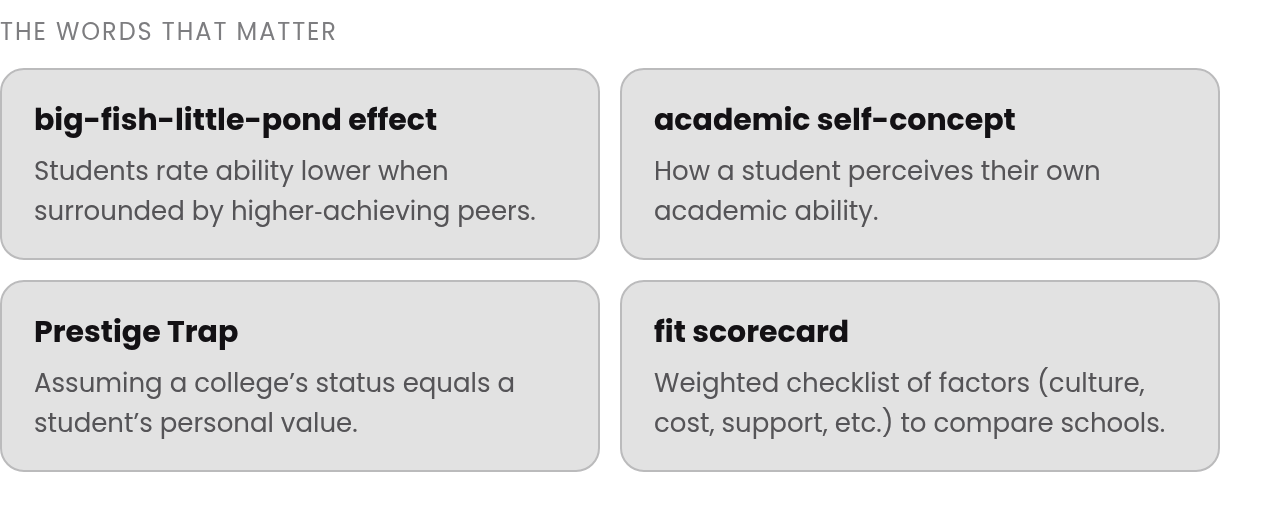
Psychologists call it the big-fish-little-pond effect. Put two equally able students in different schools, and the one surrounded by high achievers tends to rate her own ability lower. The one in an average peer group tends to rate it higher. Same student, different pond. The dip is a predictable comparison effect, not evidence that a student doesn't belong.
The finding is remarkably consistent. In a 26-country study of 103,558 15-year-olds, the effect of school-average achievement on self-concept was negative in every single country. Their review of the evidence connects academic self-concept to later coursework choices and attainment.
One limit we flag for every family: those data come from secondary schools, not colleges. We read them as a strong signal for what can happen on a selective campus, not a direct measurement of it.
Are Families Overreading the Prestige Gap?
Often, yes. As applications surge and acceptance rates at the most selective schools fall, many families narrow their list to a handful of elite names. Status tends to drive that list more than fit does. Jeff Selingo, who worked on rankings early in his career, says there's little real difference between schools ranked 40 and 60. The number looks precise. In the middle of the list, it mostly isn't.
Parents still push toward the brands, afraid that stepping away will cost their child something. One counselor names this the "Prestige Trap", where a school's status gets fused with a student's sense of worth. Stack the pond effect on top of that, and an ordinary dip in confidence can start to feel like an identity crisis.
Selingo's broader argument is that finding the right fit may matter far more than chasing prestige. That's a separate question from self-concept, but the two point the same way. Class size, access to professors, and campus culture tend to tell you more about a student's daily experience than a rank does.
None of this means every student should avoid selective schools. Some students genuinely love being stretched. Others need a program only a few campuses offer. For them, the humbling can be worth it. We just want it to be a choice your family makes on purpose, not a default.
When the Famous Name Makes the Decision for You
Your family holds two acceptances. One comes from the better-known university. The other comes from a college with the stronger advising model for your student's intended major. The famous name feels like the responsible pick, so the decision gets made before anyone compares classrooms, office hours, or who the classmates will be. That reflex is often where a student's "college humbled me" story gets written in advance.
The rankings gap behind that reflex is usually thinner than it looks. In the same Harvard EdCast conversation, Selingo describes the middle of the rankings as far less precise than families believe. It's a crowded, noisy signal, not a clean ladder.
Rank Buys a Smaller Edge Than the Pond Costs
To be fair to the famous name, a higher-ranked school can offer real advantages: strong classmates, deep course catalogs, respected faculty, a powerful peer network. Nobody's disputing that those exist. The question is whether, for your particular student, they're large enough to outweigh feeling perpetually average in a room full of academic outliers.
The pond research gives families a useful warning here. Peer context changes how students read their own ability. So the practical question is simple, if uncomfortable: is the prestige bump worth the confidence tradeoff?
The research doesn't say selective environments are bad for every student. It says the self-comparison cost belongs in the decision, rather than being discovered in October of freshman year.
Prestige Turns a Predictable Dip Into a Verdict
Line those two ideas up and the trade can get lopsided. Choosing a school mainly for a small rankings edge may mean accepting a real change in how capable your student feels day to day.
It gets harder when a family has absorbed the Prestige Trap, which the Challenge Success counselor describes as "the deep, ingrained assumption among students that the prestige of their chosen college is somehow interchangeable with their value as a human being." Under that belief, a normal adjustment period stops looking normal. It reads as proof the student never belonged.
That's why we have families compare class sizes, professor access, advising, major flexibility, and where the student would likely land among peers before rank enters the conversation at all. When two schools are broadly comparable on reputation, rank has earned a vote. It hasn't earned the first one.
Building a Fit Scorecard Instead of a Rank List
It's April. Two admission letters sit on the kitchen table, and the only number anyone has written down is each school's rank. We ask families in that spot to set the rank aside for one evening and build a scorecard instead. That hour can shape what "college humbled me" means for a student two years later: a normal adjustment, or a crisis of confidence.
Rankings feel like a shortcut for a reason. Selingo points out that families face a sprawling, often confusing market, and many reach for rankings just to get some clarity. A list can organize a search. It can't tell you which campus fits your kid.
Set Your Weights Before You Read Any Ranking
Score each school from 1 to 5 on every row, then multiply by a weight your family agrees on in advance. Agreeing on weights first keeps a rank from quietly overriding everything else.
| Factor | What to check | Your weight (1 to 3) |
|---|---|---|
| Academic alignment | Depth in the intended major, access to upper-level courses, ease of switching majors | |
| Campus culture | Collaborative or cutthroat, class size, how students describe pressure | |
| Support services | Advising, tutoring, mental health access, professor availability | |
| Cost and resources | Net price after aid, funding for research or internships | |
| Long-term pathways | Mentoring, sustained project work, regional job connections |
A note on the cost row: net price is what your family would actually pay once grants and scholarships come off the sticker price. It's rarely the published cost of attendance, and it's the number that belongs on the scorecard.
Then add one ranking-context prompt. If one school wins the scorecard but loses on prestige, what exactly would the more prestigious school need to offer to change your mind? If nobody at the table can name a concrete advantage, the ranking is probably doing too much of the work.
Ask How Each Pond Will Feel From the Inside
The last prompt is about confidence. Academic self-perception is shaped by the surrounding peer group, so ask your student directly: where would I likely sit among these classmates, and how would I handle being in the middle?
One caution. The pond research tracked younger students, so use it to generate questions, not to predict college outcomes. Challenge Success's work on the prestige trap adds a useful counterweight: post-graduation wellbeing tends to follow what students do in college, like mentor relationships and sustained projects, more than where they enroll. We see the two findings working together.
If your student has already thrived in the middle of a strong cohort, skip this prompt. They've answered it.
The Bottom Line on "College Humbled Me": Review Fit After Every Letter
A binding early decision application (one where the student commits to enroll if admitted) comes back in December as a deferral, meaning the school will reconsider it alongside the regular applicant pool. By dinner, your student is asking what's wrong with them. For many families, that evening is when the "college humbled me" meaning first takes shape, months before move-in day.
Usually, nothing is wrong. Selingo puts it bluntly on the Harvard EdCast: "There's nothing that has a high fidelity when it comes to the signal of what any of these pieces of the application have." A low-signal outcome deserves a fit review. It doesn't deserve a verdict on your child. We suggest running the checklist below after every acceptance, denial, deferral, and aid letter.

What Belongs on a One-Page Fit Review?
Print this and fill it in for each school still on the table.
- Academic alignment: Does the school teach your student's intended subjects in a way that suits how they learn?
- Campus environment: Would they still choose this place with the name covered up?
- Support: Who is their first call when a course goes badly? Look for named advisors, tutoring, and real office hours.
- Cost: What does the family actually pay after aid, and what does that trade away?
- Pathways: Which projects, mentors, and internships can they reach in year one?
- Prestige check: Is rank breaking a real tie, or making the decision?
Parents, keep the conversation on choices. Selectivity is one feature of a school, not the goal. Your student needs a place where they can learn, recover from setbacks, ask for help early, and see themselves fully part of campus life.
Will This Peer Group Build or Erode Confidence?
Ask your student one reflection question: in this classroom, would I feel stretched, or would I feel small?
The pond effect can last beyond the first weeks. Still, their work describes averages. It can't forecast how one particular student will respond, which is why the answer belongs to your student, not to a study.
Skip this question for a student who has thrived for years among high achievers and wants more of that. And don't use it to talk them out of a reach school, the kind of long-odds application that's worth sending when the fit is genuinely there.
References
[1] The Pressure to Chase Prestige in College Admissions - https://www.gse.harvard.edu/ideas/edcast/26/03/pressure-chase-prestige-college-admissions
[2] For students choosing college, it takes a village to avoid the 'Prestige Trap' - https://www.challengesuccess.org/for-students-choosing-college-it-takes-a-village-to-avoid-the-prestige-trap/
[3] Big-fish-little-pond effect on academic self-concept. A cross-cultural (26 ... - https://pubmed.ncbi.nlm.nih.gov/12971085/
[4] (PDF) The Big-fish–little-pond-effect Stands Up to Critical Scrutiny - https://www.researchgate.net/publication/225776264_The_Big-fish-little-pond-effect_Stands_Up_to_Critical_Scrutiny_Implications_for_Theory_Methodology_and_Future_Research
Frequently Asked Questions
Does feeling humbled in college mean my student chose the wrong school?
Not automatically. It may mean the student has moved from being one of the strongest students in one environment to being surrounded by many similarly strong peers. Pay attention to what happens next: do they still ask questions, visit office hours, join projects, and recover from disappointing grades? If yes, the humbling may be part of healthy adjustment rather than a sign of mismatch.
Does the big-fish-little-pond research actually apply to college students?
Use it carefully. The evidence is best treated as a lens for thinking about peer comparison, not as a college-specific forecast. It can help families ask better questions during selection: how competitive will the classroom feel, what support exists, and has the student handled similar environments before?
Should a high-achieving student avoid highly selective colleges altogether?
No. A selective school can be the right pick when the student understands the tradeoff and wants that environment. The concern is not selectivity itself; it is choosing prestige by reflex, then being surprised when the student no longer feels exceptional.
What should we do if an early decision application gets deferred?
Treat a deferral as a cue to revisit fit, not a verdict on your child. A deferral means the college has postponed its decision and will review the application again later. Recheck support, cost, academic alignment, and peer environment for every school still on the table.