Ex-Admissions Officer vs Four-Year Counselor: Who Reads Your Kid Right?
September 23, 2026

Who's actually reading your child's file, and what they're paid to care about
The person advising your child sees the application through a specific lens, and that lens shapes every recommendation they make. So the first question isn't "how good is this advisor?" It's "what is this advisor built to notice, and what are they paid to do?"
Three common options: a former admissions officer, a four-year high school counselor, and an independent team. Each one reads a student through a different set of priorities and a different set of incentives.
When you hire guidance, you're not just buying technical knowledge. You're buying the motivations that decide how that knowledge gets used. Whether feedback comes back candid, cautious, or genuinely built around your kid depends a lot on how the advisor gets paid.
Why does the advisor's incentive matter as much as their resume?
Follow the money and you'll usually find the advice. Some independent consultants collect a flat fee whether a student aims for an ambitious reach or a likely safety. High school counselors typically work on district salaries with no direct connection to a single admissions result, and many juggle large caseloads. Both can be sincere. Some fee structures do not put the advisor's pay at risk if a family is dissatisfied.
We describe our practice as the other way around. Our team uses a base-plus-bonus structure with a happiness guarantee; we describe the bonus portion as designed to land only when a family is genuinely satisfied with the work. We describe base rates as accessible. As we describe it, that structure gives us a professional stake in thorough, attentive work from the first meeting to the last submission.
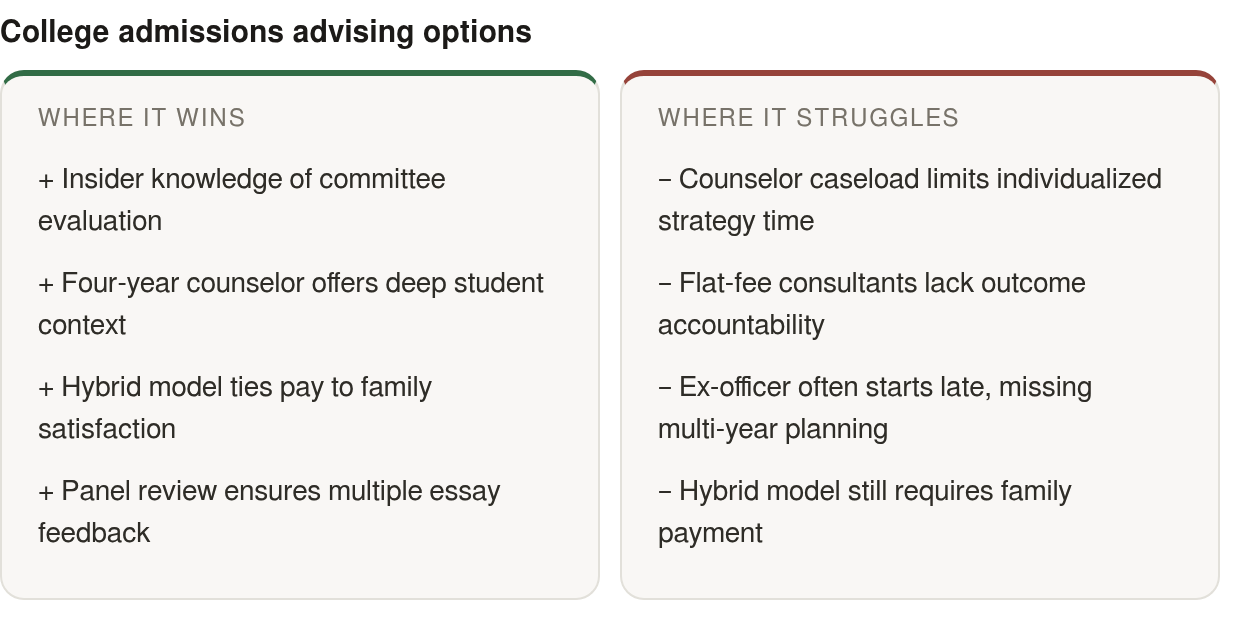
Those differences show up in the primary lens, student load, incentive alignment, and financial risk. A former officer may read files with an admissions-committee lens; a counselor may carry a long-term student-growth lens; a panel-based service may try to combine both. Caseloads and pay structures vary.
According to the IECA, school counselors often work at caseloads near 400 students each. These are committed people. But volume like that can set a hard ceiling on how much individual attention any one applicant can get.
What happens when advice and student don't match?
Mismatched guidance can be expensive in both years and dollars. Aiming at a poor-fit college tier or misreading a student's competitiveness may lead to transfers, delayed progress, or merit aid that does not materialize. Sizing up each advisor's strengths and limits before you commit can help keep the investment pointed at the child's actual goals.
The short version: incentives can steer counsel as much as credentials do. District counselors may carry caseloads that make deep, individual strategy difficult. Some solo consultants work on fixed retainers with little formal accountability for the family's satisfaction. Families often weigh committee evaluation, high school context, and aligned consulting when targeting selective admissions.
What ex-admissions officers actually see when they open a file
A former admissions officer may read the way a committee reads: fast, holistic, and pattern-aware. Some have screened many files under real volume pressure and may know how an application can be sorted quickly.
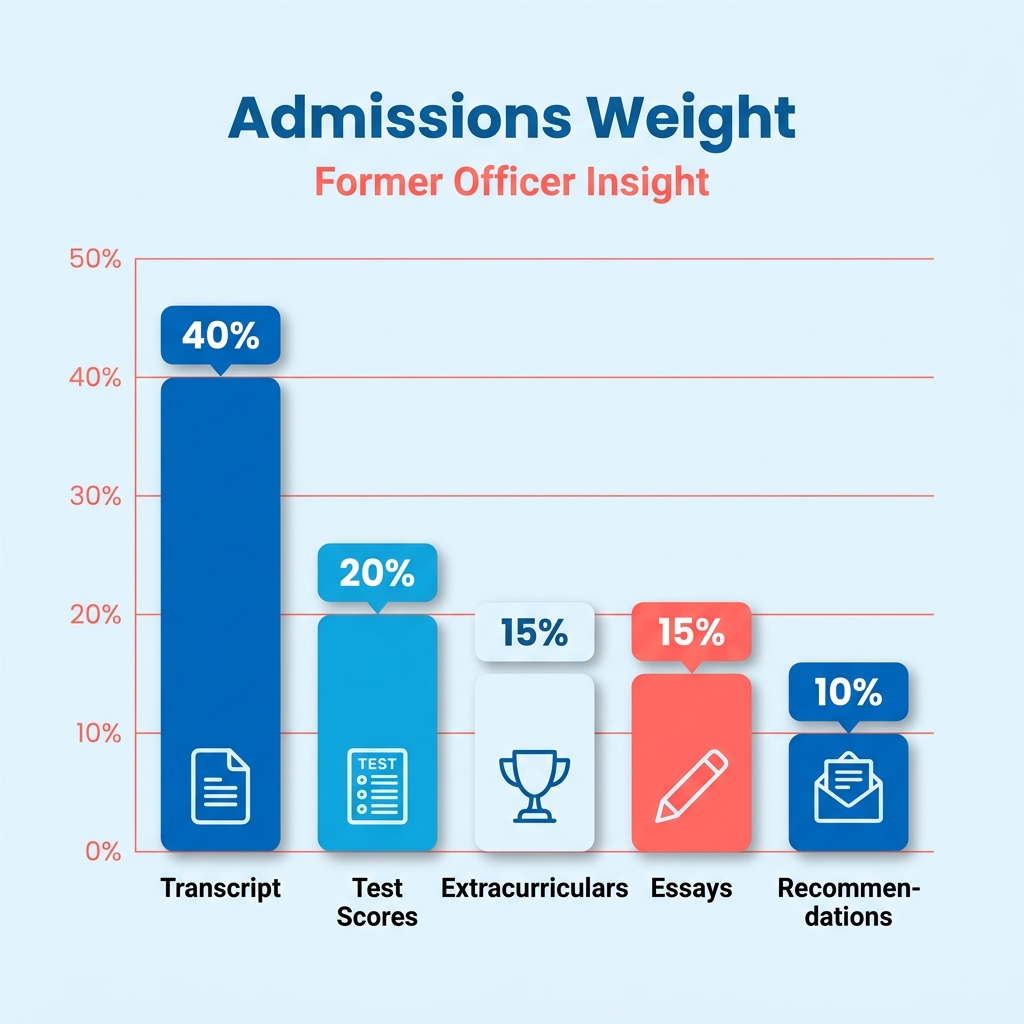
Holistic review generally weighs academic performance against institutional priorities for that year. The transcript often does the heavy lifting because it shows four straight years of rigor, not one Saturday morning of testing. Essays, recommendations, and the depth of a student's activities fill in the story that separates one strong applicant from the next.
What the insider lens actually notices
Some former officers look for consistency. They may catch the gap between what a student claims and what the transcript shows, like an applicant who says they're bound for scientific research but dropped lab sciences after tenth grade. They may spot recommendation letters full of warm, generic praise and zero classroom specifics. And they may recognize an essay that has been sanded down by an adult editor.
When two applicants show up with the same grades and the same test percentiles, these quiet signals can decide it. A profile that tells one clear, honest story often beats an application that reads like a checklist of activities.
An insider's critique only helps when they're paid to be blunt. Because we describe our compensation as tied to family satisfaction rather than a retainer collected up front, our advisors aim to name the real weaknesses in a file instead of handing out polite reassurance.
The ex-officer perspective often pays off most when a student is aiming at highly selective schools and needs precise, unvarnished feedback on how a committee may read the story.
What four-year counselors know that no one else does
A school counselor watches a student grow up. Four full years of academic and personal change can give them context nobody else has. They may understand why grades dipped freshman fall or why a passion showed up late, and they translate that into the official school report.
The limit isn't skill. It's bandwidth. As the IECA points out, school counselors often work at caseloads near 400 students each. At that volume, college strategy may have to fight for time against everything else on the desk.
What does a counselor actually manage across four years?
The daily load can run long: graduation audits, standardized testing logistics, crisis counseling, scheduling conflicts, general academic support. College planning may be one item among many state-mandated duties. Detailed, school-by-school positioning can fall outside what a district counselor can realistically deliver.
Independent consulting may fill that gap by spending its hours on college strategy alone, shaped around a specific student's milestones and target programs.
The tradeoff is often described as a student-load and cost difference: counselors are district-paid and carry broad duties; independent consultants charge families directly and focus on college strategy. We describe our model as a panel-based, customized planning service with a base-plus-bonus fee.
Endurable Education: pairing the committee read with the four-year view
Lean on one perspective and the gaps can show. A solo former officer may sharpen the final evaluation but may not have a multi-year runway to build from. A school counselor often has the long view but constrained hours for intensive coaching. We describe our model as stitching the two together, with advisors from schools like Harvard, Yale, and Princeton alongside full multi-year academic roadmaps.
We describe a collaborative review setup in which essays and application pieces are read by at least two team members. Narrative, tone, and positioning are vetted before submission.
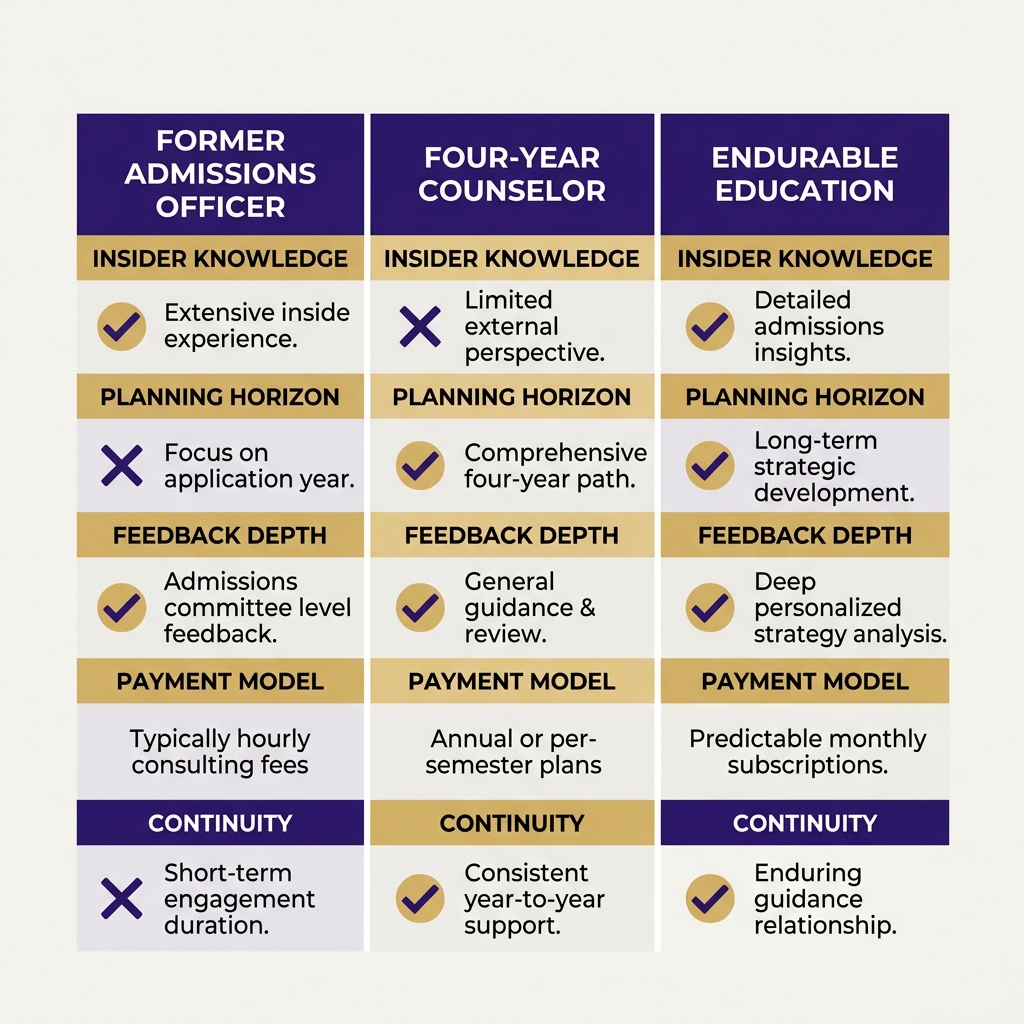
How does our base-plus-bonus model change the incentive math?
Some consulting pay structures can bend advice in a particular direction. Contingency-based models may create an incentive for consultants to steer students toward safer lists. Non-refundable flat retainers can pay an advisor in full regardless of how thin the support turns out.
We describe our two-tier structure as intended to reduce that tension. The base is described as covering steady, rigorous multi-year mentorship and application review. The bonus is tied to how satisfied the family is. We say that creates an incentive to support an ambitious reach strategy while staying accountable through the process.
Ex-admissions officer vs four-year counselor vs Endurable Education, side by side

Put the options next to each other and the tradeoffs get concrete: institutional access, strategic depth, accountability.
Once you see how each option handles review bandwidth and pricing, it's easier to spend your money where it counts.
How do the three perspectives compare head-to-head?
| Criterion | Ex-Admissions Officer | Four-Year Counselor | Endurable Education |
|---|---|---|---|
| Insider knowledge | High, from reading files firsthand | Low to moderate | High, as described |
| Planning horizon | Often one cycle | Often four years | Multi-year arcs |
| Feedback frequency | Cycle-based | Limited by caseload | At least two reviewers per essay (as described) |
| Incentive alignment | Flat or hourly fee | Salaried by the district | As described: base plus bonus, satisfaction-linked |
| Ideal student profile | Late-stage applicants polishing a file | Any enrolled student | Families wanting insider read plus planning |
District counselors offer neutral, community-based academic tracking. Private advisors often provide concentrated strategy built around competitive targets. Different jobs.
Which one fits your family?
A standalone former officer may be the right call for a senior who already has a fully built profile and just wants a final institutional gut-check before hitting submit.
If what you want is frequent essay feedback and a custom-built school list, public school caseloads often cannot hold weekly strategy sessions. That's not a knock on counselors. It's arithmetic.
We describe our collaborative model as running multi-year development next to serious file critique, with advisor effort tied to satisfaction milestones so the incentives point the same way you do.
Same student, three different endings
Composite scenarios make the differences easy to see, so picture two juniors with nearly identical credentials: top of their class, strong leadership in one activity, both aiming at highly selective schools.
Same student, three different endings
With a counselor only, the student gets a warm, supportive recommendation. But with advising time stretched thin, the college list may drift toward familiar regional names. Solid safety admits, reach applications that never got optimized.
With a senior-year former officer only, the essays may come out sharp and well positioned. Yet since the work started late in junior year, the activity record may lack the multi-year build that selective committees look for. Strong essays, thin resume.
The path that pairs early profile planning with panel-based essay review lets the student build real academic depth over several years and land a competitive, well-supported reach strategy.
The incentive behind each ending
Advising relationships tend to hold up when accountability is baked into the structure, not just promised in a meeting. Salaried roles and standard flat retainers can roll forward regardless of how the family feels about the work. Tying pay to satisfaction, as we describe, is intended to sustain engagement through every phase.
You can read more about how we think about all this on our planning blog.
When to lean on each perspective
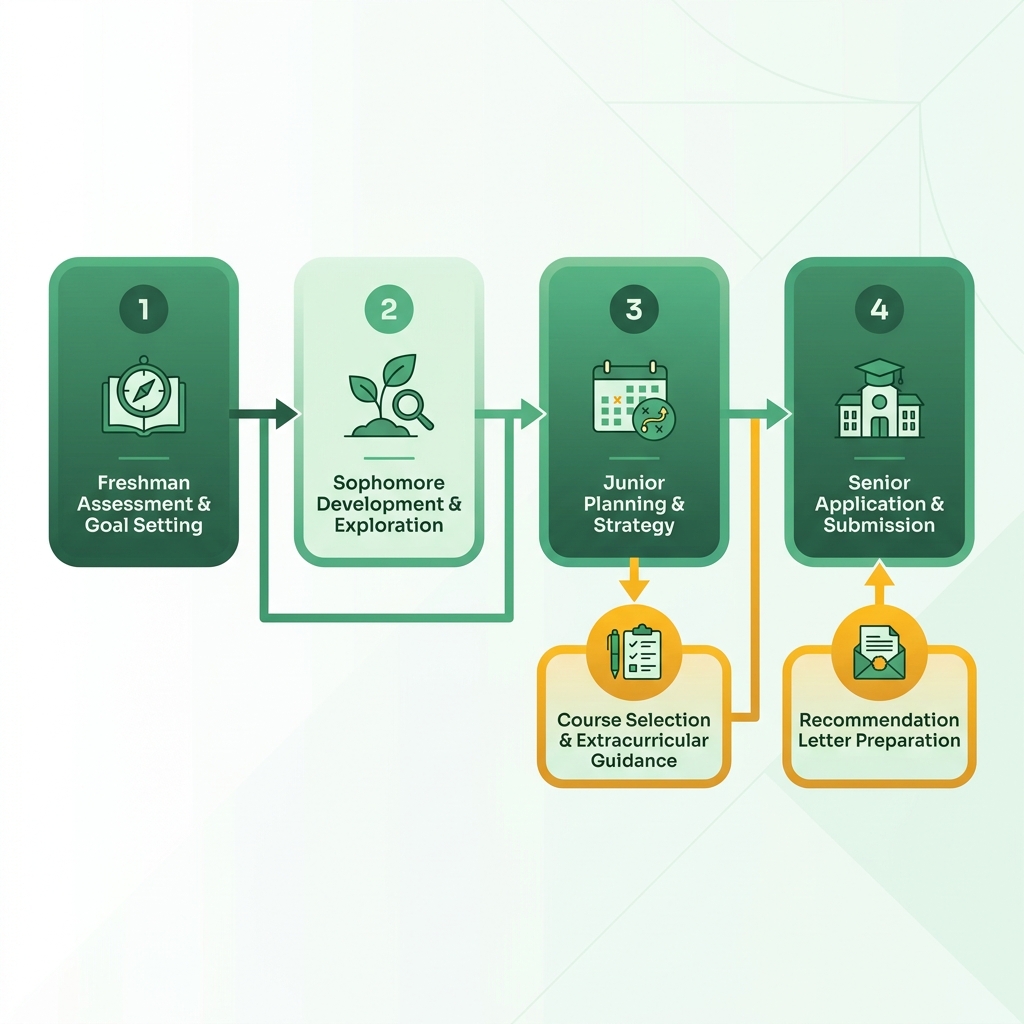
What a student needs changes as they move through high school. The early years call for long-term curriculum and activity planning. Senior year calls for intensive narrative work and interview prep.
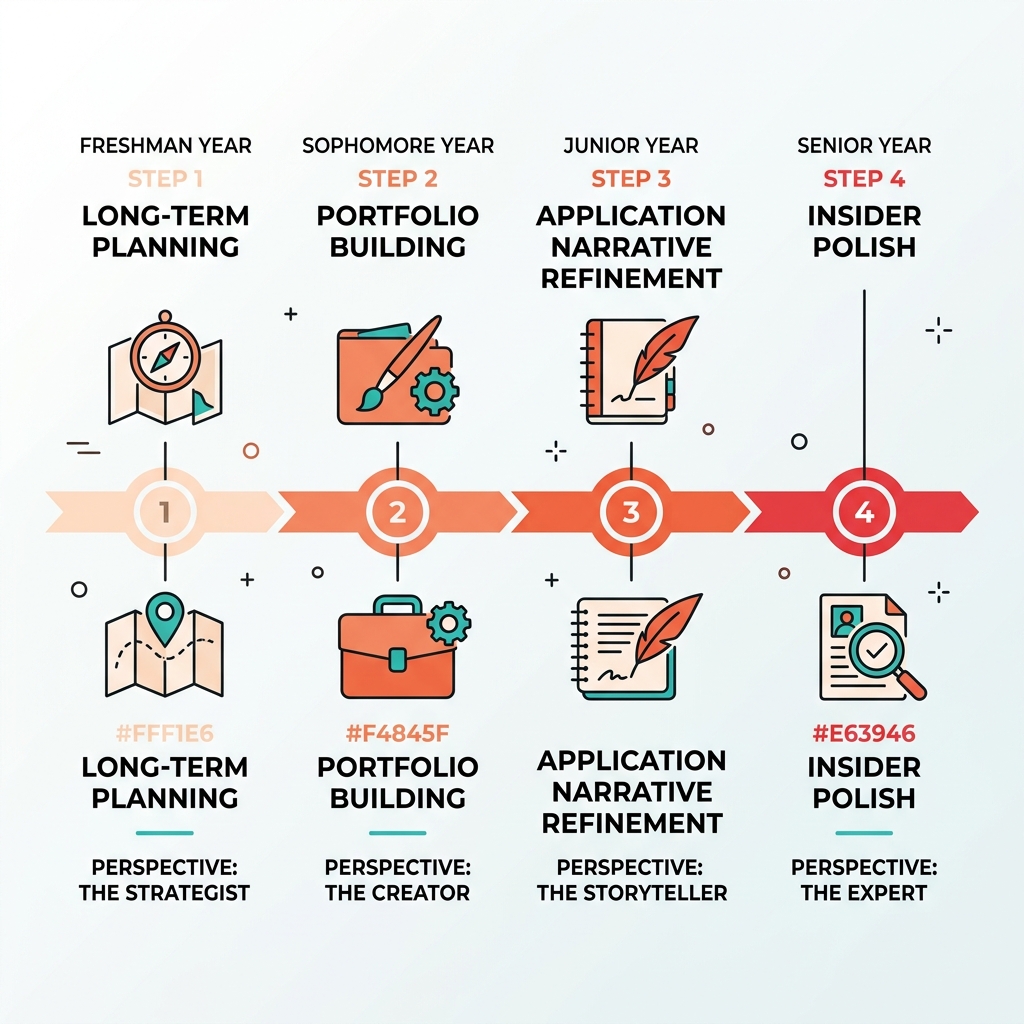
When does each perspective earn its keep?
The school counselor often stays essential the whole way through, for curriculum management, transcript accuracy, and the counselor recommendation letter.
Specialized admissions insight can earn its keep during narrative development, supplement strategy, and interview prep, the spots where subjective committee judgment often decides things.
We describe our work across both stretches: multi-year mentorship to grow genuine intellectual curiosity early, then rigorous review when the final submissions get built.
Is a hybrid approach worth the cost?
Aiming at schools with broad acceptance rates and clear score cutoffs? Standard school counseling may be plenty. No need to pay for more.
Dedicated private advising can start to earn its cost when the targets are highly selective, where essays, holistic factors, and careful narrative positioning can be especially important.
Pairing school support with an accountable private framework may let a family keep the institutional advocacy while adding focused strategic guidance on top.
Getting three voices to say the same thing
The strongest admissions plans often line up the counselor's school context, the insider's evaluative eye, and real project management into one coordinated effort.
Run several advisors at once and you need clear boundaries, or you may get contradictions. Uncoordinated feedback can leave students getting mixed messages about course loads and essay topics. A structured panel can pull the inputs into a single, workable roadmap.
How do you keep three advisors saying the same thing?
Set up a central timeline and assign clear ownership over each application piece. We describe our panel as handling pacing, tracking deadlines, and routing every written component through multiple reviewers before submission.
One caution: if a student is already on track, resist piling on outside opinions during the underclassman years. The money often works hardest in the high-impact windows: early curriculum planning and senior-year execution.
How to choose an advisor who's actually on the hook
Picking an admissions partner often comes down to two things: expertise and accountability. Some independent consultants on fixed contracts and salaried school staff work under different constraints, and not all link their pay to whether you end up satisfied.
We describe our base-plus-bonus structure as tying the two together, keeping the team invested in strong mentorship, serious essay review, and a well-built school list.
Which perspective actually protects your money?
How a firm structures its client commitments can tell you a lot about where your money stands.
| Factor | Ex-Admissions Officer | Four-Year Counselor | Endurable Education (as described) |
|---|---|---|---|
| Fee at risk if results disappoint | Not generally | Not generally | Yes, as described, via bonus + happiness guarantee |
| Advisor pedigree | Varies | Varies | Says advisors include Harvard/Yale/Princeton grads |
| Planning horizon | Often one cycle | Often four years | Says 8th grade onward |
| Review model | Often solo | Often solo, spread thin | Two-reviewer panel |
Two sets of eyes can catch what one set misses. We say each essay gets a full narrative and technical read before it goes out.
Who benefits most from this model?
We describe this framework as built for complicated profiles: international students decoding unfamiliar evaluation criteria, first-generation applicants learning the unwritten rules, and specialized talents whose commitments need careful presentation.
If you're aiming at selective national universities, the payoff often comes from early strategic planning plus rigorous, multi-perspective review of the file. Start the conversation early, and give the plan room to build.
References
[1] What Is an Independent Educational Consultant? - IECA - https://www.iecaonline.com/student-parent-information/what-is-an-independent-educational-consultant/
Frequently Asked Questions
If my child is a first-generation or international applicant, does this comparison still apply?
Non-traditional, first-generation, and international candidates can face distinct evaluation dynamics, including foreign transcript evaluations, differing school profile formats, and unfamiliar holistic criteria. Because high school counselors often support hundreds of students simultaneously, they may rarely have time to explain these institutional nuances, making structured private guidance especially impactful for some non-standard applications.
Does a former admissions officer's knowledge apply to schools where they never worked?
An ex-officer's deep knowledge of institutional priorities may apply most directly to the specific campuses where they evaluated files. When assessing other colleges, their primary advantage often lies in general committee literacy—understanding how readers skim files, what makes an essay stand out during fast reviews, and how selection panels weigh transcripts against qualitative materials.
Can I skip paid help entirely and just use my free school counselor?
For colleges with clear, index-based admission thresholds, high school counselors can provide sufficient guidance. Private advisory services may become relevant primarily when applying to highly selective universities where holistic admissions criteria can make narrative development, essay execution, and extracurricular framing important to the final decision.
What does a two-reviewer panel actually change compared to one advisor?
Relying on a single advisor can leave an application vulnerable to individual subjective preferences and blind spots. We describe a two-reviewer model in which one advisor evaluates overarching narrative flow and thematic impact, while another checks for clarity, tone balance, and technical execution across every supplemental submission.