Timing College Admissions Consulting Across Four Years: Freshman Courses to Senior Essays
September 22, 2026
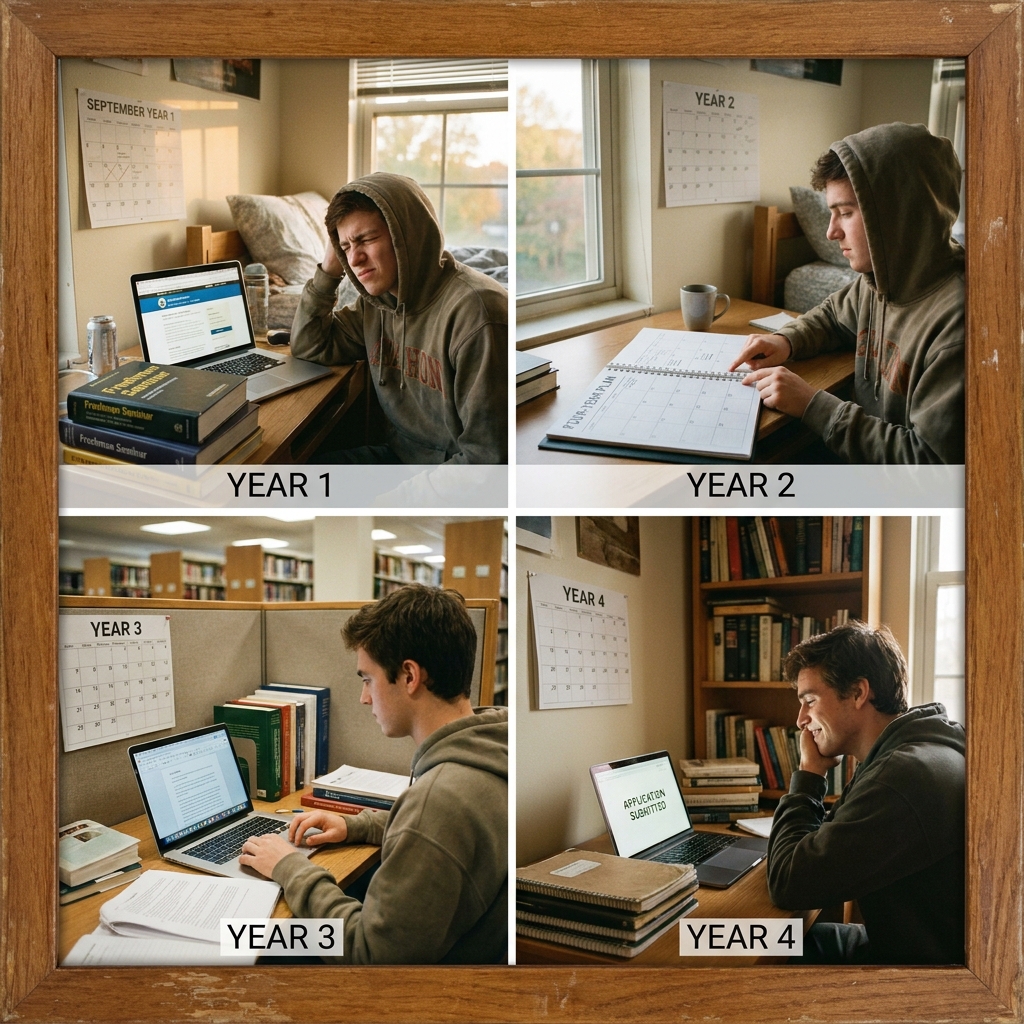
Key Takeaways
- Most of a candidacy is locked by junior year. There is no senior-fall window to invent a story early coursework never seeded.
- Freshman year is a light workload with outsized narrative value. Ninth-grade course choices become raw material for essays submitted three years later.
- Course rigor outweighs a spotless GPA. A B in an AP class often reads better than an easy A.
- Junior year is the heaviest stretch: spring SAT/ACT, rec letter requests by January, and a working list of 10 to 15 target schools.
- Senior applications spike around early action and early decision deadlines on November 1 to 15, then the May 1 deposit date.
Quick Summary
The whole four-year arc, in one sentence: freshman and sophomore course choices are not just academic prep; they shape the senior essay. Solid college admissions consulting treats ninth-grade course selection as the first draft of a story submitted three years later.
Why worry about it that early? Because the substance of a candidacy is mostly settled by junior year. As the team at InGenius Prep argues, by the time applications open, four years of grades and real depth in a few activities are already on the books. You cannot manufacture that in senior fall. The students who write the cleanest essays are usually those whose ninth-grade choices already pointed somewhere.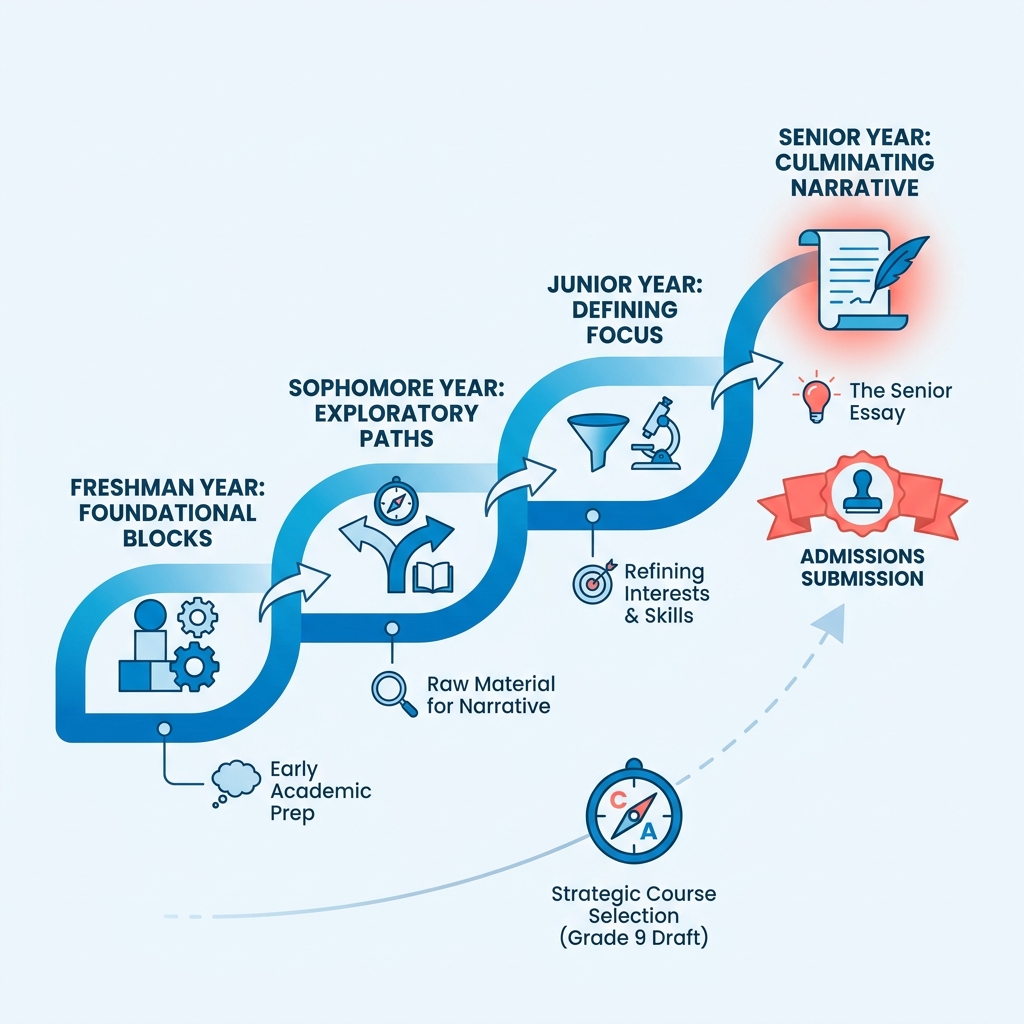
The Four-Year Timeline at a Glance
| Year | Consulting Focus | Key Milestones | Relative Effort | Difficulty / Priority |
|---|---|---|---|---|
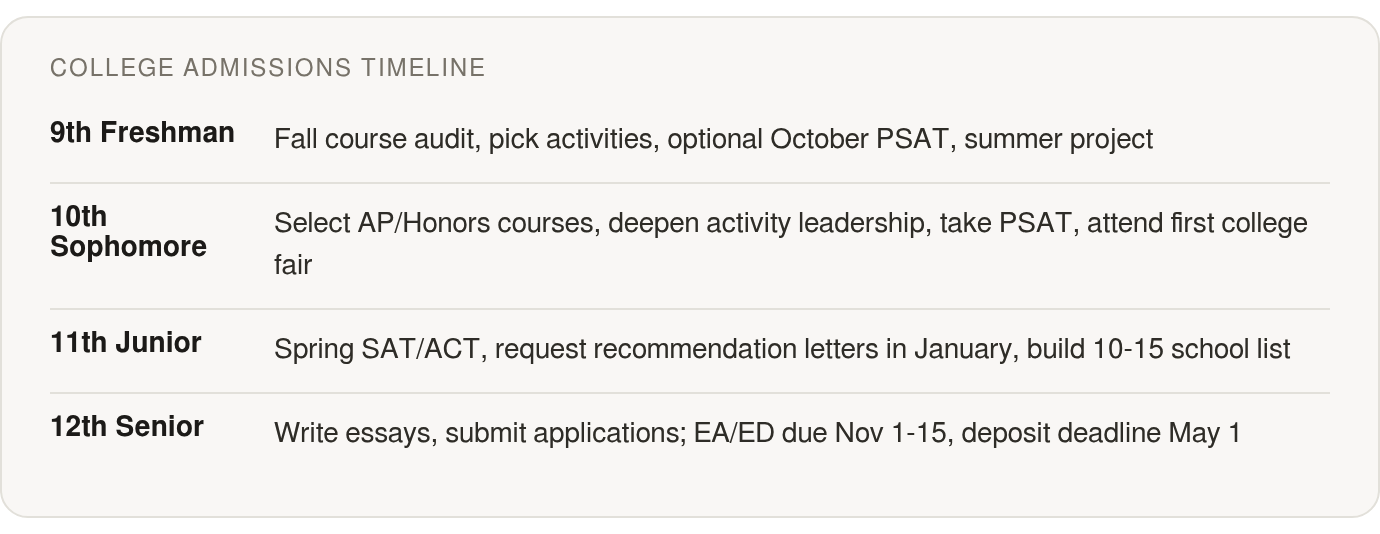
| 9th (Freshman) | Foundation + narrative seeding | Fall course audit; pick 2-3 activities to commit to; optional October PSAT; summer interest project | Light | 🟢 Low load, high use |
| 10th (Sophomore) | Exploration + rigor ramp | Strategic AP/Honors selection; deepen one activity into leadership; PSAT; first college fair | Building | 🟡 Medium |
| 11th (Junior) | Positioning + testing | SAT/ACT (spring), request rec letters, build 10-15 school list, major-aligned summer | Heavy | 🔴 High priority |
| 12th (Senior) | Execution | Essays, applications, EA/ED due Nov 1-15, financial aid, May 1 deposit | Peak | 🔴 Highest intensity |
The colors flag where effort pays off most. Freshman year sits green because the load is light but the narrative use is enormous. Junior and senior years turn red not because they matter more, but because that is when the earlier groundwork gets cashed in.
The Early Wins That Compound
The highest-return freshman moves cost almost nothing. Join a club tied to a possible major and stay with it, because a major-focused applicant needs one or two activities that genuinely prove that interest on the Common App's ten slots. Plan a summer around real curiosity, not a résumé line that dies after one season.
Rapid-Fire Takeaways
- Start now. As the Coalition for College puts it, you'll be less stressed the earlier you begin.
- Freshman grades count. They do reach admissions officers, so there's no throwaway year.
- Go deeper, not wider, with activities. Sustained commitment beats a longer list.
- Rigor over a perfect GPA. Colleges weight course rigor heavily; a B in an AP often beats an easy A.
- Test early, keep a retake in reserve. Register for a spring junior SAT/ACT, but hold one fall attempt open.
- Ask for rec letters in January of junior year. The ones who ask late find the list full.
One honest caveat: for the hundreds of colleges happily admitting strong B students, junior and senior years still hold real runway. This tight, early sequencing matters most when you're aiming at the most competitive programs in the country.
Why Timing College Admissions Consulting Matters
The competitive math is what makes timing the whole game. Admit rates at schools like Harvard, Stanford, and MIT keep sliding, and a strong senior transcript cannot rewrite three years of drift, as InGenius Prep's grade-by-grade guide lays out. That is the pressure good college admissions consulting is built to manage: not the senior-fall paperwork, but the years of choices that decide what the paperwork can even say. It's also why we split our service into a life-preparation phase and a college-application phase, sometimes starting as early as eighth grade.
This is where families lose ground. They treat consulting as a senior-year service and show up with a transcript full of solid but disconnected courses. We start earlier because the evidence for a senior essay has to be generated while the material is still fresh, and freshman and sophomore course selection is where that evidence gets planted or lost.
Early Timing Widens Options at the Top, Not Everywhere
Two respected voices disagree here, and the split matters. InGenius Prep argues the substance of a candidacy is mostly set by junior year. The team behind the 2025 rising-junior timeline counters that junior year is where the journey starts for real, and even a fall-semester senior can work the list without panic.
Both are right, depending on the tier. For the most hyper-selective schools, the story has to be seeded early or the runway is gone. For the hundreds of excellent colleges happy to admit a strong B student, real time remains in junior and senior year. Starting early does not foreclose those options. It keeps the top end open, and that's where our track record lives.
Course Choices Are Narrative Bets, Not Just Rigor
The smartest timing moves treat a course as a plot point. Subjects test best right after you finish them, so sequencing decides whether early academics become clean evidence or wasted effort. Which course a student takes when isn't a scheduling detail. It's a bet on the story the transcript will eventually tell.
The Activity Slot Problem Nobody Plans For
Activity lists reward focus. A major-focused applicant needs a commitment or two that genuinely support that major, and the Common App only gives you ten slots. The catch is that a one-off summer after freshman year rarely survives onto the final list.
So an early course choice only pays narrative dividends if it seeds a commitment that lasts long enough to earn its place. Deeper beats wider. This is the through-line parents underestimate most, and it's why we start mapping courses and activities together in ninth grade rather than sorting them in twelfth.
For families weighing whether structured guidance is worth it this early, our look at coaching yourself versus hiring help walks through the tradeoff honestly.
Freshman Year Foundations: Academic & Extracurricular Planning
The most useful thing we do in ninth grade isn't picking the hardest schedule. It's deciding which two or three threads a student will pull for four years. That's where college admissions consulting earns its keep early: not by inflating a freshman transcript, but by choosing courses and activities that can still be part of the same story in the senior essay.
The tension we work with: guides like the Coalition for College timeline stress that planning shouldn't wait until senior year. But a checklist doesn't make a narrative. Our job in freshman consulting is to connect those tasks so each one seeds the next.
How do we audit a freshman's strengths and interests?
Before we touch course selection, we run a real inventory. It starts with an initial consultation built to read each student's strengths, interests, and goals, and we lean on years of experience to catch signals a fourteen-year-old can't yet put into words.
That inventory isn't busywork. It gives us evidence for course choices the student couldn't articulate on their own. A curious-but-unstructured kid needs a different honors sequence than one who thrives on routine, and our planning is built around exactly those differences.
What should a freshman course load actually look like?
Rigor that survives four years beats rigor that peaks and collapses. InGenius Prep's grade-by-grade guide puts it bluntly: students who treat freshman year as a warm-up spend the next three years climbing out of a GPA hole.
So we sequence deliberately, building the ramp toward advanced courses over time instead of stacking a heavy load all at once. Jumping from a light schedule to a crowded AP slate is a hard adjustment for anyone, so we plan the progression early.
One caveat worth saying plainly: a non-STEM student has no reason to rush physics. Match the sequence to the story, not to a generic "hardest possible" default.
Which freshman activities actually reach the senior essay?
The Common App gives students a limited set of activity slots, and a major-focused applicant needs one or two that provide real evidence for that major. That's the whole game for early extracurriculars.
The trap is that the summer after freshman year rarely survives onto the final list. A one-off experience gets crowded out by three years of deeper commitment. So we plant activities that can grow into leadership, not résumé one-liners.
For families targeting the most competitive schools, this early planting matters, because an application builds over years rather than appearing overnight. If you want the longer four-year picture, our college admissions planning blog walks through how these threads compound.
Sophomore Year Strategy: Academic Rigor, Test Prep, & Early College Research
The sophomore move that pays off later isn't adding three AP classes. It's picking the one or two higher-level courses that feed the story a student started telling in ninth grade. College Essay Guy's grade-by-grade timeline says it plainly for tenth grade: if your school offers honors or AP, challenge yourself with one or two, in areas you actually care about. That last clause is where consulting does real work. We steer the rigor toward the thread, not the transcript.
Here's the sequencing logic most families miss. Material is easiest to demonstrate while it's fresh. Sara Harberson, a former Penn associate dean of admissions, describes her own sophomore son weighing AP Chemistry over AP Physics precisely because his Honors Chemistry was recent. Her flip side matters just as much: a humanities-bound student has no reason to rush physics. Take AP Physics senior year, enjoy Honors Chemistry now. That's not laziness. It's protecting space for the courses that build the narrative.
How much rigor is the right amount in tenth grade?
Enough to build a runway, not a cliff. Harberson's sharpest warning is against jumping from zero APs in tenth grade to five in eleventh. That leap is brutal for anyone, and admissions readers see the seam.
We map the climb instead. One or two honors or AP courses sophomore year, weighted toward the intended field, sets up a believable escalation into junior year. The Coalition for College timeline frames tenth grade as taking rigorous courses and doing your best, then layering in test awareness. Steady beats sudden.
When should test prep and the PSAT actually start?
Sophomore fall is for the PSAT as practice, not pressure. Some schools let tenth graders sit the October PSAT, and treating it as a diagnostic tells you where SAT or ACT prep should aim next year.
On the test itself, two respected voices split. Harberson favors registering for an SAT or ACT in March or April of junior year to clear it before AP exams. Khan Academy's master timeline notes that some students test more than once, with a final attempt in early fall of senior year to capture new coursework. We use both: front-load an early junior attempt, keep one fall retake in reserve. Sophomore year, the job is just building the reading and math base that makes either plan work.
What does early college research look like at this stage?
Attend a local college fair. Visit a campus or two on a family trip. Start a simple interest cluster list of what subjects, settings, and majors keep pulling you back.
The narrative test is stricter than the checklist. Activity slots are limited, and the summer after freshman year rarely earns a spot on the final list. So sophomore-year choices have to seed commitments that last. If a research lab or mentorship this summer cannot still be talked about in senior fall, it is not building your story.
Junior Year Development: Narrative, Recommendations, & College Visits
Junior year is when the story you seeded in ninth and tenth grade finally has to write itself down. The essay brainstorming, the recommendation requests, the campus visits: none of it invents a narrative. It documents one. This is why the life-preparation phase matters so much. Students who spent earlier years building real experiences arrive with material to draw from, and the application phase moves faster because of it.
Worth naming the tension again. InGenius Prep's guide argues the substance of a candidacy is largely set by junior year, while Admissions Mom's timeline insists junior year is where the journey starts for real. Both are true, at different tiers. For the most selective schools, much of the raw evidence is already in place. Good consulting expands options at the top end without foreclosing them anywhere else.
Fall Essay Drafts Start With the Thread You Planted
Start brainstorming in late summer or early fall, and aim for a rough first draft before the winter deadline crush. The reason is simple: early drafts get revised, and revision is where a decent essay becomes a strong one.
The best drafts pull from a commitment that's been running since freshman year. Those long-standing activities are your essay's supporting cast. If the thread only started last summer, the essay reads thin, and readers notice.
The Recommendation Window Closes Earlier Than Families Think
Request letters in winter or spring of junior year, not summer. College Essay Guy's timeline recommends asking two academic teachers from junior year, the ones who saw your work while the material was fresh.
Timing here isn't a courtesy. It's capacity. As the SAGE Scholars month-by-month guide puts it plainly:
"The students who ask in January get a spot; the students who ask in June find out the list is full."
Ask a teacher who taught a course tied to your narrative. A recommendation that echoes the theme of your essay makes the whole application read as one argument, not three disconnected ones.
Campus Visits Should Test the Narrative, Not Start It
Fold in college visits during junior spring, once your list starts taking shape around 10 to 15 schools across reach, match, and likely categories. Visits work best as a test: does this program actually fit the story you've been building?
On testing, we lean toward Harberson's advice to register for an SAT or ACT in March or April, clearing it before AP exams. Keep one fall retake in reserve if new coursework could lift the score. Front-load the stress, but don't burn the safety net.
Senior Year Execution: Final Applications, Decision Strategies, & Enrollment Prep
By senior fall, the essay isn't being invented. It's being transcribed. Everything in the application phase assumes the raw material was generated in ninth and tenth grade, so the senior climax is really about proofing a story that already exists on the transcript. That's the quiet truth good consulting keeps front and center: the strongest senior essays read like the natural conclusion of a course sequence a student chose years earlier.
Here's where our team spends senior-year energy. Not on manufacturing a theme, but on making sure the application documents the one already there. If a student took AP Chem because Honors Chem lit something up sophomore year, the essay, the activities list, and the recommendations should all point back to that same thread. When they do, consulting becomes verification work rather than rescue work.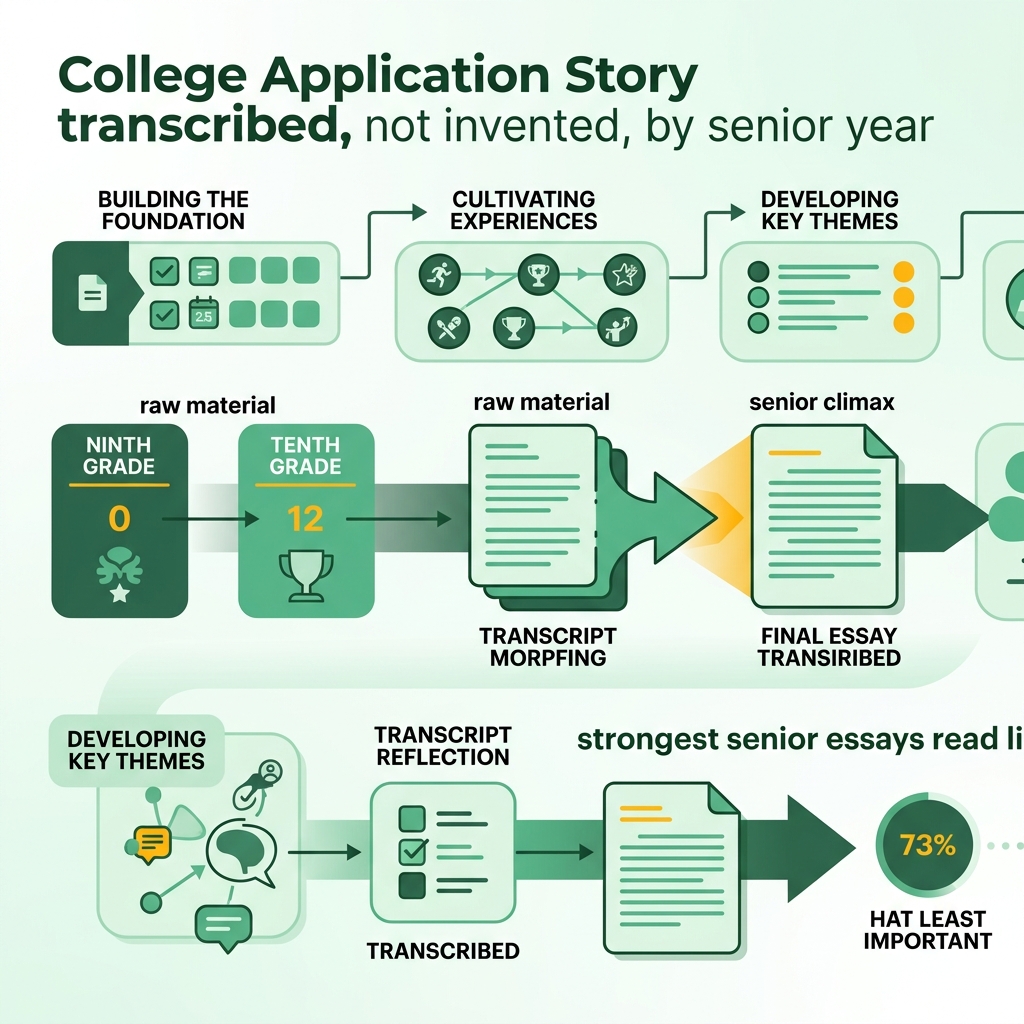
What are the real deadline windows for early and regular applications?
Early decision and early action move first. Some colleges want test scores and completed applications as early as October 15 for early decision, so anything early has to be finished while the rest of senior fall is still ramping up.
Financial aid runs on its own clock. The FAFSA and CSS Profile open October 1, and aid forms sometimes fall due before the applications themselves. We build regular check-ins and feedback sessions into the workflow so families stay on track and momentum carries into the regular-decision batch.
One deadline detail gets missed constantly: recommendations. BigFuture advises giving teachers at least 10 school days to write. The two academic letters that matter most should come from junior-year teachers who watched the narrative develop, which is why we push those requests early.
How does a final application review protect the narrative?
The last read-through is a coherence check, not a spellcheck. We line up four things and ask whether they tell one story:
- The activities list, verified for accuracy and sustained commitment rather than one-off summer experiences
- The essay, confirmed to trace back to the early courses and interests that seeded it
- A senior schedule that still carries five academic core classes, since colleges read rigor across all four years
- Test scores, including any fall retake, which some seniors take after another semester of coursework

There's a real tension in list-building worth naming. One source says narrow to 5 to 10 schools; another suggests a wider 10 to 15 spread across reach, match, and likely. These aren't in conflict. The wider list is junior-year research; the tighter one is the final senior slate. We trim as certainty grows.
What about decision day and the transition in?
Weigh financial aid packages against fit, not name recognition. If a strong essay and coherent transcript earn multiple offers, the aid conversation becomes a real negotiation rather than a scramble. Skip the panic timelines you see online: as Admissions Mom notes, even a fall-semester senior can still work the list without freaking out. Enrollment prep, deposits, orientation, and course registration are the last handoff, and they go smoothly when the story was built on purpose.
Action Plan & Resources Checklist for Families
This is the part families actually tape to the fridge. Everything above stays theoretical until it becomes weekly execution, so this is the checklist we hand parents when consulting shifts from strategy to routine. The through-line holds: every tool, every question, every book should feed the course-to-essay thread a student started building in ninth grade.
One honest scope note before the lists. If your student is a low-stress applicant aiming at open-admission or rolling-admission schools, most of this is overkill. The tooling below earns its keep when a family is targeting selective programs where narrative coherence actually moves the needle.
What free planning tools should families set up first?
Start with two documents, not ten. An activity log is the backbone. College Essay Guy's timeline recommends creating one freshman year to track extracurriculars, summer experiences, and academic honors as they happen, not reconstructing them from memory in senior fall.
Pair it with a course-and-application tracker. The same guide points to a self-assessment sequence worth doing early: a values exercise, a strengths inventory, and an interest assessment to test whether a student's course thread still matches who they're becoming.
Then add a college list spreadsheet junior year. A month-by-month junior guide suggests 10 to 15 schools across reach, match, and likely, sorted by graduation rates and merit-aid generosity rather than name recognition.
What should you ask in a first consulting consultation?
Ask how early the partner engages. If the answer is senior year, that's a red flag for the story-building work this whole guide argues for. Good partners start course planning in ninth or tenth grade.
Ask how they connect coursework to the essay. Can they show you a case where a freshman's honors and AP sequence became the spine of a senior narrative? Ask about the essay lab too: how many drafts, whether peer review happens, and who reads the final.
Ask about their stance on rigor. The right answer matches the research: push for the most challenging courses a student can handle well, since a B in an AP class with a solid GPA beats an overloaded schedule that tanks it.
How do families handle aid and well-being without burning out?
On money, start freshman year, not senior year. Explore how to pay for college early, and by junior spring understand the split between need-based aid, merit scholarships, and rewards programs. The Coalition timeline also flags the deadlines that sneak up: early applications due Nov 1 to 15, and a May 1 deposit decision.
On recommendations, move early. Winter of junior year, not summer, when the teachers you want still have open slots.
On well-being, protect the deeper-not-wider principle for parents too. Support one sustained commitment over a frantic pile of new ones. The calmer families are the ones who started early, which is exactly why the Coalition team says you'll "be better set up for success and less stressed the earlier you begin."
References
[1] A College Admissions Game Plan for Freshmen, Sophomores, and Juniors - https://www.saraharberson.com/blog/college-admissions-game-plan-freshmen-sophomores-juniors
[2] College Application & Admissions Timeline (AKA What Should I be ... - https://www.collegeessayguy.com/blog/college-application-timeline
[3] 2025 Timeline for Almost Rising Juniors and Seniors - https://admissionsmom.college/admissions-journey-timeline/2025-timeline-for-rising-juniors-and-seniors/
[4] 12th Grade College Application Timeline - BigFuture - https://bigfuture.collegeboard.org/plan-for-college/apply-to-college/college-application-timeline-12th-grade
[5] College Application Timeline: A Month-by-Month Guide for High School ... - https://www.tuitionrewards.com/newsroom/articles/766/college-application-timeline-a-month-by-month-guide-for-high-school-juniors
[6] Master timeline: college admissions (article) - Khan Academy - https://www.khanacademy.org/college-careers-more/college-admissions/get-started/introduction-ca/a/master-timeline-college-admissions
[7] College Planning Timeline Guide | Coalition for College - https://www.coalitionforcollegeaccess.org/mycoalition-counselor-all/the-college-planning-timeline
[8] Early College Planning: A Grade-by-Grade High School ... - https://ingeniusprep.com/blog/early-college-planning-a-grade-by-grade-high-school-timeline/
Common Questions
My child is already a junior. Is it too late for this kind of planning to help?
Junior year still holds real runway for many students. The substance of a candidacy is largely set by then only for hyper-selective schools like Harvard or MIT. For the hundreds of colleges admitting strong B students, junior and senior years leave genuine time to build a competitive list and application.
How many AP classes should a student take, and can they catch up by loading them junior year?
Two or three well-chosen AP or honors courses usually beat a crowded schedule. The risky move is jumping from zero APs as a sophomore to five as a junior. Readers see the seam, and the grades that matter most often suffer. A steady climb weighted toward the intended field reads as believable.
Do freshman grades actually reach admissions officers, or is ninth grade a warm-up year?
Freshman grades reach admissions officers and factor into your cumulative transcript, so there is no throwaway year. Students who treat ninth grade as a warm-up often spend the next three years climbing out of a GPA hole. Course rigor also counts heavily, since a B in an AP class frequently outweighs an easy A.
My child is humanities-focused. Should they rush to take AP Physics early anyway?
A humanities-bound student has no urgency to rush physics. Former Penn associate dean Sara Harberson suggests enjoying Honors Chemistry now and taking AP Physics later if it fits. Sequencing courses while the material is fresh matters more than chasing the hardest possible schedule. Match the progression to the story you're telling, not a generic default.
How early can college admissions consulting realistically start?
Planning can begin as early as eighth grade. Endurable Education splits its service into a life-preparation phase and a college-application phase precisely so course and activity choices get mapped before ninth grade locks them in. Starting early keeps the top of your list open without foreclosing options elsewhere.
When do financial aid forms open, and can they be due before the applications?
The FAFSA and CSS Profile open October 1, and aid forms sometimes fall due before the applications themselves. Treat financial aid as its own timeline rather than an afterthought. Missing an early aid deadline can cost money even when the application itself is submitted on time.
Should I hire a consultant or just coach my family through this myself?
The decision hinges on how much coordination you need across four years and which schools you're targeting. For the most competitive programs, aligning courses, activities, essays, and recommendations into one argument is where outside help earns its keep. Endurable Education walks through the coach-yourself-versus-hire tradeoff honestly in a dedicated piece.