Should You Hire an Admissions Consultant, or Coach Yourself to Yale?
August 15, 2026

Key Takeaways
- At elite feeder high schools, close to 90% of students already use private admissions support. At that saturation, a consultant buys parity, not an edge.
- The best time to hire is sophomore spring. Wait longer, and course selection and testing timelines narrow.
- In competitive suburban publics, 60-70% of applicants work with a professional somewhere in the process.
- Consultants solve three things a student cannot fix from inside their own file: strategic timing, narrative translation, and blind spots.
- Two former admissions officers, from Northwestern and Berkeley, both point to narrative as the hardest part to get right.
- The math has flipped from "advantage gained" to "disadvantage avoided" once most of the pool already has help.
- Hire in senior fall, and you've missed the decisions that actually move the needle: courses and testing.
Related Video
Watch: Watch This Before You Record Your Yale or Kellogg MBA Video Essay by MBA Protocol
What You're Actually Buying When You Hire a Consultant
It depends on what you're buying.
Most guides skip the part that matters. As private admissions support becomes standard in high-performing districts, the baseline for a competitive application moves with it. When a large slice of the pool has had professional help, hiring a consultant is less about buying an edge and more about making sure your student's materials do not get outclassed on sight by peers whose profiles have been professionally shaped.
What a consultant actually solves
Good guidance tackles problems that are hard to see from inside your own application. The first is long-range academic planning: lining up course selection and testing timelines before your options close. Get this wrong early and it's expensive to fix in junior year.
Narrative is the harder problem. Skyler A., a former Northwestern admissions officer, and Avi L., a former Berkeley admissions officer, both argue that storytelling separates top-tier candidates. There's a catch, though. Research on private consulting found that admissions officers get skeptical of essays that feel too polished when the shine does not match the rest of the file. Good consultants teach authentic self-presentation. Weak ones hand you a glossy artifact that gets decoded and discounted.
How costs and approaches compare
| Approach | Cost | Time commitment | Reported success | Difficulty |
|---|---|---|---|---|
| Endurable base-plus-bonus | Lower base fee, bonus tied to satisfaction | Guided, structured | Over 65% admitted to Top 10 + Ivy League | Moderate |
| Full-service consultant | $5,000-$25,000 | Consultant-led | ~30% Ivy admits | Low effort, high cost |
| Hourly consultant | ~$250/hour | Piecemeal | Varies | Moderate |
| Self-coaching | Free resources | 100+ hours solo | No benchmark | High |
The top firms post eye-catching numbers. 97% of Command Education's 2025 graduates got into a top-three school, and Ivy Coach reports a 14-year Dartmouth streak for its ED applicants. Impressive. But you pay the full fee whether the experience meets your expectations or not.
Where our model differs
Most consultants charge one flat fee no matter how it goes. Our base-plus-bonus structure flips that. Families pay a modest base, and the bonus is tied to our Happiness Guarantee, so you only pay full fare if you're satisfied. That makes it a risk-shared partnership rather than a fixed bet.
Skip a paid consultant entirely if your student is a strong self-starter at a well-resourced school with free counseling that already fits, as Arun Ponnusamy notes. Consulting earns its keep for high achievers aiming at sub-10% schools, and for first-generation or underrepresented students who need translation, not a data dump. If that sounds like you, our admissions planning resources are a fine place to start weighing it.
When to Hire a Consultant for Yale Applications
Deciding when to hire a college admissions consultant for Yale comes down to three things: how competitive your target is, how early you're starting, and how much risk you're willing to carry alone. Yale's acceptance rate sits around 4%, per MassMutual, and more than 70 universities now admit 20% or fewer applicants. At those odds, the question is not whether help exists. It's whether the help you buy is priced fairly and honestly.
That kind of competition rewards a pricing structure that ties the consultant's incentives to your goals. When fees are entirely front-loaded, the financial risk of a rejection lands on the family alone. A shared-risk approach keeps the advisory team motivated to refine every piece of the application, from early planning through final submission.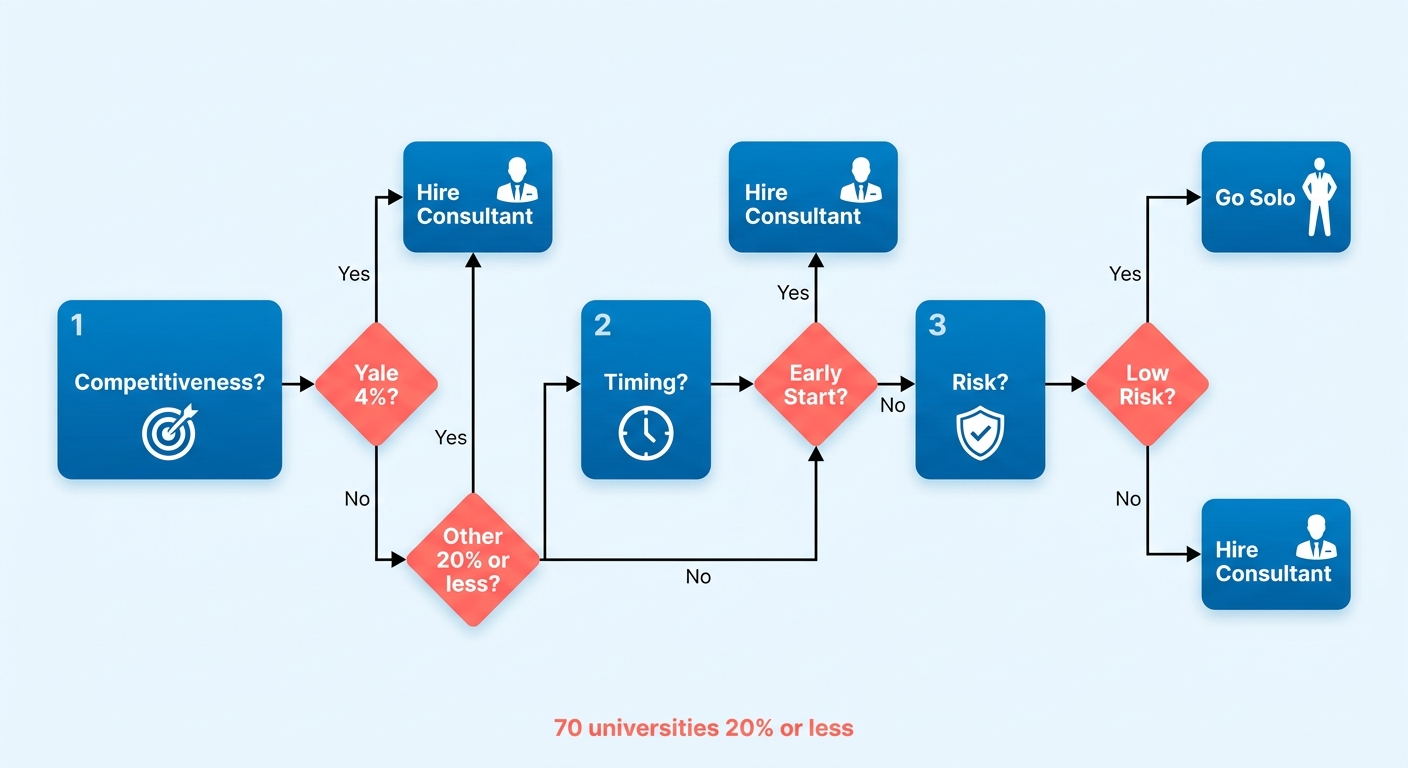
Who actually benefits
Three student profiles get the most from expert help: those with unusual strengths that resist easy categorization, those with a specific dent in the record, and those whose story needs translation. A consultant catches what a motivated student cannot see from inside their own file. Take a student splitting time between competitive robotics and volunteer teaching. On paper it reads scattered. Empowerly guided a similar student with disconnected interests toward a Stanford research internship, which pulled the pieces into one narrative and led to multiple Ivy acceptances. That's translation, not gaming.
Skip a consultant if your student already writes fluently in elite academic register and has a clean, coherent record. Tiffany Huang's research on private consulting found that higher-income students already produce essays with greater lexical range. If you're fluent in the code, you're paying for translation you do not need.
When to start
Earlier engagement buys strategic positioning. Later engagement buys damage control. Both work. They're just different products at different prices.
The sources genuinely disagree here. Oriel argues for early engagement to shape course selection and testing timelines. Ivy Coach reports that 41% of deferred students who came in late still earned admission to their early school. Our read: start early if you want to build a case, but a late-stage narrative rescue is still worth it when a strong student gets deferred.
| Timing | What you're buying | Best for |
|---|---|---|
| Early (10th-11th grade) | Course, testing, and activity strategy | Students building a Yale-level profile |
| Junior fall | Essay narrative and school list | Students with strong records needing polish |
| Senior/deferral | Narrative refinement, damage control | Deferred or waitlisted applicants |
We treat each application as its own project. Families with older siblings often assume the old playbook still works. It rarely does. The market moves fast, and video-essay prompts now reward genuine self-presentation over polished artifacts. We coach for the former, keeping the student's real voice at the center.
Cost Breakdown and ROI Analysis of College Admissions Consulting
The ROI pitch in this space usually cites 30:1 returns by multiplying consultant fees against projected lifetime earnings from brand-name schools. One analysis frames it exactly that way. The math holds only if two assumptions do: the consultant caused the acceptance, and the elite-school earnings premium applies evenly across careers. Neither survives much scrutiny. The earnings lift concentrates in finance, consulting, and tech. For teachers, nurses, or nonprofit directors, the gap shrinks fast.
A more honest framework weighs the cost against the risk of presenting an uncompetitive profile. In a highly selective pool, an unguided application can stand out for the wrong reasons, missing the structure and narrative focus committees expect. Think of the fee as a defensive measure, insurance that a qualified student's achievements do not get buried by weak presentation.
What the money actually buys
Comprehensive packages generally bundle school selection, essay editing, extracurricular positioning, and interview prep. Timing shapes where the effort goes: early clients get help with academic rigor and summer planning, while late-stage clients spend almost all of it on rapid essay iteration and deadline triage.
Some firms sell multi-year plans. One national consultant advertised a five-year, full-service package for $1.5 million. An outlier, sure, but it shows where the ceiling sits for families treating admissions as a concierge service. We do not play at that tier, and most families targeting Yale do not need it.
What you're really buying is time and translation. Time because public school counselors carry about 470 students each, per federal data. Translation because elite schools read narratives written in a specific cultural and linguistic register, and families who do not already speak that language need help closing the gap.
Published success rates and selection bias
Some firms lean on acceptance data to justify the spend. Empowerly clients report a 98% acceptance rate at Top 100 universities. Spark Admissions claims an Ivy League rate eight times the national average. Those numbers sound great until you ask who these firms take as clients in the first place. Self-selection runs deep here. Consultants screen for students who already have the academic profile and extracurricular depth to compete. Nobody's taking a 1200 SAT and turning it into a Yale admit.
The firms with the shiniest stats also tend to have the most selective intake. When you only work with students carrying 1500+ SATs, straight As in AP courses, and national-level activities, high acceptance rates are baked in before a single essay edit. That makes the consultant's actual contribution nearly impossible to separate from what the student would have done on their own.
How base-plus-bonus changes the equation
Traditional pricing ignores performance. When the whole fee is upfront, the consultant faces no financial consequence if the final list of results comes back thin. Tying compensation to satisfaction keeps the advisor invested in the quality of the work across the entire cycle.
Splitting the fee into a standard operational base and a performance-based piece gives families a partner with real skin in the game. The focus shifts from billable hours to value actually delivered.
It also forces transparency. A firm willing to stand behind its service with a satisfaction-based fee has no reason to oversell during the first call. The relationship starts from realistic expectations instead of a sales pitch.
And you're not paying for false confidence. Families hire consultants partly to lower the stress, but flat fees quietly reward overpromising. One consultant quoted by MassMutual said the process gets "less stressful" with professional help. True, but only if the consultant is honest about what's realistic. Once you've paid in full, there's no penalty for being too optimistic. Tie the bonus to your satisfaction and honesty becomes the default.
| Pricing Model | Upfront Cost | Results-Based Fee | Risk Allocation |
|---|---|---|---|
| Flat Fee (Industry Standard) | Fixed payment | None | Client carries all risk |
| Hourly (Variable rate) | Pay as you go | None | Client pays regardless of outcome |
| Our Base-Plus-Bonus | Lower base fee | Bonus tied to your satisfaction | Risk shared between client and firm |
When late-stage help still works
Early planning gives you the most room to shape a profile, but late-stage work does something different. When a student already has strong credentials and just lacks a cohesive narrative, targeted help in the final months can organize those achievements into something that reads clearly.
For deferred or waitlisted students, Ivy Coach reports that strategic adjustments can still pay off. The work is diagnostic: read the original application, find the points of friction, recalibrate the supplements, and write a clear letter of continued interest that speaks to the committee's specific concerns. That can turn a holding pattern into an admit.
The catch: late-stage consulting costs more per hour of value because you're compressing the work into a shorter window. You're also paying for someone to diagnose what went wrong and fix it fast, which is a different skill than building a multi-year strategy from scratch. If that's your situation, make sure the consultant has a track record with deferred and waitlisted applicants, not just early-round wins.
Final Recommendation and Decision Checklist
The decision comes down to three factors: how competitive your target schools are, whether you have time to build strategic positioning from scratch, and whether you value transparent pricing that rewards satisfaction. You're not deciding whether help exists. You're deciding whether the help you buy fits your needs.
Families tend to split into three camps. The first knows it needs guidance and wants fair pricing with built-in accountability. The second thinks it can self-coach but underestimates how fast admissions criteria shift between sibling cycles. The third hires late, treats it as crisis management, and pays full freight for incremental gains. In our experience the first group gets the best ROI, because they're buying strategic positioning, not damage control.
When hiring makes sense
Guidance works best woven into long-term planning. Start early and you can make deliberate calls on academic rigor, testing schedules, and summer plans. The profile then develops naturally around a theme instead of forcing a narrative onto a scattered set of activities at the last minute.
Families keep assuming an older sibling's strategy still holds. It does not. Admissions markets change faster than most parents track. When testing went test-optional, application volume surged at top schools. Harvard saw a 42% jump in a single cycle. What worked three years ago may already be obsolete. Tracking those shifts is a consultant's full-time job.
Consulting adds the most value when you're juggling multiple application systems (Common App, Coalition, school-specific portals), managing early decision strategy across different deadlines, and coordinating teacher recommendations with your narrative. Those are process problems that compound quickly without experienced hands.
When self-coaching works
Self-coaching makes sense for students who read admissions criteria carefully, write well without heavy editing, and have time to research schools on their own. You'll be mapping timelines, tracking testing windows, and drafting essays through multiple revisions with no outside accountability. Research points to the structural advantages well-resourced applicants get through specialized writing support, but self-coaching students can close some of that gap by actively pulling objective feedback from teachers and mentors.
The risk cuts both ways. Admissions officers spot over-coached essays when polish outruns the rest of the file. They also spot under-coached essays when the narrative doesn't hold together. Self-coaching means balancing authenticity with strategic framing. That's learnable, but it takes trial and error most families do not have room for in a compressed senior-year timeline.
Our take: self-coaching works if you start early, your student writes naturally, and you're targeting a range of schools where a few strong applications beat one perfect reach. It falls apart when you're aiming only at the most selective schools and treating the application as a one-shot gamble.
Decision checklist
Use this to figure out where you land.
Hire a consultant if:
- Your student has strong credentials but struggles to articulate a cohesive narrative
- You want strategic guidance on course selection, testing timelines, and extracurricular positioning
- You prefer transparent pricing that rewards your satisfaction with the service
- Your high school counselor is stretched too thin for individualized support
- You're applying to schools where demonstrated interest and institutional fit carry weight
Self-coach if:
- Your student writes well and takes feedback without getting defensive
- You have access to strong mentorship through school or community programs
- You're targeting a mix of schools with varied selectivity
- Your student has time to iterate on essays through multiple drafts
- You're comfortable researching admissions criteria and application mechanics on your own
- You can commit 15-20 hours to understanding each school's specific priorities
Red flags that say you need help:
- Treating the application as a résumé dump rather than a narrative project
- Relying only on school counselors at under-resourced high schools
How our pricing works
Industry-standard fees run from thousands to tens of thousands of dollars regardless of results. Families deserve a model built around accountability instead. By structuring fees around client satisfaction, we keep our team committed to the quality of the guidance, and our success stays tied to the value we deliver.
This matters because competitive admissions is an 18-24 month effort, not a senior-fall sprint. Fair pricing with quality incentives beats paying for process alone. You're not buying coaching hours. You're buying a partnership where we're motivated to deliver results you actually value.
The alternative is hiring late, paying crisis-management rates, and hoping a little extra polish moves the needle. It rarely does. If you're going to invest in consulting, do it early enough to influence the variables that matter: course rigor, testing strategy, and extracurricular coherence. That's where the return compounds, not in senior-year essay edits.
References
[1] The Case for Using a Law School Admissions Coach - https://menlocoaching.com/law-school-admissions-consulting/the-case-for-using-a-law-school-admissions-coach/
[2] Inside the Pricey, Totally Legal World of College Consultants - https://www.nytimes.com/2019/03/13/us/admissions-cheating-scandal-consultants.html
[3] College Admissions Consultants, Events, & Resources - https://www.joinleland.com/search/school/college
[4] Ivy Whisperers: 10 elite gurus getting your kids into top schools - NY Post - https://nypost.com/lifestyle/best-college-admissions-consulting-firms-ivy-league/
[5] When Should You Hire a College Admissions Consultant? - https://orieladmissions.com/when-to-hire-college-admissions-consultant/
[8] Ivy Coach: Private College Counselors & Admissions ... - https://www.ivycoach.com/
[9] Translating Authentic Selves into Authentic Applications - https://www.researchgate.net/publication/375103215_Translating_Authentic_Selves_into_Authentic_Applications_Private_College_Consulting_and_Selective_College_Admissions
[10] Watch This Before You Record Your Yale or Kellogg MBA Video Essay by MBA Protocol - https://www.youtube.com/watch?v=PvXqYc1v7as
Frequently Asked Questions
1. Can a consultant guarantee admission to Yale?
No consultant can guarantee admission. Highly selective institutions look for unique institutional fits that cannot be manufactured. While some firms advertise near-perfect placement rates, these figures typically reflect highly selective client enrollment policies rather than the absolute impact of the consulting itself.
2. Is it worth hiring a consultant after you've already been deferred?
Yes, late-stage assistance can help identify and address specific weaknesses in an initial application. The focus shifts to analyzing the deferred file, drafting a compelling letter of continued interest, and submitting updated materials that directly address potential concerns raised by the admissions committee.
3. Do admissions officers notice essays that were heavily edited by consultants?
Experienced admissions readers are trained to spot writing that does not match a student's academic profile or age. If an essay sounds like it was written by an adult, it can raise red flags. Effective consulting focuses on helping students express their own voice clearly, rather than rewriting their work.
4. How does the base-plus-bonus model differ from flat-fee consulting?
Traditional consulting requires paying the entire fee upfront, regardless of the quality of service or the student's satisfaction. A base-plus-bonus model structures the payment so that a portion of the fee is only due when the family is satisfied with the support received, sharing the risk more equitably.
5. Is a paid consultant worth it if my school already has a good counselor?
If your school counselor has the bandwidth to provide detailed, personalized feedback on your essays and school list, external help may be unnecessary. However, when school counselors are responsible for hundreds of students, a private consultant can provide the dedicated time needed to manage complex application timelines.
6. Does the earnings payoff from an elite school apply to every career?
The financial return on an elite degree varies significantly by industry. Fields like investment banking or management consulting show a clear salary premium for Ivy League graduates. In contrast, careers in education, healthcare, or public service show much smaller salary differences based on institutional prestige.