5 College Admissions Consulting Models, and Which Fits Your Student
September 22, 2026

The Short Version
Comprehensive packages average around $6,500 for most families. The range runs from $10,000 to $120,000. Some four-year deals reach $500,000. Counselor caseloads vary by model, and flat fees do not change with that load. Former admissions officers command a 35–45% price premium. Yet higher pricing shows no reliable link to better admissions outcomes. Elite firms advertise acceptance rates from self-selected, already-strong applicant pools. Those numbers cannot prove the consultant caused the result.
Quick Summary
Five models dominate college admissions consulting right now: comprehensive multi-year packages, junior/senior packages, essay-only help, hourly consulting, and satisfaction-tied base-plus-bonus arrangements. Two things separate them where your wallet feels it: how much personal attention you get, and whether your fee depends on your satisfaction.
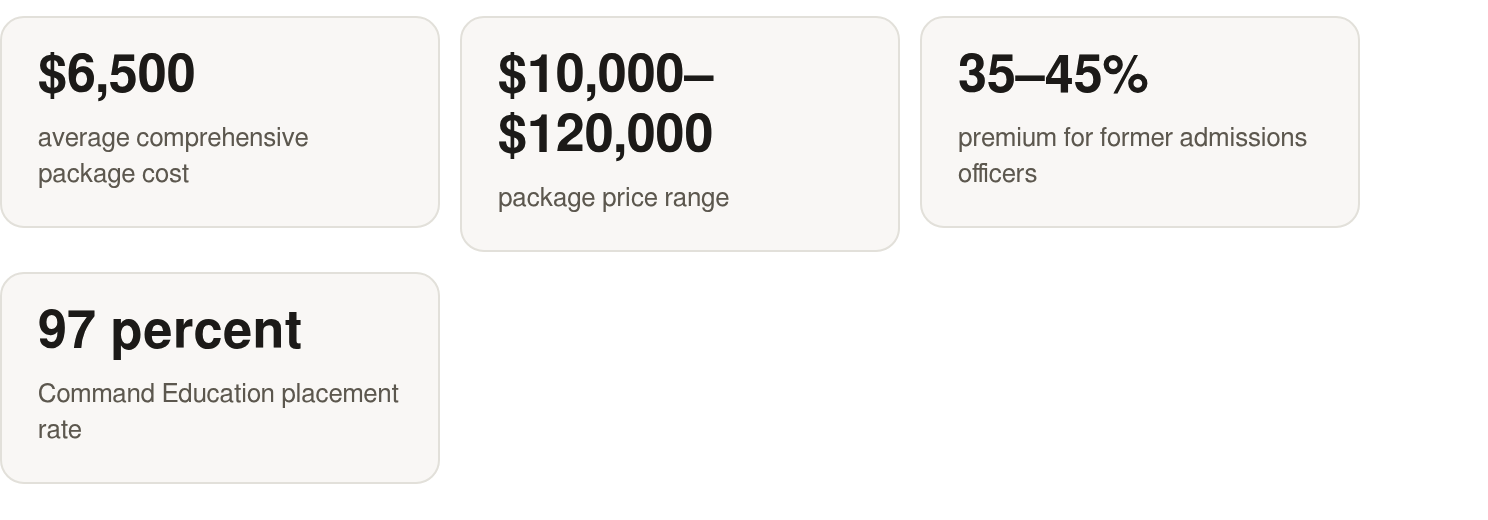
Most families spend around $6,500 for a comprehensive package, though the 2026 cost report from Private Prep tracks packages running from $10,000 to $120,000, with some four-year deals reaching $500,000. Here is how the models stack up.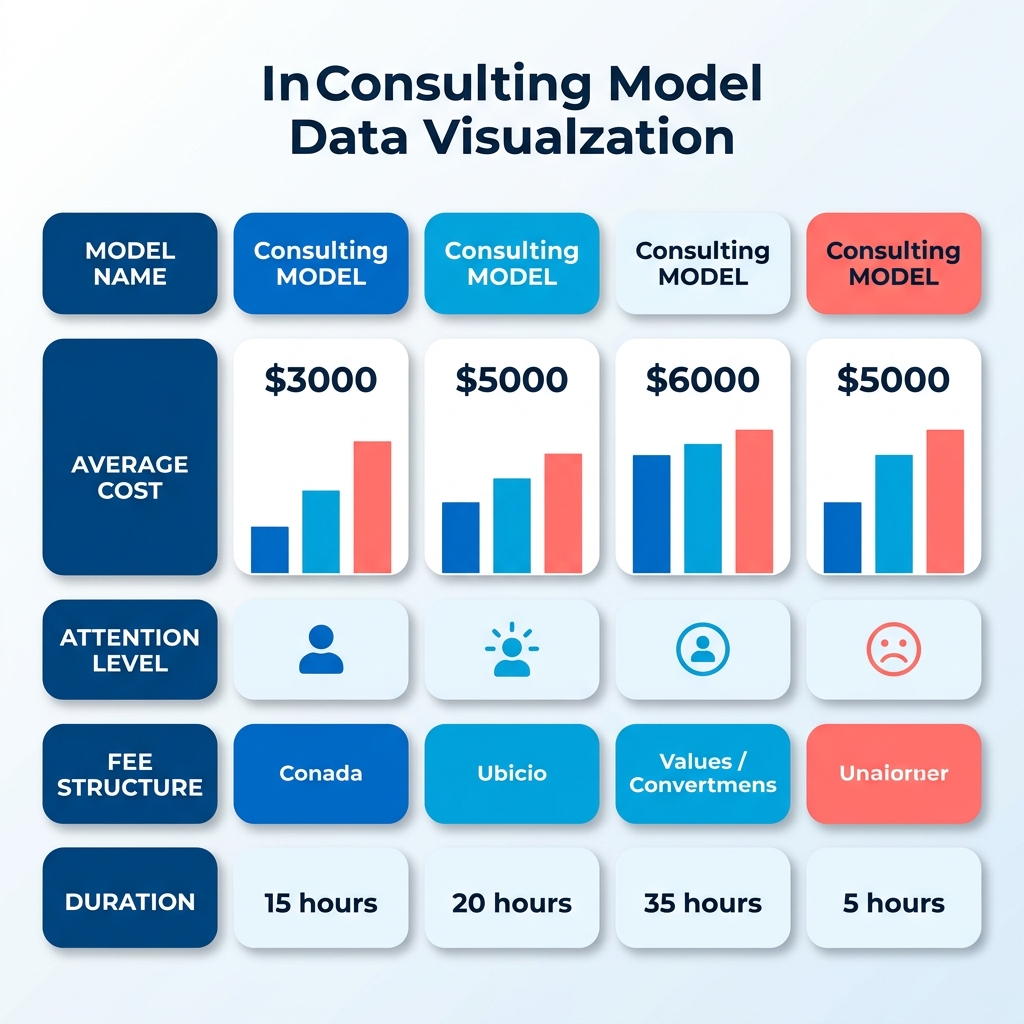
| Model | Pricing Structure | Typical Duration | Personalization | Ideal Student |
|---|---|---|---|---|
| Comprehensive package | $10,000–$120,000 flat | 2–4 years | High (12–20 per counselor) | Early planners starting 9th grade |
| Junior/Senior package | $5,000–$50,000+ flat | 2 years | Medium (20–30 per counselor) | Students committing in 11th grade |
| Essay-only | $100–$500/hour | 3–6 months | Narrow, essay-focused | Self-directed applicants needing polish |
| Hourly consulting | $150–$2,500/hour | As needed | Variable (35–40 per counselor) | Families wanting targeted check-ins |
| Base + bonus (satisfaction-tied) | Lower base, bonus on satisfaction | Multi-year, from 8th grade | High, panel review | Ivy/top-tier aspirants wanting shared risk |
Which pricing model actually protects families?
The satisfaction-tied base-plus-bonus model shifts risk off the family. You pay a lower base up front, and you owe the full fare only if you're satisfied with the service. Every flat-fee model on this list charges the same no matter how many students a counselor carries, a load the cost data puts anywhere from 12 to 40 per counselor.
That distinction matters more than any headline acceptance rate. Private Prep's data notes that higher pricing doesn't necessarily correlate with better outcomes, yet former admissions officers still command a 35–45% premium. You can pay for the résumé and still get less of your advisor's week.
Do the elite firms' success rates hold up?
Treat the big numbers with skepticism. Firms profiled by the NY Post's Ivy Whisperers piece tout eye-catching admit rates and odds multipliers. Those pools are self-selected and already strong, so the results don't prove the consultant caused the outcome.
That's why we favor an incentive-aligned fee. When your consultant collects the full fee only if you're satisfied, they share the downside instead of claiming credit for students who would have gotten in regardless. Endurable Education built its base-plus-bonus happiness guarantee on that logic, and its support starting as early as 8th grade gives students a life-preparation phase to build meaningful experiences before the application work begins.
Which model fits your student?
Match the model to your timeline and goals. Skip comprehensive packages if your student is a strong senior who only needs essay polish. Essay-only or hourly work is enough there.
Reach for multi-year, high-personalization support if you're aiming at the most selective, single-digit admit schools. And if transparency worries you, favor a structure that pays out on satisfaction, not promises.
Why the fee structure decides more than you think
Choosing a college admissions consulting model is a financial decision with real downside risk, and most families make it blind. The fee structure you pick shapes how much attention your student gets, how much stress the process creates, and whether you pay full price when the acceptance letters don't arrive. We built our base-plus-bonus model around fairness and transparency, so you pay our full fare only if you're satisfied with our service.
Here's the problem we keep running into. The headline numbers in this business look staggering. Elite firms featured in roundups like the NY Post's list advertise sky-high acceptance rates at the most selective schools, and premium packages lean hard on those figures. The numbers sell packages. They don't prove causation.
Why headline acceptance rates mislead families
Elite firms report outcomes on applicant pools that were already strong. A student who could afford a mid-six-figure package and arrived with a 4.0 and national awards was going to do well anywhere. The firm claims credit for a result it may not have produced.
Industry cost reporting makes a quieter, more useful point: a higher price tag doesn't guarantee a better outcome. So the metric families should interrogate is attention per student, not the acceptance-rate billboard. A model where more than one advisor reviews your student's essays tells you more about the support you'll get than any advertised rate does.
What you should actually compare between models
Compare who carries the risk and how much personal time you get. A flat fee costs the same whether your consultant juggles 6 students or 200, and it costs the same whether your student gets in everywhere or nowhere.
| Fee Structure | Who Carries Downside Risk | What Predicts Your Outcome |
|---|---|---|
| Flat comprehensive package | You do, fully | Attention per student |
| Hourly consulting | You do, per session | Your own follow-through |
| Base-plus-bonus (ours) | Shared with the consultant | Satisfaction-aligned incentive |
The pedigree debate exposes the same gap. Some firms lean on former admissions officers; others emphasize recent graduates who relate to your kid. Both have a point. Former officers decode committee behavior. Recent grads connect with students. But neither pedigree guarantees the result you're paying for. Our own team blends degrees from Princeton, Harvard, and Yale with real-world experience at companies like McKinsey and Uber.
How base-plus-bonus changes the math
A base-plus-bonus fee ties part of what you pay to whether you're satisfied with our work, instead of billing you the same regardless. Because you pay our full fare only when we've earned it, the incentive is to keep doing great work over years rather than coast on a signed contract.
That matters most for families without a safety net of pedigree or connections. First-generation and international students face the steepest information gap, and research on private college consulting warns that over-coached, over-polished essays can read as inauthentic to skeptical readers. Paying for aligned effort beats paying for a template. If you're only targeting local or less-selective state schools, though, skip the premium models entirely. The evidence doesn't support the spend. Not sure where you land? Our walkthrough of whether you actually need a consultant covers it plainly.
Model 1 – Full‑Service Elite Boutique Consulting
The elite boutique model is what most people picture when they consider hiring help: one senior advisor, often a former admissions officer, guiding a student from ninth-grade course planning through final interview prep. You get a single relationship, deep knowledge of your kid's story, and a name-brand promise attached to the acceptance letter.
It's also the most expensive tier, and where the incentive problem shows up hardest. Full-service boutique engagements often run multi-year, with contracts locking families in from freshman or sophomore year, according to the 2026 cost report from Private Prep, which shows Tri-State pricing running well above national averages. You commit that money up front, whether your student gets in or not.
The success rates are real numbers attached to hand-picked students
Boutique firms lead with eye-popping outcomes. The NY Post's roundup reports Command Education placing 97 percent of its 2025 graduates in one of their top three schools, with those students 6.8 times more likely to land at Harvard than the general pool. Empowerly cites a 98 percent acceptance rate at "Top 100" universities across a network of 240-plus counselors.
Here's what those numbers can't tell you: whether the firm caused the outcome or simply enrolled students who were already going to succeed. Elite boutiques recruit from a pool of high-achieving, high-resource families. When you start with strong applicants, a high acceptance rate reflects your intake as much as your coaching.
That's the gap flat-fee pricing hides. You fund the pedigree up front regardless of result, and the firm books your win as proof of its method even when your student would have gotten in anyway.
Pedigree is not the same as attention
There's a live debate over who coaches better. Private Prep's data argues that caseload size and individual attention predict outcomes more reliably than a consultant's institutional background. Command Education pushes the opposite case, arguing that near-peer recent graduates beat former officers because they understand today's process firsthand.
Both have a point. Former-officer insight helps decode how committees actually read a file, which matters for interviews. Near-peer mentors relate to the student. But neither pedigree is the metric that protects your wallet. Ask how many students the advisor carries. A counselor juggling forty families cannot give yours the depth the brochure promises. A caseload in the single digits per advisor is what buys the attention you're paying for, and it's a fair question to raise before you sign anything.
This model fits families who want a single deep relationship and can absorb the cost without flinching. If you'd rather the consultant share the risk than bank a premium on your student's existing strength, our base-plus-bonus structure answers the exact incentive gap these headline rates expose.
Model 5 – Endurable Education's Customized Panel Model
Every other model on this list pins your fee to something other than your satisfaction. You pay for an advisor's hours, a fixed package, or an essay edit, and the check clears whether you feel well served or not. Our model breaks that pattern. We built our service around a panel of advisors and a base-plus-bonus fee, so you pay our full fare only when you're satisfied with the service.
How it works in practice: you start with us as early as 8th grade, not junior year when options have already narrowed. A team of advisors, not one person, reviews your student's essays, activity list, and course plan. You pay a base fee up front, then a bonus that comes due in full only when you're satisfied with our work. Some parents have even doubled our bonuses as a sign of appreciation.
What a panel does that a solo advisor can't
One advisor gives you one read. A panel gives you several, which matters most on the two pieces that decide selective admissions: the essays and the activity list.
Different reviewers catch different weak spots. A story that lands for one reader falls flat for another, and that disagreement is the point. It surfaces the flat draft before an admissions officer ever sees it.
The 8th-grade start is the other half. We use the early years for life-prep and skill-building, so the application phase has real material to work with instead of a scramble in the fall of senior year.
How the pricing compares
| Model | Fee tied to satisfaction? | Advisors per student | Starts as early as |
|---|---|---|---|
| Endurable panel | Yes, via bonus | Multiple (panel) | 8th grade |
| Elite boutique | No | One senior advisor | 9th grade |
| Junior/senior package | No | One | 11th grade |
| Essay-only | No | One | As needed |
| Hourly | No | One | As needed |
Skip our model if you want a single name-brand advisor and don't care whether your fee moves with your satisfaction. That's a real preference, and the boutique tier serves it well.
But if you want more than one set of eyes and a fee that charges you in full only when you're happy with the work, the panel plus base-plus-bonus is the fit.
Matching student profiles to the right model
Start with the question most families skip: what does your student actually need help with? The right model follows from that answer, not from a brochure's acceptance-rate claims. A kid who needs a second set of eyes on one essay does not need the same thing as a ninth grader who needs four years of course planning.
Most families sort into three buckets of motivation, and the Charlotte Observer's service comparison lines up neatly with them. Some want strategy and long-term planning. Some want essay and application execution. Some want confidence and encouragement more than tactics. Match the bucket to the model before you match the price to your budget.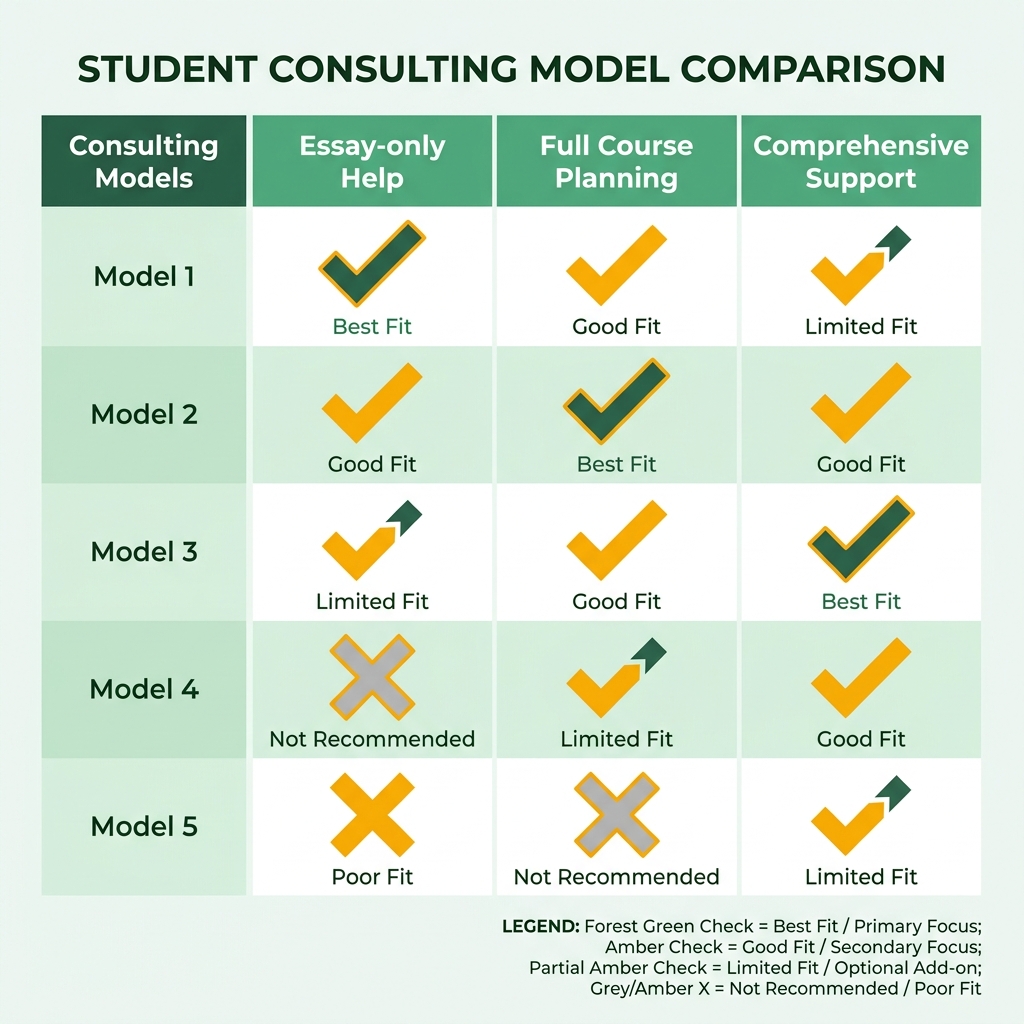
Which model fits which need
The match usually turns on two things: how far out you're starting and how narrow the gap is. A sophomore with strong grades but no sense of which majors fit is a planning problem, not an essay problem. A senior sitting on a finished draft that reads flat is the reverse. And a bright student who freezes every time a deadline gets close often needs a coach who checks in weekly more than a strategist who maps out four years.
Watch for mismatches in both directions. Families sometimes buy a full multi-year package when the student only needs help polishing supplements. Others try to solve a broad planning gap with a few hourly sessions that never build momentum. The study-abroad case is its own category worth naming: a student aiming for a degree overseas needs someone who knows those systems, not a domestic generalist. Name the actual gap first and the model stops being a guessing game.
One warning on the strategy side. Higher pricing does not necessarily correlate with better outcomes, since premium firms sometimes manage larger caseloads to justify their fees. If your list is mostly regional public universities, a premium package is money spent on firepower you won't use.
What should actually drive the decision
Not pedigree. The 2026 Private Prep cost report makes the point cleanly: caseload size and attention per student predict outcomes better than whether your advisor once worked in an admissions office. Comprehensive packages tend to keep the lowest ratios, around 12 to 20 students, while essay-only and hourly services often manage 35 or more. Ask any consultant how many students they carry before you ask where they went to school.
Then check the money the same way. The headline package price scares people more than the actual monthly math does.
A five-line worksheet before you sign
Fill these in honestly:
- My student's single biggest gap is ____ (strategy, essays, or confidence).
- We start in grade ____ (earlier favors comprehensive; senior year favors essay-only).
- Our comfortable ceiling is $____ total.
- This consultant carries ____ students.
- If the acceptances don't come, do I still pay full price? Yes / No.
That last line is where our model parts ways with the rest. Every other option on this list bills you in full whether you feel served or not. We tie the bonus portion of our fee to your satisfaction, so the incentive to actually deliver stays on our side of the table. Still unsure whether you need outside help at all? Our take on when a consultant is worth it is a fair place to start.
Key Questions to Ask When Evaluating a Consultant (and Final Recommendation)
Most families evaluate a college admissions consulting firm on one number: the advertised acceptance rate. That's the wrong place to start. The questions that actually protect your money are about verification, caseload, and what happens if the results don't come.
Before you sign anything, run the firm through a short due-diligence checklist. Good consultants answer these plainly. The ones who dodge tell you everything you need to know.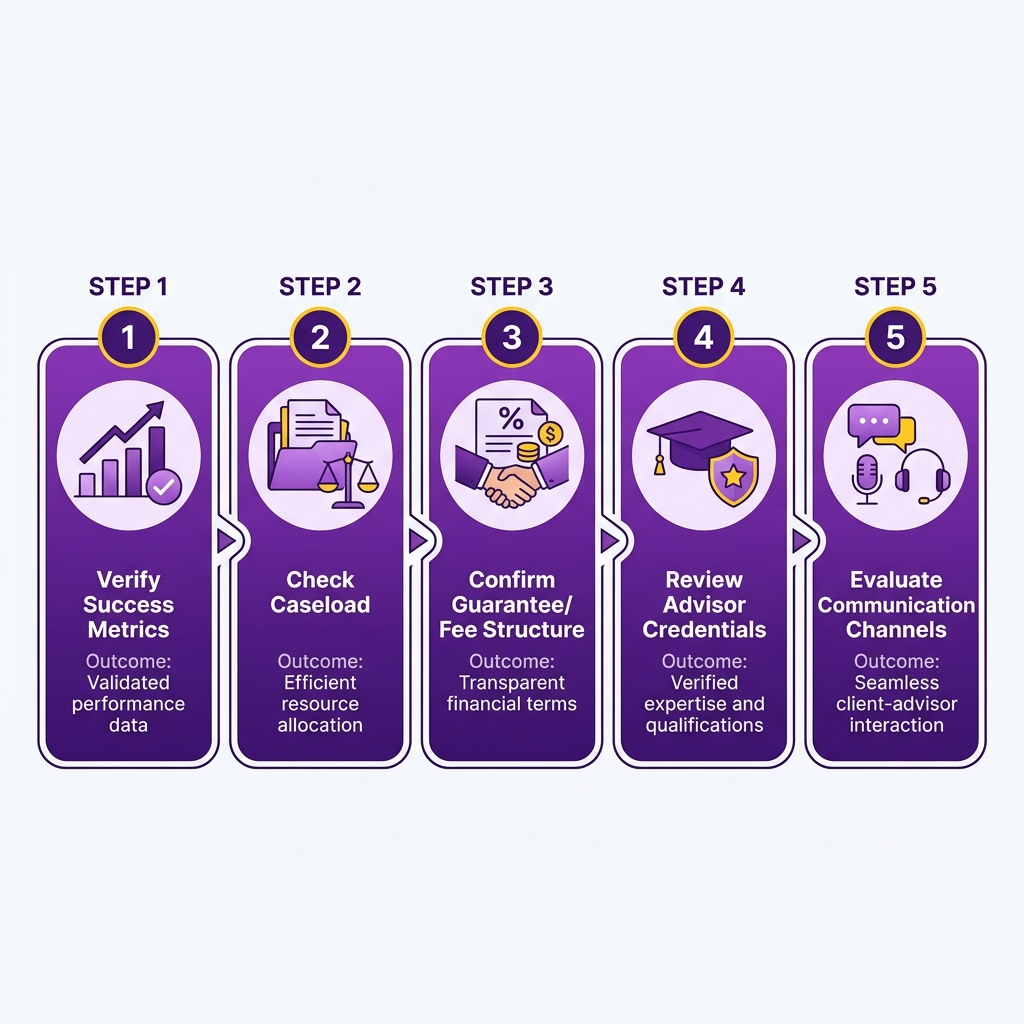
How do you verify a success rate?
Ask for the math behind the headline. Firms love round, impressive figures, but a rate means nothing until you know how it was built. Ask three things: which class year it covers, how many students were in the pool, and whether "success" means an admit to any school on a list or an admit to the specific school the family was paying to reach.
Here's what a big number can hide. Firms that recruit already-strong applicants from high-resource families show high prices and high results side by side without one causing the other. A 90-plus percent figure drawn from students who were going to get in anyway tells you about the intake, not the coaching. You can't prove the consultant added the value.
So ask for outcomes by specific class year, not lifetime aggregates. Ask whether the rate counts every enrolled student or only the ones who finished the program. If a firm won't break it down, the number is marketing.
What to ask about credentials and caseload
The industry sells pedigree, but pedigree is not the strongest predictor of results. What matters more is how many families your advisor carries at once and how much of their week actually reaches you. The 2026 Private Prep cost report documents fees climbing well past five figures at the premium tier, so the practical question is simple: how many hours of that advisor's time does your money buy, and is the number in writing?
There's also a live debate on credentials worth knowing. Former-officer firms charge a premium for insider knowledge of how committees read files. Other firms argue recent-graduate mentors understand today's process better. Both have a point. Former officers help decode interview and committee behavior; near-peer mentors relate to the current student experience. Neither pedigree matters if your advisor is juggling 200 applicants.
| Question to Ask | Green Flag | Red Flag |
|---|---|---|
| Success rate proof | Class-year data, all students counted | Lifetime aggregate, no breakdown |
| Advisor caseload | Capped and disclosed | Vague or undisclosed |
| Communication cadence | Set schedule, named contact | "As needed," rotating staff |
| Refund or fee policy | Fee tied to satisfaction or outcomes | Full payment up front, no recourse |
What I'd tell a family before they sign
Ask every firm the refund question last, because it exposes who shares your risk. Most charge full price whether you're thrilled or ignored. We built our fee the other way. You pay a base up front, then a bonus that comes due only when you're satisfied with the work. Some parents have chosen to double that bonus. That's our answer to the incentive problem the caseload data and inflated acceptance rates both expose.
For families aiming at Ivy or Top 35 schools who want a long-term, collaborative team rather than a single overbooked advisor, that structure fits. If you only need one essay reviewed or you're targeting local state schools, a lighter hourly or essay-only option will serve you better and cost far less. Still deciding whether you need help at all? Our take on whether you actually need a consultant is a good place to start.
References
[1] Cost of College Admissions Consultants: 2026 Report - https://privateprep.com/cost-of-college-admissions-consultants-2025-report/
[3] Ivy Whisperers: 10 elite gurus getting your kids into top schools - NY Post - https://nypost.com/lifestyle/best-college-admissions-consulting-firms-ivy-league/
[4] Private College Consulting and Selective College Admissions - https://www.researchgate.net/publication/375103215_Translating_Authentic_Selves_into_Authentic_Applications_Private_College_Consulting_and_Selective_College_Admissions
Common Questions
Are former admissions officers worth the higher price they charge?
Former admissions officers command a 35–45% price premium, but that pedigree shows no reliable correlation with better admissions outcomes. They help decode how committees read a file, which matters for interviews. Recent graduates relate better to current students. Neither guarantees results if the advisor carries too many families at once.
What kind of consultant does a student applying to schools abroad need?
A student aiming for a degree overseas needs someone who knows those specific systems, not a domestic generalist. This is its own category worth naming separately. A consultant fluent in U.S. admissions won't necessarily understand the requirements, timelines, or application norms of international universities, so match the expertise to the destination before comparing prices.
Can hiring a consultant actually hurt my student's application?
Over-coached, over-polished essays can read as inauthentic to skeptical admissions readers, according to research on private college consulting. Paying for aligned effort beats paying for a template. This risk makes the incentive structure matter: a consultant who profits from a formulaic edit is not the same as one paid on your satisfaction.
What happens with the base-plus-bonus fee if I'm not satisfied?
With Endurable Education's model, you pay a base fee up front and a bonus that comes due only in full when you're satisfied with the work. That structure shares the downside instead of billing you the same regardless of outcome. Some parents have even chosen to double the bonus as appreciation.
Which model helps first-generation or international families the most?
First-generation and international students face the steepest information gap, so they benefit most from a model paying for aligned effort rather than a template. A satisfaction-tied structure keeps the incentive to deliver on the consultant's side, which matters when a family lacks the safety net of pedigree or connections to verify quality independently.
How is a junior/senior package different from a comprehensive package?
A junior/senior package runs about two years starting in 11th grade. Comprehensive packages span 2–4 years from 9th grade. Earlier starts favor comprehensive. Committing in junior year fits the shorter package.