What Your $75 Application Fee Really Covers and How to Budget
September 20, 2026

TL;DR
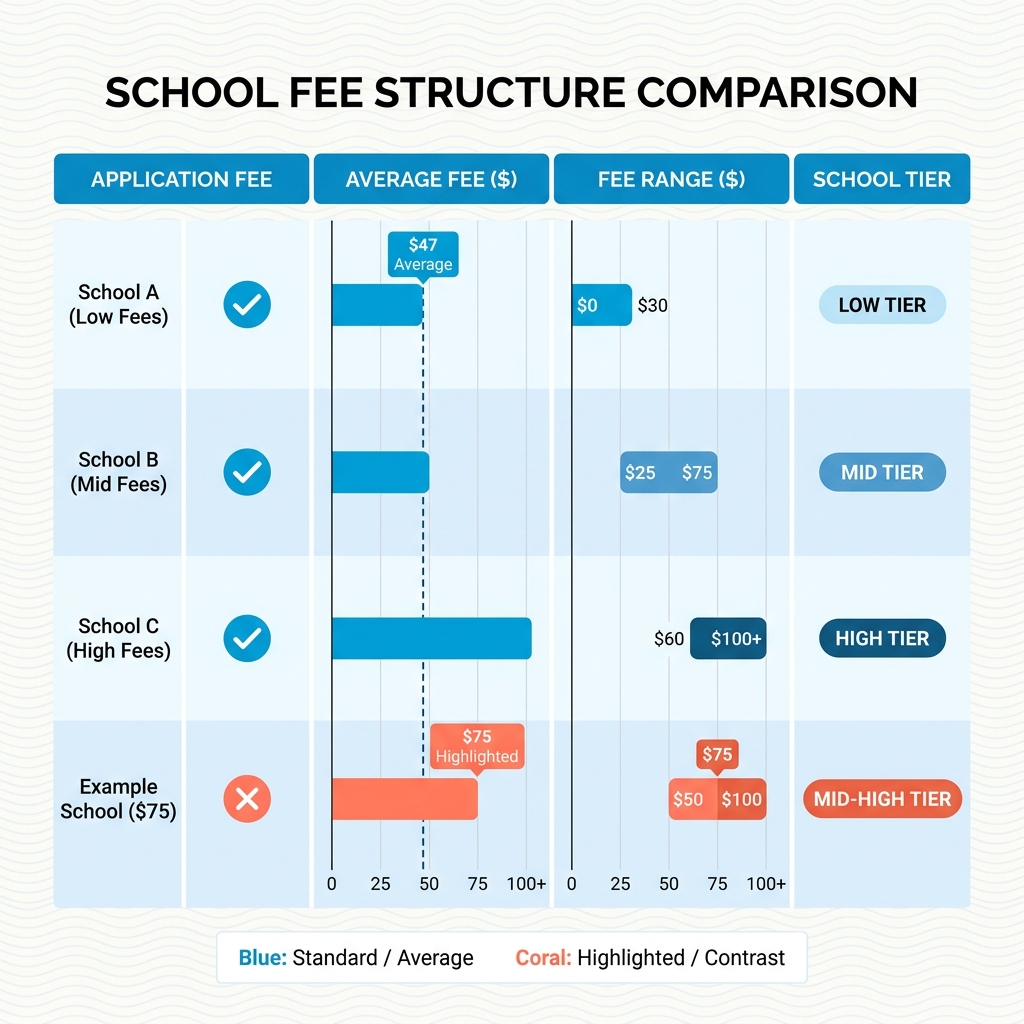
- The average undergraduate application fee runs about $47, with most schools charging between $30 and $90 per submission.
- A $75 fee sits on the higher end, though it's common at selective private universities with large applicant pools.
- More than 700 of the top 1,600 four-year colleges accept applications for free, roughly 44% of top institutions.
- Some universities receive more than 50,000 applications a year, and the fee helps offset review costs.
- Total application spending can approach $2,000 across ten schools once score sends and the CSS Profile pile on.
- Application fees can't be paid from a 529 plan, so this is out-of-pocket cash for families.
- Test prep is the real cost, from $50 for a study book to several hundred for a full course.
Quick Summary
That $75 at checkout is one of the smallest numbers in your entire application budget. Knowing what it buys changes how you plan everything around it. The fee covers the administrative cost of reviewing your file, including transcripts, test scores, and the personal statement for university admissions readers actually sit down and evaluate. It does not cover the expensive parts: test registration, per-school score sending, and the hours behind the essays.
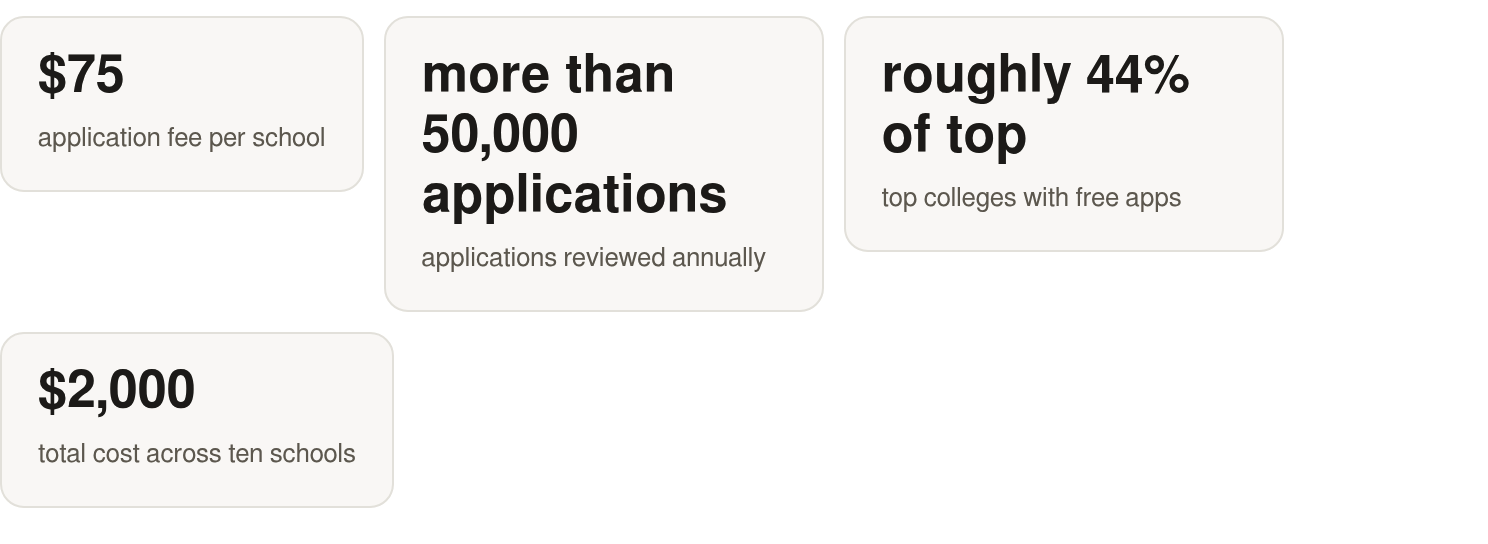
The average undergraduate application fee is around $47, with most schools in the $30 to $90 range, according to Citizens Bank's fee breakdown. Seventy-five dollars is high but ordinary at selective privates. Treat it as the entry ticket, not the number that decides your budget.
What a $75 application fee actually pays for
An application fee is a one-time, non-refundable charge that funds the review of a single application, including reading essays and processing your documents. It rarely buys you anything you get back.
Fees exist for two reasons. Schools recover the cost of reading enormous volumes, and a single university can field upwards of 50,000 applications a year. The fee also screens out applicants who aren't serious. Some colleges skip it entirely, on the theory that any fee shrinks and flattens the pool they're trying to build.
| Institution type | Typical fee | Major cost components | Common deadlines | Fee-waiver eligibility |
|---|---|---|---|---|
| Public university | Often $0 or below average | Application review, document processing | Varies | SAT/ACT fee-waiver holders, demonstrated financial need |
| Private/selective | Can exceed $100 | Review, essay reading, interviews | Varies | SAT/ACT waiver holders, financial need, campus visit |
| Graduate programs | $100+ | Committee review, credential checks | Program-specific | Limited; ask directly |
| No-fee colleges | $0 | Fully absorbed by school | Varies | N/A |
Free and waived applications are more common than families expect
Once you narrow the view to strong schools, yes. It's free to apply to over 700 of the top 1,600 four-year colleges, even though no-fee schools remain the exception across all colleges. Both things are true at once: rare overall, but close to 44% among top institutions.
You can also ask an admissions office for a waiver even when the form shows no formal option. Financial aid officers often use discretion for families who take the initiative to reach out.
One catch worth naming: waiving the fee only removes the money barrier. Drop the processing charge and the bottleneck moves straight to supplemental drafting, which is where a smart list strategy earns its keep.
Before you pay anything, pull these together:
- Test scores (SAT/ACT) and your list of free score-send recipients
- Financial documents (FAFSA data, tax records, free/reduced lunch proof) for waiver requests
- A finalized, prioritized school list, so you only pay for applications worth submitting
Why the $75 fee is the wrong number to worry about
The fee at checkout won't make or break your college budget. It's the smallest visible line item in a spend that can run into four figures. It's also the moment most families first look up and ask what they're actually paying for, which makes it a decent place to start planning the rest, including the hours you'll pour into a personal statement for university applications.
This matters most for high-achieving students working a long list. Write one personal statement, then reshape it for eight or ten schools, and the essay time dwarfs the fee. Getting families to see that early is half the job.
The fee is a rounding error in the real budget
Look at the totals. Add score sends and the CSS Profile and a single application climbs well past its sticker price. Applying to ten colleges stacks those costs on top of each other, and some students spend nearly $2,000 across the whole process.
Against that, a $44 average fee (per U.S. News figures) barely registers. The money that moves the needle sits in test prep, which runs from $50 for a study book to several hundred for a full course, and in per-school score sending.
One detail catches parents off guard: you can't pay application fees from a 529 plan. This is out-of-pocket cash, which is why it belongs in the same conversation as the bigger costs instead of getting treated as an afterthought.
Waivers kill the dollar cost, not the time cost
Two views tend to collide here. One says the fee rarely needs to be a barrier, since waivers and fee-free options are widely available on request. The other says that even with every fee waived, applying broadly still backfires, because each added school dilutes your attention and weakens every submission.
Both hold up. Clearing the checkout charge handles cash flow. It leaves the writing load fully intact. Once money is off the table, your own stamina becomes the constraint that decides quality.
So the real budgeting move is building an intentional list, not hunting minor discounts. A tighter set of targets protects narrative quality across every essay, which is the balance our student-by-student consulting is built to find.
Who actually needs to think about this
If you're applying to two or three schools on an obvious list, skip the fee math. It won't change anything.
If you're balancing several reach programs, or forecasting the full cost of the cycle, tracking these small numbers gives you a frame for the bigger ones. And when standard waiver criteria don't fit your situation, ask directly. Institutional flexibility is real, but you usually have to request it.
Budgeting the $75 fee across the whole cycle
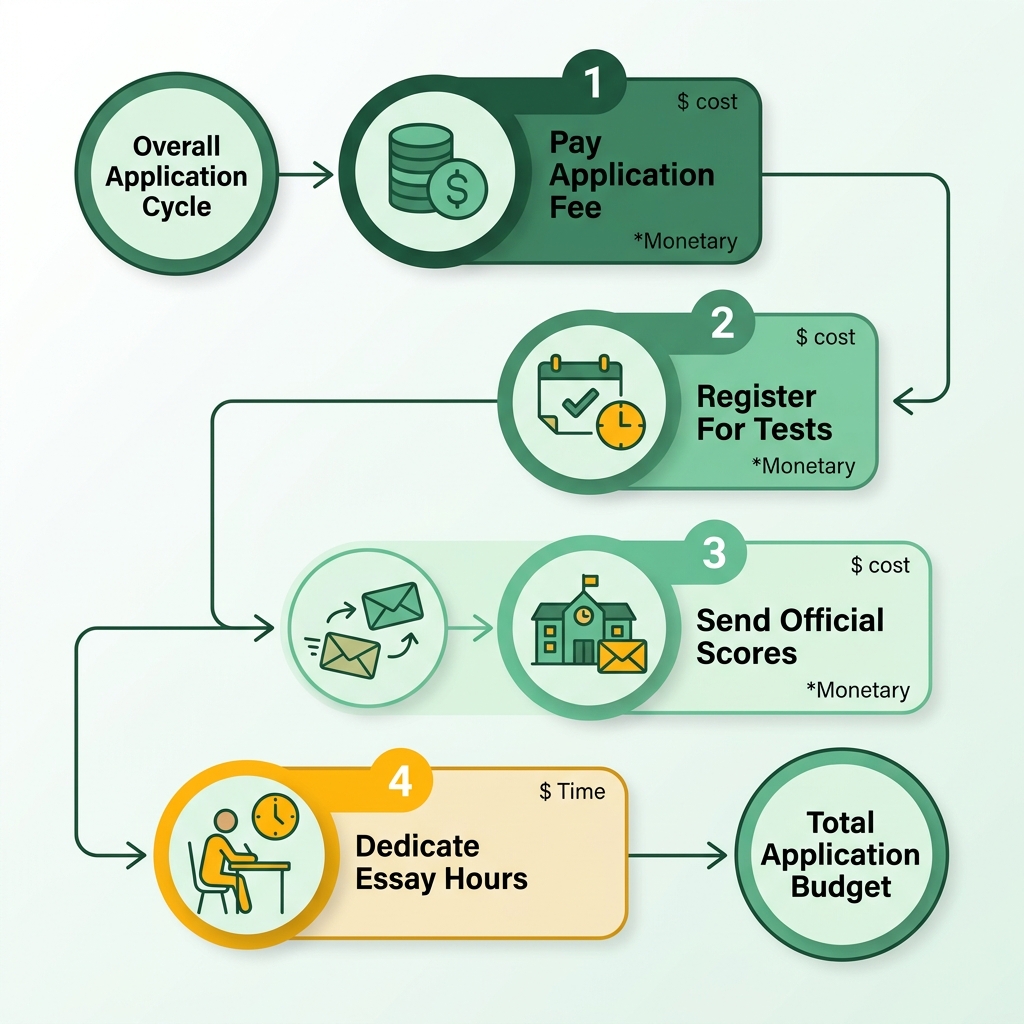
Start with the entire cycle in view, not the checkout screen. The application fee is real, but it sits next to score sending, test registration, and the many hours behind strong materials. Plan for the cash and the endurance at the same time, because a lean list protects both.
Your total scales with the list, not the fee
Estimate the cycle by counting schools first, then multiplying. Fees vary widely by institution, and a longer list widens that spread fast. Layer in score sending and test registration and the all-in total climbs well past the fees alone.
That's why the school count matters more than any single fee. Twelve schools carry a very different price than five, even before you count the supplemental essay demands the larger set brings. The list length is the lever.
Because these fees are locked out of tax-advantaged college savings accounts, families should set aside dedicated liquid cash in the fall of senior year.
Where free and waived applications actually come from
A meaningful share of top-tier colleges offer zero-cost applications, and established pipeline programs open the door to many more. Target schools often partner with initiatives designed to lower the financial gate.
Formal routes include SAGE Scholars lists such as TRIO, Upward Bound, National Merit recognition, recruited-athlete exemptions, and demonstrated need through federal student aid metrics. Admissions officers also read direct appeals from students whose circumstances fall outside those standard definitions.
Automate the fund, then spend the savings where it counts
Set up a dedicated application fund early and time your payments to deadlines. Many public schools waive fees for applications received by a certain date, so front-loading submissions can cut costs outright. Handling early-decision and early-action pieces first keeps the rest of the cycle organized.
Now redirect what you save. Test registration and score sending are separate expenses on top of application fees, so send scores selectively. Skip broad score sending when your numbers sit below a school's range.
Those freed-up dollars belong in essay time and list strategy, which is exactly where our customized planning does its work. Trimming two low-fit applications does more for your outcome than any single waiver. That call, made early, is data-driven admissions work, not guesswork.
What a fee's size tells you about the school
Published pricing runs from zero to triple digits, and it reflects institutional scale and review methodology more than raw prestige, as Citizens Bank's breakdown lays out. An above-average fee generally signals a labor-heavy holistic review, where the narrative parts of your file get read closely by committee.
How much do application fees actually vary?
Pricing tiers track institutional structure and workload, according to Citizens Bank. State flagships often price on the low end to keep regional access open. Private research universities running multi-reader holistic reviews sit at the top, funding the committee hours that review takes.
Zero-dollar portals make up a real share of competitive four-year colleges. Many highly ranked liberal arts and specialized colleges deliberately absorb the review cost to keep their applicant pools economically diverse.
Where your fee budget should really go
Point your money and your time at the parts of the file that carry weight. Score reporting fees and campus-visit logistics pass application charges quickly. Investing in sharper writing beats spreading yourself thin across redundant applications.
Nail the fit before you allocate funds. A sharper list beats a fee waiver, because every supplement you submit gets a real revision and a clear angle. Once the list is well-calibrated, the fees become predictable entry costs inside a strategy built around narrative clarity, testing benchmarks, and genuine fit.
Getting your money's worth from the fee
The fee buys a review of your file, but plenty of schools attach extras to that same transaction, and most families never claim them. Some bundle virtual campus sessions, supplemental essay guidance, or interview slots into the cost of applying. When you're building university applications, those touchpoints are institutional access you've already paid for.
Applicants who ignore built-in info sessions and then pay third parties for the same insight are buying the same thing twice. Treat the application fee as an engagement tool and you can use the school's own programming to strengthen your profile.

Free resources often do the fee's job better
Take stock of what the school gives you before you buy commercial services. Many selective institutions run zero-fee policies right on their application portals, per Citizens Bank. Standardized testing fee waivers can automatically unlock secondary fee exemptions across hundreds of member campuses, as SAGE Scholars outlines.
For colleges without an automatic fee-reduction toggle, a direct note to an admissions rep often produces a custom waiver code for students facing unusual economic barriers.
The hidden costs that erode the fee's value
Secondary charges quietly compound the total, as Citizens Bank notes. Beyond testing fees, official transcript delivery and portfolio submission portals add up across multiple deadlines. Score reporting adds a direct marginal cost for every campus you add to the distribution list.
Test prep stays a common expense, but holistic admissions puts growing weight on personal essays and course rigor, so balance where your dollars go accordingly.
Guidance captures more value than any waiver
A waiver removes the checkout charge and leaves the writing load untouched. Work through a stack of supplements without a clear focus and applicant fatigue sets in fast.
Prioritizing your best-fit programs frees you to spend deeper writing cycles on the schools that matter most. A data-driven read on your list keeps your essay portfolio focused on the distinctive personal insight an admissions officer recognizes on the first pass. That's the return the fee itself never buys.
References
[1] College Application Fees: Costs, Waivers & Tips - Citizens Bank - https://www.citizensbank.com/student/articles/what-you-need-to-know-about-college-application-fees.aspx
[2] Budgeting for College Applications - https://howtopayforcollege.com/blog/budgeting-for-college-applications
[3] College Application Fees - Tuition Rewards by SAGE Scholars - https://www.tuitionrewards.com/newsroom/articles/85/college-application-fees
[4] Applying to College: Costs to Expect & Tips to Save - https://harvardfcu.org/blog/applying-to-college/
Frequently Asked Questions
1. Can I get an application fee refunded if I decide not to attend or withdraw my application?
Application fees are non-refundable by design. The charge funds the review of your file the moment it is processed, including reading essays and handling documents. Once submitted, you cannot recover it regardless of your admission outcome or later decision to withdraw.
2. How much do score reports actually cost once I use up my free sends?
Score reports typically cost about $14 per school after you exceed the free sends built into your SAT or ACT registration. A wide list multiplies that fast, so send scores selectively and skip schools where your numbers sit below their range.
3. Does a free application mean the school is lower quality or less selective?
Free-to-apply status has nothing to do with quality. Many strong institutions absorb the cost, believing any fee shrinks and homogenizes their applicant pool. Some selective schools waive fees for early applications, so a $0 fee often signals strategy, not weaker standards.
4. Why can't I use my 529 plan to pay application fees?
The IRS restricts 529 distributions strictly to qualified higher education expenses incurred once enrolled, such as tuition, mandatory fees, books, and eligible room and board. Application fees, test prep, and score transmissions occur before matriculation, requiring payment from standard household checking funds.
5. If every school on my list waives its fee, should I just apply everywhere?
No. Submitting dozens of applications stretches your time thin, resulting in generic supplemental essays that diminish your overall chances. A targeted list of high-affinity schools produces stronger, more authentic writing that stands out to evaluators.
6. I have no formal waiver option on the form. What can I do?
Reach out directly to the regional admissions counselor or the financial aid desk. Detail your interest in the institution alongside any relevant financial considerations, as admissions offices frequently generate manual override codes for engaged applicants.
7. Should I put more money into test prep or into my essays?
Prioritize essays when schools weigh the personal statement over test scores, which many now do. Test prep ranges from a $50 study book to a several-hundred-dollar course, so over-investing there while writing thin essays is a poor trade for your budget and outcome.