Maximizing Your Leadership Experience in the New Common App Format
September 16, 2026

Key Takeaways
- The Common App activities section holds up to 10 activities, with 50 characters for a position title, 100 for the organization name, and 150 for each description.
- The activities list is often scanned before your personal statement.
- The redesigned section is now called "Activities and Experiences" for the 2026-2027 cycle, widening what colleges may count as relevant experience.
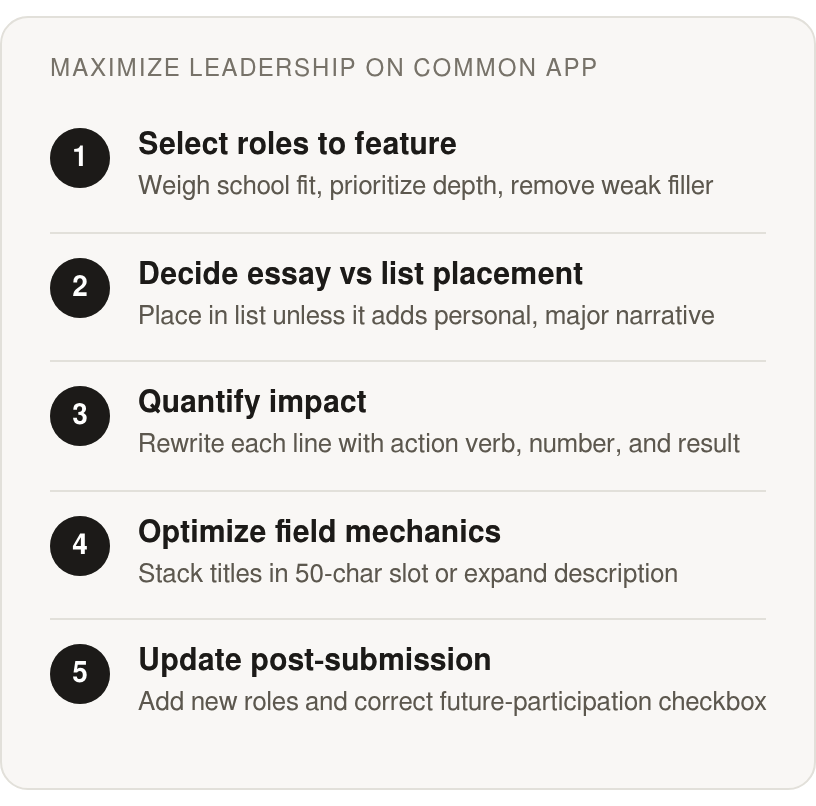
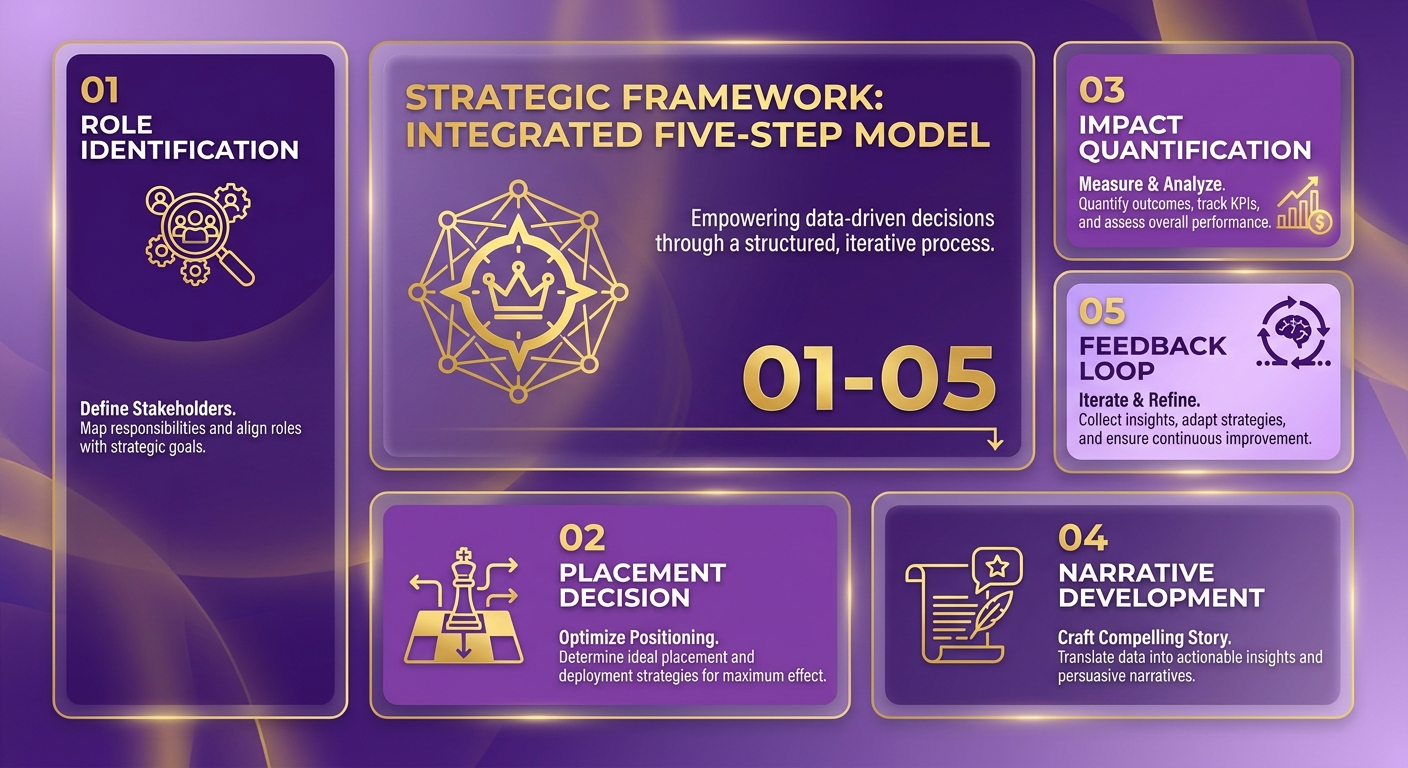
- Of the five moves that shape a leadership profile, deciding where a role goes is the hardest (1-2 hours), and quantifying impact takes the most time (3-4 hours).
- Leadership needs no official title to count. Selective schools weigh depth of impact over the number of roles you list.
Related Video
Watch: How To Fill Out the Common App Activities Section (the RIGHT Way) by ElevatEd School
Quick Summary
Maximizing leadership in the current Common App comes down to one decision, made once per role: does this experience earn 650 words in your personal statement, or does it do more work as a line in the activities list? Working through that question, role by role, is a core part of how we build a student's application strategy.
The order matters because officers read the list first. The activities list acts like the whole file's table of contents. They scan it before your essay. So your leadership choices frame how a reader interprets everything that follows.
The Five Moves That Shape a Leadership Profile
Here's what actually moves the needle, with a realistic sense of the time each takes and where students tend to get stuck.
| Action | What it involves | Est. Time | Difficulty |
|---|---|---|---|
| Select which roles to feature | Weigh fit with target schools against depth of impact; cut weak filler | 2–3 hrs | Medium |
| Decide essay vs. Activities placement | Keep a role in the activities list unless it adds a personal, major layer to your story | 1–2 hrs | Hard |
| Quantify impact | Rewrite each 150-character line as action verb + number + result | 3–4 hrs | Medium |
| Optimize the field mechanics | Stack titles in the 50-char slot or redirect that space into description | 1 hr | Easy |
| Update post-submission | Add new roles, correct the future-participation checkbox | 30 min | Easy |
The hardest call is placement, and it's harder than most families expect. A big win on paper doesn't automatically belong in the essay. If the story doesn't reveal something a résumé line can't, it stays in the list.
What Changed: Impact Beats Title
The current cycle rewards demonstrated impact over formal labels. Leadership doesn't need an official title to count. The field limits stay tight: up to 10 activities, 50 characters for position, 100 for the organization, 150 for the description.
And if your list is genuinely thin, skip the polish work. Empty slots beat weak filler. Don't manufacture roles to fill all 10.
Three Moves Worth Getting Right
- Lead every line with a number. As the Prepworks activities guide puts it, numbers are your best friend. "Led 22-member team to state finals" beats "was president" every time.
- Own the verb. Cut passive phrasing like "helped the leaders plan." That hands your credit to someone else. Use "mentored," "launched," "restructured."
- Match roles to the school, not your ego. Feature the two or three experiences that reinforce your spike and fit your target programs. Depth in a few areas reads stronger than breadth across many.
Do this, and your leadership profile stops being a list. It becomes the frame that primes a reader to see the rest of your application the way you intend.
Why Leadership in the New Common App Is a Routing Problem
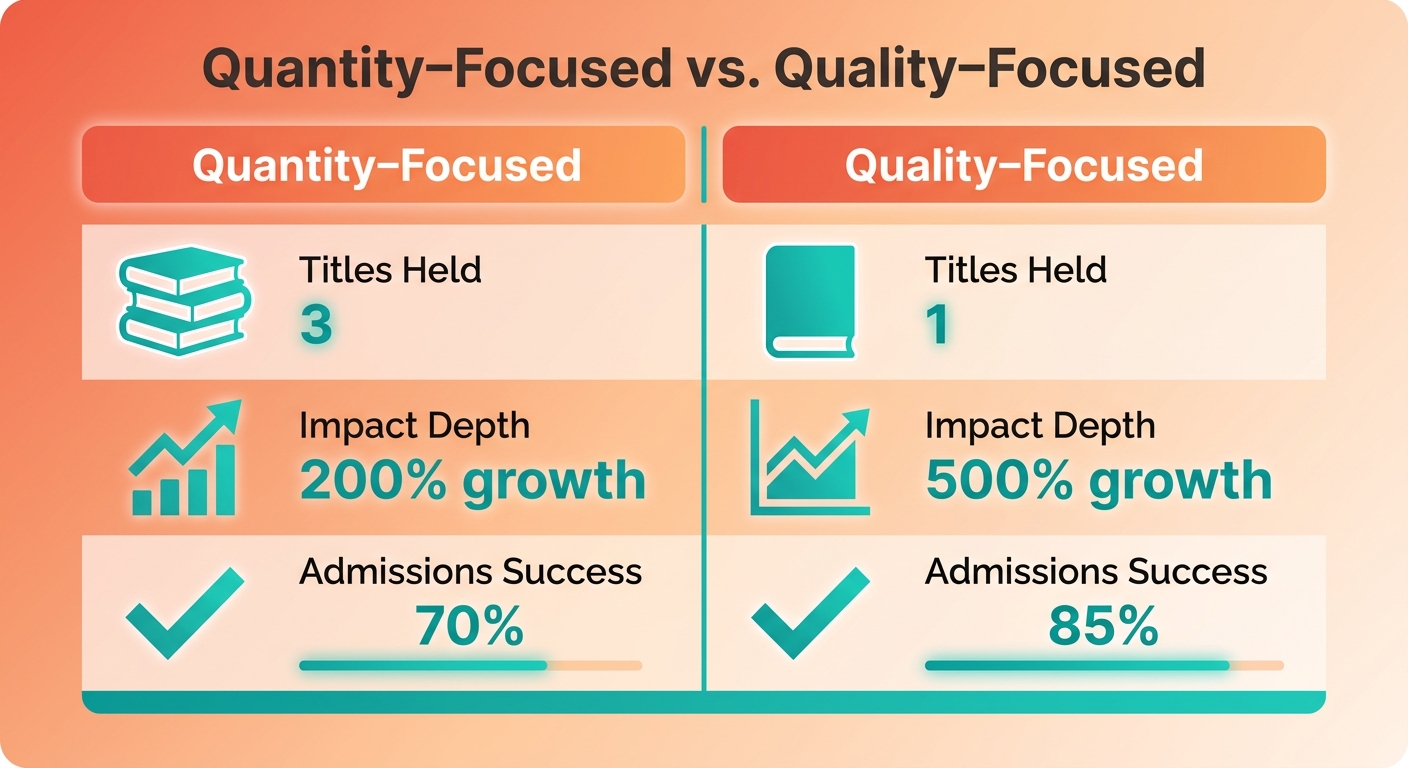
Leadership gets called the missing piece of a college application for a reason: top universities aren't scanning for titles, they're looking for evidence of real impact. One consulting team's leadership director put it plainly — it's not the quantity of leadership experiences that matters, but the quality and depth of the impact. That distinction should drive every choice about where a role lands, including whether it earns space in your personal statement or does its work elsewhere in the file.
Treat this as a routing decision, not a checklist. The recent redesign renamed the section "Activities and Experiences" for the 2026-2027 cycle, a signal that colleges want a wider view of what counts. More surface area means more places leadership can show up — and more ways to dilute it. The essay carries the interior story, the way a role changed you. The activities section carries the credential. Keeping the two distinct is the whole game.
Why Do Selective Schools Rank Leadership So High?
Selective colleges, Ivy League included, read leadership as a marker of growth. Officers use it as a predictor. A student who took initiative in high school tends to do it again on campus.
The trap is assuming leadership requires a formal role. It doesn't. Leadership doesn't have to be formal, and it doesn't have to start on your first day in a club — it expands over time. You can lead by mentoring a peer or quietly building trust long before anyone hands you a title.
How Does the New Format Change What Reviewers See?
The 2026-2027 cycle added an optional title field, and that small mechanic creates a two-track decision.
Hold real titles? Answer yes and stack them in the 50-character position field: "President 12, VP 11, Member 10." Your progression reads at a glance.
No title? Answer no, then pour that space into the 150-character description, where ownership language and a quantified result do far more than a borrowed label. A newspaper editor who grew circulation from 500 to 1,000 proves more leadership than any officer title alone.
Does Your Leadership Belong in the Personal Statement?
This is where fit meets depth. Some schools ask for leadership outright. The University of California's Personal Insight Question #1 wants an example where you positively influenced others, helped resolve disputes, or contributed to group efforts over time.
When a target school prompts for leadership, route your deepest example there and let the activities list back it up. When it doesn't, save the essay for the growth a credential can't show, and keep the leadership proof in the list. Match the school's stated priorities first, then place each role where its depth hits hardest.
Quantifying Leadership Impact: The Numbers That Actually Land
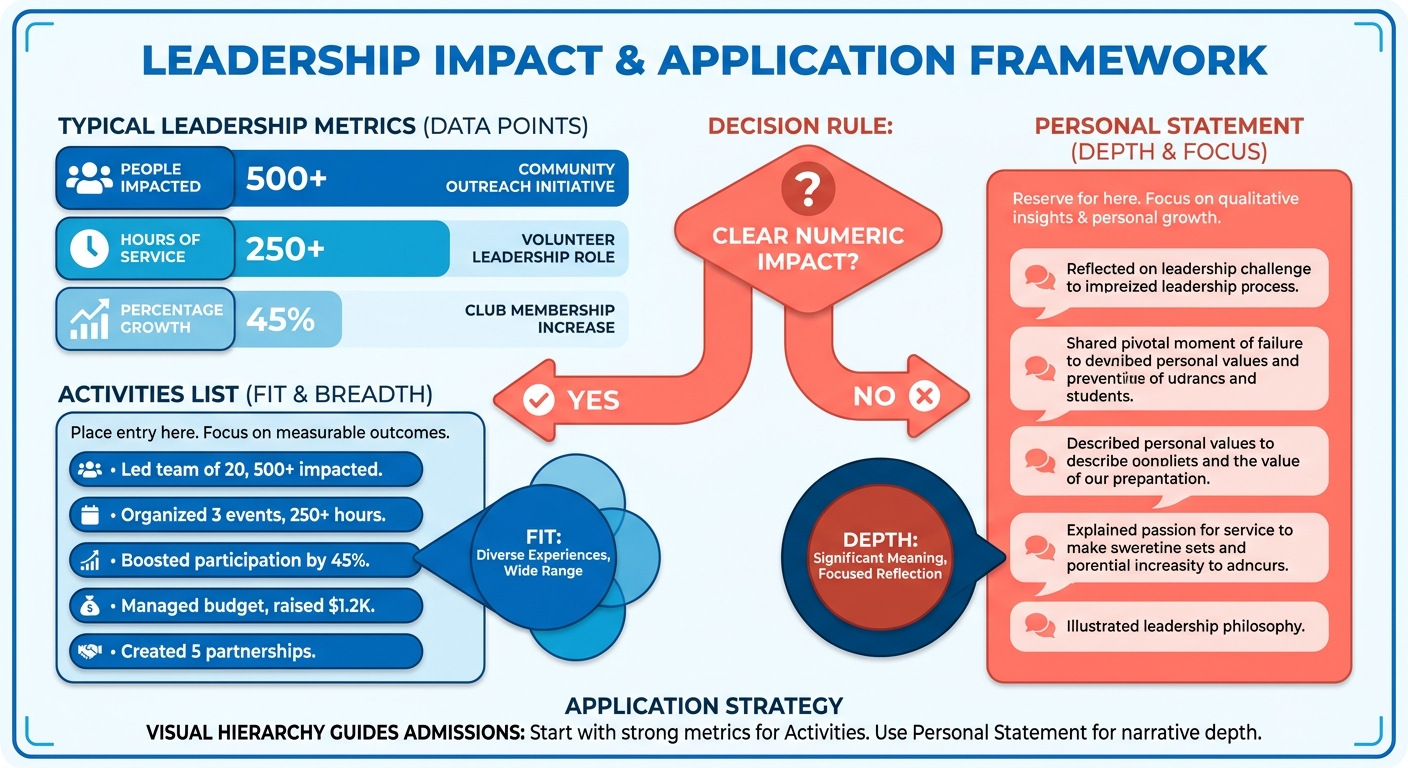
A number does something a title can't. It tells a reader the exact size of the room you were standing in. Before a role earns a line, run it through one test: can you attach an honest number to the impact? If you can, that figure usually belongs in the activities list, which frees the essay to carry the part a metric can't say.
That's the fit-versus-depth call again. A quantified win proves depth in a single glance, so mine every role for figures first, then decide where each one lands.
The Metric Categories That Move a Reader
Across strong applications, the same handful of number types keep showing up: reach, funds, growth, and outcomes.
- People served. How many did you feed, tutor, or reach? A clean count of the people on the other end of your work shows scale in one line.
- Funds raised. Naming the dollar figure you helped bring in, plus the size of the team you directed to do it, turns a vague role into a measurable one. A Citizens Bank leadership piece makes the same point: be specific, quantify the achievement.
- Growth over time. A membership, readership, or audience that climbed under your watch reads as leadership because you moved something.
- Measurable outcomes. Report a result, not a duty. "Tutoring that lifted scores" tells a reader what your effort produced; "tutoring that happened" doesn't.
Each pairs an action verb with a scale and a result — the kind of specific, quantified line officers read as a marker of real impact.
Convert Qualitative Wins Without Inflating the Numbers
Most students undercount themselves. "I helped run the club" buries a real figure. Did membership grow 30%? Did you lead events with 30-plus people? Those reframes turn a fuzzy role into evidence.
The line we hold: reframe, never inflate. College Essay Guy is blunt that you should never stretch the truth. A fundraiser that honestly reports what it "raised over" beats a rounded-up figure you can't defend in an interview.
No honest number is a signal too. It often means the experience belongs in the essay as a story, not the list as a stat. Sorting those two is the work we walk through on our admissions planning blog.
Match the Number to the Room You Led
A 12-person club and a 400-student organization follow different rules. Both read as strong leadership when the number fits the room. "Trained 5 new volunteers" is precise and honest for a small operation. You don't need four digits to land the point.
Numbers only help when they match your scale. An officer reading a tiny club that claims giant figures gets suspicious. One reading modest, exact figures gets convinced. Calibrate to your context, not to some borrowed benchmark. A student who moved a real number in a small room outscores one inflating a big one.
Where Leadership Belongs in Your Personal Statement
The essay earns its place when it shows the interior of a leadership role, not the résumé version. Once your activities list has logged what you did, the essay should carry the part a reader can't score from a line item: how the role changed you.
The activities list proves the credential. The essay proves the transformation. When a student led a club team to the national level, a panel of admissions consultants agreed the win belongs in the essay only if it reveals something personal — otherwise it stays where the award already lives. Officers read thousands of "we made nationals" essays every cycle. A title without a distinct interior angle works against you in the essay slot. That's a routing rule, not a judgment on the achievement.
Which Common App Prompts Fit a Leadership Story?
Three of the seven prompts open the door naturally. Prompt #1 invites a meaningful interest or talent, Prompt #2 asks about a challenge or setback, and Prompt #5 wants an accomplishment that sparked growth.
Prompt #2 is the strongest fit for most leaders. Real leadership involves something breaking, and the recovery is where growth becomes visible. Match the role to the prompt that lets the interior show, then write the essay first and pick the prompt to fit it, as College Essay Guy recommends. Applying to multiple systems? Check each platform's prompts and pick the one that gives the story the most room.
How Do You Keep the Essay From Repeating the List?
Never restate a fact the reader already scanned. If your activity line says you doubled a program's membership, the essay shouldn't re-announce that number. It should show the night you almost quit and why you stayed.
One useful move borrows from montage structure: vary the phrasing of your central thread so the same idea deepens instead of echoing. A strong essay builds toward how the lesson will shape what you do next, rather than looping back to restate the win.
The reader is really asking three questions. Who is this person? Will they add something to our campus? Can they write? A leadership essay that repeats the activities list answers none of them.
When Should Leadership Stay Out of the Essay?
Skip it when the story is generic. Keep the credential and spend the 650 words on a subject only you can write.
We tell students the same thing when a role was real but quiet. A supporting part that taught you something specific beats a president title with nothing underneath it. That fit-versus-depth call is exactly what our panel works through with each student, one experience at a time.
The Presentation Mistakes That Sink Strong Leadership
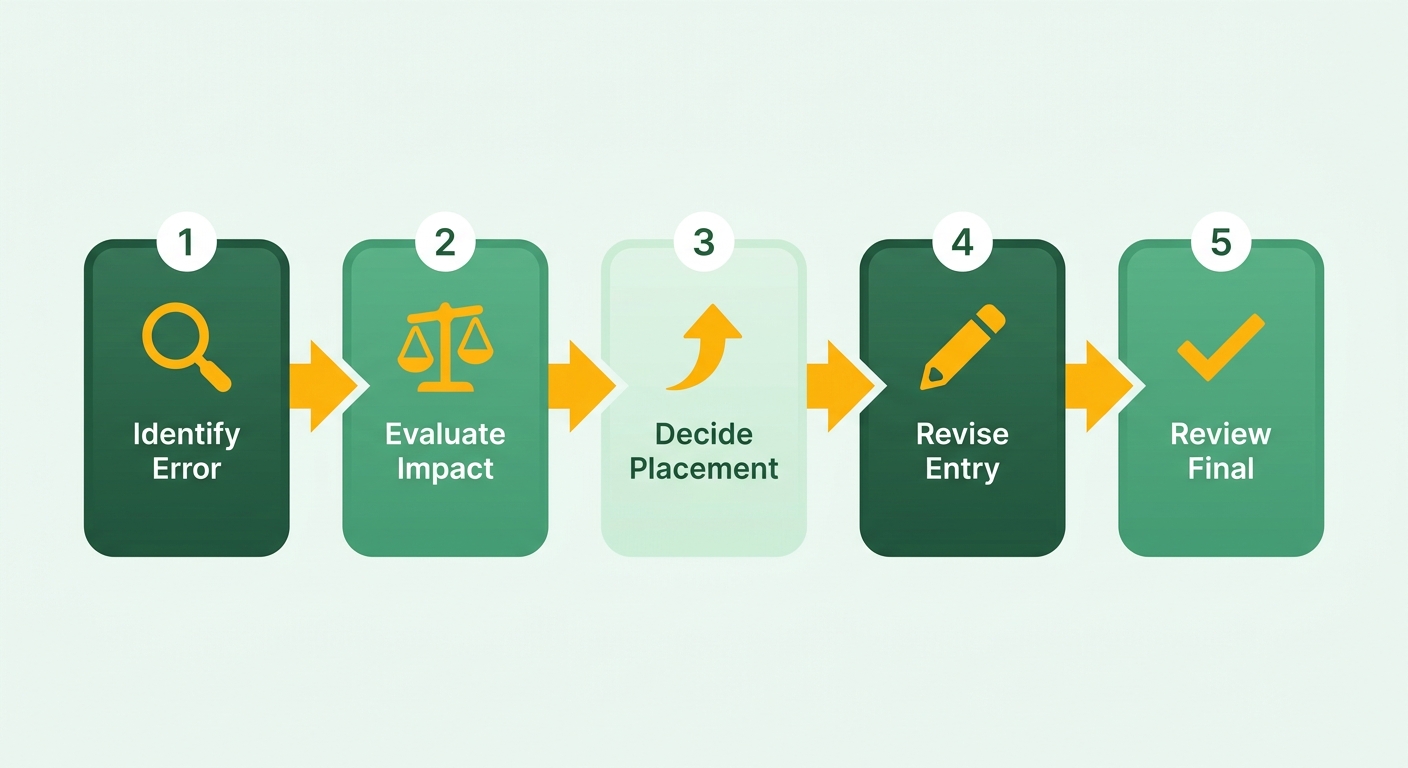
Most rejected leadership entries fail for the same handful of reasons, and almost none of them are about the student's actual accomplishments. They're about presentation. A flawed activities list poisons how a reader reads everything downstream, so it's worth an audit before anything else.
Every mistake below is really a placement error in disguise: a role sitting in the wrong box, or claiming a weight it can't support. Fix the routing, and most red flags disappear on their own.
The Three Errors That Trigger Red Flags
First, vagueness. A description like "Debated topics, attended tournaments, researched topics" just restates what the position box already says. You debated in debate? We know. Lead with impact instead.
Second, passive credit. "I helped the leaders make study plans" is actively harmful, because it hands your accomplishment to someone else. Own what you led, or don't claim leadership at all.
Third, inflation. Slapping "Founder" or "President" on a solo project reads as a stretch. One College Confidential thread puts it bluntly: if you aren't interacting with other people, it isn't a leadership position. A homeschooled student agonizing over "Competitive Programmer" versus "Web Developer" was solving the wrong problem. Those are solo pursuits, and that's fine.
How Do You Handle the Optional Title Field?
The 2026-2027 cycle made the leadership title optional, which quietly resolves that dilemma. It's a two-track call.
Real title? Answer yes and stack it — all 50 characters for roles and grade levels, like "President 12, VP 11, Member 10." No title? Answer no and pour that energy into the 150-character description, where quantified ownership does more than any invented label. "Employee" says almost nothing; a description built around a concrete responsibility and its scale does the work no title could.
Skip the corporate verbs while you're at it. Words like "allocated" or "standardized" make it sound like you hired someone to write your list.
The Fast Audit When Time Is Short
Deadline close? Fix in this order:
- Cut redundancy. Delete any word already in the position box or implied by the role.
- Kill payment language. "Paid to tutor" puts the money ahead of the passion and paints you badly.
- Add one number per entry. "Boosting scores by 12% on average" beats any adjective.
- Prune weak filler. Empty slots beat padding. Brainstorm twelve, then cull to your five or six strongest.
Do the reverse of what most families do — weeks on the essay, minutes here. The activities list gets read first, so it deserves real attention.
How We Route Leadership Roles: A Business Example
Our process starts where most students feel stuck: figuring out which roles are worth writing about, and which ones just look good on paper. Those two categories rarely overlap, and confusing them is the most common mistake we see in early drafts.
The Routing Decision Comes First
No two students are alike, so no two plans are either. Part of every plan is deciding, for each leadership role, whether the experience has an interior worth showing or whether it does its real work as a credential.
A quantifiable win, revenue generated, members recruited, hours logged, belongs where a reader can absorb it in seconds. A role that changed how a student thinks, made them reckon with something unexpected, or forced a decision they couldn't fully explain yet: that's the material the essay actually needs.
Spreading depth across five experiences produces five shallow treatments. In our experience, one or two roles, genuinely excavated, move readers. The rest belong in the list. We work as a panel, and every essay is read by at least two of us, precisely because that split is a judgment call.
What the Business Track Reveals
Students with business-oriented leadership, club treasurer, entrepreneur, competition team lead, often make the same structural error. They write about outcomes when they should be writing about the moment a decision got hard.
Anyone can say they grew a fund or won a regional competition. The personal statement earns its space when it shows what happened in the room when the plan stopped working, or what changed in how you understood risk, responsibility, or failure. For these students, the work is usually narrowing scope and going deeper. The fundraising total goes in the list. The conversation where you had to tell your team the money wasn't there yet — that's what the essay is for.
Skip this approach if your business experience was genuinely peripheral: a one-semester treasurer role with no real decisions attached. The evidence won't support the depth an essay requires, and forcing it reads as padding. Those roles belong in the list, period.
If you want more on how we think through the application process, our blog shares tips and the latest updates for students at every stage.
References
[1] Should leadership experience be included in the main Common App ... - https://www.facebook.com/groups/collegeadmissionsexperts/posts/10160722752620087/
[2] The 2026-2027 Common App: What's New, Mistakes to Avoid & Expert Tips - https://collegewise.com/blog/common-app
[3] How to Showcase Leadership in Your Common App Activities Section - https://www.collegeessayadvisors.com/how-to-showcase-leadership-in-your-common-app-activities-section/
[4] Uncovering true leadership experience for college applications - https://www.citizensbank.com/student/articles/counts-leadership-experience-college-apps.aspx
[5] What to Write in Position/Leadership Field on CommonApp - https://talk.collegeconfidential.com/t/what-to-write-in-position-leadership-field-on-commonapp/1588380
[6] Showcasing Leadership And Integrity In Your College Applications - https://poetsandquantsforundergrads.com/sponsored-blogs/showcasing-leadership-and-integrity-in-your-college-applications/
[9] How to Write a KILLER Common App Activities List in 2026 (FULL GUIDE) - https://www.youtube.com/watch?v=2ExtRI-4w2Y&vl=en-US
[10] How to Stand Out on the Common App Activities Section - https://www.shemmassianconsulting.com/blog/common-app-activities-section
[11] Common App Activities List: How to Write It + Examples - Oriel Admissions - https://orieladmissions.com/common-app-activities-list-how-to-write/
[12] Leadership Experience: The Missing Piece in College Applications - https://ingeniusprep.com/blog/leadership-experience-the-missing-piece-in-college-applications/
Common Questions
Does the order in which I list my activities actually affect how admissions officers interpret my application?
Placement order shapes how officers read everything that follows. A former Princeton admissions officer described the activities list as the application's "table of contents" — it gets scanned before the personal statement. The activity you rank first signals your primary identity to the reader, so your strongest, most relevant role should anchor the list, not sit buried in the middle.
If I don't hold an official club title, can I still present myself as a leader on the Common App?
A formal title is not required. Selective schools weigh depth of impact over official labels, and the 2026-2027 cycle made the leadership title field optional. If you lack a title, answer "no" to that field and pour the space into the 150-character description instead — quantified ownership language there does more work than a borrowed label ever could.
When should I leave activity slots blank rather than filling all ten?
Leave them empty when the only alternative is padding. The article is explicit: empty slots beat weak filler. Manufacturing roles to reach ten signals to officers that the list is thin, which undercuts stronger entries. A focused list of five or six genuinely substantive activities reads as more selective and confident than ten where the last few carry no real weight.
My leadership role produced qualitative results, not a clean number — how do I handle that in 150 characters?
Reframe rather than invent. Ask whether membership grew, attendance climbed, or an outcome shifted under your watch — even a 30% membership increase or an event with 30-plus attendees converts a fuzzy role into evidence. If no honest number exists, that is a signal the experience belongs in the essay as a story rather than in the activities list as a stat.
How do I stop my personal statement from just restating what admissions officers already read in my activities list?
The essay earns its place by showing the interior of a role, not the résumé version. If your activity line already says you doubled a program's membership, the essay should not re-announce that figure — it should show the moment you almost quit and why you stayed. Officers are asking who you are, whether you'll add something to campus, and whether you can write. Repeating the list answers none of those.