How to Compensate for Fewer Application Supplements
September 18, 2026

The Short Version
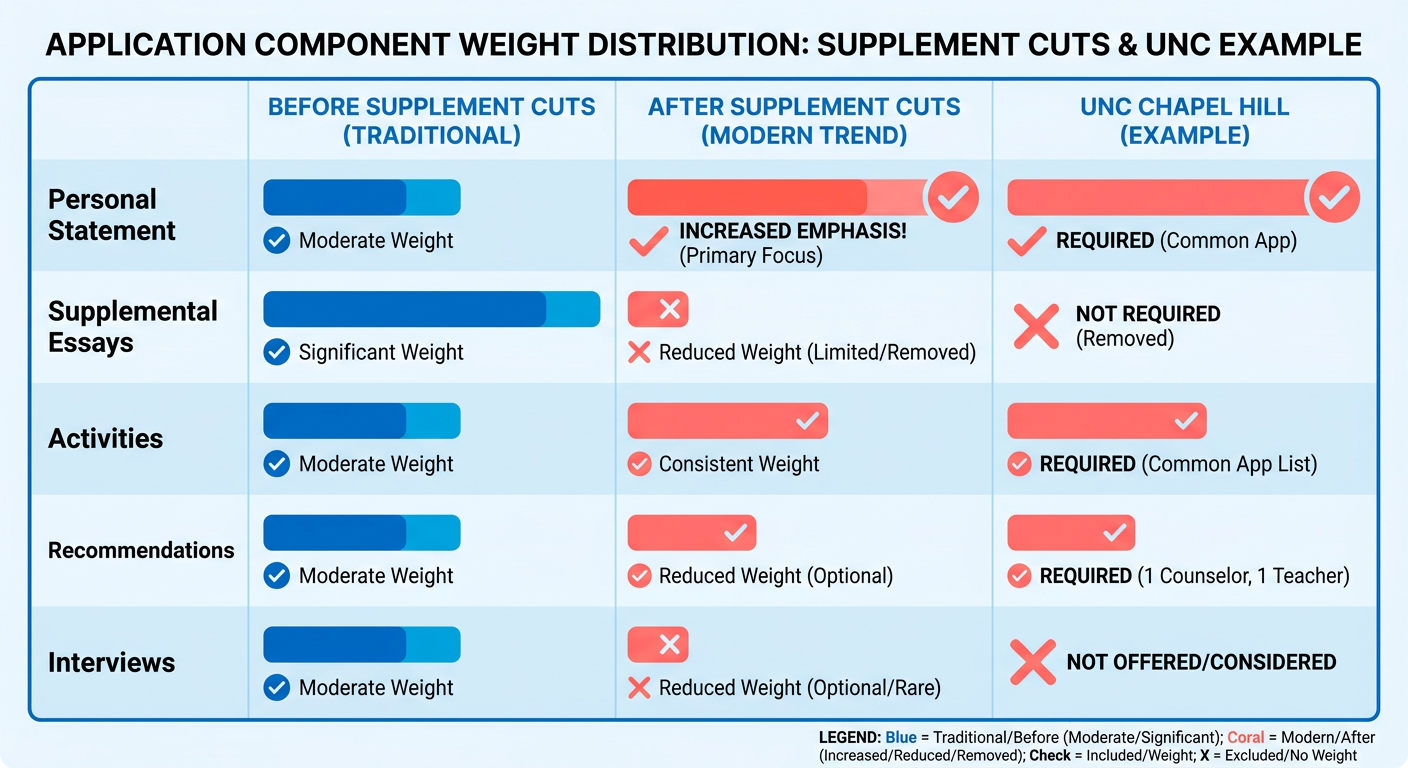
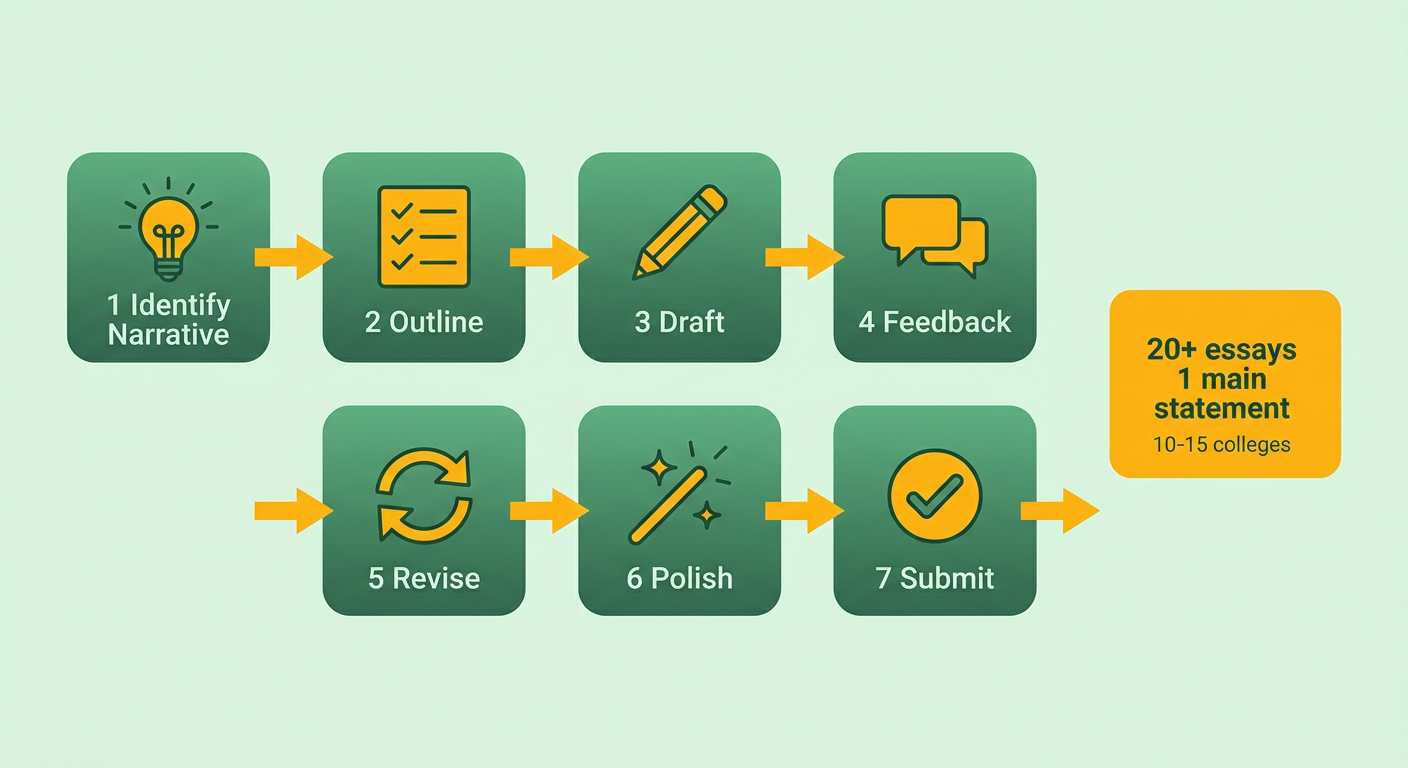
UNC Chapel Hill now asks for only the Common App personal statement and an activities list. Nothing else. When a school drops its supplements, it lowers the cost of applying. That floods the pool while seats stay fixed, so applying gets easier and admission gets harder. A student applying to 10 to 15 colleges used to grind out 20 or more supplemental essays in a single summer. When those requirements vanish, so does that block of work. Georgetown, Stanford, MIT, and most elite liberal arts colleges still require their full supplement set. Tulane, UVA, and Washington University in St. Louis have trimmed theirs.
Why the freed hours are your real edge
Retiring a prompt doesn't lower the bar. It shifts the weight onto whatever's left, and the heaviest piece left is your personal statement. With fewer places to prove fit, that one essay does work it never had to do before. UNC applicants now submit the Common App essay plus an activities list, per StrivePath's cycle breakdown. If it reads flat, nothing behind it picks up the slack.
Why does a lighter application get harder to win?
The mechanism is volume. A Wall Street Journal report said it plainly: these moves make applying simpler and getting in tougher. Drop the supplement, and the lighter form invites more people to hit submit. Same seats, more competitors.
Schools frame the cuts as stress relief. That holds for exactly one student filling out one form. Prestige's analysis catches the tell: if stress were the real driver, colleges would shorten prompts instead of deleting whole writing categories while leaving coursework and recommendations untouched. Both things can be true. Less friction per application, worse odds across the board.
Where should the freed time actually go?
That stack of summer essays doesn't turn into free afternoons. It becomes yours to reinvest. In our experience, the highest-return move is redirecting those hours into personal statement depth, sharper activity framing, and interview prep.
The reinvestment is also defensive. Colleges increasingly say AI has made it harder to tell whether students are doing their own writing, as the Journal reports. A polished-but-lifeless essay now reads as riskier than an imperfect one that sounds like a real person. Your voice has to stay consistent across the essay, the interview, and any short answer that's left.
Who benefits most from getting this right?
International applicants, students without a deep extracurricular résumé, and families fighting a tight timeline gain the most. When there's no supplement to explain your context, that context has to live in the personal statement and the interview instead.
Skip the heavy reinvestment only if your list is entirely schools that kept the full set. Georgetown, Stanford, MIT, and most elite liberal arts colleges still ask for the whole battery, per StrivePath's list. For everyone else, the freed hours aren't a break. They're your edge.
The personal statement is now the whole argument
When a school cuts its supplements, your personal statement stops being one essay among many. It becomes the case for why you belong. Treat it that way and a lighter workload turns into leverage.
We tell families to reinvest the freed time, not bank it. The hours you'd have spent drafting eight supplements can go into deeper interview prep and the real experiences that fill out an activities list. This is where our base-plus-bonus fee model does its work: our standard prices stay below competitors', and you pay the full fare only if you're satisfied. That keeps us invested in the harder work fewer supplements now demand.
How do you pick a topic that carries the whole application?
Pick the topic only you could write. A strong personal statement now has to prove the fit a "Why Us?" essay used to handle, so choose a moment that reveals how you think, not just what you did. Specificity beats grandeur every time.
Start from your core strengths. Name two or three, then thread the strongest one through the essay, the activities list, and the guidance you give recommenders. When every piece points the same way, the reader hears one clear argument instead of five disconnected ones.
What is the through-line technique?
A through-line is a single thread of meaning that pulls a scattered life into one story. You name a value or a question early, then return to it as the essay moves through different experiences. It lets you fold research, leadership, and community work into one arc instead of listing them like a résumé.
That matters more now that fit signaling has to live inside the main essay. IvyWise cites a Boston College prompt built on the idea that a university is a sustained conversation about big questions. You can answer that spirit by showing the questions you keep circling back to, even at schools that never ask.
Read model essays for shape, not sentences. As the SAGE Scholars guide puts it, "You use example essays for an example of structure, not to copy the writing style and conventions."
How should you quantify impact without leaning on numbers?
Lead with the change you caused, then let one number confirm it. Outcome first, metric second.
Our editing runs in panel rounds. Every essay is read by at least two members of the Endurable Education team, so more than one set of eyes tests the through-line, the vague claims, and your voice. That layered pass is where a competent essay becomes one a reader remembers.
Recommenders and the interview do the confirming
When a school drops its supplements, the two pieces most students underprepare become the tiebreakers: recommendation letters and the interview. Your personal statement carries the narrative, but a teacher's letter and a live conversation confirm it from the outside. Admissions readers trust corroboration. Fewer essays, deeper prep.
Brief your recommenders like you mean it
A generic letter says you're hardworking and kind. A strong one names the afternoon you stayed after class to rebuild a failed experiment. The difference is the brief you hand the teacher.
Give each recommender a short packet: two or three specific stories, the traits those stories prove, and the schools' stated priorities. You're not writing the letter. You're giving the writer the raw material to be concrete.
Skip this only if a teacher already knows your work cold and writes strong letters by reputation. For everyone else, that brief is the highest-return hour you'll spend this fall.
The interview is where a thin application recovers
With one essay doing the heavy lifting, a sharp interview fills in everything the paper application couldn't say.
Practice out loud. Note the moments you ramble or undersell, and rerun the same questions until the answers land tight. We teach students to anchor a response in a real situation, the action they took, and the result, so stories stay specific instead of drifting into cliché. School-specific research matters too, so we drill you on why this program, not just why college. Vague enthusiasm reads as unprepared.
The trade is simple. You gave up supplement volume. In return, you walk into the interview with answers most applicants improvise. Our admissions blog walks through how these pieces fit a lighter application.
The activities list is evidence now, not a footnote
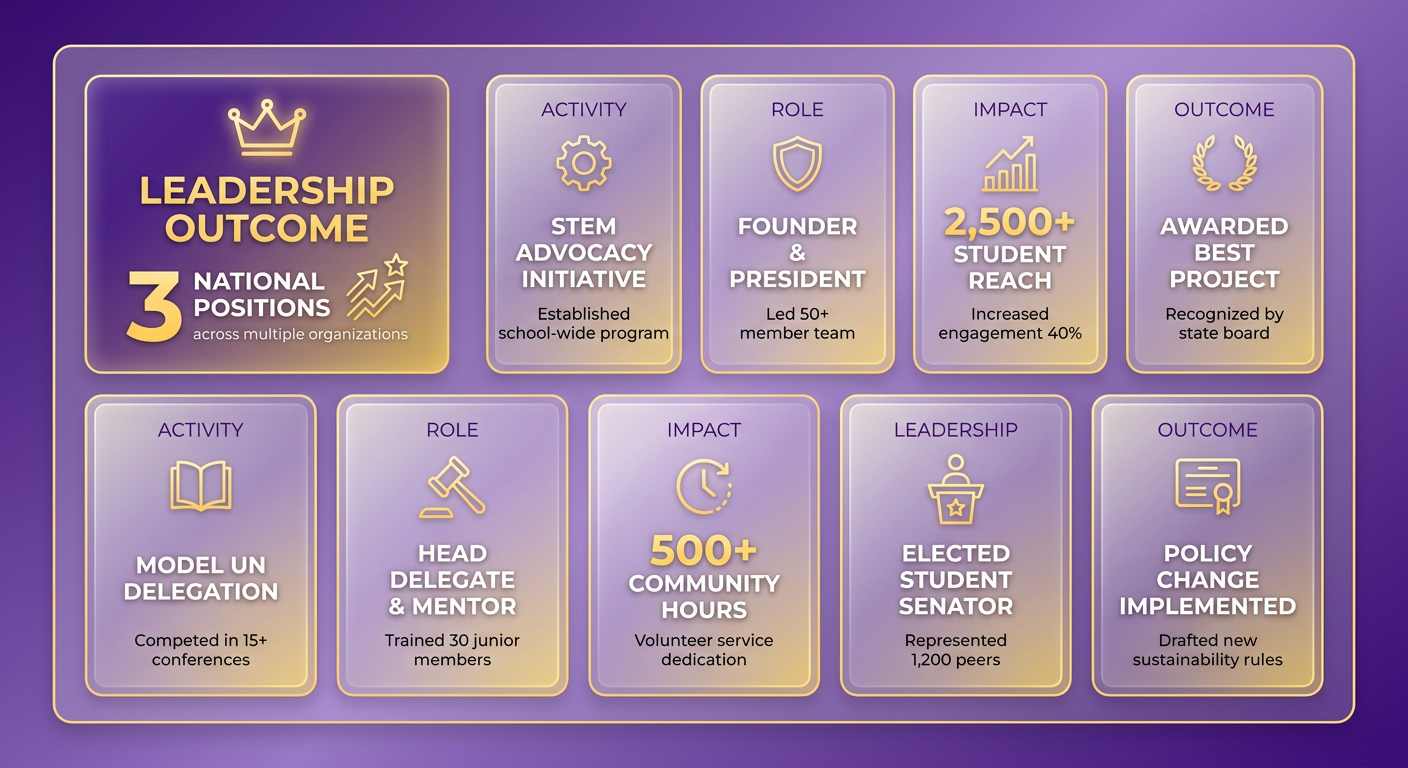
When supplements disappear, the activities list stops being a formality tacked on at the end. It becomes proof you actually did the things you claim. We treat those ten entries as their own argument.
How do you show depth without leaning on numbers?
Depth beats breadth. A reader would rather see one activity you shaped over three years than ten you joined for a season. So pick a lane and go deep.
Measurable impact doesn't require statistics. "Rebuilt the tutoring schedule so younger students got weekly sessions" says more than "logged 200 hours." Name what changed because you were there. Who benefited. What existed after you that didn't before. That's impact a reader can picture.
Start each entry with a verb that carries weight. Founded. Organized. Rewrote. Trained. Cut the passive filler and lead with the action.
What ties the entries together?
Order your activities so they tell one story, not ten unrelated ones. Group by theme. If your narrative is community health, cluster the clinic volunteering, the biology club, and the fundraiser near the top so the thread shows on the first pass.
The top three slots do the heaviest lifting. Put your deepest, most defining commitment first. Readers move fast, and the early entries frame everything below them. A short list of real leadership beats a long list of memberships, so skip the padding. We build this portfolio work with students all year, exactly where the reclaimed supplement hours go.
Demonstrated interest is the new "Why Us?"
When schools drop supplements, some quietly bring back a different signal: demonstrated interest. Washington University in St. Louis now weighs whether a student visited campus, attended an info session, or engaged directly, according to College Placement Consulting's breakdown of this cycle. The essay that used to prove fit is gone. Showing up is how you prove it now.
That reshapes how we build a college list. A strong personal statement still anchors everything, but it no longer has a supplement backing up your reasons for one specific school. So we pick targets where your genuine strengths match what the school actually values, then let low-effort interest signals carry the "why us" the retired essay used to.
Match schools to your personal statement's strengths
Start with fit, not prestige. A no-supplement school isn't automatically a safe bet. Northeastern pulled in 105,092 applications for the Class of 2029, and easy-to-submit forms draw exactly that crowd. Deceptively competitive is the phrase to hold onto.
No two students are alike, so no two of our strategies are. We map your academic record and activities against what each school genuinely rewards. Where a school values engagement and your profile already leans that way, it earns a spot. Where it doesn't, another essay-free application is just a lottery ticket you paid for with effort.
Interest signals beat another essay
For demonstrated-interest schools, that means concrete, non-essay actions:
- Attend virtual info sessions and register with your real email so the visit is logged.
- Send one specific, researched question to an admissions officer or a professor whose work fits your interests.
- Use Early Action where it signals commitment, but treat the round as a deadline for depth, not a shortcut.
That last point needs care. Early Action volume tends to climb each year, yet the early "advantage" is largely unproven, because most colleges never reveal how odds shift by round. The gain comes from a non-rushed, well-prepared submission, not the slot itself. Apply early because you're ready, not to game a rate nobody publishes.
Track outreach before it slips
Demonstrated interest only counts if it's recorded and consistent. That's what our regular check-ins are for: we use them to clarify goals, prioritize commitments, and track each school's contact, session attendance, and interview status. It sounds basic. It's also the difference between four logged touchpoints and a vague memory of "I think I opened their email." In a crush of more students sending more applications to the same seats, a documented pattern of genuine interest does the quiet persuading your missing supplement used to.
Timeline and checklist for a lighter application
A calendar beats good intentions. When supplements shrink, the danger isn't too much work. It's drift. With fewer hard deadlines forcing your hand, the personal statement and the deeper prep around it can slide until October, when panic does the writing for you.
So anchor the year to the one fixed date that still matters. The Common App opens August 1, and most supplement prompts land in the weeks before, according to IvyWise. Treat the summer before senior year as build season, not rest.
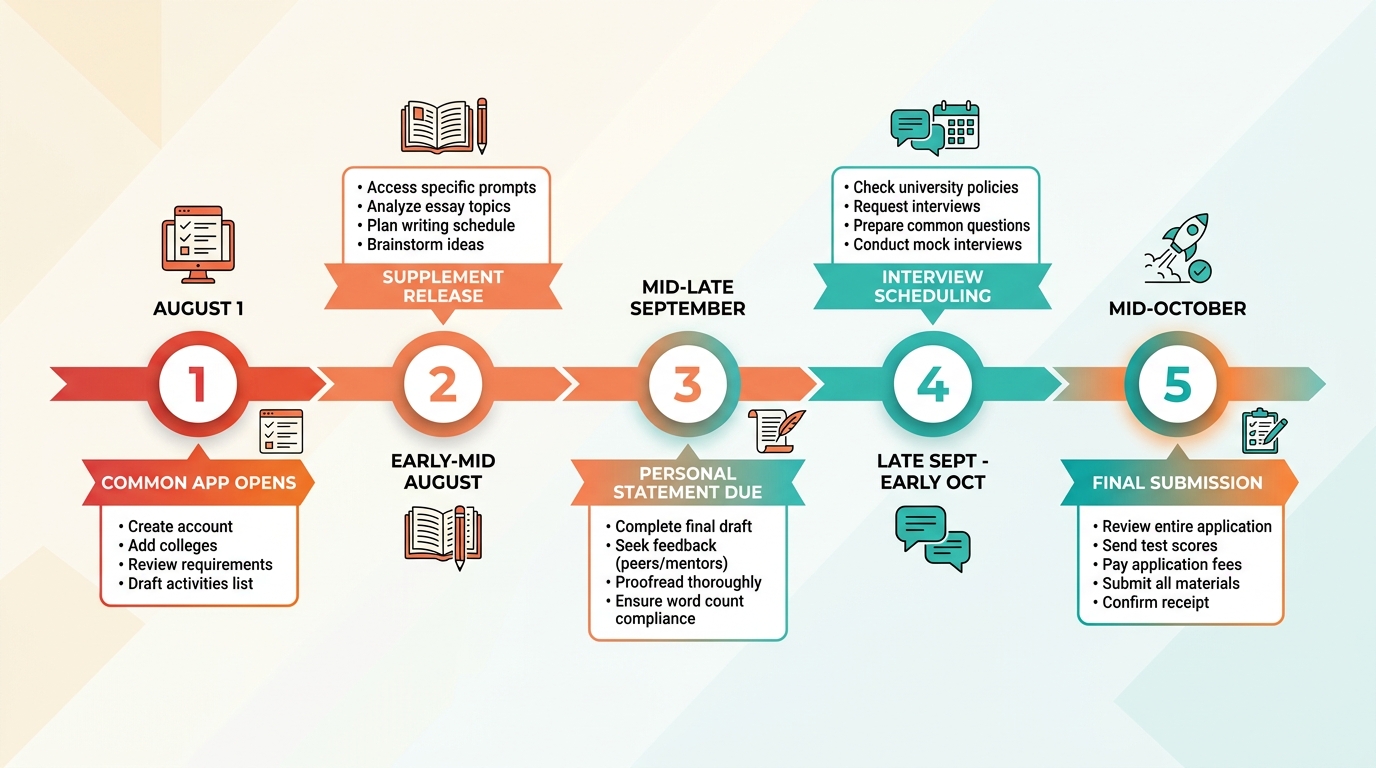
When should your personal statement for university be finished?
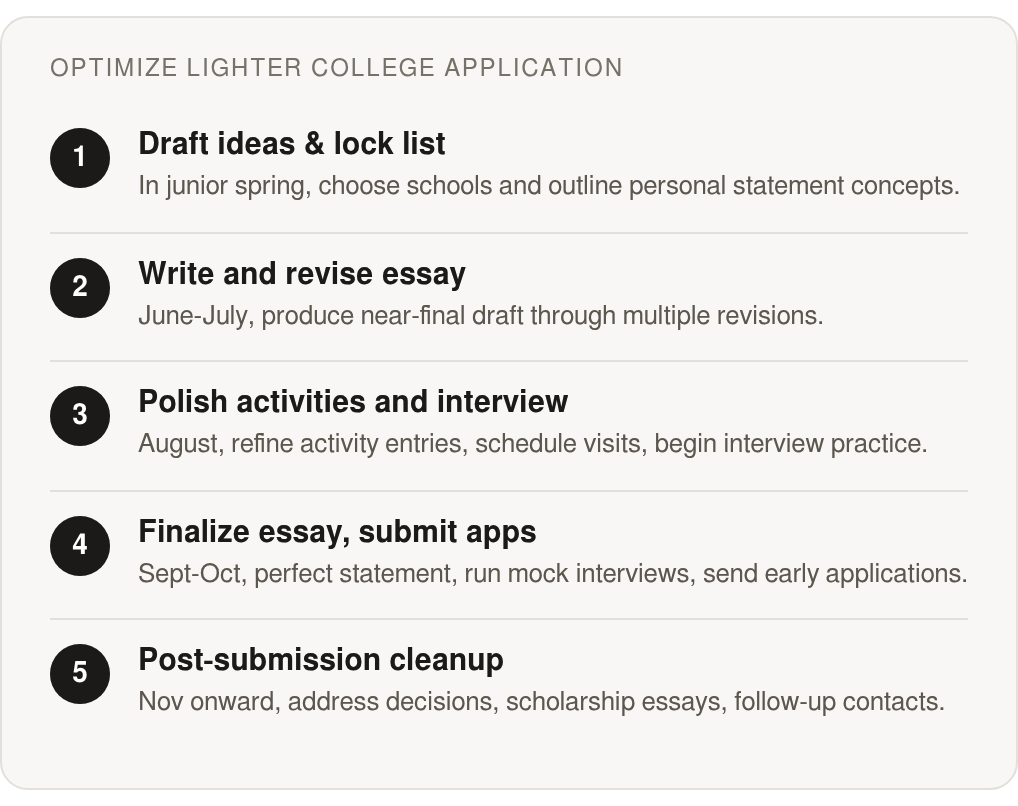
Here's the sequence we run. Adjust the months to your deadlines, but keep the order.
- Spring of junior year: Lock your college list and draft main essay ideas. Ask recommenders now, before their queue fills.
- June to July: Write and revise the main essay to a near-final draft.
- August: Polish activities entries and start interview prep. Book campus visits where demonstrated interest counts.
- September to October: Finalize the personal statement, run mock interviews, submit early applications.
- November onward: Regular decision cleanup and scholarship essays.
Notice the front-loading. A finished main essay by August is the single biggest lever, because everything downstream depends on it.
Where do students get stuck?
The bottleneck is almost always revision, not the first draft. Students underestimate how many passes a strong essay needs, then run out of runway. Build a two-week buffer before every submit date and guard it.
This is where our fee model pays off: lower standard prices free families to pour reclaimed supplement hours into weekly check-ins, mock interviews, and portfolio work, with full payment tied to your satisfaction. Weekly touchpoints keep the plan honest. Monthly milestones catch slippage before it becomes a missed deadline. Structure is what turns a lighter application into a sharper one.
References
[1] The Shift Away From Supplemental Essays - Applerouth - https://www.applerouth.com/blog/fewer-essays-more-applications-the-new-admissions-math
[2] Colleges Juice Application Numbers by Letting Students Write Fewer ... - https://www.wsj.com/us-news/education/colleges-essays-supplemental-applications-admissions-9e7f8651
[3] Fewer College Essays in 2026: What It Means for Your Student - StrivePath - https://www.mystrivepath.com/colleges-dropping-supplemental-essays
[4] 2026-27 Common App Supplements | IvyWise - https://www.ivywise.com/blog/common-app-supplements/
[5] Colleges Without Supplemental Essays? Yes, Please. - https://toptieradmissions.com/colleges-without-supplemental-essays-yes-please/
[6] Why Colleges Are Dropping Supplemental Essays | CPC - https://www.collegeplacementconsulting.com/post/college-supplemental-essay-changes
[7] College Applications Without Essays: Do They Exist? - Collegewise - https://collegewise.com/blog/college-application-without-essay
[8] 125 Colleges with No Supplemental Essay Requirement - PrepMaven - https://prepmaven.com/blog/researching-schools/colleges-without-supplemental-essays/
[10] Supplemental Essays Are Changing—Fewer Essays, Higher Stakes - https://www.prestigei.com/post/supplemental-essay-changes
[11] Why Colleges Are Changing These Three Admissions Policies - https://www.saraharberson.com/blog/colleges-changing-admissions-policies
Frequently Asked Questions
If a school dropped its supplements, doesn't that make it a safer school to apply to?
Treat no-supplement schools as deceptively competitive, not safe. Easier submission swells the applicant pool while seats stay fixed. Northeastern drew 105,092 applications for the Class of 2029, exactly the crowd that easy-to-submit forms attract. Match fit to what the school rewards rather than assuming lighter requirements mean better odds.
My college list is entirely schools that kept their full supplements. Do I still need to reallocate time?
Skip the heavy reinvestment if your list is entirely full-supplement schools like Georgetown, Stanford, MIT, and most elite liberal arts colleges. Those still require the whole battery of essays, so your hours already have a home. The reallocation strategy applies to students targeting schools that trimmed or dropped requirements, such as Tulane, UVA, and WashU.
Does applying Early Action improve my odds at schools that cut essays?
The early "advantage" is largely unproven, since most colleges never reveal how odds shift by round. Early Action volume tends to climb each year regardless. The real gain comes from submitting a non-rushed, well-prepared application, not the slot itself. Apply early because your materials are genuinely ready, not to game an unpublished rate.
Will polishing my personal statement with AI help or hurt my application?
Colleges increasingly say AI has made it harder to verify students actually did the writing. Because your voice must stay consistent across the essay, interview, and any short answers, an over-smoothed draft that contradicts your live conversation raises flags rather than confidence.
I don't have a deep extracurricular résumé. Does dropping supplements hurt me more?
International applicants, students without deep extracurricular résumés, and families on tight timelines gain the most from getting this right. When no supplement exists to explain your context, that context has to live in the personal statement and interview instead. The freed hours become your best chance to build that missing narrative deliberately.
How does Endurable Education's pricing actually work?
Endurable uses a base-plus-bonus structure: standard prices stay lower than competitors', and you pay the full fare only if you are satisfied with the service. That model ties their revenue to the deeper work fewer supplements now demand, including panel essay review, where every essay is read by at least two team members, plus mock interviews and portfolio work.
When in the timeline should I ask teachers for recommendation letters?
Ask recommenders in spring of junior year, before their queue fills. That sits at the front of the recommended sequence: draft main essay ideas and lock your list that spring, revise the essay June through July, then prep interviews and activities in August. Requesting late risks a rushed, generic letter instead of a concrete, story-driven one.