What a $15,000 Admissions Consultant Buys: Hours, Essay Drafts, and School Lists
October 31, 2026

Key Takeaways
-
Three consultant quotes near $15,000 can deliver very different workloads, since hourly, boot camp, and multi-year pricing models allocate hours differently.
-
Jill Smith's Brandeis dissertation describes an "admission industrial complex" of commercial firms that has expanded over roughly the past two decades.
-
Families interviewed by Smith credited consultants with mediating, matchmaking, and personal-assistant work while downplaying connections and secret strategies.
-
Endurable Education publishes a self-reported admission figure for top 10 and Ivy League schools; like other firms' numbers, it isn't comparable across consultants.
-
Essay support can move from brainstorming and outlining through student drafting, revision, and final polish across the personal statement and supplements, but the number of drafts is unpredictable.
What $15,000 actually buys from a college admissions consultant
It's spring of junior year, and you have three quotes on the kitchen table, each close to $15,000. One is an hourly rate. One is a boot camp. One is a multi-year package. Each college admissions consultant may land on a similar total and still deliver very different amounts of work, so we start every comparison the same way: turn the price into hours.
That math can be sobering. At the top published rate of $3,000 an hour, $15,000 buys five hours. The quote alone won't tell you how many essay drafts or list revisions that turns into. The market itself has grown more established and more visible, as Jill Smith's Brandeis dissertation documents. More firms means more ways to package the same dollar figure.
What should you compare across admissions consultants?
Four things, side by side. The rate or package structure. What the hours cover. How customized the work is. Any fee sitting outside the quote. Outcome percentages get their own column, because every firm reports its own numbers and few tie their fee to them.
It also helps to know where the hours tend to go:
- Early decision is a binding fall application. If your student is admitted, they commit to attend.
- Regular decision is the standard, nonbinding round with a later deadline.
- Supplemental materials, or supplements, are the school-specific essays and short answers each college adds to the main application.
| Pricing model | What you pay for | Structure | What to check | Extra costs to ask about |
|---|---|---|---|---|
| Hourly | Time with a counselor | Billed per hour, often after a consultation | How many hours your budget actually covers | Whether the consultation fee comes on top of hours |
| Fixed program or boot camp | A set block of sessions | One package, often in senior year | How customized the sessions are to your student | Whether test prep or extra counseling is billed separately |
| Multi-year package | Support across several grades | Tiers based on grade level | Which tier fits your student's stage | What happens if you need more help mid-package |
Timing is a cost too. Some programs ask families to commit well before the work begins. Ours can start as early as 8th grade, with early work focused on meaningful experiences and skills before any application work. Ask every firm the same question: how does its fee connect to the quality of its work?
Do outcome claims justify the price?
Not on their own. We publish a self-reported admission figure, as do other firms. The trouble is that each one picks its own student population, its own school categories, and its own reporting method, which makes the numbers hard to line up. And the target list the consultant helped build shapes the very outcome being measured.
Our recommendation is simple. Pay for work you can count: hours, essay drafts, list revisions. That's also why price rarely predicts which consultant helps. If your student already writes strong drafts and has a sensible list, you can skip the top-tier hourly rate without much regret.
Essay drafts, from brainstorm to final polish
Late August. Your student has three possible opening lines for a personal statement and no idea which one sounds like them. This is where a consultant either earns the fee or quietly burns through your hours. "Unlimited essay support" on a contract tells you nothing about who does the work or how the time gets spent, so ask.
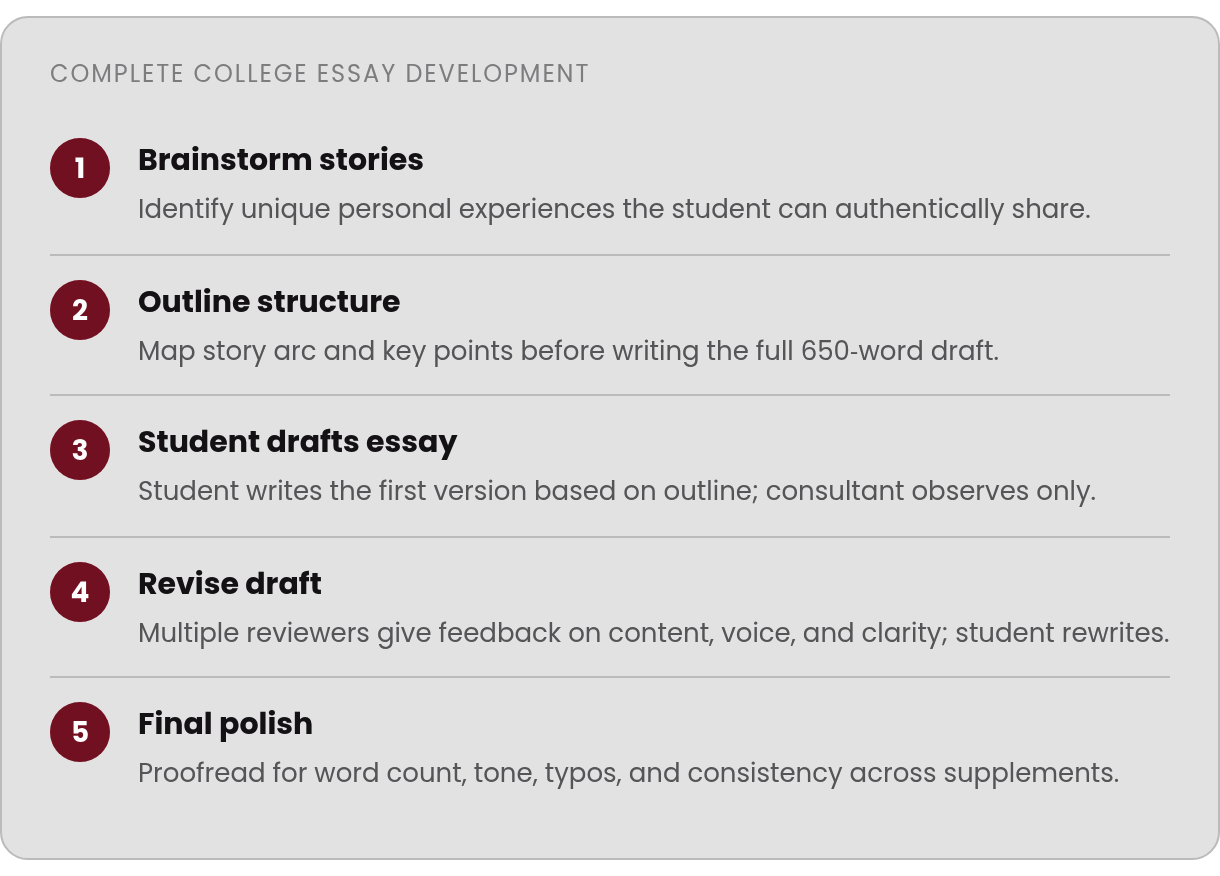
A strong essay process usually moves through five stages:
- Brainstorming surfaces stories only your student can tell.
- Outlining tests whether a story has a shape before drafting begins.
- Drafting belongs to the student. Full stop.
- Revision is often where most of the work happens. Our panel approach gives your student several readers on the same draft instead of one person's opinion.
- Final polish catches word counts, tone slips, and typos across the personal statement and supplements.
How many drafts? Hard to say. Some essays click on the second pass. Others need a full restart in October. A consultant who quotes a fixed draft count is pricing a guess.
Useful feedback tends to cover four areas:
| Feedback area | The question to ask |
|---|---|
| Structure | Does the essay move from a moment to its meaning? |
| Voice | Does it sound like a 17-year-old, not a parent or editor? |
| Clarity | Can a stranger follow it on one read? |
| Storytelling | Is there a specific scene, a turn, and a reason to care? |
If your student already writes well and only needs a proofread, skip the premium essay package. You'd be paying for strategy hours you won't use, and a few hourly reviews will usually cover it. Our breakdown of the five types of admissions consultants shows which models suit lighter needs. Whoever you hire, the essay should stay in your student's own words. Regular check-ins help keep revisions on track without the final draft drifting toward an adult's voice.
Building a school list that fits
Your student's spreadsheet has forty colleges on it. Half were added because a friend applied there. Trimming that list is one of the least glamorous jobs a consultant does, and one of the easiest to overlook when comparing quotes. Ask how many list revisions the fee covers and whether those meetings draw down your hours.
List building is a standard part of independent consulting. Still, no fixed number of schools or set reach-to-safety split works for every student, which is why we customize the plan to each student's strengths and goals. A thoughtful list tends to weigh several factors at once:
- Academic profile: grades, course rigor, and testing, read against each school's realistic range.
- Extracurricular depth: where your student's sustained commitments will actually stand out.
- Geography: distance from home, campus setting, and region.
- Finances: net price, aid policies, and what your family can carry for four years.
These are judgment calls, not an algorithm. A consultant who promises a matching formula is selling a certainty this process doesn't offer.
Early decision belongs in the same conversation. It can sharpen a strategy when one school is a clear first choice and the finances already work. It's often the wrong move if you need to compare aid offers, so raise that early with whoever is advising you.
If your student has a focused, affordable list and a responsive school counselor, don't pay a premium for list work. Put those hours toward essays.
The bottom line on a $15k package vs. DIY or a solo consultant
Your shortlist has three names, and each prices the work differently. One quotes hourly, one sells a four-day workshop, one sells a package tied to grade level. To judge value, line every quote up against the same columns: price, hours, continuity, service scope, school-list deliverables, essay rounds, and reported outcomes. For most firms, the fee buys time or access rather than a promise about the decision—which is why we price on a base + bonus structure.
Here's the published and reported market, drawn from The College Investor's consultant roundup and Smith's dissertation:
| Provider | Pricing model | Reported price | Reported outcome |
|---|---|---|---|
| IvyWise | Consultation, then hourly | $1,350 start; up to $3,000/hour | Top schools admission figure (self-reported) |
| Top Tier Admissions | 4-day Application Boot Camp | $18,000 | 95% admitted to at least one top school (self-reported) |
| Spark Admissions | Stage-based packages | $8,195 to $37,495, depending on grade | Not listed |
| Michele Hernandez | Private counseling (press account) | "Upwards of $40,000" | Not listed |
These aren't like-for-like products. Read the table as a map of pricing models, not a ranking.
What does consulting time actually cover?
Smith describes consultants meeting students for "five hours or more" to discuss career interests, build school lists, review essays, and help with financial aid forms. Those four categories make a working checklist. If a quote doesn't say how each one is covered, you can't really price it.
Convert every quote to a unit cost. Top Tier's $18,000 boot camp works out to $4,500 per workshop day. Smith's finding of "five hours or more" is another anchor: at the top published hourly rate, five hours equals $15,000. Spark's tiers span about $29,300 from cheapest to most expensive, so the grade your student enrolls in can move the price as much as the services do. Watch the calendar as well. Top Tier students often enroll as sophomores for a boot camp held senior year, which means your money is committed two years early.
Should reported success rates drive your choice?
They shouldn't be the deciding factor. The reported outcome figures in that table are self-reported, and "top schools" is usually defined with the consultant's help. Treat those percentages as one data point next to scope and hours, never as proof that the fee caused the admission.
Smith's interviews point to a better test: did the consultant keep the process moving through communication, accountability, and access? So ask each firm what those look like inside the fee. And if your student only needs essay feedback, a full package probably isn't the right purchase at all.
References
[1] [PDF] The Role of Independent Educational Consultants in the College ... - https://scholarworks.brandeis.edu/view/pdfCoverPage?instCode=01BRAND_INST&filePid=13419035530001921&download=true
[2] Best College Admissions Consultants - https://thecollegeinvestor.com/45277/best-college-admissions-consultants/?srsltid=AYCX9vLX21UTaD7aqehYbgKgHKr9iHfTIXa8_j4BFBkEgXqih7Q2zkQX
Frequently Asked Questions
Will an admissions consultant write my student's college essays?
The consultant's role should be closer to coach and editor than ghostwriter. Ask how the firm protects authorship, handles disagreement between advisors, and records revisions. A useful engagement leaves the student able to explain every choice in the submitted essay.
Is it worth signing with a consultant before junior year?
Earlier work is most useful when it has a defined purpose rather than simply starting the billing clock. Before signing, ask what deliverables belong to each grade, when application work begins, and whether unused services carry forward. A long contract should explain its milestones in plain language.
Can I hire a consultant for just one part of the application?
Yes. A focused engagement might cover a financial-aid discussion, a final list review, or a second opinion on an application plan. Request a written scope before buying hours, including who attends meetings and what documents the consultant will review. That makes a small project easier to compare with a full-service package.