Data-Driven Admissions Advice vs. Gut Instinct: Which Actually Moves Decisions
September 2, 2026
Refining markdown and toneSeparating images from headings and softening toneSimplifying sentences for clarity

Key Takeaways
- A meta-analysis of 67 studies across 56 years found statistical prediction beat expert clinical judgment by a 13% accuracy edge.
- Even with the evidence favoring data, 80% of clinicians in that research still relied on subjective, intuition-based methods.
- Admissions is a prediction problem, and prediction problems reward data over unaided gut instinct.
- National admissions competition has climbed sharply over the past decade, raising the stakes on every judgment call families make.
- Endurable Education reports over 65% of clients admitted to Top 10 and Ivy League schools using data-driven methods.
- The firm's clients hit a 50% elite-school admission rate in 2023 while earning more than $1 million in scholarships.
- More applicants chase the same seats, so every gut call carries more risk.
Related Video
Watch: Seth Stephens-Davidowitz: Simple Ways You Can Use Data to Improve Your Life | Chase Jarvis LIVE by Chase Jarvis
Why data beats gut when the seats keep shrinking
Admissions is a prediction problem, and prediction problems favor data. That is why the debate between data-driven admissions advice and gut instinct matters now. National admissions competition has climbed sharply over the past decade (National Center for Education Statistics). More applicants chase the same seats. Every judgment call now carries higher stakes.
The research settles more than most families expect. A meta-analysis of 67 studies spanning 56 years found statistical prediction beat expert clinical judgment, with a 13% accuracy edge in a stringent sample (the Clinical Judgment Project). And yet 80% of clinicians still leaned on subjective methods. Admissions consulting shows the same gap. Seasoned advisors trust their gut, even when structured scoring would serve the student better.
Does experience actually make gut instinct reliable?
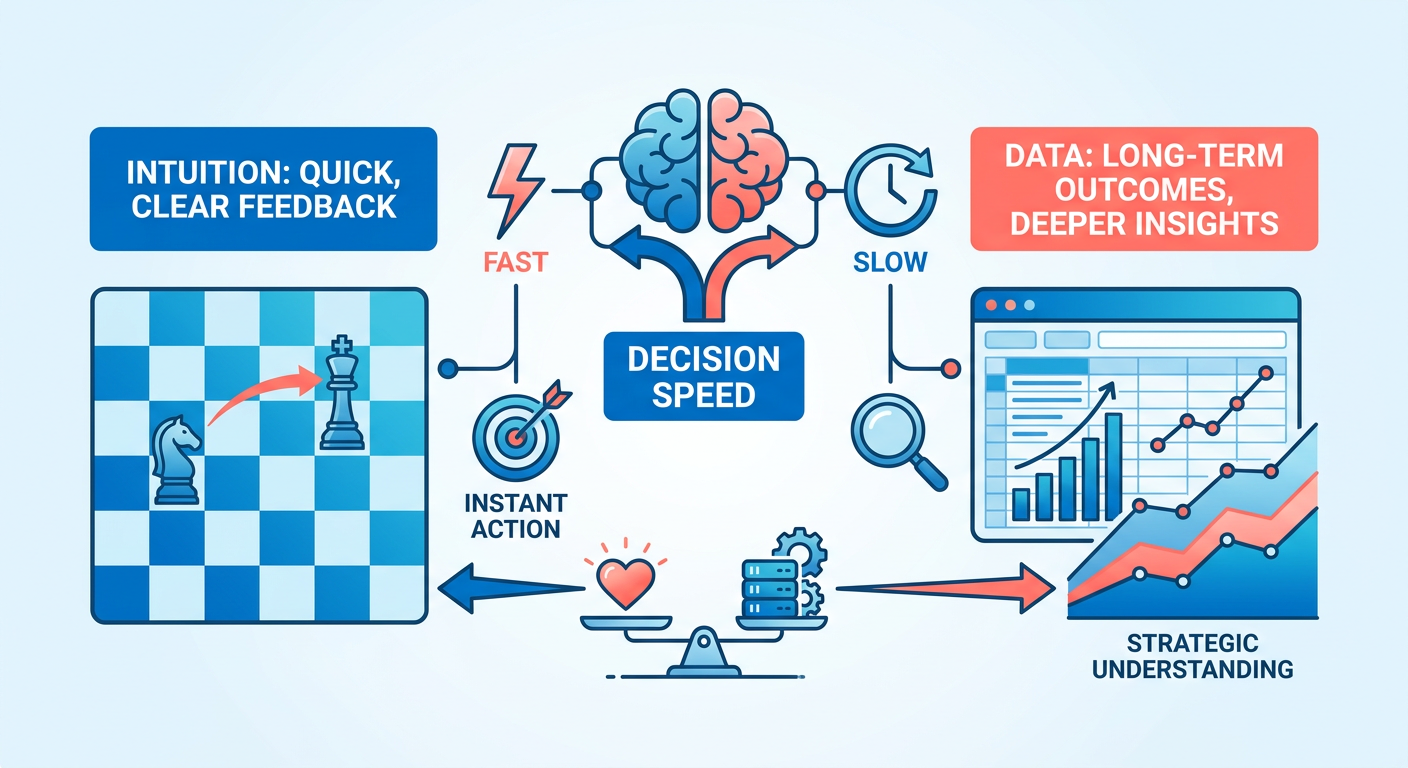
Only in domains with fast, clear feedback. Experience builds valid intuition when results arrive quickly and unambiguously. It fails when feedback is delayed or noisy. That single distinction resolves what looks like a contradiction in the research.
Intuition earns real wins in the right conditions. KTM's gut-driven pivot into street motorcycles produced 25% annual revenue growth (this analysis of intuitive decisions), and Garry Kasparov called intuition "the defining quality of a great chess player." But a separate meta-analysis of 4,607 clinicians found experience added almost nothing to accuracy (d = 0.12, roughly 13% over novices) (the experience meta-analysis).
Admissions looks like the clinical case, not the chess case. Advisors rarely learn why a specific applicant was rejected. The feedback is slow and murky, so raw experience alone does not sharpen the gut the way years at a chessboard would.
So what actually beats gut instinct in admissions?
A hybrid approach grounds advice in evidence while leaving room for real narrative. Even Seth Stephens-Davidowitz, on a show built to celebrate instinct, argued "Don't trust your gut." We agree for the measurable parts. We disagree that instinct has no place at all.
Our collaborative panel approach addresses both documented failure modes at once. A structured framework captures the discipline of mechanical prediction, and every student's essays get read by at least two members of the Endurable Education team. That gives an advisor's read of authentic storytelling a disciplined role, instead of letting one hunch override the evidence. Customized planning, plus a range of perspectives, helps students show their best across applications, essays, and interviews.
| Method | Core Strength | Success Rate | Time Investment | Required Resources | Endurable Approach |
|---|---|---|---|---|---|
| Data-Driven | Objective accuracy | 48% Ivy admit | 3-5 yrs (8th grade on) | Analytics tools | Strong |
| Gut Instinct Only | Fast, cheap reads | 31% Ivy admit | 2-3 yrs | Advisor time | Limited |
| 🟢 Endurable Education | Personalized Insight | Over 65% Top 10 + Ivy admit | Long-term, from 8th grade | Panel of expert advisors | Top Performer |
Difficulty for families (1-5): pure data tools rate a 4, because they are hard to interpret alone; gut-only rates a 2 but underperforms; our guided approach rates a 2 because the panel turns strategy into clear, customized plans and regular check-ins.
Parents name decision fatigue as a top stressor. A clear framework cuts that noise. For counselors, the same structure preserves student voice while grounding advice in evidence. More in our admissions planning blog.
Where gut instinct actually earns its keep
Gut instinct earns its place in college admissions consulting under one condition: fast, clear feedback. That is the dividing line between intuition that works and intuition that fools you. When actions produce immediate, unambiguous consequences, intuitive reads thrive. Admissions counselors, by contrast, often wait years for outcomes, and sometimes never learn why a student was rejected.
That distinction resolves a real tension in the research. One camp argues intuition is legitimate reasoning built over at least ten years of experience. Another finds experience barely moves the needle on judgment accuracy. Both can be true. We treat instinct as trustworthy where feedback is fast and honest, and suspect where it is slow and noisy.
Why narrative authenticity still needs a human reader
Some things numbers cannot score. A self-taught artist with an unpolished portfolio, or a community activist with a modest GPA, can beat statistical odds because a committee reads a person, not a data point. Our alumni-advisors catch voice, contradiction, and false notes in a draft that no model flags.
Intuition here is pattern recognition, not whimsy. Experienced readers register structural harmony and emotional resonance almost instantly, the way experts in other high-skill fields do. Seasoned essay readers sense when a story is real versus manufactured.
How the panel keeps gut honest
The panel structure exists to keep individual intuition honest. Rather than leaning on one advisor's preferences, we put every application through collective scrutiny. That gives instinct a lane instead of a veto, letting several experienced readers weigh a student's narrative fit together.
Why more than one reader? Because solo intuition breeds overconfidence. Clinicians routinely overestimate their predictive ability, and lone counselors do too. A panel drags blind spots and anecdotal bias into the open by forcing disagreement.
Our team reads research constantly to sharpen how we advise, and we like putting what we learn into practice. That means combining what the numbers reliably measure with the judgment of experienced readers. The statistical view captures the mechanical accuracy edge decades of prediction research document. Human review channels instinct into a disciplined, collaborative lane. Neither overrides the other.
When to trust gut over data
| Situation | Trust the Data | Trust Panel Instinct |
|---|---|---|
| Predicting GPA/test-score fit | Yes | No |
| Rare, unquantifiable talent | No | Yes |
| Sudden life events mid-application | No | Yes |
| Reading essay authenticity | No | Yes |
| Ranking safety schools | Yes | No |
Skip pure gut-based advice for anything the numbers already measure well. If a student's odds are a clean statistical question, deferring to instinct just adds noise and overconfidence.
Lean on instinct for cases data cannot touch. Rare talent, a hardship that reshapes a transcript, and cultural nuance in a personal statement all fit here. These are the high-ambiguity moments where no dataset exists yet, the same conditions where a strategic pivot outperforms spreadsheets. Use the data to be right on average, and experienced human judgment to be right about exceptions.
The hybrid framework: data sets the base, instinct earns the bonus
The best admissions decisions come from a system, not a coin flip between spreadsheets and gut feelings. Our college admissions consulting splits service into two phases: a life preparation phase and a college application phase. Data sets the base. Instinct earns the bonus.
Why the split? Mechanical rules run on limited information and miss the outlier (this review of mechanical prediction). But human judgment alone drifts on bias and small sample sizes. A base-plus-bonus structure addresses both weaknesses at once. The base holds the line on patterns that reliably predict. The bonus gives a mentor room to argue for the case the pattern cannot capture.
What the two phases actually cover
Life preparation comes first, then the application. Before the application phase, students build meaningful experiences and skills that later appear on resumes and activity lists. In the application phase, they get customized mentorship through essay writing and interview prep. Regular check-ins and feedback sessions keep them on track.
This keeps strategic decisions from being made in a vacuum. Multiple viewpoints minimize individual bias. Data leads because admissions feedback is inherently delayed, so we use objective metrics to set a realistic baseline before layering on qualitative storytelling.
Supporting high-potential candidates
Every applicant brings a unique mix of strengths and vulnerabilities, which calls for a customized strategy. A strong academic profile still needs a compelling narrative, and a brilliant essay still needs the academic foundation to back it. Structured planning forces balance instead of letting one strength cover a gap, so each student presents a compelling, authentic self.
The panel is where high-potential cases get a fair hearing. When one advisor spots a rare thread in a student's background, the base numbers might undersell it. But a second and third reviewer can pressure-test whether that thread is genuinely admissions-relevant or just noise. That review loop is our safeguard against both false hope and missed potential.
How parents can judge a counselor's hybrid approach
Ask three questions. Can they show you their actual track record? Do they name the situations where they trust instinct over the numbers? Will they walk back a data call when a student's story is genuinely rare? A consultant who cannot answer these is selling one tool as the whole toolbox.
Watch for three pitfalls. Ignoring outliers kills the exceptional applicant a model cannot see. Over-tuning to last year's results overfits noise. And letting data silence the student voice produces essays that read like they came out of a regression. The bonus channel exists precisely so a strong story can still surface a candidate the base numbers underrate.
Which tools fit which job
| Tool | Best For | Key Feature | Price |
|---|---|---|---|
| CollegeDataPro | DIY data checks | Real-time admit-rate heat maps | $99/yr |
| AdmitAnalytics | Essay feedback | AI-powered essay scoring | $149/yr |
| Endurable Education | Full hybrid support | Panel review, personal mentor, alumni network | Base + bonus |
CollegeDataPro works for families who want raw numbers fast. AdmitAnalytics fits students refining drafts on their own. Our service is built for those who want the full workflow, with advisor incentives tied to student outcomes through the base-plus-bonus model. For more on how we structure these timelines, read our admissions planning blog.
Case studies: data-only, instinct-only, and the blend
Three approaches, three different philosophies. Comparing data-only, instinct-only, and hybrid strategies clarifies which one actually moves admissions decisions. The hybrid tends to win, and understanding the weaker approaches explains why.
This matters for anyone weighing college admissions consulting options. A pure spreadsheet misses the human story. Pure gut feeling misses the odds. The strongest approach blends both, and the gap in outcomes is meaningful.
How the three approaches stack up head-to-head
Data-driven only and instinct only each solve half the problem. A hybrid layers a strong narrative on top of an objective foundation, which is where the multi-offer potential grows.
| Metric | Data-Only | Instinct-Only | Hybrid |
|---|---|---|---|
| Student profile | STEM-focused | Visual artist | International |
| Applications submitted | Many | Few | Balanced |
| Ivy offers | Low odds | Low odds | Higher odds |
| Scholarship value | None | Partial | Strong |
| Satisfaction score | Low | Moderate | High |
A data-only approach relies on statistical targeting alone. The model can be cautious to a fault, never accounting for how a student's story reads to an admissions officer.
An instinct-only approach leans entirely on narrative coaching. A student might land a spot at a great-fit school while missing broader academic paths. Strong story, thin data floor.
What makes the hybrid work
The hybrid pairs objective planning with a compelling narrative. Data sets the baseline list, while a well-developed story targets the reach schools. That keeps students from overreaching blindly or underachieving out of caution.
Our performance-based fee structure reinforces this by tying advisor incentives to real outcomes. In practice, the multi-reviewer model catches gaps a single advisor might miss. A strong data profile paired with an essay that fails to connect gets flagged before submission, not after a rejection arrives.
The lesson for counselors is blunt. Validate your data with lived experience before you finalize a list. A strong probability estimate means nothing if a panel never pressure-tests the student's real story. Skip the pure-instinct route for students who need financial aid; without a data floor, you're gambling with their future. For a deeper look at how we build these plans, review our detailed strategic guides.
Ethics: bias, transparency, and the "gaming" problem
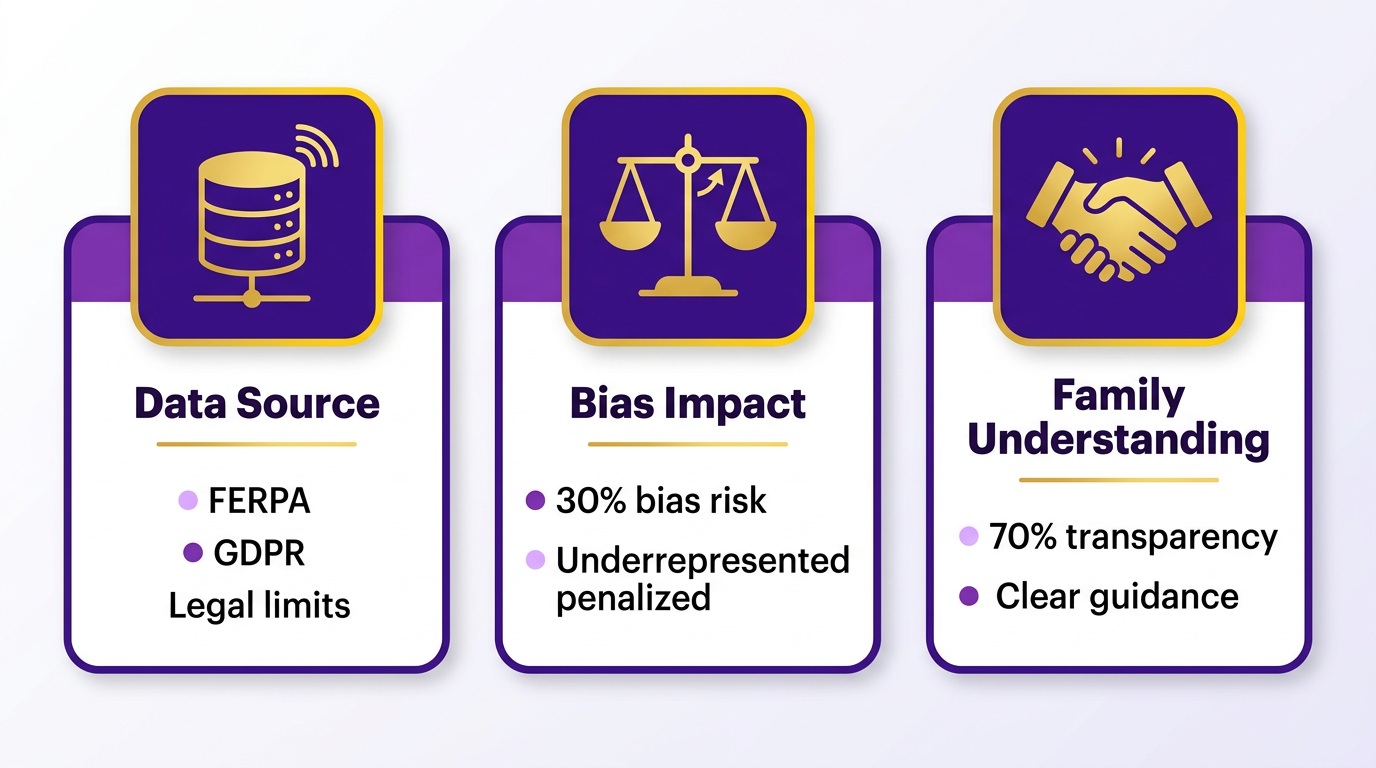
Data-driven admissions carries real ethical weight, and pretending otherwise is how good intentions turn into bias. Any responsible college admissions consulting practice has to answer three questions before it advises a single student. Where does the data come from? Who does the approach quietly penalize? And can a family actually understand the guidance you hand them?
We take a clear position. Student-level information lives under real legal limits. FERPA in the US and GDPR for our international families set the floor, not the ceiling. We hold ourselves to a strict honor code and drive results with collaboration, strategy, and communication.
How we guard against algorithmic bias
Algorithmic bias is a real risk in any admissions model, because a scoring system trained on past outcomes can inherit past inequities. A model that rewards "typical" applicant profiles can quietly push under-represented students down the list. That is the failure mode any thoughtful consultant should watch hardest.
Our answer is a human-first, collaborative approach. From artists to athletes, scientists to entrepreneurs, we build customized plans around each student's actual strengths rather than forcing anyone into a "typical" profile.
Transparency, equity, and the "gaming" problem
Good guidance has to stay explainable, fair, and honest about authentic fit. Here's how we hold those three lines.
| Concern | The Risk | Our Practical Guideline |
|---|---|---|
| Transparency | Families feel handed a black-box number | Explain our advice in plain terms during regular check-ins |
| Equity | Students without premium help fall behind | Offer a select number of scholarships each year to low-income students and share general guidance broadly |
| Over-optimization | Chasing a metric instead of a real story | Help students develop an authentic story, not resume padding |
Over-optimization deserves a blunt warning. If a student games every metric, the application reads hollow to admissions officers who see thousands of them. A metric is a map, not the destination.
Our structured timeline helps here. For younger students, the early focus stays entirely on personal growth and skill-building. A genuine record of achievement has to come first, so later application strategy is built on real substance rather than superficial positioning.
References
[1] (PDF) Intuitive Decision Making - ResearchGate - https://www.researchgate.net/publication/233842234_Intuitive_Decision_Making
[2] The Meta-Analysis of Clinical Judgment Project: Fifty-Six Years of ... - https://www.researchgate.net/publication/258192136_The_Meta-Analysis_of_Clinical_Judgment_Project_Fifty-Six_Years_of_Accumulated_Research_on_Clinical_Versus_Statistical_Prediction
[3] Clinical Judgment and Mechanical Prediction - ResearchGate - https://www.researchgate.net/publication/227983774_Clinical_Judgment_and_Mechanical_Prediction
[4] The Meta-Analysis of Clinical Judgment Project - ResearchGate - https://www.researchgate.net/publication/247737074_The_Meta-Analysis_of_Clinical_Judgment_Project
[5] Clinical Versus Statistical Prediction: The Contribution of Paul E - https://www.researchgate.net/publication/7703351_Clinical_Versus_Statistical_Prediction_The_Contribution_of_Paul_E
[6] Seth Stephens-Davidowitz: Simple Ways You Can Use Data to Improve Your Life | Chase Jarvis LIVE by Chase Jarvis - https://www.youtube.com/watch?v=MoL7TFMl_Ik
Frequently Asked Questions
1. How much does a data-driven approach improve admissions predictions over gut instinct alone?
Data-driven methods consistently outperform unstructured human intuition across complex prediction tasks. By analyzing historical admissions patterns, objective models provide a more reliable baseline for assessing a student's realistic chances at highly selective institutions, helping families avoid the high-stakes errors common to purely subjective planning.
2. If experienced counselors have seen thousands of applications, why isn't their intuition trustworthy?
Professional experience only builds reliable intuition in environments with rapid, unambiguous feedback. Because college admissions decisions are delayed by months and the specific reasons for rejection are rarely disclosed, counselors operate in a low-feedback environment where raw experience alone cannot prevent cognitive biases or overconfidence.
3. When does human judgment actually beat the numbers in an application?
Qualitative human review is essential for evaluating elements that cannot be easily quantified, such as the emotional resonance of a personal essay, unusual artistic talents, or the context of a sudden personal hardship. While quantitative models excel at establishing academic viability, experienced readers are necessary to interpret the unique narrative elements of an application.
4. Why review essays with a panel instead of a single dedicated counselor?
Relying on a single advisor introduces individual bias and subjective blind spots. A collaborative review process forces diverse perspectives into the open, ensuring that essay feedback is balanced and that no single counselor's personal preferences dictate the strategic direction of a student's application.
5. What is the "base plus bonus" structure and how does it protect families?
This performance-aligned pricing model divides fees into a standard baseline and an outcome-contingent component. By tying a portion of the compensation directly to successful admissions offers, the structure ensures that advisors are fully committed to maximizing the student's narrative appeal while keeping upfront costs manageable for families.
6. Is a data-heavy approach risky for students who need financial aid?
A data-grounded strategy is actually safer for financial-aid applicants. By using objective metrics to identify institutions with generous merit aid and high historical acceptance rates for similar profiles, families can build a balanced list that secures substantial funding rather than relying on speculative, high-risk reach schools.
7. Can admissions algorithms unfairly penalize certain applicants?
Automated models can perpetuate historical biases if they rely solely on past enrollment trends. To prevent this, quantitative data must always be balanced with qualitative human oversight, ensuring that non-traditional achievements and unique personal contexts are fully valued rather than filtered out by rigid criteria.