How Community Colleges Joining Common App Affects Your Application Strategy
September 16, 2026

Key Takeaways
- Common App added its first community college cohort in Illinois for the 2024-2025 season, and according to Common App, more member institutions join each cycle.
- Community colleges generally use open admission: no GPA floor, no required test scores, and no holistic review deciding admission.
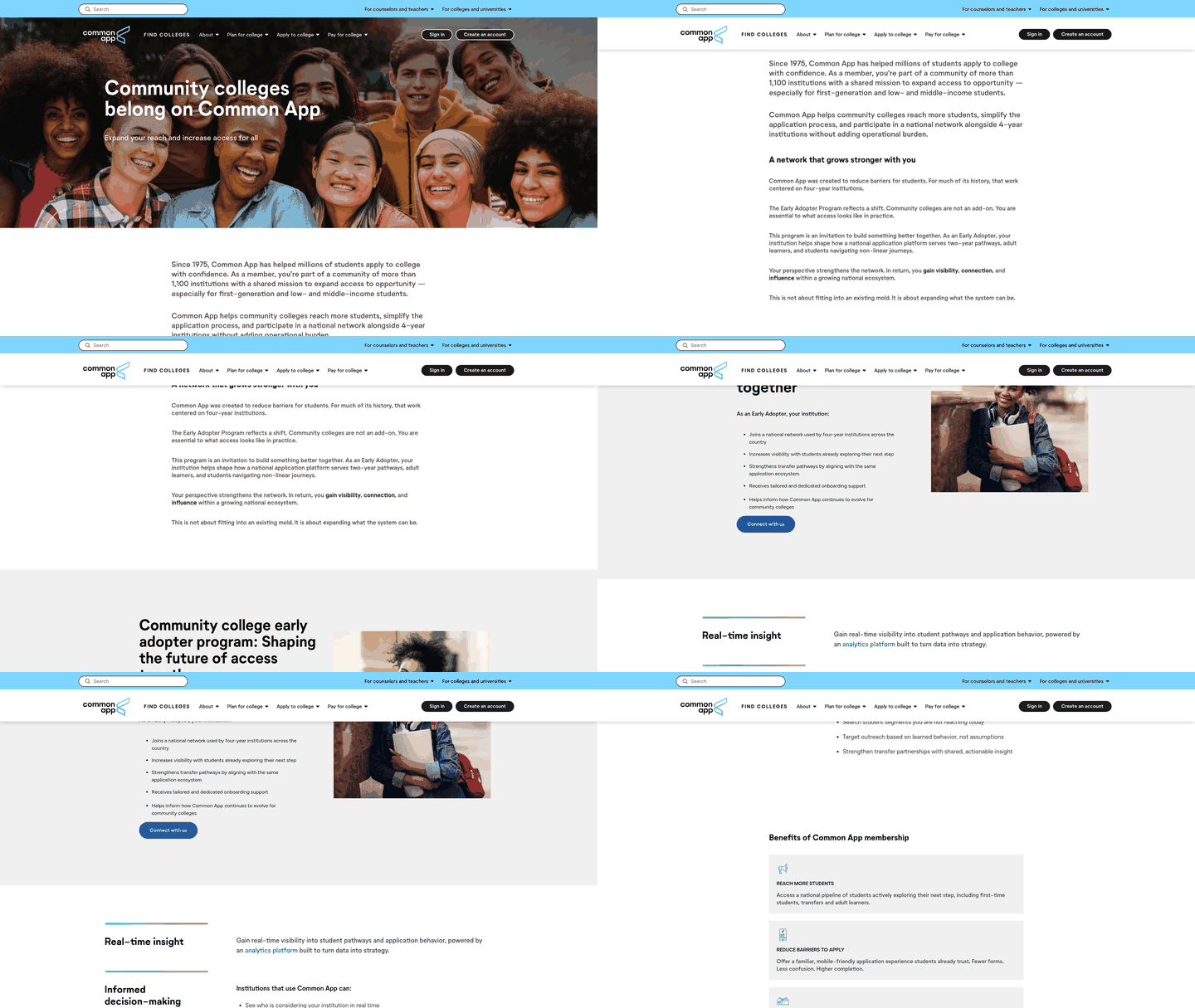
- The network now spans more than 1,100 member institutions, according to Common App — four-year universities, liberal-arts colleges, and two-year schools on one account.
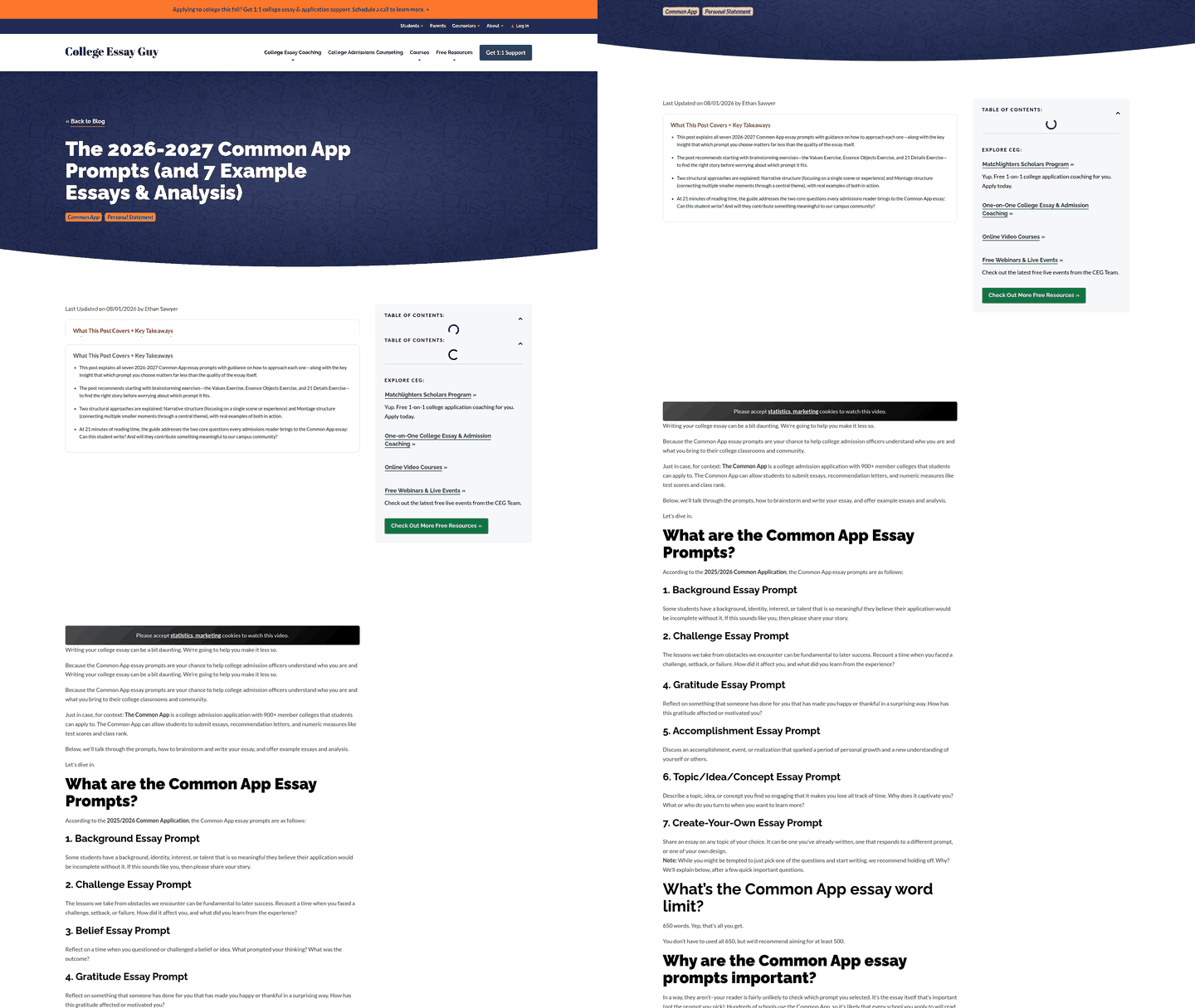
- A single 650-word personal statement, activities list, and transcript can be reused across the schools you add, but each campus controls its own requirements and review.
- Community-college deadlines often run rolling or open-access; four-year schools often hold fixed ED/EA fall and RD winter cutoffs.
- According to Common App, many colleges charge no application fee, and students who qualify may be eligible for fee waivers at the ones that do.
- Common App says filling in your GPA and profile can surface direct-admissions offers and scholarship matches before you file a formal application.
Quick Summary
Here's the move most seniors miss. Community colleges now live on the same Common App as four-year schools. Because they generally use open admission, a strong student can secure an acceptance with little extra work. Your personal statement for university applications, your profile, and your activities list can all carry over. You write the 650-word essay once, and it can serve both the community-college submission and your competitive four-year targets.
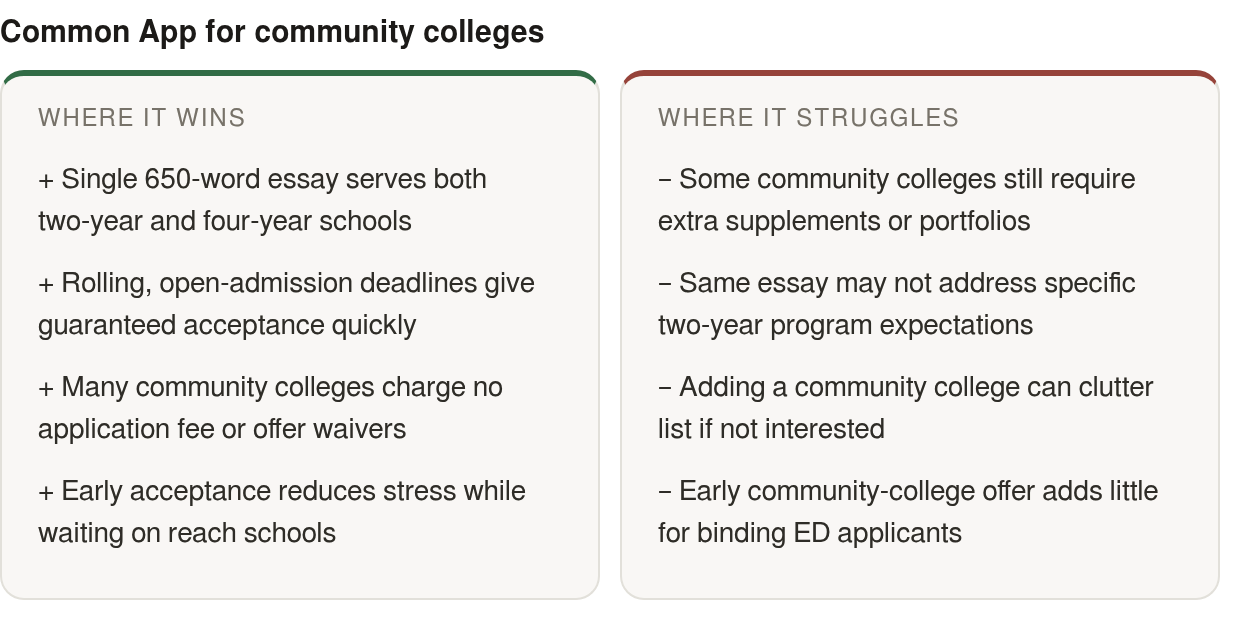
Locking one early offer while your reach schools are still pending can reduce cycle stress. The essay you sweat over for a selective school can do double duty here, so the marginal cost of an early community-college submission may be close to zero.
What Should You Check at a Glance?
Common App added its first community college cohort in Illinois for the 2024-2025 season, and it keeps adding institutions each cycle. Here's a general comparison of the two tracks on one account.
| Factor | Community College | Four-Year School |
|---|---|---|
| Deadlines | Often rolling / open access | Fixed (ED/EA fall, RD winter) |
| Profile setup | Shared | Shared |
| Personal statement | Reusable | Same essay, refined for fit |
| Supplements | Minimal or none at many schools | Varies across your list |
| Essay difficulty | Lower for many open-admission programs | Higher |
| Fee-waiver process | Straightforward at many schools | Varies by college |
| Admission certainty | Generally assured under open admission | Competitive |
Where Do the Real Wins Come From?
Three things stack. First, according to Common App, adding your GPA and profile info can surface direct-admissions offers and scholarship matches before you formally apply. Second, many community colleges are open access, so admission often isn't the main variable. Third, everything sits on one account.
Put those together and you get the strategic move: a high-achiever can hold a genuine offer in hand while the hard decisions are still out. The acceptance isn't the prize. The floor it puts under you is.
On fees: according to Common App, many colleges never charge an application fee, and many students qualify for fee waivers at the ones that do. A community-college submission rarely adds cost.
Skip this if you have zero interest in a two-year pathway and the early offer would only clutter your list. It's a stress-reduction and scholarship-matching play, not a substitute for your reach applications.
What Documents Do You Need Ready?
Gather these once and they can support every submission on your account:
- High school transcript: usually handled in the Education section; some schools want self-reported grades.
- Activities list: work, clubs, community engagement, and family responsibilities.
- Test scores: SAT/ACT if you're submitting; check each school's testing policy.
- Parent/guardian info: occupation, education level, and colleges attended.
- Academic honors: separate from activities, so list them there too.
Submit the community-college application early if that school uses rolling admission. Then spend your fall iterating on the four-year supplements that are more likely to decide your outcome.
Why the Four-Year Crowd Should Care More Than Anyone
When community colleges started showing up on the same platform used for Ivy League applications, it read like another access initiative. Well-intentioned, but built mainly for students already planning a two-year start. The strategic value can run the other direction: high-achievers bound for competitive four-year programs can hold a lower-risk early offer while their reach schools are still deliberating.
Adding two-year schools brought them into a network that, according to Common App, already spans more than 1,100 member institutions, all sitting in the same account. Your activities list, personal statement for university admissions, and transcript can be reused across every school you add. And because community colleges generally use open admission, a strong applicant isn't gambling on getting in. They're locking a likely acceptance while selective schools take months to decide.
The access story is real, but it's not the whole story
Common App's mission has long centered on expanding access, especially for first-generation and low- and middle-income students. Bringing community colleges onto the platform extends that reach and gives students a familiar, mobile-friendly way to explore two-year pathways next to four-year ones. That is a real benefit for students already headed toward a two-year start or who need an affordable entry point.
What the access framing underplays is that community colleges are generally open access: no GPA floor, no test scores required, no holistic review deciding admission. Common App's recent piece on transfer planning notes that community colleges can offer a path to college regardless of GPA. For a student with strong grades and test scores, that open-access model can flip from a safety feature into a strategic one. Admission isn't the main variable, so submitting may cost little and may deliver an acceptance quickly if the college uses rolling admission.
Why it's a low-friction move
A competitive applicant usually builds their Common App profile the summer before senior year: courses, test scores, activities, and the 650-word personal statement. Adding a community college can be quick. Search by state, click "add to my colleges," and check which sections that school requires. Many community colleges ask for the core application only and skip supplements, though some programs may add a brief form or portfolio. The essay you already revised for your reach schools can carry over without a word changed. Because the platform stores one profile and lets you reuse it, the cost of submitting to additional schools can drop sharply.
Timing is the other half. Many community colleges use rolling admission, so an early application may return a decision within a few weeks. If you lock an offer early, you enter the rest of the cycle with a concrete backup already banked. When December brings a deferral or March delivers several waitlists, that early acceptance can keep the process from feeling like freefall.
In our work with students targeting top programs, stress peaks when uncertainty piles up. One early acceptance can take the pressure off. The student still grinds on their reach applications, but they're writing from security rather than desperation, and that can show up in the clarity of their supplements.
How a tactical acceptance becomes a four-year plan
Community colleges are one route into the transfer population using the platform, and Common App has expanded transfer-related resources. Some students who start two-year do so with transfer in mind. But many students who intend to transfer never complete the move, and much of the gap can come from students not understanding guaranteed admissions agreements, joint admissions programs, and articulation agreements — formal partnerships that map two-year coursework onto a four-year degree.
A senior who banks a community-college acceptance early, then gets multiple rejections later, has a live option that isn't a gap year or a reapplication scramble. If that college holds a transfer agreement with a nearby state university, the student can start there, follow the transfer curriculum, and arrive as a junior with many general-education requirements behind them. Not the August dream. But a structured path to the same bachelor's degree, and it exists because they added one school back when the application opened.
Where This Fits in Your Senior-Year Calendar
Because your personal statement can be reused across your Common App account, an early community-college submission may cost you very little calendar time. You write the essay once, and it can feed every school on your list.
The trick is sequencing. Many community colleges use open admission, so acceptance often isn't in doubt. That lets you submit early and bank an offer while your four-year deadlines are still weeks or months out. The same essay you'll refine for a selective school is often already strong enough for the two-year submission.

When Should You Submit Each Application?
Map your calendar backward from the tightest four-year deadline. Early Decision I and most Early Action deadlines often land in the fall, well ahead of Regular Decision deadlines, which commonly cluster around Jan. 1. Those early cutoffs squeeze the timeline hardest.
Community colleges often don't run on that same pressure. Many use rolling admission, so there's no single cliff. If your community college uses rolling admission, submit that application first — early in the cycle, such as September or early October — and you may lock an offer before the November crunch starts.
Then spend the fall iterating on competitive supplements with a floor already in place. That order matters more than most students realize.
How Do Fee Waivers Work Across Both School Types?
Money is rarely the obstacle. Common App is blunt about it: many colleges never charge an application fee, and many students qualify for waivers at the ones that do.
The Common App fee waiver process typically requires your counselor to confirm eligibility. Individual colleges may also offer their own. Community colleges were brought on in part to close the low- and middle-income access gap, so cost barriers are often minimal on that side of your list.
One overlooked upside: Common App notes that when you add your GPA and profile during account creation, you may surface scholarship matches or direct-admissions offers before you formally apply. That's found money for a strong applicant.
What Timing Mistakes Should You Avoid?
The biggest error is treating both tracks as one deadline. They aren't. A rolling community-college submission may have no hard cutoff, but your four-year Early deadlines are often unforgiving. Don't let the relaxed pace of one lull you into missing the other.
Watch the platform's published calendar, too. Application availability and cycle dates can shift from year to year, so confirm the current dates inside your account. Many supplemental prompts are visible ahead of the cycle, which can let you draft early — but verify that the schools on your list haven't changed their questions.
Skip the early community-college submission only if you're applying Early Decision to a school you'd attend no matter what. A binding ED acceptance may end the cycle anyway, so the early offer adds little. For everyone else weighing multiple reaches, banking that acceptance first can be a strong use of your fall. Our customized planning and regular check-ins exist to help you map exactly this kind of dual calendar and stay on track.
One Essay, Two Very Different Readers
Your Common App profile can hold one shared personal statement, and you can send that same essay to every school on your list. That shared architecture is what makes the community-college move work. Add a two-year school, and it can read the essay you wrote for your competitive four-year targets without asking you to rewrite a word.
The tactical question is whether that single essay serves both audiences well enough to submit early.
Will the Same Essay Work for Both?
Students worry a community-college reviewer expects something fundamentally different from what a selective four-year school wants. The Common App personal-statement prompts are generally the same set across member institutions. You choose from the same topic options whether you're applying to an open-access two-year program or an Ivy.
The real difference is how reviewers weigh the essay. At many open-admission community colleges, your essay usually doesn't determine acceptance. You're already in under open admission. It can, however, influence scholarship consideration, honors-program placement, or advising track. At a selective four-year school, the essay can carry real weight in holistic review where admission itself is the outcome.
That asymmetry can work for you. You write for the harder audience, and the community-college submission gets the same polished narrative at no extra cost.
Signaling Transfer Intent Without Overcommitting
Some students want to flag that the community college is a stepping stone. Saying so explicitly can backfire. Frame the two-year school as purely instrumental and you risk sounding dismissive in an application to that institution. Push transfer plans too hard in the four-year application and you might suggest you're not genuinely interested in the school you're addressing.
The safer play is to keep the essay on your core story: what drives you, what you've learned, what you want to explore — without anchoring it to one institution or timeline. That story travels. A community-college reviewer can read it as curiosity and readiness. A four-year reviewer can read the same narrative as a case for admission.
If a supplemental prompt unique to the community college asks directly about your goals, that's where you can be transparent about transfer. Many two-year schools don't add supplements, but when they do, you have room to explain the pathway in concrete terms without touching the main statement that goes everywhere.
Making Activities and Work Land With Both Audiences
The Activities section can be reused across your whole account, too. You list activities with brief descriptions, and each school sees the materials you submit. Community-college reviewers often value work experience, family responsibilities, and non-traditional commitments as much as, sometimes more than, the résumé selective schools emphasize. Four-year schools still care about depth and leadership, but they also recognize that meaningful responsibility takes many forms.
Our approach is to build a list that shows continuity and impact. If you worked twenty hours a week to help your family, that belongs there with the same care you'd give a club presidency. What you contributed and what the role demanded matters more than the title. We've worked with students who describe caregiving alongside academic achievement, and both entries strengthen the application when they're specific and honest about the work.
Shape the list this way and you don't have to choose between audiences. The community college sees a student who manages real responsibilities. The four-year school sees the same evidence of character and capability.
The Supplements That Decide Which Credits Move
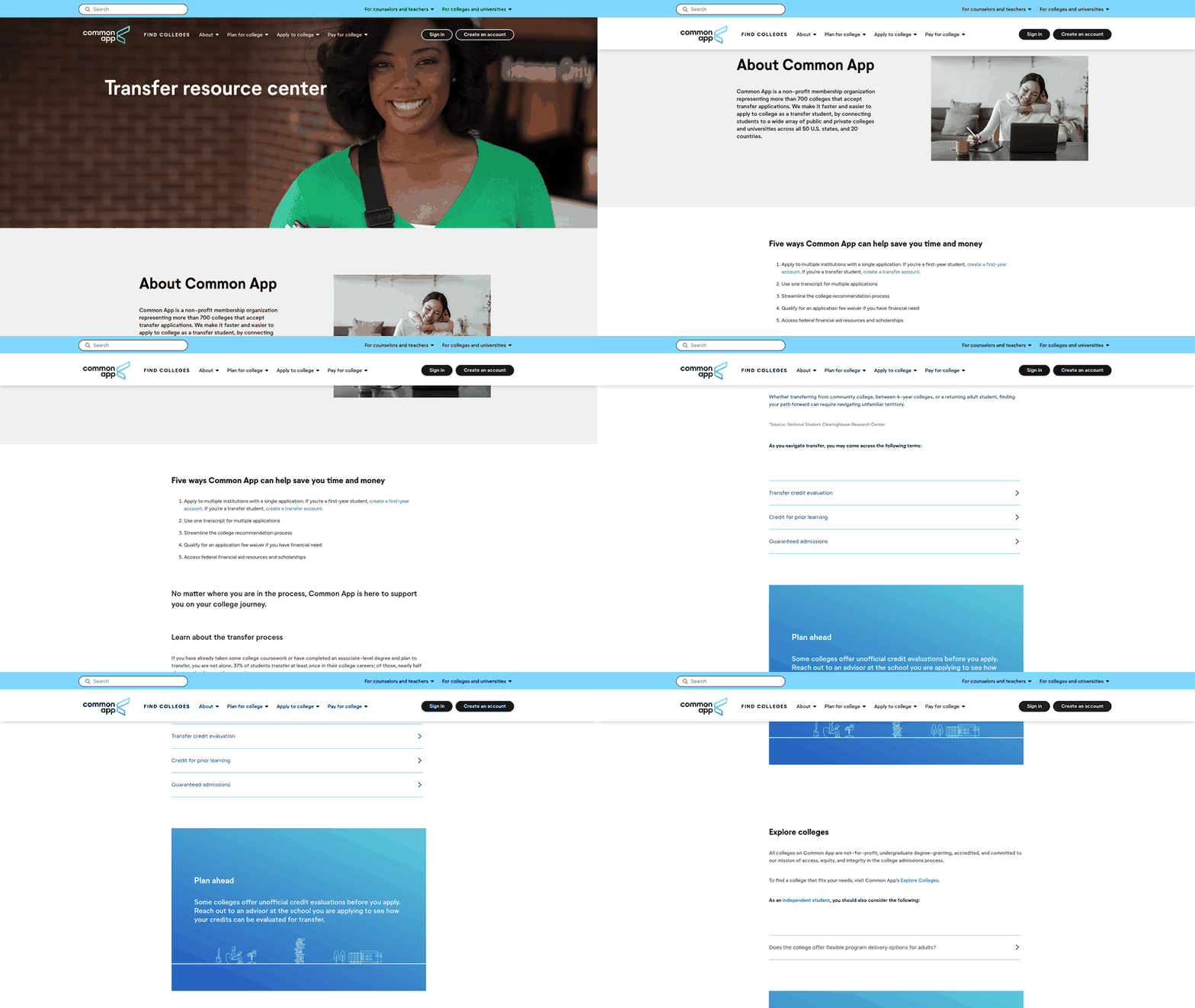
Don't skip supplemental materials if you're planning to transfer. The community-college application may take almost no extra effort, since your core profile already exists on the platform. But articulation agreements and accepted supplemental work can determine which credits actually move when you transfer. A portfolio ignored now can cost you a semester later.
Not Every Community College Asks for the Same Files

Open-access admission may mean you're accepted with or without supplemental material, but transfer-pathway programs and specific majors often recommend or require additional uploads. Students sometimes assume a simple application is a complete application. It isn't always. Some two-year schools ask for a writing sample, portfolio link, or short supplemental essay when you indicate a specific major. Art and media programs often want a portfolio. Nursing tracks may ask for prerequisite documentation. Honors programs may expect a brief statement of interest.
The application includes space for activities descriptions and academic honors, and transfer reviews may consider what you enter. Advisors often suggest that students who skip these fields may have less material to support a later advanced-standing review.
Articulation Agreements Map Which Credits Transfer
An articulation agreement is a formal contract between a community college and a four-year institution guaranteeing that specific courses count toward a bachelor's degree. Students who take coursework outside these mapped paths may lose credits in transfer, even with strong grades. Many community-college students don't know these agreements exist until after they've finished a year of non-transferable electives.
Check articulation databases before you register for a single class. Many states keep searchable tools showing exactly which courses at a given two-year school satisfy requirements at in-state universities. If your target four-year school appears in an agreement with the community college on your list, note the course codes. When you register, stick to them. A general-education credit outside the agreement may still transfer, but it may count as an elective rather than a core requirement, pushing your graduation timeline out.
Same logic for supplements. If the agreement lists portfolio review as part of the transfer pathway for a design major, submit the portfolio now rather than waiting until you apply to the four-year school. Transfer reviews often move faster when the receiving institution can see consistent demonstrated skill instead of a portfolio assembled only during the transfer application.
Use the Same Upload System for All Schools
Common App may let you reuse certain uploaded materials, but each college controls what it requires and reviews. Before relying on a single upload, confirm whether the file is shared across schools on your list or whether a specific program expects a separate submission. That can make it easier to reuse a portfolio or supplemental essay across your community-college submission and your four-year applications if the schools accept it.
Quality matters more than volume. A three-page portfolio of finished work beats a twenty-page dump of sketches. A 500-word supplemental essay explaining why you chose the two-year pathway — cost, location, a specific program strength — reads better than a generic statement about exploring options. Community-college readers are used to open-access volume, but transfer coordinators and four-year reviewers may see the same files later, and they're comparing you to students who treated every upload as finished work.
What the Platform Tracks, and How to Use It
Since the platform expanded to include community colleges, it helps to separate what Common App reports in public dashboards from what individual admissions offices actually see. That distinction can save you from optimizing for the wrong things.
Common App Reports Aggregate Trends, Not Individual Applicant Behavior
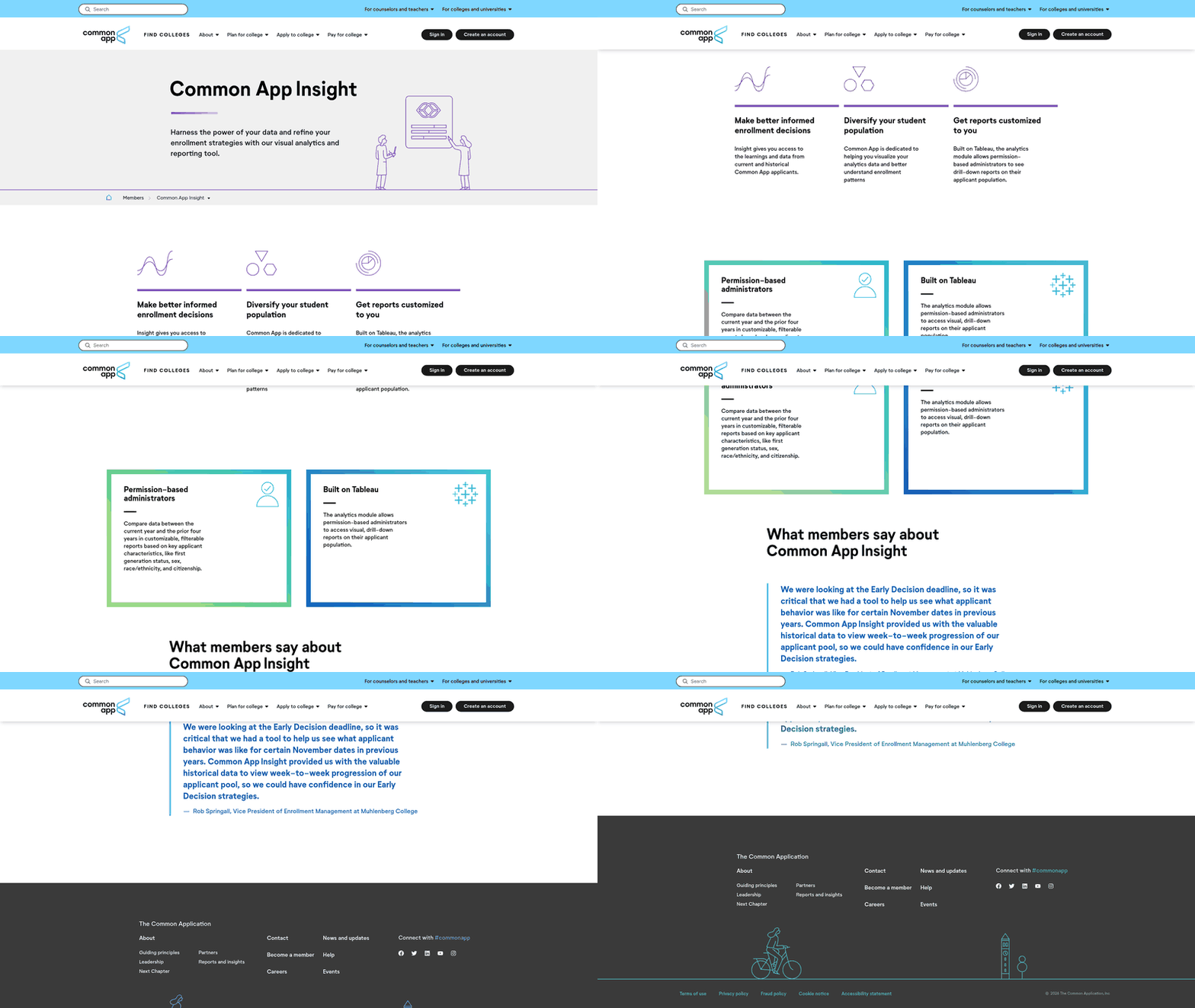
Common App's end-of-season reports describe aggregate trends across applicant demographics, community income, and institution type. They can show broad patterns such as who submits early, how many applications move through the platform, and which sections see delays.
That is not the same as an individual admissions office seeing your completion timestamps, time spent on sections, or essay revision count. Common App's public materials do not support the claim that colleges review that behavior as part of your application. The safer assumption is that schools review the materials you actually submit, not the behavioral path you took to get there.
A senior who submits a community-college application early can still benefit in a simpler way: the profile is complete, the essay is done, and the remaining four-year work can proceed with fewer moving pieces. That can lead to a more polished four-year submission later.
Direct Admissions Runs on Profile Data You Control
Common App's direct-admissions program says it matches students to institutions using information such as GPA, test scores, zip code, and activities list, then triggers proactive offers and scholarship matches before you click submit. According to Common App, the program expanded to 234 participating institutions for 2026-27. Because these matches may rely on structured fields rather than your essay, the parts of your profile you might treat as afterthoughts can carry more weight. The more complete those fields, the more exposure you may receive.
Students who leave activity descriptions vague or skip the honors section may forfeit opportunities they never see. A blank activities list can read as no involvement, not modesty. Fill relevant fields with specifics — role, time commitment, tangible outcomes — and do it before the community-college submission. That early completion may feed any available matching opportunities while your four-year deadlines are still months out.
The Real Risk Isn't Getting In
Some published transfer analyses cited by Common App suggest that while many community-college students aim to transfer, only about a third complete the move. The risk for a competitive applicant isn't usually admission to the two-year school, which is often assured under open enrollment. It's selecting courses that don't transfer cleanly.
Day-one course selection and articulation agreements matter, and your transcript preview should reflect alignment with the transfer requirements of your four-year targets. The data clarifies where students often lose momentum: not at the application stage, but at the credit-transfer stage later.
How I'd Sequence This, Start to Finish
Here's what it takes to go from strategy to submitted application. The focus is the move most high-achievers miss: banking an early community-college offer through the same platform that feeds your four-year targets.
Lock the Sequence Before You Draft Anything
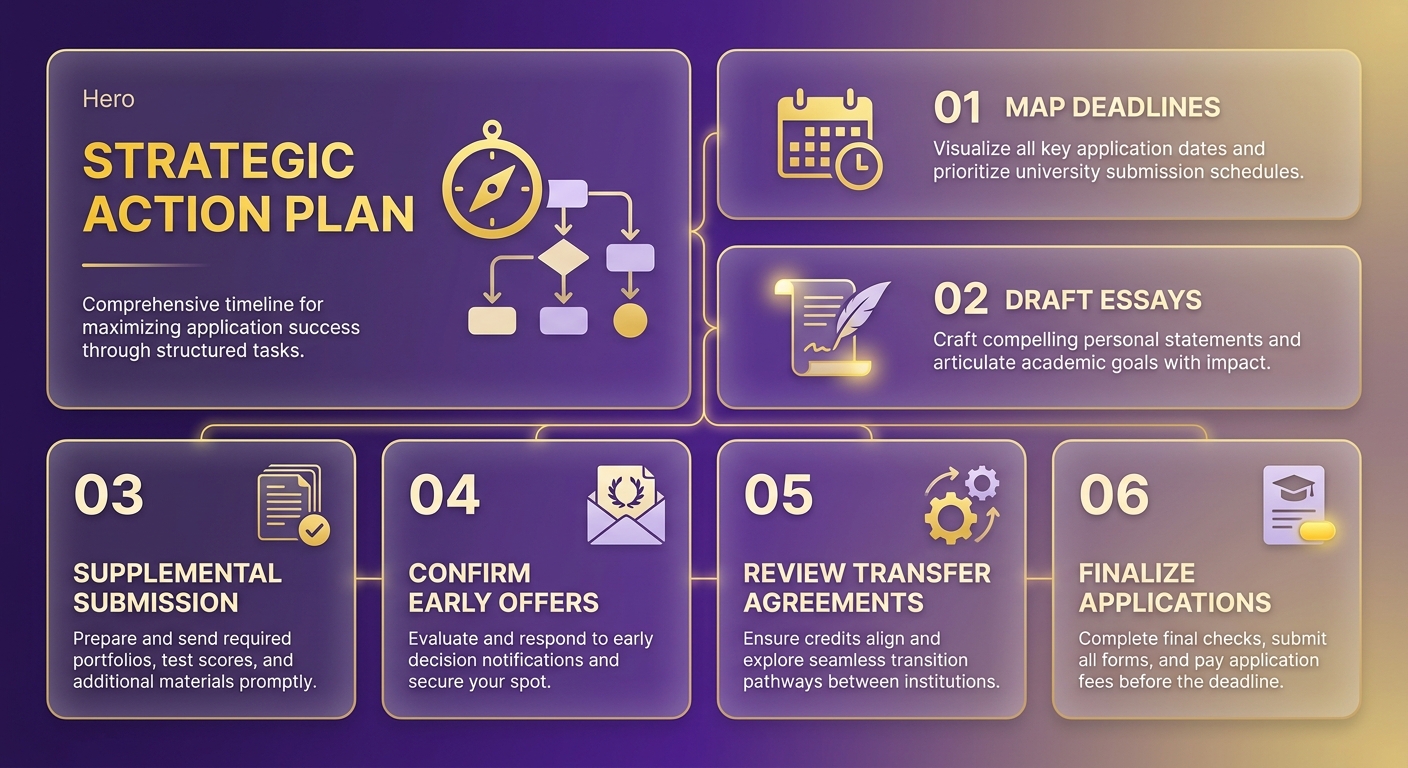
Map every deadline backward from your tightest four-year cutoff. Early Decision and Early Action cycles close well before regular deadlines, so confirm each school's exact date inside your account. Regular Decision deadlines land later and vary by campus, so verify each one rather than assuming a single date. Many community colleges use open admission, so your acceptance isn't the variable — timing is. Submit that one first. You already have a profile, activities, and an essay draft by late summer, and the two-year school can use the same essay without asking for a rewrite. If that campus uses rolling admission, submitting early in the cycle may lock an offer while you're still iterating on competitive supplements. That acceptance can remove the fear of finishing senior year with nothing.
Track each school's requirements in the platform's requirements grid. It lives inside your account and updates when schools publish changes. Testing policy, recommendation count, and writing supplements vary by campus. The community-college row will often show far fewer asks beyond your core profile.
Fee waivers can apply to both tracks. According to Common App, many colleges never charge an application fee, and students who qualify for a waiver at a four-year school can often get the same relief at a two-year campus. The waiver process usually involves counselor confirmation, so check the current instructions in your account.
What You'll Actually Upload
Your essay, activities list, and self-reported grades form the core. Many community colleges rarely ask for supplemental writing, so the personal statement may do most of the narrative work. That's the piece worth drafting in July. Outline five moments or themes that show intellectual curiosity, resilience, or a specific interest, then pick the one that still feels urgent after a week. Write short paragraphs, two to four sentences, and cut every line that restates the prompt.
If the two-year school holds an articulation agreement with your target four-year program, check whether the pathway recommends a portfolio, an extra transcript, or a program-specific form. Open-access admission may mean you're in without those files, but transfer pathways can prefer or require them. Confirm what each pathway needs in writing, because a missing form can cost you credit when you move. That's exactly the kind of detail our planning sessions catch early.
Some campuses accept test scores; others are test-optional. The community-college Testing section can tell you which applies. If you're submitting scores to four-year schools, self-report them once in the Testing section if the schools accept self-reported scores — then verify whether each campus also requires an official report. For counselor recommendations and transcripts, assign your counselor through the portal and confirm which schools require the School Report.
Tools That Pair With the Platform for Free
The platform's own first-year toolkit includes a timeline, checklist, and video walkthrough. It's dry, but accurate, and it loads inside your account. Use the checklist to flag missing items before you submit.
For essay revision, trade drafts with another senior applying this cycle instead of leaning on a generic online editor. A peer writing their own statement catches vague claims and clichéd openers faster than software. Working alone? Read the essay out loud. Sentences that trip your tongue will trip a reader's attention.
Common App's direct-admissions expansion means that if you add your data early, some campuses may generate a provisional offer or scholarship match before you formally submit. It's not universal, but it costs little to fill your profile in August and see what surfaces.
We help students build a submission calendar that sequences community-college, Early Action, and Regular Decision applications so the early offer lands while reach-school supplements are still open. If you want a second set of eyes on your timeline or your essay before the early-deadline wave, that's what our planning sessions are for.
The Questions That Come Up Every Cycle
Does applying to a community college hurt my four-year chances? No, according to Common App's design. Individual colleges do not see your full Common App college list. Each campus reviews only the materials you submitted to it.
Can I apply to the same community college and four-year school in one cycle? Yes. The platform treats them as independent entries. If you're admitted to both and enroll at the two-year campus, you'll apply as a transfer student when you're ready to move.
What if my essay changes after I submit? You may be able to update essay drafts for schools you haven't submitted to yet. Once a submission goes through to a given campus, that version may be final for that campus. Sequence matters: send the two-year school early with a solid draft, then refine the essay for your later deadlines if the platform allows those edits.
Do I need to visit the community college before applying? Not for admission. If you're serious about starting there, a visit can help you confirm the articulation agreement with your transfer target and meet the advising team. But the application itself generally has no demonstrated-interest requirement.
How do I know if the community college will accept my AP or dual-enrollment credits? Email the registrar or check the transfer-credit policy on the school's site. The Common App doesn't adjudicate credit; that's a campus-by-campus call. Get it in writing before you enroll.
References
[1] Apply to college with Common App - https://www.commonapp.org/
[2] Application guide for first-year students - Common App - https://www.commonapp.org/apply/first-year-students/
[3] Common App for Community Colleges - https://www.commonapp.org/members/community-colleges/
[4] Common App welcomes its first cohort of community colleges to the platform - https://www.commonapp.org/blog/common-app-welcomes-its-first-cohort-community-colleges-platform/
[5] News and updates - Common App - https://www.commonapp.org/blog/
[6] The Common App: A How-to Guide - College Essay Guy - https://www.collegeessayguy.com/blog/common-app
[7] Reports and insights - Common App - https://www.commonapp.org/about/reports-and-insights/
[8] Common App launches transfer initiative to improve college access - https://www.commonapp.org/blog/common-app-launches-new-transfer-application-improve-college-access-millions-bachelors-degree/
[9] Championing transfer students' journeys through early awareness - https://www.commonapp.org/blog/championing-transfer-students-journeys-through-early-awareness/
Common Questions
Will a community college see that I've also applied to Ivy League or other selective schools on the same account?
According to Common App, schools on your list don't see your other applications or their outcomes. The account stores a shared profile — essay, activities, transcript — but each institution reviews the materials you submit to it. Adding a two-year school alongside competitive four-year targets should not affect how any single college evaluates you.
If I get accepted to my top four-year school, what happens to the community-college offer I banked earlier?
The early community-college acceptance simply goes unused — you decline it or let it lapse and enroll where you prefer. It functions as a backup, not a commitment. Its main value is the security it provides during the fall crunch, so an unused offer means the strategy worked as intended.
Should I mention my transfer plans in the main personal statement I share across all schools?
Keep transfer intent out of the shared personal statement. Anchoring your essay to a two-year-then-transfer plan can read as dismissive to the community college and signal weak interest to four-year schools. Save concrete transfer goals for a supplemental prompt if the community college asks one directly — many don't add supplements.
Does open admission mean my essay and activities list don't matter at a community college?
Your essay may not determine admission at many open-admission schools — you're already in — but it can still influence scholarship consideration, honors-program placement, and advising track. Community-college reviewers often weigh work experience and family responsibilities heavily, sometimes more than selective schools do. Specific, honest activity descriptions can strengthen your standing even when admission is assured.
How do I know whether my community-college credits will actually transfer to a four-year school?
Check your state's articulation databases before registering for courses. An articulation agreement is a formal contract guaranteeing specific classes count toward a bachelor's degree. Courses outside those mapped paths may transfer only as electives rather than satisfying core requirements — even with strong grades — which can push your graduation timeline back.
Do community colleges require supplemental materials if admission is open access?
Open-access admission may accept you without extras, but transfer-pathway and specialized programs can recommend or require additional uploads. Art and media tracks often want a portfolio, nursing may ask for prerequisite documentation, and honors programs may expect a short interest statement. Submitting these early can also support faster credit evaluation when you later transfer.