How Former Stanford Readers Spot the Essay That Wins Committees
September 21, 2026

Why Spotting the Winning Essay Matters
The odds are brutal. The essay is where you earn attention or lose it fast. Stanford accepted 2,210 of 38,828 applicants in a recent cycle. Slightly less than 1 in 17, according to Stanford Magazine's admissions deep-dive. That's the reality our college admissions consulting work is built around. Raw talent alone doesn't clear the bar.
Applications to elite schools have swelled, and even top scores guarantee nothing. Dean Richard Shaw names the fallacy directly. He warns against thinking one missed top school means disaster. When the pools get this large and this strong, the essay stops being a formality. It becomes the thing that separates you.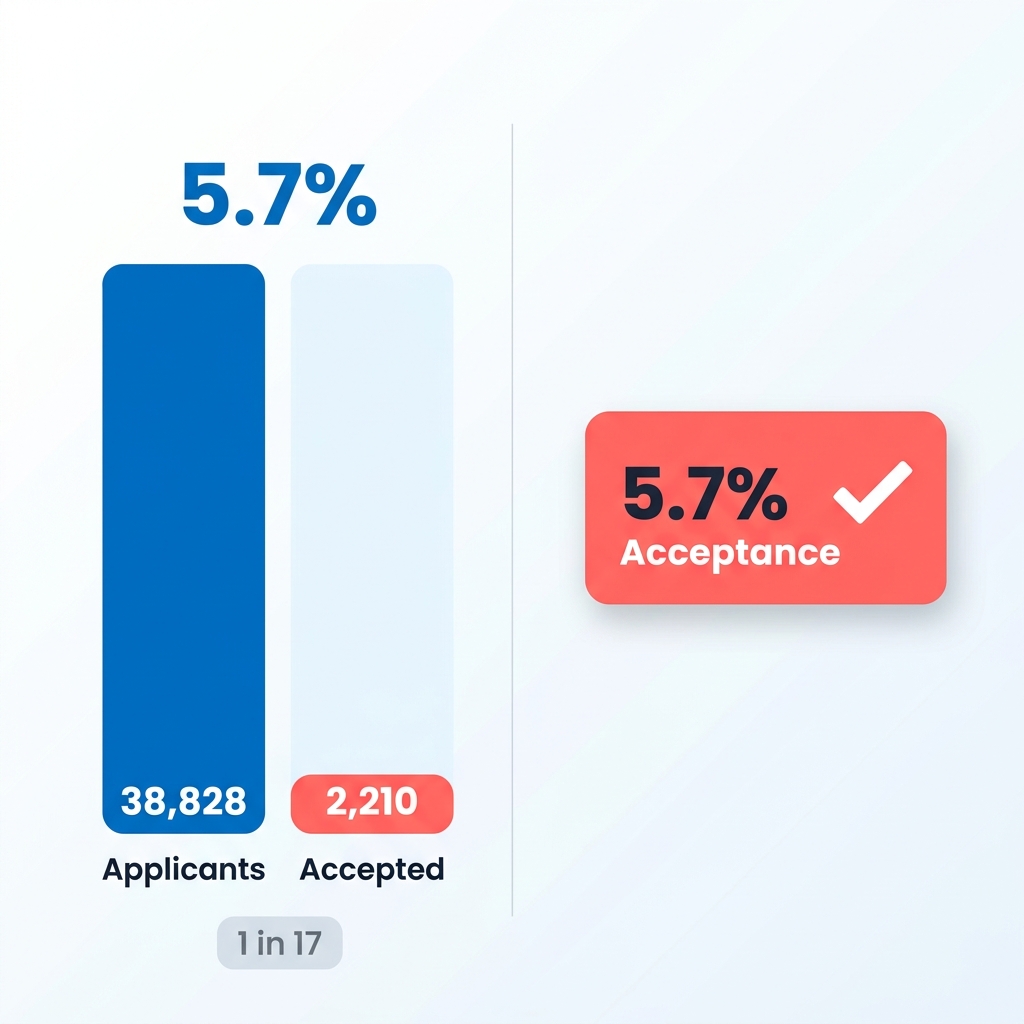
The 15-Minute Window Decides Everything
Readers triage. Stanford's pool hit an all-time high of 38,828 in a recent cycle, and your essay isn't read at leisure. It's sorted.
That math changes your editing priorities. The opening line isn't decoration. It's the moment a tired reader decides whether to lean in or coast to the next file. We review every student's essays as a panel. Each one is read by at least two people. We push on that opening until it earns a second look.
Readers weigh the personal essay heavily when deciding who stands out. That attention is what you're competing for, and it's what our advising is aimed at winning.
Voice Beats Polish, But Only If You Know the Game
Shaw told Stanford Magazine the team wants to hear a "voice," not polished prose. That preference matters more than it sounds, and the research explains why.
A study found essay style correlates strongly with household income and SAT scores. Measurable writing polish tracks with money. Not a level field.
But there's an opening for under-resourced applicants. Concrete, lived specificity is a kind of capital far less tied to income than academic polish. A reader remembers a raw, specific admission over a grammatically flawless paragraph about leadership. Coaching that mines your real experience partially offsets the polish advantage wealthier applicants buy.
One honest caveat. That same research treats the essay's predictive value for future academic success as a cautionary tale. The essay is a weak predictor of how you'll do at Stanford. It's a strong lever for whether you get in. Different jobs, and admission is the one you're solving for right now.
The Short Version
Stanford accepted 2,210 of 38,828 applicants in a recent cycle, an admit rate just under 1 in 17. Volume hit an all-time high, which forces readers to triage essays fast, so the opening line often decides whether they lean in. A study found writing style correlates strongly with household income and SAT scores. Dean Richard Shaw told Stanford Magazine the admissions team wants to hear a "voice" rather than polished prose. Research treats the essay as a weak predictor of college performance.
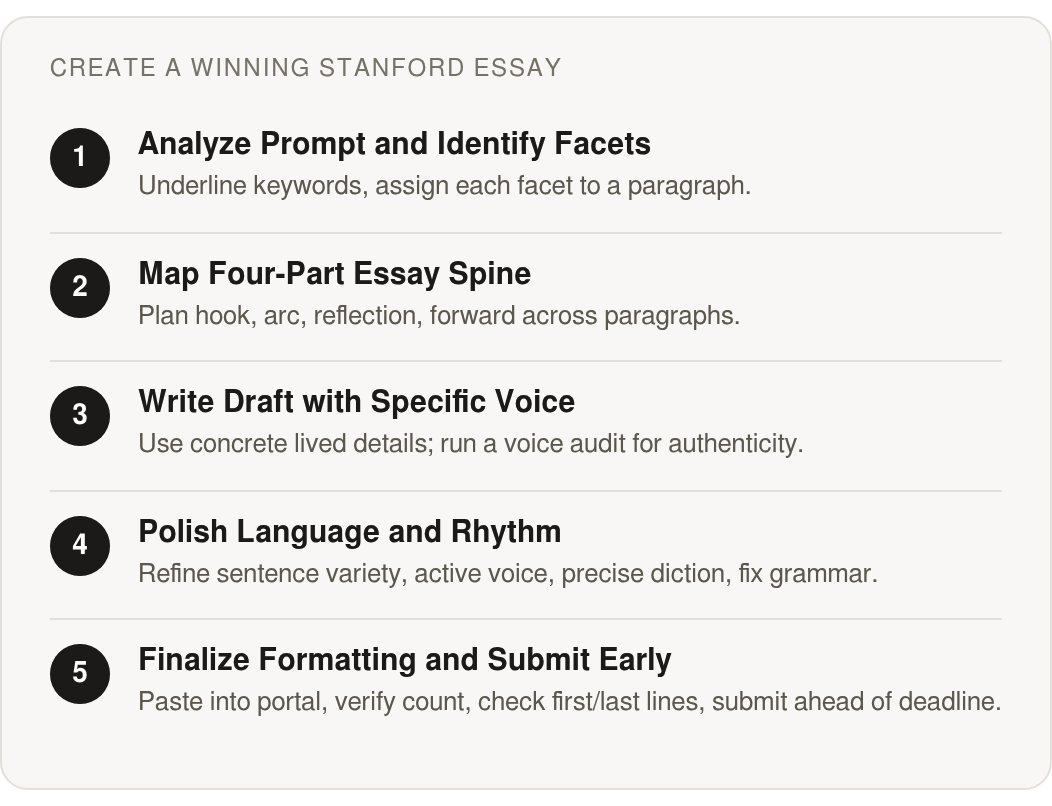
The Prompt Is a Question About Fit, Not a Blank Canvas
Every Stanford prompt is checking something specific: whether your answer maps to what the university actually cares about. Intellectual curiosity, contribution to a community, honest personal growth. Miss that mapping and even a beautiful paragraph reads as off-topic. Alignment is coachable, and it's measurable, which is where our work starts.
Here's the model that keeps us honest about it. We use base-plus-bonus pricing, so you pay our full fare only if you're satisfied, and every draft gets read by at least two people on the team. Nobody hands you a polished essay that quietly ignores the prompt. If a draft drifts, we flag it and rewrite until every paragraph earns its place.
Read The Prompt Like A Reader Grades It
Start by underlining the operative words. A prompt asking what idea makes you lose track of time is testing intellectual vitality, not your resume. Circle the verb and the noun that carry the real ask.
Then write the value beside each clause. If the prompt says "roommate," Stanford wants community and daily generosity, not achievement. Students lose points when they answer the prompt they wish they got instead of the one on the page.
Make Every Paragraph Answer A Facet
Break the prompt into its distinct facets, then assign each to a specific paragraph. One prompt often hides two asks: what you did and why it changed you. Cover both, or the essay feels half-finished.
The most common misalignment we correct is over-generalizing. A student writes about "helping people" when the prompt wanted one concrete moment. We push for the smaller, truer detail every time, because specificity is what signals genuine growth to a committee.
We see it constantly. A draft about a robotics award reads as a trophy list. The prompt asked about learning. We reframe it around the failed prototype and what the student taught a younger teammate afterward. Same experience, now answering the actual question.
Our broader planning approach treats the essay as one piece of a coherent application, not a standalone stunt.
The Four-Part Spine Behind Essays That Land
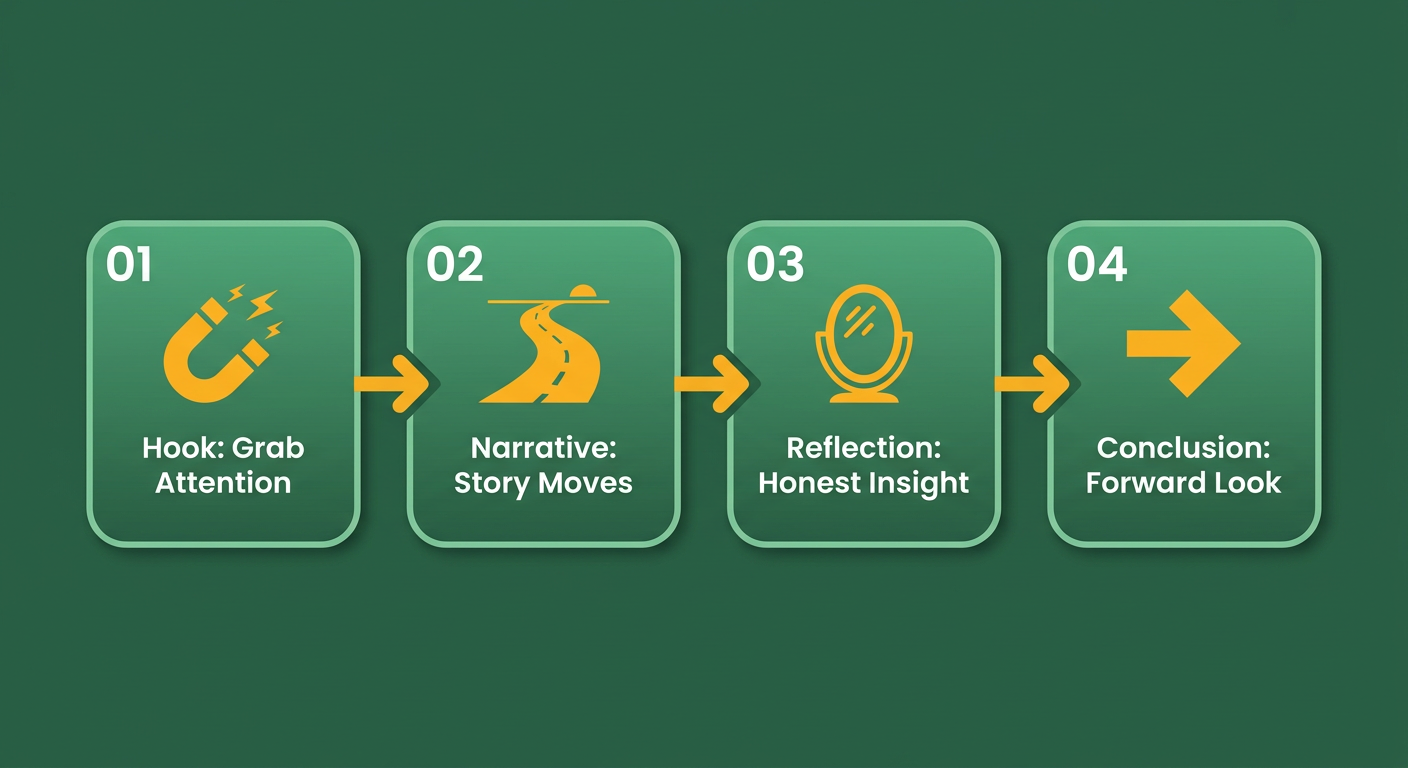
A strong college essay follows a recognizable rhythm. Not a rigid template, but a shape that keeps a compelling story from collapsing into a diary entry: a hook that earns attention, a narrative that moves, a moment of honest reflection, and an ending that points forward. When we work with students, this four-part spine is one of the first things we map together, because structure is what separates a memorable essay from a well-written summary of events.
Most of our business comes from satisfied families referring friends, and our bonus is tied to your satisfaction. So there's every incentive to give you honest, rigorous feedback rather than comfortable praise. Here's the blueprint.
[ HOOK ] → 1 short paragraph. A concrete image or a line
 that stops the reader cold.
 |
[ ARC ] → 2-3 paragraphs. Scene, tension, movement.
 Something changes.
 |
[ REFLECTION ] → 1-2 paragraphs. What you learned, not just
 what happened.
 |
[ FORWARD ] → 1 short paragraph. How this shapes what you
 bring to campus.
The Hook Decides Whether Paragraph Two Gets Read
Look at how Stanford's own staff described a favorite opener: "Cancer tried to defeat me, and it failed." It doesn't explain itself. It forces a question the reader now needs answered.
That's the job of a first line. Start with a specific moment, not a thesis. Save the meaning for later.
Depth Over Length, Every Time
The strongest essays run four to six tight paragraphs, with most of the room spent on reflection rather than plot. Transitions should feel like breathing, not signposting. If a paragraph doesn't earn its place, cut it.
Skip the chronological life-story format. Readers score movement and insight, not a timeline. One turning point, examined honestly, beats a decade summarized. We work through this draft by draft with students, which is exactly the kind of collaborative, iterative work our advising is built on.
Voice & Authenticity: How Readers Detect a Genuine Narrative
A reader tells you what they're hunting for in four words. Stanford's admissions team put it plainly: they want to hear a "voice," calling it a critical component. That single line explains more about winning essays than any rubric. When someone is moving fast through a large stack, voice is what makes them slow down instead of skim.
This is the part of the work we care about most, because voice is where authenticity either shows up or gets faked. And readers are trained to smell the fake.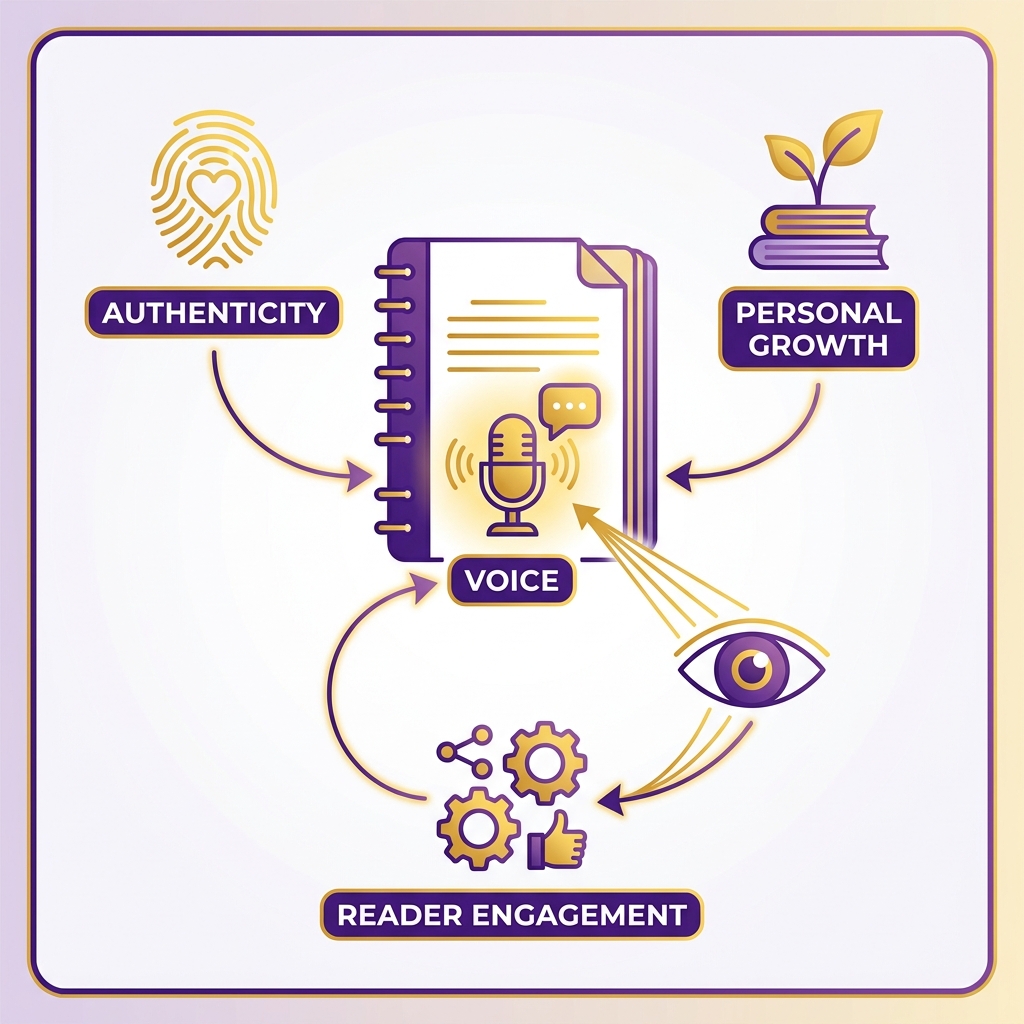
What Do Readers Flag as Inauthentic?
The tell is almost always generic language. Stanford's own staff singled out openers rooted in lived, specific experience: "When I was in eighth grade I couldn't read," and "Cancer tried to defeat me, and it failed," and "I change my name each time I place an order at Starbucks." None of those sentences could belong to anyone else. That's the point.
Contrast them with the sentences readers skim past: prose built from abstractions like leadership, dedication, and a lifelong love of learning. An officer reading hundreds of files a week sees those same phrases recycled essay after essay, and they blur one applicant into the next. Specific lived detail does the opposite work. A student who can't afford an expensive editor can still out-write one by mining their own experience, which is exactly the field-leveling move we coach toward.
How Do You Run a Voice Audit?
A voice audit is simple and brutal. Read your draft aloud, then cover your name and ask one question: could a friend recognize this as yours? If any sentence could appear in a stranger's essay, cut it or make it specific.
Then run a detail inventory. Go paragraph by paragraph and mark every concrete, sensory item: the burbling pan, the vinyl waders, the fresh cut on a forehead. Vague claims about "passion" and "growth" get no marks. If a paragraph scores zero, it's doing no work for you.
A useful nuance sits underneath this. Polished prose often tracks with advantages a student was born into more than with true potential. That's true, and it doesn't undercut the point. The essay's job isn't to predict your GPA. Its job is to win a reader's attention during a fast read. Two different games, and admissions plays the first one.
How Our Panel Tests Your Voice
Working as a panel rather than one-on-one, we bring diverse perspectives to help refine and develop your story so it shows your best. Each essay is read by more than one member of the team for input.
Because our bonus is tied to your satisfaction, nobody has an incentive to hand back a technically clean essay that sounds like no one. We keep working with you until the draft actually reflects you.
Polish: Where the Read Is Won or Quietly Lost
Polish is where a good essay either earns its final read or loses a reader who was almost convinced. At the sentence level, the work is unglamorous: cutting a limp verb, breaking a run-on, replacing a vague word with the exact one. This is the least visible part of the job.
Our polishing rounds tie directly to outcomes. We don't hand back a lightly proofread file and call it done. We keep revising diction and rhythm until the essay sounds like you on your sharpest day.
What Do Former Readers Scrutinize Line By Line?
Readers move fast, so surface friction costs you. Here's what former readers tend to scrutinize line by line:
- Sentence variety. Ten sentences of identical length lull a reader to sleep. Mix short punches with longer, moving lines.
- Active voice. "I organized the fundraiser" beats "The fundraiser was organized by me." Active verbs carry momentum; passive constructions bury the person doing the work.
- Precise diction. Swap "good" for the specific word. "Relentless," "meticulous," "reckless" tell a reader something; "very passionate" tells them nothing.
- Grammatical cleanliness. A comma splice or a subject-verb slip signals carelessness. It plants doubt right when you need trust.
How Does A Single Revision Change Readability?
A student writes: "It was decided by me that the club needed changes that would be helpful." That sentence hides the actor, leans passive, and says almost nothing.
Rewritten, it becomes: "I rebuilt the club from four members to forty." Same event. One version drags; the other lands.
That jump is what our final rounds are built to produce. We keep polishing until the essay reads like your best, and the bonus only follows a result you're proud of. For more on how our readers think, see the Endurable Education blog.
Submission Savvy: Formatting, Timing, and Final Checks
The essay is written and it sings. Now don't lose the read to a formatting slip nobody catches until it's too late. Application portals count characters, not intentions, and a paragraph that looks clean in your word processor can truncate mid-sentence the moment you paste it in.
This is the unglamorous end, and it's where a pay-for-results model earns its keep. Because our bonus rides on an essay that actually wins its spot, we treat submission as part of the work, not a clerical afterthought.
How Should You Format the Essay Before You Paste It In?
Write in a plain document first, then paste into the portal and read the whole thing again inside the box. Portals often strip italics, smart quotes, and spacing, so what you approved isn't always what the reader sees.
Respect the character or word limit the application states, and check whether the count includes spaces. When a field lets you attach a PDF, keep the font standard and readable at a glance. No reader rewards a clever typeface.
When Should the Final Draft Be Done?
Finish days before the deadline, not hours. Servers strain on the last night, and a portal that hangs at 11:52 p.m. turns a strong essay into a panic.
Our timeline planning builds in that buffer on purpose. We set the final polish date well ahead of the official deadline so families submit calm, with time to fix a surprise.
Before you hit submit, run this last pass:
- Reread inside the portal, not just your draft file, to catch formatting that broke on paste.
- Confirm the prompt matches the school. A recycled essay naming the wrong university is the fastest rejection there is.
- Check the character count after pasting, since the box may truncate silently.
- Read the first and last sentence aloud. These carry the most weight with a fast reader.
- Submit early, then confirm the portal shows the essay as received.
We hold that line every cycle, because an essay that wins committees still has to arrive intact.
References
[1] What It Takes | STANFORD magazine - https://stanfordmag.org/contents/what-it-takes
[2] Let Me Introduce Myself - STANFORD magazine - https://stanfordmag.org/contents/let-me-introduce-myself
[3] Academic Writing Skills in College Admissions Essays - Sage Journals - https://journals.sagepub.com/doi/10.3102/0013189X251324189
Frequently Asked Questions
If the essay barely predicts how I'll perform at Stanford, why should I pour so much effort into it?
The essay does two different jobs, and admission is the one that matters now. Research treats it as a weak predictor of college GPA, yet it remains a strong lever for getting in because it decides whether a fast-reading officer leans in or moves on.
I can't afford a professional editor. Can I still compete with wealthier applicants?
Concrete lived detail is capital far less tied to income than academic polish. A reader remembers "I couldn't read in eighth grade" over a flawless paragraph about leadership. Mining your real experience partially offsets the polish advantage money buys, which is exactly what good coaching draws out.
What's the actual difference between "voice" and just writing well?
Voice means a sentence that could belong to no one else, like "I change my name each time I place an order at Starbucks." Polished prose can be technically clean yet interchangeable. Readers slow down for the specific and skim past recycled abstractions like dedication and love of learning.
How do I know if my draft actually sounds like me?
Run a voice audit. Read it aloud, cover your name, and ask whether a friend would recognize it as yours. Then inventory concrete sensory details paragraph by paragraph. Any paragraph scoring zero on specific items is doing no real work and should be cut or sharpened.
Should I tell my whole life story in chronological order?
Skip the timeline format. Readers score movement and insight, not a decade summarized. One turning point examined honestly beats a full chronology. The strongest essays run four to six tight paragraphs, with most space spent on reflection rather than replaying every event that happened.
My essay looked perfect in Word but I'm worried about the portal. What breaks on paste?
Portals often strip italics, smart quotes, and spacing, and character limits can truncate a paragraph mid-sentence. Write in a plain document, paste into the portal, then reread the whole thing inside the box. What you approved is not always what the reader sees.
What's the single fastest way to get rejected on a technicality?
Submitting a recycled essay that names the wrong university. Beyond that, a comma splice or subject-verb slip signals carelessness and plants doubt right when you need trust. Confirm the prompt matches the school and check the character count after pasting, since boxes truncate silently.
How does Endurable's panel review differ from a single editor reading my essay?
Every draft is read by at least two team members, bringing diverse perspectives to develop your story. Because the base-plus-bonus model ties payment to your satisfaction and most work comes from referrals, there's incentive to give honest feedback rather than hand back a clean essay that sounds like nobody.