Admissions Officers Read Your File in 10 Minutes: Where Consultants Help, Where They Can't
September 21, 2026

Key Takeaways
- At some elite colleges, an application gets read in 8 minutes or less, then sorted onto a fast track or a slow one.
- Georgia Tech, Rice, and Bucknell split each file between two readers, one on academics, the other on activities and essays.
- UGA can spend nearly three months on borderline files, reading actual core grades and trends instead of the GPA printed on the transcript.
- At Duke, the Dean of Admissions runs first reads himself, scanning an overview page in about 15 minutes per student.
- Harvard's first reader scores six categories, academic through personal, on a scale where 1 is best and 6 is worst.
- A Harvard randomized study found counseling barely changed application quality, and many students ignored the advice.
- Economist Christopher Avery's research suggests holistic review may favor wealthy applicants who know how to play up strengths and bury flaws.
What a 10-minute read can and can't decide
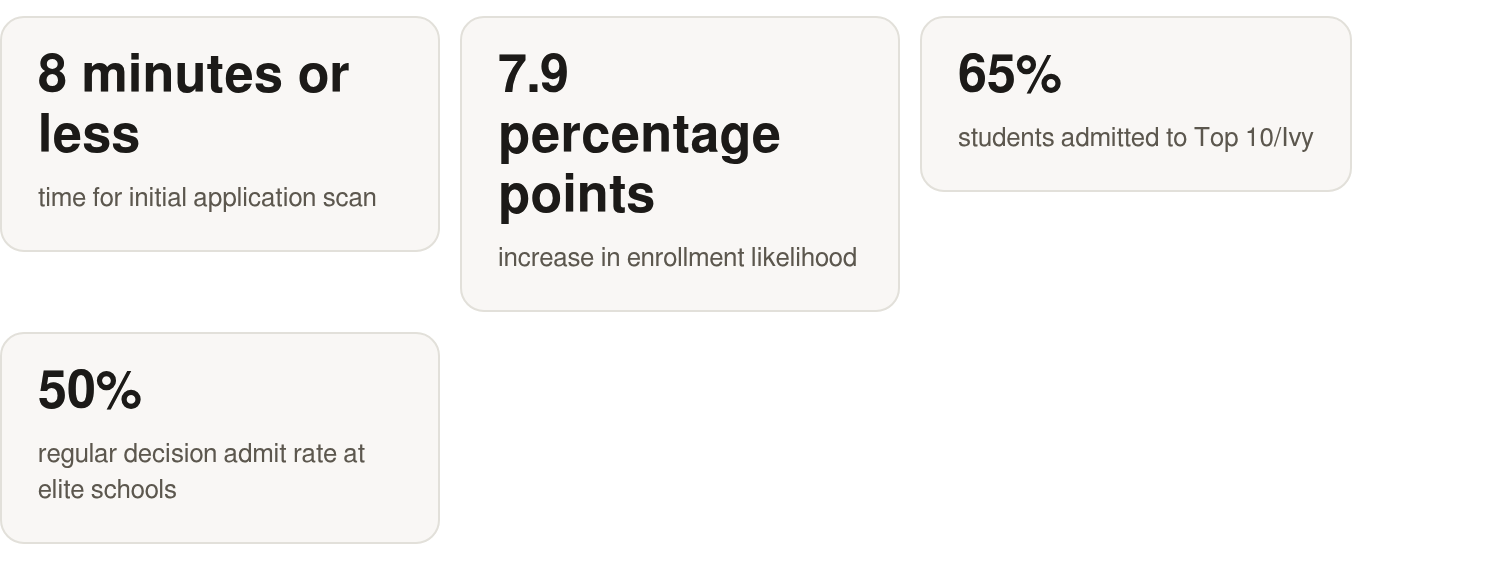
Files move fast at the front end because the math forces it. Huge pools, fixed deadlines, a finite number of readers. At some elite colleges, an officer scans an application in 8 minutes or less, then routes it onto a track. Knowing how that routing works tells you where a consultant actually earns their fee and where they're selling you a story.
Here's my read after years of this work: outside help pays off when a student needs list targeting, structure, and a second set of eyes. It does almost nothing for the applicant who already has clear grades, a real narrative, and the discipline to submit on time. Most of what you can buy is organization, not achievement.
One wrinkle families miss: the read isn't always one person going front to back. At several selective schools, your file gets carved up and evaluated by two people at once. You're not writing for a single reader. You're writing for a committee that never sits in the same room.
Two readers, two halves of your file
At Georgia Tech, Rice, and Bucknell, a two-person team divides each application. One reviewer takes transcripts, test scores, and counselor recs. The other takes activities and essays. Neither one reads the whole thing.
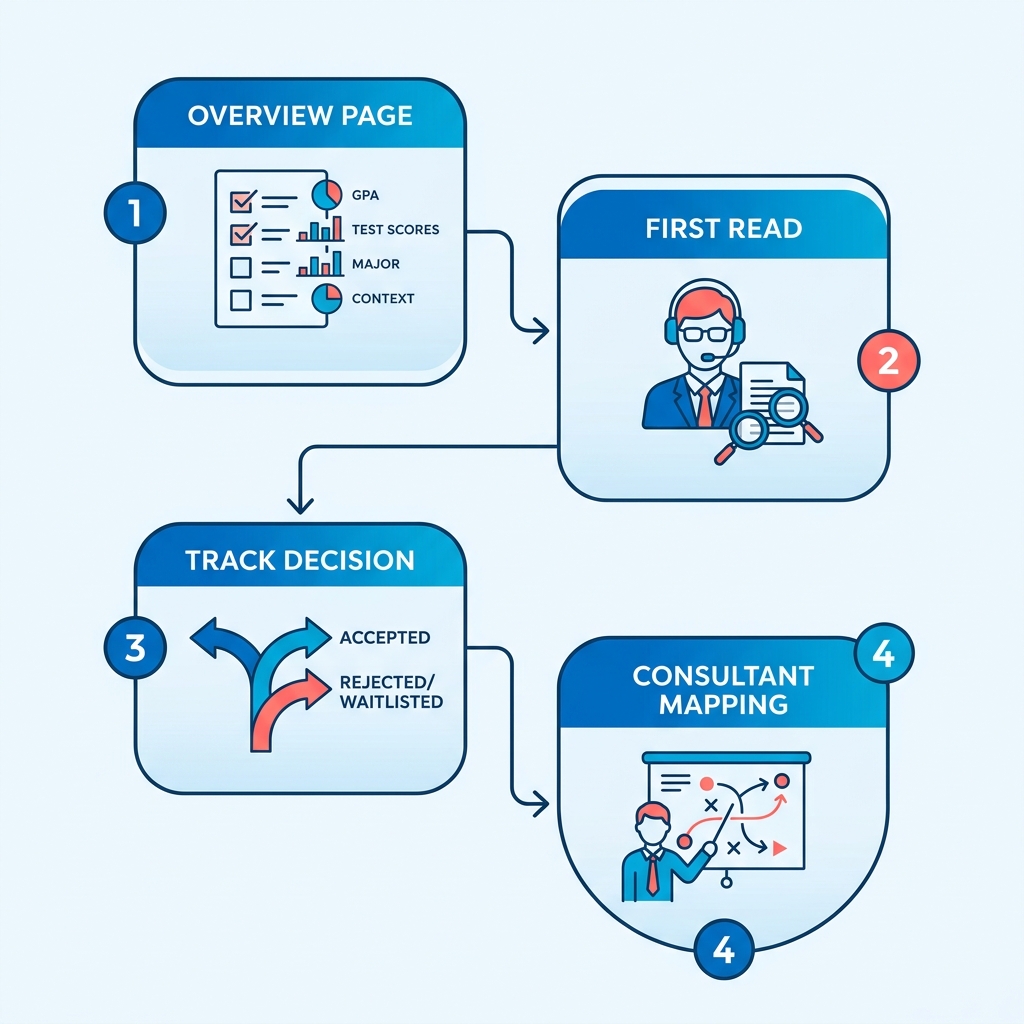
The College Essay Guy calls these roles the Driver and the Passenger. The Driver owns academics and context. The Passenger owns the personal side. At Duke, the first reader scans an overview page of GPA, scores, intended major, and context in about 15 minutes, sometimes less.
So the file has to work on both fronts at once. Crisp numbers and school context for the academic reader. A focused, genuine story for the qualitative one. Polish one and neglect the other and you've left half the evaluation exposed.
The fast scan and the slow read are both real
Eight minutes and three months look like a contradiction. They aren't.
| Track | Who lands here | How long | What decides it |
|---|---|---|---|
| Fast sort | Clear academic admits or denies | 8-15 min, one pass | Overview page: GPA, scores, rigor |
| Slow read | Borderline files | ~3 months, multiple reads | Full holistic review across six areas |
UGA spends almost three months on students who don't clear the bar on academics alone, reading the real core grades and the trend line rather than the cumulative number on the transcript. The 10-minute figure describes the sorting read, not the whole process. Which is why long-game preparation matters. A solid academic and extracurricular foundation holds up whether your file gets triaged in one pass or fought over in committee.
Who gets overlooked in a fast read
First-generation and lower-income students carry the most risk in a quick scan. Christopher Avery, the Harvard economist, found that holistic review may favor wealthy applicants who have the savvy to spotlight strengths and hide weak spots.
That same randomized study carries a blunt lesson for families weighing paid help: guidance can't manufacture achievements a student hasn't earned. What a good advisor does is decode how institutions want materials presented and help organize them well. A capable student who can already execute on their own doesn't need to write a check for that.
Inside the scan: what officers actually look at first
Readers orient before they dig. They hit the high-level metrics, the intended major, and the high school's profile before touching a single supplement. That first pass sets a benchmark, and everything after gets measured against it.
The move, then, is to make sure your strongest signals land in that opening window. Not spreading effort evenly across every field, but front-loading your most distinctive accomplishments and confirming that the core academic data reads cleanly at a glance.
What does a reader see first?
The academic index. A reader forms a picture fast. PrepMaven quotes a Princeton officer who, in 15 minutes or less, wants to know whether you're competitive. Harvard's first reader scores six categories, academic through personal, where 1 is best and 6 is worst.
Make those academic markers obvious on the opening summary page so the reader isn't guessing at your course rigor or grade trend. If your grades climbed over three years, that should be visible without anyone cross-referencing three documents to find it.
How do you rank on rigor and breadth?
Course rigor beats raw GPA. Admissions teams rebuild your record to check year-over-year progression and how you did in core subjects relative to what your school actually offered, rather than leaning on the cumulative figure.
Context has to be right there on the page. As the College Essay Guy's guide points out, a reader working through hundreds of files can't stop to research your school's course catalog. If your school offered three AP courses and you took two of them, that's maximal rigor, but only if the school profile or counselor letter spells out the limitation, as Miami's admissions office explains. Otherwise it just looks light.
Where do essays and activities land?
Later in the scan. But they decide the close calls. UGA rewards depth and consistency in activities over a long list, and on essays they weigh voice and how well you make your point, not comma placement.
Jargon is where good students trip. Readers evaluate applicants across hundreds of different intended majors, so they need writing that lands for an educated generalist, not a specialist walkthrough of your robotics subroutine. Write so it registers instantly.
| Read order | Quick-read signal that helps | Red flag that stalls the file |
|---|---|---|
| Overview page | Clear GPA, upward trend, rigor visible | Numbers below regional peers, no context |
| High-school profile | Hardest courses offered were taken | Light schedule with no explanation |
| Activity list | Depth, leadership, one clear commitment | Long padded list, no through-line |
| Essays | Distinct voice, specific story | Overly technical, generic topic |
| Recommendations | Concrete anecdotes about you | Vague praise anyone could earn |
Order is everything here. A well-qualified candidate loses ground when the good stuff is buried three sections deep. Arrange your materials to match the reader's scanning path so the evidence that matters gets seen while attention is still high.
Where consultants hit their limits
The largest studies of admissions advising draw a clear line around what coaching can do. In Avery's NBER study, ten hours of structured guidance produced no meaningful change in baseline essay quality or holistic rating rubrics. Coaching can't stand in for the academic record underneath it.
The one measurable win was in targeting and list-building. Advised students were more likely to enroll at a Barron's "Most Competitive" college. That tells you where the leverage lives: picking the right schools and hitting deadlines moves outcomes more than fussing over individual paragraphs.

Does more editing actually help?
Past a point, no. Over-editing sands off the student's actual voice. The College Board's holistic review guide frames holistic admissions as structured professional judgment aimed at reading individual character and context. Over-polish an essay and you can swap a real seventeen-year-old for formulaic prose that dies in a fast read.
The useful work is narrative coherence and structural clarity, not making every sentence sound the same. Keep the student's voice intact so the application reads as sincere while still hitting the school's bar for clarity and organization.
Why does expensive help sometimes fail?
Because outcomes ride on execution. Advice on essay revisions, activity framing, or testing strategy returns exactly zero if the student never acts on it or files late.
Cookie-cutter packages make this worse, handing out rigid action items that don't fit how a given student works. Advising has to pair the strategy with real milestones and check-ins, or the deadlines slip and the plan was theater.
Which model fits which student?
It depends on what a student already has. Applicants with an attentive school counselor and strong writing rarely get their money's worth from a high-priced comprehensive package.
| Service type | Main weakness | Best fit |
|---|---|---|
| High-end white-glove firms | Over-editing risks losing student voice; high cost | Families needing full-process management |
| Template/package services | Generic strategy ignores each school's priorities | Students wanting structure on a budget |
| School guidance alone | High caseloads limit per-student targeting | Students with strong self-direction |
| Our approach | Depends on student follow-through | Students needing customized, follow-through targeting |
A sane advising model leans on list targeting, honest positioning, and reliable execution. At Endurable Education, our multi-reader review keeps any single editor from over-shaping a personal statement, which protects the student's voice while making sure the file still communicates. We've written elsewhere about how officers scan certain lines first, and the same rule holds: clarity only works when it sits on top of real experience.
Endurable Education against the alternatives
Most advising comparisons obsess over billable hours and package price, and ignore how officers actually process files. In a fast-read environment, the real question is whether a team builds strategy around your specific profile or shoves your background into a standard formula.
A well-organized student with engaged parents can handle the basic mechanics solo. What a solo applicant can't do is stress-test how different readers will interpret the same essay and activity list. That multi-perspective read is where a collaborative model does real work.

How does our panel review sharpen your application?
Every essay gets read by at least two advisors. A single independent consultant gives you one subjective take. A team surfaces the inconsistencies and weak hooks before a committee ever does.
That structure also supports the long game, helping students build a distinctive extracurricular profile and prep for interviews. Feedback from more than one reader keeps the final submission working across different reader personalities, which matters when you don't know who'll draw your file.
| Dimension | Our Service | Boutique Consultant | Large Firm | DIY |
|---|---|---|---|---|
| Feedback perspectives | 2+ reviewers per essay | 1 | 1, sometimes rotating | 0 |
| Planning approach | Customized to each student | Ad hoc | Templated | None |
| Alumni network access | Yes | Varies | Sometimes | No |
| Early life-planning phase | Built in | Rare | Rare | No |
Where should you skip us?
If you're targeting regional schools with high acceptance rates, or you already write with real clarity and have a balanced list, extensive panel advising is overkill. Save your money.
Our model is built for hyper-selective pools, where the field is dense and a small presentation error can sink an otherwise strong file. That's where early profile development, structured accountability, and multi-reader essay critiques give you an actual operational edge.
When outside help earns its fee
Admissions offices work under real time pressure on that first pass, as the Wall Street Journal has documented. The fast window rewards students who present clean academic credentials and a focused extracurricular theme right away. A consultant adds value not by inventing credentials, but by organizing the real ones to match how committees read.
So paying for help is a targeted call, not a default. A student with attentive school counseling and good narrative instincts can run this process alone. Formal advising returns the most when a student needs structured accountability and more than one reader to sharpen their positioning.
Which decision criteria actually matter?
Weigh four things: budget, timeline, how well the model protects the student's voice, and how personalized the program really is. Rigid template firms treat every candidate the same, which is exactly how you lose the narrative hook that catches a reader's eye.
| Criteria | DIY / School Counselor | Template-Based Firms | Endurable Education |
|---|---|---|---|
| Personalization | Limited by counselor caseload | One checklist for all | Plan built per student's strengths |
| Ongoing mentorship | None | Application-phase only | Career advice + alumni network |
| Essay review depth | Solo | Single editor | At least two team members per essay |
| Timeline support | Senior-year rush | Application-phase only | Starts as early as 8th grade |
| Pricing model | Free / low | High flat fee | Base + bonus, pay-on-satisfaction |
Price transparency belongs on that list too. Some boutique firms charge hundreds of thousands for a comprehensive package. Our fee stays competitive at baseline and ties final compensation to client satisfaction, so the incentive lines up with the outcome.
Why we fit the fast-read reality
Advising only works when advice turns into finished, quality work. We pair a customized roadmap with milestone check-ins that kill procrastination and keep students on the pieces of the portfolio that carry weight.
Our panel is made up of graduates from Harvard, Yale, and Princeton who work together to simulate the multi-reader dynamics of a selective office. The results track: over 65% of our students earn admission to Top 10 and Ivy League universities, alongside a 50% REA admit rate to Harvard, Yale, Princeton, Stanford, and MIT in the 2023 cycle.
If you want a tailored, honest strategy that holds up under a rapid file review, start with an initial consultation and we'll build your roadmap from there.
References
[1] How Colleges Read Your Application: A 4 Step Process | PrepMaven - https://prepmaven.com/blog/applying/how-colleges-read-your-application-a-4-step-process/
[2] Some Elite Colleges Review an Application in 8 Minutes (or Less) - https://www.wsj.com/articles/some-elite-colleges-review-an-application-in-8-minutes-or-less-1517400001
[3] How Selective Colleges Review Applications - https://www.collegeessayguy.com/blog/how-selective-colleges-review-applications
[4] [PDF] Understanding Holistic Review in Higher Education Admissions - https://highered.collegeboard.org/media/pdf/understanding-holistic-review-he-admissions.pdf
[5] The Holistic Review Process-Beyond the Numbers - UGA Admissions - https://admissions.uga.edu/blog/the-holistic-review-process-beyond-the-numbers/
[6] [PDF] What is Holistic Review in College Admissions? - personal.umich.edu - https://www-personal.umich.edu/~bastedo/policybriefs/Bastedo-holisticreview.pdf
[7] What Does Holistic Admission Really Mean - University of Miami News - https://news.miami.edu/admissions/stories/2019/04/holistic-review-jay-jacobs.html
[8] UGA Holistic File Review Process - https://admissions.uga.edu/blog/uga-holistic-file-review-process/
[9] [PDF] The Effects of College Counseling on High-Achieving, Low-Income ... - https://www.nber.org/system/files/working_papers/w16359/w16359.pdf
[10] The Effects of College Counseling on High-Achieving, Low-Income ... - https://dash.harvard.edu/entities/publication/73120378-c980-6bd4-e053-0100007fdf3b
Questions People Ask
1. If my high school offers only a few AP courses, will that hurt me in a fast scan?
Limited course offerings do not penalize applicants as long as the school profile makes those limitations clear. Admissions officers evaluate transcript rigor strictly within local constraints; taking dual-enrollment college courses or the highest available honors track signals strong academic drive when specialized AP or IB programs are absent.
2. Does a longer activity list improve my chances in holistic review?
Unfocused activity padding often weakens an application. Review committees prioritize sustained commitment, measurable leadership, and clear personal themes over an exhaustive catalog of minor club memberships that lack meaningful investment.
3. How do I know whether my file gets the fast sort or the slow read?
Initial routing depends on baseline academic alignment. Candidates with metrics clearly above or below institutional thresholds are typically resolved in the opening sorting pass, whereas competitive applicants with nuanced profiles or mixed indicators advance to multi-reader holistic committees for comprehensive deliberation.
4. If my school counselor already knows my target colleges, is a paid consultant worth it?
Independent counseling is rarely necessary when a student receives dedicated support from an experienced school counselor and possesses strong self-advocacy skills. Outside guidance primarily benefits applicants who need specialized portfolio positioning, multi-tier list calibration, and structured accountability that high-caseload school environments cannot provide.
5. Can too much editing actually backfire on an essay?
Over-editing strips away the authentic perspective and natural voice that evaluators seek during holistic review. When an essay sounds overly corporate or generic, it fails to make a memorable impression. Feedback should focus on refining narrative structure and clarity while keeping the student's authentic storytelling intact.
6. How early should a student start planning if the goal is a top school?
Starting profile development in middle school or early high school allows students to explore genuine intellectual interests, secure progressive leadership roles, and build rigorous course schedules naturally, avoiding the frantic, superficial credential-gathering common in senior year.
7. Why would expensive help still fail to improve my odds?
Advisory recommendations produce zero competitive advantage if the applicant fails to execute them diligently. A customized strategic plan only succeeds when paired with consistent student engagement, timely drafting, and thorough follow-through across all application components.