Why Admissions Runs on Panels, and Your Consulting Should Too
September 23, 2026

Quick Comparison Summary
Three common models show up when you hire help for competitive applications. Solo advisors give you one perspective. Big-name firms give you scale and a brand name. Panel-based college admissions consulting puts multiple readers on your file, so they check each other's judgment. Each one fits a different kind of applicant.
Most consulting still runs one-on-one. One advisor, one read, one set of blind spots. That's fine for a clean file with a sensible school list. But at highly selective schools, a lone reviewer is a real limitation, because the office on the other end often decides by committee, not by one person's hunch.
The group-research caveat matters here. Adding reviewers helps mainly when each reviewer forms an independent judgment before the group starts comparing notes [7]. If reviewers anchor on one another too early, process losses can erase the benefit [7]. The wisdom-of-select-crowds research points in the same direction: small selected panels can outperform lone experts and anonymous committees when independent judgments are aggregated carefully [9]. That is the strongest argument for a well-run panel, not just a larger group.
Which consulting model fits your situation?
Solo consultant: One advisor guides the whole process. Best for students who want a single point of contact and a lower-stakes list.
Large firm: Brand recognition and standardized systems, often at premium flat rates. Pricing and staffing vary widely by provider and package.
Panel-based: Several advisors read your essays and strategy, closer to how a real admissions committee works. Best when your targets are the most selective schools.
| Factor | Solo Consultant | Large Firm | Panel-Based (Endurable Education) |
|---|---|---|---|
| Readers per file | One | Varies, often one | At least two team members |
| Pricing | Flat fee | Flat, often premium | Base + bonus, pay full only if satisfied |
| Bias check | None built in | Limited | Built in through multiple perspectives |
| Team background | Varies | Varies | Harvard and Yale graduates (per provider) |
| Best for | Simple lists | Name recognition | Highly selective targets |
What makes the pricing models different?
The real split is how you pay. Many flat-fee firms collect the full amount up front regardless of outcome. A base plus bonus setup can keep the standard price lower and tie the rest to satisfaction, so the advisor's compensation tracks how well they served you. The exact satisfaction terms vary by provider.
One honest caveat: If your list is a handful of less-competitive schools, a full panel is more than you need. Skip it and keep the money. Multiple readers earn their keep when you're chasing seats where one missed weakness in an essay costs you the admit.
Key Takeaways
- Some panel-based consulting assigns multiple reviewers per file, while solo advisors and many large firms may assign one reader.
- Large firms often charge premium flat rates up front; package pricing varies widely by provider and scope.
- Endurable Education's published pricing model is base plus bonus, with the full fee tied to client satisfaction.
- Cross-reading by multiple reviewers can build in a bias check that catches blind spots one advisor's instinct would miss.
- First-generation applicants, students with a dipped semester, and international candidates are the complex cases where committee-style scrutiny changes outcomes most.
Who actually needs a panel
Not every student does. Applying to a solid state school with strong grades and a clear major? One experienced advisor covers it. Save the heavier machinery for the files where committee-style scrutiny actually moves the decision.
The students who gain most from panel-based consulting are the ones reaching for the most selective schools, where a single reader's blind spot can quietly sink a strong file. When your application is about to be judged by a committee, it helps to have a committee read it first.
When is panel review worth it?
Reach for multiple readers when your case is complex or high-stakes. A first-generation applicant with an unconventional story. A student whose transcript dipped one semester and needs that framed honestly, not buried. An international candidate translating achievements that don't map cleanly onto U.S. norms. These are the files where one advisor's instinct is a genuine risk, and where a second and third read pays off.
Skip the panel for routine, low-variance applications. If your profile is clean and your target schools admit most qualified applicants, you're paying for scrutiny you don't need.
What should you weigh when choosing?
Three things matter most: who reads your file, how they get paid, and whether their pricing rewards quality or just volume.
Here is one place the institutional-review analogy helps. Admissions committees often triage files in stages: an initial read for academic viability, a deeper read for fit and context, and a final committee discussion for borderline cases. A full-file panel review works best when it audits the same failure point that real review misses — the moment a file gets compressed into a few summary impressions before the committee debate begins.
| Factor | Solo advisor | Large firm | Our panel model |
|---|---|---|---|
| Readers per file | One | Often one assigned | Multi-reviewer panel |
| Bias check | None | Limited | Multiple readers audit each other |
| Pricing incentive | Flat/hourly | Package fees | Base + bonus, satisfaction-based |
| Best for | Straightforward cases | Volume and brand | High-stakes, complex files |
Endurable describes its base plus bonus structure as keeping the standard fee lower and tying the full fee to satisfaction. That keeps the focus on doing great work over the long haul. The reasoning behind that stance is spelled out in College Admissions Consulting: Data Beats Gut Instinct.
How the models differ, feature by feature
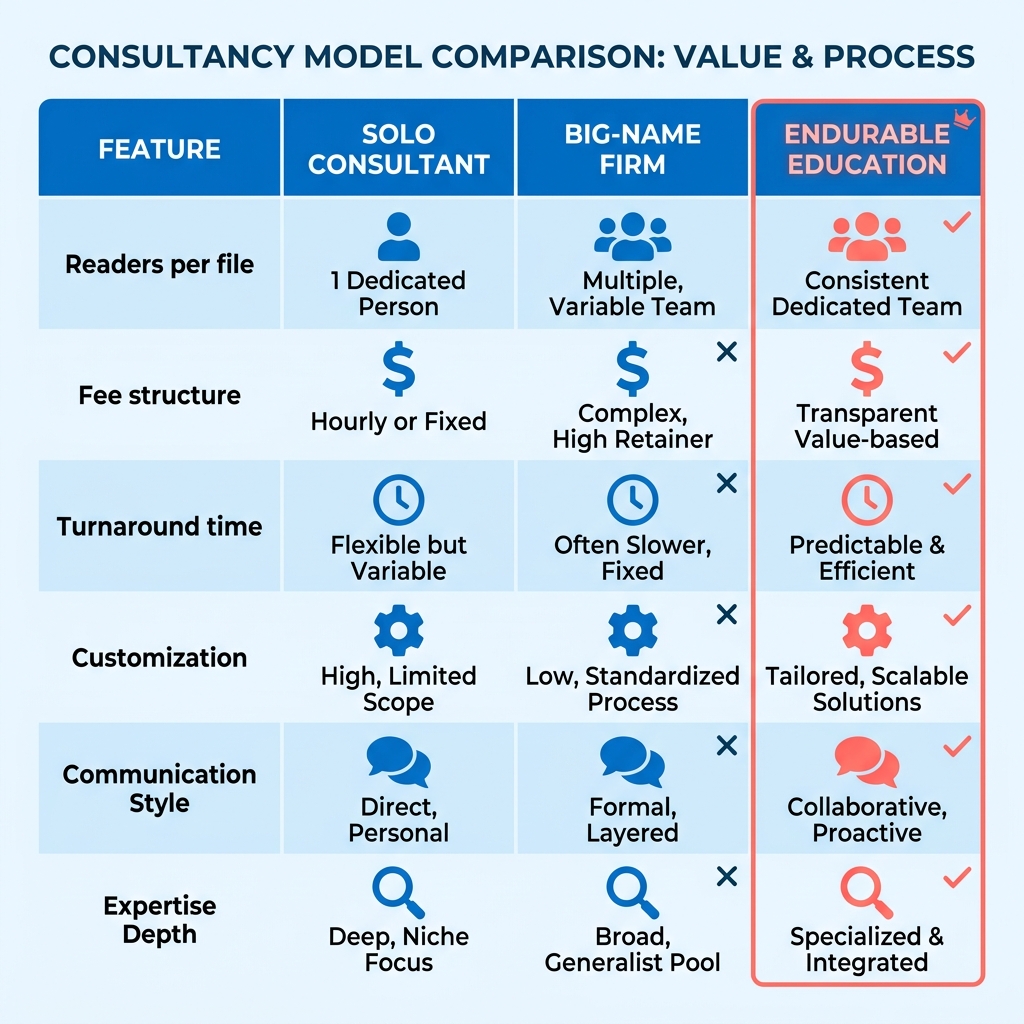
Line up the actual features, and the gaps get concrete fast. Most consulting sells you access to a person or a brand. What matters more is how the file gets read, who reads it, and how the fees are built.
Here's the feature-by-feature look, Endurable's own service included so you can judge it against the rest.
| Feature | Solo Consultant | Big-Name Firm | Endurable Education |
|---|---|---|---|
| Readers per file | One | Often one assigned advisor | A panel of reviewers |
| Reviewer background | Varies | Varies; staff experience may be mixed | Harvard and Yale alumni (per Endurable) |
| Bias check | None built in | Depends on the advisor | Cross-reading catches blind spots |
| Pricing model | Flat or hourly | Flat packages; pricing varies | Base + bonus, tied to satisfaction |
| Mirrors committee review | No | Rarely | Yes, by design |
What do the reviewer credentials actually change?
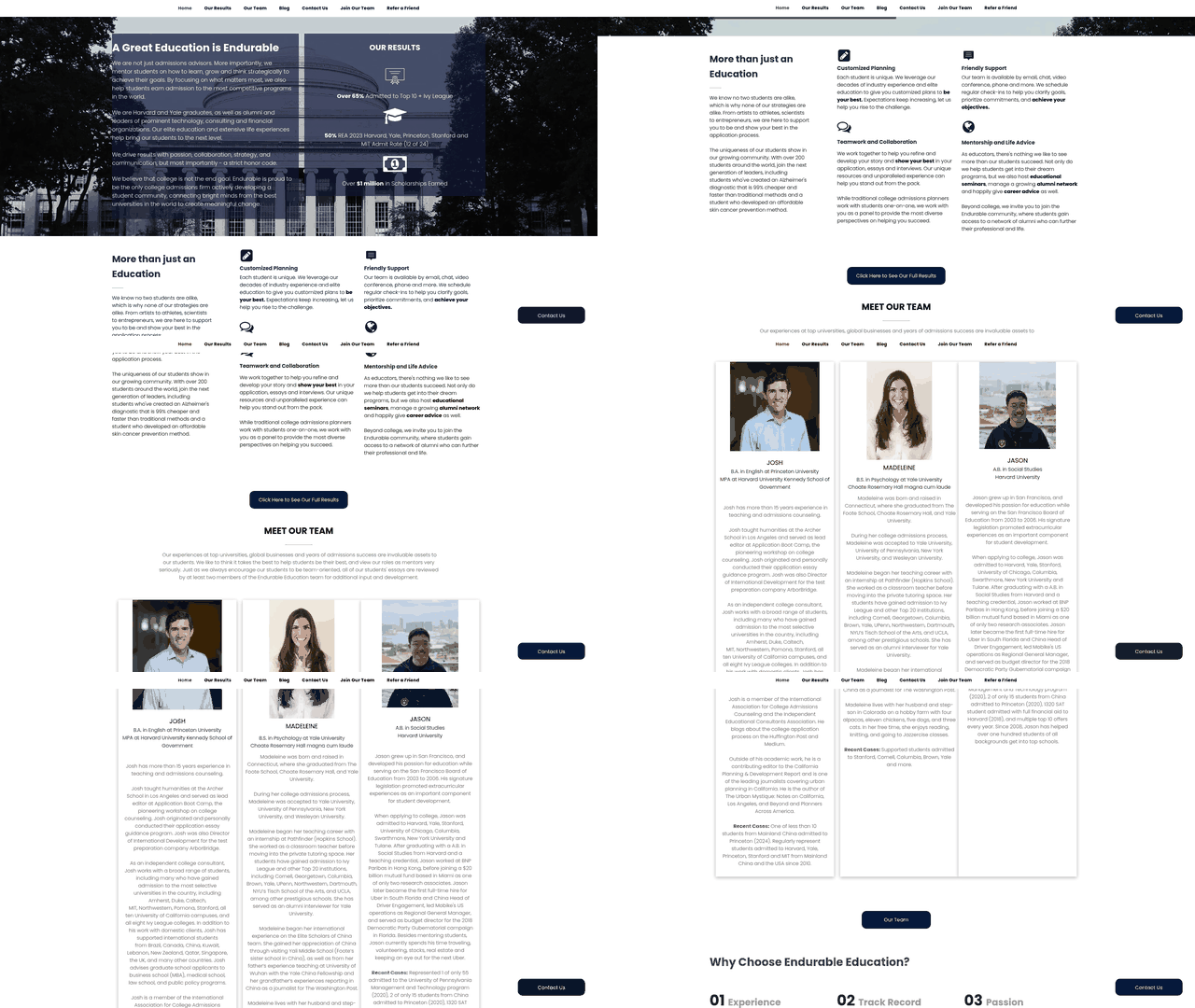
Who reads your file shapes the feedback you get. A single advisor brings one background and one set of instincts. Endurable describes its panel as requiring every essay to be read by at least two team members, with backgrounds that include Harvard and Yale alumni, so the notes come from people who sat inside selective systems.
Admissions offices decide by committee, so a committee-style read before you submit catches the weak spot one person would wave through. We treat the review as an audit, not a pep talk.
The selected-crowd logic applies here: the benefit comes from independent judgments before deliberation. If a second reader sees the first reader's conclusion too early, the panel may just amplify one perspective instead of testing it [9].
How does base + bonus pricing shift the incentive?
Flat packages get paid whether you're happy or not. That's the quiet problem with most pricing. The advisor's payday doesn't move with how well they served you.
Tie part of the fee to satisfaction, and the incentive flips. The team stays focused on application strength instead of billable add-ons, and the notes stay objective through every draft rather than padded to log hours. Exact bonus terms vary by provider and should be confirmed in writing.
If your list is all schools with predictable, numbers-based criteria, an hourly line-edit from one consultant is often all you need. Intensive multi-stage critiques belong on applications where qualitative nuance decides the call.
Speed versus depth
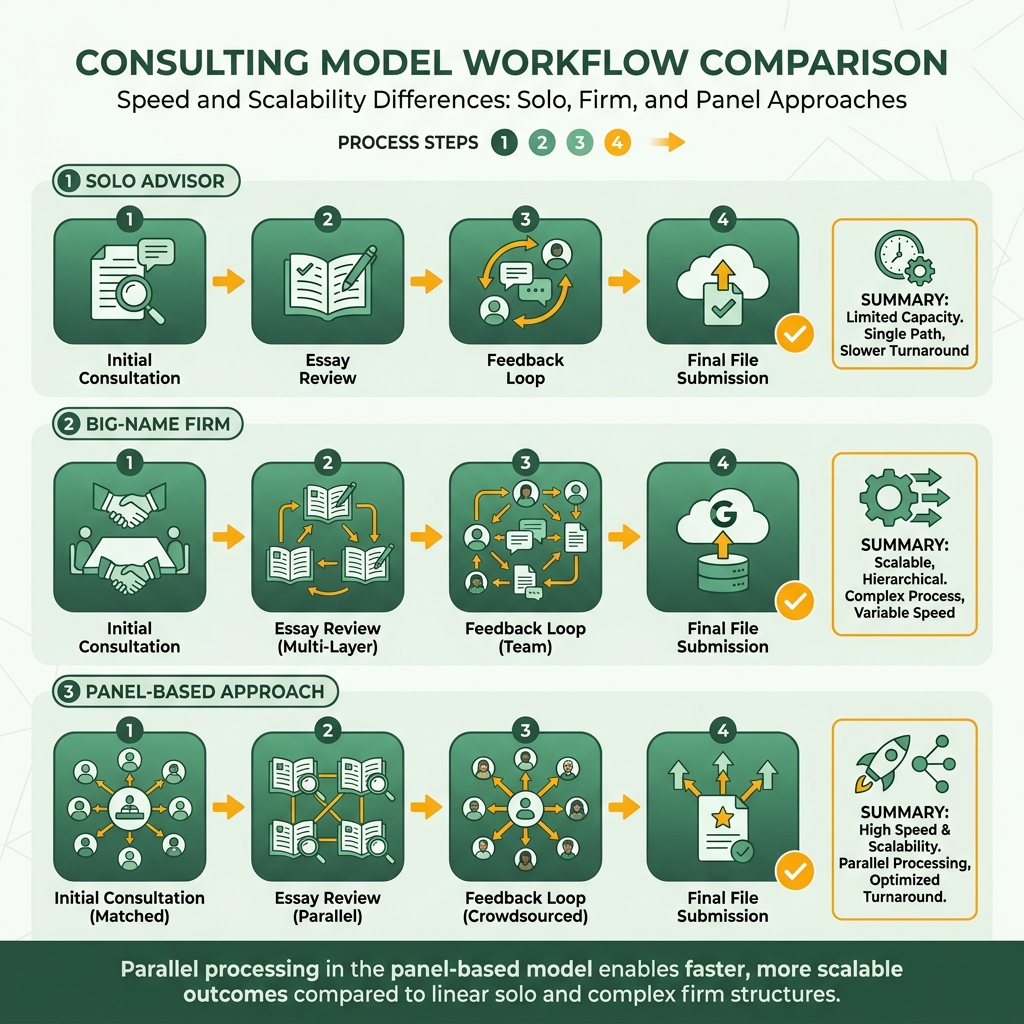
Speed matters when deadlines loom, but it isn't the whole story. The real question is whether a faster read gives you a better one. A solo advisor can often turn an essay around quickly because one person makes the call. Quick, yes. It's also a single set of eyes on a file a committee will judge together.
Scalability cuts the other way. Large firms can handle high volume by distributing work across larger advising teams, so turnaround can stay fast even in peak season. The tradeoff is that the speed may come from volume rather than depth. Endurable describes its panel approach as putting multiple reviewers on each file, with every essay read by at least two members of the team, so blind spots get caught.
How the models trade speed for depth
Here's the operational side, not just the read itself.
| Factor | Solo Consultant | Big-Name Firm | Endurable Education |
|---|---|---|---|
| Reviewers per draft | One person | Staff-driven | At least two team members by design |
| Reach and roster | Limited by one person | High, scales with staff | Depth-focused; size varies |
| Reader effort per file | One reviewer's hours | Distributed across staff | Multiple reviewers on each file |
| What you're paying for | Speed and access | Volume and brand | Depth and cross-checking |
The pattern is clear. Want the fastest possible reply on a straightforward file? A solo advisor wins on raw speed. Need a large firm's machinery to keep pace during a crunch? The volume model delivers. Neither one optimizes for the thing that actually moves a committee.
Depth is the resource that pays off
Endurable says it spends more reviewer hours per student on purpose. A panel means multiple experienced readers put real effort into one file, which costs time and coordination. For a reach application, that's exactly where you want the resources concentrated.
Applications judged mainly on index scores or a baseline GPA threshold don't need rounds of debate. Pointing the collaborative hours at the borderline decisions puts the high-effort analysis where a small improvement actually shifts the odds.
Pros and Cons
Every model buys you something and costs you something. The trick is knowing which tradeoff you can live with. Solo advisors, big-name firms, and panel review each solve a different problem, and none of them is free of downsides.
Here's the honest ledger, weaknesses included.
| Model | Strengths | Weaknesses |
|---|---|---|
| Solo consultant | One consistent voice, fast turnaround, lower cost | Single blind spot, no internal check, capacity caps out |
| Big-name firm | Scale, brand recognition, handles peak season | Staff experience can vary, flat premium pricing, uneven depth |
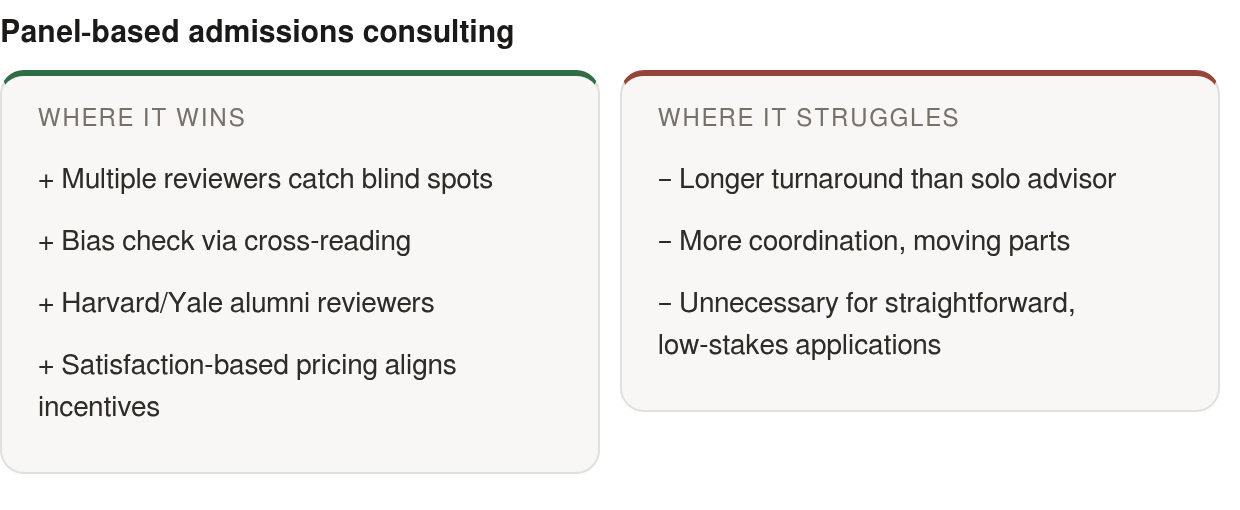
| Endurable Education | Panel of Harvard and Yale alumni, cross-reading catches bias, bonus tied to satisfaction | More coordination than one voice, more moving parts, not needed for every case |
What do you give up with a panel?
Speed and simplicity, mostly. When several readers weigh in, you don't get the overnight essay turnaround a single advisor offers. More voices also means more coordination. That's real, and we won't pretend otherwise.
The payoff is a read that mirrors how offices actually decide. One reader's assumption about your story goes unchecked. Two or three readers catch what one misses. For a reach application to the most selective schools, that second look changes outcomes.
Holding part of the fee against satisfaction adds mutual accountability too, which keeps the team invested in whether the finished essay is clear and persuasive, not just delivered.
When is a panel the wrong call?
Programs with formulaic cutoffs rarely reward multi-perspective editing. If a school admits mostly on standardized metrics and core prerequisites, paying for collaborative editorial rounds adds overhead without shifting your odds.
Committees save their extended debate for files where the qualitative materials decide the margin. Your spending should mirror that split. For the data behind why committee-style judgment tends to beat solo reads, the data over gut instinct argument digs into it.
Matching the model to the student
The clearest way to pick is to match the model to the applicant, not the brand. Different students need different amounts of scrutiny, and the wrong fit either wastes money or leaves gaps. Here's how we sort it by who actually benefits.
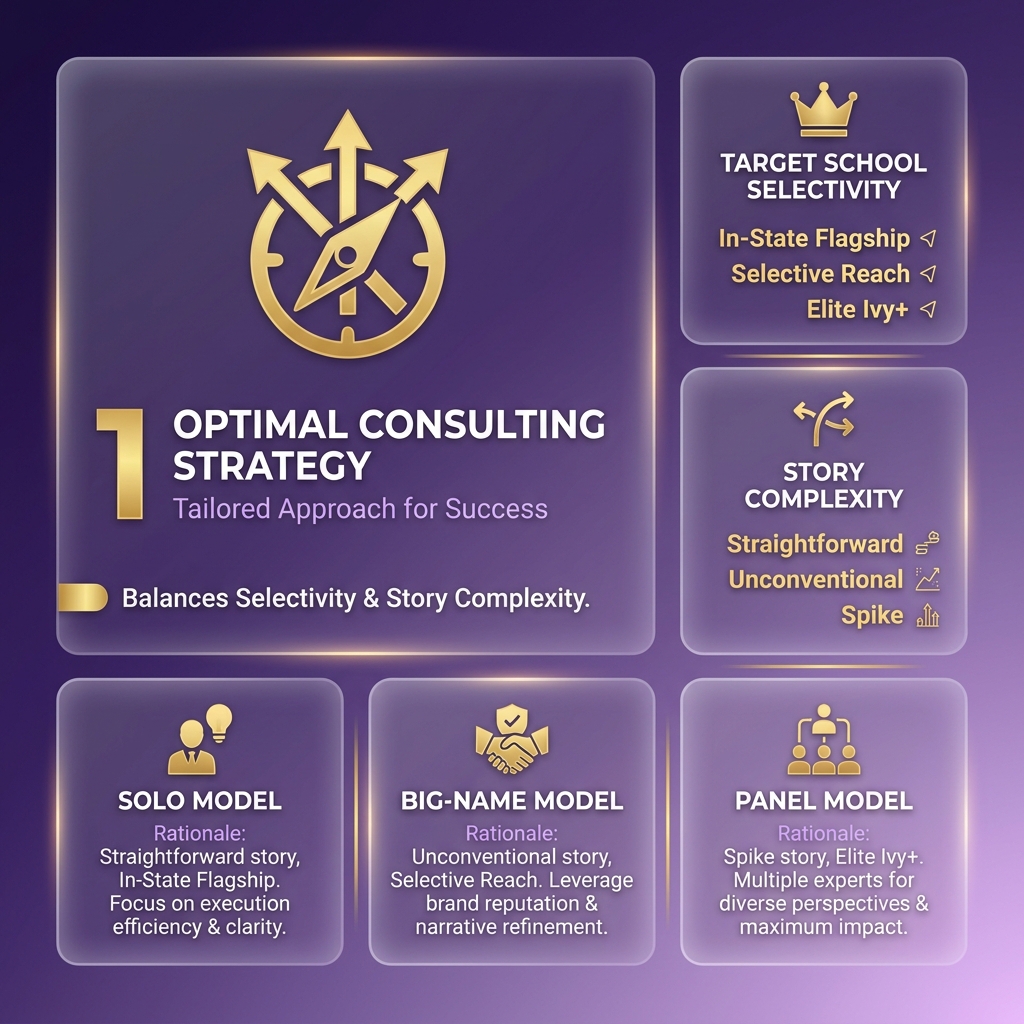
Start with your target schools and the complexity of your story. A strong student aiming at the in-state flagship rarely needs a panel. A student with a spike, an unconventional path, or reach schools at highly selective admit rates is exactly who committee-style review protects.
Which Student Fits Which Model
| Student profile | Best fit | Why |
|---|---|---|
| Solid grades, clear major, state or regional target | Solo consultant | One steady voice covers the process at lower cost |
| High volume of applications, wants brand assurance | Big-name firm | Scale and staffing can keep turnaround fast in peak season |
| Reach-school applicant with a complex or high-stakes story | Endurable Education | A multi-reviewer panel cross-reads the file so no single blind spot decides it |
The panel earns its keep in the reach-school case. When a committee of admissions officers will judge your file together, having it read first by multiple experienced reviewers matches that reality. Endurable built the service for students whose margin for error is thin.
The families who get the most from a panel
Students with non-traditional academic paths gain the most. When extracurriculars cross several unrelated fields, or an applicant has to explain an atypical course sequence, a single reviewer tends to read personal preference into the narrative. Multiple evaluators test how different committee members might interpret those same choices.
Applicants working through foreign curriculum conversions or unfamiliar activity tiers benefit for the same reason. A panel spots the cultural assumptions that could confuse a domestic reader before the file ever reaches a regional dean.
Families who want transparency like the structure too. Contingent pricing, where offered, removes some of the upfront financial risk baked into high-ticket packages and sets clear expectations between the team and the family through every review phase.
How to choose before you apply
Start with one question: how selective are your targets, and how complex is your story? That answer points you to a model faster than any brand comparison. Most models put one person on your file. A panel puts several. Which you need follows from those two variables, nothing else.
Match the model to the stakes
Use this as your gut-check when you're deciding where to spend.
| Your situation | Best fit |
|---|---|
| Strong grades, clear major, state or regional target | Solo consultant |
| High application volume, want brand recognition | Big-name firm |
| Reach schools at highly selective admit rates, complex or unconventional story | Endurable Education |
Match the model to institutional selectivity, and you protect both your budget and your outcome. Straightforward applications with clear metric thresholds run fine on single-advisor guidance. Once you enter holistic pools, where committees weigh narrative, fit, and subtle portfolio flaws, a multi-reader read is your best defense.
Why our structure backs the recommendation
Several experienced graduates critiquing each essay means the tone, framing, and academic presentation hold up under different kinds of reader scrutiny, not just one. Pair that with a fee tied to your satisfaction, and the guidance stays aligned with your goals, not with hours billed.
For the fuller argument on why we lean on evidence over instinct, it's laid out in College Admissions Consulting: Data Beats Gut Instinct.
References
[1] Admissions Committees: What Goes On Behind-the-Scenes - Collegewise - https://collegewise.com/blog/admissions-committees-behind-the-scenes
[2] Admissions Committee: The Review Process - IvyWise - https://www.ivywise.com/ivywise-knowledgebase/how-the-admissions-committee-review-process-works/
[3] Admissions Committees Best Practices - https://kb.wisc.edu/grad/131751
[4] The Admissions Committee Process - The Leadership Alliance - https://theleadershipalliance.org/resource/admissions-committee-process
[5] How Admissions Committees Review Applications - YouTube - https://www.youtube.com/watch?v=PYcDb-pO5vM
[6] Consulting Multiple Advisors: When It Hurts and When It Does Not Hurt ... - https://onlinelibrary.wiley.com/doi/10.1002/bdm.2382
[7] (PDF) Group Performance and Decision Making - ResearchGate - https://www.researchgate.net/publication/8902777_Group_Performance_and_Decision_Making
[8] [PDF] Group versus individual decision-making: Is there a shift? - https://www.ias.edu/sites/default/files/sss/papers/econpaper91.pdf
[9] (PDF) The Wisdom of Select Crowds - ResearchGate - https://www.researchgate.net/publication/264462189_The_Wisdom_of_Select_Crowds
[10] The Wisdom of Crowds - ResearchGate - https://www.researchgate.net/publication/259327958_The_Wisdom_of_Crowds
Frequently Asked Questions
Can I combine a solo advisor for safety schools and a panel for my reach schools?
Matching the model to the stakes makes strategic sense. Straightforward applications with clear metric benchmarks can be handled through targeted hourly reviews, allowing families to direct collaborative panel evaluations toward reach schools where admissions committees debate subjective margins.
With base-plus-bonus pricing, who decides whether I'm satisfied enough to owe the full fee?
Under Endurable's published model, the client holds final approval over whether the advisory process fulfilled expectations. Tying the bonus component directly to client approval aligns the consulting team with candidate success, ensuring feedback remains thorough and focused on application impact.
Why do big-name firms often assign junior staff instead of senior reviewers?
Some large agencies rely on broad staffing models to accommodate seasonal spikes. In those setups, routine editing may be handled by less experienced staff, while senior reviewers focus on higher-stakes decisions. The exact mix varies by firm.
Does having two readers slow down my essay turnaround?
Coordinating multiple reviewers requires additional time compared with single-reader feedback. While you may lose immediate next-day turnaround, a deliberate multi-reader workflow can resolve narrative weaknesses and conflicting interpretations before submission.
Is a first-generation applicant with strong grades still a good fit for a panel?
Even with high marks, candidates from families unfamiliar with elite holistic admissions can benefit from committee-style review. Multiple readers help contextualize achievements and highlight personal resilience in ways that resonate with institutional evaluators.
Pick the model that matches your stakes. For the hardest cases, read your file the way the committee will.