3 Prerequisites Before You Hire a College Admissions Consultant
September 20, 2026

Key Takeaways
- The average student-to-counselor ratio in U.S. public schools sits at 430 to 1, nearly double the recommended 250 to 1.
- That staffing gap leaves the typical senior about 44 minutes a year to talk college applications with a counselor.
- Christopher Avery's research found that just ten hours of expert counseling raised a student's odds of applying to and enrolling in top-tier schools.
- Educational consulting is a wholly unregulated market, so a high base fee is a weak proxy for actual quality.
- Mark Moody's cadence calls for a solid college list by summer before senior year.
- It also calls for every application finished by mid-December.
Related Video
Watch: Should You Hire a College Admissions Consultant? by Ask Dr. Hoffman
Do the prep work before you ever call a consultant
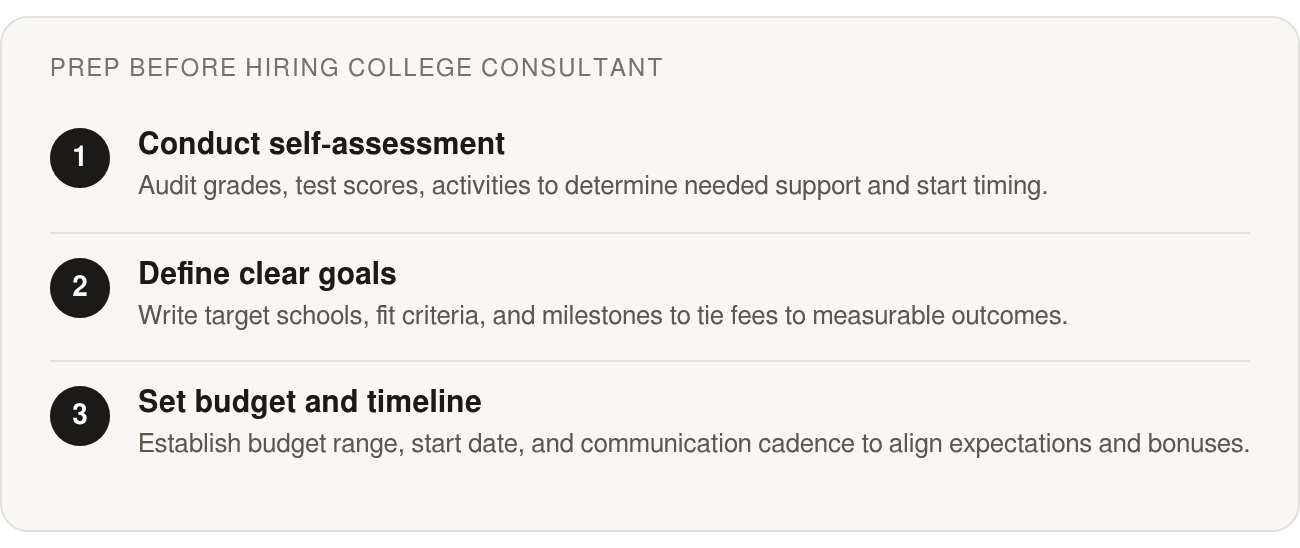
Here's what I tell families before they shop for anyone: three things need to be nailed down first. A candid read on where your student stands. A clear set of goals. A realistic budget and timeline. Skip that groundwork, and you can't tell whether you're paying for substance or for a logo on the letterhead.
The reason matters more than it sounds. Most quality consultants price with a base fee plus a bonus. That structure only becomes readable once you know what you're actually buying. Without your own self-assessment, defined goals, and a budget, you have no way to judge whether a fee rewards real work or just guarantees the consultant a healthy margin.
Admissions consulting has grown from informal advice into a data-driven business, and applicant volumes keep climbing. College Essay Guy frames that as good news for access and bad news for any single applicant trying to stand out. At the same time, public school guidance offices are drowning in caseloads. The math above tells the story: 44 minutes a year per senior is not a strategy; it's a hallway conversation.
That gap is why families reach outside for help. Getting good help, though, depends on the three factors you settle before any contract talk starts.
Your self-assessment sets the timeline and the fee
An honest audit of grades, activities, and academic trajectory tells you how much support you actually need. Avery's research found that just ten hours of expert counseling moved the needle on applying to and enrolling in top schools. A tight, targeted engagement is often enough. Your profile decides whether you sit in that focused bracket or need heavier oversight.
- Inventory current grades, test scores, and activities honestly. This profile decides whether you need a freshman-year start or a junior-year one.
- Flag any specialized track early. Recruited athletes and sequenced majors like nursing often need to begin sooner to keep options open.
Defined goals turn vague fees into measurable ones
Clear fit objectives are the best filter you have, both for picking an advisor and for reading a contract. College Essay Guy's first tip is to figure out what you need before you shop: essay editing, list-building, or end-to-end guidance. Name those priorities and you can tie variable pay to concrete deliverables instead of vague promises.
- Write down your target school types and what "fit" means to you beyond the rankings.
- Decide which milestones matter most, so a bonus rewards work the consultant controls rather than luck.
No private advisor can promise an acceptance, and that's worth sitting with. Incentives should track operational checkpoints the counselor actually supervises. Mark Moody's cadence is a good yardstick: a solid college list by the summer before senior year, and every application in by mid-December. Peg pay to those windows, and your money follows verified work, not a committee's mood.
Budget and timeline clarity protect you in an unregulated market
Private advising is wholly unregulated, so a jaw-dropping quote tells you nothing about quality. Plenty of families reach for the priciest package on the assumption that money equals competence. It doesn't. A base-plus-bonus arrangement strips out that blind premium and ties spending to stages you defined in advance.
- Set a firm budget range and map it against fee models: per hour, per application, or flat package.
- Confirm your timeline before the first call, so you can spot whether a proposed bonus rewards real milestones or just repackages the base rate.
Settle these early, and the contract gets simple. You walk into conversations knowing what services you're securing and how any bonus should be built. That's the whole reason a base-plus-bonus model works: the fee stays tied to the results you defined, not to the brochure.
Prerequisite 3 – Set a Realistic Budget, Timeline, and Communication Plan
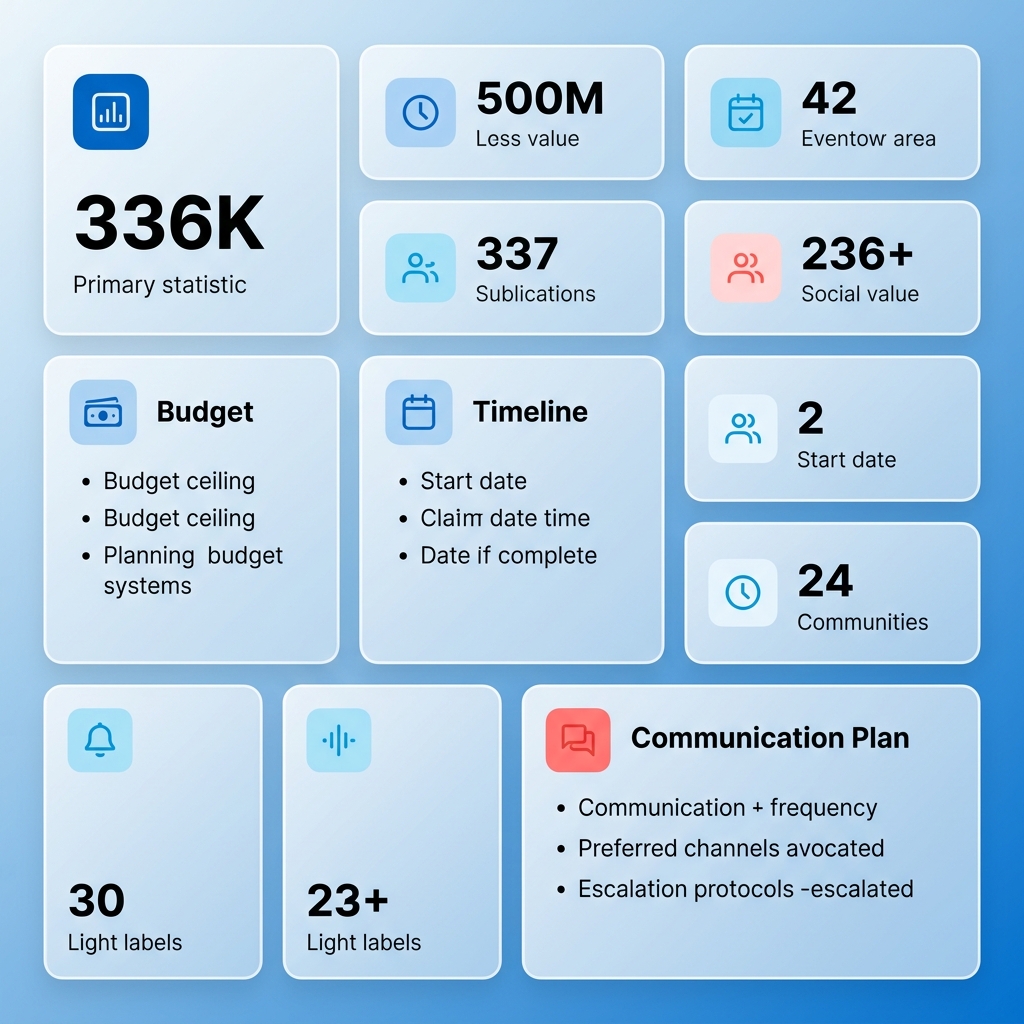
Money, scheduling, and communication are the three areas families misjudge most. Leave them fuzzy, and scope creep is almost guaranteed: unbilled hours pile up, platform surcharges appear, and the total drifts well past the estimate. Lock each one down, and you can read a fee schedule accurately.
This matters most when you're negotiating a milestone-based deal. Variable payment tiers only help you when the ceiling, the start date, and the check-in rhythm are set beforehand. Those terms are how you tell whether an agreement actually pushes the consultant toward student-centered work or just protects their margin no matter what gets delivered.
How much should you budget for college admissions consulting?
Pricing across the field is all over the map, and the expensive packages are often driven by marketing spend rather than better counselors or more personalized care.
That's exactly why splitting the base fee from the bonus is useful. A flat sum gets spent whether the work is good or not. Performance tiers make the extra payout follow something you can actually see.
- Confirm the pricing model. Some counselors charge per hour, some per application, some a flat package, as College Essay Guy notes. Know what each dollar buys.
- Budget the hidden costs too. Test prep, application fees, and campus travel add up fast and rarely sit inside the consulting quote.
- Tie any bonus to process milestones the consultant controls, not acceptance letters. Rewarding a finalized school list and fully submitted applications pays for effort and organization, not a committee vote.
When should the clock start?
Start dates should match the student's academic path and activities, not a calendar default. Consultants who work with athletes push for freshman-year starts; one specialist is now "already long full" and takes freshmen almost exclusively. Long-range planning pays off most for varsity prospects and students on demanding prerequisite tracks.
- Start freshman year for a recruited athlete. Coaches can actively recruit after June 15 following sophomore year, and the House v. NCAA settlement's roster limits have tightened the odds.
- Plan course sequencing early for specialized paths. A nursing hopeful needs AP Bio, AP Chem, and anatomy on the transcript, and that's hard to squeeze in if you start junior year.
- Engage sooner if your student already stresses over every grade. Starting early tends to bring that anxiety down rather than pile onto it.
For a general academic applicant without recruiting or complex course constraints, starting midway through high school gives plenty of runway.
What communication cadence fits your family?
Pick a rhythm that matches how your family actually operates. Some parents want frequent video calls. Others prefer async: shared docs, essay drafts reviewed on their own time, a regular email summary. Settle this early, and you head off misunderstandings and line up check-ins with the deadlines that matter.
- Agree on channel and frequency up front, whether that's monthly video calls or async email review.
- Set response-time expectations for essay drafts and deadline-sensitive questions.
- Map each milestone to a scheduled check-in, so you see the work before any bonus is earned.
How to vet a consultant using the prerequisites as a framework
The discovery call is where your prep work earns its keep. Your finished self-assessment, your target tier, and your budget become a diagnostic checklist that reveals whether an advisor brings real expertise or leans on prestige marketing. It also shows how an advisor handles accountability when you press.
Premium pricing often papers over a thin admissions background. In one extreme case, an agency reportedly charged $32,000 for a single hour. Vet candidates systematically, and every billed dollar maps to a task the counselor controls. Use the checklist below during intake calls.
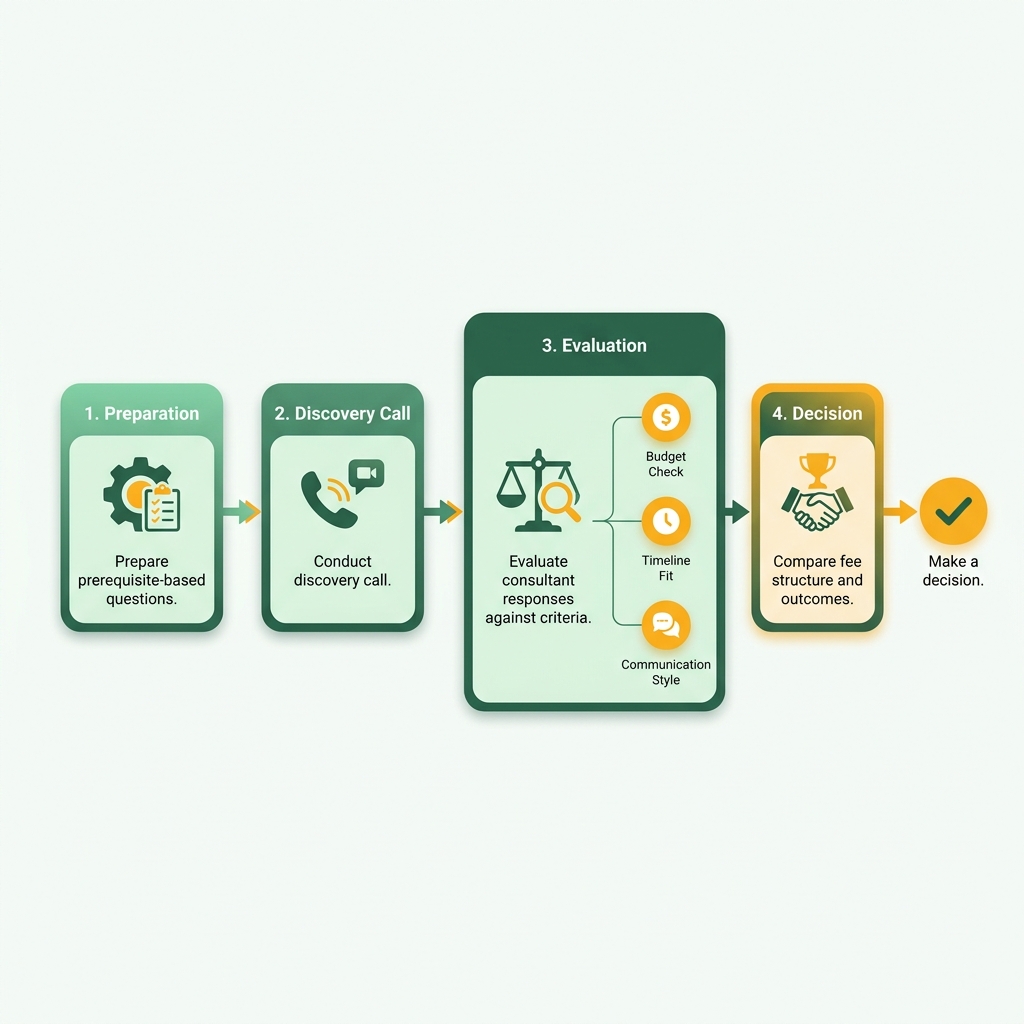
Test whether they can read your student's audit
This maps to your self-assessment. A strong consultant interprets a profile. A weak one just reacts to the GPA.
- Ask them to name the two biggest gaps in your student's current profile after reviewing the audit. Vague praise means they skipped the reading. Specific observations mean they can build a strategy.
- Ask how they'd sequence advanced coursework for a demanding technical or pre-professional major, so graduation requirements and competitive prerequisites don't collide.
- Confirm they know the difference between reading applications and coaching them. As College Essay Guy notes, time in an admissions office doesn't automatically mean someone can help a student build a compelling story.
Watch how they adjust the target list
This maps to your goals and school list. The value shows up when a consultant turns an unrealistic list into a workable one.
- Ask for a recent example where a self-audit changed a student's list. Families in one dissertation study valued a counselor who acted as a matchmaker, not a cheerleader.
- For athletes, confirm they understand how a coach's pre-read and the Academic Index shape which programs are realistic. A consultant who knows recruiting will balance the list around schools where the student clears both the athletic and the academic bar.
- Ask whether they'll coordinate with your school counselor. Anyone who asks to stay hidden from the school is waving a transparency flag.
Tie the bonus to milestones, not acceptances
This maps to your budget and timeline. Since no one can guarantee admission, a bonus should reward execution the consultant actually controls.
- Ask what triggers the bonus. A good answer names verifiable submission deadlines and finished essay portfolios well ahead of institutional closing dates.
- Reject any bonus pegged to acceptance letters. That structure pays for luck. Milestone-based pay keeps the incentive on the work.
- Ask how often you'll meet and how fast they respond. Responsiveness and availability ranked among the top themes families cited when rating counselors.
Endurable Education's own base-plus-bonus structure runs on this logic. Standard prices stay lower than competitors, and the full fare only applies if you're satisfied with the service. A panel approach puts multiple advisors on each student, with every essay reviewed by at least two team members, so the base fee buys collaborative judgment. After the application is done, students keep access to the alumni network for ongoing support.
What to settle before you sign
Your audit, your target parameters, and your budget put you in control of the contract terms. The checklist below turns that prep into a working tool for evaluating a consulting deal before you commit.
Keep the incentives tied to concrete deliverables. Admissions decisions belong entirely to university committees, so the better consulting models reward operational rigor, polished essays, and early dossier completion over verdicts nobody can predict.
What should go on your printable checklist?
Work these in order. Each one feeds the next, and skipping any leaves a gap a vague contract can exploit.
- Complete the self-audit worksheet so you know whether your profile calls for a freshman-year start or a later junior-year cadence. Timing is profile-dependent, and the audit tells you which applies.
- Draft a target-school list with reach, match, and safety tiers, and set an early deadline to finalize it before senior year begins.
- Build a budget spreadsheet with a ceiling, the base fee, and any bonus triggers spelled out. If a trigger names an acceptance you can't control, flag it.
- Schedule two or three discovery calls to compare proposals side by side, not one at a time.
- Confirm the consultant will coordinate with your school counselor. Stay away from anyone who asks to stay hidden.
How do you compare proposals side by side?
Line up the three prerequisites against time, effort, and a decision metric, and it gets clear where the real service value sits, so you can skip the overpriced packages that deliver little.
| Prerequisite | Relative Time Required | Effort / Difficulty | Key Decision Metric | Example Outcome |
|---|---|---|---|---|
| Self-audit | Short | Moderate | Does the consultant tailor advice to your profile? | You learn you need an early start for a specialized track |
| Target-school list | Longer | Moderate-high | List finished by summer before grade 12 | A balanced reach/match/safety list ready for essays |
| Budget + fee review | Short | Low-moderate | Bonus tied to milestones, not acceptances | You sign only when incentives match your goals |
Good counseling isn't about secret advantages. As research on the process notes, it comes down to personalized guidance, focused essay help, and one-on-one coaching that overloaded school counselors can't consistently provide. Score each proposal against those qualities, and the table tells you what the fee actually buys.
What are your next steps?
Start the self-audit this week. It's the shortest task, and it unlocks everything else. If you want guided help, Endurable Education's process opens with a consultation that assesses your student's needs and goals, then builds a plan from there.
One honest limit, though. If you already attend an independent school with dedicated college counselors, extra help can backfire when duplicate conversations produce conflicting advice. Let need drive the decision, not the fact that everyone else seems to be hiring someone. For more on timing and fit, our admissions and life-planning blog goes deeper.
References
[1] When Should You Engage a College Admissions Consultant? - https://howtopayforcollege.com/blog/when-should-you-engage-a-college-admissions-consultant
[2] How to Choose a College Admissions Counselor - The Princeton Review - https://www.princetonreview.com/college-advice/how-to-choose-a-college-admissions-counselor
[3] Should You Hire a College Admissions Consultant? - https://generalacademic.com/college-admissions-consultants-guide/
[4] Do You Need a Private College Counselor? I Asked the Pros - https://akilbello.com/posts/do-you-need-a-private-college-counselor-i-asked-the-pros/
[5] College Admissions Counselor: Factors to Consider and Questions ... - https://www.collegeessayguy.com/blog/college-admissions-counselor
[6] Should You Hire a College Admissions Consultant? by Ask Dr. Hoffman - https://www.youtube.com/watch?v=rKsML0wIgAk
Common Questions
1. Should I still hire a consultant if my student attends a school with dedicated college counselors?
Carefully assess your school's existing college counseling resources first. When an institution provides low counselor-to-student ratios and thorough individual roadmaps, hiring an outside advisor can create friction, conflicting narrative feedback, and unnecessary stress for the applicant. Retain private support only if your student has distinct niche needs that school staff cannot accommodate.
2. Can a college admissions consultant guarantee my student gets in?
No external advisor can promise admission to any selective institution, as ultimate decisions depend entirely on institutional review processes. For this reason, professional agreements should anchor performance bonuses strictly to manageable project targets, such as completing all essays and application submissions ahead of key deadlines, rather than speculative admission decisions.
3. Does a higher base fee mean I'm getting a better consultant?
High pricing does not correlate with counseling effectiveness. Because private college advising is not governed by credentialing standards, boutique firms frequently inflate rates to project exclusivity or fund client acquisition campaigns. Focus your vetting on verified past student outcomes, editing workflow, and transparent milestone-based payment structures.
4. When should a recruited athlete start compared to a typical applicant?
Student-athletes navigating varsity recruitment benefit from beginning their planning early in high school, allowing them to balance athletic showcases, Academic Index benchmarks, and coach outreach before recruiting windows open. Conversely, non-athletic applicants following traditional academic paths can comfortably wait until midway through high school to begin intensive list curation and application drafting.