5 Things to Verify Before You Pay a College Admissions Consultant
September 25, 2026

What You Need to Know
- Full-service admissions packages can cost several thousand dollars at many firms, even though nobody needs a license to hang out a shingle in this field.
- Caltech admits roughly 3 percent of applicants, and the Ivies hover near 4 percent, which makes any promised admission outcome inherently fragile.
- No licensing board, exam, or required credential exists for admissions consultants, so the entire burden of verification lands on families.
- MassMutual argues a missing HECA or IECA membership may not matter, while career educators counter that voluntary certification at least signals accountability.
- Base-plus-bonus pricing ties payment to inspectable milestones, finished school lists, drafted essays, and on-time submissions, rather than a single admission decision.
- Harvard, Yale, and Princeton offer alumni or registrar degree-verification lookups, though some route through third-party clearinghouses for a fee.
- Reading applications as a former admissions officer and coaching a teenager to build one are genuinely different skill sets.
Verify First, Pay Second: Why the Order Matters
The stakes are real. Families put serious money into admissions consulting in a market where a confident claim can look a lot sturdier than it is. That's a big check to write for a service most parents buy exactly once.
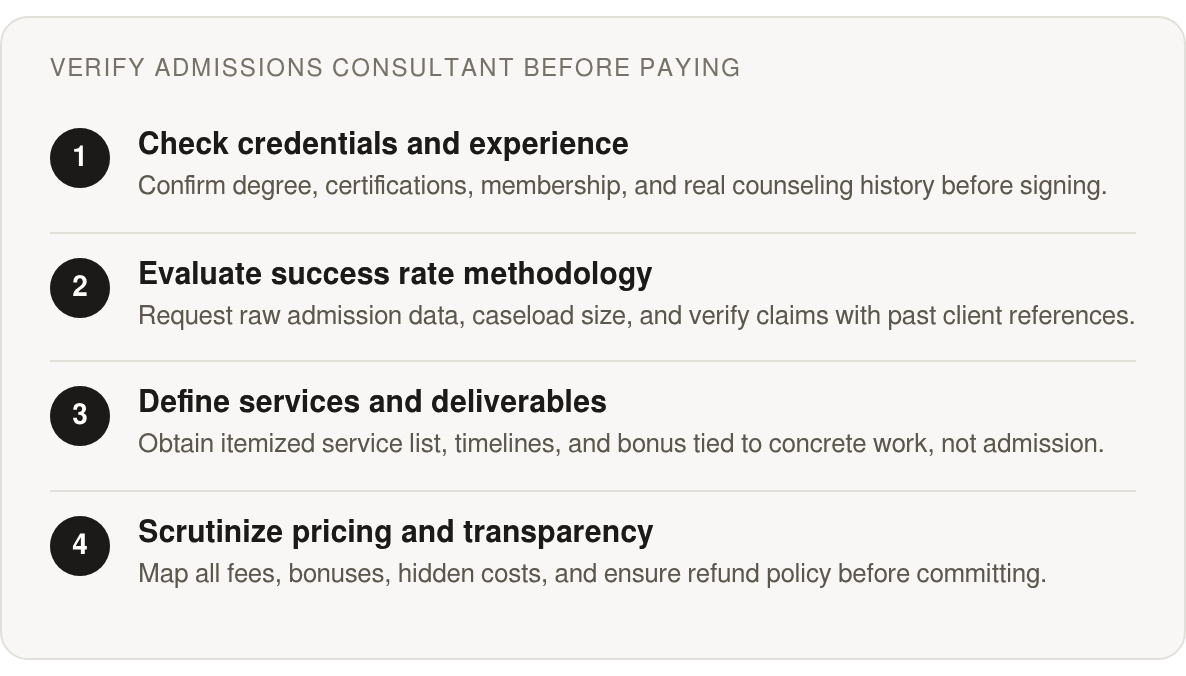
The uncomfortable part is how few built-in protections the market gives you. When we walk through fee structures with families, we push for payment tied to evidence of work rather than a large flat fee handed over before anyone has started. Verify before you pay. A contract is only as good as the details you check before you sign it.
Why does verifying protect your money?
Because outcomes are uncertain, and a flat fee charges you the same whether the process was careful or careless. Selective colleges make decisions from applicant pools sitting far outside any consultant's control, per MassMutual's analysis.
That uncertainty is the whole reason a guarantee should scare you off. A consultant cannot ethically promise a committee's vote. Paying extra solely for an admit letter starts to look like the kind of placement incentive families should steer clear of.
So the version we trust rewards work you can actually evaluate. Pay for the coaching, planning, and execution, then let any additional payment ride on concrete progress you can see.
- Confirm the fee isn't a lump sum paid before any meaningful work happens.
- Check that any incentive rewards completed, checkable work rather than just a final admission decision.
- Ask in writing whether any college, program, or scholarship pays the consultant. That's a conflict under industry ethics rules.
What credentials actually predict results?
Credentials are the cheapest proxy for accountability in an unregulated field, but pedigree and price don't predict outcomes. Sources disagree here. Some consumer-finance reporting is relaxed about professional memberships, while career educators argue outside affiliation matters precisely because families have so few formal protections.
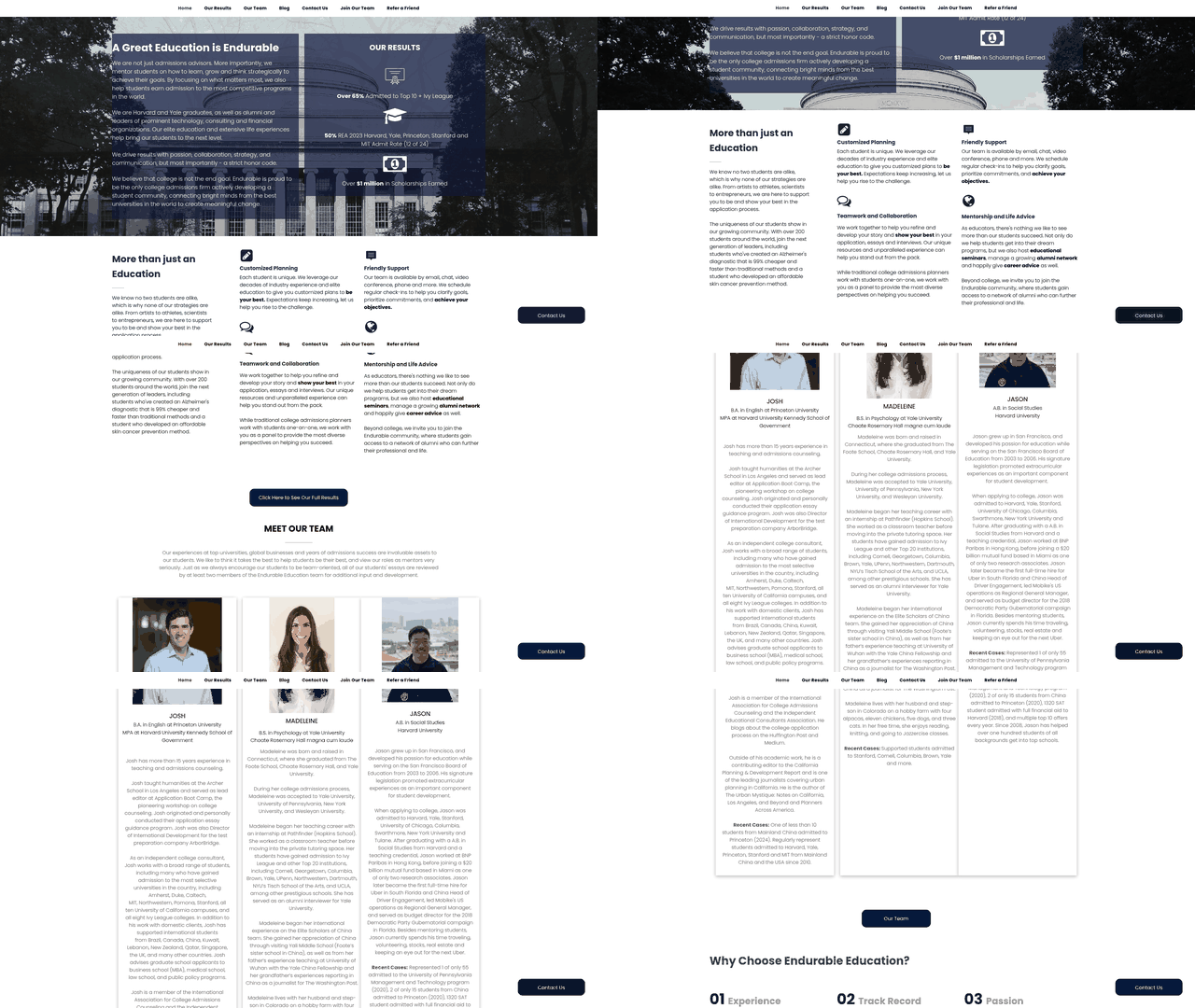
We land in the middle. A missing credential isn't automatically disqualifying, but a verifiable one gives you something firmer than a polished biography. Watch the résumé trap, too. A prestigious admissions background can be useful, and it still tells you nothing about whether the person can motivate a teenager, sharpen a draft, or manage a fourteen-month application calendar.
- Verify certification or membership in a recognized body as a baseline, not a guarantee.
- Ask for the student-to-counselor caseload. A small load beats a famous résumé for real attention.
- Request past clients you can call, so the track record is confirmed rather than claimed.
Done right, good consulting can save families money. Verifying first is how you make sure that's what you're paying for, and not a promise no one can keep.
1. Verify Credentials and Experience
Anyone can print business cards that say college admissions consultant. Verification is entirely on you, and it starts with confirming the person's claimed background is real.
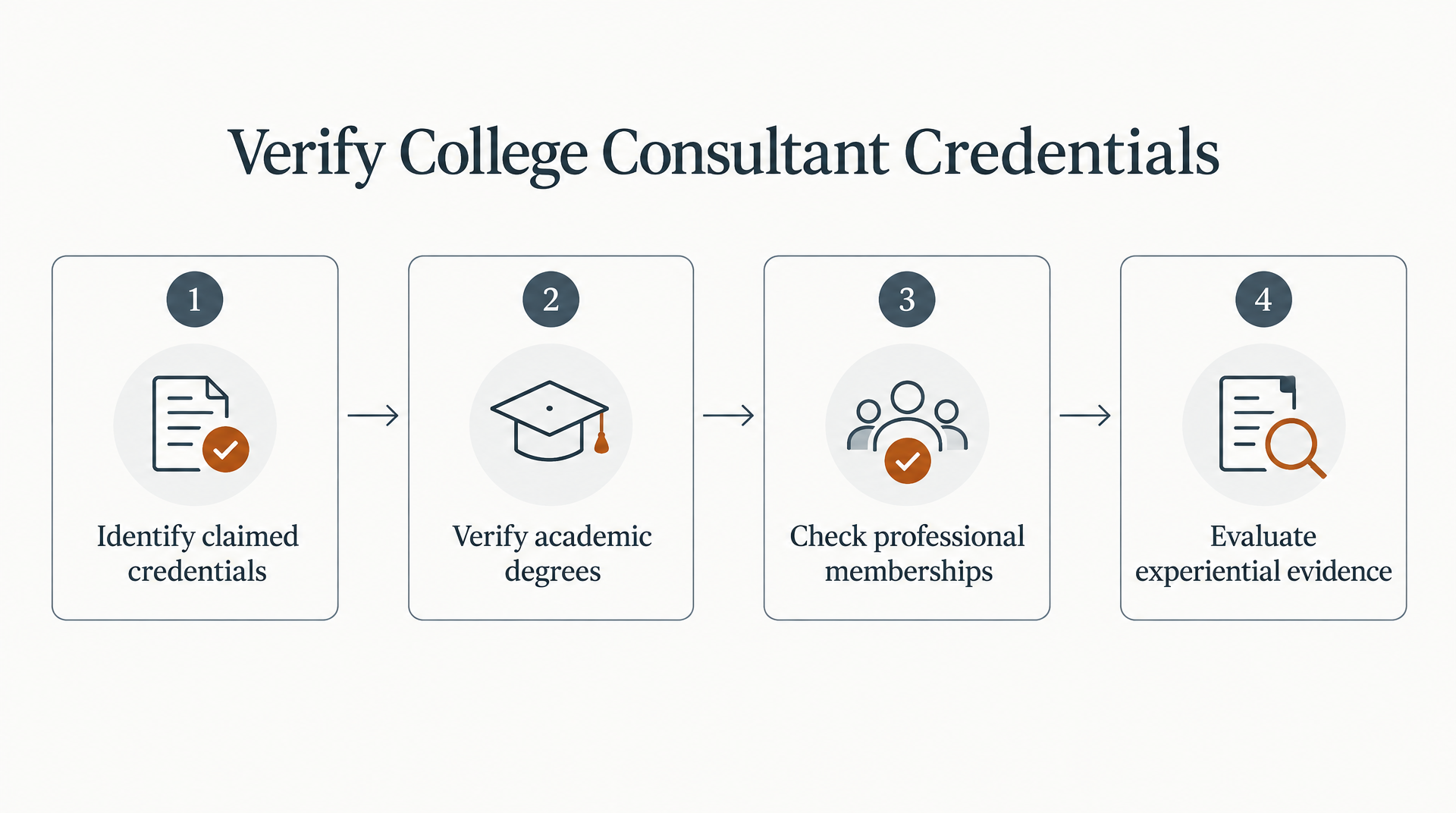
Two kinds of proof matter, and families tend to weight the wrong one. Formal qualifications are the checkable facts: a named degree, a certification, membership in a professional body. Experiential credibility is the softer stuff, years counseling students, published success stories, an easy confidence on the intro call. Both count. Only one can be independently verified before you sign. That gap matters more when your fee rewards quality of work, because you want hard evidence the person can deliver what the contract describes.
How do you confirm a degree is real?
If a consultant claims a degree, ask for the exact school, credential, and year, then check through the institution's official process instead of trusting a website bio. A vague "Ivy-educated" with no named institution is a red flag, because it blocks you from confirming the most basic part of the story.
- Confirm the exact degree, institution, and graduation year through the school's official alumni or registrar verification, not just a bio.
- Cross-check their LinkedIn against their site. A missing profile or an employment history that doesn't line up is worth questioning.
- Search for the success stories they cite and see whether any trace back to real, named students or programs.
Which certifications actually mean something?
In this market, a voluntary credential is one of the few accountability proxies you get. The career educator behind 21 vetting questions argues you should only consider a Certified Educational Planner through the American Institute of Certified Educational Planners, or at minimum someone with a college counseling certificate plus membership in HECA or the Independent Educational Consultants Association.
There's real disagreement here. MassMutual's reporting takes a more flexible view, since the occupation has no mandatory credentialing path. My read: an absent credential isn't automatically disqualifying, but in a field with no floor, a verifiable membership is the easiest filter you have. Use it.
- Look up the consultant in the IECA or AICEP member directory to confirm the credential is current, not lapsed.
- Ask what specific training they completed for teen college counseling, and treat "I've just been doing it a long time" as an incomplete answer.
Why credentials matter more with a bonus-based fee
Here's where the fee model changes the math. Self-reported "success rates" are nearly unverifiable, anyone can claim a track record, and price doesn't map neatly to results. So shift your questions from "what's your acceptance rate?" to the structural facts you can check: verified degree, active certification, caseload, and whether any outside institution has a financial relationship with them.
That last one carries a conflict-of-interest warning worth heeding. A consultant paid by a college or program may have incentives that don't line up with your student's interests. Verified credentials don't erase every risk, but they make the relationship easier to audit before money changes hands.
2. Read a Success Rate the Way an Admissions Officer Would
A polished success rate looks impressive until you ask how it was built. Any firm can advertise a number that's technically true and still tells you almost nothing. The question is what sits underneath it.
Start with the hardest rule in the field. If a counselor guarantees you a spot, walk away. The career educator behind those 21 questions puts it flat: "If an IEC assures you of admissions to any college or type of college, run." No one controls a committee. A promised outcome is a marketing claim, not a track record.
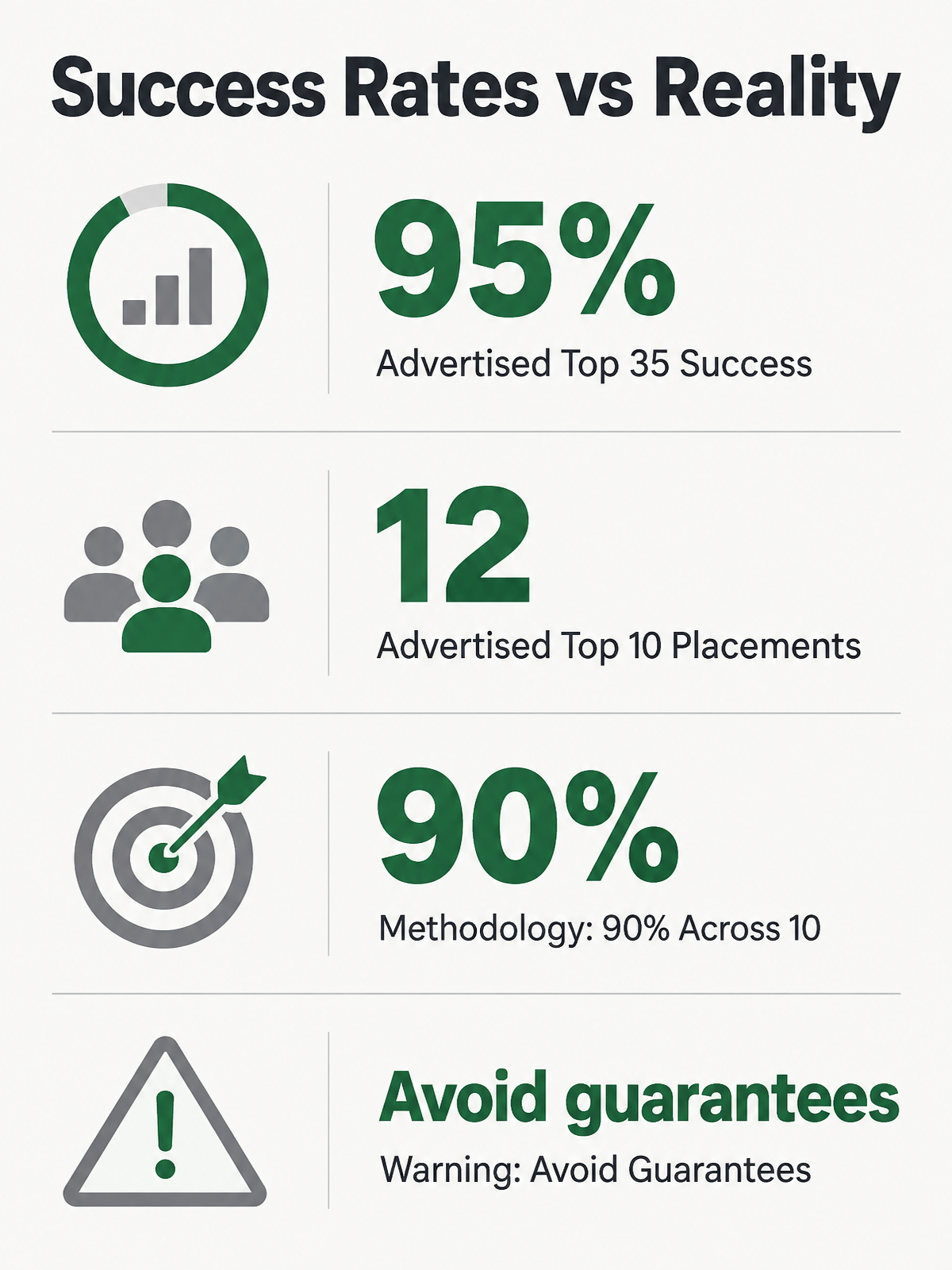
A "Top 35" placement is not a "Top 10" placement
Watch the framing on any headline stat. "95% of our students got into a Top 35 school" and "we placed 12 students at Top 10 schools last year" are different claims wearing similar clothes. The first bundles a wide band of colleges into one flattering number. The second is checkable.
Ask for the breakdown a flattering stat hides:
- Request raw counts, not percentages. How many students applied, and how many were admitted to your actual target tier, not a broad "Top 35" bucket?
- Ask for year-over-year figures. One strong cycle can be luck; a three-year trend suggests a repeatable process.
- Confirm the denominator. A 90% rate across 10 students means something very different from 90% across 200.
Caseload predicts results better than pedigree
Here's where families weight the wrong signal. An elite school or a former admissions office on a bio feels like proof, but the number that actually predicts your student's attention is caseload. Reporting on the cost of admissions consultants and analysis from the College Essay Guy team point the same way: a high price tag doesn't guarantee more individual attention, and how many students a counselor carries shapes how much yours gets.

A high price paired with a glossy résumé can quietly mean a more crowded calendar. The 21-questions author prefers the intimacy of a boutique practice over high-volume, video-library systems. When you compare success rates, adjust for how many students each counselor actually sits with, and how often they give direct feedback.
Verify the story before you fund the outcome
Testimonials are curated by definition. Ask to speak with past client families directly, and ask for consented references rather than the polished quotes on the homepage.
- Contact two or three past families and ask what the counselor did versus what the student did.
- Request case studies that name the data points, not just the happy ending.
- Confirm no conflict of interest. A consultant paid by a college or program has a built-in conflict that runs against the field's good-practice principles.
Outcome language needs to be precise here. A fair agreement can reward planning quality, responsiveness, and completed application work. It should never suggest a consultant can sell access to a committee vote.
3. Clarify Services and Support Offered
Two firms can both call themselves full-service and hand you completely different things. Pin that down before you sign. The service label tells you almost nothing. The scope of work tells you everything.
Start with the actual menu. According to the IECA data cited by MassMutual, about half of consultants offer career advice, roughly a third offer test prep, almost half provide financial aid guidance, and the vast majority advise on academic course selection. Some also plan college visits and help pick extracurriculars. No two bundles overlap perfectly, so map their menu against your own gaps. If your student already has SAT prep handled, a package that leans heavily on test prep is wasted money.
Map the bundle to what you actually need
The point of an itemized list is to see what your base fee buys before any incentive payment enters the picture. A firm's "process" can mean holistic, hands-on work or a thin layer of check-ins. Some consultants do deep relational work, guiding a student through strategy, essays, and interviews over months. Others offer lighter reviews and periodic touchpoints. Both are legitimate. They are not the same purchase.
- Get the service list in writing, item by item, so strategic planning, essay coaching, interview prep, and extracurricular guidance each appear as named deliverables instead of vague promises.
- Confirm delivery timelines and meeting cadence, since a light-touch model costs a fraction of weekly one-on-one work and should be priced that way.
- Ask directly whether the practice is boutique or high-volume; the answer tells you how much direct oversight your student is likely to get.
The basic-versus-premium line is where the real scope hides
Premium tiers usually differ from basic ones on counts you can measure: essay drafts reviewed, mock interview sessions, hours of meetings included. Prices reflect that spread. Single sessions and open-ended packages sit at very different price points, and comprehensive full-service packages can run into several thousand dollars.
- Nail down revision limits in writing, because "essay help" with a two-draft cap is a different service than open-ended editing.
- Ask what happens when you hit the meeting or draft ceiling, and what an overage costs.
Tie any bonus to deliverables, not the decision
This is where the fee model does its work. A base-plus-bonus structure only protects you if the bonus rewards verifiable service quality, not the admissions decision itself. No consultant controls a committee, and paying extra for a "yes" edges toward the pull-and-connections arrangements the field flags as red flags.
- Anchor any bonus to completed, checkable deliverables like finished essays and interview rehearsals, not the acceptance letter.
- Ask whether post-admission support, career advice, or alumni networking is included or billed separately, so mentorship past decision day is scoped, not assumed.
The CollegeXpress guide notes that good consulting can save families money in the end. That payoff only shows up when you know exactly what you bought.
4. Understand Pricing and Cost Transparency
Pricing is where transparency tends to disappear. Comprehensive packages carry substantial upfront investments, and premium multi-year services can climb far higher, with pricing that varies widely across the industry. That spread is wide enough to hide almost anything.
The number on the contract is rarely the number you pay. Before you sign, map every line item, every trigger, and every clause that lets the price climb after you've committed. This is exactly where a base-plus-bonus model earns its keep. When part of your payment rides on your satisfaction with the process instead of getting collected up front, the consultant carries some of the risk with you.
The pedigree premium you shouldn't pay for
Former highly selective admissions officers often command a premium, and regional markets like the Tri-State area tend to price above national averages. That doesn't mean every premium is unjustified. It means you should know what, exactly, the premium buys.
The problem is simple: a big-name résumé doesn't guarantee individual attention, and a large caseload can mean less time for your student. You can pay top dollar for an impressive background and get less of what actually moves the needle. As College Essay Guy notes, picking a counselor who specializes in the areas you need most matters more than a title. Pedigree is a signal families often overpay for.
- Ask for the consultant's current student-to-counselor caseload, not their former job title. A high fee paired with a large caseload signals weaker access.
- Confirm what a flat headline price actually includes before comparing it to anyone else's.
- Get the hourly and essay-only rates in writing too, so you can see what each service costs before you commit.
Where the hidden costs hide
The sticker price is the beginning, not the end. Watch for à-la-carte add-ons that stack up fast once you're already invested.
- Extra essay revisions beyond a capped number, which many contracts limit quietly.
- Travel or campus-visit fees layered on top of the base package.
- Optional workshops or summer programs sold as "recommended." An elite summer program can rival a meaningful share of a full multi-year plan, so treat these as separate budget decisions.
- A written refund policy and payment schedule. If you can't see how money comes back when the work falls short, that's your answer.
Make the bonus reward process, not promises
There's an honest tension in any incentive-based model. The 21-questions author warns that finder's-fee arrangements are a conflict of interest, and admissions decisions stay outside a consultant's control.
So a defensible fee doesn't pay a consultant for a decision they can't ethically influence. It ties the bonus to your satisfaction with the quality of the work and the process. We structure the base to cover the work and the bonus to align our incentives with yours, which is a cleaner deal than writing a full check before anyone has read a single essay.
5. Check Communication, Availability, and Fit
The part you can't check from a website is how a consultant actually talks to you. Credentials and success rates live on paper. Communication and fit only show up once you're in the room. That gap is exactly why families rush into these agreements and regret them later.

If your fee model ties to how satisfied you are with the process, responsiveness stops being a courtesy and becomes part of the value you're buying. A flat-fee firm already has your money. A consultant whose pay depends partly on your experience has a reason to keep communication clear.
A boutique caseload beats a rotating team
Ask one blunt question early: how many students are you carrying right now? The 21-questions author states a clear preference for the intimacy of a boutique practice, because it gives clients the face time and oversight that video libraries and high-volume systems can't.
That same source raises a detail families forget to ask about: what happens if your counselor gets sick or travels? A single overloaded advisor and a faceless rotating team fail in opposite ways. You want a named point of contact who knows your student, plus a backup plan you've actually confirmed.
- Ask for the current active caseload and how coverage works during illness or travel, so you're not left stranded mid-application.
- Confirm a dedicated point of contact rather than whoever's free that week, since continuity is what makes feedback coherent.
Availability is what your bonus should buy
A good consultant is reachable, not just credentialed. The CollegeXpress hiring guide frames it plainly: a consultant invested in your student should be consistently available and offer real one-on-one time, not canned advice.
The practical payoff is a calmer household. As one consultant told MassMutual, families report that having a consultant made home life happier because nobody had to nag about application progress. Regular check-ins are what produce that. Tie that rhythm to a satisfaction-linked bonus and the incentives finally point the same direction.
- Pin down check-in frequency and preferred channels in writing before you sign, not after.
- Request a trial or intro session to test whether your student clicks with the advisor's style.
| Verification item | Why it matters | How to verify | Red-flag indicator |
|---|---|---|---|
| Response time | Deadlines are unforgiving | Ask for a stated turnaround on drafts | Vague "we'll get back to you" |
| Point of contact | Continuity of feedback | Confirm a named advisor + backup | A rotating, unnamed team |
| Check-in cadence | Keeps the plan honest | Get frequency in the agreement | No set schedule offered |
| Personality fit | Trust drives honesty | Do a trial session first | No intro meeting available |
Skip the fit worry if you're buying a single one-hour consult; a quick meeting doesn't need chemistry. For any multi-year engagement, fit is the whole game. You're hiring someone your teenager has to trust with their essays, their setbacks, and their stress for two years straight.
References
[1] How to Choose a College Admissions Counselor - The Princeton Review - https://www.princetonreview.com/college-advice/how-to-choose-a-college-admissions-counselor
[2] College Admissions Counselor: Factors to Consider and Questions ... - https://www.collegeessayguy.com/blog/college-admissions-counselor
[3] Cost of College Admissions Consultants: 2026 Report - https://privateprep.com/cost-of-college-admissions-consultants-2025-report/
[5] Top 6 Things to Know Before Hiring a College Consultant for Your Student - https://www.collegexpress.com/counselors-and-parents/parents/blog/6-tips-hiring-college-consultant-your-student/
[6] 21 Questions to Ask Before Hiring an Independent College Admissions ... - https://effectivestudents.com/articles/21-questions-to-ask-before-hiring-an-independent-college-admissions-counselor/
Frequently Asked Questions
1. What should I do if a consultant won't share client references or verify their degree?
Treat it as a red flag and consider walking away. A reputable consultant should make basic verification straightforward: the claimed education should be specific enough to check, and references should come from real families who have agreed to speak. If the consultant keeps everything vague, you are being asked to buy trust without evidence.
2. Is a former admissions officer worth the higher fee?
Sometimes, but only if the consultant can translate that background into useful student coaching. Ask how they give essay feedback, how they build a college list, and how much direct access your student gets. The title may open an interesting perspective; it should not substitute for proof of fit, availability, and process.
3. How do I compare a boutique consultant against a high-volume firm?
Compare the working relationship. Who meets with your student? Who reads drafts? Who notices when deadlines slip? A smaller practice may offer more continuity, while a larger firm may have more backup systems. The better choice is the one that can explain exactly how attention, coverage, and accountability will work.
4. What is the clearest sign I should not hire a particular consultant?
The clearest sign is pressure: pressure to sign quickly, pressure to pay before scope is clear, or pressure to believe the consultant has special influence that cannot be verified. A trustworthy advisor welcomes hard questions about credentials, pricing, communication, references, and conflicts before asking you to commit.