3 Pass/Fail Gates Your Personal Statement Must Survive Before Submitting
September 15, 2026

What You Need to Know Before You Write
- A personal statement clears the first gate only when the narrative is unmistakably yours and directly answers the school’s prompt.
- Dr. Mark Butt reviews more than 3,000 essays a year; he says success means showing values and motivations that grades cannot capture.
- Most early rejections stem from treating the essay as a glorified resume instead of a story of growth.
- A genuine voice emerges from concrete experiences, not lofty summaries or contrived hooks.
- Admissions readers skim hundreds of files weekly; clichés and borrowed opening quotes are instant red flags.
- Starting with a vivid scene sets the tone for everything that follows.
- No amount of line-editing can rescue an essay built on generic or off-target material.
Gate 1: Does Your Story Actually Sound Like You?
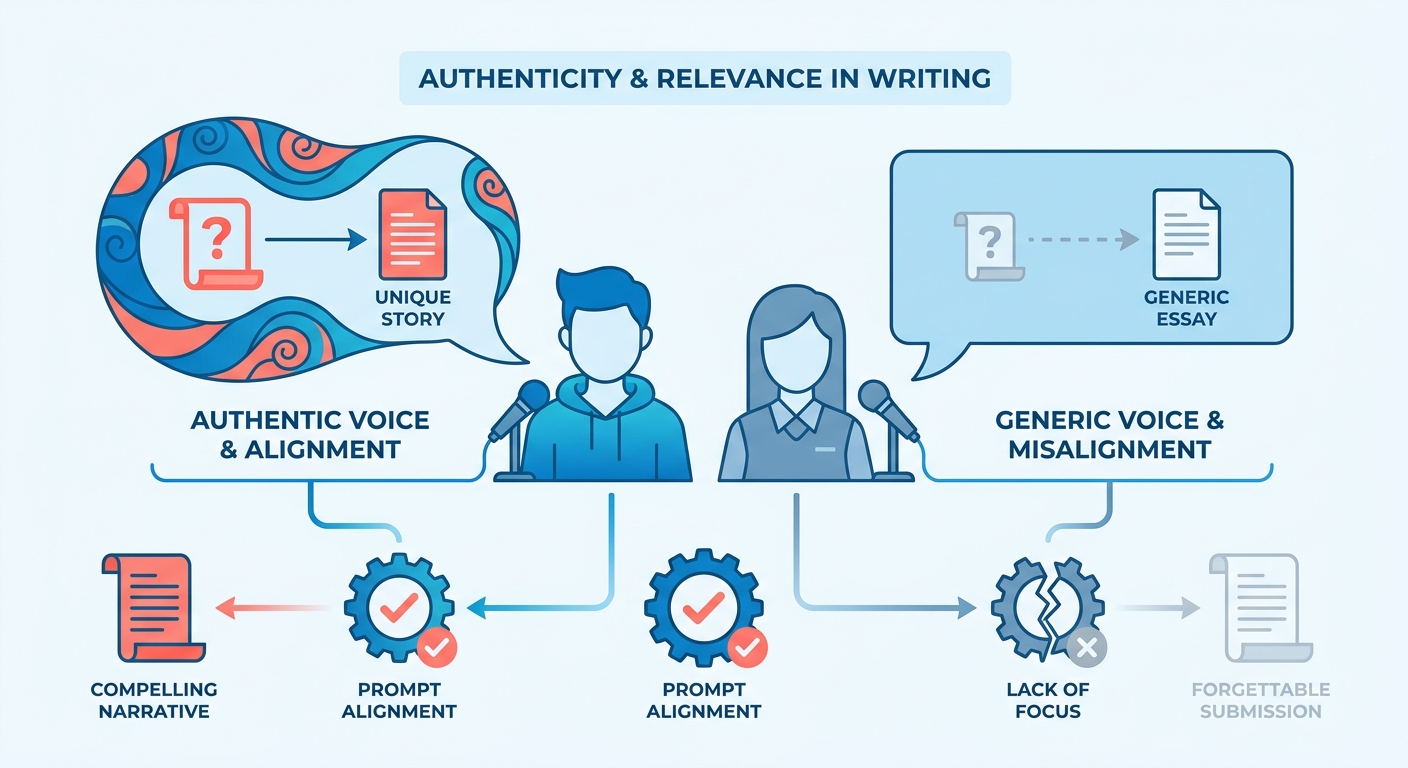
The first gate asks two questions: Is this essay authentically yours? and Does it answer the prompt? If the draft fails here, polishing sentences won’t help.
Dr. Mark Butt, who reviews over 3,000 personal statements each year, describes the goal as “inviting the reader into your story, showcasing values and motivations that grades cannot capture.” Experienced readers spot formulaic patterns in seconds.
What Authenticity Looks Like
Authenticity means using specific scenes to reveal your values, not a laundry list of achievements. The temptation is to catalog awards; the real work is showing how those moments changed you.
The College Essay Guy guide warns against broad topics and manufactured hooks. Ground the opening paragraph in a tangible moment and the rest of the essay inherits credibility.
- Open with a concrete, sensory detail—not a philosophical platitude or a famous quote. Admissions officers want your voice, not someone else’s.
- Cut any sentence that merely repeats an honor already listed elsewhere.
- Skip literary or intellectual references that serve as shortcuts for original analysis.
Are You Answering This School’s Prompt?
Relevance means your narrative arc aligns with what the school is looking for. Emory’s admissions office advises applicants to research the institution and tie personal milestones to its values. An eloquent essay that sidesteps the question will still be rejected.
Oxford Royale suggests you explain gaps or uneven grades only when they illustrate resilience. Life disruptions that reshaped your intellectual path belong in the essay; raw numbers belong on the transcript sheet.
- Verify that every paragraph moves you toward a direct answer to the prompt.
- Link your worldview to specific academic or cultural aspects of the target campus.
- Mention transcript irregularities only when they act as catalysts for growth.
Gate 1 at a Glance
| Gate | Core Criteria | Pass Indicators | Review Time | Difficulty (1-5) |
|---|---|---|---|---|
| 🟢 1 | Authenticity + prompt relevance | Specific moments, clear voice, direct answer, school-value thread | 45-60 min mentor read | 4 |
Use a simple color-code while drafting: red for generic or off-topic material, yellow for voice present but fit under-developed, green for a distinctive narrative that nails the prompt. A green rating is required before you tackle the next layers, as outlined in our admissions planning blog.
Gate 2: Does Your Essay Flow Like a Story?
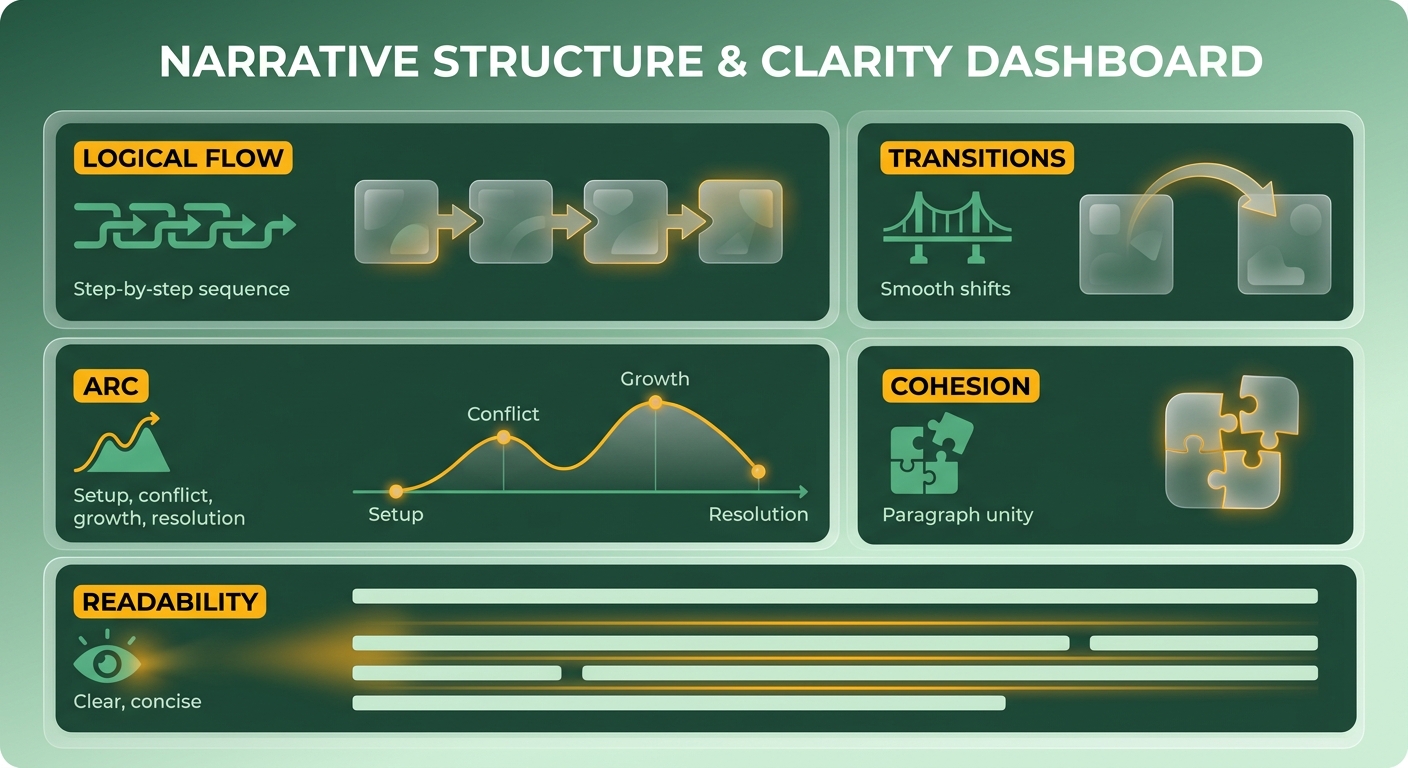
Even a compelling story can fall flat if the structure drags or jumps. Gate 2 checks narrative momentum, pacing, and logical progression.
When paragraphs hop between unrelated memories without bridges, the reader loses interest. Architectural clarity must precede line-level polishing because a shaky framework prevents any sentence from landing.
A Working Story Arc
A solid arc moves from context → tension → internal change → insight. The College Essay Guy identifies two common frameworks:
- Narrative – follows a single conflict and its resolution.
- Montage – stitches distinct episodes together under a unifying theme.
Both work if you enforce discipline. Structural failure shows up when there’s no clear turning point or when each paragraph feels like a stand-alone anecdote. Before you fine-tune language, write a one-sentence purpose for each paragraph and make sure every piece pushes the central argument forward.
Pitfalls That Trip Reviewers
The most frequent flaw is a missing pivot—no moment where perspective shifts measurably. Oxford Royale notes that essays opening with grand literary quotations often stumble later because the subsequent paragraphs lack an anchor.
Relying on external quotations at the start also masks your own voice, leaving the reader without a foothold.
Gate 2 Checklist
- Outline each paragraph’s function: what does it add to the thesis? Trim anything redundant.
- Confirm continuity: ensure a causal chain (narrative) or a strong thematic thread (montage).
- Smooth transitions: bridge changes in time or place so they feel intentional.
- Spot the turning point: highlight the moment of measurable growth or insight.
- Ground the intro: start with your own perspective, not a borrowed quote.
- Cold-read the draft: mark every sentence where momentum stalls and rework those joints.
Clearing Gate 2 keeps the reader engaged from opening line to final reflection.
Gate 3: Are the Mechanics Spot-On?
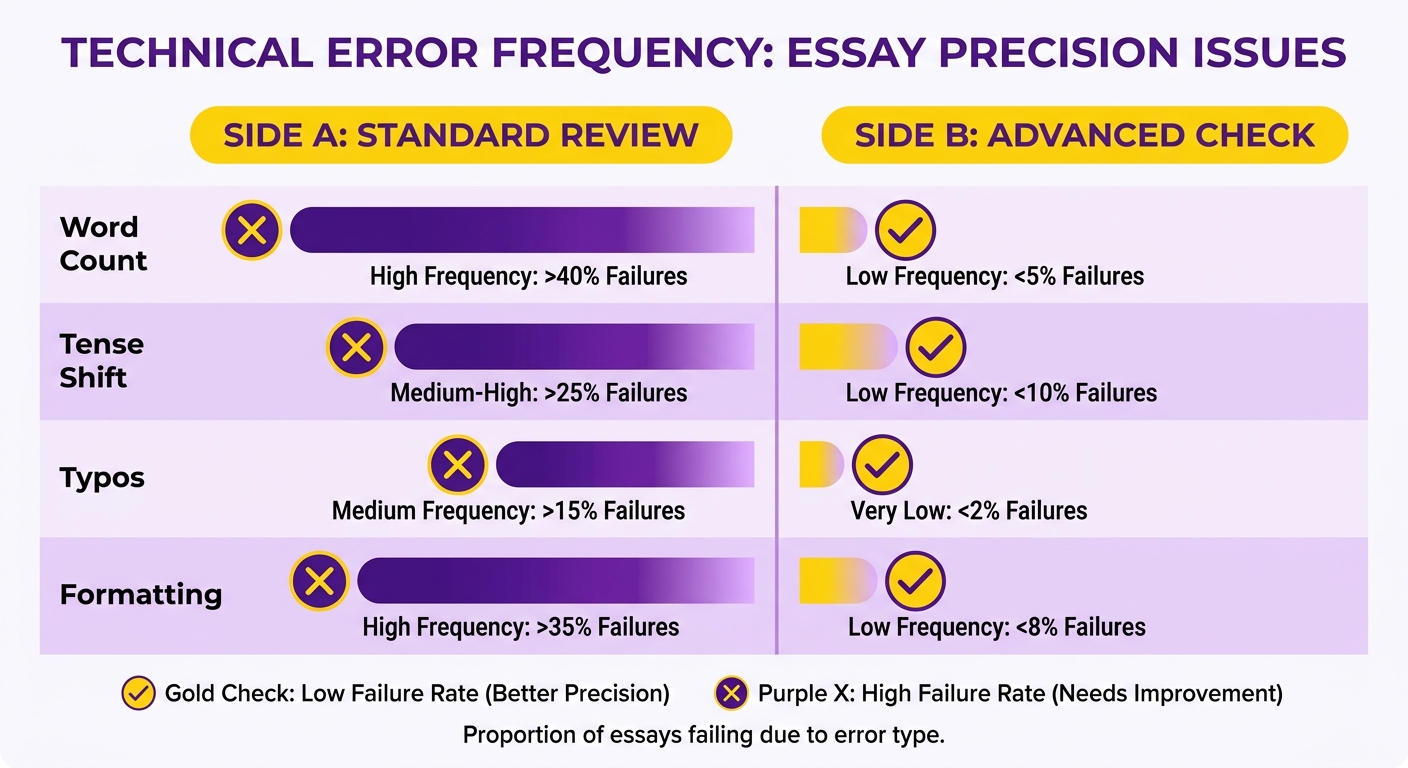
The final gate covers formatting, grammar, and compliance with each school’s guidelines. Even a brilliant narrative can be derailed by a stray comma or a word-count violation.
This stage is pure quality control. The personal statement is the only long-form narrative you control on most application portals; sloppy mechanics signal a lack of attention to detail.
What Colleges Actually Enforce
- Common App: 250-650 words.
- UCAS (UK): character limits vary by application. Many international applicants overshoot; double-check the count.
- Use a clean, uniform font with consistent spacing.
- Keep the essay to 3-6 paragraphs, each with a clear break.
Language Traps That Sink Good Essays
Tone missteps erode credibility as fast as a typo. Overly ornate phrasing, forced humor, or slang can read as insincerity.
- Strip throat-clearing filler and decorative adjectives that add length without meaning.
- Remove slang, sarcasm, or situational jokes that may not translate to a committee’s reading.
- Run a meticulous proofread to catch tense slips and stray punctuation.
- Ensure each sentence adds a fresh qualitative angle rather than rehashing extracurricular bullet points.
Should You Explain Weak Grades Here?
Only weave academic setbacks into the essay when they serve a larger narrative of intellectual reinvention. Isolated dips without deeper meaning belong in an addendum, not the personal statement.
- Frame challenges as concrete adaptations that led to sustained improvement.
- Avoid defensive justifications that shift focus away from personal growth.
- Read the essay aloud; awkward cadence often reveals hidden weaknesses.
Passing all three gates means your essay meets both artistic and technical expectations of competitive admissions panels. For a broader timeline, see our college admissions planning blog.
Final Polish & Submission Checklist
Once your essay clears the structural and technical benchmarks, run a comprehensive audit before uploading. Give yourself at least a 24-hour buffer; a fresh read catches the tiny errors that spell-checkers miss.
Content Pass
- Emphasize personal perspective, not uncontextualized achievement lists (per College Essay Guy).
- Avoid duplicating material that already appears in your honors section (Collegewise).
- Open with an immediate narrative anchor, not a generic background statement.
Admissions officers often spend very little time per file, so the personal statement is your chance to make a human connection beyond the numbers.
Technical Pass
- Verify word count respects the 250-650 range (Common App) or character limit (UCAS).
- Keep typography clean and uniform.
- Review the generated application PDF preview for line-wrapping glitches.
- Ensure fee classifications match submitted documentation.
Report optional test scores only when they meet or exceed the school’s middle-50% range; otherwise, let the narrative speak for itself.
Peer & Mentor Review
Multiple perspectives surface blind spots.
- Ask a reader to summarize your thesis in one sentence; the summary should match your intended message.
- Get feedback from an evaluator trained in admissions analysis who can judge the essay against competitive standards. Details on timing and strategy are in our admissions planning blog.
How Endurable Education Helps You Pass All Three Gates
Going through each gate alone leaves blind spots. Our advisory model applies a collaborative, two-stage review to every personal statement, ensuring diagnostic rigor at every level.
The Panel Review Process
We pair two independent advisors: one focuses on narrative integrity, the other views the piece through the lens of a competitive admissions committee. Diverging feedback highlights the areas most likely to trip reviewers.
When drafts are riddled with uncontextualized achievements, we help pivot toward pivotal moments of personal initiative. We also coach students to cultivate authentic intellectual pursuits early, so the eventual essay feels natural rather than forced.
What to Verify Before Trusting Any Review
- Engage at least two independent evaluators to mitigate individual bias.
- Include an adversarial pass that measures the essay against strict committee expectations.
- Prioritize iterative revisions over a single copyedit.
- Ensure reviewers assess the personal statement within the context of your entire application portfolio.
Independent, multi-angle review confirms that your essay satisfies all three gates before you hit submit.
References
[1] How to Write a Personal Statement (Tips + Essay Examples) - https://www.collegeessayguy.com/blog/personal-statement
[2] What is a Personal Statement? A Complete Guide (2026-2027) - https://collegewise.com/blog/personal-statement
[3] The Top 10 Final College Application Checklist (Before You Hit Submit) - https://www.youtube.com/watch?v=eai9rDFUiFc
[4] How to Write a Meaningful Personal Statement - Emory Admission Blog - https://blog.emoryadmission.com/2025/10/how-to-write-a-meaningful-personal-statement/
[5] The World's Worst Personal Statement: Why It Fails and How to Fix It - https://www.oxford-royale.com/articles/analysis-personal-statement
Frequently Asked Questions
1. Should I write my personal statement as a narrative or a montage?
Select your structural framework based on the nature of your subject matter. If your journey centers on a defined inflection point or a specific obstacle that prompted personal transformation, a chronological narrative provides clear causal progression. If your background features multifaceted pursuits across distinct disciplines, a thematic montage allows you to link diverse experiences through a cohesive intellectual motif.
2. Can I fix a weak essay by polishing the writing later?
No. High-level line editing cannot repair fundamental issues with prompt relevance or superficial personal reflection. If an essay fails to articulate genuine values or simply summarizes extracurricular entries, cosmetic adjustments to vocabulary or sentence structure will not satisfy admissions committees. Content authenticity and narrative focus must be resolved before stylistic polishing begins.
3. What word count should my Common App personal statement hit?
A strong draft usually lands in the upper part of the Common App range. While the system permits between 250 and 650 words, drafts below 500 words rarely demonstrate sufficient analytical depth, while pushing up against the maximum risks accidental cutoff due to web portal formatting quirks. For UK UCAS applications, check the current character and line limits carefully.
4. Should I explain a low grade or test score in my essay?
Incorporate academic setbacks into the personal statement only if they represent a pivotal turning point that altered your perspective or work ethic. For external disruptions, health challenges, or isolated low scores that do not connect to your primary narrative, utilize the Common App's dedicated "Additional Information" section to keep your main essay focused on growth and character.
5. Why do famous quotes and name-dropping get flagged so quickly?
Admissions committees read applications to evaluate your intellectual voice, not to review canonical literature. Prefabricated quotations consume valuable introductory space without providing personal insight, signaling a reliance on external authority rather than independent thought.
6. How is a panel review different from a single admissions counselor?
A panel review eliminates individual reader subjectivity by subjecting the draft to paired evaluation. One reader champions narrative depth while another evaluates the submission with critical committee skepticism. This multi-perspective approach uncovers structural ambiguities and tonal discrepancies that a single reviewer might miss.
7. When should I do the final read before submitting?
Conduct your final review the morning after completing all structural revisions. Stepping away from the draft resets your cognitive familiarity, allowing you to catch mechanical errors, awkward cadence, and missing words when reading aloud from a physical printout. Always verify formatting inside the application software's generated PDF preview.