4 Types of Admissions Consultants, and When Each One Wastes Your Money
September 3, 2026

Key Takeaways
- Four consultant models dominate the market: essay-only specialists, hourly advisors, comprehensive package firms, and outcome-aligned base-plus-bonus practices.
- Comprehensive packages have the widest spread, from $10,000 to $120,000, though most families land near $6,500 for full support.
- Essay-only and hourly advisors both charge $100 to $500 an hour. They are cheaper, but narrower.
- Essay-only help suits strong students who need polish. Comprehensive packages fit early starters wanting two to four years of guidance.
- Base-plus-bonus practices tie part of the fee to results, which appeals to families who want aligned incentives.
- Full-service work runs $4,000 to $25,000, depending on depth and duration.
- Pick wrong, and you may pay premium rates for polish, not acceptance.
The four models, side by side
Four consultant types run college admissions consulting today: essay-only specialists, hourly advisors, comprehensive package firms, and outcome-aligned base-plus-bonus practices. Each fits a different budget and need. Pick wrong, and it gets expensive. You can end up paying premium rates for a resume instead of results.
Here's the fast version before we get into the numbers.
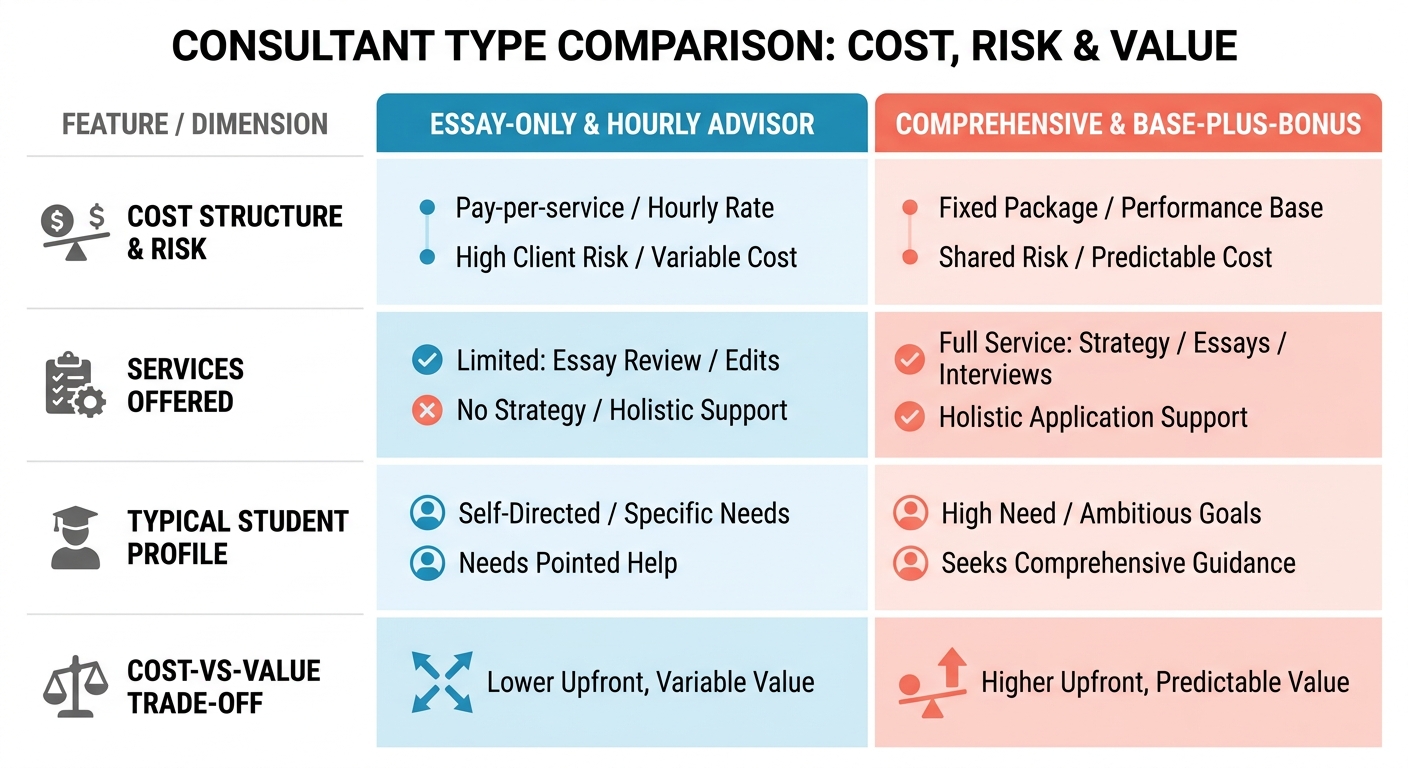
How the types stack up
Essay-only help is cheapest, but narrow. Hourly advising is flexible, but self-directed. Comprehensive packages give the deepest personalization. Base-plus-bonus ties part of your fee to results.
| Type | Typical Pricing | Duration | Best For |
|---|---|---|---|
| Essay-Only | $100–$500/hour | 3–6 months | Strong students needing polish |
| Hourly Advising | $100–$500/hour | As needed | Self-driven families on a budget |
| Comprehensive Package | $10,000–$120,000 | 2–4 years | Early starters wanting full support |
| Base-Plus-Bonus | Lower base + results bonus | Multi-year | Families who want incentives aligned |
Most families land around $6,500 for a comprehensive package. Full-service work runs $4,000 to $25,000 on the standard end, and premium multi-year contracts climb past $100,000.
What's really driving the price gaps
The biggest gap isn't service depth. It's pedigree. Former admissions officers command a 35–45% premium, yet that same report found caseload size and individual attention predict outcomes better than prior work history.
That creates a real tension. Research.com leads with brand-level success signals like IvyWise's 98% top-choice rate. PrivatePrep argues those numbers reflect selection and attention, not pedigree.
The base-plus-bonus model is a practical tiebreaker. When part of your fee only comes due if you're happy with the result, the consultant competes on effort, not on a diploma hanging in the office. That's the trade-off the standard tiers quietly skip.
When each type wastes your money
Skip essay-only help if your whole strategy is shaky. Polishing three essays won't fix a weak activity list or a mismatched school list. You'd be sanding a table with a broken leg.
Skip the premium former-officer package if attention is what you actually need. A caseload of 12 to 20 students with real personalization beats a big-name consultant juggling too many families. The pedigree markup buys a story, not a schedule.
One number reframes the whole spend. Consultant-guided students transfer less often, and each avoided transfer semester saves $12,000 to $26,000. A single avoided transfer can exceed the median comprehensive fee. Seen that way, the right consultant is risk mitigation, not a bet on prestige.
The families who win start early. As the 2026 cost report puts it, "Families who begin the process in 9th or 10th grade consistently have more options and more peace of mind." Whichever type you pick, timing beats budget.
What actually separates them
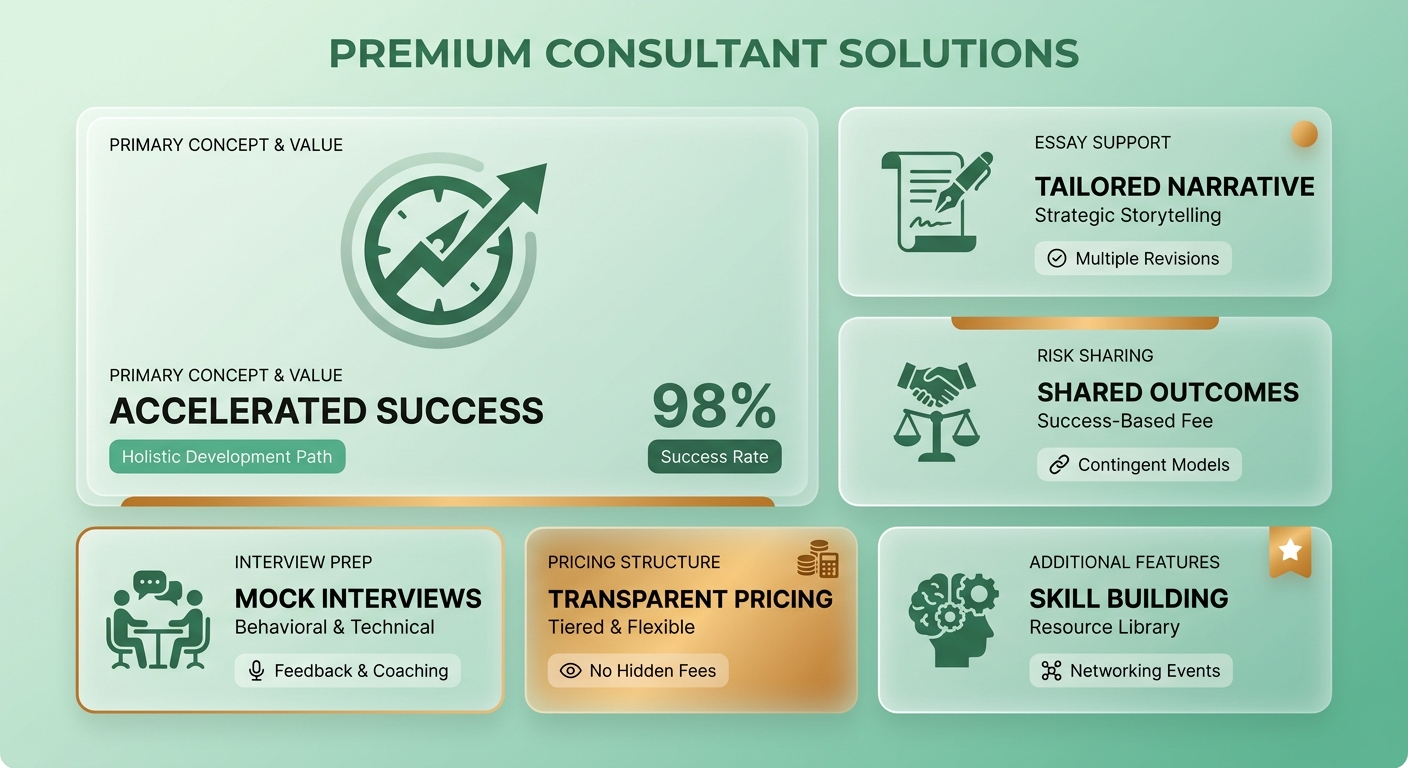
The dividing line between these four isn't just price. It's who carries the risk when the work doesn't land. Most college admissions consulting models charge you the same whether your student gets in or gets rejected. Base-plus-bonus is the exception, and that one design choice changes how the consultant behaves after you've signed.
Here are the real differences, side by side.
Continuity is the quiet variable
Past the raw hours, the structural difference is continuity. When a firm churns through staff, a student can cycle through three advisors in a single year. A stable, dedicated advisor keeps the student's narrative consistent from the first brainstorming session to the final submission. That consistency builds a cohesive application, one an admissions committee reads as a single voice instead of a patchwork.
The feature that actually moves the needle
Project management. A high-touch consultant doesn't just edit essays. They build a timeline for testing, course selection, and extracurricular development. That structure prevents the last-minute panic that wrecks application quality each fall, so every part of the file is polished before deadlines.
When you can skip the premium tiers
For students with straightforward profiles, premium tiers are overkill. Specialized applicants are the exception. Visual artists needing portfolio reviews, or students working through athletic recruitment, benefit from targeted expertise. There, the investment is justified by the consultant's specific grasp of a niche pathway, not by general prestige. That kind of guidance helps a student surface talents a standard package might miss.
Pros and cons
Every consultant type carries a hidden trade-off. It usually shows up in who absorbs the risk when the application doesn't land. Each of the four college admissions consulting models solves one problem well and leaves another exposed. Knowing which weakness you can live with matters more than chasing the lowest price.
Here's the honest breakdown of what each option gets right and where it falls short.
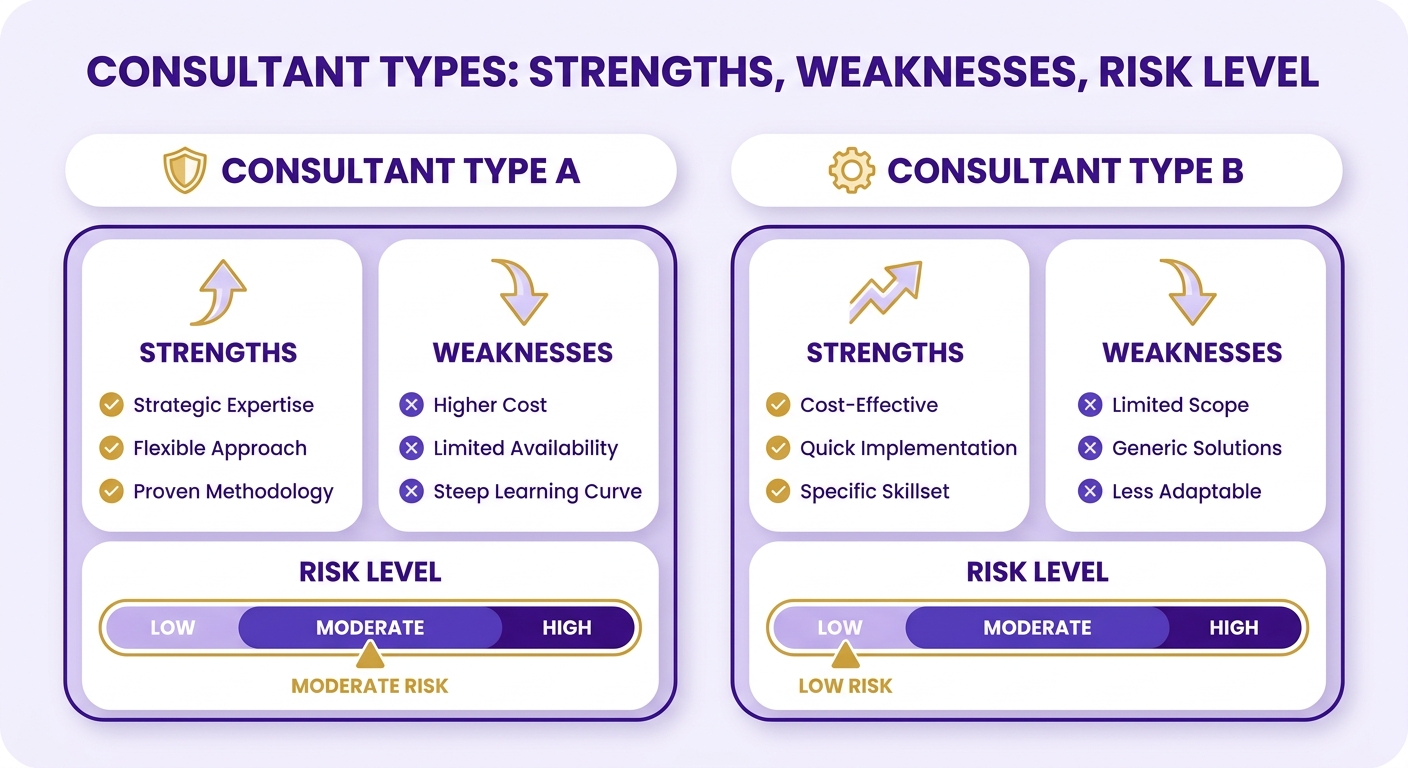
What each model gets right, and wrong
The trade-offs go beyond pricing to who does the work. Essay-only services assume the student has already locked in a balanced school list and a clear position, and focus purely on execution. Hourly advising offers flexibility, but leaves the family responsible for managing timelines and booking sessions.
Comprehensive packages carry the whole project-management burden, which is why they're popular for complex situations like athletic recruitment or a busy extracurricular profile. The catch: these packages can breed over-reliance, where the student waits for direction instead of owning the process. Outcome-aligned models keep the advisor highly engaged, though fewer firms run this way.
Does prestige actually deliver better results?
Not reliably. High-prestige firms often keep strict GPA and test-score minimums for incoming clients, which quietly inflates their published acceptance rates. The real coaching value shows when a consultant helps an average student find a perfect-fit program where they'll thrive, not when they guide an already-strong student to a predictable outcome. That distinction matters for families trying to tell whether a high price reflects actual teaching or just selective admissions.
When a consultant earns the fee
Often, it comes down to institutional aid. Plenty of colleges offer sizable merit scholarships that require separate applications or earlier submissions. An experienced advisor makes sure those deadlines are met and the essays are tailored to specific scholarship criteria, which can secure tens of thousands in non-need-based aid that offsets the consulting fee entirely. That planning is where the fee starts paying for itself.
Who each model actually fits
The right consultant depends on where your student sits: their grade, their budget, and how much of the work they can drive alone. College admissions consulting isn't one product. Match the model to the situation, and you stop paying premium rates for help you don't need.
Here's who each option actually fits.
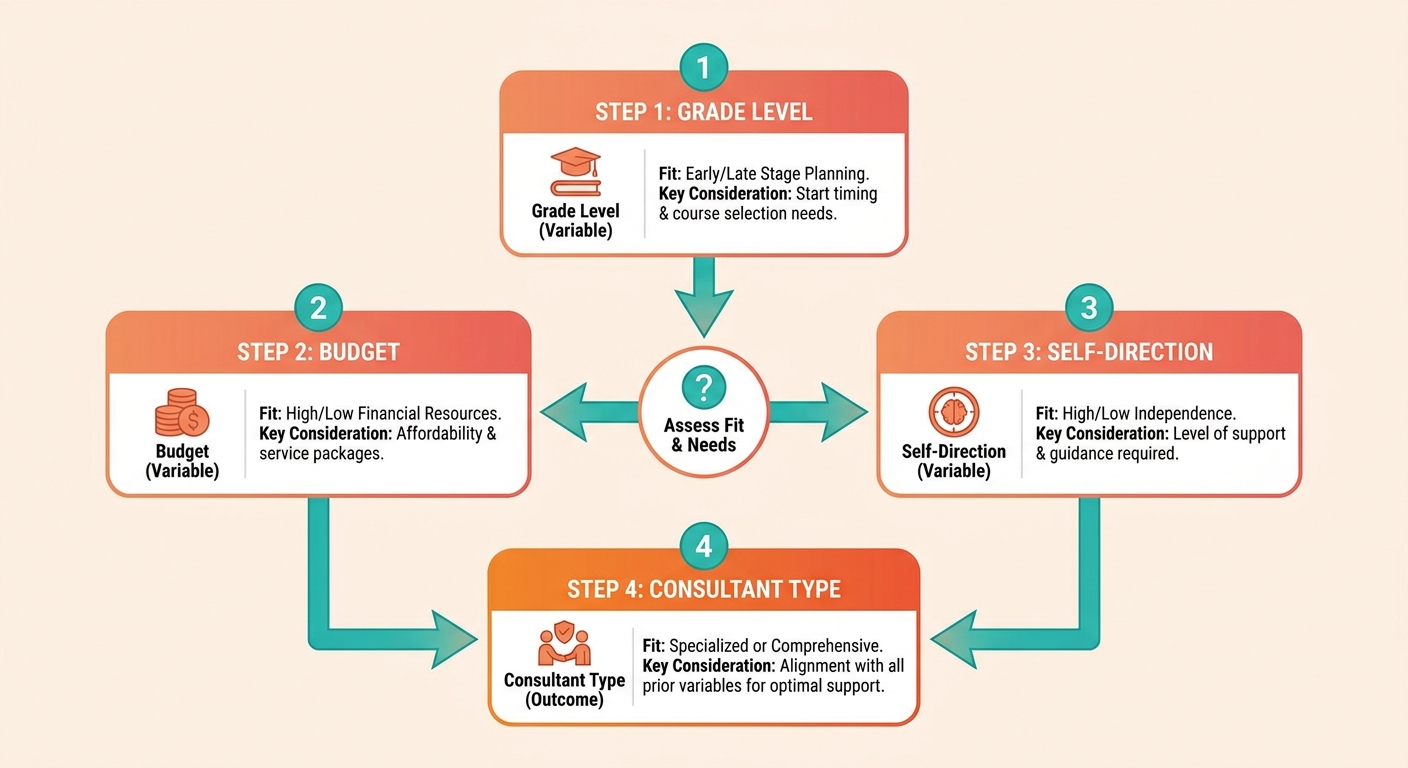
Which type fits your student
It comes down to academic stage and self-motivation. A senior in October has few variables left to control, so targeted essay feedback is the practical choice. An underclassman has the runway to shape a profile, choose meaningful summer programs, and build a coherent extracurricular story over several years. Match the service to the remaining timeline, and you avoid paying for strategy when all that's left is execution.
| Student Profile | Best-Fit Model | Why |
|---|---|---|
| Self-driven senior, list set | Essay-Only | Needs polish, not strategy |
| Focused question, tight budget | Hourly Advising | Pay only for what you use |
| 9th–10th grader, full guidance | Comprehensive Package | Low caseloads, deep personalization |
| Wants incentives tied to outcomes | Base-Plus-Bonus (Endurable Education) | Consultant paid partly on results |
When to skip the premium
Pedigree matters less than communication style. A consultant with an impressive resume but a cold or rigid approach may never get a reserved student to open up. The best work happens when the chemistry is there, so the student writes something authentic and a little vulnerable instead of a formulaic answer built to please a committee. Rapport over credentials makes the whole process more productive and less stressful.
Who benefits most from outcome-aligned fees
Families who want shared accountability. When both sides have skin in the game, the relationship shifts from a transactional service to a real partnership. It fits families who want a balanced, realistic college list, because the consultant is incentivized to steer away from long-shot strategies that lead to disappointing results. The focus stays on realistic, high-quality placements.
What I'd actually recommend
The right college admissions consulting choice comes down to one question: who carries the risk if the application doesn't land? Every model here solves a different problem, but only one ties part of the fee to your satisfaction with the work.
Here's how we'd decide, scenario by scenario.
Which consultant should you pick?
The decision hinges on where your student needs the most support: high-level strategy, or final-mile editing.
| Scenario | Best Pick | Why |
|---|---|---|
| Strong list, needs polish | Essay-only | Cheapest, fast, narrow scope fits |
| A few targeted questions | Hourly advising | Flexible, pay only for what you use |
| Starting in 9th or 10th grade | Comprehensive package | Deepest attention over years |
| Want fees tied to satisfaction | Base-plus-bonus | Consultant shares the risk |
That shared-risk approach is central to how we operate. By tying our fees to mutual satisfaction, our team stays invested in your student's process from start to finish, with our goals aligned with your family's.
When to skip the premium
For straightforward editing or quick questions, premium structures are unnecessary. But the landscape stays brutal. Harvard's acceptance rate fell to 3.5% for the Class of 2027, down from roughly 16% in 1980. That environment calls for a clear-eyed read on your student's independence. If they need full guidance to stand out, locking in that support early gives them time to build a genuine, compelling narrative. For more on planning the full arc, see our college admissions and life planning blog.
References
[1] 8 Best College Admissions Consultants Ranking for 2026 - https://research.com/universities-colleges/best-college-admissions-consultants-ranking
[2] Cost of College Admissions Consultants: 2026 Report - https://privateprep.com/cost-of-college-admissions-consultants-2025-report/
Frequently Asked Questions
1. Can I switch between consultant types partway through the process?
Yes, though the benefit of switching decreases as deadlines approach. A senior switching to a comprehensive package in November cannot retroactively alter their course selection or extracurricular profile. Underclassmen, however, can easily scale their support upward as their academic and extracurricular needs become more complex.
2. Do former admissions officers actually deliver better results?
Their background provides valuable insight into how committee decisions are made, but their pedigree does not guarantee individual availability. An advisor's responsiveness and willingness to deeply engage with a student's unique voice often matter more than their former employer's brand. When evaluating consultants, ask about their specific feedback process rather than just their resume.
3. How does a low caseload actually affect my student's application?
A smaller client roster directly affects response times and the depth of feedback. When an advisor manages only a limited number of students, they can dedicate substantial time to iterative brainstorming and meticulous line-editing. This prevents the rushed, superficial reviews that often occur at larger firms during peak application weeks in November and January.
4. Is hiring a consultant worth it if my student is already a strong candidate?
Highly motivated students with excellent academic records and clear goals often only need a sounding board. For these individuals, targeted feedback on their personal statement is highly effective. Premium, multi-year packages are better reserved for students who need help identifying their unique angle or managing a complex list of highly selective reach schools.
5. What hidden costs does the right consultant help me avoid?
A primary benefit is ensuring a strong institutional fit from the outset, which minimizes the likelihood of a student wanting to change colleges later. Additionally, consultants help families navigate complex financial aid and merit scholarship opportunities, ensuring that students do not miss out on institutional grants due to overlooked deadlines or poorly optimized applications.
6. How does the base-plus-bonus model differ from a money-back guarantee?
Unlike a money-back guarantee, which operates as a retroactive refund policy after a negative outcome, this model structures payments to keep the advisor actively motivated throughout the entire process. It establishes a collaborative partnership where the consultant's financial success is directly tied to delivering a high-quality, satisfactory experience for the family.
7. When should my student start working with a consultant?
Starting early allows for gradual, low-stress development of a student's profile. Beginning the planning process before junior year provides ample time to select appropriate courses, secure leadership roles in extracurriculars, and plan meaningful summer activities, preventing the high-stress environment of a compressed senior-year timeline.