Business Bachelor's Applications: What Admissions Readers Scan First
October 17, 2026

Every fall, students ask us why a file with strong extracurriculars and good grades still stalled at a selective business program. Usually the answer lies in the early first read. Before anyone reads the essay or recommendations, a reader often makes a provisional academic judgment for that high school.
Key Takeaways
- Reported first-read times and orders vary by source. Some accounts describe a quick scan of a few minutes; Duke’s dean has described a roughly 15-minute first read.
- In many readers’ descriptions, academic index and school context are read before activities, essays, and recommendations.
- Families should treat the opening academic check as the gate, not assume a careful full review starts from page one.
- Duke’s dean conducts a roughly 15-minute first read that scans high school, GPA, test scores if submitted, intended major, and gender, per PrepMaven’s report.
- After the academic screen, readers often look at the activities list for leadership, depth, and measurable impact rather than volume.
- GPA and course rigor are evaluated against each high school’s profile and offerings, not against a national standard or norm.
The first read is a gate, not a full review
We spend time on first reads because families expect a full review. The reported length and sequence of that first read are not identical across sources. Some former readers describe a quick initial scan—sometimes only a few minutes—while Duke’s dean has publicly described a roughly 15-minute first read. Officers often decide in that opening window whether a file advances to a full read or stops.

Why the reported first-read order is not one fixed formula
The source accounts we link below differ on small ordering details. Some place the academic index first; others describe the school profile as the first lens for reading the academic index. Duke’s public example is a 15-minute overview that includes intended major and gender; other accounts describe much shorter scans. For applicants, the practical conclusion is not to memorize one exact clock, but to assume the academic gate comes before narrative materials.
What the first scan actually covers
Academic index and school context come before activities, essays, and recommendations in the reader descriptions we use. The first pass decides whether a full read is worth the time.
- Academic index is the opening gate. A breakdown by former readers at Harvard, Princeton, and Columbia describes the initial academic review as a screening step, not a full evaluation.
- School profile is the local context. The school profile is the document your high school sends with course offerings, grading scale, and recent college outcomes. Readers compare your GPA and rigor to what it shows, not a national norm. Some former readers describe this as a territory-based comparison before any larger pool judgment.
- Duke’s dean reported a 15-minute first read that scans high school, GPA, test scores if submitted, intended major, and gender, per a report on Duke’s first-read routine. Business applicants should notice intended major sits in that overview.
- A former admissions officer who read at Johns Hopkins, Bowdoin, and other schools describes the same general order: school profile first, then factual data, activities, and essays. The small ordering difference matters less than the shared point: local context and transcript come before narrative.
How business applicants keep the gate open
Treat the sequence as an academic gate first and a business case second. If the academic index does not clear the local threshold, the rest of the application may never get a full read.
- Make math and economics rigor visible early in the transcript. That is the first thing readers check against the school profile.
- Put the strongest business spike in the first two activities lines. The reading order moves from activities to essay, so early lines carry more weight.
- Do not expect additional information to rescue a weak academic scan. If the first academic gate does not clear, later materials may never get a full read.
Academic index: what gets read in the opening check
The opening academic check usually answers one question: does this student clear the academic bar for their own high school? Families often overestimate how far a business essay or leadership list will carry a file when that scan raises concern. At selective programs, if the academic index—the internal rating a college builds from GPA, course rigor, and test scores—doesn’t hold, the rest of the application may never get a full read. Former readers differ on whether the academic index or the school profile is described first in the opening seconds; both versions place activities and essays later.
Duke’s Dean of Admissions runs first reads himself, scanning an overview page that shows high school attended, GPA, standardized test scores if submitted, intended major, and gender within about 15 minutes per applicant, as PrepMaven’s breakdown of selective college reads describes. That page is the academic index at a glance.
What belongs on your academic scan checklist
These are the items a first reader checks before activities or essays.
- GPA read against the school profile. A 4.2 means little until the reader sees your school’s grades and where its admitted students go. This former admissions officer’s walkthrough explains that school profiles give readers the averages and course information needed to interpret what your GPA actually means.
- Rigor: did you take the hardest courses available? Readers weigh whether you signed up for 2, 4, or 6 AP classes only after they see what your school offered.
- Test scores if you submitted them. First-read overviews scan SAT or ACT results when present, but they don’t pause the review when scores are absent.
Activities list: what happens after the academic screen
Once the academic screen clears, the activities list is usually read next. Exact time limits and character counts vary by application platform, so we do not treat any single number as universal. We use a panel approach, so activities are reviewed from multiple angles before essays. Former admissions officers at Harvard, Princeton, and Columbia place the activities list second, after the academic screen.
That scan is not a search for volume. It is a search for leadership, depth over breadth, and measurable impact. A long list of scattered memberships works against you because the reader is choosing which entries could become committee talking points. Impact tied to a clear niche tends to stand out more than broad involvement, as this Ivy admissions primer explains.
How to run a fast activities self-audit
You can run the same fast pass on your own list and check four things.
- Lead with entries that show ownership or trust. The first two activities set expectations, so move real leadership above filler memberships.
- Combine shallow memberships into one line or cut them. A longer list does not read as more impressive when some first reviews run as short as four minutes.
- Make each description specific. Name a number, a change, or a responsibility. Vague titles say you were present; concrete impact says you solved something.
- Check that the activities align with the essay story. The activities list sets the frame the essay should deepen.
If the academic index still feels weak, put your time there first. The activities list only earns a full read after the transcript clears the bar.
Essays and supplements: short reads, specific claims
By the time the personal statement appears in the first read, the academic index and activities have already shaped expectations. We tell students the essay window is short: just a few minutes, depending on the reader and the program, and even less for each school-specific supplement. Published first-read examples range from a quick scan of a few minutes to Duke’s roughly 15-minute overview, leaving little room for a slow setup.
The personal essay is a brief voice check
Readers check for voice, self-awareness, maturity, and an authentic story. The officer is not looking for the best writer; they want the most genuine, self-aware person, former readers explain. Some former readers used shorthand for files that blurred together.
- Keep the essay’s through-line consistent with the activities list. Readers expect the essay to deepen the strongest interest, not introduce an unrelated one.
- Show one moment of self-awareness or growth instead of listing more accomplishments. A mature reflection gives the reader a reason to advocate in committee.
Business supplements collapse without specific references
For business programs, the supplement has only a short window to prove genuine fit. Cue readers scan for specific references to programs, not general love of the school. If you can swap the school name and the essay still works, it reads as generic.
- Name a specific course, center, professor, or project and connect it to past work. Generic school love signals a copy-paste essay.
- Check for generic fit phrases like “I want to study business because it combines my interests.” Replace them with concrete evidence tied to that program.
Recommendations and additional information: the credibility check
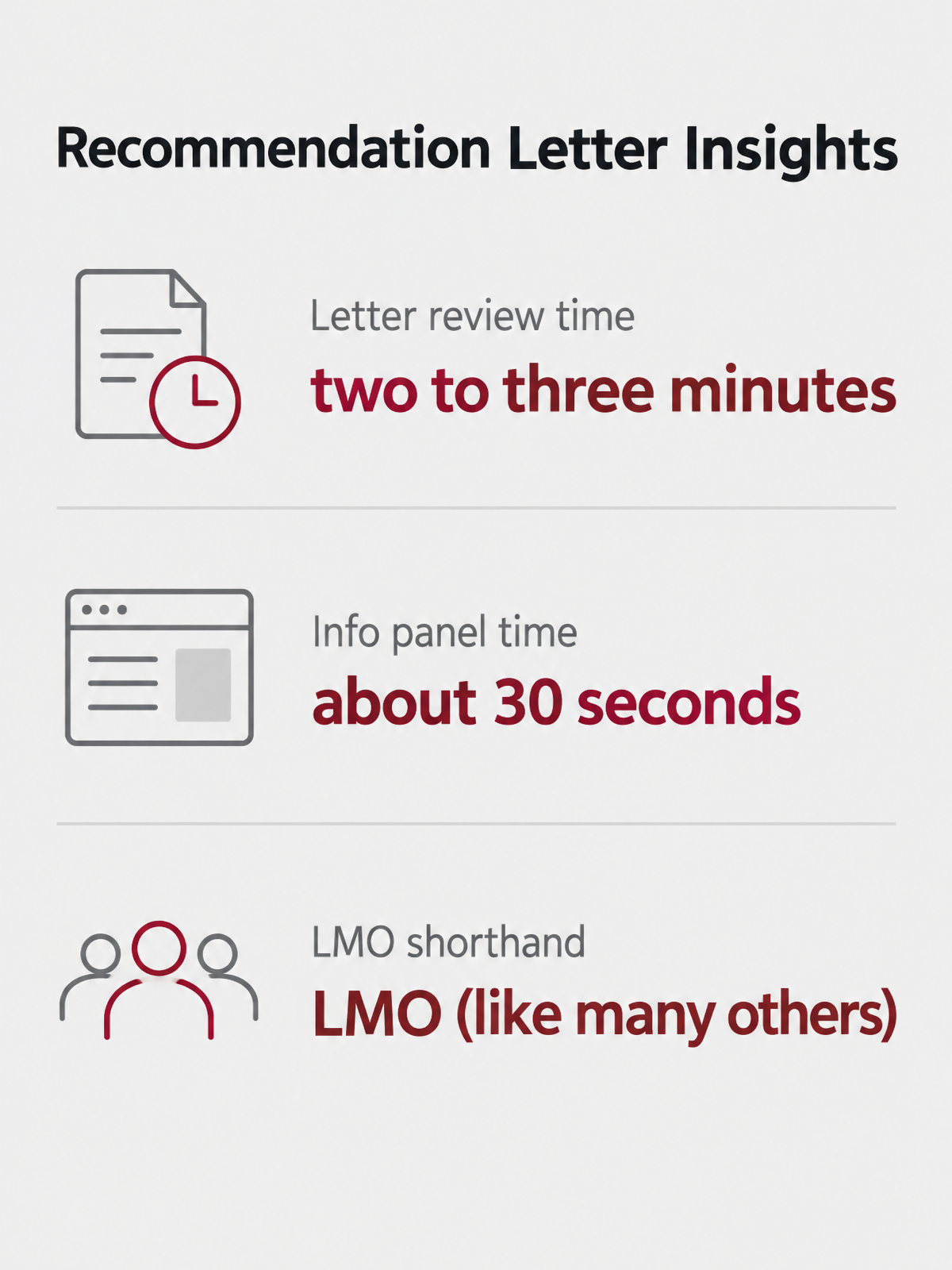
We treat recommendation letters as the last substantive check before a file reaches committee. Published sources do not agree on an exact minute count for this part of the first read, but the former admissions officer at Johns Hopkins and Bowdoin describes reading recommendations near the end, after transcript and essays. That means letters act as third-party confirmation rather than new narrative; they usually confirm or complicate the story a student has already built rather than introduce a new one.
The recommendation scan
We tell families to read letters the way a tired regional officer would: looking for a specific classroom story, not a character summary.
- Ask each recommender to anchor one claim in concrete behavior. A sentence about leading a case discussion or defending a pricing analysis gives the reader a committee-ready detail; “She is a hard worker” does not.
- Avoid the LMO trap. Former readers used shorthand like “LMO (like many others)” to mark unremarkable candidates, and a letter that repeats GPAs and adjectives blends into that stack.
What belongs in the additional information review
This section is a context panel, not a second essay. Reviewers may give it only a short look—enough to clarify an irregularity but not enough to introduce a new credential.
- Use it to explain one anomaly: a grade dip, a gap year, or a family circumstance. That is the only job this space performs well in a first scan.
- Leave it blank for a clean application. A quick reader will not reward an extra essay here, and a blank section often scans as honesty rather than omission.
- Put the explanation in the first sentence. If the reason sits at the bottom of a paragraph, a short review may miss it.
What I’d actually check before you submit
Before you submit, pull up your application and read it the way a first reader would, not the way you wrote it. The first pass follows a generally consistent order in the source accounts we reviewed, even if small ordering details differ. One former reader describes taking shorthand notes and recommending an initial outcome before the file moves to committee. Borderline files may catch more attention in committee, but only after the first-read screen.
Does the academic opening hold up on the first pass?
Your application can stall here if these two boxes raise concern. A quick first look often determines whether the rest gets read.
- Academic index: Check that your GPA, course rigor, and test scores would clear the threshold for your high school. The opening scan looks for the hardest available path, not just a high number.
- School profile: Confirm your record reads well against what your school offers. Missing rigor or a local grading curve needs a visible explanation.
Do the narrative sections reinforce one story?
Once the academic screen clears, the remaining review rewards consistency across activities, essays, and recommendations.
- Activities list: Put your deepest leadership entry first. A reader looks for depth over breadth, not a long list of scattered memberships.
- Personal essay: Read the first paragraph aloud. If it doesn’t show voice or self-awareness right away, revise. The full essay gets a careful read, but only after the opening has earned it.
- Supplemental essays: Name something specific about each business program to show fit, not generic admiration.
- Recommendations and additional information: Skim letters for concrete anecdotes rather than labels. Leave additional information blank unless it explains a real anomaly; that space should add context, not padding.
References
[1] How Colleges Read Your Application: A 4 Step Process | PrepMaven - https://prepmaven.com/blog/applying/how-colleges-read-your-application-a-4-step-process/
[2] How College Admissions Officers Read Your Application - https://ingeniusprep.com/blog/college-admissions-officers/
[3] How Admissions Officers Read Your Application: 8-Minute Review - https://orieladmissions.com/how-admissions-officers-read-application-8-minute-review/
[4] What Admissions Officers See (REAL Walkthrough) - YouTube - https://www.youtube.com/watch?v=XU6yHoMH3t0
[5] College Application Review Time: What Admissions Officers Do - https://www.cosmic.nyc/blog/how-long-do-colleges-spend-reading-applications
[6] How Admissions Officers Read a College Resume Quickly: 2026 Guide - https://schoolnbeyond.com/how-admissions-officers-read-resume/
[7] What Ivy Admissions Officers Look for When Reading College Applications - https://toptieradmissions.com/what-ivy-admissions-officers-look-for-college-applications/
[8] Aspiring Business Majors: A How-To Guide to Building a Strong Case for ... - https://www.collegeessayguy.com/blog/aspiring-business-majors
[9] Undergraduate Admissions | Gies College of Business | U of I - https://giesbusiness.illinois.edu/apply/admissions
FAQ
How do readers compare students from different high schools?
Readers use each high school’s profile to interpret GPA and rigor. A 4.2 at one school can signal something different at another, so officers check course offerings and grading patterns before comparing applicants. Some former readers describe this as a local or territory-based comparison rather than a single national benchmark.
Does leaving test scores blank hurt a business applicant during the first scan?
Missing scores do not stop the initial review at schools that scan what is present. Readers check GPA and course rigor against your school profile first; submitted SAT or ACT results are noticed, but their absence does not pause the file. A weak transcript is a larger concern.
Should I use Additional Information for a grade dip or leave that section blank?
Use it only to explain one concrete anomaly, such as a grade dip or family circumstance, and put the explanation in the first sentence. We remind students that readers may miss context lower in a paragraph. If nothing needs explaining, leaving it blank scans as cleaner.
Can a strong recommendation rescue a borderline academic scan?
Recommendations usually cannot rescue a borderline academic scan. They are read after the transcript and essays, so they act as third-party confirmation only if the file survives the academic gate. A specific classroom story can support a competitive borderline case in committee, and borderline files may receive extra debate there, but a recommendation cannot reopen a file that fails the first index check.
How specific should a business program supplement be?
Specific enough that swapping the school name would break the essay. Readers want a named course, center, professor, or project connected to work you have already done. Generic phrases about loving business or combining interests tend to read as copy-paste and do not show fit for that program.