Candidates Versus Applicants: Why Yale Admissions Rewards One Type
September 5, 2026
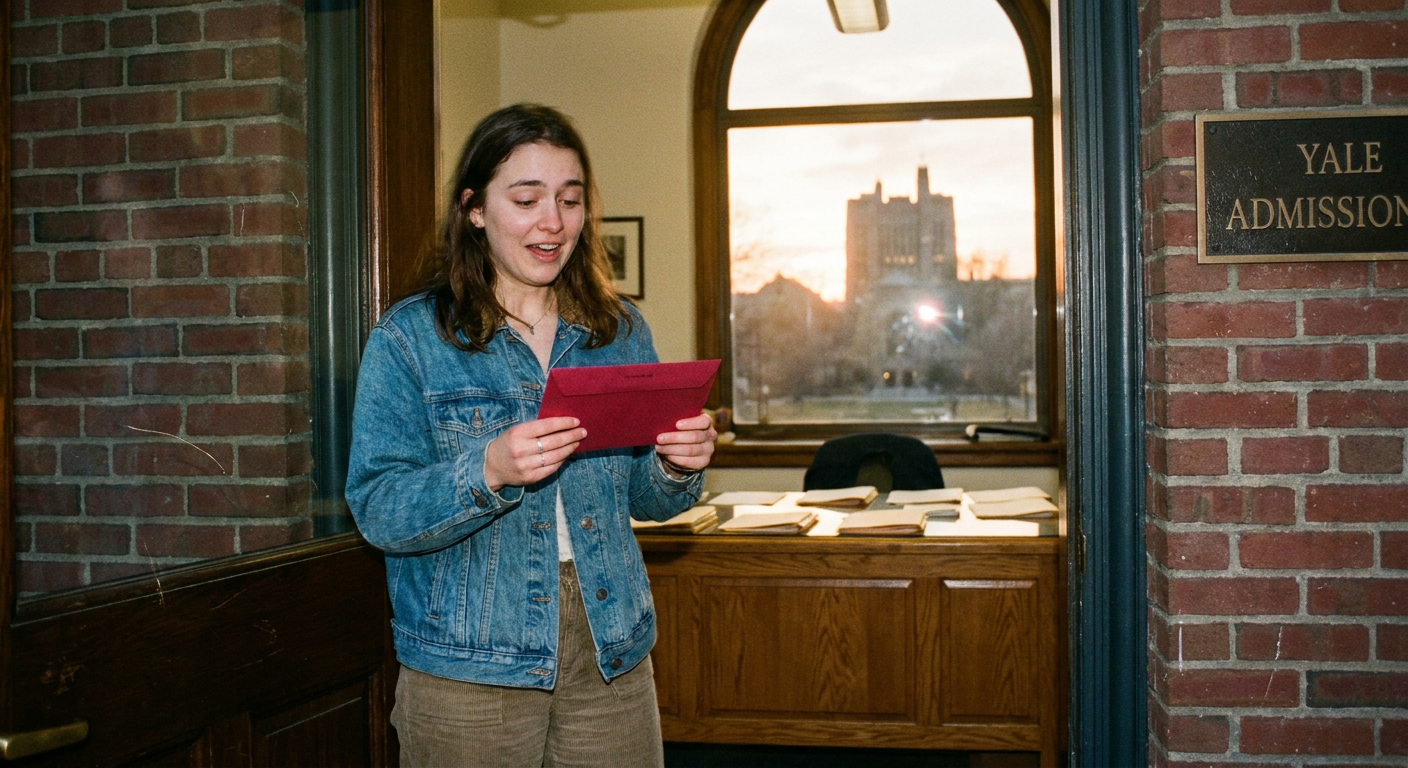
Key Takeaways
- Yale admits about 4.8% of applicants, so high scores are a baseline, not a way to stand out.
- With 97% of admits ranking in the top 10% of their class, near-perfect academics do not separate one strong file from another.
- An applicant clears Yale's academic thresholds. A candidate shows commitment across years.
- Yale's admissions office names the high school transcript, not test scores, as the most important document in a file.
- Admitted students average roughly a 4.0 GPA and an SAT near 1540, per College Essay Guy's breakdown.
- Early action gives no admissions edge. Yale's officers say it does not turn an applicant into a candidate.
- The qualitative layers do the real sorting: activity order, interview reports, and faculty ratings.
Why "Candidate" and "Applicant" Aren't the Same Word
The difference between a candidate and an applicant is not marketing spin. An applicant meets Yale's numbers. A candidate proves a drive the numbers cannot show. That distinction decides who gets in once academic excellence is common across the pool.
Here is the uncomfortable math. When strong metrics are universal, they stop being a differentiator. They become a floor.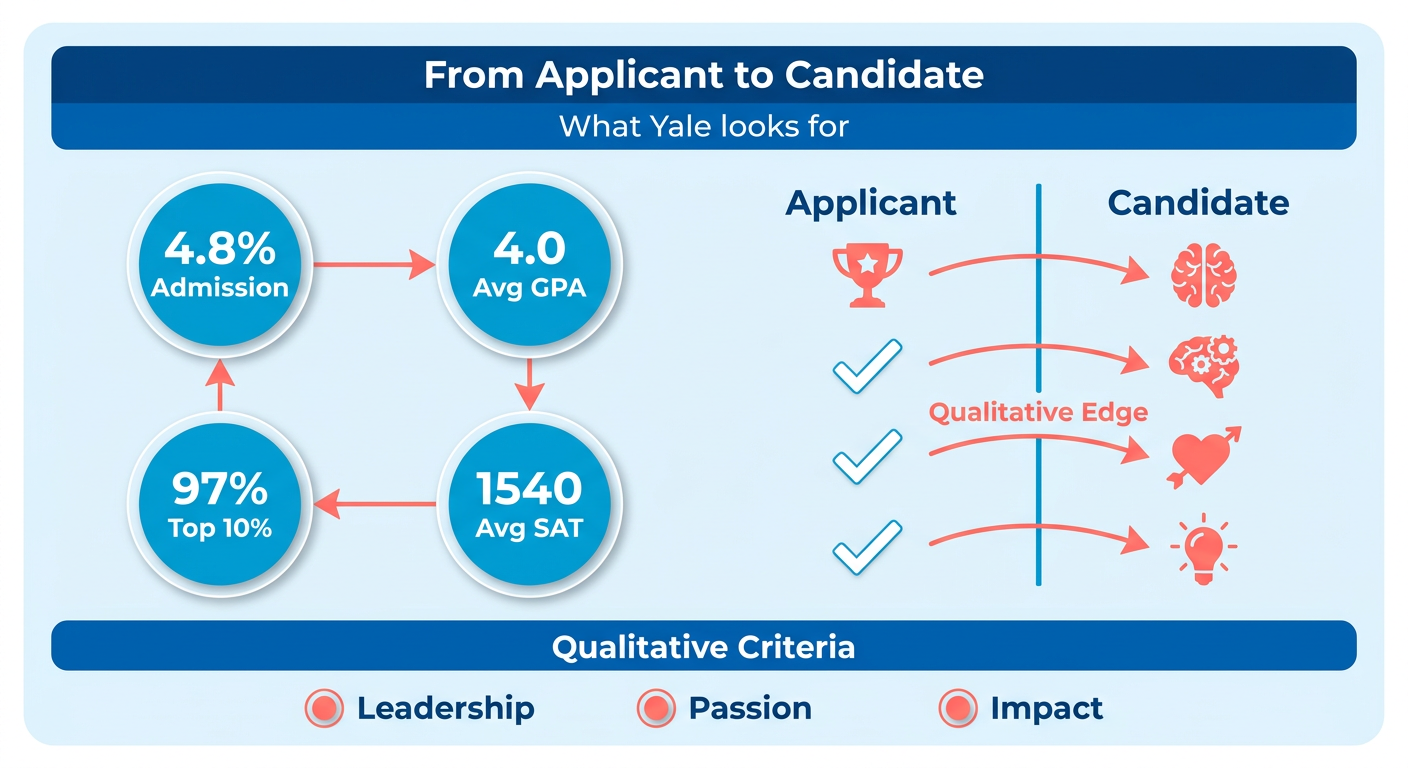
What actually separates the two
Applicant: someone who meets the academic threshold. Candidate: someone whose transcript, activities, and story show a documented pattern of commitment over years. Yale's admissions office treats the multi-year academic record as the main window into a student's intellectual curiosity and resilience.
That changes the frame. The transcript, interview report, activity ordering, and faculty-reviewed supplements do the sorting. Families often obsess over one more SAT retake when the real leverage sits in the qualitative layers that turn a strong applicant into a memorable candidate.
Does applying early action make you a candidate?
No. Yale's admissions officers say plainly that early action gives no advantage in admissions or financial aid. That directly contradicts the common view of early action as a probability boost.
So where is the trade-off? Early action is not a statistical lever. It is a forcing function. The November 1 deadline pushes you to have a developed leadership narrative months earlier. The edge comes from that earlier preparation, not from the platform itself.
Side-by-side: candidate vs. applicant
| Dimension | Candidate | Applicant |
|---|---|---|
| Definition | Meets numbers + sustained impact | Meets the academic numbers |
| Typical Profile | Top-decile GPA, deep focus in 1-2 areas | Top-decile GPA, broad but shallow activities |
| Admission Odds | Materially higher within the 4.8% pool | At or below baseline |
| Key Strength Required | Evidence of drive across years | Strong test scores |
| Common Pitfall | Overpacking essays; losing depth | Assuming scores carry the file |
| Timeline | ~36-48 months from first activity | Often a rushed senior-year sprint |
| Difficulty | Hard (sustained) | Medium (achievable) |
| How We Bridge It | Base-plus-bonus narrative development | . |
Candidates already show sustained impact, so they read as stronger files. Applicants clear the floor but blur together.
Why base-plus-bonus fits this problem
Since early action buys no probability edge, paying for a timing trick makes no sense. Our base-plus-bonus pricing invests in the work that actually moves files: narrative development. You fund the qualitative work that turns an applicant profile into a candidate profile, and the bonus reflects our satisfaction guarantee. You pay the full fare only if you are satisfied with the work.
Skip this if your student is a genuinely well-rounded senior with no room to deepen a focus. There, the money is better spent on essay coaching alone. But if there is real drive to document, that is where the candidate advantage is built.
Defining the Terms: Candidates vs. Applicants
An applicant clears Yale's numbers. A candidate shows Yale something the numbers cannot. That distinction runs through every decision the committee makes, and it changes how you should spend your prep time.
The clean version: an applicant submits a file that meets the academic threshold. A candidate is an applicant whose record proves sustained drive, real impact, and a fit with what Yale says it wants. The gap between those two words is where admission is won or lost.
What does Yale actually evaluate first?
Yale's first consideration is academic potential, judged through a holistic read of your high school curriculum. The What Yale Looks For page says the committee wants students who consistently challenged themselves with the most rigorous coursework available to them.
This is the nuance that matters. Officers describe the transcript as a four-year story, one that shows whether a student sought out harder courses as options opened up. A file can hit every numeric benchmark and still read as static. The question is not "did this student perform," it is "did this student keep reaching." That separates the two categories before a single essay is read.
Strong numbers are a portrait of the pool. The transcript and the qualitative layers do the actual selecting. High scores buy you a seat at the table. They do not win the argument.
Where does the "candidate" label really come from?
The candidate idea is Yale's practical version of a decades-old philosophy. Yale President Kingman Brewster framed admissions around selecting leaders in their generation, a vision the office still cites. Leadership, moral concern for others, and a willingness to explore new horizons are what turn a strong file into a candidate file.
Yale reads the whole application, not a single metric. On its own podcast, an admissions officer put it plainly:
"Whole person means the whole thing… we have these different parts of the application because it is not the case that one thing is considered more than others."
That is the whole game. The interview report, the ordering of your activities, and faculty-reviewed supplementary material carry weight that scores cannot.
Applicant vs. candidate at a glance
| Dimension | Applicant | Candidate |
|---|---|---|
| Academic profile | Meets the floor | Same floor, plus a transcript showing rising rigor |
| Extracurriculars | Long list of activities | Depth and sustained leadership in a few |
| Essays | Covers many topics | One idea explored with real reflection |
| Fit signal | Generic "wants a top school" | Clear contribution to Yale's community |
| Recommendations | Confirms competence | Documents specific, memorable impact |
Why a high score alone will not make you a candidate
Yale rejects thousands of applicants with perfect or near-perfect standardized scores every cycle. High numbers produce indistinguishable applicants. When everyone clears the floor, the floor stops sorting anyone.
This is why we treat the qualitative layers as the real investment: the narrative development that converts an applicant into a candidate. You invest in documented evidence of drive, not a timing strategy. That is the trade-off this article keeps returning to. You can see how we think about long-term positioning on our college admissions blog.
From Submission to Decision: How the Process Actually Runs
The Yale application runs on a longer clock than most families expect. It starts well before senior year and ends in April with a decision. Between those bookends sit fixed deadlines that reward applicants who treat them as production schedules, not finish lines.
Every applicant moves through the same milestones. The question is whether you arrive at each one as a finished candidate or a rushed submission.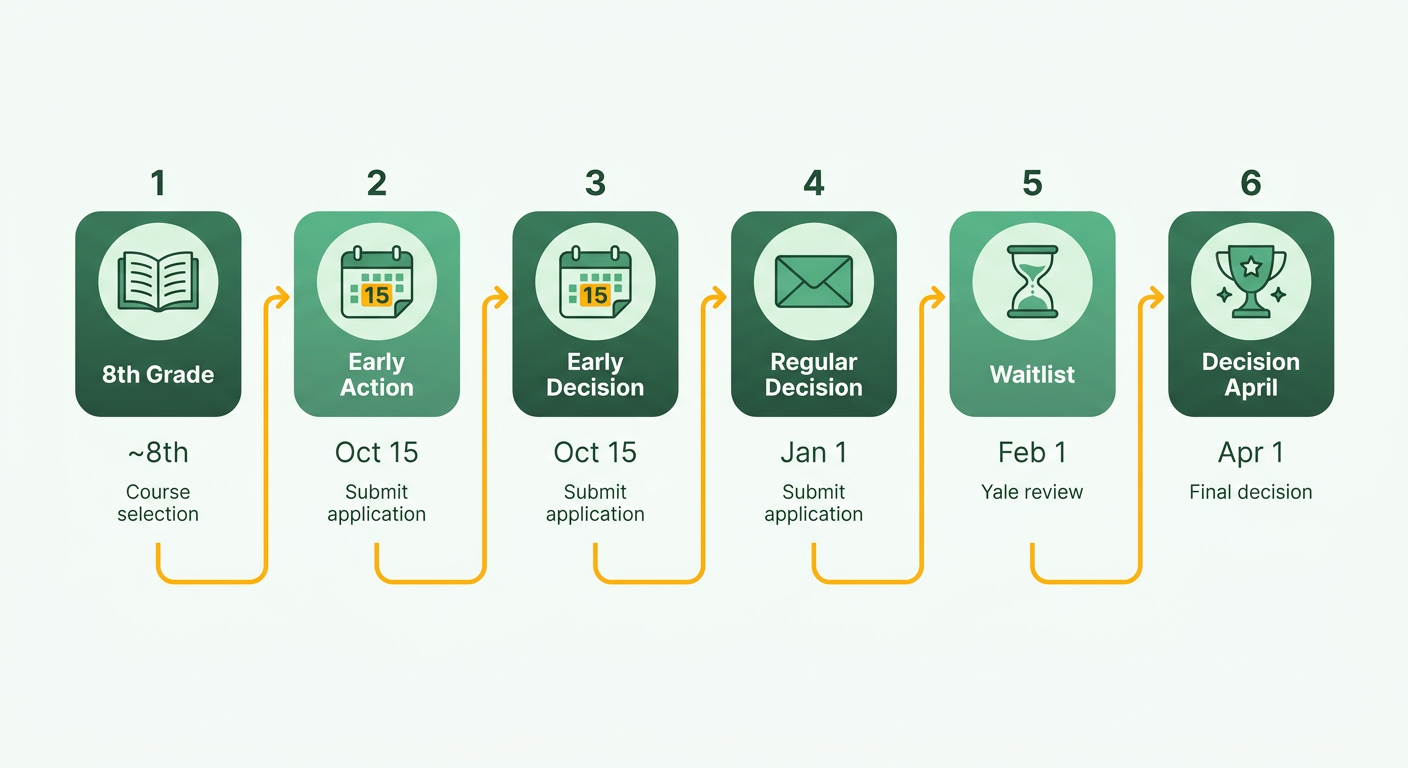
What does the Yale timeline actually look like?
The path from prep to decision spans roughly four years. Foundation work starts around 8th grade with course selection and activity choices. The visible application comes together in senior fall. The verdict lands in April.
| Milestone | Timing | What decides your standing |
|---|---|---|
| Foundation | 8th–11th grade | Transcript rigor, sustained activities |
| Application | Senior fall | Essays, activity ordering, supplements |
| Early deadline | November 1 | Fully developed narrative |
| Regular deadline | Early January | Same file, more time to polish |
| Decision | April | Whole-person committee review |
Notice where the weight sits. The choices made during the foundation years shape the arc of your transcript. They matter far more than the frantic senior fall most families fixate on.
Does Early Action give an applicant an advantage?
The evaluation standards do not change. Yale's admissions office is blunt: the criteria for admission do not shift between rounds. Financial aid is identical too, with early applicants submitting the same financial profiles and receiving the same institutional methodology.
So why does the early-versus-regular question matter? The November deadline is a useful milestone for self-assessment. To submit a compelling file early, your narrative has to be mature and fully realized. The payoff is having a completed, high-quality application locked in early, which frees you up for other academic goals over the winter.
Here is the honest trade-off. If your narrative is ready, early action locks in a polished file and clears your winter. If it is not, you are trading two months of essay depth for a checkbox that does nothing for your odds. Skip early action when your story still needs those weeks.
How do candidates prepare for the interview and supplements?
Interviews and supplementary materials are where applicants become candidates. Committee review often opens with the interview report, used as an independent summary of who you are. Supplements in art, music, dance, or film go to a faculty member who rates them and writes back to the office.
These qualitative layers carry weight for a reason. Interviews are offered by alumni volunteers across the country, and while not every applicant gets one, the report becomes part of the file readers weigh alongside essays and recommendations. The supplement review adds a second expert voice from inside Yale's own faculty.
Our planning maps to each checkpoint: narrative build before November, interview rehearsal before the report is written, supplement curation before faculty review. A collaborative review means your essays get multiple professional eyes at each stage. It puts the resources on the qualitative development that actually moves a file, not on a timing advantage that does not exist.
Turning an Applicant into a Candidate
The fastest way to turn an applicant into a candidate is to build one deep body of work, not five shallow ones. Strong academic metrics establish your baseline. The qualitative layers are what earn a serious second look from the committee.
Here is the trade-off that matters. Since the early timeline offers no statistical advantage, when you submit should depend on whether your portfolio is ready. Rushing to meet an early deadline with an incomplete narrative is a real risk. The goal is a fully realized profile, whichever round you choose.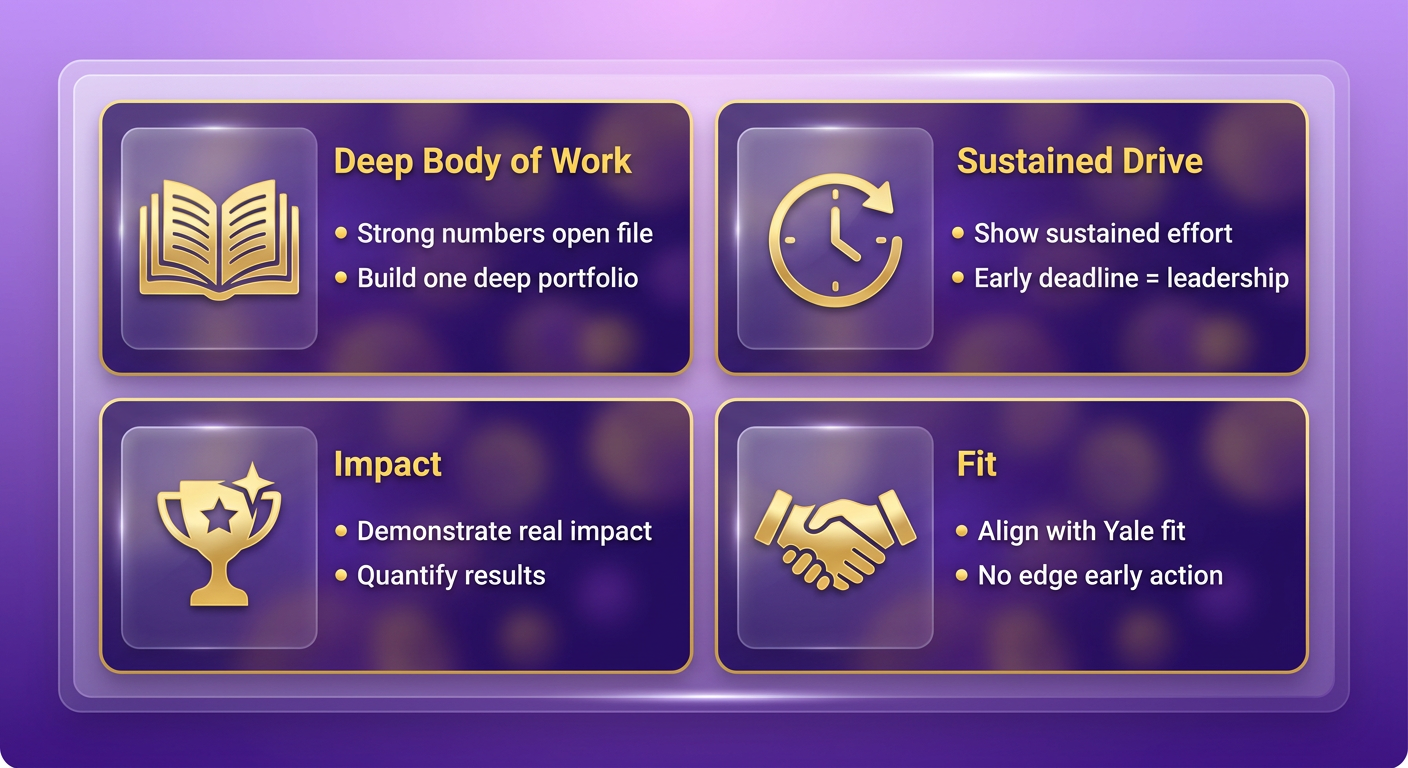
What tactics move the needle fastest?
We score every tactic on impact, effort, and time horizon so families can invest deliberately, and direct their energy at the work that strengthens a profile.
| Tactic | Impact | Effort | Time Horizon |
|---|---|---|---|
| Signature project (research, portfolio, or community build) | High | High | 8-month cycle |
| Sustained leadership in one role | High | Medium | 18+ months |
| Intellectual curiosity (summer institutes, MOOCs, publications) | Medium | Medium | 6-12 months |
| Cohesive narrative thread across the whole file | High | Low | Ongoing |
The single-role leadership point is the one students fight us on. They want three club presidencies. We push for one tenure that lasts long enough to show real impact, because that depth is what maps to the long-term leadership Yale says it wants in a class.
How Endurable Education builds the candidate profile
Our approach centers on customized planning plus alumni-network mentorship. We build meaningful experiences early, run essay workshops, and prepare students for interviews so the qualitative layers all point the same direction.
Customized planning: tailored strategies that help each student build documented evidence of drive during the life-prep phase, not a résumé line.
Here is how three firms stack up on what actually converts applicants:
| Feature | Endurable Education | Firm B | Firm C |
|---|---|---|---|
| Mentorship depth | Alumni-network, 1:1 | Group sessions | Assigned coach |
| Long-term planning | Starts as early as 8th grade | 12-month plan | Application-year only |
| Pricing model | Base-plus-bonus | Flat retainer | Hourly |
We win on mentorship depth and long-term planning. Here is the honest carve-out: for students entering the process late, a different approach applies. There, we pivot entirely to polishing what already exists. A humanities-focused student might refine a writing portfolio to surface a unique creative voice. A social-impact advocate works to pull years of local volunteering into one coherent personal statement. A third student with similar credentials stays an applicant because they present a disconnected list of achievements with no unifying thread. The qualitative gap is what separates those different paths.
The evidence of drive you can document is the whole game. For families mapping that timeline early, our college planning blog breaks the sequence down further.
Endurable Education: From Applicant to Yale Candidate
Here is the trade-off no applicant should ignore. Managing the timeline takes a deliberate plan. Our whole model exists to make sure you arrive at your chosen deadline with a fully realized, competitive file instead of a rushed submission.
We tie our success to yours. Structuring fees around performance and milestones keeps our team invested in your admissions goals. That is some peace of mind in a landscape where the odds are brutal.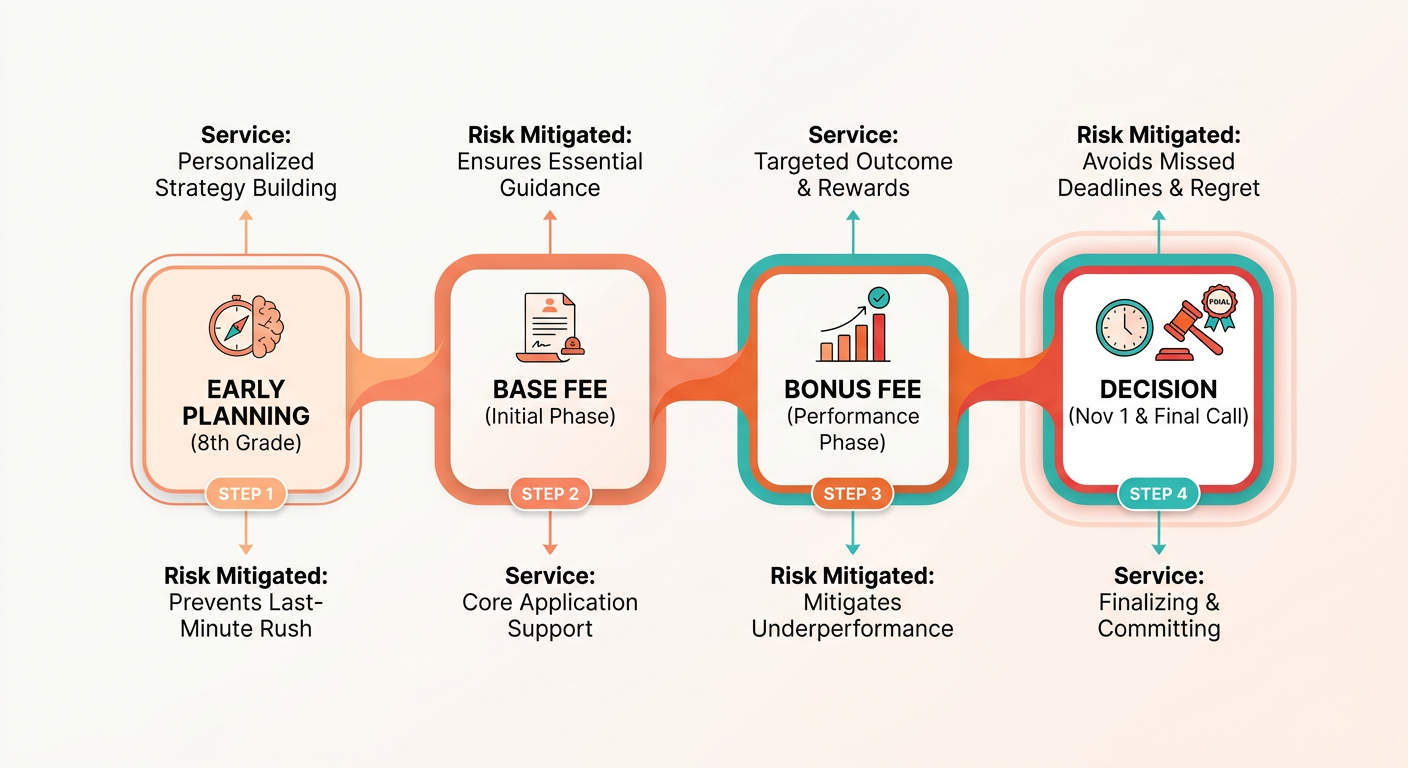
What makes our approach different?
We work as a panel, not a single advisor. That collaborative review means your essays and strategy get multiple professional perspectives. Our team includes Harvard, Yale, and Princeton graduates who bring firsthand experience with elite admissions to your strategy. We focus on long-term development, helping students build genuine leadership and intellectual depth over several years, so that by senior fall the narrative is already on the page.
The results back the method: over 65% of our students admitted to Top 10 plus Ivy League schools, and in the 2023 REA cycle, 12 of 24 students earned HYPSM offers.
How does it compare to the alternatives?
| Factor | Endurable Education | Generic Consulting | DIY |
|---|---|---|---|
| Essay review | Reviewed by 2+ team members | Single advisor | Self / peers |
| Timeline start | 8th grade pipeline | Senior year | Ad hoc |
| Pricing | Base + bonus on outcome | Flat fee up front | Free |
| Best for | Long-term candidate development | Quick fixes | Budget-conscious, high risk |
When to choose us: you have strong GPA and test scores but shallow extracurricular depth, and you want a runway of a year or more. DIY fits budget-conscious families comfortable with high risk. Generic consulting suits last-minute polish.
Our services are built for families who want comprehensive, strategic guidance, not a final proofread.
Start with an initial consultation to size up your needs and goals.
References
[1] What Yale Looks For | Undergraduate Admissions - https://admissions.yale.edu/what-yale-looks-for
[2] (Sound on!) Feeling overwhelmed or mystified by the Yale Admissions ... - https://www.facebook.com/YaleUndergraduateAdmissions/videos/sound-on-feeling-overwhelmed-or-mystified-by-the-yale-admissions-process-have-no/7494919200521873/
[3] How to get into Yale: Admission Requirements 2026/2027 - https://www.collegeessayguy.com/blog/how-to-get-into-yale
Frequently Asked Questions
1. Does Yale superscore the SAT, and would a higher superscore help my file?
Yale considers all standardized test results within the broader context of your school environment and curriculum. While a strong score demonstrates academic readiness, it functions primarily as a baseline credential. The admissions committee places far greater emphasis on your multi-year academic trajectory and the qualitative depth of your personal narrative to distinguish top-tier files.
2. If early action gives no admissions advantage, why would anyone apply early to Yale?
Applying early can be effective for students who have already fully developed their application portfolio by the fall. It allows you to receive an early decision and, if admitted, simplifies your senior year. However, if your essays or extracurricular descriptions would benefit from additional time and refinement, waiting for the regular decision round is the wiser choice.
3. Can a senior applying this year still become a candidate rather than an applicant?
While long-term profile building requires years of sustained effort, a senior can still maximize their impact by carefully curating their existing experiences. At this stage, the focus should shift entirely to narrative synthesis, ensuring your essays, activity descriptions, and recommendation letters present a cohesive, compelling story of your intellectual and personal growth.
4. Does everyone who applies to Yale get an alumni interview?
No, interviews depend on local alumni availability and do not reflect your application's strength if one cannot be scheduled. When an interview does occur, the resulting report provides the admissions committee with additional qualitative context about your conversational engagement and personal qualities, serving as a helpful supplement to your written materials.
5. Is having multiple leadership titles better than one sustained role?
Depth of impact is far more persuasive than a long list of titles. The admissions committee looks for evidence of sustained commitment where a student has driven real change or demonstrated significant growth over time. A single, deeply felt leadership role where you achieved tangible results carries much more weight than holding multiple nominal positions.
6. How does Endurable Education's base-plus-bonus pricing actually work?
Our pricing model is designed to align our goals with your family's aspirations. By splitting our fees between an initial service fee and a performance-based milestone, we ensure our team is invested in the quality of your student's application. This structure emphasizes our commitment to delivering strategic guidance throughout the process.
7. When is Endurable Education the wrong choice for a family?
We are not the right fit for families seeking a simple proofreading service or a last-minute checklist. Our methodology is built around deep, strategic mentorship and long-term narrative development. Families who prefer a self-directed approach or are looking for quick, low-touch feedback may find other options better suited to their needs.