Cover Letters That Explain Your Portfolio Weaknesses: When to Send One
August 27, 2026

Key Takeaways
- When you leave a gap unexplained, the reader fills it in for you. Their invented story is almost always worse than the truth.
- A weakness earns a cover letter only if a reviewer would notice it and form a negative story.
- Students agonize over a 30-point SAT dip while ignoring a semester of C's a reader clocks in ten seconds.
- The portfolio SWOT audit is a one-page, four-quadrant matrix that flags exactly which items a college reader will scrutinize.
- The threats quadrant captures what a skeptical reader might assume about each weakness. That assumption is what your letter corrects.
- Benchmark against published class profiles. A 3.7 against a 3.9 median is a soft spot, not an emergency.
- A dropped year of math weighs far more for an engineering applicant than for most other majors.
Which weaknesses actually deserve a letter
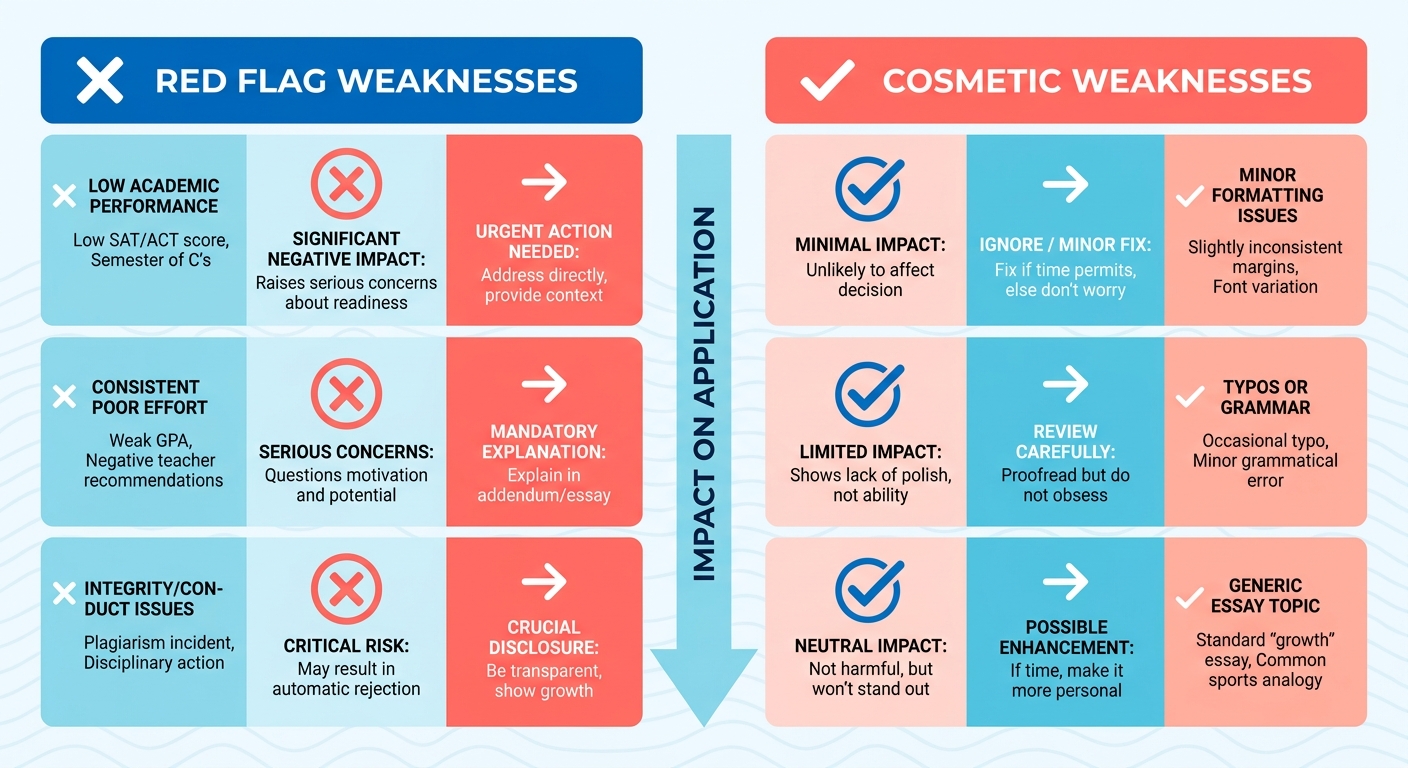
Before you write a single line, decide which weakness deserves one. Most students get this backwards. They fuss over minor details and skip the glaring academic or creative inconsistencies. Your first job is an honest audit of your creative portfolio and academic record, separating real red flags from cosmetic ones.
That means reading your own file the way a stranger would. Admissions officers look for consistency across your academic history and your creative submissions. Leave an anomaly unexplained and they'll draw their own conclusion, which rarely breaks in your favor. That risk should drive the whole assessment.
How to run a portfolio SWOT audit
Portfolio SWOT sorts your application into four buckets so you can judge how your work will actually read to a committee, not how it feels to you.
Grab a sheet and split it into four quadrants. Under weaknesses, log the usual suspects: GPA dips, gaps in coursework, thin leadership, low-impact activities, inconsistent test scores. The threats quadrant is where you write the negative read a reviewer might take from each one. That's the exact interpretation your letter has to head off.
Then quantify. Pull the published class profiles for your target schools and benchmark yourself against the admitted range, honestly. This is how you tell a minor variance that sits inside the normal band from a curriculum gap that collides with your intended field.
Which weaknesses clear the bar
Prioritize by visibility, not by how much the weakness nags at you. A single semester of failing grades screams off a transcript. A 30-point SAT dip below median barely registers when your GPA is strong. Aim at what the reviewer sees first.
The test is simple: if several readers would independently notice an issue, it probably needs a word. Everything below that line is noise you should leave alone. Over-explaining minor gaps reads as anxiety, and it burns credibility you'll want for the real problems.
The Common App already gives you room for this. The Additional Information section runs up to 650 words, and the Challenges and Circumstances field caps at 250 for first-year applicants. Colleges use these notes to understand context and sometimes to route support. Two examples that work well there: clarifying a medical leave that hit your grades, or explaining a thin activity list because of family caregiving.
On length, those fields make the case for you. A brief factual note beats a narrative when the container is built for context. GradPilot's 3-to-6-sentence guidance and the Common App's 250-word cap land on the same ceiling. Past roughly five sentences, explanation turns into excuse.
What the full cover letter plan looks like
| Section | Core Objective | Approx. Word Count | Time to Draft (hrs) | Difficulty (1-5) |
|---|---|---|---|---|
| Opening context | Name the weakness plainly | 40-60 | 0.5 | 2 |
| Impact statement | Show what it affected, factually | 60-90 | 1 | 3 |
| Recovery evidence | Prove the upward trajectory | 80-120 | 1.5 | 4 |
| Forward pivot | Tie it to fit and growth | 50-70 | 0.5 | 3 |
| Close | End without apology | 30-40 | 0.5 | 2 |
Opening: state the fact, skip the drama. Impact: quantify, don't narrate. Recovery: this is where you win the reader. Pivot: connect the gap to who you are now. Close: confidence, not contrition.
Budget 3 to 5 hours to draft and another 1 to 2 hours to revise. If your audit turns up nothing several readers would notice, skip the letter. Not every application needs one, and a clean record speaks for itself.
Timing: when to send a letter that addresses a weakness
Timing decides whether your explanation reads as honest context or as a panic move. The same letter that strengthens a creative portfolio in October can undercut it in December if you send it at the wrong moment. Treat timing as a strategic choice, not an afterthought.
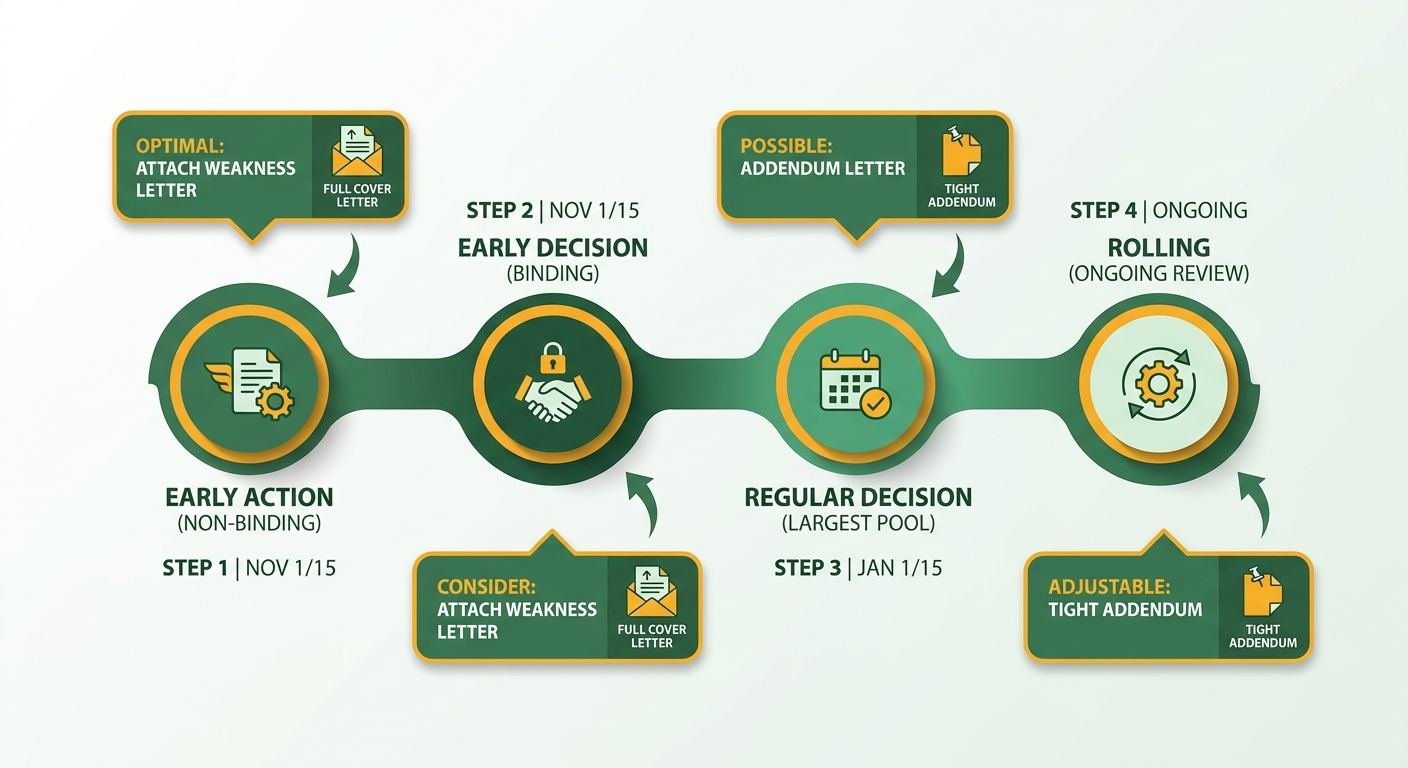
The rule we follow: match the format to the round. A full cover letter fits some moments. A tight addendum fits others.
Early rounds: keep it to an addendum
Early Action or Early Decision: skip the full cover letter. Use a brief addendum instead. Early rounds move fast, and readers process dense files under pressure. A short note clipped to your portfolio submission does the job without adding bulk.
You have room to be factual, but keep it short. Readers in early rounds often spend 7 to 8 minutes on a first-pass file. A single tight paragraph explaining an academic dip lands better than a page of narrative.
Factual, not narrative. A direct explanation gives the reader exactly what they need to read the situation correctly. That's the whole goal.
How the choice shifts by round
Regular Decision: you get more space. Submit the letter with your main application or upload it as a supplemental PDF. This is the round where a full explanation earns its place.
Post-interview follow-up: if a weakness surfaced in your interview, send a concise letter to reframe it. Do it within a day or two, while the conversation is still fresh.
Scholarship and financial-aid packets: most already require a personal statement. Fold the explanation into that document. Don't send a separate letter.
One rule saves applicants repeatedly: give reviewers at least 48 hours to read a supplemental letter before scoring starts. Last-minute uploads read as rushed, and rushed writing carries errors that quietly cut your credibility.
Send early. Read it aloud twice. Then send.
Structuring the letter: opening, body, close
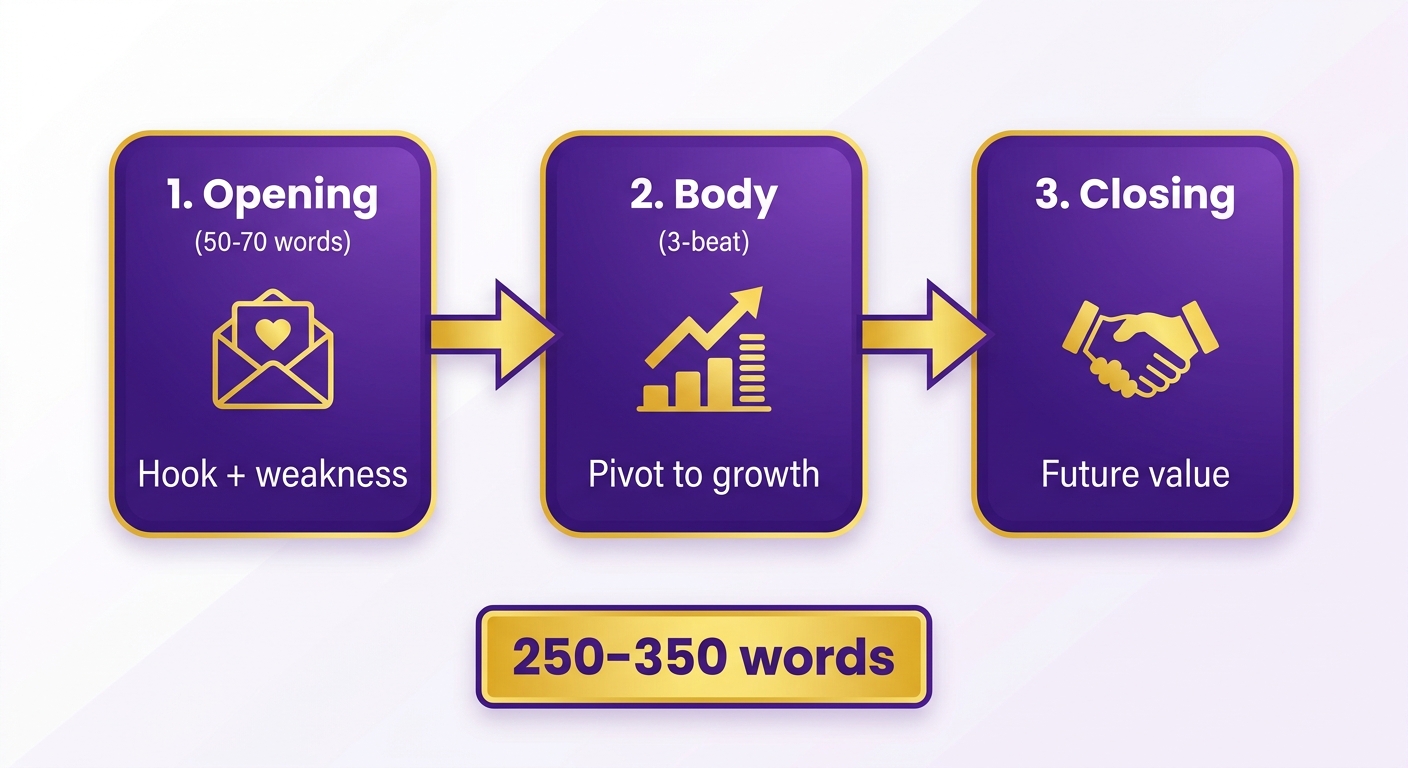
A letter that lands follows a tight three-part shape: a specific opening, a three-beat body, a short close. Keep the whole thing between 250 and 350 words. Longer than that and a reader starts skimming, which defeats the point of explaining a gap in your creative portfolio at all.
One rule sits above the rest: pivot fast from the problem to the growth. The moment you finish naming the weakness, you should already be turning toward what you learned and how you fixed it.
Opening without sounding generic
Opening (50-70 words): lead with one or two sentences naming a specific program, professor, or value the school actually offers. Then add one context sentence saying why you're writing.
Skip the throat-clearing. "I'm applying to your visual arts program and want to briefly address a gap in my submitted work" does more than three lines of flattery. Reference something real. A named studio course or a faculty member's research signals you did the homework.
What goes in the body
Body (150-200 words): three quick beats. Acknowledge, prove, project.
Name the weakness in two or three sentences. No more. Take responsibility and move on. Be blunt with yourself here. Over-apologizing or blaming outside forces reads worse than the gap itself.
Then show concrete remediation. The course you took, the project you finished, the mentor you sought out. Specifics beat adjectives every time.
Finally, turn that recovery into future value. Explain how the experience makes you a sharper contributor on that campus.
How to close
Closing (30-50 words): reaffirm your interest, add one clear call to action, thank the reader.
Ask for an interview if the program allows it. Use active voice throughout. Swap "I'm sorry" for "I've learned." That one change moves the whole letter from defensive to forward-looking.
Turning the gap into proof of growth
Naming a weakness is the easy part. The real work is turning that gap into proof of what you learned. Once you've explained a soft spot in your creative portfolio, every remaining sentence should point forward, showing a reader who you became because of it.
The principle is simple: draw a direct line from the past challenge to your current readiness. That's where a defensive letter turns persuasive.
Building a growth narrative
Use a four-beat structure: Situation → Action → Result → Reflection. It keeps you honest and stops the letter from drifting into excuse-making.
- Situation: one sentence naming what happened. A rough chemistry semester. A stalled portfolio project.
- Action: what you actually did next. Found a tutor, rebuilt your study schedule, took on an independent project.
- Result: the concrete outcome, ideally with a number. "I raised my chemistry grade from a 2.5 to a 3.8 in one semester."
- Reflection: the skill you can now name and carry forward.
Numbers do the heavy lifting. "I improved" is a claim. "I improved from a 2.5 to a 3.8" is evidence. Readers trust verifiable specifics over adjectives.
Which transferable skills to highlight
Name the skill the setback taught you, then tie it to something real at the target school. The ones that translate best: resilience, analytical thinking, project management, communication.
A student who turned a low-grade chemistry term into a summer research internship can, in a later letter, link that recovered analytical skill to a specific lab she wants to join. That direct line from weakness to lab is what makes a growth story land.
Do the same. Cite an actual course, professor, or program that matches your new skill. Vague praise for a school's "amazing opportunities" tells a reader you did no homework.
One warning: don't oversell. Keep every claim authentic and verifiable. A reader who catches one inflated detail will doubt the whole file.
Formatting, tone, and the pitfalls that sink letters
A clean letter earns trust before a single word registers. Sloppy formatting signals a rushed application, which is the wrong message when you're explaining a gap in your creative portfolio. Layout and tone are the frame around your growth story. Get the frame wrong and the picture inside stops mattering.
The fixes are mechanical. That's the good news. You control every one of them.
The formatting rules
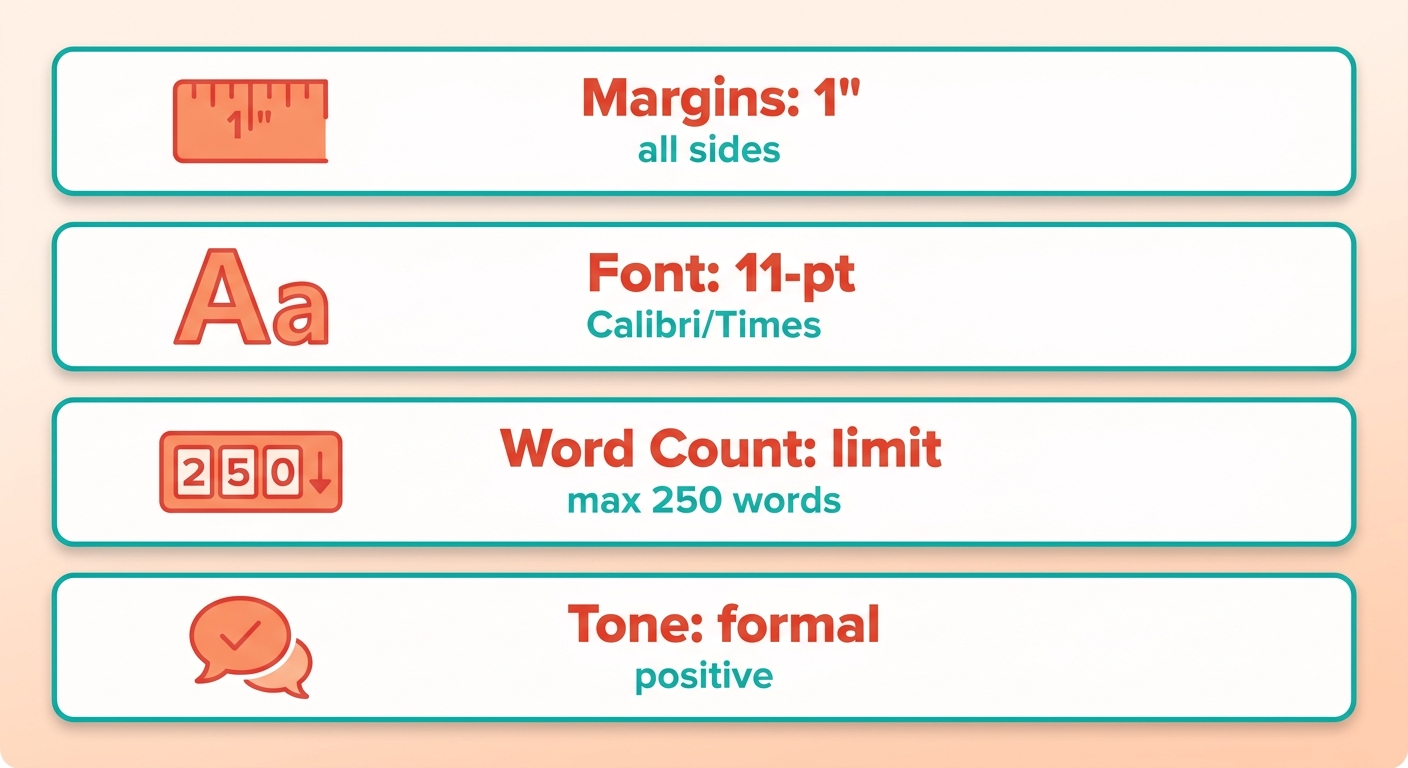
Use clean, standard formatting that reads well on an admissions officer's screen. Nothing about your layout should draw attention to itself.
- Margins: 1-inch on all sides.
- Font: 11-pt Calibri or Times New Roman.
- Alignment: left-aligned, never justified.
- Spacing: single-spaced with a blank line between paragraphs.
File naming matters more than students expect. Admissions staff track hundreds of documents. Name yours LastName_CoverLetter_Program.pdf so it sorts cleanly and never gets lost in a folder. A file called "final_draft_v3.pdf" reads as careless.
Keep the writing accessible too. Plain language. Break up dense blocks. If you embed any graphic from your portfolio, add alt-text so the file stays readable across systems.
Keeping the tone professional
Aim for confident, forward-looking, concise. The moment you slip into excuses, blame, or heavy self-deprecation, you weaken the letter. You're providing context, not apologizing for existing.
Run this checklist before you submit:
- Confident: state what happened, then pivot to what you learned.
- Forward-looking: end every explanation pointing ahead, not backward.
- Concise: cut anything that repeats your resume word for word.
The common pitfalls cluster in a few spots. Over-explaining tops the list. So do jargon, irrelevant personal detail, and copying resume lines verbatim. Each one dilutes your message.
One more habit worth keeping: stick to information you can share responsibly, and avoid referencing anything a school may treat as confidential, like grades not yet officially released.
How to proofread
Two separate passes. First for content and logic. Second for grammar and typos, only.
Use a grammar tool for the mechanical sweep, then hand the draft to a peer or advisor for fresh eyes. A second reader catches what you've gone blind to after five rewrites.
Case studies and how our team works it
The theory only matters if it moves a decision on a reader's screen. Here's how a weakness-focused letter can shift an outcome, drawn from the kind of work our team does with students who arrive convinced their creative portfolio or transcript is a dealbreaker.
Every case follows the same sequence: portfolio audit, weakness prioritization, timing plan, draft, advisor feedback, final submission. Nothing exotic. Just discipline applied in the right order.
What the approach actually shows
Scenario 1, "The GPA Gap": a student whose semester GPA dipped after a family disruption names the circumstance in one clean sentence, then pivots to remedial coursework and leadership in a community tutoring program. We treat the red flag as context, not a verdict, because no two students, and no two strategies, are alike.
Scenario 2, "The Activity Void": a student with a thin activity list after a year of homeschooling doesn't need to apologize for the gap. The letter can surface a self-initiated coding project or a community garden leadership role from that same year. This is where our panel approach earns its keep. We work with you as a team, so the "void" reads as full the whole time.
Scenario 3, "The Bridge Candidate": an applicant coming to a program from outside their formal background acknowledges the gap directly, details a self-directed research project, and connects existing analytical skills to the new field. Honesty plus a bridge beats pretending the gap wasn't there. Our team's experience across artists, athletes, scientists, and entrepreneurs helps students build that bridge.
Does the approach hold up?
Our track record reflects the payoff of this kind of disciplined storytelling: over 65% of our students admitted to Top 10 and Ivy League schools, and a strong majority admitted to Top 20 institutions. That comes from the same three moves you can copy today.
Replicate the audit checklist. Follow the timing matrix. Apply the structural template. Do those three things and you stop leaving your story to a stranger.
Assess your application honestly before you draft a supplement. If your profile already sits inside the expectations of your target programs, an unnecessary explanation can pull attention to minor details you'd rather leave quiet. Save this move for when a clear, provable trajectory of growth is what the file actually needs.
References
[2] Low GPA on Your CASPA Personal Statement - https://gradpilot.com/news/caspa-low-gpa-personal-statement-templates
Frequently Asked Questions
1. Should I write a cover letter if my weakness is a low SAT score but strong GPA?
In most cases, a minor standardized test variance is offset by a strong academic record. Admissions committees typically view a multi-year GPA as a more reliable indicator of academic capability than a single test score. Instead of drafting an explanation for a slight test score dip, focus your application on highlighting your academic achievements and creative portfolio strengths.
2. Can I use the Common App's Additional Information section instead of a separate cover letter?
Yes, using these built-in platform fields is efficient because admissions officers are trained to look there first for context. This option keeps your main application package streamlined and ensures your explanation sits directly in your primary file. Reserve a separate cover letter for specialized portfolio submissions or programs that explicitly request supplemental statements.
3. What if my weakness comes up during an admissions interview?
Use the follow-up note to reinforce the positive aspects of the conversation while briefly clarifying the specific point raised. Keep the tone appreciative and forward-looking, focusing on your enthusiasm for the program. This communication should serve as a professional thank-you note that happens to resolve any outstanding questions, rather than a defensive explanation.
4. How long should my weakness explanation actually be?
Aim for a length that lets you state the context, show your recovery, and pivot to your future goals without unnecessary elaboration. A concise explanation respects the reader's time and keeps the focus on your qualifications. If you can convey the necessary context in a single, well-crafted paragraph, that is often more effective than a multi-page document.
5. Does the same weakness matter equally for every major I apply to?
Academic and creative expectations vary significantly across departments. A humanities program will evaluate your writing and analytical coursework closely, whereas a fine arts program will place the greatest emphasis on your visual submissions. Align your explanation with the specific competencies valued by the department to which you are applying.
6. What's the biggest tone mistake students make in these letters?
The most common error is adopting an emotional or defensive posture. Writing with excessive emotion can distract from your qualifications and make the reviewer uncomfortable. Maintain a professional, objective tone by focusing on verifiable facts and concrete steps you have taken to address the issue, ensuring the letter remains constructive.
7. When is sending no cover letter the better choice?
If your academic record and portfolio meet the standard criteria of your target institutions, adding an explanation is unnecessary. An application without supplemental explanations allows the admissions committee to focus entirely on your achievements and creative potential. Only submit additional statements when there is a significant, undeniable discrepancy that requires context.