Dual Enrollment or AP? 3 Gates Decide Which Fits Your Student
September 6, 2026

Key Takeaways
- AP credit only lands with an exam score of 3 or higher. Dual enrollment guarantees credit for any passing grade of C or better.
- Dual enrollment permanently affects a student's college GPA. AP exams carry no such lasting academic record risk.
- The 2026 AP exam fee runs roughly $99. Dual enrollment ranges from free in Florida and Texas to about $400 per course elsewhere.
- AP courses can boost high school GPA by up to a full point, versus dual enrollment's maximum 0.5-point weighted bump.
- AP credit is accepted nationwide but may be declined by top selective schools. Dual enrollment credit transfers mainly to in-state public colleges.
- AP courses are taught by trained high school teachers. Dual enrollment classes are led by college professors at real college difficulty.
- For high-achieving students aiming at selective schools, this choice can decide thousands of dollars in tuition savings and scholarship outcomes.
The Fast Version
Both dual enrollment and AP earn college credit while you're still in high school. But they follow different rules, and those rules decide how much tuition you save and how scholarship math works out.
AP trades a low exam fee for a passing score. Dual enrollment guarantees credit, but it ties that credit to a permanent college GPA. For a student targeting selective schools, that difference can be worth thousands.
Here's the quick version before we break it down.
What's the Core Difference?
AP: College Board courses taught in your high school that end in a standardized exam. Credit only lands if you score 3 or higher, and Florida's public colleges award minimum credit for qualifying scores.
Dual enrollment: Actual college courses taught by college professors, at real college difficulty. Credit comes from passing with a C or better. No exam.
| Factor | AP | Dual Enrollment |
|---|---|---|
| Credit trigger | Exam score of 3+ | Course grade of C/70% or better |
| Upfront cost | ~$99 exam fee (2026) | Free in FL/TX; ~$400/course elsewhere |
| Taught by | Trained high school teachers | College professors |
| GPA impact | Up to 1.0 point boost | Up to 0.5 point; affects college GPA too |
| Credit acceptance | Nationwide, but top schools may decline | Mostly in-state public colleges |
| Guaranteed credit? | No | Yes, on passing |
The AP exam fee runs $99 for 2026. Dual enrollment ranges from free to several hundred dollars depending on your state.
Which One Actually Saves More Money?
The cheaper option depends entirely on the odds you realize the credit. AP's low fee is a bet that pays zero if you score below 3. Dual enrollment in Florida or Texas guarantees credit at no cost.
Our take: the "cheap" AP path turns expensive when a failed exam forces you to retake intro courses in college. We've watched a student struggle with AP exams, earn no credit, and end up paying for those courses twice.
The reverse penalty exists too. Dual enrollment credits often transfer only to in-state public colleges. A private or out-of-state school may reject them entirely.
When Should You Choose Each One?
Choose dual enrollment if you're heading to an in-state public university and want guaranteed credit. Students have graduated high school with 30 college credits, entered as sophomores, and cut a full year of tuition.
Choose AP if you're targeting a selective or out-of-state private school. Watch for the double penalty here: dual enrollment credits often won't transfer to those schools, and a weak dual enrollment grade sits permanently on your college GPA before you even enroll.
Skip the "which is better" framing. Both more than double the odds of graduating in six years. This is a wallet-and-transcript decision, not a prestige ranking. We help families weigh it as part of a long-term strategy, sometimes starting as early as 8th grade.
Why This Choice Matters More Than It Looks
Both paths earn college credit before graduation. But those different rules decide how much tuition you save. Every year we work with families who pick the wrong path for their target school and lose credit they thought was banked.
The right choice comes down to one question: where is your student applying, and what will that school do with the credit? A selective private college and an in-state public flagship treat these two pathways very differently.
When Dual Enrollment Wins the Cost Math
Dual enrollment wins when your student targets an in-state public university and the program is free. Credit is guaranteed on passing, not gambled on a single exam. Many state systems waive tuition entirely and cover course fees, so a full semester can cost your family nothing beyond a book or two.
The savings add up quickly. Students who earn an associate degree alongside their high school diploma can bypass general education requirements entirely at participating state universities, shaving up to two years off their undergraduate timeline. Regional dual credit programs are often built to streamline exactly this.
There's a signal benefit too. A Florida study found dual enrollment participants were 12% more likely to attend college, and an Oklahoma program tripled enrollment among African American and Latino students.
When AP Is the Safer Scholarship Play
AP wins when your student targets a selective or out-of-state private school. Highly selective institutions use standardized AP scores to measure academic rigor against a global pool of applicants. That's a consistent benchmark local dual enrollment grades can't match.
This shifts the risk profile. For a student aiming at a private university, the downside of an unweighted high school course is far lower than carrying a subpar grade on an official college transcript. AP gives you a way out: if the exam score is low, you can simply withhold it from the application.
AP also travels. Because the College Board standardizes the curriculum, out-of-state institutions can easily map these courses to their own graduation requirements, which is why AP exams are accepted widely across the country. A strong test-taker can place directly into advanced, major-specific seminars first semester, banking credit at a prestigious university without repeating intro material.
The Quick Selection Table
| Factor | Dual Enrollment | AP |
|---|---|---|
| GPA impact | Hits high school AND college GPA | High school GPA only |
| Best transfer target | In-state public colleges | Nationwide, including selective schools |
| Eligibility | 3.0 GPA + test readiness | Open to any student |
| Course setting | College campus or online | Your high school classroom |
| Credit timing | Banked as you pass | Awarded after summer scoring |
Notice the eligibility flip. The "free" option is the more gatekept one. Dual enrollment often requires a 3.0 unweighted GPA plus test scores, while AP is open to anyone willing to sit the exam.
Our honest carve-out: skip the rigid either-or. Many of our strongest students run both, pairing AP English with a dual enrollment course to show rigor while banking guaranteed credit. No two students are alike, so none of our plans are alike. We weigh each student's academic load and commitments before making the call, then map that against each target school's credit policy. More on building that plan on our college admissions blog.
Feature Comparison
Let's put the two pathways side by side on the features that actually move your tuition and scholarship math. Credit certainty, GPA exposure, eligibility, and transferability. Those four levers decide which path saves you more.
Here's the grid our team uses when we sit down with families.
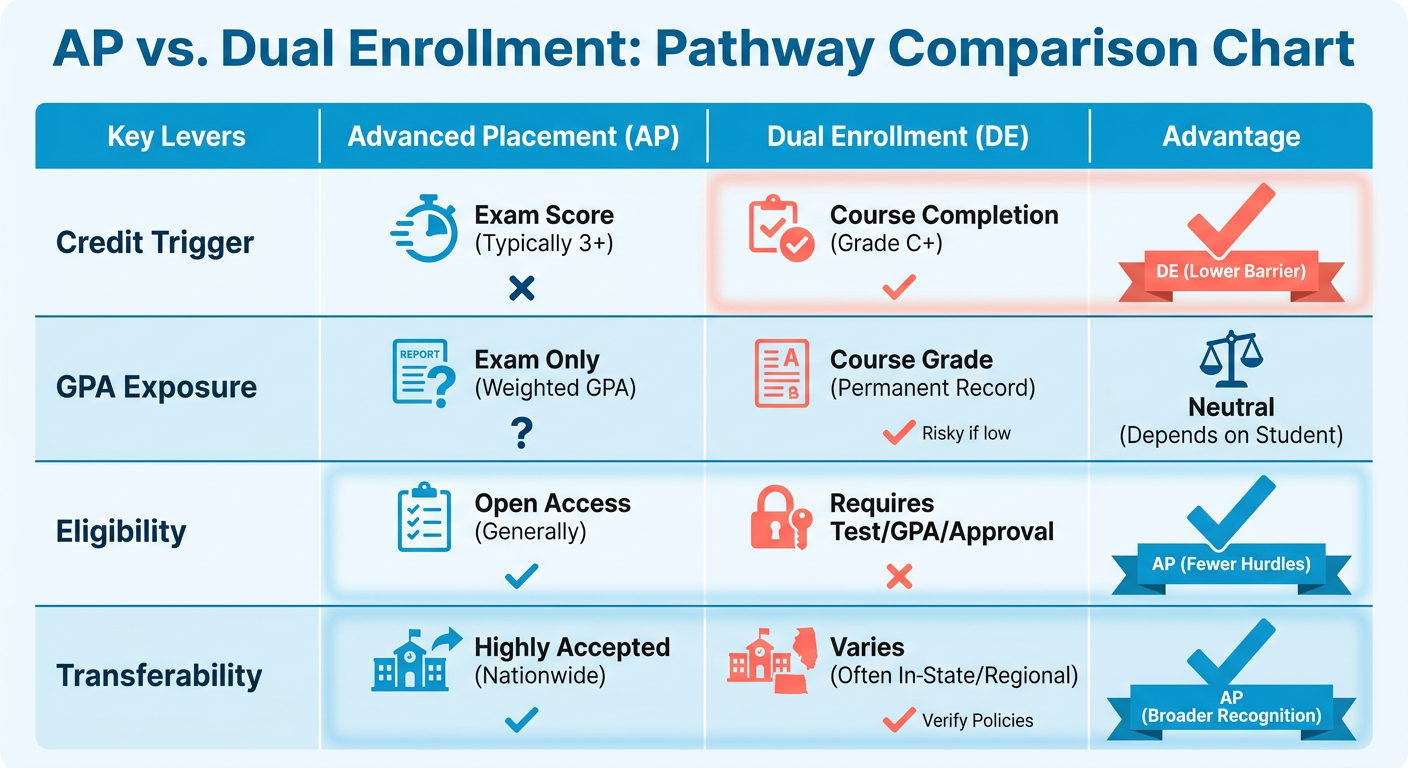
| Feature | AP | Dual Enrollment |
|---|---|---|
| Credit trigger | Exam score of 3+ (Garland ISD) | Passing the class, grade of C or better (TCC dual credit) |
| GPA impact | Weighted HS boost; no college GPA effect | Smaller HS boost and enters your college GPA (NLTCC) |
| Transfer reach | Accepted nationwide, but top schools may decline | All in-state public colleges; private/out-of-state often reject |
| Eligibility | Open to any student | 3.0 GPA + test readiness/TSI approval |
| Instruction | High school teacher, AP-audited syllabus | College professor, standard college course |
Which Path Guarantees the Credit You Paid For?
The two programs earn credit in completely different ways. Dual enrollment rewards sustained semester-long performance. AP hangs entirely on a single three-hour cumulative exam. Your daily homework, quizzes, and midterms in an AP class don't count toward the college credit at all.
When the exam score falls short of a college's threshold, none of that high school work turns into advanced standing. So families end up budgeting for those intro credit hours during freshman year, effectively paying for the same subject twice.
For students staying in-state, the direct articulation agreements between local high schools and public universities smooth the transfer and remove the spring-exam anxiety. That matters, because as admissions experts keep pointing out, the AP exam is not a guarantee of college credit.
The Hidden GPA Penalty in Dual Enrollment
Dual enrollment courses are real college classes, so the final grade lands on an official postsecondary transcript. That grade becomes a permanent part of the undergraduate record, shaping academic standing before the student ever sets foot on their destination campus.
This has real consequences for financial aid. Many state and institutional scholarships require a specific cumulative GPA during college. A mediocre grade earned back in high school can immediately jeopardize eligibility for those funds.
Rigor and Prestige: A Genuine Conflict
The sources disagree on rigor, and you should know both sides. One ResearchGate analysis calls dual enrollment less rigorous because no standardized exam validates it. NLTCC counters that dual courses are taught by actual college professors at real college difficulty.
Both are right, in different ways. AP carries standardized external validation that selective admissions officers reward. Dual enrollment often delivers harder day-to-day work but a weaker prestige signal.
Committees at highly competitive universities tend to treat the standardized AP curriculum as a known quantity, which lets them compare applicants across regions fairly. Dual enrollment rigor, by contrast, varies widely by partnering institution, making it harder for out-of-state officers to read. If you want help mapping this to a specific school list, that's the core of our admissions planning work.
Pros and Cons
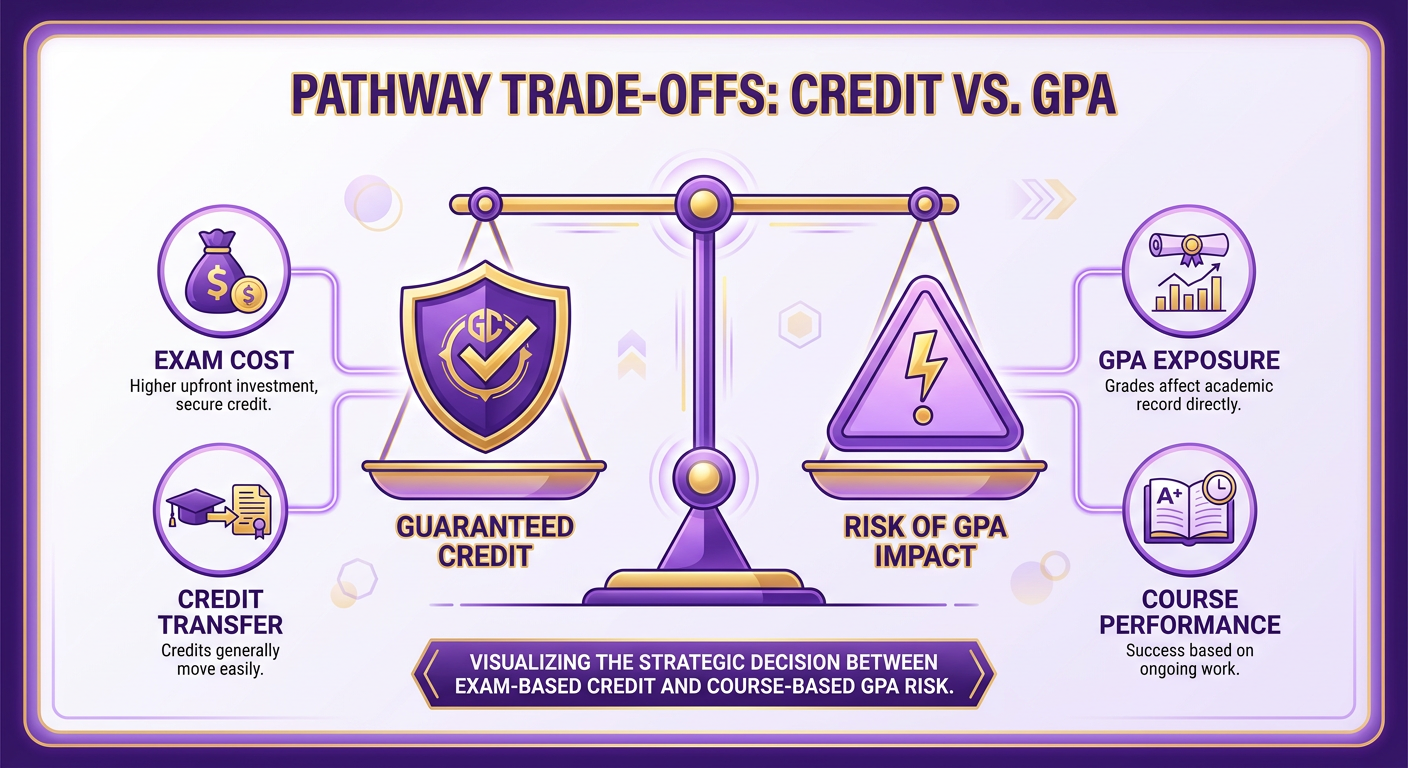
Every advantage on one path shows up as a risk on the other. AP gambles a low fee against a pass. Dual enrollment locks in credit but puts your student's college GPA on the line before they enroll. Here's how the trade-offs shake out.
The Real Advantages of Dual Enrollment
The main benefit of dual enrollment is its continuous assessment model. Grades come from a cumulative average of exams, essays, and projects over fifteen weeks, not one high-stakes testing day. That mirrors the actual college experience and rewards consistent study habits. It's also the only path that can hand a student an associate degree while still in high school.
Completing these courses also lets students register for classes earlier once they matriculate, since registration priority often runs on completed credit hours. That early access helps them lock in high-demand major courses and, in some cases, graduate in three years instead of four.
The catch: this direct integration into the college system demands real maturity. Students have to manage college administrative deadlines like add/drop dates, which run on their own calendar, not the high school's. Miss one and you can end up with an administrative withdrawal or a failing grade on a permanent record.
When AP Beats Dual Enrollment on Cost
AP travels better across state lines. Because the College Board's curriculum is recognized nationwide, private and out-of-state public universities already have frameworks for awarding credit based on specific exam scores. That makes it a more reliable option for students with broad geographic preferences.
For students aiming at elite institutions, AP also signals a willingness to take the most demanding curriculum their high school offers. Admissions offices at these schools read the school profile closely to see whether applicants are maximizing what's available to them.
The main drawback stays the binary nature of the credit. A student who aces the class all year but underperforms on exam day gets no college credit. Because the exam isn't a guarantee, families can end up paying for the same intro courses in college, raising overall costs and erasing the time savings that drew them to AP in the first place.
Pros and Cons at a Glance
| Factor | AP | Dual Enrollment |
|---|---|---|
| Credit certainty | Gambled on exam (3+) | Guaranteed on passing |
| GPA exposure | None; exam only | Permanent college GPA hit |
| Selective/private acceptance | Widely recognized | Often rejected |
| Public in-state savings | Solid | Strongest (free in FL/TX) |
| Access barrier | Open to all | Requires GPA 3.0 + test readiness |
Both programs build the academic discipline postsecondary work demands. Research on the impact of Advanced Placement and dual enrollment programs shows that advanced coursework in high school helps students develop the stamina to handle a college curriculum. The decision hinges on matching the student's testing strengths and college list to the specific credit policies of their target schools, a topic we dig into further on our admissions planning blog.
Use Cases and Ideal Users
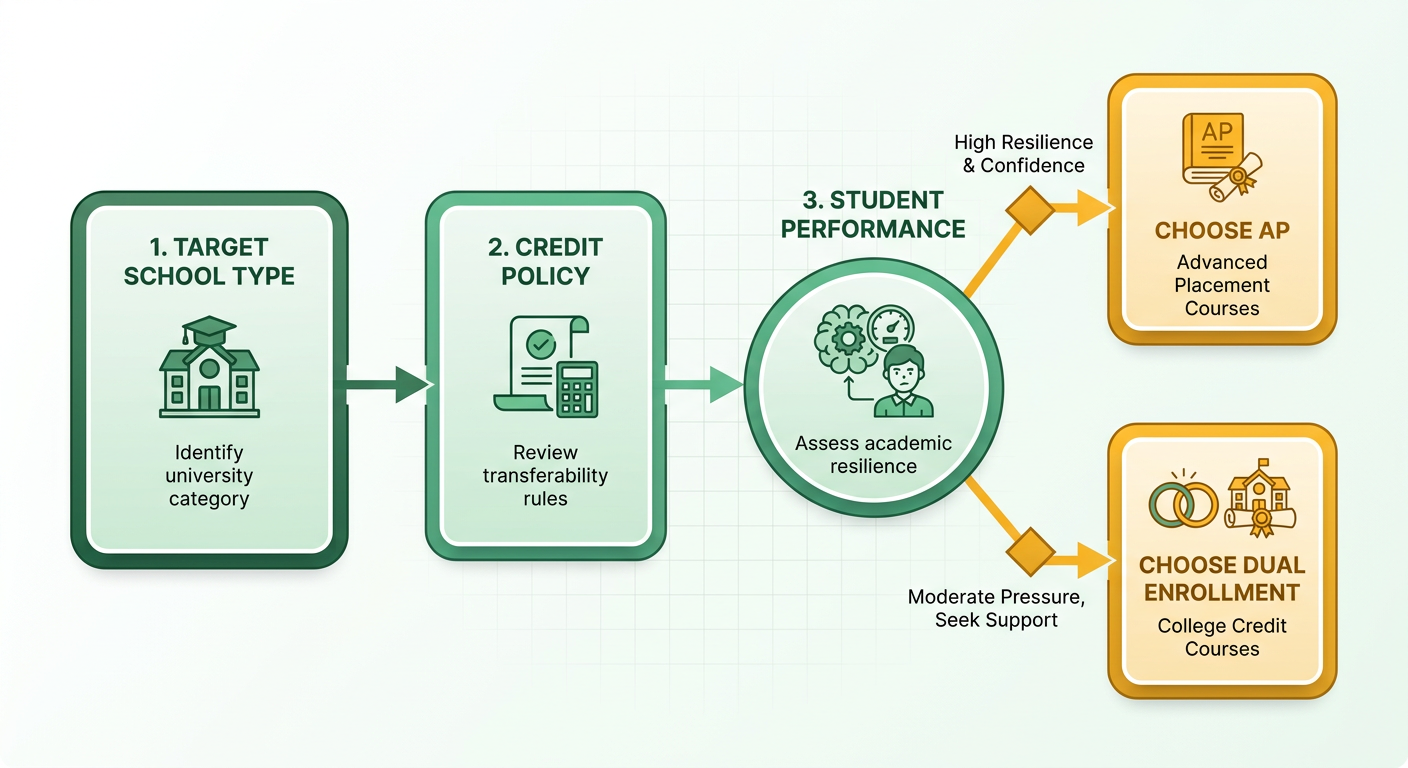
The right path depends on three things: where your student applies, how they perform under pressure, and what the target school does with credit. Get those wrong and you lose money. Get them right and either path becomes real tuition savings.
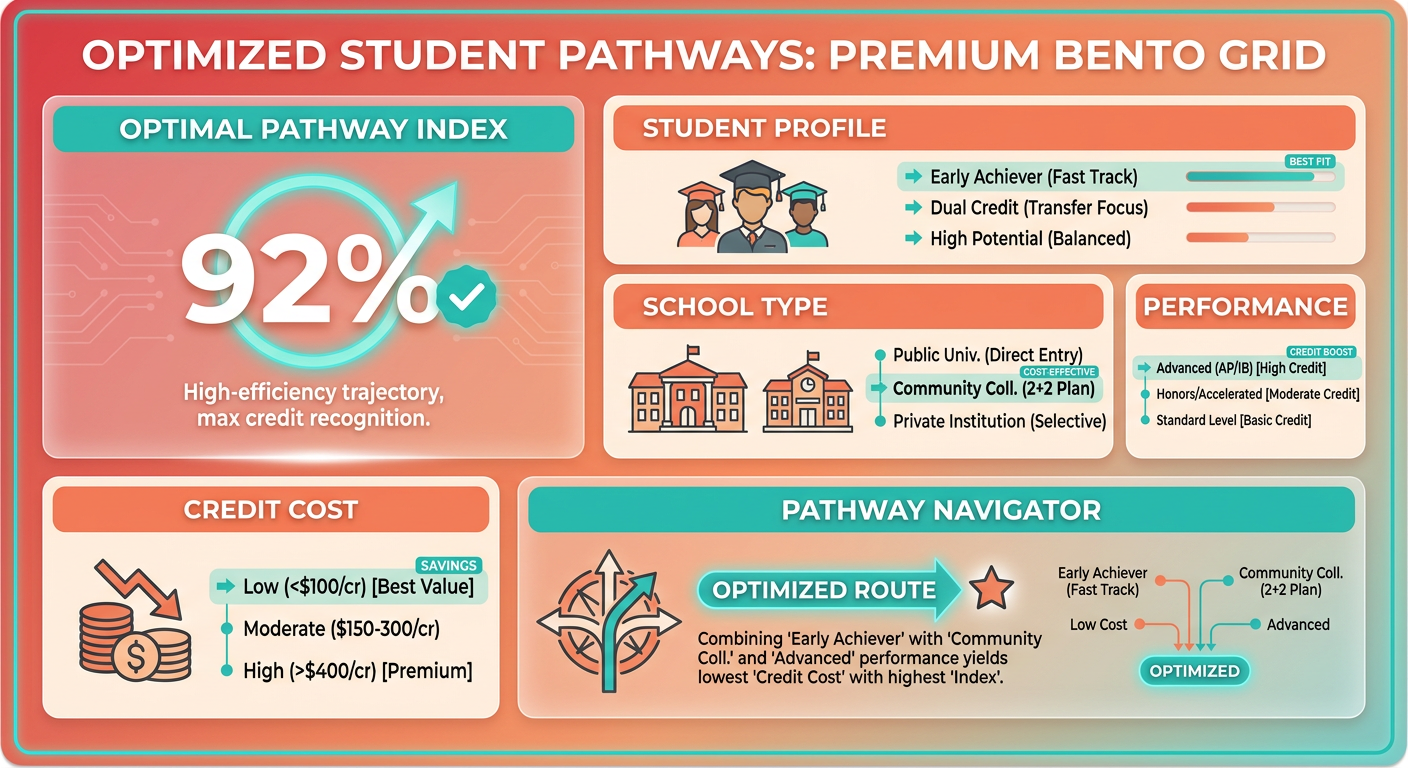
Here's how we match students to the path that protects their scholarship math.
Who Should Choose Dual Enrollment?
Dual enrollment fits students headed to local public universities who prefer a collaborative, continuous learning environment. It suits those who do better with project-based assessment and steady weekly coursework than with a single high-stakes exam.
It also helps students who want a genuine college environment early. Working alongside older peers and using campus resources like college libraries and tutoring centers eases the social and academic jump to university life.
For students building confidence, that early exposure demystifies higher education. Navigating office hours and joining college-level discussions helps them see they can actually handle a postsecondary setting.
The condition: the student needs the organizational skills to manage college deadlines, because these grades permanently affect their cumulative college GPA.
Who Should Choose AP?
AP is the better choice for students targeting competitive out-of-state or private universities. Those schools lean on standardized AP scores to validate the rigor of a high school's curriculum, leveling the field for applicants from all kinds of backgrounds.
It also fits students who perform well under exam conditions and want to maximize their weighted GPA. The heavier weight on AP courses, often up to 1.0 point versus 0.5 for dual enrollment, can matter in tight class rankings. A high score, say a 4 on the AP exam, can unlock immediate credit at selective institutions.
Students with severe test anxiety, on the other hand, may find the single-exam format works against them. As the Florida Prepaid guide notes, a year of hard work can be undone by one bad testing session, which makes the continuous assessment of dual enrollment a safer alternative for some.
Which Student Profile Matches Which Path?
| Student profile | Better fit | Why it wins the cost math |
|---|---|---|
| In-state public flagship, free DE | Dual enrollment | Guaranteed credit, no exam gamble |
| Selective/private/out-of-state | AP | Credit transfers; college GPA stays clean |
| Strong under exam pressure | AP | Bigger GPA bump; skips intro courses |
| Self-driven, wants college pace | Dual enrollment | Real professor-taught rigor |
| Applying broadly, undecided | Both, balanced | Rigor signal plus banked credit |
A balanced approach often works best for students with diverse college lists. Combining both paths lets a student show academic rigor to selective colleges while banking guaranteed credit for in-state options. As Appily's guide notes, the right call depends on the student's overall academic load and extracurricular commitments.
That balancing act is the heart of good college planning. Since advanced coursework has been shown to roughly double the odds of finishing a four-year degree within six years, we help families read their target school list and student strengths, then build a personalized academic roadmap. Contact us to schedule an initial consultation and build a strategy for your student.
What I'd Actually Tell a Family
The choice between dual enrollment and AP comes down to three gates: where your student applies, how they perform under pressure, and what the target school does with credit. Clear all three the right way and you protect thousands in tuition.
Here's how the trade-offs stack up once you look past the sticker price.
Which Path Wins for Your Scenario?
Portability is the pattern that matters. AP scores travel nationally, so they hold value the moment a student's list crosses state lines or aims at selective privates. Dual enrollment credit delivers its full return when the destination is a public system that has already agreed to honor it.
That distinction usually settles the decision. Students aiming at highly selective private institutions benefit from AP's standardized validation. Those committed to in-state public universities can lean on dual enrollment for guaranteed credit. Either way, you avoid taking courses that won't transfer to private or out-of-state schools.
The Cost-Benefit Verdict
Weigh upfront cost against the probability of realized credit, not the sticker price alone. A free program that guarantees credit on passing can still lose to a paid exam if that exam's score is accepted at more of your target schools. Fit beats free.
The long-term payoff is substantial. Research shows either path roughly doubled the odds of finishing a four-year degree within six years. Entering university with advanced standing reduces time-to-degree, which means students can enter the workforce earlier or start graduate work ahead of schedule.
When to Combine Both
A hybrid strategy lets students diversify. A student might take AP in core STEM subjects to show rigor to out-of-state schools, while using dual enrollment for elective or humanities requirements that transfer easily to local institutions.
The decision should be driven by the student's target college list, not perceived prestige. Aligning course selection with the specific transfer policies of destination universities is what turns every hour of hard work into real progress toward a degree.
And skip dual enrollment entirely if your target is a private or out-of-state school that rejects the credit. You'd take on the GPA risk for zero payoff. Want a strategy built around your student's exact goals? That's the kind of one-on-one mentorship we provide in our college admissions planning.
References
[1] Dual Enrollment vs. AP Classes: Here's How to Decide - Appily - https://www.appily.com/guidance/articles/applying-to-college/dual-enrollment-vs-ap-classes
[2] How to Choose Between Dual Enrollment & AP Courses | About - https://www.nltcc.edu/about/blog/1633552/dual-enrollment-or-ap-courses-how-to-choose-what-is-best-for-you
[3] Which is Better for Your Student: AP or Dual Enrollment? - Florida Prepaid - https://www.myfloridaprepaid.com/learn/blog/which-is-better-ap-or-dual-enrollment/
[4] AP vs Dual Enrollment: Which Type of College Course is Better? - https://tenneyschool.com/ap-vs-dual-enrollment-which-type-of-college-course-is-better/
[5] How Does Dual Credit Compare with Advanced Placement? — TCC - https://www.tccd.edu/academics/high-school-programs/dual-enrollment/dual-credit/dual-credit-vs-ap/
[6] AP vs. Dual Credit: Choosing Your Path to College Success - https://www.arrupevirtual.org/post/ap-vs-dual-credit
[7] AP vs. Dual Credit: What's the Difference? - Garland ISD - https://garlandisd.net/ap-vs-dual-credit-whats-difference
[8] AP vs. Dual Enrollment for Florida Teens – College Credit Guide - https://www.xceedprep.org/ap-vs-dual-enrollment-for-florida-teens-college-credit-guide/
[9] (PDF) The Impact of Advanced Placement and Dual Enrollment ... - https://www.researchgate.net/publication/36442600_The_Impact_of_Advanced_Placement_and_Dual_Enrollment_Programs_on_College_Graduation
[10] Dual enrollment in the broader context of college‐level high school ... - https://www.researchgate.net/publication/260410215_Dual_enrollment_in_the_broader_context_of_college-level_high_school_programs
[11] Breakeven curve for Concurrent Enrollment Programs (CEP) versus... - https://www.researchgate.net/figure/Breakeven-curve-for-Concurrent-Enrollment-Programs-CEP-versus-Advanced-Placement-AP_fig1_241711365
[12] College Acceleration for All? Mapping Racial Gaps in Advanced ... - https://www.researchgate.net/publication/349788942_College_Acceleration_for_All_Mapping_Racial_Gaps_in_Advanced_Placement_and_Dual_Enrollment_Participation
Frequently Asked Questions
1. Can my student take both AP and dual enrollment courses at the same time?
Many high-achieving students run both pathways simultaneously. A common combination pairs AP English with a dual enrollment course, showing academic rigor while banking guaranteed credit. This hybrid approach works best when students can handle the load and target schools with different credit acceptance rules.
2. What happens if my student fails the AP exam after taking the course?
An AP exam score below the target college's required threshold, typically a 3 or 4, results in no college credit being awarded. While this score does not affect the student's high school or college GPA, it means the student must enroll in the equivalent introductory course in college, paying standard tuition rates for that class.
3. Are there GPA requirements to qualify for dual enrollment?
Many dual enrollment programs establish strict entry requirements, such as minimum high school GPA thresholds and qualifying scores on placement exams. AP courses, conversely, generally feature open enrollment policies, allowing any student to take the class and register for the spring exam regardless of prior academic performance.
4. Will a private university accept my dual enrollment credits?
Private and out-of-state institutions evaluate transfer credits on an individual basis and frequently decline to award credit for dual enrollment courses, particularly if the class was taught on a high school campus. Additionally, because these courses generate an official college transcript, any grade earned will permanently affect the student's cumulative undergraduate GPA.
5. How much does each pathway cost in 2026?
While AP exams require a standardized fee per test, dual enrollment costs are highly dependent on state funding and local school district partnerships. Some states fully subsidize these courses for high school students, while others charge discounted tuition rates per credit hour. Families should evaluate these upfront costs against the likelihood of the credits being accepted by their target colleges.
6. Who teaches these courses, and does the difficulty differ?
AP classes are conducted by high school faculty who align their instruction with a standardized national curriculum designed by the College Board. Dual enrollment courses are college-level classes taught by approved college instructors, requiring students to adapt to university-level grading standards and independent study expectations.
7. Does taking either pathway actually improve college graduation odds?
Participation in either program strongly correlates with higher college graduation rates and shorter times to degree. Engaging with advanced coursework during high school helps students develop the academic stamina and study skills necessary to navigate postsecondary curriculum successfully, regardless of which specific pathway they choose.